Rank-Based Tests for Mutual Independence of High-Dimensional Random Vectors via L_q Norm
Reviewed by Pith T0 review T1 audit T2 compute T3 formal T4 kernel 2026-06-29 21:04 UTCgrok-4.3pith:5WU4GEHWrecord.jsonopen to challenge →
The pith
Combining L2, L4, L6 and L∞ rank-based power-sum statistics via Cauchy combination produces a test for mutual independence that is robust to the sparsity of alternatives in high dimensions.
A machine-rendered reading of the paper's core claim, the machinery that carries it, and where it could break.
Core claim
We introduce fixed finite-Lq power-sum statistics under three classes of rank-based correlations and establish their asymptotic independence from the corresponding L∞ statistic under the null, then combine the L2, L4, L6 and L∞ p-values through a Cauchy rule to obtain a procedure that is robust to sparsity.
What carries the argument
The fixed finite-Lq power-sum statistics based on simple linear rank statistics, non-degenerate and degenerate rank-based U-statistics, which interpolate between dense and sparse sensitivity when combined with L∞.
If this is right
- The resulting L2,4,6,∞ procedure is highly robust to the sparsity of the alternative.
- It has strong empirical power across the considered designs.
- The statistics interpolate between the dense-alternative sensitivity of the L2 statistic and the sparse-alternative sensitivity of the L∞ statistic.
Where Pith is reading between the lines
- This approach may extend to other high-dimensional testing problems where the signal sparsity is unknown.
- Similar combinations could be used with different dependence measures beyond ranks.
- Finite-sample performance might be further improved by adaptive choice of q values.
Load-bearing premise
Asymptotic independence holds between any fixed finite-Lq block and the corresponding L∞ statistic under the null hypothesis of mutual independence.
What would settle it
A Monte Carlo simulation under the null where the joint distribution of the finite-Lq statistic and the L∞ statistic shows dependence would falsify the validity of the Cauchy combination.
Figures



read the original abstract
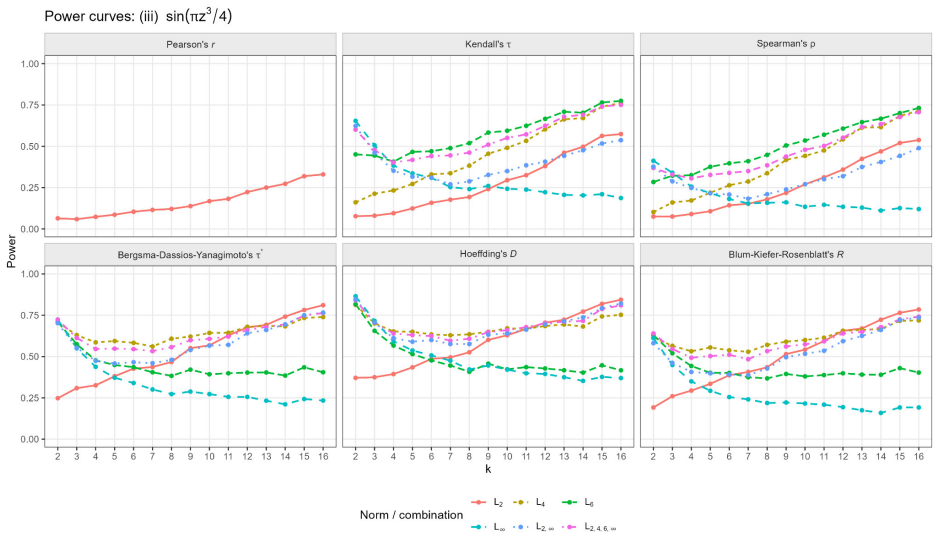
We consider the problem of testing mutual independence among the components of a high-dimensional random vector. Building on the rank-based max-sum framework, we introduce fixed finite-$L_q$ power-sum statistics under three general classes of rank-based correlations: simple linear rank statistics, non-degenerate rank-based U-statistics and degenerate rank-based U-statistics. The proposed statistics interpolate between the dense-alternative sensitivity of the $L_2$ statistic and the sparse-alternative sensitivity of the $L_\infty$ statistic. We establish the asymptotic independence between any fixed finite-$L_q$ block and the corresponding $L_\infty$ statistic, and combine $L_2,L_4,L_6$ and $L_\infty$ p-values through a Cauchy rule. Numerical studies show that the resulting $L_{2,4,6,\infty}$ procedure is highly robust to the sparsity of the alternative and has strong empirical power across the considered designs.
Editorial analysis
A structured set of objections, weighed in public.
Referee Report
Summary. The paper introduces fixed finite-L_q power-sum statistics based on three classes of rank correlations (simple linear rank statistics, non-degenerate and degenerate rank-based U-statistics) for testing mutual independence of high-dimensional random vectors. It establishes asymptotic independence between any fixed finite-L_q block and the corresponding L_∞ statistic under the null, then combines p-values from the L2, L4, L6 and L∞ statistics via the Cauchy combination rule. Numerical studies are used to demonstrate that the resulting L_{2,4,6,∞} procedure is robust to sparsity of the alternative and has strong empirical power.
Significance. If the asymptotic independence result holds in the high-dimensional regime, the approach supplies a tuning-free method that automatically adapts power to both dense and sparse alternatives while preserving type-I error control through the Cauchy rule; the reported numerical robustness across designs would then constitute a practically useful contribution to high-dimensional independence testing.
major comments (1)
- [asymptotic independence result] The asymptotic independence between fixed finite-L_q blocks and L_∞ (stated in the abstract as established) is the load-bearing step for validity of the Cauchy combination; the manuscript must confirm that this independence continues to hold when dimension p grows with n, without residual dependence induced by the rank transformations or the max-norm component.
minor comments (1)
- The three classes of rank-based correlations should be defined with explicit formulas at the first mention rather than deferred.
Simulated Author's Rebuttal
We thank the referee for the detailed report and the emphasis on the asymptotic independence result, which is indeed central to the validity of the proposed procedure. We address the major comment below.
read point-by-point responses
-
Referee: [asymptotic independence result] The asymptotic independence between fixed finite-L_q blocks and L_∞ (stated in the abstract as established) is the load-bearing step for validity of the Cauchy combination; the manuscript must confirm that this independence continues to hold when dimension p grows with n, without residual dependence induced by the rank transformations or the max-norm component.
Authors: The asymptotic independence is derived under the high-dimensional regime in which p = p(n) may diverge with n (see Assumptions 1–3 and the statements of Theorems 2–4). The proofs in the appendix establish the result by showing that the covariance between any fixed finite-L_q power-sum statistic and the L_∞ statistic vanishes asymptotically; this argument relies on uniform convergence of the rank-based empirical processes (which holds uniformly over p under the stated moment and dependence conditions) together with maximal inequalities for the max-norm component that remain valid as p grows. Because the underlying variables are mutually independent under the null, the rank transformations introduce no additional asymptotic dependence between the finite-L_q block and L_∞. We are therefore confident the stated independence already covers the growing-p case. To make this scope explicit we will add one clarifying sentence in Section 3 and a short remark after Theorem 2. revision: partial
Circularity Check
No circularity; derivation rests on standard rank-statistic asymptotics
full rationale
The paper introduces fixed finite-L_q power-sum statistics from three classes of rank-based correlations, states that it establishes asymptotic independence between any fixed finite-L_q block and the L_∞ statistic under the null, and combines the resulting p-values via the Cauchy rule. No equations or claims in the abstract reduce a 'prediction' or central result to a fitted parameter, self-definition, or self-citation chain; the independence result is presented as a derived theorem rather than an input. The procedure is therefore self-contained against external rank-statistic theory and does not trigger any of the enumerated circularity patterns.
Axiom & Free-Parameter Ledger
Reference graph
Works this paper leans on
-
[1]
Anderson, T. W. (2003). An Introduction to Multivariate Statistical Analysis, 3rd ed. Wiley, New York
2003
-
[2]
and Zheng, S
Bai, Z., Jiang, D., Yao, J.-F. and Zheng, S. (2009). Corrections to LRT on large-dimensional covariance matrix by RMT. Annals of Statistics 37 3822--3840
2009
-
[3]
and Dassios, A
Bergsma, W. and Dassios, A. (2014). A consistent test of independence based on a sign covariance related to Kendall's tau. Bernoulli 20 1006--1028
2014
-
[4]
R., Kiefer, J
Blum, J. R., Kiefer, J. and Rosenblatt, M. (1961). Distribution free tests of independence based on the sample distribution function. Annals of Mathematical Statistics 32 485--498
1961
-
[5]
Cai, T. T. and Jiang, T. (2011). Limiting laws of coherence of random matrices with applications to testing covariance structure and construction of compressed sensing matrices. Annals of Statistics 39 1496--1525
2011
-
[6]
Chatterjee, S. (2021). A new coefficient of correlation. Journal of the American Statistical Association 116 2009--2022
2021
-
[7]
and Shi, H
Drton, M., Han, F. and Shi, H. (2020). High-dimensional consistent independence testing with maxima of rank correlations. Annals of Statistics 48 3206--3227
2020
-
[8]
and Xiong, W
Feng, L., Jiang, T., Liu, B. and Xiong, W. (2022). Max-sum tests for cross-sectional dependence of high-dimensional panel data. Annals of Statistics 50 1124--1143
2022
-
[9]
and Sch\"olkopf, B
Gretton, A., Herbrich, R., Smola, A., Bousquet, O. and Sch\"olkopf, B. (2005). Kernel methods for measuring independence. Journal of Machine Learning Research 6 2075--2129
2005
-
[10]
H., Song, L., Sch\"olkopf, B
Gretton, A., Fukumizu, K., Teo, C. H., Song, L., Sch\"olkopf, B. and Smola, A. J. (2008). A kernel statistical test of independence. In Advances in Neural Information Processing Systems 20 585--592
2008
-
[11]
and Liu, H
Han, F., Chen, S. and Liu, H. (2017). Distribution-free tests of independence in high dimensions. Biometrika 104 813--828
2017
-
[12]
and Pan, W
He, Y., Xu, G., Wu, C. and Pan, W. (2021). Asymptotically independent U-statistics in high-dimensional testing. Annals of Statistics 49 154--181
2021
-
[13]
and Gorfine, M
Heller, R., Heller, Y. and Gorfine, M. (2013). A consistent multivariate test of association based on ranks of distances. Biometrika 100 503--510
2013
-
[14]
Hoeffding, W. (1948b). A non-parametric test of independence. Annals of Mathematical Statistics 19 546--557
-
[15]
and Yang, F
Jiang, T. and Yang, F. (2013). Central limit theorems for classical likelihood ratio tests for high-dimensional normal distributions. Annals of Statistics 41 2029--2074
2013
-
[16]
Jiang, T. (2004). The asymptotic distributions of the largest entries of sample correlation matrices. Annals of Applied Probability 14 865--880
2004
-
[17]
and Yang, F
Jiang, D., Jiang, T. and Yang, F. (2012). Likelihood ratio tests for covariance matrices of high-dimensional normal distributions. Journal of Statistical Planning and Inference 142 2241--2256
2012
-
[18]
Kendall, M. G. (1938). A new measure of rank correlation. Biometrika 30 81--93
1938
-
[19]
and Drton, M
Leung, D. and Drton, M. (2018). Testing independence in high dimensions with sums of rank correlations. Annals of Statistics 46 280--307
2018
-
[20]
Joint limiting laws for high-dimensional independence tests
Li, D. and Xue, L. (2015). Joint limiting laws for high-dimensional independence tests. arXiv:1512.08819
work page internal anchor Pith review Pith/arXiv arXiv 2015
-
[21]
and Xie, J
Liu, Y. and Xie, J. (2020). Cauchy combination test: A powerful test with analytic p-value calculation under arbitrary dependency structures. Journal of the American Statistical Association 115 393--402
2020
-
[22]
and Shao, Q.-M
Liu, W.-D., Lin, Z. and Shao, Q.-M. (2008). The asymptotic distribution and Berry--Esseen bound of a new test for independence in high dimension with an application to stochastic optimization. Annals of Applied Probability 18 2337--2366
2008
-
[23]
Mao, G. (2014). A new test of independence for high-dimensional data. Statistics & Probability Letters 93 14--18
2014
-
[24]
Mao, G. (2017). Robust test for independence in high dimensions. Communications in Statistics - Theory and Methods 46 10036--10050
2017
-
[25]
Mao, G. (2018). Testing independence in high dimensions using Kendall's tau. Computational Statistics & Data Analysis 117 128--137
2018
-
[26]
Nagao, H. (1973). On some test criteria for covariance matrix. Annals of Statistics 1 700--709
1973
-
[27]
and Zhu, J
Pan, W., Wang, X., Zhang, H., Zhu, H. and Zhu, J. (2020). Ball covariance: A generic measure of dependence in Banach space. Journal of the American Statistical Association 115 307--317
2020
-
[28]
uhlmann, P., Sch\
Pfister, N., B\"uhlmann, P., Sch\"olkopf, B. and Peters, J. (2018). Kernel-based tests for joint independence. Journal of the Royal Statistical Society: Series B 80 5--31
2018
-
[29]
Roy, S. N. ( red 1957 ). red Some aspects of multivariate analysis. Wiley, New York
1957
-
[30]
Schott, J. R. (2005). Testing for complete independence in high dimensions. Biometrika 92 951--956
2005
-
[31]
and Du, J
Shi, X., Xu, M. and Du, J. (2023). Max-sum test based on Spearman's footrule for high-dimensional independence tests. Computational Statistics & Data Analysis 185 107768
2023
-
[32]
Spearman, C. (1904). The proof and measurement of association between two things. American Journal of Psychology 15 72--101
1904
-
[33]
Sz\'ekely, G. J. and Rizzo, M. L. (2013). The distance correlation t -test of independence in high dimension. Journal of Multivariate Analysis 117 193--213
2013
-
[34]
J., Rizzo, M
Sz\'ekely, G. J., Rizzo, M. L. and Bakirov, N. K. (2007). Measuring and testing dependence by correlation of distances. Annals of Statistics 35 2769--2794
2007
-
[35]
and Ma, Y
Wang, H., Liu, B., Feng, L. and Ma, Y. (2024). Rank-based max-sum tests for mutual independence of high-dimensional random vectors. Journal of Econometrics 238 105578
2024
-
[36]
and Wang, Z
Wang, G., Zou, C. and Wang, Z. (2013). A necessary test for complete independence in high dimensions using rank-correlations. Journal of Multivariate Analysis 121 224--232
2013
-
[37]
and Pan, W
Wu, C., Xu, G. and Pan, W. (2019). An adaptive test on high-dimensional parameters in generalized linear models. Statistica Sinica 29 2163--2186
2019
-
[38]
and Dai, J
Xia, L., Cao, R., Du, J. and Dai, J. (2025). Consistent complete independence test in high dimensions based on Chatterjee correlation coefficient. Statistical Papers 66 3
2025
-
[39]
and Liu, L
Xia, L., Cao, R., Du, J. and Liu, L. ( red 2026 ). Rank-based combination independence tests for high-dimensional data. Journal of Multivariate Analysis 212 105550
2026
-
[40]
and Pan, W
Xu, G., Lin, L., Wei, P. and Pan, W. (2016). An adaptive two-sample test for high-dimensional means. Biometrika 103 609--624
2016
-
[41]
and Shao, X
Yao, S., Zhang, X. and Shao, X. (2018). Testing mutual independence in high dimension via distance covariance. Journal of the Royal Statistical Society: Series B 80 455--480
2018
-
[42]
and Shao, X
Zhang, Y., Wang, R. and Shao, X. (2025). Adaptive testing for high-dimensional data. Journal of the American Statistical Association 120 1893--1905
2025
discussion (0)
Sign in with ORCID, Apple, or X to comment. Anyone can read and Pith papers without signing in.