Consistent CutPINNs for Elliptic PDEs on Curved Level-Set Domains
Pith reviewed 2026-06-29 20:48 UTC · model grok-4.3
The pith
A discrete H^{1/2} surrogate built from collocation points on a C^2 curve is equivalent to the continuous trace norm and yields a priori H^1 error bounds for PINNs on curved domains.
A machine-rendered reading of the paper's core claim, the machinery that carries it, and where it could break.
Core claim
We introduce a discrete H^{1/2}(∂Ω) surrogate built directly from collocation points on a C^2 curve, prove a Chord-arc norm equivalence between this surrogate and the continuous trace norm, establish an a priori H^1 error bound on cut domains, and derive convergence rates under Besov regularity using optimal recovery theory.
What carries the argument
The Chord-arc norm equivalence between the discrete H^{1/2} surrogate constructed from boundary collocation points and the continuous H^{1/2} trace norm on the C^2 curve.
If this is right
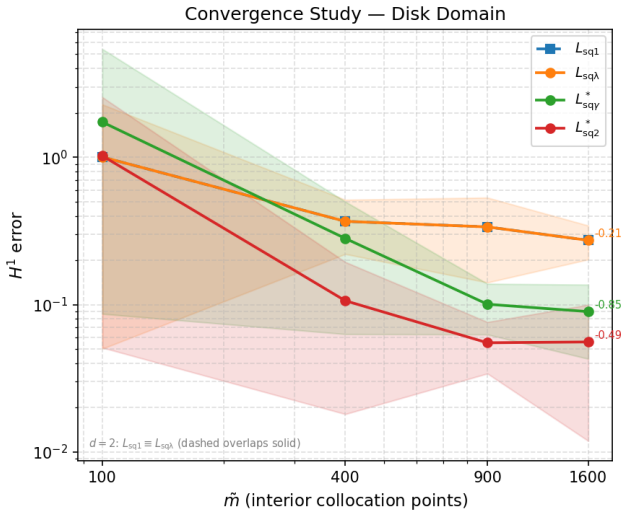
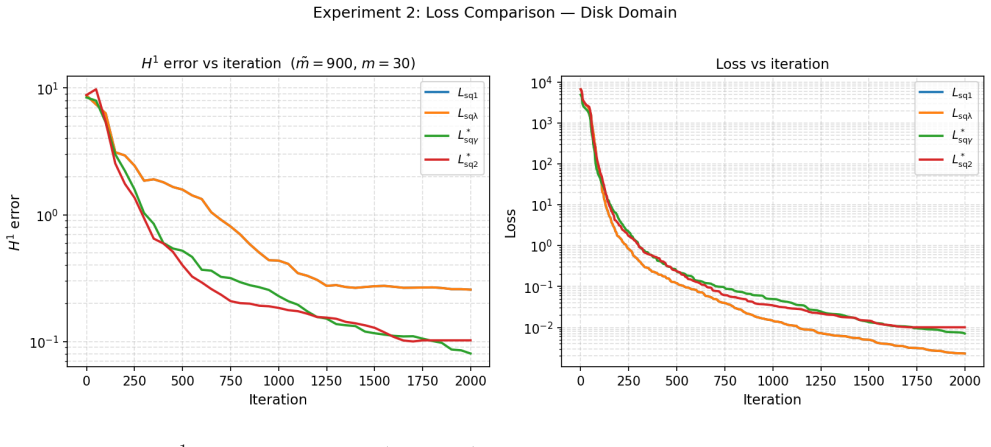
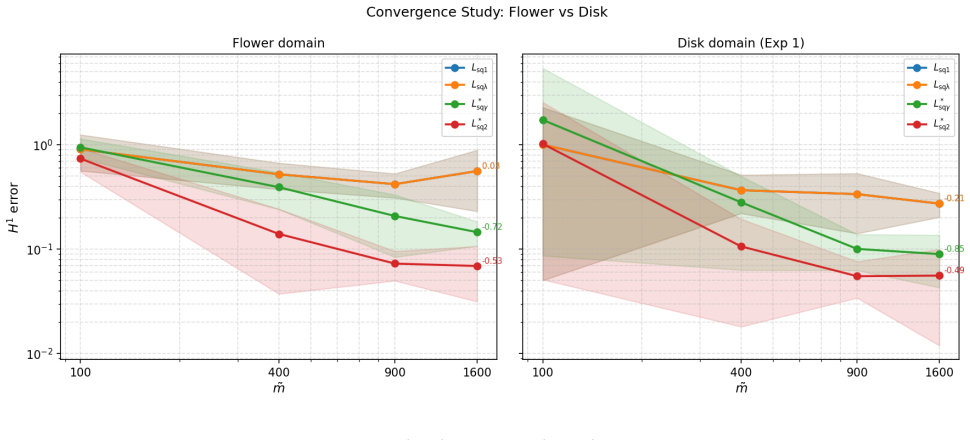
- The consistent boundary loss produces smaller H^1 errors than the standard L^2 penalty on the same collocation set.
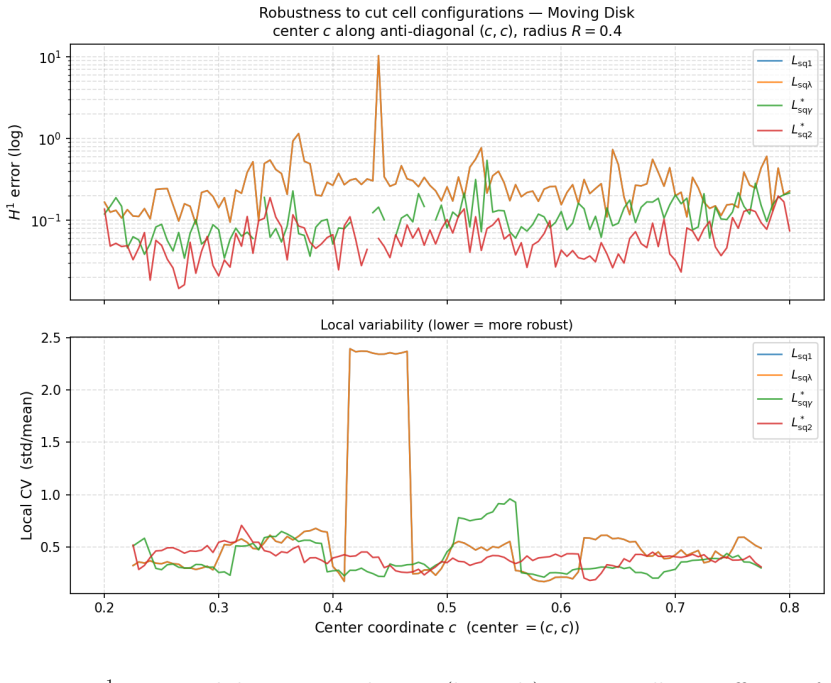
- The method remains accurate across varying cut-cell configurations without retuning.
- Convergence rates follow from Besov regularity of the solution via optimal recovery arguments.
- The framework applies to any second-order elliptic problem on a two-dimensional domain whose boundary is given by a C^2 level-set function.
Where Pith is reading between the lines
- The same point-based surrogate construction could be attempted on surfaces in three dimensions if a suitable discrete norm equivalence can be proved.
- The Chord-arc equivalence supplies a general template for replacing L^2 boundary penalties with trace-norm surrogates in other variational problems.
- Because the rates rest on optimal recovery, they are likely sharp for the stated Besov classes.
Load-bearing premise
The chosen collocation points on the C^2 curve are dense enough that the discrete surrogate norm remains equivalent to the continuous H^{1/2} trace norm with constants independent of the discretization.
What would settle it
For some C^2 level-set curve and sequence of collocation sets, the ratio of the discrete surrogate norm to the continuous H^{1/2} norm tends to infinity as the number of points grows.
Figures
read the original abstract
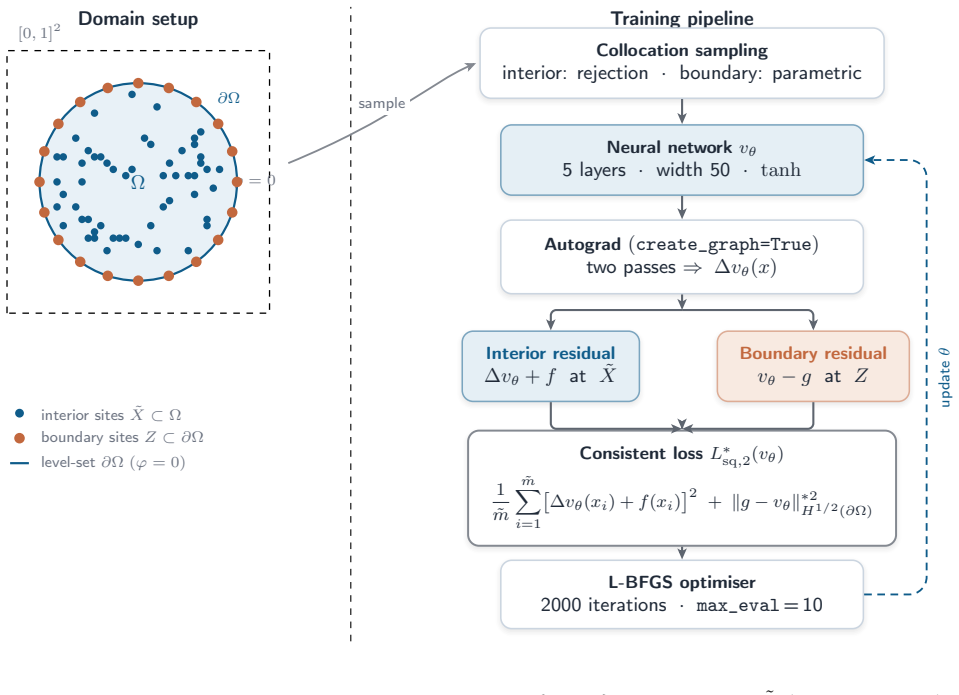
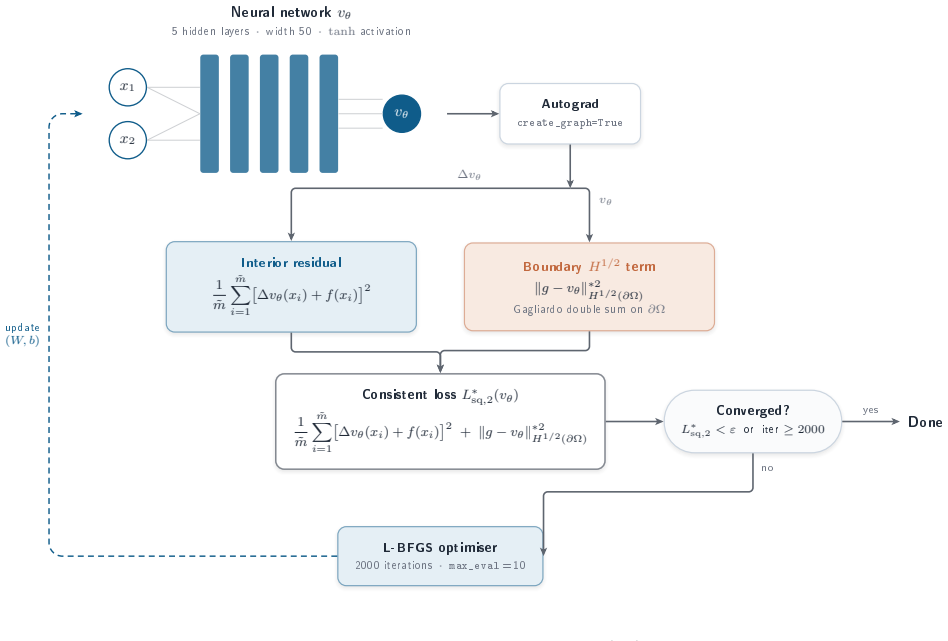
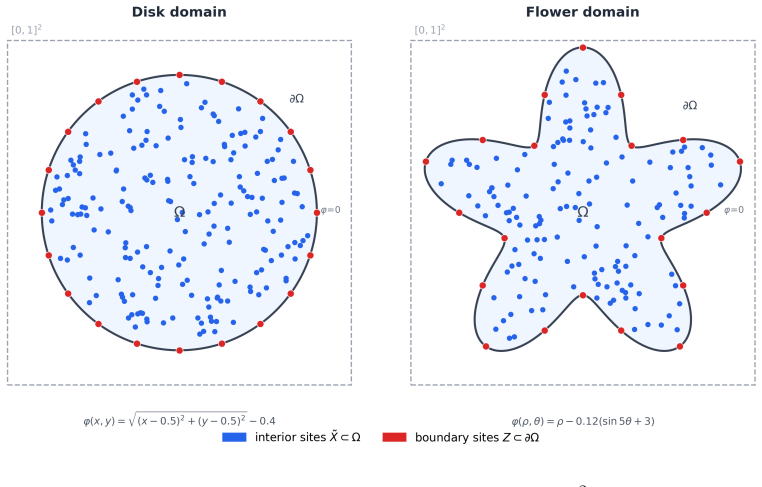
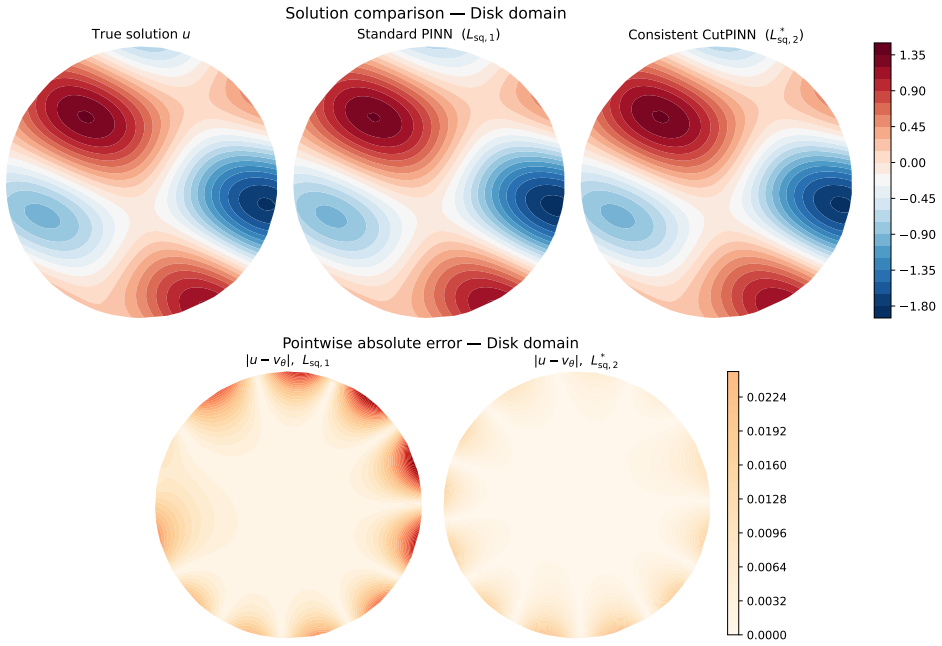
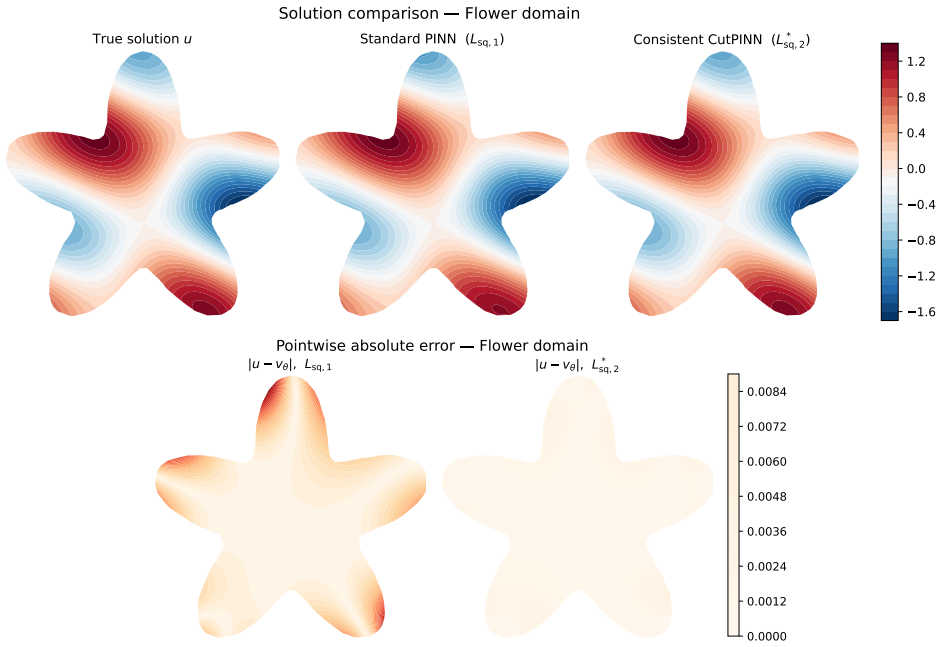
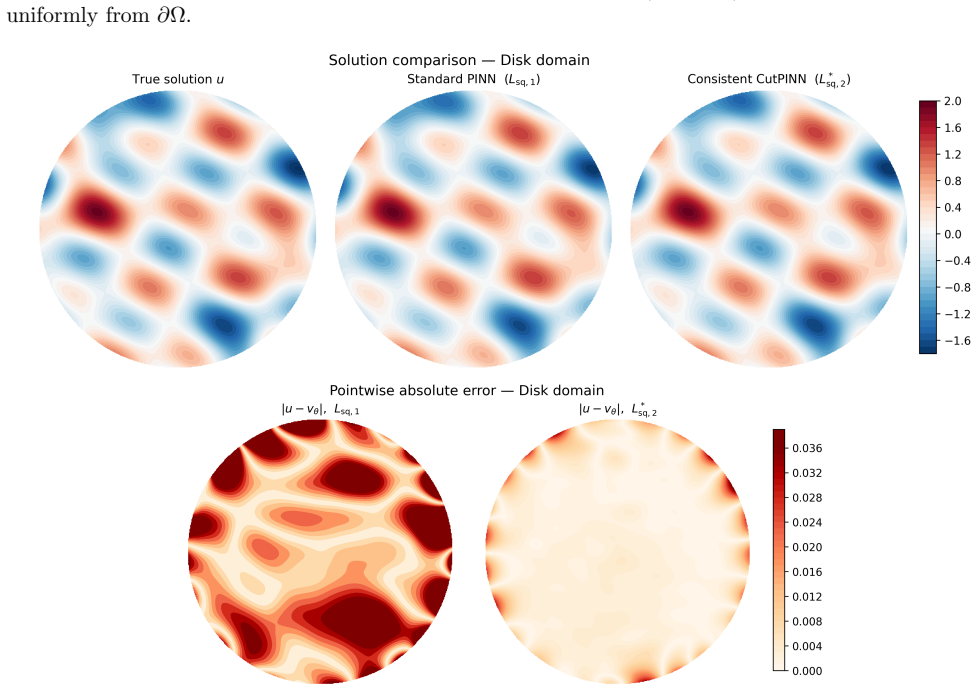
We propose \emph{Consistent CutPINN}, a framework for partial differential equations posed on bounded curved domains defined implicitly by a $\C^2$ level-set function, $\Omega = \{\varphi < 0\}$. In this paper we develop the framework for second-order elliptic problems in two dimensions. The standard PINN loss penalises the boundary mismatch in $L^2(\partial\Omega)$, but $L^2(\partial\Omega)$ does not control the $H^{1/2}(\partial\Omega)$ trace norm that appears in the $H^1(\Omega)$ energy estimate. The consistent PINN framework of Bonito et al.~\cite{bonito2025} fixes this on the unit cube $(0,1)^d$ via a Kuhn--Tucker simplicial decomposition of the flat boundary faces, but the construction relies on the affine structure of the faces and does not carry over to smooth curved boundaries. We address this gap. Specifically, (i) we introduce a discrete $H^{1/2}(\partial\Omega)$ surrogate built directly from collocation points on a $\C^2$ curve, (ii) we prove a \textit{Chord-arc} norm equivalence between this surrogate and the continuous trace norm, (iii) we establish an \emph{a priori} $H^1$ error bound on cut domains, and (iv) we derive convergence rates under Besov regularity using optimal recovery theory. Numerical experiments on a disk and a non-convex flower domain confirm that the consistent loss is much more accurate than the standard PINN loss and far more robust to cut-cell configurations.
Editorial analysis
A structured set of objections, weighed in public.
Referee Report
Summary. The manuscript proposes the Consistent CutPINN framework for second-order elliptic PDEs posed on 2D bounded domains defined implicitly by a C^2 level-set function. It constructs a discrete H^{1/2}(∂Ω) surrogate directly from collocation points on the curve, proves a Chord-arc norm equivalence between this surrogate and the continuous trace norm, establishes an a priori H^1 error bound on cut domains, and derives convergence rates under Besov regularity via optimal recovery theory. Numerical experiments on a disk and a non-convex flower domain demonstrate that the consistent loss outperforms the standard L^2 boundary penalization in accuracy and robustness to cut-cell configurations.
Significance. If the equivalence and a priori bounds hold, the work supplies a theoretically grounded extension of the consistent PINN approach to curved boundaries, ensuring the boundary loss controls the H^{1/2} trace norm appearing in the H^1 energy estimate. The chord-arc equivalence, the a priori bound on cut domains, and the application of optimal recovery theory for rates constitute clear strengths; the numerical validation on both convex and non-convex geometries further supports practical utility.
minor comments (3)
- [Abstract and §1] The reference to Bonito et al. (2025) appears in the abstract and introduction; confirm that the bibliography entry is complete and that the year is accurate.
- [Numerical experiments] The description of the flower domain level-set function is given only qualitatively; an explicit formula would aid reproducibility of the non-convex example.
- [§3] Notation for the discrete surrogate norm is introduced without an explicit equation label in the early sections; adding an equation number would improve cross-referencing.
Simulated Author's Rebuttal
We are grateful to the referee for their detailed summary of the manuscript and for recommending minor revision. The report does not contain any major comments, therefore we provide no point-by-point responses below. We will make the necessary minor revisions to the manuscript accordingly.
Circularity Check
No significant circularity identified
full rationale
The paper's central claims consist of a new discrete H^{1/2} surrogate constructed from collocation points on a C^2 level-set curve, a proved Chord-arc equivalence to the continuous trace norm, an a priori H^1 error bound on cut domains, and convergence rates derived via optimal recovery under Besov regularity. These are presented as original mathematical constructions and proofs rather than reductions to fitted inputs, self-definitions, or prior results by the same authors. The reference to Bonito et al. (2025) supplies only the base consistent-PINN loss for flat domains and is not load-bearing for the curved-boundary extensions, which rest on independent arguments. No patterns of self-definitional equivalence, fitted quantities renamed as predictions, or ansatz smuggling via self-citation are present.
Axiom & Free-Parameter Ledger
Forward citations
Cited by 1 Pith paper
-
Consistent CutPINNs for Convection-Diffusion Equations on Curved Level-Set Domains
Proves a single a priori H1 error bound for consistent CutPINNs using discrete L^gamma interior loss (gamma = 1 + 1/log m_til) and discrete H^{1/2} boundary trace norm on curved level-set domains, with rate limited by...
Reference graph
Works this paper leans on
-
[1]
Anandh, D
T. Anandh, D. Ghose, H. Jain, and S. Ganesan. FastVPINNs: Tensor-driven acceleration of VPINNs for complex geometries.SIAM J. Sci. Comput., 47(3):C578–C600, 2025
2025
-
[2]
Anandh, D
T. Anandh, D. Ghose, H. Jain, P. Sunkad, S. Ganesan, and V. John. Improving hp-variational physics-informed neural networks for steady-state convection-dominated problems.Comput. Methods Appl. Mech. Eng., 438:117797, 2025
2025
-
[3]
Badia, F
S. Badia, F. Verdugo, and A. F. Mart´ ın. The aggregated unfitted finite element method for elliptic problems.Comput. Methods Appl. Mech. Eng., 336:533–553, 2018
2018
-
[4]
Bonito, R
A. Bonito, R. DeVore, G. Petrova, and J. W. Siegel. Convergence and error control of consistent PINNs for elliptic PDEs.IMA J. Numer. Anal., 2025
2025
-
[5]
S. C. Brenner and L. R. Scott.The Mathematical Theory of Finite Element Methods. Springer, New York, 3rd edition, 2008
2008
-
[6]
Cengizci, ¨O
S. Cengizci, ¨O. U˘ gur, and S. Natesan. A PINN-enhanced SUPG-stabilized hybrid finite element framework with shock-capturing for computing steady convection-dominated flows.Adv. Eng. Softw., 216:104135, 2026
2026
-
[7]
Cohen, R
A. Cohen, R. DeVore, G. Petrova, and P. Wojtaszczyk. Optimal stable nonlinear approximation. Found. Comput. Math., 22(3):607–648, 2022
2022
-
[8]
Cuomo, V
S. Cuomo, V. S. Di Cola, F. Giampaolo, G. Rozza, M. Raissi, and F. Piccialli. Scientific machine learning through physics–informed neural networks: Where we are and what’s next.J. Sci. Comput., 92(3):88, 2022
2022
-
[9]
De Ryck and S
T. De Ryck and S. Mishra. Generic bounds on the approximation error for physics-informed (and) operator learning.Advances in Neural Information Processing Systems, 35:10945–10958, 2022
2022
-
[10]
De Ryck and S
T. De Ryck and S. Mishra. Numerical analysis of physics-informed neural networks and related models in physics-informed machine learning.Acta Numer., 33:633–713, 2024
2024
-
[11]
DeVore, B
R. DeVore, B. Hanin, and G. Petrova. Neural network approximation.Acta Numer., 30:327–444, 2021
2021
-
[12]
R. A. DeVore and R. C. Sharpley. Besov spaces on domains inR d.Trans. Amer. Math. Soc., 335(2):843–864, 1993
1993
-
[13]
Frerichs-Mihov, L
D. Frerichs-Mihov, L. Henning, and V. John. On loss functionals for physics-informed neural net- works for steady-state convection-dominated convection-diffusion problems.Commun. Appl. Math. Comput., 8(1):287–308, 2026
2026
-
[14]
T. G. Grossmann, U. J. Komorowska, J. Latz, and C.-B. Sch¨ onlieb. Can physics-informed neural networks beat the finite element method?IMA J. Numer. Anal., 89(1):143–174, 2024. 27
2024
-
[15]
When do ex- tended physics-informed neural networks (xpinns) improve generalization?SIAM J
Zheyuan Hu, Ameya D Jagtap, George Em Karniadakis, and Kenji Kawaguchi. When do ex- tended physics-informed neural networks (xpinns) improve generalization?SIAM J. Sci. Comput., 44(5):A3158–A3182, 2022
2022
-
[16]
A. Khan, K.-A. Mardal, and S. Mishra. Mixed consistent PINNs for elliptic obstacle problems with stability analysis.arXiv preprint arXiv:2604.01719, 2026
-
[17]
Mart´ ın, and Santiago Badia
Wei Li, Alberto F. Mart´ ın, and Santiago Badia. Unfitted finite element interpolated neural networks. J. Comput. Phys., page 114547, 2026
2026
-
[18]
Mishra and A
S. Mishra and A. Khan. Consistent PINNs for higher-order elliptic PDEs.Int. J. Numer. Methods Eng., 127(7):e70320, 2026
2026
-
[19]
Mishra and R
S. Mishra and R. Molinaro. Estimates on the generalization error of physics-informed neural networks for approximating PDEs.IMA J. Numer. Anal., 43(1):1–43, 2023
2023
-
[20]
Paszke et
A. Paszke et. al. PyTorch: An imperative style, high-performance deep learning library.Advances in neural information processing systems, 32, 2019
2019
-
[21]
Plankovskyy, Y
S. Plankovskyy, Y. Tsegelnyk, N. Shyshko, I. Litvinchev, T. Romanova, C. Velarde, and J. M. Jos´ e. Review of physics-informed neural networks: Challenges in loss function design and geometric integration.Mathematics, 13(20):3289, 2025
2025
-
[22]
Raina, S
A. Raina, S. Badireddi, and S. Natesan. Application of PINN to obtain solution of boundary layer problems arising in fluid dynamics.Math. Found. Comput., 10:89–108, 2026
2026
-
[23]
Raissi, P
M. Raissi, P. Perdikaris, and G. E. Karniadakis. Physics-informed neural networks: A deep learning framework for solving forward and inverse problems involving nonlinear partial differential equations. J. Comput. Phys., 378:686–707, 2019
2019
-
[24]
John Wiley & Sons, 2009
Robert J Serfling.Approximation theorems of mathematical statistics. John Wiley & Sons, 2009
2009
-
[25]
Y. Shin, J. Darbon, and G. E. Karniadakis. On the convergence of physics informed neural networks for linear second-order elliptic and parabolic type pdes.Comm. Comput. Phys., 28(5):2042–2074, 2020
2042
-
[26]
Singh and R
A. Singh and R. K. Sinha. SS-DNN: A hybrid strang splitting deep neural network approach for solving the Allen–Cahn equation.Eng. Anal. Bound. Elem., 169:105944, 2024
2024
-
[27]
Singh and R
A. Singh and R. K. Sinha. Mc-PINN for solving conservative allen–cahn equations using Metropolis– Hasting based sampling.Eng. Anal. Bound. Elem., 184:106643, 2026
2026
-
[28]
E. M. Stein.Singular Integrals and Differentiability Properties of Functions. Princeton University Press, Princeton, NJ, 1970
1970
-
[29]
Visser, A
C. Visser, A. Heinlein, and B. Giovanardi. PACMANN: Point adaptive collocation method for artificial neural networks.Comput. Methods Appl. Mech. Eng., 452:118723, 2026
2026
-
[30]
Zeinhofer, R
M. Zeinhofer, R. Masri, and K.-A. Mardal. A unified framework for the error analysis of physics- informed neural networks.IMA J. Numer. Anal., 45(5):2988–3025, 2025. 28
2025
discussion (0)
Sign in with ORCID, Apple, or X to comment. Anyone can read and Pith papers without signing in.