Time-Varying Parametric Channel Estimation With CP Decomposition Tensor Processing
Pith reviewed 2026-06-29 20:42 UTC · model grok-4.3
The pith
A CP decomposition algorithm estimates time-varying frequency-selective channels with accuracy close to SAGE benchmarks at far lower computational cost.
A machine-rendered reading of the paper's core claim, the machinery that carries it, and where it could break.
Core claim
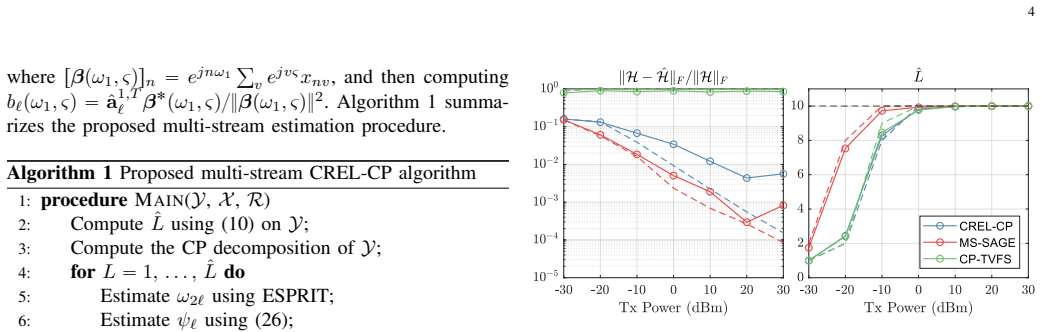
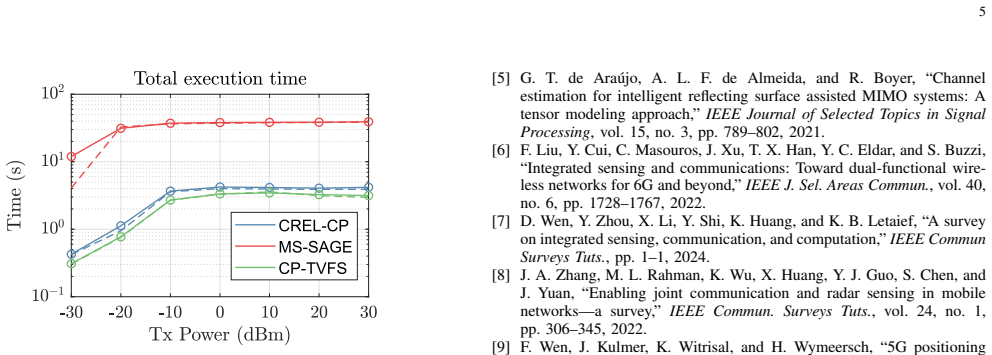
The proposed CP-based algorithm for time-varying parametric channel estimation achieves performance close to a multiple-start SAGE benchmark while clearly outperforming a related CP baseline and requiring about one order of magnitude less execution time for both fully digital and hybrid receiver cases.
What carries the argument
Canonical polyadic (CP) decomposition of the received-signal tensor, initialized by ESPRIT and refined by exact line-search alternating coordinate descent, to extract the parametric channel coefficients.
If this is right
- The method supplies a practical lower-complexity alternative for real-time sensing and localization tasks in 6G systems.
- Separate formulations allow direct use in both fully digital and hybrid analog-digital receiver hardware.
- Execution time reductions of roughly one order of magnitude enable higher update rates for channel tracking.
- Outperformance of prior CP-based estimators indicates that the added refinement steps are responsible for the accuracy gain.
Where Pith is reading between the lines
- The same tensor structure could be reused for joint channel estimation and sensing parameter extraction without separate processing chains.
- If the initialization step proves robust, the algorithm may extend to other multilinear models arising in array signal processing.
- Lower computational cost opens the possibility of embedding the estimator inside resource-constrained edge devices for distributed sensing.
Load-bearing premise
The simulation scenarios chosen for comparison represent the behavior of actual time-varying frequency-selective channels and the CP rank and initialization remain stable without scenario-specific retuning.
What would settle it
Running the algorithm on measured high-mobility channel traces and finding that its mean-square error exceeds the multiple-start SAGE benchmark by more than a small fixed margin would falsify the performance claim.
Figures
read the original abstract
Integrated sensing and communications (ISAC) is a key use case for sixth-generation (6G) wireless systems, where parametric channel estimation (PCE) plays a central role in enabling sensing, localization, and channel equalization in high-mobility scenarios. However, PCE is typically more computationally demanding than conventional channel estimation, which motivates the development of lower-complexity solutions. In this letter, we propose a fast PCE algorithm for time-varying and frequency-selective (TVFS) channels based on canonical polyadic (CP) decomposition and tensor processing, combined with ESPRIT-based initialization, component refinement, and exact line-search alternating coordinate descent. Two variants are presented: one for fully digital and another for hybrid receiver architectures. Numerical results show that the proposed method clearly outperforms a related CP-based baseline while achieving estimation performance close to a multiple-start SAGE benchmark at a substantially lower computational cost, with about one order of magnitude shorter execution time.
Editorial analysis
A structured set of objections, weighed in public.
Referee Report
Summary. The manuscript proposes a fast parametric channel estimation (PCE) algorithm for time-varying frequency-selective (TVFS) channels in ISAC systems. It uses canonical polyadic (CP) decomposition tensor processing combined with ESPRIT-based initialization, component refinement, and exact line-search alternating coordinate descent (ACD). Two variants are developed for fully digital and hybrid receiver architectures. The central claim, supported by numerical results, is that the method outperforms a related CP-based baseline and achieves estimation performance close to a multiple-start SAGE benchmark at roughly one order of magnitude lower computational cost.
Significance. If the reported performance gains hold under representative TVFS channel conditions without scenario-specific tuning of CP rank or initialization, the work would offer a practical low-complexity alternative to existing PCE methods for 6G high-mobility applications. The combination of tensor decomposition with ESPRIT initialization and line-search ACD is a technically coherent approach that directly targets the computational bottleneck noted in the introduction.
major comments (1)
- [Numerical Results] Numerical Results section: the claim that the proposed method 'clearly outperforms a related CP-based baseline' and approaches multiple-start SAGE performance rests on simulation scenarios whose generation process, model mismatch level, and CP-rank selection procedure are not described in sufficient detail to assess whether the tested channels are representative or whether rank/initialization choices required post-hoc adjustment. This is load-bearing for the central empirical claim.
minor comments (2)
- [Abstract] The abstract and introduction would benefit from an explicit statement of the assumed CP rank and how it is obtained or fixed across experiments.
- [Section on hybrid architecture] Notation for the hybrid receiver variant should be introduced with a brief comparison table to the fully digital case to improve readability.
Simulated Author's Rebuttal
We thank the referee for the detailed review and constructive comment on the numerical results. We address the concern below and will revise the manuscript to provide the requested details.
read point-by-point responses
-
Referee: [Numerical Results] Numerical Results section: the claim that the proposed method 'clearly outperforms a related CP-based baseline' and approaches multiple-start SAGE performance rests on simulation scenarios whose generation process, model mismatch level, and CP-rank selection procedure are not described in sufficient detail to assess whether the tested channels are representative or whether rank/initialization choices required post-hoc adjustment. This is load-bearing for the central empirical claim.
Authors: We agree that the simulation setup requires more explicit documentation to support the central claims. In the revised manuscript we will expand the Numerical Results section with: (i) the full TVFS channel generation procedure, including the underlying multipath model, Doppler and delay distributions, and SNR ranges; (ii) the precise model-mismatch level introduced (e.g., any deviation from the assumed CP structure or noise statistics); and (iii) the CP-rank selection rule together with a statement that the rank and initialization parameters were fixed prior to running the Monte-Carlo trials and were not adjusted post-hoc on the basis of observed performance. These additions will allow readers to judge the representativeness of the tested conditions without ambiguity. revision: yes
Circularity Check
No circularity; empirical performance claims rest on external benchmarks
full rationale
The manuscript proposes a CP-decomposition algorithm for TVFS channel estimation and validates it via numerical comparisons to a CP baseline and multiple-start SAGE. No derivation chain is presented that reduces a claimed result to its own fitted inputs or self-citations by construction. The abstract and described approach contain no self-definitional equations, no parameter fitted to a subset then relabeled as prediction, and no load-bearing uniqueness theorems imported from the authors' prior work. The performance claims are explicitly empirical and therefore falsifiable against the stated benchmarks; they do not collapse into the algorithm's own definitions.
Axiom & Free-Parameter Ledger
Reference graph
Works this paper leans on
-
[1]
Tensor decompositions in wireless communications and MIMO radar,
H. Chen, F. Ahmad, S. V orobyov, and F. Porikli, “Tensor decompositions in wireless communications and MIMO radar,”IEEE J. Sel. Top. Signal Process., vol. 15, no. 3, pp. 438–453, 2021
2021
-
[2]
PARAFAC- based unified tensor modeling for wireless communication systems with application to blind multiuser equalization,
A. L. F. de Almeida, G. Favier, and J. C. M. Mota, “PARAFAC- based unified tensor modeling for wireless communication systems with application to blind multiuser equalization,”Signal Processing, vol. 87, no. 2, pp. 337–351, 2007
2007
-
[3]
Tensor space–time (TST) coding for MIMO wireless communication systems,
G. Favier, M. N. da Costa, A. L. F. de Almeida, and J. M. T. Romano, “Tensor space–time (TST) coding for MIMO wireless communication systems,”Signal Processing, vol. 92, no. 4, pp. 1079–1092, 2012
2012
-
[4]
Semi-blind receivers for non-regenerative cooperative MIMO communications based on nested PARAFAC modeling,
L. R. Ximenes, G. Favier, and A. L. F. de Almeida, “Semi-blind receivers for non-regenerative cooperative MIMO communications based on nested PARAFAC modeling,”IEEE Transactions on Signal Process- ing, vol. 63, no. 18, pp. 4985–4998, 2015
2015
-
[5]
Channel estimation for intelligent reflecting surface assisted MIMO systems: A tensor modeling approach,
G. T. de Ara ´ujo, A. L. F. de Almeida, and R. Boyer, “Channel estimation for intelligent reflecting surface assisted MIMO systems: A tensor modeling approach,”IEEE Journal of Selected Topics in Signal Processing, vol. 15, no. 3, pp. 789–802, 2021
2021
-
[6]
Integrated sensing and communications: Toward dual-functional wire- less networks for 6G and beyond,
F. Liu, Y . Cui, C. Masouros, J. Xu, T. X. Han, Y . C. Eldar, and S. Buzzi, “Integrated sensing and communications: Toward dual-functional wire- less networks for 6G and beyond,”IEEE J. Sel. Areas Commun., vol. 40, no. 6, pp. 1728–1767, 2022
2022
-
[7]
A survey on integrated sensing, communication, and computation,
D. Wen, Y . Zhou, X. Li, Y . Shi, K. Huang, and K. B. Letaief, “A survey on integrated sensing, communication, and computation,”IEEE Commun Surveys Tuts., pp. 1–1, 2024
2024
-
[8]
Enabling joint communication and radar sensing in mobile networks—a survey,
J. A. Zhang, M. L. Rahman, K. Wu, X. Huang, Y . J. Guo, S. Chen, and J. Yuan, “Enabling joint communication and radar sensing in mobile networks—a survey,”IEEE Commun. Surveys Tuts., vol. 24, no. 1, pp. 306–345, 2022
2022
-
[9]
5G positioning and mapping with diffuse multipath,
F. Wen, J. Kulmer, K. Witrisal, and H. Wymeersch, “5G positioning and mapping with diffuse multipath,”IEEE Trans. Wireless Commun., vol. 20, no. 2, pp. 1164–1174, 2021
2021
-
[10]
Overview of constrained PARAFAC models,
G. Favier and A. L. F. de Almeida, “Overview of constrained PARAFAC models,”EURASIP Journal on Advances in Signal Process- ing, vol. 2014, 9 2014
2014
-
[11]
Tensor decomposition for signal processing and machine learning,
N. D. Sidiropoulos, L. De Lathauwer, X. Fu, K. Huang, E. E. Papalex- akis, and C. Faloutsos, “Tensor decomposition for signal processing and machine learning,”IEEE Transactions on Signal Processing, vol. 65, no. 13, pp. 3551–3582, 2017
2017
-
[12]
Tensor-based channel estimation for massive MIMO-OFDM systems,
D. C. Ara ´ujo, A. L. F. de Almeida, J. P. C. L. da Costa, and R. T. de Sousa, “Tensor-based channel estimation for massive MIMO-OFDM systems,”IEEE Access, vol. 7, pp. 42133–42147, 2019
2019
-
[13]
Tensor-based hybrid-field channel estima- tion for extremely large-scale massive MIMO systems,
J. Cao, C. Luo, and Y . Luo, “Tensor-based hybrid-field channel estima- tion for extremely large-scale massive MIMO systems,”IEEE Transac- tions on Wireless Communications, vol. 25, pp. 8326–8340, 2026
2026
-
[14]
Millimeter wave time- varying channel estimation via exploiting block-sparse and low-rank structures,
L. Cheng, G. Yue, D. Yu, Y . Liang, and S. Li, “Millimeter wave time- varying channel estimation via exploiting block-sparse and low-rank structures,”IEEE Access, vol. 7, pp. 123355–123366, 2019
2019
-
[15]
Tensor decomposition- aided time-varying channel estimation for millimeter wave MIMO sys- tems,
L. Cheng, G. Yue, X. Xiong, Y . Liang, and S. Li, “Tensor decomposition- aided time-varying channel estimation for millimeter wave MIMO sys- tems,”IEEE Wireless Communications Letters, vol. 8, no. 4, pp. 1216– 1219, 2019
2019
-
[16]
Tensor decomposition-based channel estimation for hybrid mmWave massive MIMO in high-mobility scenarios,
R. Zhang, L. Cheng, S. Wang, Y . Lou, W. Wu, and D. W. K. Ng, “Tensor decomposition-based channel estimation for hybrid mmWave massive MIMO in high-mobility scenarios,”IEEE Transactions on Communications, vol. 70, no. 9, pp. 6325–6340, 2022
2022
-
[17]
The expectation-maximization algorithm,
T. Moon, “The expectation-maximization algorithm,”IEEE Signal Pro- cess. Mag., vol. 13, no. 6, pp. 47–60, 1996
1996
-
[18]
Channel parameter estimation in mobile radio environ- ments using the SAGE algorithm,
B. Fleury, M. Tschudin, R. Heddergott, D. Dahlhaus, and K. Inge- man Pedersen, “Channel parameter estimation in mobile radio environ- ments using the SAGE algorithm,”IEEE J. Sel. Areas Commun., vol. 17, no. 3, pp. 434–450, 1999
1999
-
[19]
Sparse variational bayesian SAGE algo- rithm with application to the estimation of multipath wireless channels,
D. Shutin and B. H. Fleury, “Sparse variational bayesian SAGE algo- rithm with application to the estimation of multipath wireless channels,” IEEE Trans. Signal Process., vol. 59, no. 8, pp. 3609–3623, 2011
2011
-
[20]
Robust OFDM-SAGE channel estimation algorithm with adaptive model order,
E. T. R. Pinto and M. Juntti, “Robust OFDM-SAGE channel estimation algorithm with adaptive model order,”IEEE Trans. Wireless Commun., vol. 25, pp. 5275–5290, 2026
2026
-
[21]
Richter,Estimation of Radio Channel Parameters
A. Richter,Estimation of Radio Channel Parameters. PhD thesis, Technische Universit¨at Ilmenau, Nov 2005
2005
-
[22]
Analysis of individual differences in multidimensional scaling via an N-way generalization of “Eckart- Young
J. D. Carroll and J.-J. Chang, “Analysis of individual differences in multidimensional scaling via an N-way generalization of “Eckart- Young” decomposition,”Psychometrika, vol. 35, no. 3, p. 283–319, 1970
1970
-
[23]
Robust multilinear tensor rank esti- mation using higher order singular value decomposition and information criteria,
T. Yokota, N. Lee, and A. Cichocki, “Robust multilinear tensor rank esti- mation using higher order singular value decomposition and information criteria,”IEEE Trans. Signal Process., vol. 65, no. 5, pp. 1196–1206, 2017
2017
-
[24]
Tensor Decompositions and Applica- tions,
T. G. Kolda and B. W. Bader, “Tensor Decompositions and Applica- tions,”SIAM Review, vol. 51, no. 3, pp. 455–500, 2009
2009
-
[25]
E. T. R. Pinto, S. Mandelli, M. Henninger, and M. Juntti, “Paramet- ric channel estimation with hardware impaired hybrid beamformers: Sensing, communications, and power efficiency tradeoffs,”IEEE Trans. on Wireless Commun., submitted, Feb. 2026. Preprint available: http: //dx.doi.org/10.36227/techrxiv.177155628.83126625/v1
-
[26]
Optimization-based al- gorithms for tensor decompositions: Canonical polyadic decomposition, decomposition in rank-pL r, Lr,1qterms, and a new generalization,
L. Sorber, M. Van Barel, and L. De Lathauwer, “Optimization-based al- gorithms for tensor decompositions: Canonical polyadic decomposition, decomposition in rank-pL r, Lr,1qterms, and a new generalization,” SIAM Journal on Optimization, vol. 23, no. 2, pp. 695–720, 2013
2013
-
[27]
Tensorlab 3.0
N. Vervliet, O. Debals, L. Sorber, M. V . Barel, and L. D. Lathauwer, “Tensorlab 3.0.” Available: http://www.tensorlab.net, March 2016
2016
discussion (0)
Sign in with ORCID, Apple, or X to comment. Anyone can read and Pith papers without signing in.