Justice-informed Planning of Intermodal Autonomous Mobility-on-Demand Systems under Operational Constraints
Pith reviewed 2026-06-29 20:57 UTC · model grok-4.3
The pith
Free public transit achieves justice levels in intermodal AMoD systems nearly matching a fully free setup while preserving efficiency metrics.
A machine-rendered reading of the paper's core claim, the machinery that carries it, and where it could break.
Core claim
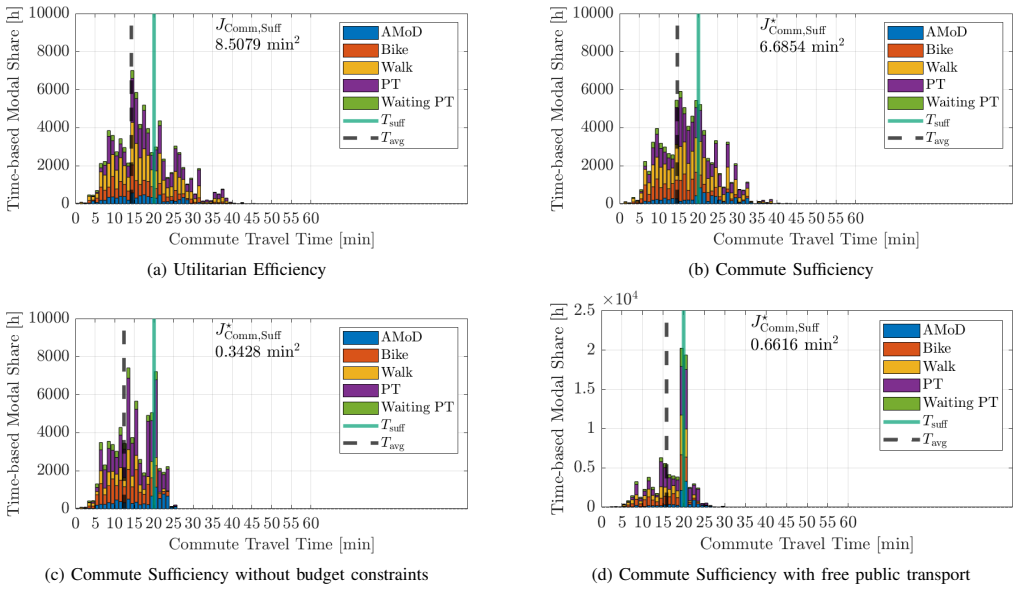
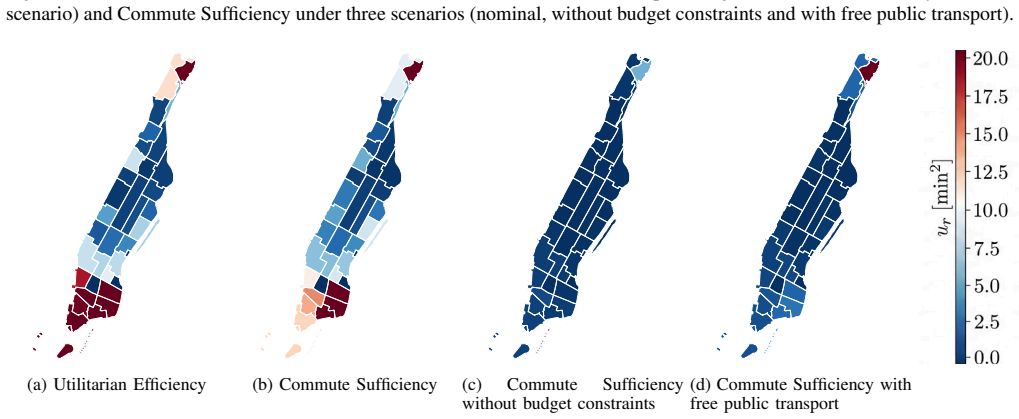
The paper shows that monetary budgets significantly limit the social justice potential of AMoD systems if deployed as transportation network companies, while granting free public transit can result in sufficiency levels very close to a completely free intermodal AMoD system, where justice-informed operations can be achieved without compromising standard efficiency metrics.
What carries the argument
Mesoscopic network flow models that characterize intermodal AMoD operations and enable optimization of both utilitarian efficiency and justice-informed objectives under budget, safety, and capacity constraints.
If this is right
- Monetary budgets significantly limit the social justice potential of AMoD systems when they are deployed as transportation network companies.
- Granting free public transit can result in sufficiency levels very close to a completely free intermodal AMoD system.
- Justice-informed operations can be achieved without compromising standard efficiency metrics.
- Social policies hold strong potential for improving justice outcomes in mobility systems.
Where Pith is reading between the lines
- Cities might achieve comparable justice gains by subsidizing existing transit rather than new autonomous services.
- The approach could be applied to other dense cities to test whether the free-transit effect persists outside Manhattan.
- Direct inclusion of justice metrics in planning tools might shape future regulations for emerging mobility options.
Load-bearing premise
The mesoscopic network flow models accurately represent user budget constraints, safety limits, and infrastructural capacities in a way that allows justice metrics to be optimized without post-hoc adjustments or unmodeled behavioral responses.
What would settle it
A comparison using actual Manhattan ridership data that shows sufficiency levels with free public transit fall substantially below those of a free AMoD system once real user responses are included.
Figures
read the original abstract
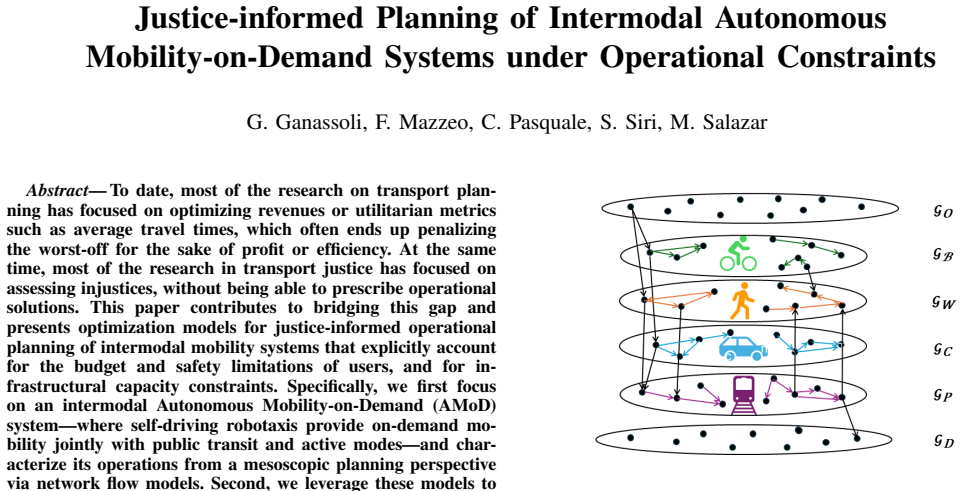
To date, most of the research on transport planning has focused on optimizing revenues or utilitarian metrics such as average travel times, which often ends up penalizing the worst-off for the sake of profit or efficiency. At the same time, most of the research in transport justice has focused on assessing injustices, without being able to prescribe operational solutions. This paper contributes to bridging this gap and presents optimization models for justice-informed operational planning of intermodal mobility systems that explicitly account for the budget and safety limitations of users, and for infrastructural capacity constraints. Specifically, we first focus on an intermodal Autonomous Mobility-on-Demand (AMoD) system -- where self-driving robotaxis provide on-demand mobility jointly with public transit and active modes -- and characterize its operations from a mesoscopic planning perspective via network flow models. Second, we leverage these models to optimize system operations through both utilitarian efficiency and justice-informed objectives. We showcase our framework in a real-world case-study for Manhattan, New York. Our results show that monetary budgets significantly limit the social justice potential of AMoD systems if they are to be deployed as transportation network companies. At the same time, granting free public transit can result in sufficiency levels very close to a completely free intermodal AMoD system, where justice-informed operations can be achieved without compromising standard efficiency metrics, ultimately highlighting the strong potential of social policies.
Editorial analysis
A structured set of objections, weighed in public.
Referee Report
Summary. The paper develops optimization models for justice-informed operational planning of intermodal Autonomous Mobility-on-Demand (AMoD) systems using mesoscopic network flow models that account for user budget and safety limitations as well as infrastructural capacities. It optimizes system operations under both utilitarian efficiency and justice-informed objectives and presents results from a Manhattan, New York case study, concluding that free public transit can achieve sufficiency levels close to those of a completely free intermodal AMoD system without compromising efficiency metrics.
Significance. If the modeling assumptions hold, the work is significant in bridging the gap between transport justice research, which has focused on assessment, and operational planning, which has prioritized efficiency or revenue. The Manhattan case study provides concrete evidence that social policies like free public transit can promote justice in mobility systems while maintaining standard efficiency, offering policy-relevant insights for intermodal systems.
major comments (1)
- [Manhattan case study] The headline result that granting free public transit yields sufficiency levels very close to a completely free intermodal AMoD system (abstract) is load-bearing for the policy conclusion; it rests on the mesoscopic network flow models treating budget limits and safety thresholds as fixed capacities or linear penalties without apparent post-hoc recalibration or validation against agent-based models for income-stratified responses or trip-chaining.
minor comments (1)
- [Abstract] The abstract would be strengthened by briefly naming the specific justice metrics (e.g., sufficiency, Rawlsian, or other) optimized in the framework.
Simulated Author's Rebuttal
We thank the referee for their constructive comments. We respond to the major comment below.
read point-by-point responses
-
Referee: [Manhattan case study] The headline result that granting free public transit yields sufficiency levels very close to a completely free intermodal AMoD system (abstract) is load-bearing for the policy conclusion; it rests on the mesoscopic network flow models treating budget limits and safety thresholds as fixed capacities or linear penalties without apparent post-hoc recalibration or validation against agent-based models for income-stratified responses or trip-chaining.
Authors: The mesoscopic network flow models treat budget limits as reduced capacities on paid modes and safety thresholds as linear penalties in the objective precisely to enable scalable city-wide optimization under justice criteria. These parameters are derived from Manhattan-specific census income distributions and published surveys on mode safety perceptions rather than arbitrary values. While the manuscript does not include post-hoc recalibration or direct comparison to agent-based simulations of income-stratified trip-chaining, such micro-validation lies outside the intended scope of a mesoscopic planning framework whose primary advantage is computational tractability for optimization. The structural policy finding—that free public transit approximates the justice performance of a fully subsidized intermodal system—follows directly from the optimized flows under the stated constraints. We will add an expanded limitations subsection discussing behavioral assumptions and the potential value of future agent-based validation. revision: partial
Circularity Check
No significant circularity; results are optimization outputs
full rationale
The paper formulates mesoscopic network flow models for intermodal AMoD operations under budget, safety, and capacity constraints, then applies standard optimization with utilitarian and justice-informed objectives to a Manhattan case study. The reported sufficiency levels (e.g., free public transit approaching fully free AMoD) are presented as computed outcomes of these models rather than inputs or self-definitions. No equations reduce by construction to fitted parameters renamed as predictions, no load-bearing self-citations are invoked for uniqueness or ansatzes, and the derivation chain remains independent of the target results. This is the expected non-finding for an applied optimization paper whose central claims rest on external data and solver outputs.
Axiom & Free-Parameter Ledger
Reference graph
Works this paper leans on
-
[1]
A vision of our transport future,
L. Burns, “A vision of our transport future,”Nature, no. 497, pp. 181– 182, 2013
2013
-
[2]
Intermodal autonomous mobility-on-demand,
M. Salazar, N. Lanzetti, F. Rossi, M. Schiffer, and M. Pavone, “Intermodal autonomous mobility-on-demand,”IEEE Transactions on Intelligent Transportation Systems, vol. 21, no. 9, pp. 3946–3960, 2020
2020
-
[3]
Routing and rebalancing intermodal autonomous mobility-on-demand systems in mixed traffic,
S. Wollenstein-Betech, M. Salazar, A. Houshmand, M. Pavone, C. G. Cassandras, and I. C. Paschalidis, “Routing and rebalancing intermodal autonomous mobility-on-demand systems in mixed traffic,”IEEE Transactions on Intelligent Transportation Systems, vol. 23, no. 8, pp. 12 263–12 275, 2021
2021
-
[4]
Martens,Transport Justice – Designing Fair Transportation Sys- tems
K. Martens,Transport Justice – Designing Fair Transportation Sys- tems. Taylor & Francis, 2017
2017
-
[5]
How accessibility shapes land use,
W. G. Hansen, “How accessibility shapes land use,”Journal of the American Institute of Planners, vol. 25, no. 2, pp. 73–76, 1959
1959
-
[6]
Congestion-aware system optimal route choice for shared autonomous vehicles,
M. W. Levin, “Congestion-aware system optimal route choice for shared autonomous vehicles,”Transportation Research Part C: Emerg- ing Technologies, vol. 82, pp. 229 – 247, 2017
2017
-
[7]
Analysis and control of autonomous mobility-on-demand systems,
G. Zardini, N. Lanzetti, M. Pavone, and E. Frazzoli, “Analysis and control of autonomous mobility-on-demand systems,”Annual Review of Control, Robotics, and Autonomous Systems, vol. 5, 2022
2022
-
[8]
Robotic load balancing for Mobility-on-Demand systems,
M. Pavone, S. L. Smith, E. Frazzoli, and D. Rus, “Robotic load balancing for Mobility-on-Demand systems,”Proc. of the Inst. of Mechanical Engineers, Part D: Journal of Automobile Engineering, vol. 31, no. 7, pp. 839–854, 2012
2012
-
[9]
Routing autonomous vehicles in congested transportation networks: Structural properties and coordination algorithms,
F. Rossi, R. Zhang, Y . Hindy, and M. Pavone, “Routing autonomous vehicles in congested transportation networks: Structural properties and coordination algorithms,”Autonomous Robots, vol. 42, no. 7, pp. 1427–1442, 2018
2018
-
[10]
A congestion-aware routing scheme for autonomous mobility-on-demand systems,
M. Salazar, M. Tsao, I. Aguiar, M. Schiffer, and M. Pavone, “A congestion-aware routing scheme for autonomous mobility-on-demand systems,” inEuropean Control Conference, 2019
2019
-
[11]
A time-invariant network flow model for ride-pooling in mobility-on-demand systems,
F. Paparella, L. Pedroso, T. Hofman, and M. Salazar, “A time-invariant network flow model for ride-pooling in mobility-on-demand systems,” IEEE Transactions on Control of Network Systems, vol. 12, pp. 906– 917, 2024
2024
-
[12]
Analysis of nash and stackelberg equilibria of autonomous mobility-on-demand systems in mixed traffic,
F. Paparella, C. Lucas, C. Cenedese, and M. Salazar, “Analysis of nash and stackelberg equilibria of autonomous mobility-on-demand systems in mixed traffic,” inEuropean Control Conference, 2025, in Press
2025
-
[13]
F. Rossi, R. Iglesias, M. Alizadeh, and M. Pavone, “On the interaction between Autonomous Mobility-on-Demand systems and the power network: Models and coordination algorithms,” inRobotics: Science and Systems, 2018, Extended version available at https://arxiv.org/abs/ 1709.04906
work page internal anchor Pith review Pith/arXiv arXiv 2018
-
[14]
On the interaction between autonomous mobility-on-demand and public transportation systems,
M. Salazar, F. Rossi, M. Schiffer, C. H. Onder, and M. Pavone, “On the interaction between autonomous mobility-on-demand and public transportation systems,” inProc. IEEE Int. Conf. on Intelligent Transportation Systems, 2018
2018
-
[15]
Transport and mobility justice: Evolving discussions,
E. Verlinghieri and T. Schwanen, “Transport and mobility justice: Evolving discussions,”Journal of Transport Geography, vol. 87, p. 102798, 2020
2020
-
[16]
Advances and pitfalls in measuring transportation equity,
A. Karner, R. H. M. Pereira, and S. Farber, “Advances and pitfalls in measuring transportation equity,”Transportation, pp. 1–29, 2024
2024
-
[17]
Relations matter: Towards relational egalitarianism in transport,
A. Piazza and K. Martens, “Relations matter: Towards relational egalitarianism in transport,”Transport Reviews, vol. 46, no. 1, pp. 131–150, 2026
2026
-
[18]
Equity in acces- sibility: Moving from disparity to insufficiency analyses,
K. Martens, M. E. Singer, and A. L. Cohen-Zada, “Equity in acces- sibility: Moving from disparity to insufficiency analyses,”Journal of the American Planning Association, vol. 88, no. 4, pp. 479–494, 2022
2022
-
[19]
Accessibility and the capabilities ap- proach: a review of the literature and proposal for conceptual ad- vancements,
G. Vecchio and K. Martens, “Accessibility and the capabilities ap- proach: a review of the literature and proposal for conceptual ad- vancements,”Transport Reviews, vol. 41, no. 6, pp. 833–854, 2021
2021
-
[20]
On transport justice and safety in bicycle network design optimization,
M. Campero Jurado, C. Canudas de Wit, G. De Nunzio, and M. Salazar, “On transport justice and safety in bicycle network design optimization,” inProc. IEEE Conf. on Decision and Control, 2025
2025
-
[21]
Multi-period bus frequency optimiza- tion and fleet rebalancing based on equity over time,
E. Qiu, D. Rey, and T. Waller, “Multi-period bus frequency optimiza- tion and fleet rebalancing based on equity over time,”Transportation, 2025
2025
-
[22]
Operationalizing social justice theory in transport resource allo- cation,
——, “Operationalizing social justice theory in transport resource allo- cation,”Transportation Research Part D: Transport and Environment, 2026
2026
-
[23]
Mobilizing transport justice: A sufficientarian optimiza- tion framework for intermodal mobility systems,
M. Salazar, S. Betancur Giraldo, F. Paparella, L. Pedroso, and K. Martens, “Mobilizing transport justice: A sufficientarian optimiza- tion framework for intermodal mobility systems,”NPJ Sustainable Mobility and Transport, vol. 2, no. 43, 2025
2025
-
[24]
Urgency-aware optimal routing in repeated games through artificial currencies,
M. Salazar, D. Paccagnan, A. Agazzi, and W. P. M. H. Heemels, “Urgency-aware optimal routing in repeated games through artificial currencies,”European Journal of Control, vol. 62, pp. 22–32, 2021, european Control Conference Special Issue
2021
-
[25]
On accessibility fairness in intermodal mobility-on-demand systems,
M. Salazar, S. Betancur Giraldo, F. Paparella, and L. Pedroso, “On accessibility fairness in intermodal mobility-on-demand systems,” in Proc. of the IFAC Symposium on Control in Transportation Systems, 2024
2024
-
[26]
Longitudinal employer-household dynamics (lehd),
United States Census Bureau, “Longitudinal employer-household dynamics (lehd),” 2024. [Online]. Available: https://lehd.ces.census. gov/
2024
-
[27]
American community survey (acs) 5-year estimates, 2018–2022,
U.S. Census Bureau, “American community survey (acs) 5-year estimates, 2018–2022,” https://www.census.gov/programs-surveys/acs, 2022, accessed: 2025-02-07
2018
-
[28]
Population factfinder,
N. D. of City Planning, “Population factfinder,” 2025. [Online]. Avail- able: https://popfactfinder.planning.nyc.gov/explorer/ntas/MN0202
2025
-
[29]
New york taxi fare estimator - rates and prices,
EstimaTaxi, “New york taxi fare estimator - rates and prices,”
-
[30]
Available: https://estimataxi.com/north-america/ united-states/new-york/
[Online]. Available: https://estimataxi.com/north-america/ united-states/new-york/
-
[31]
New york city subway,
C. N. York, “New york city subway,” 2024. [Online]. Available: https://www.introducingnewyork.com/subway
2024
-
[32]
Y ALMIP : A toolbox for modeling and optimization in MATLAB,
J. L ¨ofberg, “Y ALMIP : A toolbox for modeling and optimization in MATLAB,” inIEEE Int. Symp. on Computer Aided Control Systems Design, 2004
2004
-
[33]
Europeans recognize Zohran Mamdani’s supposedly radical policies as ‘normal’,
A. Kassam, “Europeans recognize Zohran Mamdani’s supposedly radical policies as ‘normal’,”The Guardian, Nov 2025
2025
-
[34]
Mobility data justice,
F. Behrendt and M. Sheller, “Mobility data justice,”Mobilities, vol. 19, no. 1, pp. 151–169, 2024
2024
-
[35]
Sheller,Mobility justice: The politics of movement in an age of extremes
M. Sheller,Mobility justice: The politics of movement in an age of extremes. Verso Books, 2018
2018
discussion (0)
Sign in with ORCID, Apple, or X to comment. Anyone can read and Pith papers without signing in.