Methods for Centrality Determination Using Forward Detectors in the BM@N Experiment
Pith reviewed 2026-06-29 19:33 UTC · model grok-4.3
The pith
Modified Bayesian and forward-detector methods determine collision centrality in BM@N with agreement to Glauber models within 5%.
A machine-rendered reading of the paper's core claim, the machinery that carries it, and where it could break.
Core claim
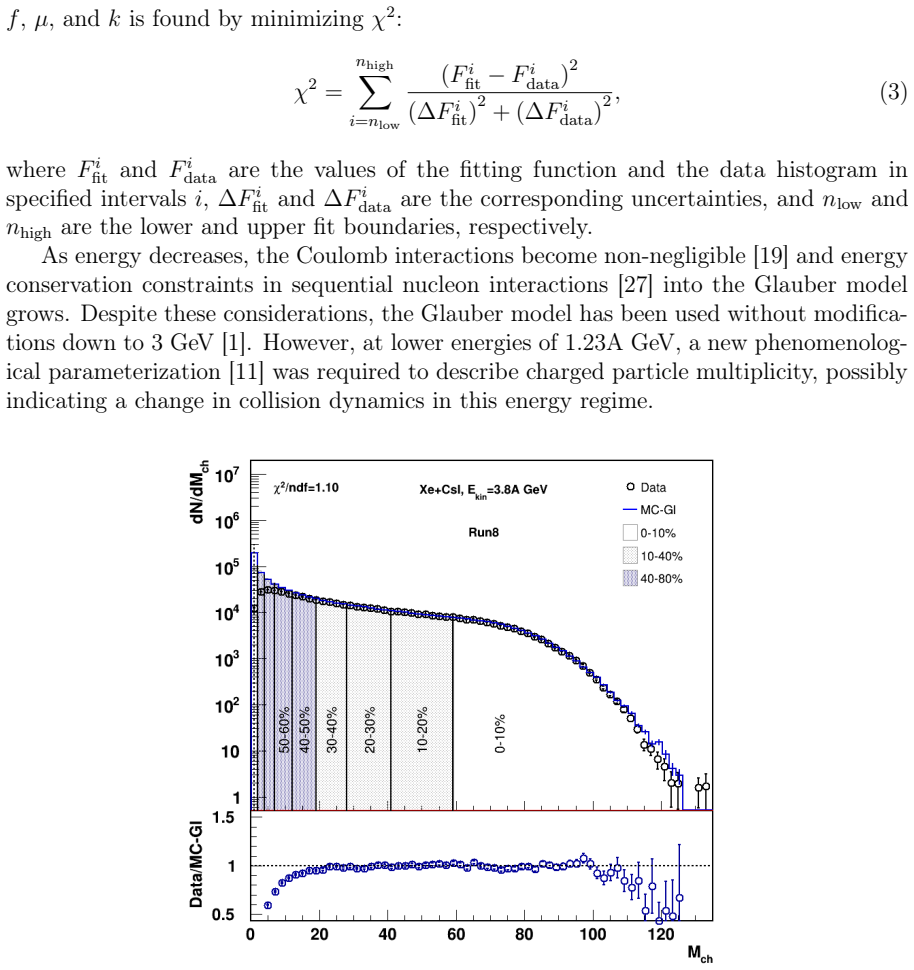
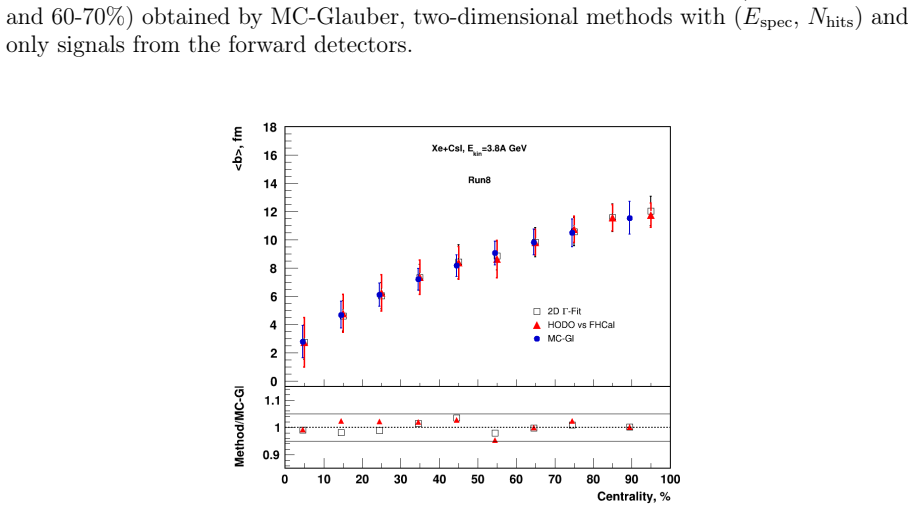
The developed methods for centrality determination, including a modified Bayesian approach and two approaches based on forward detectors, agree with the classical Monte Carlo Glauber approach within 5% when applied to Xe+CsI collisions at 3.8 A GeV, confirming their reliability and mutual consistency.
What carries the argument
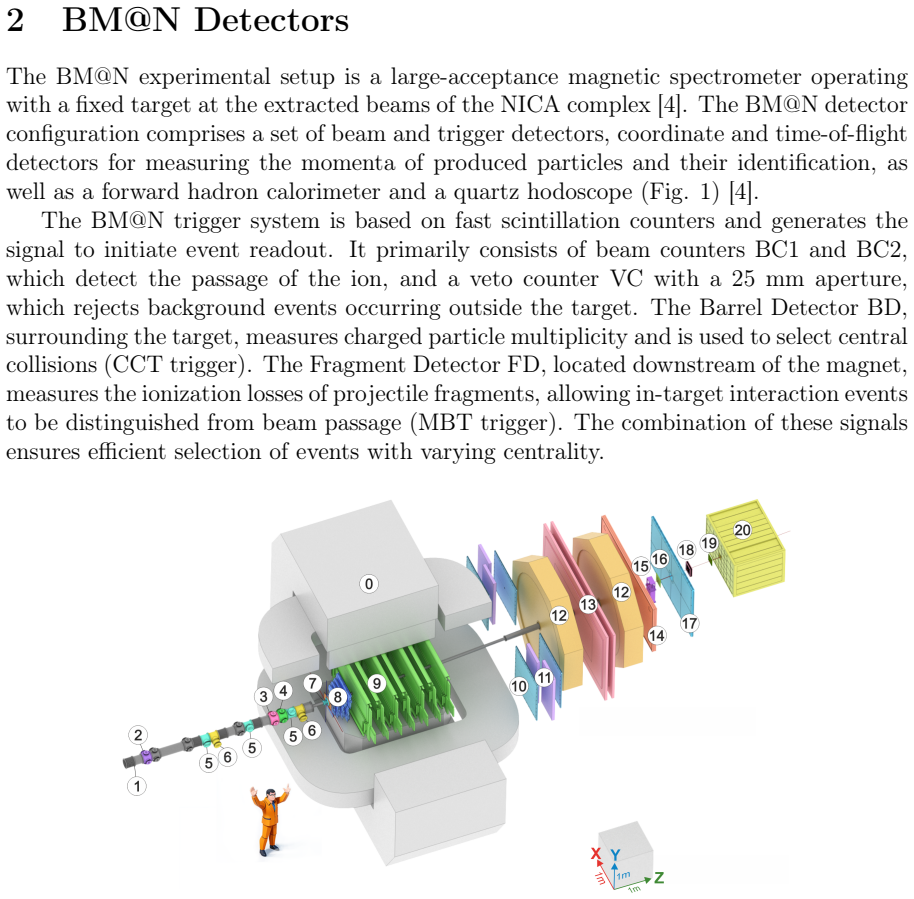
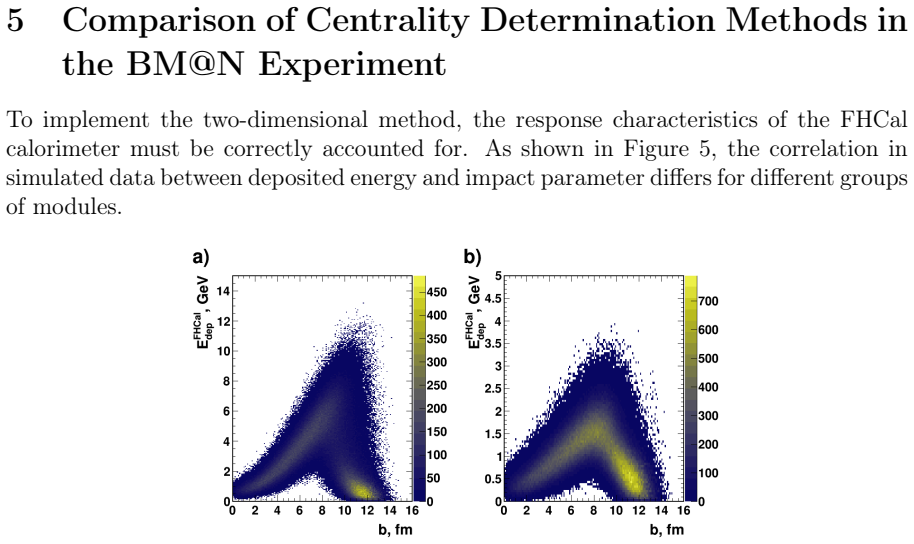
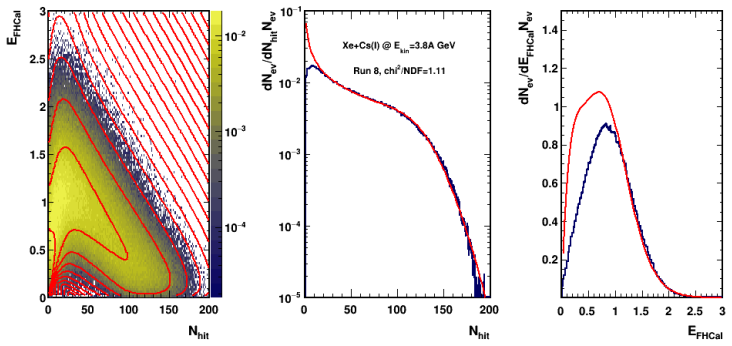
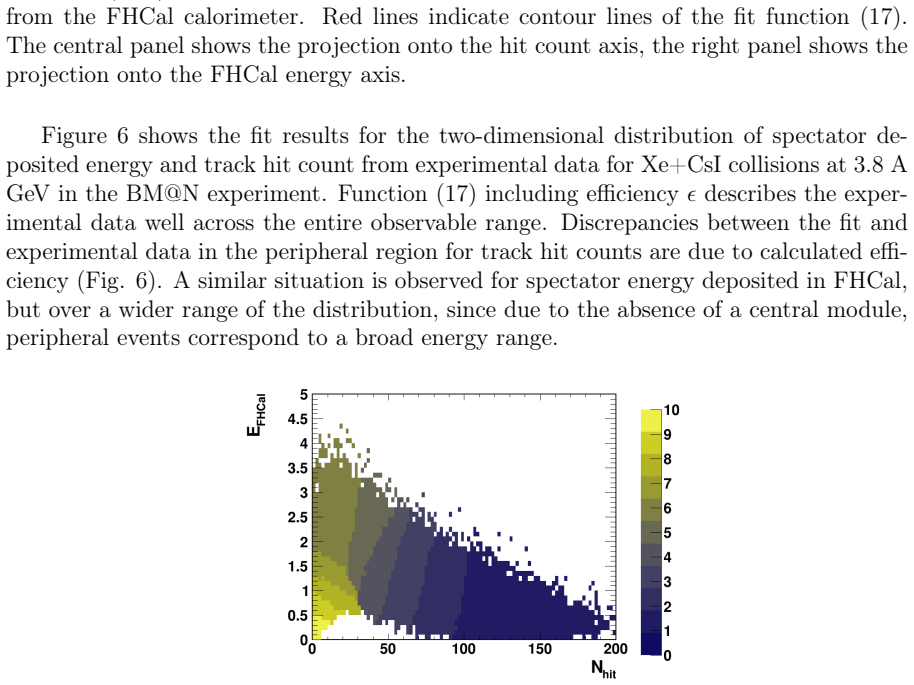
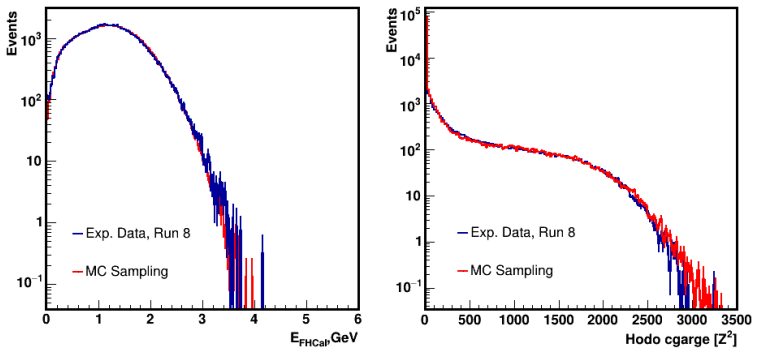
The two-dimensional method combining track hit counts and spectator deposited energy in the FHCal, along with the method using quartz hodoscope and FHCal signals, for estimating centrality.
If this is right
- These methods can be used for data processing in the BM@N experiment and other heavy-ion experiments at intermediate energies.
- The use of forward detectors provides an independent tool for assessing initial collision geometry.
- They can reduce autocorrelation effects in studies of proton multiplicity fluctuations.
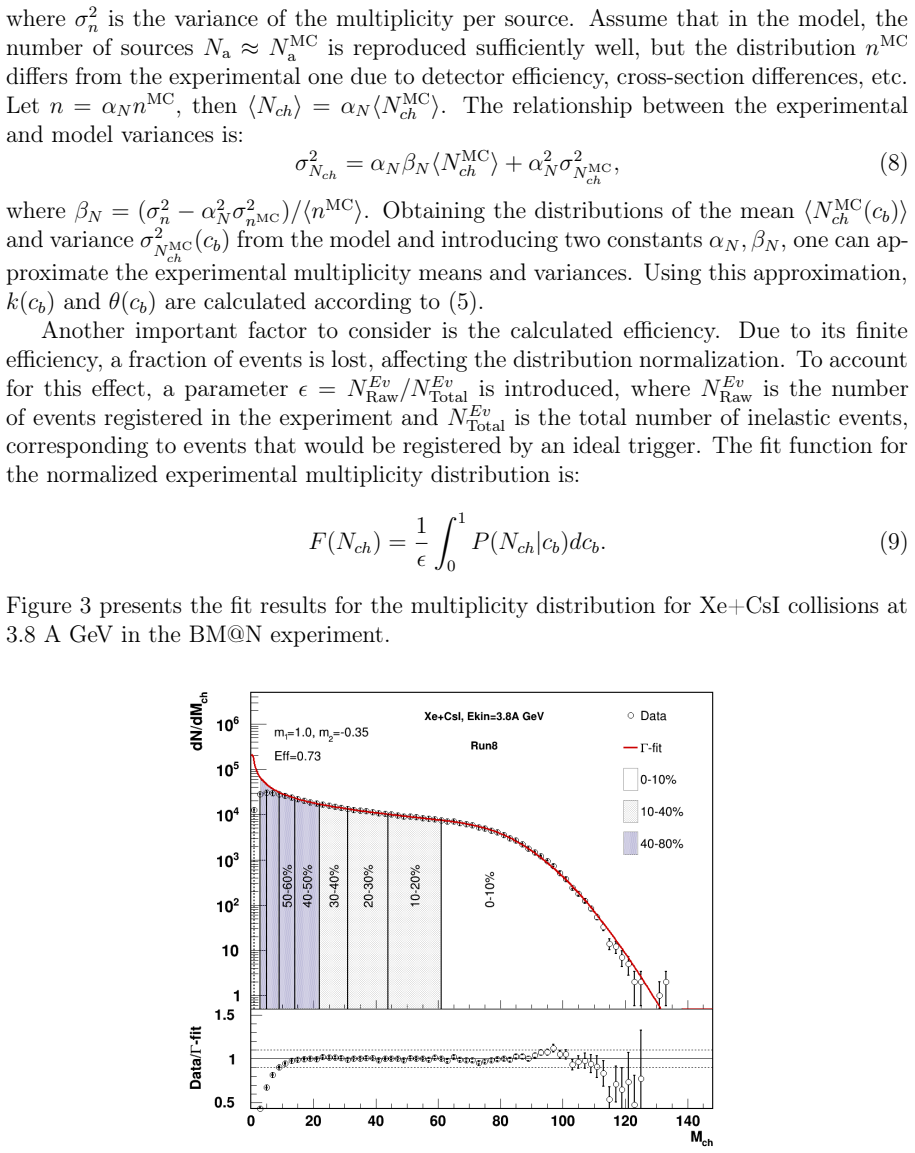
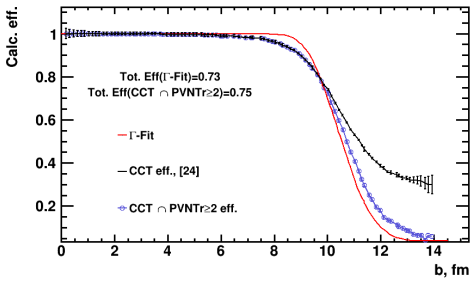
- The modified Bayesian approach allows estimation of event registration efficiency versus impact parameter.
Where Pith is reading between the lines
- The methods might allow better comparison of data across different experiments by providing consistent centrality measures.
- If applied to other energies, they could test how centrality determination scales with beam energy.
- Reducing autocorrelation could lead to more accurate measurements of fluctuations in particle production.
Load-bearing premise
The assumption that the event registration efficiency depends on impact parameter in a way that can be estimated from charged particle multiplicity using the modified Bayesian method.
What would settle it
A direct comparison showing disagreement larger than 5% between the new methods and the Glauber approach in the same dataset would falsify the claim of reliability.
Figures
read the original abstract
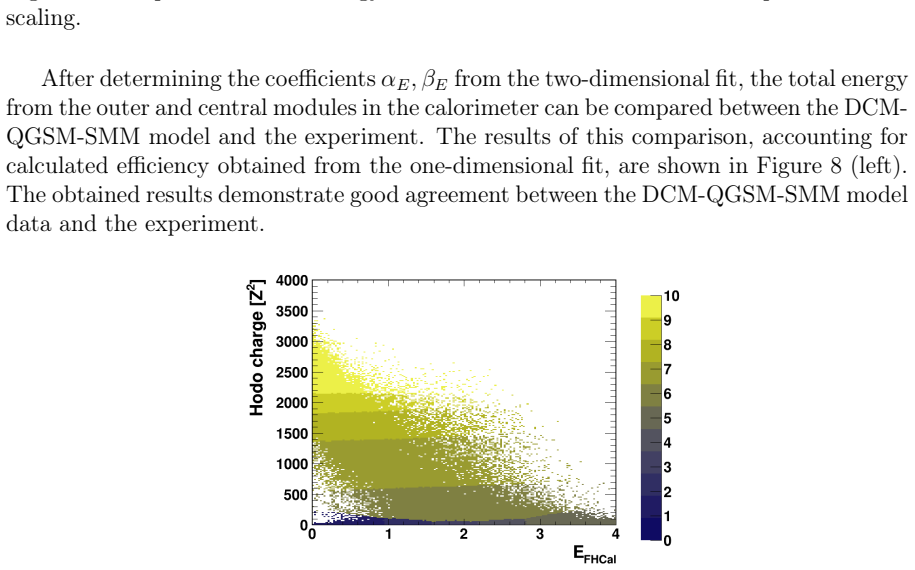
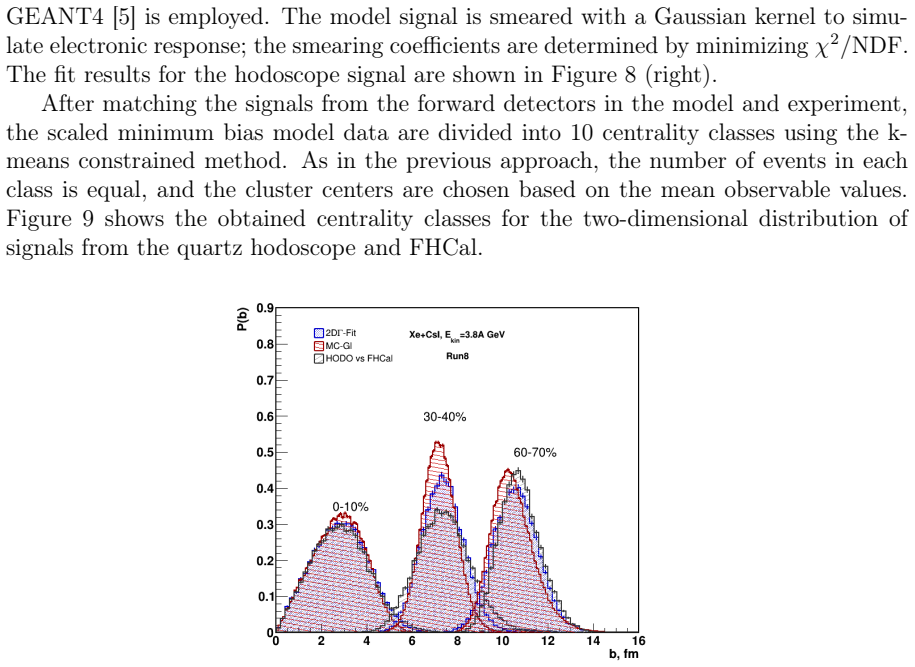
Collision centrality is a key parameter for studying nuclear matter properties, as it determines the initial interaction geometry and the size of the produced system. Accurate centrality determination is essential for comparing experimental data obtained from different experiments and for benchmarking against theoretical models. This work presents a modification of the approach for centrality determination using charged particle multiplicity based on Bayes' theorem. The proposed improvements enable an estimation of event registration efficiency as a function of the impact parameter. Furthermore, two approaches utilizing forward detectors are proposed: a two-dimensional method based on the combined analysis of track hit counts and spectator deposited energy in the Forward Hadron Calorimeter FHCal, and a method employing signals from the quartz hodoscope and FHCal. These methods were applied to data from the first physics run Xe+CsI of the BM@N experiment (Baryonic Matter at Nuclotron) with a xenon beam at the energy of 3.8 A GeV. A comparison of the developed methods with the classical Monte Carlo Glauber approach demonstrates agreement within 5% across all considered methods, confirming their reliability and mutual consistency. The use of forward detectors for centrality determination may serve as an independent tool for assessing the initial collision geometry and can reduce autocorrelation effects in studies of proton multiplicity fluctuations. The developed approaches can be employed for data processing in the BM@N experiment, as well as in other heavy-ion experiments at intermediate energies.
Editorial analysis
A structured set of objections, weighed in public.
Referee Report
Summary. The manuscript presents a modified Bayesian approach to centrality determination from charged-particle multiplicity that incorporates an impact-parameter-dependent event registration efficiency, along with two forward-detector methods (a 2-D combination of track-hit multiplicity and FHCal deposited energy, and a hodoscope-plus-FHCal signal combination). These are applied to the first-physics Xe+CsI run at 3.8 A GeV in BM@N; direct comparison with a classical Monte-Carlo Glauber reference yields agreement within 5 % for all three methods, which the authors interpret as confirmation of reliability and mutual consistency.
Significance. If the reported 5 % agreement is supported by the quantitative comparisons and efficiency parametrizations supplied in the full text, the work supplies practical, forward-detector-based centrality estimators that can serve as an independent cross-check and reduce autocorrelation biases in multiplicity-fluctuation analyses. The explicit algorithmic descriptions and the direct Glauber benchmark constitute clear strengths for an experiment-specific methods paper.
minor comments (2)
- [Abstract] Abstract: the statement of 'agreement within 5 %' would be strengthened by a parenthetical note on the metric used (e.g., mean relative difference in centrality percentiles) and whether uncertainties are included.
- [Section describing the modified Bayesian method] The efficiency-vs-b parametrization and the 2-D hit/energy mapping are central to the new methods; ensure that the corresponding figures include the full set of selection cuts applied to the data sample.
Simulated Author's Rebuttal
We thank the referee for the positive assessment of the manuscript and the recommendation for minor revision. No specific major comments were provided in the report.
Circularity Check
No significant circularity; derivation is self-contained against external benchmark
full rationale
The paper's central result is an empirical agreement (within 5%) between three new centrality estimators (modified Bayesian multiplicity, 2D hit/energy mapping, and hodoscope/FHCal combination) and the classical Monte Carlo Glauber model on Xe+CsI data. The Glauber reference is an independent, externally established simulation framework whose inputs and assumptions are not derived from the present data or methods; the paper supplies explicit algorithmic descriptions, efficiency parametrizations, and direct comparison without any step that reduces a claimed prediction to a fitted parameter or self-citation chain. No self-definitional, fitted-input, or uniqueness-imported patterns appear in the derivation chain.
Axiom & Free-Parameter Ledger
axioms (1)
- domain assumption The Monte Carlo Glauber model provides a reliable reference for collision geometry against which new methods can be validated.
Reference graph
Works this paper leans on
-
[1]
M. S. Abdallah et al. “Measurements of Proton High-Order Cumulants in s N N = 3 GeV Au + Au Collisions and Implications for the QCD Critical Point”. en. In: Physical Review Letters128.20 (May 2022), p. 202303.issn: 0031-9007, 1079-7114. doi:10.1103/PhysRevLett.128.202303.url:https://link.aps.org/doi/10. 1103/PhysRevLett.128.202303(visited on 03/04/2026)
work page doi:10.1103/physrevlett.128.202303.url:https://link.aps.org/doi/10 2022
-
[2]
Centrality determination of Pb-Pb collisions at s N N = 2.76 TeV with ALICE
B. et. all Abelev. “Centrality determination of Pb-Pb collisions at s N N = 2.76 TeV with ALICE”. en. In:Physical Review C88.4 (Oct. 2013), p. 044909.issn: 0556-2813, 1089-490X.doi:10.1103/PhysRevC.88.044909.url:https://link. aps.org/doi/10.1103/PhysRevC.88.044909(visited on 05/26/2023)
work page doi:10.1103/physrevc.88.044909.url:https://link 2013
-
[3]
J. Adamczewski-Musch et al. “Proton-number fluctuations in s N N = 2.4 GeV Au + Au collisions studied with the High-Acceptance DiElectron Spectrometer (HADES)”. en. In:Physical Review C102.2 (Aug. 2020), p. 024914.issn: 2469- 9985, 2469-9993.doi:10.1103/PhysRevC.102.024914.url:https://link.aps. org/doi/10.1103/PhysRevC.102.024914(visited on 03/22/2026)
work page doi:10.1103/physrevc.102.024914.url:https://link.aps 2020
-
[4]
The BM@N spectrometer at the NICA accelerator complex
S. Afanasiev et al. “The BM@N spectrometer at the NICA accelerator complex”. In:Nucl. Instrum. Meth. A1065 (2024), p. 169532.doi:10.1016/j.nima.2024. 169532. arXiv:2312.17573 [hep-ex]
-
[5]
S. Agostinelli et al. “Geant4—a simulation toolkit”. In:Nuclear Instruments and Methods in Physics Research Section A: Accelerators, Spectrometers, Detectors and Associated Equipment506.3 (2003), pp. 250–303.issn: 0168-9002.doi:https:// doi.org/10.1016/S0168-9002(03)01368-8.url:https://www.sciencedirect. com/science/article/pii/S0168900203013688
work page doi:10.1016/s0168-9002(03)01368-8.url:https://www.sciencedirect 2003
-
[6]
Monte-Carlo Generator of Heavy Ion Collisions DCM-SMM
M. Baznat et al. “Monte-Carlo Generator of Heavy Ion Collisions DCM-SMM”. en. In:Physics of Particles and Nuclei Letters17.3 (May 2020), pp. 303–324.issn: 1547-4771, 1531-8567.doi:10.1134/S1547477120030024.url:https://link. springer.com/10.1134/S1547477120030024(visited on 11/07/2023)
work page doi:10.1134/s1547477120030024.url:https://link 2020
-
[7]
Constrained K-Means Cluster- ing
P. Bradley, Kristin Bennett, and Ayhan Demiriz. “Constrained K-Means Cluster- ing”. In: (Aug. 2000)
2000
-
[9]
Relating centrality to impact parameter in nucleus-nucleus collisions
Sruthy Jyothi Das, Giuliano Giacalone, Pierre-Amaury Monard, and Jean-Yves Ollitrault. “Relating centrality to impact parameter in nucleus-nucleus collisions”. en. In:Physical Review C97.1 (Jan. 2018), p. 014905.issn: 2469-9985, 2469-9993. doi:10 . 1103 / PhysRevC . 97 . 014905.url:https : / / link . aps . org / doi / 10 . 1103/PhysRevC.97.014905(visited ...
2018
-
[10]
Methods for Centrality Determination in the BM@N Experiment
A. E. Demanov and A. V. Taranenko. “Methods for Centrality Determination in the BM@N Experiment”. In:Physics of Particles and Nuclei56.3 (June 2025), pp. 886–890.issn: 1531-8559.doi:10 . 1134 / S1063779624702460.url:https : //doi.org/10.1134/S1063779624702460
-
[11]
Centrality determination of Au + Au collisions at 1.23A GeV with HADES
HADES Collaboration et al. “Centrality determination of Au + Au collisions at 1.23A GeV with HADES”. en. In:The European Physical Journal A54.5 (May 2018), p. 85.issn: 1434-6001, 1434-601X.doi:10.1140/epja/i2018- 12513- 7. url:http://link.springer.com/10.1140/epja/i2018- 12513- 7(visited on 03/19/2026)
-
[12]
A Two-dimensional Bayesian Approach to Centrality Determination in Nucleus-Nucleus Collisions
D. Idrisov, F. Guber, N. Karpushkin, and P. Parfenov.Two-dimensional Bayesian Approach for Centrality Determination in Nucleus-Nucleus Collisions. 2025. arXiv: 2510.26276 [hep-ex].url:https://arxiv.org/abs/2510.26276
work page internal anchor Pith review Pith/arXiv arXiv 2025
-
[13]
Centrality Determination MethodinNuclearCollisionsbyUsingHadronCalorimeter
D. Idrisov, I. Segal, O. Golosov, and A. Taranenko. “Centrality Determination MethodinNuclearCollisionsbyUsingHadronCalorimeter”.In:Physics of Particles and Nuclei Letters21.4 (Aug. 2024), pp. 627–630.issn: 1531-8567.doi:10.1134/ S1547477124700845.url:https://doi.org/10.1134/S1547477124700845
-
[14]
INDRA Collaboration et al.Model independent reconstruction of impact parameter distributions for intermediate energy heavy ion collisions. Version Number: 2. 2020. doi:10.48550/ARXIV.2011.04496.url:https://arxiv.org/abs/2011.04496 (visited on 08/28/2025)
work page doi:10.48550/arxiv.2011.04496.url:https://arxiv.org/abs/2011.04496 2020
-
[15]
Centrality determination with aforwarddetectorintheRHICBeamEnergyScan
Skipper Kagamaster, Rosi Reed, and Michael Lisa. “Centrality determination with aforwarddetectorintheRHICBeamEnergyScan”.en.In:Physical Review C103.4 (Apr. 2021), p. 044902.issn: 2469-9985, 2469-9993.doi:10.1103/PhysRevC.103. 044902.url:https : / / link . aps . org / doi / 10 . 1103 / PhysRevC . 103 . 044902 (visited on 11/06/2023)
-
[16]
Studies of baryonic matter at the BM@N experiment (JINR)
Mikhail Kapishin. “Studies of baryonic matter at the BM@N experiment (JINR)”. In:Nuclear Physics A982 (Feb. 2019), pp. 967–970.doi:10.1016/j.nuclphysa. 2018.07.014
-
[17]
Improved version of the PHOBOS Glauber Monte Carlo
C. Loizides, J. Nagle, and P. Steinberg. “Improved version of the PHOBOS Glauber Monte Carlo”. en. In:SoftwareX1-2 (Sept. 2015), pp. 13–18.issn: 23527110.doi: 10.1016/j.softx.2015.05.001.url:https://linkinghub.elsevier.com/ retrieve/pii/S2352711015000047(visited on 05/26/2023)
work page doi:10.1016/j.softx.2015.05.001.url:https://linkinghub.elsevier.com/ 2015
-
[18]
Volume fluctuation and auto-correlation effects in the moment analysis of net-proton multiplicity distribu- tions in heavy-ion collisions
Xiaofeng Luo, Ji Xu, Bedangadas Mohanty, and Nu Xu. “Volume fluctuation and auto-correlation effects in the moment analysis of net-proton multiplicity distribu- tions in heavy-ion collisions”. In:Journal of Physics G: Nuclear and Particle Physics 40.10 (Oct. 2013), p. 105104.issn: 0954-3899, 1361-6471.doi:10 . 1088 / 0954 - 3899/40/10/105104.url:https://i...
2013
-
[19]
The Glauber model and heavy ion re- action and elastic scattering cross sections
Ajay Mehndiratta and Prashant Shukla. “The Glauber model and heavy ion re- action and elastic scattering cross sections”. en. In:Nuclear Physics A961 (May 2017), pp. 22–36.issn: 03759474.doi:10 . 1016 / j . nuclphysa . 2017 . 02 . 002. url:https://linkinghub.elsevier.com/retrieve/pii/S0375947417300271 (visited on 03/19/2026). 17
2017
-
[20]
Glauber Modeling in High-Energy Nuclear Collisions
MichaelL.Miller,KlausReygers,StephenJ.Sanders,andPeterSteinberg.“Glauber Modeling in High-Energy Nuclear Collisions”. In:Annual Review of Nuclear and Particle Science57.Volume 57, 2007 (2007), pp. 205–243.issn: 1545-4134.doi: https://doi.org/10.1146/annurev.nucl.57.090506.123020.url:https: //www.annualreviews.org/content/journals/10.1146/annurev.nucl.57. ...
work page doi:10.1146/annurev.nucl.57.090506.123020.url:https: 2007
-
[21]
S.Navasetal.“Reviewofparticlephysics”.In:Phys. Rev. D110.3(2024),p.030001. doi:10.1103/PhysRevD.110.030001
-
[22]
Centrality Determination in Heavy-ion Collisions with MPD Detector at NICA
P. Parfenov et al. “Centrality Determination in Heavy-ion Collisions with MPD Detector at NICA”. en. In:Acta Physica Polonica B Proceedings Supplement14.3 (2021), p. 503.issn: 1899-2358, 2082-7865.doi:10.5506/APhysPolBSupp.14.503. url:http://www.actaphys.uj.edu.pl/findarticle?series=Sup&vol=14& page=503(visited on 06/03/2023)
-
[23]
Evaluation of Trigger Efficiency in the BM@N Experiment Session with a Beam of Xenon Ions with a Kinetic Energy of 3.8 AGeV
V. A. Plotnikov and M. N. Kapishin. “Evaluation of Trigger Efficiency in the BM@N Experiment Session with a Beam of Xenon Ions with a Kinetic Energy of 3.8 AGeV”. In:Physics of Particles and Nuclei Letters22.6 (2025), pp. 1406– 1415.doi:10 . 1134 / S1547477125701808.url:https : / / doi . org / 10 . 1134 / S1547477125701808
2025
-
[24]
Reconstructing the impact parameter of proton-nucleus and nucleus-nucleus collisions
Rudolph Rogly, Giuliano Giacalone, and Jean-Yves Ollitrault. “Reconstructing the impact parameter of proton-nucleus and nucleus-nucleus collisions”. en. In:Physical Review C98.2 (Aug. 2018), p. 024902.issn: 2469-9985, 2469-9993.doi:10.1103/ PhysRevC.98.024902.url:https://link.aps.org/doi/10.1103/PhysRevC. 98.024902(visited on 05/26/2023)
-
[25]
Possibilities of Using Different Estimators for Centrality Determi- nation with the BM@N Experiment
I. Segal et al. “Possibilities of Using Different Estimators for Centrality Determi- nation with the BM@N Experiment”. en. In:Physics of Atomic Nuclei86.6 (Dec. 2023),pp.1502–1507.issn:1063-7788,1562-692X.doi:10.1134/S1063778824010460. url:https : / / link . springer . com / 10 . 1134 / S1063778824010460(visited on 03/19/2026)
-
[26]
The heavy-ion program at the upgraded Baryonic Matter@Nuclotron Experiment at NICA
Peter Senger and BM@N collaboration. “The heavy-ion program at the upgraded Baryonic Matter@Nuclotron Experiment at NICA”. en. In:Proceedings of The In- ternational conference on Critical Point and Onset of Deconfinement — PoS(CPOD2021). zoom: Sissa Medialab, Aug. 2022, p. 033.doi:10.22323/1.400.0033.url:https: //pos.sissa.it/400/033(visited on 08/28/2025)
-
[27]
Accounting for Energy Losses in the Frame- work of the Modified Monte Carlo Glauber Model
S. V. Simak and G. A. Feofilov. “Accounting for Energy Losses in the Frame- work of the Modified Monte Carlo Glauber Model”. en. In:Physics of Particles and Nuclei56.3 (June 2025), pp. 877–880.issn: 1063-7796, 1531-8559.doi:10. 1134 / S1063779624702447.url:https : / / link . springer . com / 10 . 1134 / S1063779624702447(visited on 02/23/2026). 18
2025
discussion (0)
Sign in with ORCID, Apple, or X to comment. Anyone can read and Pith papers without signing in.