A Scalable Benchmark Test Suite for Dynamic Multi-Objective Optimization with a Changing Number of Objectives
Pith reviewed 2026-06-29 19:25 UTC · model grok-4.3
The pith
New benchmark suite keeps objective functions fixed while the number of active objectives changes over time.
A machine-rendered reading of the paper's core claim, the machinery that carries it, and where it could break.
Core claim
By defining a maximum-objective problem and dynamically selecting subsets of objectives from fixed Minus-DTLZ and Minus-WFG formulations, the objective functions remain constant throughout the optimization process while only the number of active objectives varies, directly addressing the isolation failure in prior suites.
What carries the argument
Dynamic subset selection from a fixed maximum-objective Minus-DTLZ or Minus-WFG problem, which holds all objective functions constant while varying the active subset.
If this is right
- Algorithms can be evaluated on their handling of objective-count dynamics in isolation from function changes.
- The suite remains scalable because any number of active objectives up to the maximum can be obtained by subset selection.
- Benchmark comparisons become cleaner because all algorithms face identical underlying functions at every time step.
- Theoretical claims about handling non-stationary objective spaces no longer rest on violated assumptions about function constancy.
Where Pith is reading between the lines
- Designers of new dynamic algorithms may add explicit mechanisms to detect and respond to changes in objective cardinality without retraining on altered functions.
- Re-running prior dynamic MOEAs on this suite could expose performance drops previously masked by the confounding function changes in older benchmarks.
- The fixed-function construction could be extended to problems with time-varying objective correlations while still keeping the function definitions themselves stationary.
Load-bearing premise
Selecting subsets from the fixed maximum-objective problem preserves mutual conflict and non-degeneracy without introducing new implicit changes to the functions.
What would settle it
A demonstration that, under the new suite, switching the active objective subset produces Pareto-front or conflict changes that cannot be explained by the subset size alone.
Figures
read the original abstract
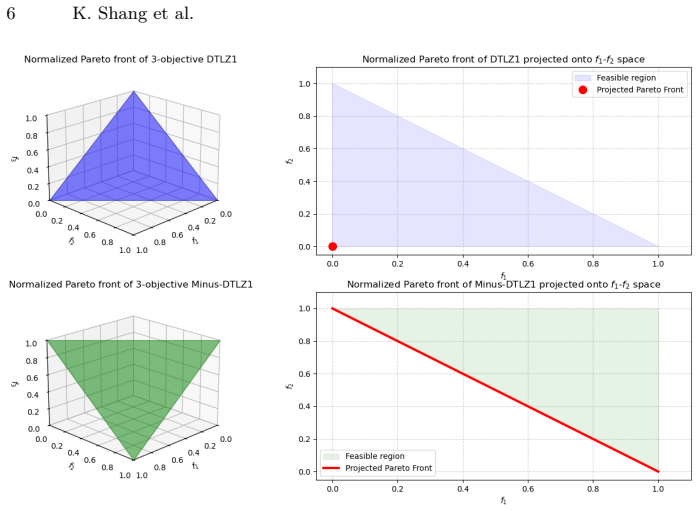
Dynamic multi-objective optimization with a changing number of objectives has recently attracted increasing attention due to its relevance to real-world problems whose evaluation criteria may evolve over time. However, existing benchmark test suites for this problem setting suffer from a fundamental limitation: when the number of objectives changes, the objective functions themselves also change implicitly. This makes it difficult to isolate and evaluate an algorithm's capability to handle dynamics in the number of objectives alone. In this paper, we analyze this issue in detail and show that several theoretical properties claimed in prior studies rely on an assumption that is violated by commonly used test suites. To address this problem, we propose a scalable benchmark test suite in which the objective functions are fixed throughout the optimization process, while the number of active objectives changes over time. Our benchmark is constructed by defining a maximum-objective problem and dynamically selecting subsets of objectives. To avoid degeneracy issues in classical DTLZ and WFG problems, we adopt Minus-DTLZ and Minus-WFG formulations, in which all objectives are mutually conflicting. Extensive benchmark studies using representative algorithms from the literature demonstrate the usefulness and flexibility of the proposed test suite.
Editorial analysis
A structured set of objections, weighed in public.
Referee Report
Summary. The paper identifies a limitation in existing benchmark suites for dynamic multi-objective optimization with a changing number of objectives: altering the objective count implicitly changes the objective functions themselves, preventing isolation of the number-of-objectives dynamic. It analyzes how this violates assumptions underlying theoretical properties in prior work and proposes a new scalable suite constructed via dynamic subset selection from a fixed maximum-objective Minus-DTLZ or Minus-WFG problem (where all objectives are mutually conflicting). Only the active objective count varies while the underlying functions remain constant; extensive experiments with representative algorithms are used to demonstrate the suite's usefulness and flexibility.
Significance. If the subset-selection construction from Minus-DTLZ/Minus-WFG indeed preserves mutual conflict, non-degeneracy, and isolation of the dynamic without introducing new implicit changes, the benchmark supplies a controlled testbed that directly targets a recognized gap. This would enable more precise evaluation of algorithm behavior under objective-count dynamics, supporting better algorithm development for applications where evaluation criteria evolve.
minor comments (2)
- [Abstract] The abstract states that the new construction 'addresses the limitation of prior suites' and that 'several theoretical properties claimed in prior studies rely on an assumption that is violated'; a concrete example of one such violated property (with reference to a specific prior suite) would strengthen the motivation section.
- The description of the dynamic subset selection mechanism should include explicit pseudocode or a formal definition of how subsets are chosen at each time step to ensure reproducibility across implementations.
Simulated Author's Rebuttal
We thank the referee for the positive summary, recognition of the significance of isolating objective-count dynamics, and recommendation for minor revision. No specific major comments were provided in the report.
Circularity Check
No significant circularity; constructive benchmark proposal is self-contained
full rationale
The paper's central contribution is an explicit construction: define a fixed maximum-objective Minus-DTLZ/Minus-WFG instance (all objectives mutually conflicting by design) and dynamically select subsets to vary only the active objective count. This directly targets the stated limitation of prior suites without any derivation reducing to fitted parameters, self-referential definitions, or load-bearing self-citations. The mutual-conflict and non-degeneracy properties are inherited from the Minus formulations as stated, and the proposal's validity is externally checkable via algorithm performance on the described problems. No steps match the enumerated circularity patterns.
Axiom & Free-Parameter Ledger
axioms (2)
- domain assumption Minus-DTLZ and Minus-WFG formulations ensure all objectives are mutually conflicting and avoid degeneracy issues present in classical DTLZ/WFG.
- domain assumption Dynamic subset selection from a fixed maximum-objective problem isolates changes in objective count without implicit changes to the objective functions.
Reference graph
Works this paper leans on
-
[1]
Surveys in Operations Research and Management Science20(2), 35–42 (2015)
Chand, S., Wagner, M.: Evolutionary many-objective optimization: A quick-start guide. Surveys in Operations Research and Management Science20(2), 35–42 (2015). https://doi.org/10.1016/j.sorms.2015.08.001
-
[2]
IEEE Transactions on Evolutionary Computation22(1), 157–171 (2018)
Chen, R., Li, K., Yao, X.: Dynamic multiobjectives optimization with a changing number of objectives. IEEE Transactions on Evolutionary Computation22(1), 157–171 (2018). https://doi.org/10.1109/TEVC.2017.2669638
-
[3]
In: Evolutionary Multiobjective Opti- mization: Theoretical Advances and Applications, pp
Deb, K., Thiele, L., Laumanns, M., Zitzler, E.: Scalable test problems for evolutionary multiobjective optimization. In: Evolutionary Multiobjective Opti- mization: Theoretical Advances and Applications, pp. 105–145. Springer (2005). https://doi.org/10.1007/1-84628-137-7_6
-
[4]
IEEE Transactions on Evolutionary Computation8(5), 425–442 (2004)
Farina, M., Deb, K., Amato, P.: Dynamic multiobjective optimization problems: Test cases, approximations, and applications. IEEE Transactions on Evolutionary Computation8(5), 425–442 (2004). https://doi.org/10.1109/TEVC.2004.831456
-
[5]
In: Evolutionary Multi-Criterion Optimization
Huband, S., Barone, L., While, L., Hingston, P.: A scalable multi-objective test problem toolkit. In: Evolutionary Multi-Criterion Optimization. Lec- ture Notes in Computer Science, vol. 3410, pp. 280–295. Springer (2005). https://doi.org/10.1007/978-3-540-31880-4_20
-
[6]
IEEE Transactions on Evolutionary Computation21(2), 169–190 (2017)
Ishibuchi, H., Setoguchi, Y., Masuda, H., Nojima, Y.: Performance of decomposition-based many-objective algorithms strongly depends on pareto front shapes. IEEE Transactions on Evolutionary Computation21(2), 169–190 (2017). https://doi.org/10.1109/TEVC.2016.2587749
-
[7]
In: 2008 IEEE Congress on Evolutionary Computation
Ishibuchi, H., Tsukamoto, N., Nojima, Y.: Evolutionary many-objective optimiza- tion: A short review. In: 2008 IEEE Congress on Evolutionary Computation. pp. 2419–2426. IEEE (2008). https://doi.org/10.1109/CEC.2008.4631121
-
[8]
IEEE Transactions on Cybernet- ics50(6), 2814–2826 (2020)
Jiang, S., Kaiser, M., Yang, S., Kollias, S., Krasnogor, N.: A scalable test suite for continuous dynamic multiobjective optimization. IEEE Transactions on Cybernet- ics50(6), 2814–2826 (2020). https://doi.org/10.1109/TCYB.2019.2896021
-
[9]
ACM Computing Surveys55(4), 76:1–76:47 (2023)
Jiang, S., Zou, J., Yang, S., Yao, X.: Evolutionary dynamic multi-objective optimisation: A survey. ACM Computing Surveys55(4), 76:1–76:47 (2023). https://doi.org/10.1145/3524495
-
[10]
In: 2007 IEEE Congress on Evolutionary Computation
Li, X., Branke, J., Kirley, M.: On performance metrics and particle swarm methods for dynamic multiobjective optimization problems. In: 2007 IEEE Congress on Evolutionary Computation. pp. 576–583. IEEE (2007). https://doi.org/10.1109/CEC.2007.4424522
-
[11]
ZTE Communications15(3), 30–42 (2017)
Liao, H., Wang, W., Huang, H., Zhang, L., Chen, Y., Wang, J.: Evolutionary algorithms in software defined networks: Techniques, applications, and issues. ZTE Communications15(3), 30–42 (2017). https://doi.org/10.3969/j.issn.1673- 5188.2017.03.004
-
[12]
Swarm and Evolutionary Computation6, 1–24 (2012)
Nguyen, T.T., Yang, S., Branke, J.: Evolutionary dynamic optimization: A survey of the state of the art. Swarm and Evolutionary Computation6, 1–24 (2012). https://doi.org/10.1016/j.swevo.2012.05.001
-
[13]
IEEE Transactions on Evolutionary Com- putation29(5), 1531–1545 (2025)
Ruan, G., Hou, Z., Yao, X.: Coping with a severely changing number of objectives in dynamic multiobjective optimization. IEEE Transactions on Evolutionary Com- putation29(5), 1531–1545 (2025). https://doi.org/10.1109/TEVC.2025.3558987
-
[14]
IEEE Transactions on Emerging Topics in Computational Intelligence8(6), 4210–4224 (2024)
Ruan, G., Minku, L.L., Menzel, S., Sendhoff, B., Yao, X.: Knowledge transfer for dynamic multiobjective optimization with a changing number of objectives. IEEE Transactions on Emerging Topics in Computational Intelligence8(6), 4210–4224 (2024). https://doi.org/10.1109/TETCI.2024.3389769 16 K. Shang et al
-
[15]
IEEE Transactions on Evolutionary Computation29(4), 865–879 (2025)
Ruan, G., Minku, L.L., Menzel, S., Sendhoff, B., Yao, X.: Learning to ex- pand/contract pareto sets in dynamic multiobjective optimization with a changing number of objectives. IEEE Transactions on Evolutionary Computation29(4), 865–879 (2025). https://doi.org/10.1109/TEVC.2024.3375751
-
[16]
While, L., Bradstreet, L., Barone, L.: A fast way of calculating exact hyper- volumes. IEEE Transactions on Evolutionary Computation16(1), 86–95 (2012). https://doi.org/10.1109/TEVC.2010.2077298
-
[17]
ZTE Communications19(4), 98–104 (2021)
Zhang, C., Zhang, N., Cao, W., Tian, K., Yang, Z.: Ai-based optimization of han- dover strategy in non-terrestrial networks. ZTE Communications19(4), 98–104 (2021). https://doi.org/10.12142/ZTECOM.202104011
-
[18]
Multiobjective evolutionary algorithms: A comparative case study and the strength Pareto approach
Zitzler, E., Thiele, L.: Multiobjective evolutionary algorithms: a comparative case study and the strength pareto approach. IEEE Transactions on Evolutionary Com- putation3(4), 257–271 (1999). https://doi.org/10.1109/4235.797969
discussion (0)
Sign in with ORCID, Apple, or X to comment. Anyone can read and Pith papers without signing in.