X-ray Polarization Signatures from Comptonization by Magnetic Reconnection Plasmoids
Pith reviewed 2026-06-29 20:24 UTC · model grok-4.3
The pith
Comptonization by trans-relativistic plasmoids produces X-rays strongly polarized perpendicular to the reconnection layer.
A machine-rendered reading of the paper's core claim, the machinery that carries it, and where it could break.
Core claim
The Comptonization off trans-relativistic bulk plasmoids is not only able to reproduce the 100 keV spectral cutoff, but furthermore produces X-rays that are above 1 keV strongly polarized perpendicular to the reconnection layer. The polarization is stronger than that from the Comptonization by an isotropic hot plasma owing to the confinement of the motion of the scattering plasmoids in the plane of the reconnection layer.
What carries the argument
Simplified plasmoid-chain model with Monte Carlo radiation transport that follows photon scattering off bulk-moving plasmoids confined to the reconnection plane.
If this is right
- The polarization signature can distinguish plasmoid Comptonization from isotropic hot-electron models in hard-state spectra.
- Polarization strength varies with azimuthal viewing angle relative to the reconnection layer.
- The mechanism can operate in an equatorial current sheet or the sheath of a black-hole jet without requiring rapid cooling of individual particles.
- Spectropolarimetric data above 1 keV can constrain the location and orientation of the reconnection region.
Where Pith is reading between the lines
- Future X-ray polarimeters could map reconnection geometry in multiple sources by measuring the polarization angle and its energy dependence.
- The same polarization pattern might appear in other high-energy reconnection environments if the plasmoid bulk motions remain planar.
- If the polarization signal is confirmed, it would reduce reliance on models that invoke continuously heated electrons to maintain the hard spectrum.
Load-bearing premise
The simplified plasmoid chain and Monte Carlo transport accurately capture the bulk motions and scattering geometry present in real astrophysical reconnection.
What would settle it
X-ray observations showing polarization above 1 keV that is not oriented perpendicular to the reconnection layer or that lacks the predicted dependence on azimuthal viewing angle.
Figures
read the original abstract
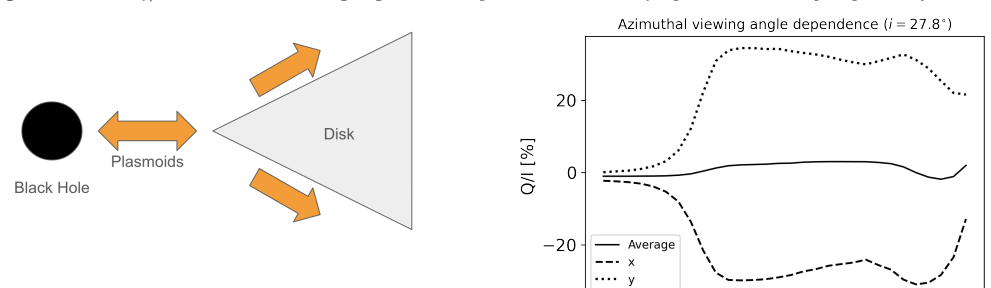
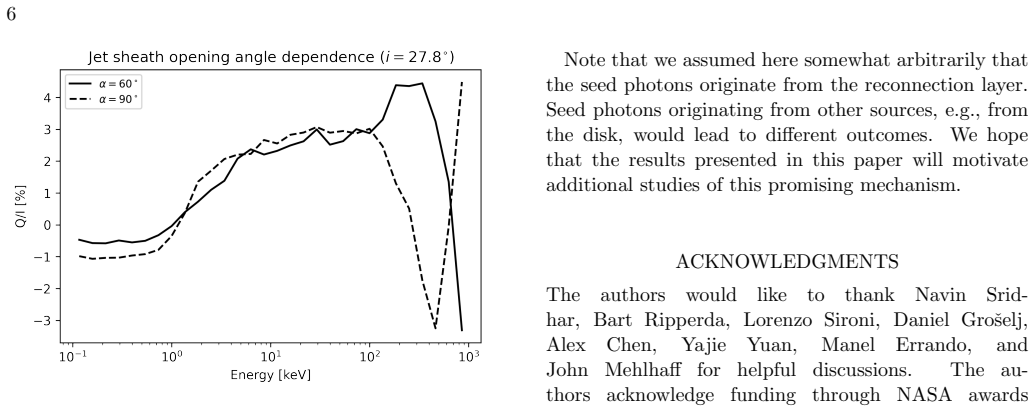
Emission from X-ray binaries in the hard spectral state is dominated by high-energy radiation attributed to the Compton scattering of seed photons. The prevalent model of the Comptonization by hot electrons or pairs faces the problem of rapid radiative cooling of the emitting particles. A proposed alternative mechanism is the Comptonization by scattering off fast plasmoids formed during magnetic reconnection. In this work, we simulate a simplified model of the plasmoid chain with Monte Carlo radiation transport and report on spectropolarimetric properties. We find that the Comptonization off trans-relativistic bulk plasmoids is not only able to reproduce the 100 keV spectral cutoff, but furthermore produces X-rays that are above 1 keV strongly polarized perpendicular to the reconnection layer. The polarization is stronger than that from the Comptonization by an isotropic hot plasma owing to the confinement of the motion of the scattering plasmoids in the plane of the reconnection layer. The dependence of polarization on azimuthal viewing angle is discussed, along with possible locations for the plasmoid chain in an equatorial current sheet or the sheath of the black hole's relativistic jet.
Editorial analysis
A structured set of objections, weighed in public.
Referee Report
Summary. The manuscript presents Monte Carlo simulations of Comptonization by a simplified chain of trans-relativistic plasmoids formed in magnetic reconnection. It claims that this process reproduces the ~100 keV spectral cutoff observed in X-ray binary hard states while also generating X-rays above 1 keV that are strongly polarized perpendicular to the reconnection layer, with the polarization degree exceeding that expected from isotropic hot-plasma Comptonization owing to the planar confinement of plasmoid bulk motions. Dependence on azimuthal viewing angle is discussed, along with possible astrophysical locations in an equatorial current sheet or jet sheath.
Significance. If the reported polarization signature holds under more realistic conditions, the work supplies a concrete, observationally testable prediction that distinguishes reconnection-driven Comptonization from standard hot-electron models and addresses the radiative-cooling problem. The forward Monte Carlo approach yields falsifiable spectropolarimetric forecasts suitable for upcoming X-ray polarimeters.
major comments (2)
- [Abstract / simulation setup] Abstract and simulation-setup description: the central claim that plasmoid bulk motions produce stronger perpendicular polarization than isotropic Comptonization rests on the assumption of strict planar confinement, yet no quantitative sensitivity tests to out-of-plane velocity components, finite layer thickness, or spreads in plasmoid size and Lorentz factor are reported; such tests are required to establish whether the claimed distinction survives modest 3D motions that would average over additional scattering angles.
- [Abstract] Abstract: the statement that the Monte Carlo simulation 'reproduces the 100 keV spectral cutoff' and 'produces' the polarization is presented without any reported parameter values, convergence diagnostics, or direct comparison runs against isotropic hot-plasma baselines, leaving the quantitative robustness of both the spectral and polarimetric results dependent on unshown implementation choices.
minor comments (1)
- The manuscript would benefit from explicit statements of the adopted plasmoid velocity distribution, optical depth, and seed-photon spectrum so that readers can reproduce the claimed polarization levels.
Simulated Author's Rebuttal
We thank the referee for their constructive and detailed comments. We address each major point below and outline the revisions we will make to strengthen the manuscript.
read point-by-point responses
-
Referee: [Abstract / simulation setup] Abstract and simulation-setup description: the central claim that plasmoid bulk motions produce stronger perpendicular polarization than isotropic Comptonization rests on the assumption of strict planar confinement, yet no quantitative sensitivity tests to out-of-plane velocity components, finite layer thickness, or spreads in plasmoid size and Lorentz factor are reported; such tests are required to establish whether the claimed distinction survives modest 3D motions that would average over additional scattering angles.
Authors: We agree that the robustness of the polarization signature against modest 3D effects is an important consideration. The present work deliberately employs a simplified planar model to isolate the effect of confined plasmoid motions. In the revised manuscript we will add a new subsection containing quantitative sensitivity tests, including additional Monte Carlo runs with small out-of-plane velocity components (up to ~0.2c), finite layer thickness, and modest spreads in plasmoid size and Lorentz factor. These tests will quantify how the perpendicular polarization degree changes relative to the isotropic baseline. revision: yes
-
Referee: [Abstract] Abstract: the statement that the Monte Carlo simulation 'reproduces the 100 keV spectral cutoff' and 'produces' the polarization is presented without any reported parameter values, convergence diagnostics, or direct comparison runs against isotropic hot-plasma baselines, leaving the quantitative robustness of both the spectral and polarimetric results dependent on unshown implementation choices.
Authors: The abstract is intentionally concise. The full manuscript already reports the simulation parameters (average plasmoid Lorentz factor, chain length, seed-photon spectrum, and Monte Carlo photon statistics) in Section 2, presents convergence diagnostics in Appendix A, and shows direct spectral and polarization comparisons to isotropic hot-plasma Comptonization in Figure 5. To improve clarity we will revise the abstract to quote the key parameter values and explicitly cite the comparison figure and appendix. revision: partial
Circularity Check
No circularity; results from explicit forward Monte Carlo simulation on constructed geometry
full rationale
The paper computes polarization signatures via Monte Carlo radiation transport through an explicitly defined plasmoid chain model whose geometry, velocities, and scattering are set as inputs. The reported perpendicular polarization above 1 keV and comparison to isotropic Comptonization are direct simulation outputs, not quantities fitted to polarization data or reduced to the inputs by algebraic construction. No self-definitional equations, fitted-input predictions, or load-bearing self-citations appear in the derivation chain. The model assumptions are stated as simplifications, and the claims follow from the transport calculation without circular reduction.
Axiom & Free-Parameter Ledger
free parameters (2)
- plasmoid bulk velocity distribution
- reconnection layer geometry and optical depth
axioms (2)
- domain assumption Magnetic reconnection produces a chain of trans-relativistic plasmoids whose bulk motion is confined to the reconnection plane.
- domain assumption Monte Carlo photon transport through the simplified plasmoid chain is an adequate proxy for radiative transfer in a real reconnection layer.
Reference graph
Works this paper leans on
-
[1]
2024, ApJ, 977, 201, doi: 10.3847/1538-4357/ad9277
Barnier, S., & Done, C. 2024, ApJ, 977, 201, doi: 10.3847/1538-4357/ad9277
-
[2]
Beloborodov, A. M. 1998, ApJL, 496, L105, doi: 10.1086/311260
-
[3]
Beloborodov, A. M. 1999, ApJL, 510, L123, doi: 10.1086/311810
-
[4]
Beloborodov, A. M. 2017, ApJ, 850, 141, doi: 10.3847/1538-4357/aa8f4f
-
[5]
1960, Radiative transfer
Chandrasekhar, S. 1960, Radiative transfer
1960
-
[6]
Davis, S. W., Blaes, O. M., Hirose, S., & Krolik, J. H. 2009, ApJ, 703, 569, doi: 10.1088/0004-637X/703/1/569
-
[7]
2025, ApJ, 989, 165, doi: 10.3847/1538-4357/adf1e6
Debnath, D., Srimani, S., & Chang, H.-K. 2025, ApJ, 989, 165, doi: 10.3847/1538-4357/adf1e6
-
[8]
Dexter, J., & Begelman, M. C. 2024, MNRAS, 528, L157, doi: 10.1093/mnrasl/slad182
-
[9]
2025, MNRAS, 541, 1774, doi: 10.1093/mnras/staf859 Gierli´ nski, M., & Zdziarski, A
Ewing, M., Parra, M., Mastroserio, G., et al. 2025, MNRAS, 541, 1774, doi: 10.1093/mnras/staf859 Gierli´ nski, M., & Zdziarski, A. A. 2003, MNRAS, 343, L84, doi: 10.1046/j.1365-8711.2003.06890.x Gierli´ nski, M., Zdziarski, A. A., Done, C., et al. 1997, MNRAS, 288, 958, doi: 10.1093/mnras/288.4.958
-
[10]
, year = 1965, month = jan, volume =
Ginzburg, V. L., & Syrovatskii, S. I. 1965, ARA&A, 3, 297, doi: 10.1146/annurev.aa.03.090165.001501
-
[11]
2026, ApJL, 998, L47, doi: 10.3847/2041-8213/ae3d37
Krawczynski, H. 2026, ApJL, 998, L47, doi: 10.3847/2041-8213/ae3d37
-
[12]
2025, ApJ, 993, 54, doi: 10.3847/1538-4357/adfddf
Krawczynski, H., & Hu, K. 2025, ApJ, 993, 54, doi: 10.3847/1538-4357/adfddf
-
[13]
2022, Science, 378, 650, doi: 10.1126/science.add5399
Krawczynski, H., Muleri, F., Dovˇ ciak, M., et al. 2022, Science, 378, 650, doi: 10.1126/science.add5399
-
[14]
Krawczynski, H., Yuan, Y., Chen, A. Y., et al. 2024, ApJL, 977, L10, doi: 10.3847/2041-8213/ad855c
-
[15]
Liska, M. T. P., Musoke, G., Tchekhovskoy, A., Porth, O., & Beloborodov, A. M. 2022, ApJL, 935, L1, doi: 10.3847/2041-8213/ac84db
-
[16]
2024, Ap&SS, 369, 68, doi: 10.1007/s10509-024-04333-3
Moscibrodzka, M. 2024, Ap&SS, 369, 68, doi: 10.1007/s10509-024-04333-3
-
[17]
Poutanen, J., Veledina, A., & Beloborodov, A. M. 2023, ApJL, 949, L10, doi: 10.3847/2041-8213/acd33e
-
[18]
2022, ApJL, 924, L32, doi: 10.3847/2041-8213/ac46a1
Ripperda, B., Liska, M., Chatterjee, K., et al. 2022, ApJL, 924, L32, doi: 10.3847/2041-8213/ac46a1
-
[19]
Sironi, L., Uzdensky, D. A., & Giannios, D. 2025, ARA&A, 63, 127, doi: 10.1146/annurev-astro-020325-115713 7
-
[20]
Beloborodov, A. M. 2025, ApJ, 979, 199, doi: 10.3847/1538-4357/ada385
discussion (0)
Sign in with ORCID, Apple, or X to comment. Anyone can read and Pith papers without signing in.