Low Latency Stand Alone Compute-Efficient Forecasting of Marine Engine Time Series Data
Pith reviewed 2026-06-30 20:42 UTC · model grok-4.3
The pith
An adaptive multi-particle SDE model with drift-based lookback and Girsanov weighting forecasts marine engine time series more stably and efficiently than fixed linear models.
A machine-rendered reading of the paper's core claim, the machinery that carries it, and where it could break.
Core claim
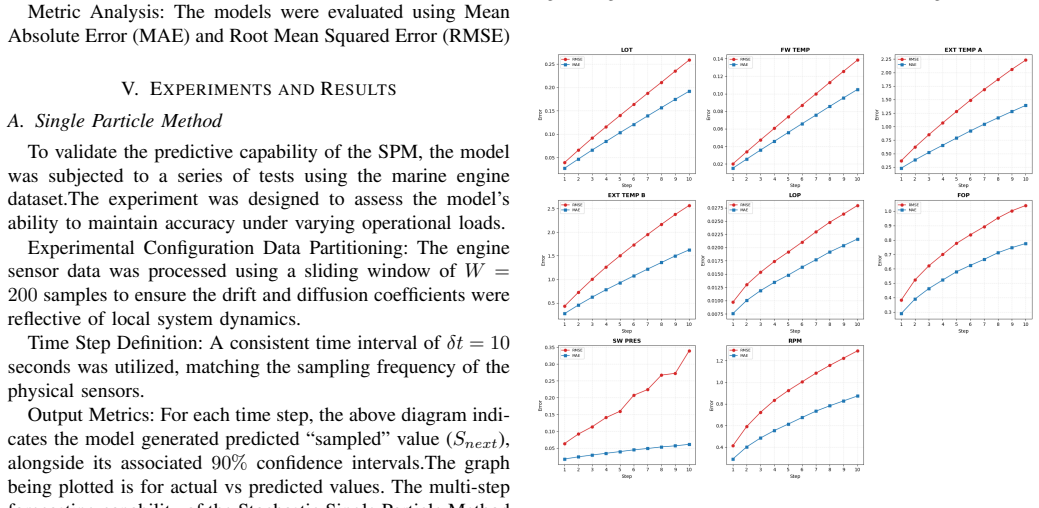
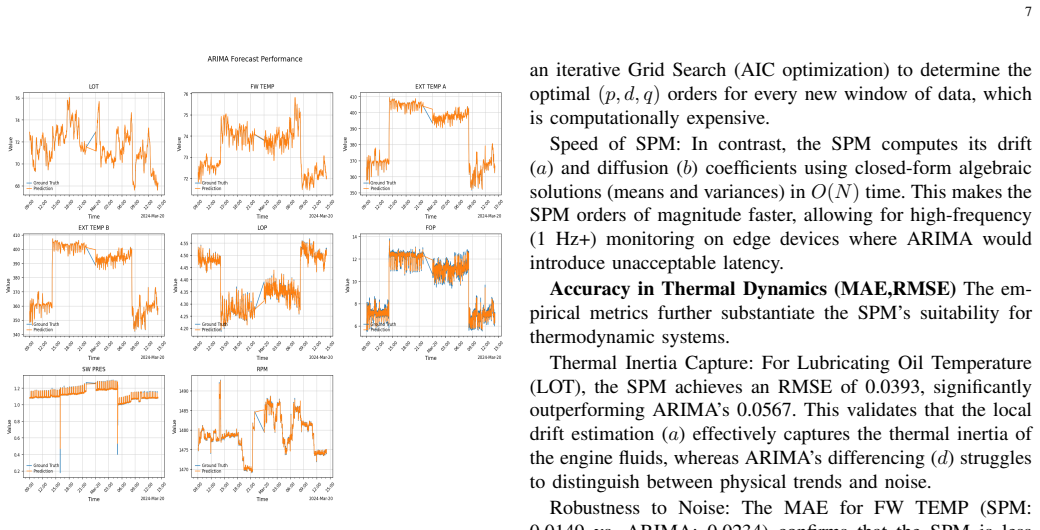
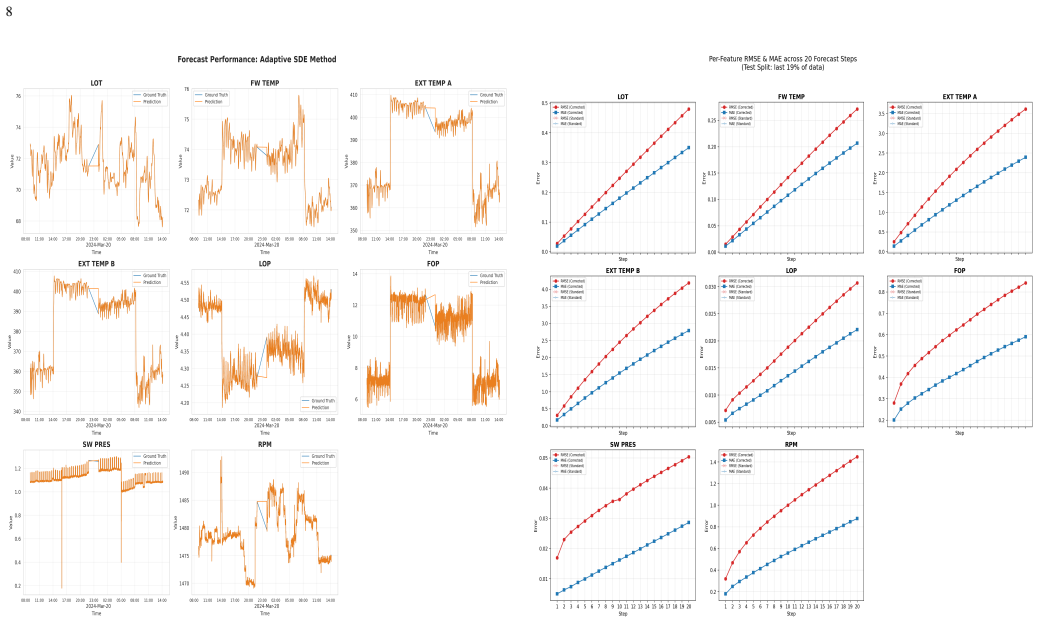
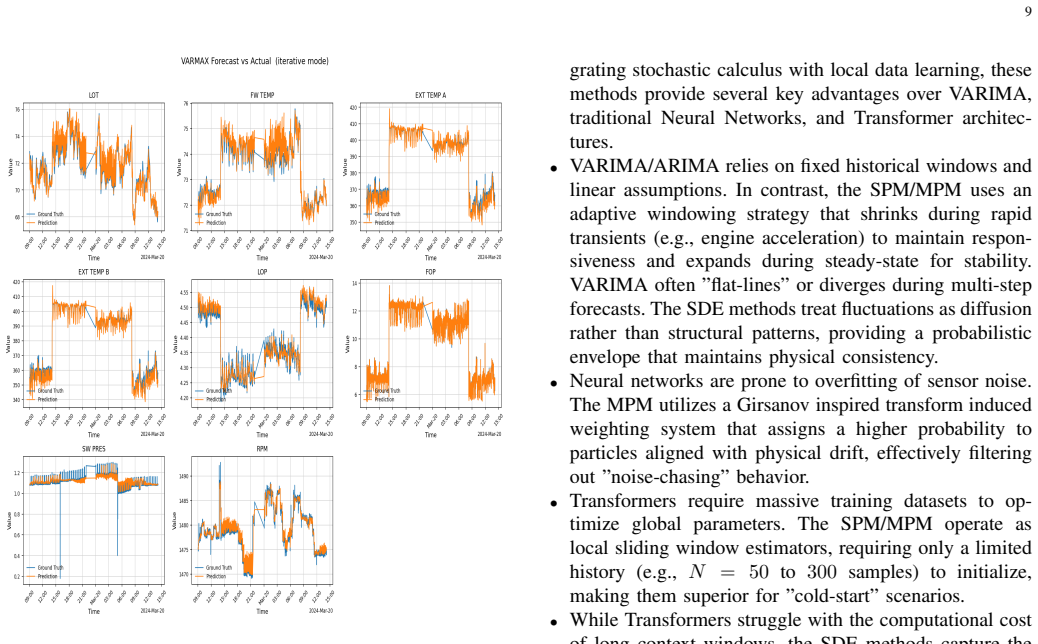
The central claim is that a dual-layered estimation approach—first an adaptive lookback rule that enlarges or shrinks the learning window according to measured drift, then a multi-particle ensemble evolved by Euler-Maruyama and reweighted by a Girsanov-induced change of measure—produces multi-step forecasts of marine engine parameters that are both more stable and computationally lighter than those obtained from classical statistical baselines such as VARIMA.
What carries the argument
adaptive-window multi-particle stochastic differential equations refined by Girsanov change of probability measure
If this is right
- Multi-step prediction stability improves when the learning window responds to instantaneous drift magnitude rather than remaining fixed.
- Computational cost drops because the Girsanov weighting suppresses noise-chasing particles and avoids full retraining at every step.
- The resulting grey-box forecasts supply real-time risk quantification for systems that exhibit high-frequency volatility and abrupt non-linear transitions.
- The same structure scales to stand-alone deployment without external model libraries or heavy hyper-parameter tuning.
Where Pith is reading between the lines
- The adaptive drift rule could be ported to other sensor-rich engineering domains that experience regime shifts, such as wind-turbine or automotive engine monitoring.
- A controlled experiment that disables the Girsanov reweighting step on the same data would isolate how much of the reported stability gain comes from the probability-measure change versus the adaptive window alone.
- If the SDE drift function were replaced by a learned neural approximator while keeping the rest of the pipeline fixed, the framework might bridge grey-box and black-box regimes without losing the low-latency property.
Load-bearing premise
Marine engine parameters obey dynamics that an SDE can capture usefully and whose physical drift can be aligned by Girsanov reweighting after Euler-Maruyama discretization.
What would settle it
Run the adaptive SDE and a VARIMA baseline on the same held-out marine engine sensor traces; if the multi-step mean-squared error and wall-clock time of the SDE model are not both lower, the performance claim is falsified.
Figures
read the original abstract
The operational reliability of a high performance marine vessel depends critically on the health of its marine propulsion systems, which are increasingly subjected to diverse operational loads and environmental stressors. This paper proposes a robust mathematical framework for non-linear state-space forecasting of marine engine parameters using adaptive-window multi-particle stochastic differential equations. Traditional time-series models such as Vector Autoregressive Integrated Moving Average, often fail to capture the inherent stochasticity and transient dynamics of complex systems due to their reliance on fixed-window linear assumptions. To address this, we develop a dual-layered estimation approach: first, an adaptive lookback mechanism dynamically adjusts the learning window size based on the instantaneous drift magnitude, ensuring responsiveness during non-stationary regimes. Second, a Multi-Particle ensemble is evolved via Euler-Maruyama discretization, where each particle trajectory represents a stochastic realization of the system state. To refine the ensemble mean and mitigate the "noise-chasing" behavior of raw estimators, a Girsanov transform induced change of probability measure is implemented, assigning higher probabilistic weights to particles that align with the physical drift. Theoretical evaluation and empirical benchmarking demonstrate that the proposed adaptive SDE framework significantly outperforms classical statistical baselines in multi-step prediction stability and computational efficiency. The model provides a scalable, "grey-box" solution for real-time risk quantification in systems characterized by high-frequency volatility and non-linear transitions.
Editorial analysis
A structured set of objections, weighed in public.
Referee Report
Summary. The paper claims to develop an adaptive SDE-based framework for non-linear state-space forecasting of marine engine parameters. It uses a dual-layered approach with an adaptive lookback mechanism that adjusts the window based on instantaneous drift magnitude and a multi-particle ensemble evolved via Euler-Maruyama discretization, refined by Girsanov transform reweighting to align with physical drift. The method is asserted to outperform classical statistical baselines like VARIMA in multi-step prediction stability and computational efficiency based on theoretical and empirical evaluations.
Significance. A well-specified and validated version of this grey-box stochastic forecasting method could contribute to real-time risk quantification for marine propulsion systems under volatile conditions. The focus on low latency and compute efficiency is relevant for practical deployment. However, the absence of any quantitative results, detailed derivations, or dataset information means the significance cannot be assessed from the current manuscript.
major comments (3)
- [Abstract] Abstract: the central claim that 'theoretical evaluation and empirical benchmarking demonstrate that the proposed adaptive SDE framework significantly outperforms classical statistical baselines' supplies no quantitative metrics, error bars, dataset descriptions, or derivation steps, leaving the assertion unsupported by visible evidence.
- [Method] Method description: the SDE form (drift and diffusion coefficients) is unspecified. The Girsanov reweighting step depends on alignment with an unspecified physical drift without providing the explicit Radon-Nikodym derivative, its derivation, or the source of the physical drift term; this is load-bearing for the claimed mitigation of noise-chasing and independence from fitting choices.
- [Adaptive lookback] Adaptive mechanism: no equation or rule is supplied for the adaptive lookback window adjustment based on instantaneous drift magnitude, which is central to the dual-layered approach and the claim of responsiveness during non-stationary regimes.
minor comments (1)
- [Abstract] Abstract: the expansion 'Vector Autoregressive Integrated Moving Average' is nonstandard (typically VARIMA refers to Vector ARIMA); clarify the exact model class used for baselines.
Simulated Author's Rebuttal
We thank the referee for the constructive comments. We acknowledge that the submitted manuscript lacks quantitative metrics, detailed derivations, dataset information, and explicit equations, preventing full assessment of the claims and significance. We will undertake major revisions to supply these elements.
read point-by-point responses
-
Referee: [Abstract] Abstract: the central claim that 'theoretical evaluation and empirical benchmarking demonstrate that the proposed adaptive SDE framework significantly outperforms classical statistical baselines' supplies no quantitative metrics, error bars, dataset descriptions, or derivation steps, leaving the assertion unsupported by visible evidence.
Authors: We agree that the abstract claim is unsupported by visible evidence in the current manuscript. In revision we will add quantitative metrics (e.g., multi-step RMSE/MAE with error bars), dataset descriptions, and an outline of key derivations; the abstract will be rewritten to reflect only the evidence that is actually presented. revision: yes
-
Referee: [Method] Method description: the SDE form (drift and diffusion coefficients) is unspecified. The Girsanov reweighting step depends on alignment with an unspecified physical drift without providing the explicit Radon-Nikodym derivative, its derivation, or the source of the physical drift term; this is load-bearing for the claimed mitigation of noise-chasing and independence from fitting choices.
Authors: The referee is correct; these specifications are absent. The revised Methods section will define the drift and diffusion coefficients, supply the explicit Radon-Nikodym derivative together with its derivation, and state the source of the physical drift term. revision: yes
-
Referee: [Adaptive lookback] Adaptive mechanism: no equation or rule is supplied for the adaptive lookback window adjustment based on instantaneous drift magnitude, which is central to the dual-layered approach and the claim of responsiveness during non-stationary regimes.
Authors: We acknowledge that only a qualitative description is given. The revision will include the explicit equation or algorithmic rule that adjusts the lookback window from the instantaneous drift magnitude. revision: yes
Circularity Check
No circularity identified from available text
full rationale
The provided abstract and context describe a proposed adaptive SDE framework with Girsanov reweighting and adaptive lookback but contain no explicit equations, derivations, or self-referential steps that reduce predictions to fitted inputs by construction. No load-bearing claims are shown to depend on self-citations, ansatzes smuggled via prior work, or renaming of known results. The method is presented at a high level without mathematical reduction that would trigger any of the enumerated circularity patterns. The derivation chain cannot be walked because no chain is exhibited; therefore the finding is no significant circularity.
Axiom & Free-Parameter Ledger
free parameters (1)
- adaptive lookback window adjustment rule
axioms (2)
- domain assumption Marine engine parameters admit a non-linear state-space representation amenable to multi-particle SDE evolution under Euler-Maruyama discretization.
- domain assumption A Girsanov-induced change of measure can assign higher weights to particles that align with the physical drift without introducing new bias.
Reference graph
Works this paper leans on
-
[1]
H. I. H. Saravanamuttoo, H. Cohen, and G. F. C. Rogers,Gas turbine theory, 5th ed. Harlow: Prentice Hall, 2007
2007
-
[2]
Gasturbolib: Simulink library for gas turbine engine mod- elling
V . Panov, “Gasturbolib: Simulink library for gas turbine engine mod- elling.” American Society of Mechanical Engineers Digital Collection, Feb. 2010, pp. 555–565
2010
-
[3]
Real-time gas turbine model for performance simulations,
H. Gazzetta Junior, C. Bringhenti, J. a. R. Barbosa, and J. T. Tomita, “Real-time gas turbine model for performance simulations,”Journal of Aerospace Technology and Management, vol. 9, no. 3, pp. 346–356, Aug. 2017
2017
-
[4]
Development of gas turbine perfor- mance models using a generic simulation tool,
A. Alexiou and K. Mathioudakis, “Development of gas turbine perfor- mance models using a generic simulation tool,” inV olume 1: Turbo Expo
-
[5]
2005, pp
Reno, Nevada, USA: ASMEDC, Jan. 2005, pp. 185–194
2005
-
[6]
Modeling, simulation and validation of mini SR-30 gas turbine engine,
R. Singh, A. Maity, and P. S. V . Nataraj, “Modeling, simulation and validation of mini SR-30 gas turbine engine,”IF AC-PapersOnLine, vol. 51, no. 1, pp. 554–559, Jan. 2018
2018
-
[7]
Prediction of gas turbine parameters based on machine learning regression methods,
N. Batayev and A. Onbayev, “Prediction of gas turbine parameters based on machine learning regression methods,” Jul. 2018, pp. 217–221
2018
-
[8]
Machine learning models for predicting ship main engine fuel oil consumption: A comparative study,
C. Gkerekos, I. Lazakis, and G. Theotokatos, “Machine learning models for predicting ship main engine fuel oil consumption: A comparative study,”Ocean Engineering, vol. 188, p. 106282, Sep. 2019. [Online]. Available: https://linkinghub.elsevier.com/retrieve/pii/S0029801819304561
2019
-
[9]
Recurrent neural network based simulation of a single shaft gas turbine,
H. Asgari, E. Ory, and J. Lappalainen, “Recurrent neural network based simulation of a single shaft gas turbine,” Mar. 2021, pp. 99–106, proceedings pages 99–106. 10
2021
-
[10]
A novel data-driven approach for predicting the performance degradation of a gas turbine,
S. Dai, X. Zhang, and M. Luo, “A novel data-driven approach for predicting the performance degradation of a gas turbine,”Energies, vol. 17, no. 4, p. 781, Jan. 2024
2024
-
[11]
Hybrid data-driven and physics- based modeling for gas turbine prescriptive analytics,
S. Belov, S. Nikolaev, and I. Uzhinsky, “Hybrid data-driven and physics- based modeling for gas turbine prescriptive analytics,”International Journal of Turbomachinery, Propulsion and Power, vol. 5, no. 4, p. 29, Dec. 2020
2020
-
[12]
Development of a mathematical model of diesel-generator units with a valve-inductor generator,
V . A. Zhigarev, A. V . Minakov, D. V . Guzei, M. I. Pryazhnikov, and V . I. Panteleev, “Development of a mathematical model of diesel-generator units with a valve-inductor generator,”Journal of Physics: Conference Series, vol. 2057, no. 1, p. 012076, Oct. 2021. [Online]. Available: https://iopscience.iop.org/article/10.1088/1742-6596/2057/1/012076
-
[13]
Integrating scientific knowledge with machine learning for engineering and environmental systems,
J. Willard, X. Jia, S. Xu, M. Steinbach, and V . Kumar, “Integrating scientific knowledge with machine learning for engineering and environmental systems,”ACM Computing Surveys, vol. 55, no. 4, pp. 1–37, Apr. 2023. [Online]. Available: https://dl.acm.org/doi/10.1145/3514228
-
[14]
Hybrid physics-infused machine learning framework for fault diagnostics and prognostics in cyber-physical system of diesel engine,
S. K. Singh, “Hybrid physics-infused machine learning framework for fault diagnostics and prognostics in cyber-physical system of diesel engine,” Ph.D. dissertation, Dept. of Automotive Engineering, Clemson University, 2023. [Online]. Available: https://www.proquest.com/openview/e0412f5729f806451dc25df4e76da380/1?pq- origsite=gscholar&cbl=18750&diss=y
2023
-
[15]
Hybrid physical and machine learning-oriented modeling approach to predict emissions in a diesel compression ignition engine,
A. Mohammad, R. Rezaei, C. Hayduk, T. O. Delebinski, S. Shahpouri, and M. Shahbakhti, “Hybrid physical and machine learning-oriented modeling approach to predict emissions in a diesel compression ignition engine,” Apr. 2021, pp. 2021–01–0496. [Online]. Available: https://www.sae.org/content/2021-01-0496/
2021
-
[16]
P. E. Kloeden, E. Platen, and H. Schurz,Numerical solution of SDE through computer experiments. Springer Science & Business Media, 2012
2012
discussion (0)
Sign in with ORCID, Apple, or X to comment. Anyone can read and Pith papers without signing in.