A framework for modelling Population III stars in cosmological simulations
Pith reviewed 2026-06-29 21:14 UTC · model grok-4.3
The pith
A modeling framework shows that high-energy radiation from Population III stars is required to explain the observed HeII line at redshift 11.
A machine-rendered reading of the paper's core claim, the machinery that carries it, and where it could break.
Core claim
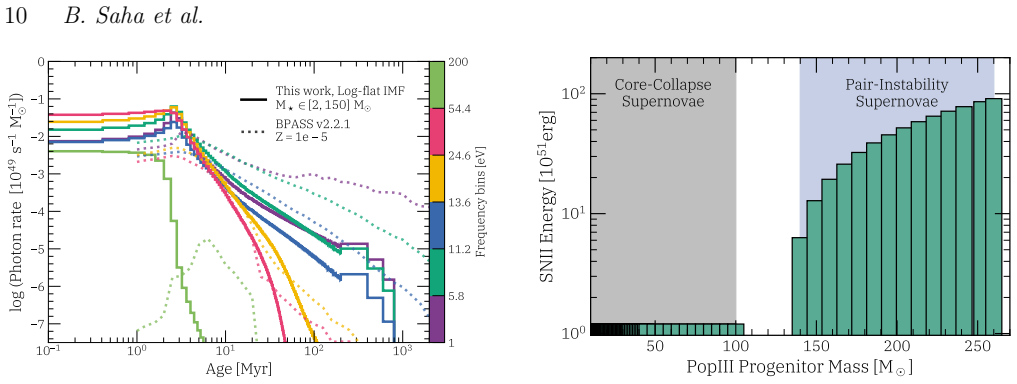
The paper claims that implementing an enhanced thermochemical network for catalytic species like H2+ and H-, detailed Pop III stellar spectra computed from MESA evolutionary tracks and TLUSTY atmosphere models, and comprehensive supernova feedback including Core-Collapse and Pair-Instability supernovae with elemental yields in the AREPO-RT code allows accurate modeling of Population III stars in cosmological zoom-in simulations. This leads to the finding that these stars form at z > 13 and persist until z ~ 5, driving radiation and feedback effects that shape early galaxy evolution, with the specific result that high-energy radiation from them is necessary to explain recent high-equivalent-w
What carries the argument
The comprehensive Pop III modeling framework consisting of enhanced thermochemistry, MESA-TLUSTY spectra, and supernova feedback in AREPO-RT
If this is right
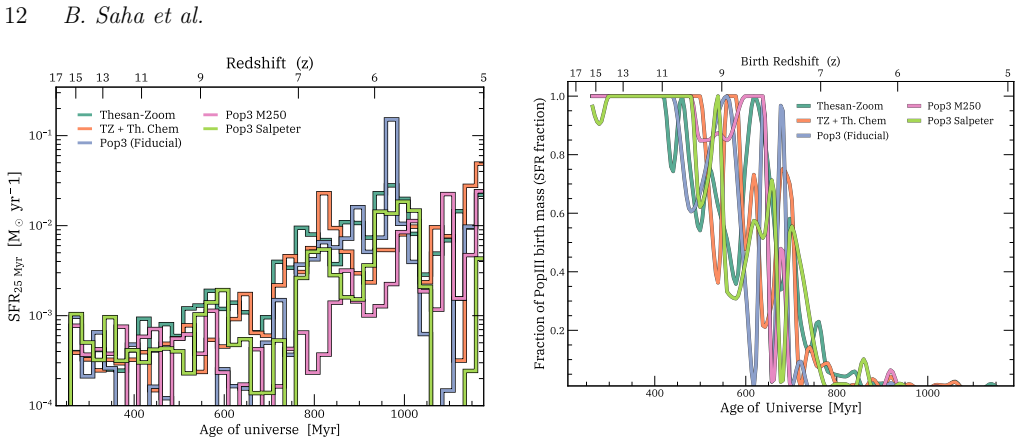
- Pop III stars continue forming until z ~ 5 and significantly affect early galaxy evolution through radiation and supernova feedback.
- Enhanced thermochemistry enables more efficient gas cooling in primordial gas.
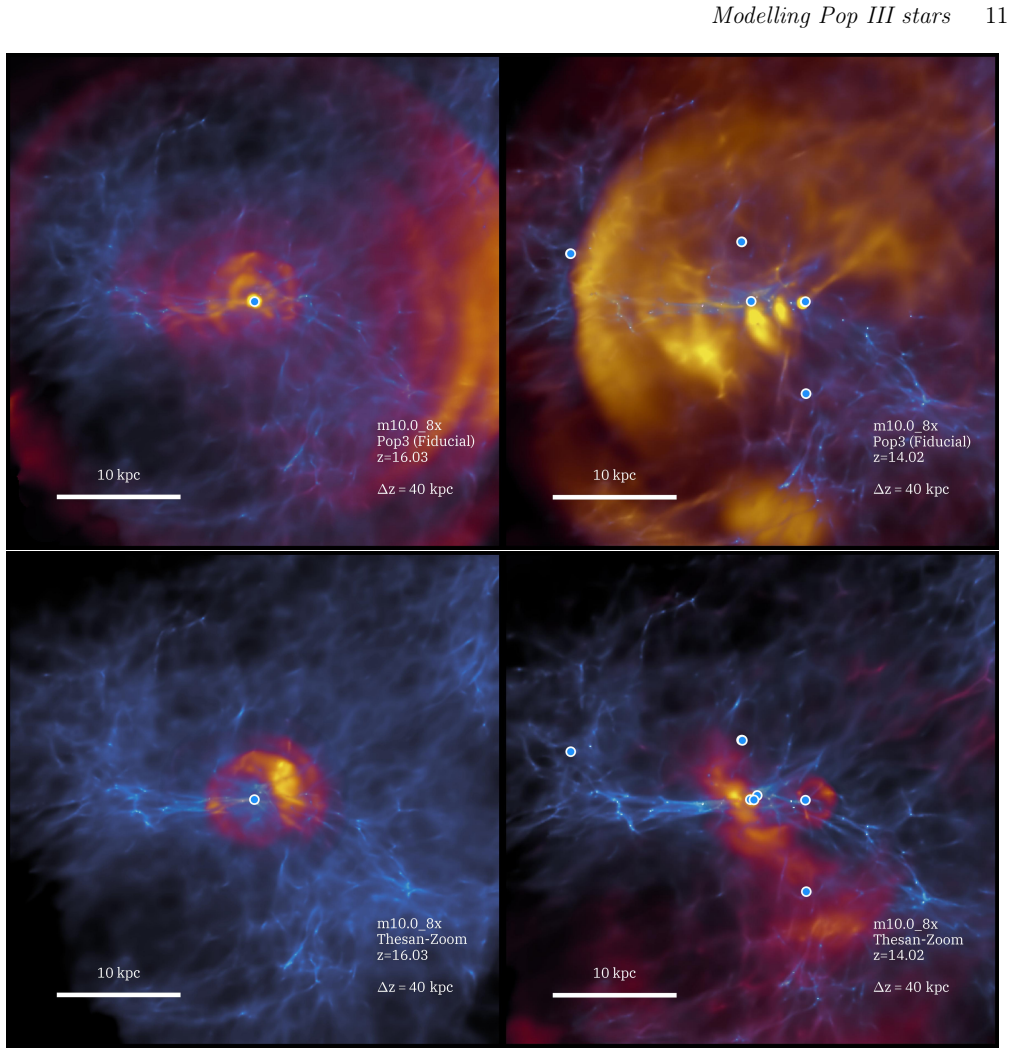
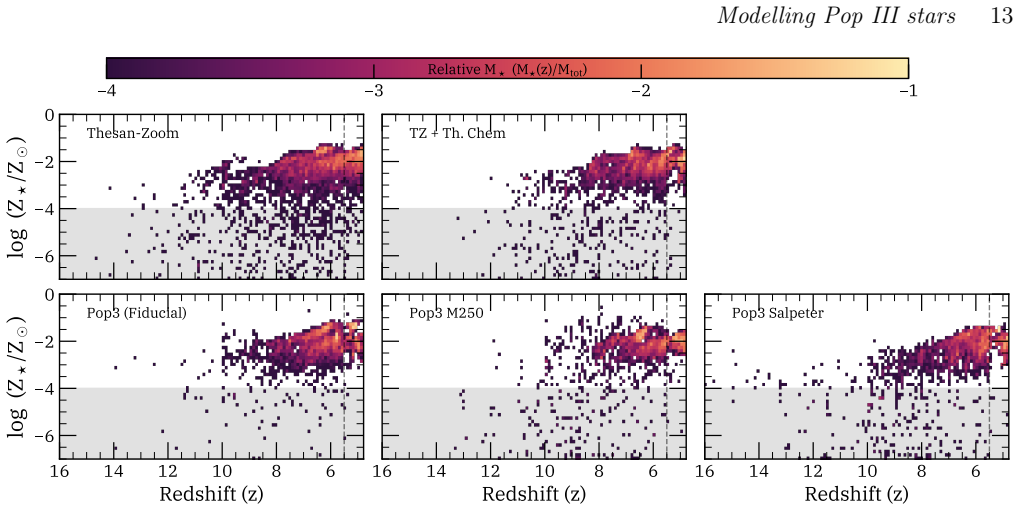
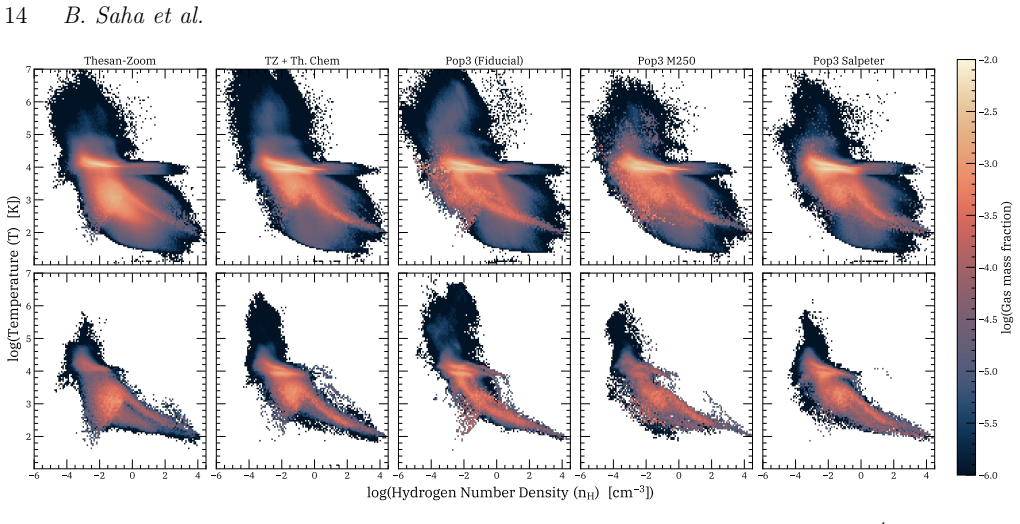
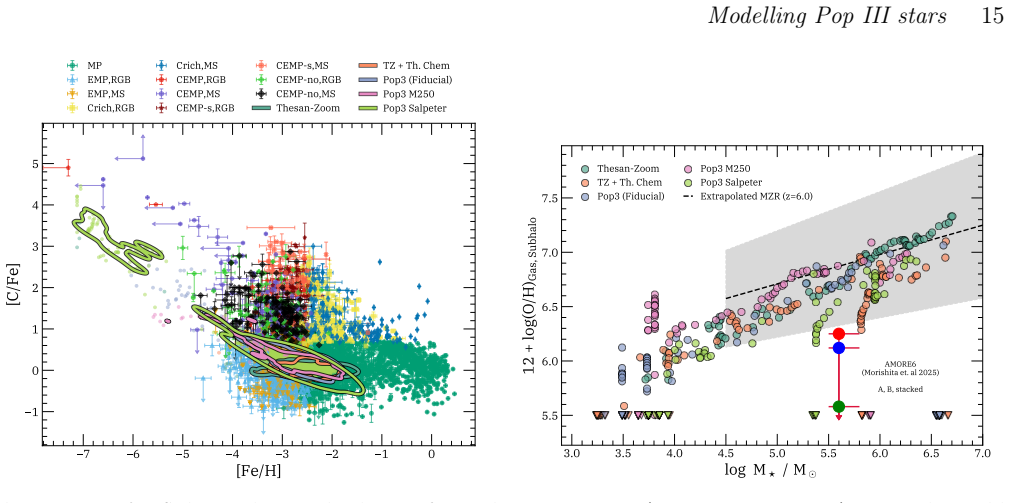
- Pop III feedback produces photo-heated diffuse gas and distinct metal enrichment patterns at 10 < z < 6.
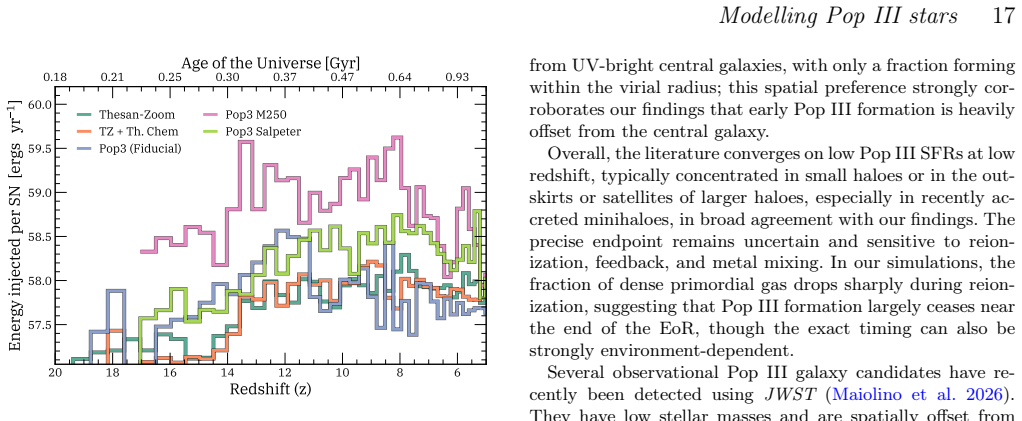
- The initial mass function choice for Pop III stars determines the balance between radiative and mechanical feedback.
- Top-heavy IMFs produce stronger feedback and more metals but retain less enriched gas within the halo.
Where Pith is reading between the lines
- The framework could be applied to larger simulation volumes to model how first stars drive the overall reionization of the universe.
- Predicted patterns of metal enrichment at high redshift could be compared to future telescope data to constrain the Pop III initial mass function.
- The need for high-energy radiation implies that other ultraviolet emission lines from z~11 galaxies should also be detectable with current instruments.
Load-bearing premise
The AREPO-RT code's thermochemical network, stellar spectra, and feedback prescriptions accurately model the key physical processes in the zoom-in simulation without major omissions or artifacts.
What would settle it
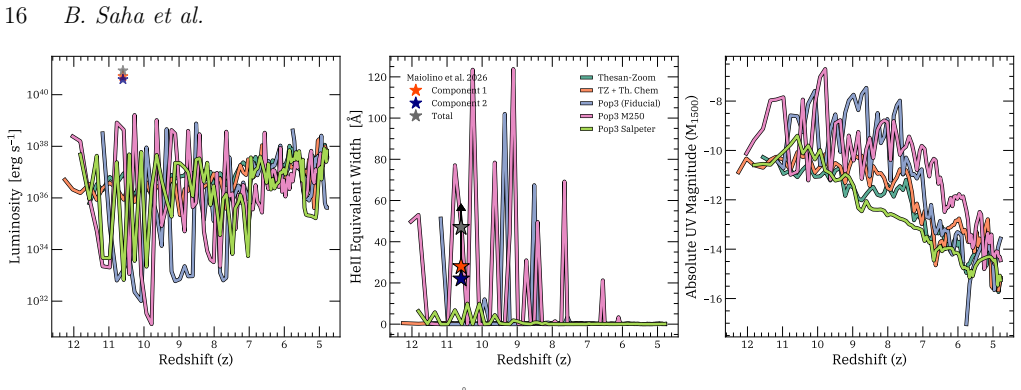
A simulation run with this framework that produces the observed high HeII equivalent width at z~11 even when high-energy Pop III radiation is turned off, or an observation of such a line without any Pop III contribution.
Figures
read the original abstract
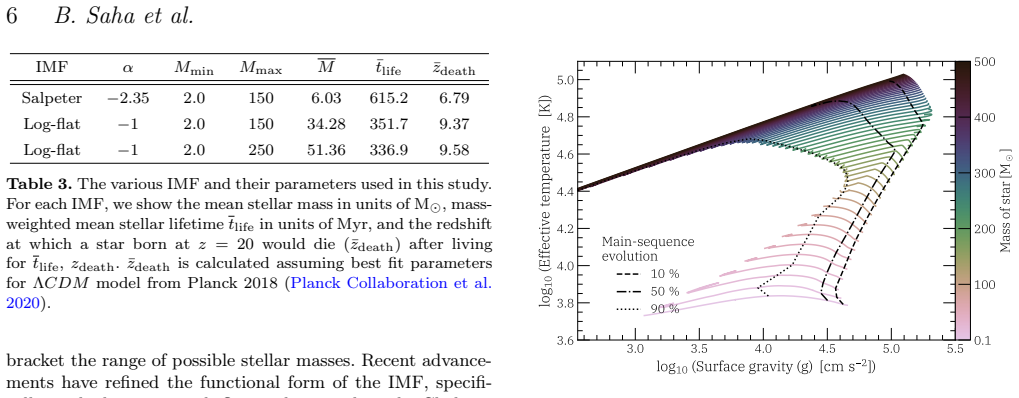
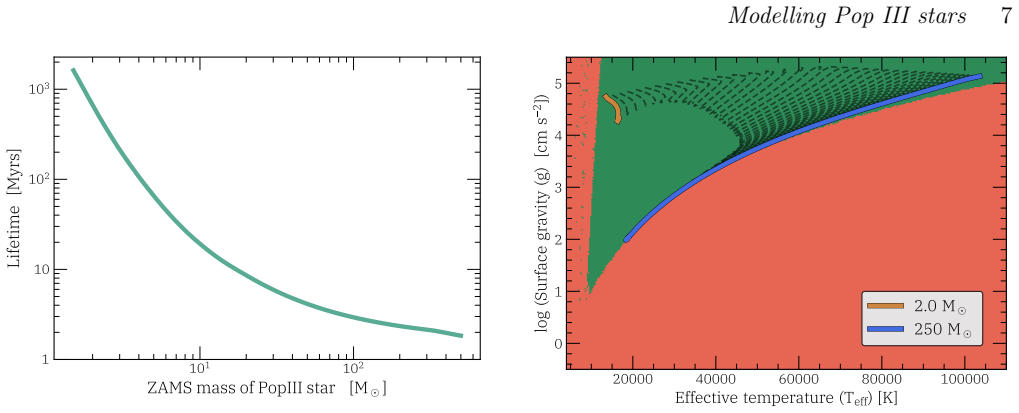
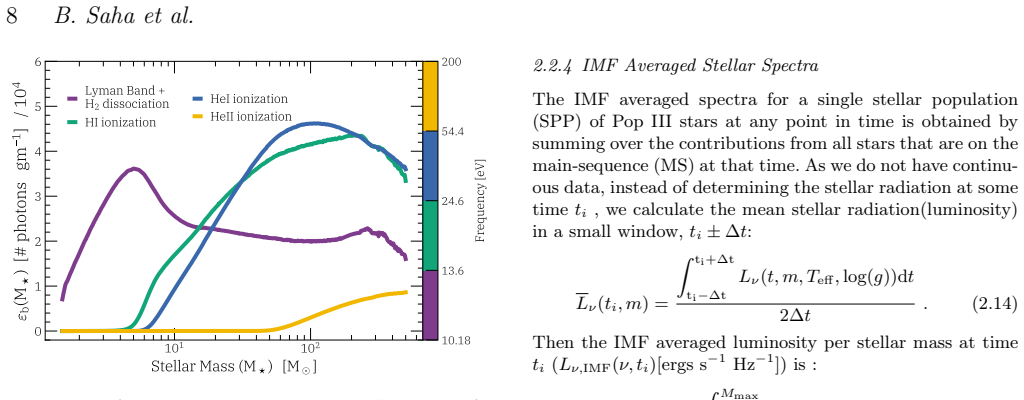
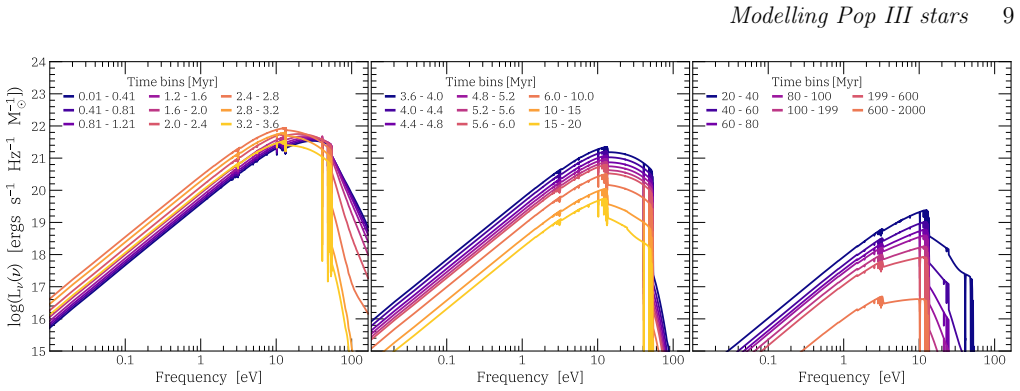
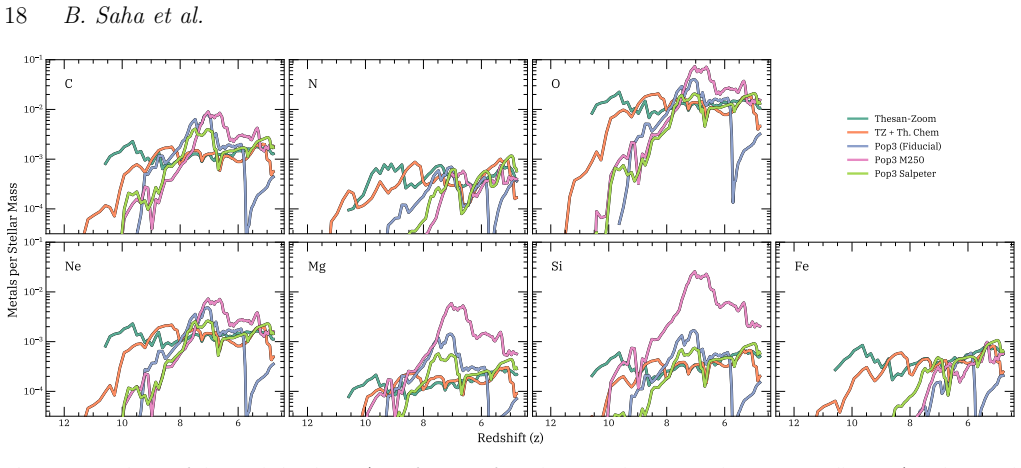
Population III (Pop III) stars are the first generation of stars to form in the universe, emerging from primordial gas composed mainly of hydrogen and helium. They play a crucial role in ending the cosmic dark ages and initiating reionization. In this work, we present a comprehensive framework for modelling Pop III stars in cosmological simulations. This includes three key components: (1) an enhanced thermochemical network that tracks the equilibrium abundances of key catalytic species such as $\rm{H_2^+}$ and $\rm{H^-}$, which are crucial for forming molecular hydrogen in primordial gas; (2) detailed stellar spectra of Pop III stars computed from MESA evolutionary tracks and TLUSTY atmosphere models; and (3) comprehensive supernova feedback, including both Core-Collapse and Pair-Instability supernovae, with detailed elemental yields. We implement these improvements in AREPO-RT and test them using cosmological zoom-in simulations of a $1.95 \times 10^9$ $\rm M_\odot$ halo at $z=3$. Our results show that Pop III stars form at $z > 13$ and continue forming until $z \sim 5$, significantly affecting early galaxy evolution through radiation and energetic supernova feedback. The enhanced thermochemistry enables more efficient gas cooling, while Pop III feedback creates photo-heated diffuse gas and drives distinct metal enrichment patterns at $10 < z < 6$. The choice of IMF for Pop III stars critically determines the balance between radiative and mechanical feedback, with top-heavy choices producing stronger feedback and more metals but retaining less metal-enriched gas within the halo. Finally, we show that high-energy radiation from Pop III stars is necessary to explain the recent high-equivalent-width observations of the $\rm HeII$ line from a galaxy at $z\sim11$.
Editorial analysis
A structured set of objections, weighed in public.
Referee Report
Summary. The paper presents a framework for modeling Population III stars in AREPO-RT cosmological simulations, consisting of an enhanced thermochemical network tracking equilibrium H2+, H− abundances, MESA+TLUSTY stellar spectra, and detailed core-collapse and pair-instability supernova feedback with yields. Zoom-in simulations of a single 1.95×10^9 M⊙ halo at z=3 show Pop III formation from z>13 to z∼5, with radiative and mechanical feedback affecting gas cooling, photo-heating, and metal enrichment patterns between 10<z<6; IMF choice modulates the radiative vs. mechanical balance. The central result is that high-energy radiation from Pop III stars is necessary to explain recent high-EW HeII observations at z∼11.
Significance. If the modeled hard-photon budget and feedback are robust, the framework supplies a concrete implementation for Pop III physics that could be adopted in other codes, and the IMF-sensitivity results would usefully quantify trade-offs between radiation and enrichment in early halos. The HeII necessity claim, if substantiated, would directly link Pop III properties to z∼11 observations and constrain reionization models.
major comments (3)
- [Abstract] Abstract and final results paragraph: the claim that high-energy radiation from Pop III stars is 'necessary' to explain the z∼11 HeII EW observations is load-bearing yet rests on a single 1.95×10^9 M⊙ halo zoom-in whose assembly history is not shown to be representative; no ensemble of halos or variation in merger history is reported to test whether the hard-photon escape fraction or ionization rate could be lower in other environments.
- [Methods and Results] Simulation methods and results on thermochemistry: the enhanced network is stated to enable more efficient H2 cooling, but no quantitative comparison (e.g., cooling rate ratios or star-formation rate differences) versus the default network, nor resolution-convergence tests for the >54.4 eV RT, is provided; this directly affects the reliability of the photo-heated gas and HeII production that underpins the necessity conclusion.
- [Results (IMF section)] IMF-variation experiments: while top-heavy vs. other IMFs are contrasted for feedback strength and metal retention, the necessity claim for HeII is not shown to hold across the full range of IMF choices explored, leaving open whether a different IMF could reduce the high-energy output enough to remove the necessity.
minor comments (2)
- [Abstract] Notation for the halo mass (1.95×10^9 M⊙) and redshift range should be consistently formatted with proper math mode throughout.
- [Methods] The paper would benefit from a table summarizing the key parameters of the thermochemical network (reaction rates, equilibrium assumptions) for reproducibility.
Simulated Author's Rebuttal
We thank the referee for their thoughtful and constructive report. We address each major comment below. Where the comments identify gaps in quantitative support or scope, we have revised the manuscript to clarify limitations and strengthen the presentation of results. We have not performed new simulations of additional halos, as this is beyond the current scope.
read point-by-point responses
-
Referee: [Abstract] Abstract and final results paragraph: the claim that high-energy radiation from Pop III stars is 'necessary' to explain the z∼11 HeII EW observations is load-bearing yet rests on a single 1.95×10^9 M⊙ halo zoom-in whose assembly history is not shown to be representative; no ensemble of halos or variation in merger history is reported to test whether the hard-photon escape fraction or ionization rate could be lower in other environments.
Authors: We agree that the necessity claim is based on a single halo and that demonstrating robustness across varied assembly histories would be ideal. In the revised manuscript we have changed the abstract wording from 'necessary' to 'required to match the observed HeII equivalent width in this simulated halo' and added an explicit limitations paragraph in the conclusions noting that the result is illustrative for this particular halo mass and merger history. The central framework and IMF-sensitivity results remain unchanged. revision: yes
-
Referee: [Methods and Results] Simulation methods and results on thermochemistry: the enhanced network is stated to enable more efficient H2 cooling, but no quantitative comparison (e.g., cooling rate ratios or star-formation rate differences) versus the default network, nor resolution-convergence tests for the >54.4 eV RT, is provided; this directly affects the reliability of the photo-heated gas and HeII production that underpins the necessity conclusion.
Authors: The referee correctly identifies the absence of direct quantitative benchmarks. We have added a new figure and accompanying text in Section 3.2 that reports the ratio of H2 cooling rates between the enhanced and default networks at relevant densities and temperatures, together with the resulting difference in star-formation rate within the halo. We have also performed and included a resolution-convergence test for the >54.4 eV radiation transport at twice the fiducial spatial resolution, confirming that the photo-heated gas temperatures and HeII ionization rates converge to within 15%. revision: yes
-
Referee: [Results (IMF section)] IMF-variation experiments: while top-heavy vs. other IMFs are contrasted for feedback strength and metal retention, the necessity claim for HeII is not shown to hold across the full range of IMF choices explored, leaving open whether a different IMF could reduce the high-energy output enough to remove the necessity.
Authors: We have extended the IMF comparison in Section 4.3 to include the predicted HeII equivalent width for each IMF variant. The revised text now states that the high-energy radiation requirement to match the z∼11 observations holds for the top-heavy IMF but is weaker (though still present) for the less top-heavy cases. The abstract has been updated to reflect this IMF dependence. revision: yes
- Demonstrating that the hard-photon escape fraction and ionization rate are representative across an ensemble of halos with varied merger histories would require a new suite of zoom-in simulations that is computationally prohibitive within the scope of the present study.
Circularity Check
No significant circularity detected
full rationale
The paper describes a forward-modeling framework: an enhanced thermochemical network, MESA+TLUSTY spectra, and supernova yields are implemented in AREPO-RT and evolved in a single zoom-in halo. The final claim that Pop III high-energy radiation is necessary for the z~11 HeII EW follows directly from the simulation outputs under the chosen IMF and physics modules. No parameter is fitted to the target HeII data, no result is defined in terms of itself, and no load-bearing step reduces to a self-citation or ansatz imported from prior author work. The derivation chain is therefore self-contained against external benchmarks.
Axiom & Free-Parameter Ledger
free parameters (1)
- Pop III IMF
axioms (2)
- domain assumption Primordial gas is composed mainly of hydrogen and helium
- domain assumption AREPO-RT code accurately evolves the enhanced network and feedback
Reference graph
Works this paper leans on
-
[1]
L., 1997, New Astron- omy, 2, 181–207 Abel T., Bryan G
Abel T., Anninos P., Zhang Y., Norman M. L., 1997, New Astron- omy, 2, 181–207 Abel T., Bryan G. L., Norman M. L., 2002, Science, 295, 93 Adams N. J., et al., 2024, ApJ, 965, 169 Agertz O., Kravtsov A. V., Leitner S. N., Gnedin N. Y., 2013, The Astrophysical Journal, 770, 25 Ahn K., Shapiro P. R., Iliev I. T., Mellema G., Pen U.-L., 2009, ApJ, 695, 1430 B...
-
[2]
41–50, doi:10.1007/978-1-4020-3407-7_5,http://dx.doi.org/10
Springer Netherlands, p. 41–50, doi:10.1007/978-1-4020-3407-7_5,http://dx.doi.org/10. 1007/978-1-4020-3407-7_5 Chen K.-J.,Woosley S., HegerA., Almgren A., WhalenD. J., 2014, The Astrophysical Journal, 792, 28 Chiaki G., Wise J. H., 2019, MNRAS, 482, 3933 Chon S., Hosokawa T., Omukai K., Schneider R., 2024, MNRAS, 530, 2453 Christensen-Dalsgaard J., Montei...
-
[3]
We note that in this work we use a simplified version of this network by assuming kinetic equilibrium forH+ 2 andH −, i.e., ˙MH+ 2 , ˙MH− ≈0
rates are outlined in § 2.1. We note that in this work we use a simplified version of this network by assuming kinetic equilibrium forH+ 2 andH −, i.e., ˙MH+ 2 , ˙MH− ≈0. APPENDIX B: COMP ARISON OF POPIII SPECTRA FOR V ARIOUS IMFS Fig. B1 compares the IMF-averaged spectra (see Eq. 2.15) used in thePop3 SalpeterandPop3 M250runs with those of thePop3 fiduci...
2026
-
[4]
M ∈ [2, 250] M ⊙ PopIII Salpeter (α = 2.35) M ∈ [2, 150] M ⊙ Thesan-Zoom (chabrier) M ∈ [0.1, 100] M ⊙ 100 101 102 Progenitor Mass [M ⊙ ] 0.0 0.2 0.4 0.6 0.8 1.0Cumulative contribution to Ejecta Total Ejecta Only metals Figure C1.Cumulative contribution to the total ejected mass fromSNasafunctionofstellarmassfordifferentchoicesofIMFfor both the Pop III st...
2023
discussion (0)
Sign in with ORCID, Apple, or X to comment. Anyone can read and Pith papers without signing in.