International Space Station operational modal analysis via iterative pole relocation
Pith reviewed 2026-06-29 20:13 UTC · model grok-4.3
The pith
NExT paired with iterative vector fitting identifies reliable vibration modes from output-only acceleration data on the ISS.
A machine-rendered reading of the paper's core claim, the machinery that carries it, and where it could break.
Core claim
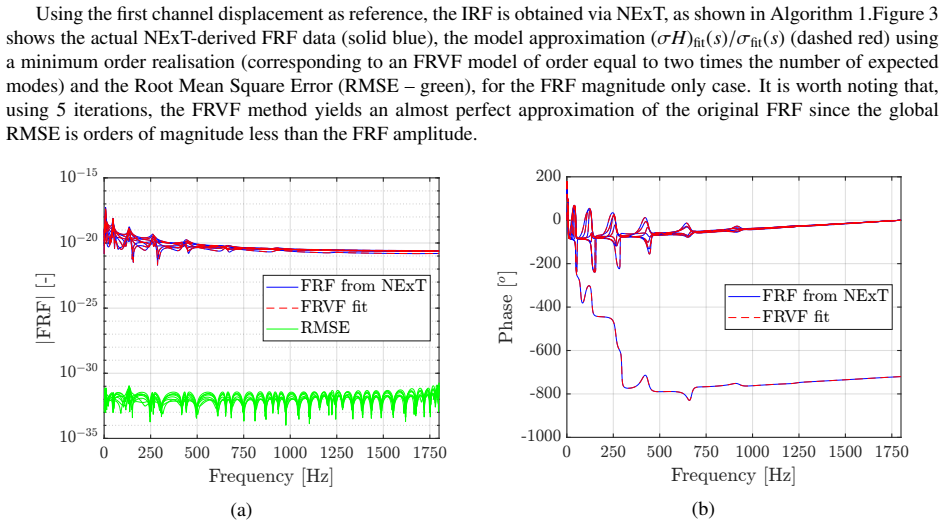
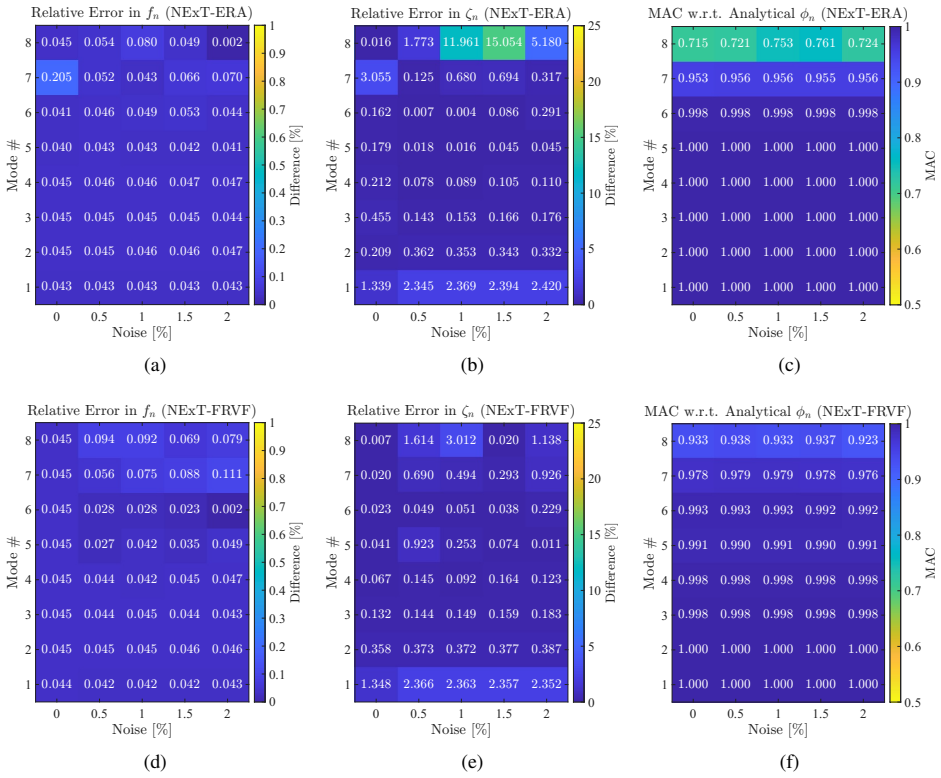
The NExT-FRVF procedure, which embeds an iterative least-squares optimisation inside the vector fitting framework, yields highly reliable modal parameter estimates on both a noisy numerical system and real experimental data from the International Space Station, matching or exceeding the performance of NExT-ERA while SSI fails to recover most modes.
What carries the argument
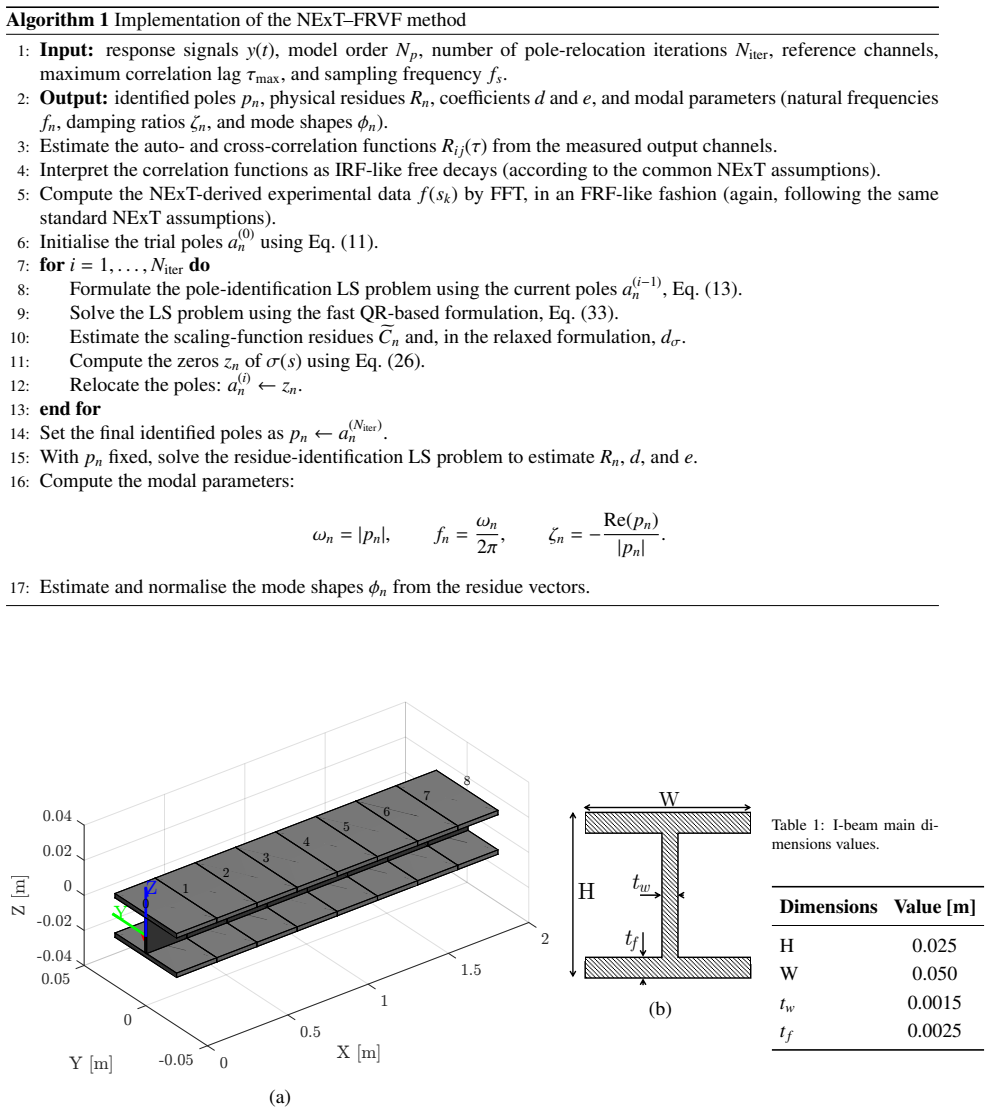
The Fast and Relaxed Vector Fitting (FRVF) algorithm with iterative least-squares optimisation, applied after the Natural Excitation Technique to convert output-only data into an equivalent input-output identification problem.
If this is right
- Structural health monitoring of space assets can proceed without measured excitation signals.
- Modal parameters extracted under operational conditions become usable for damage detection when noise levels are high.
- The method supplies a practical alternative to NExT-ERA when the data contain significant measurement noise.
- SSI is shown to be unsuitable for the ISS acceleration records examined here.
Where Pith is reading between the lines
- The same pipeline could be applied to other orbiting platforms or ground-based structures where only ambient responses are recorded.
- Automated mode-tracking across successive data windows might enable near-real-time health assessment without additional sensors.
- Because the approach avoids explicit input measurement, it lowers the cost of routine modal surveys for large civil or aerospace systems.
Load-bearing premise
That repeated occurrence of the same modes across different data segments together with their physical interpretability after processing is sufficient evidence that the identifications are accurate and superior to the benchmark methods.
What would settle it
A controlled test on the same ISS structure or an equivalent laboratory model in which known forced inputs are applied and the natural frequencies and damping ratios obtained from the input-output reference method diverge from those reported by NExT-FRVF.
Figures
read the original abstract
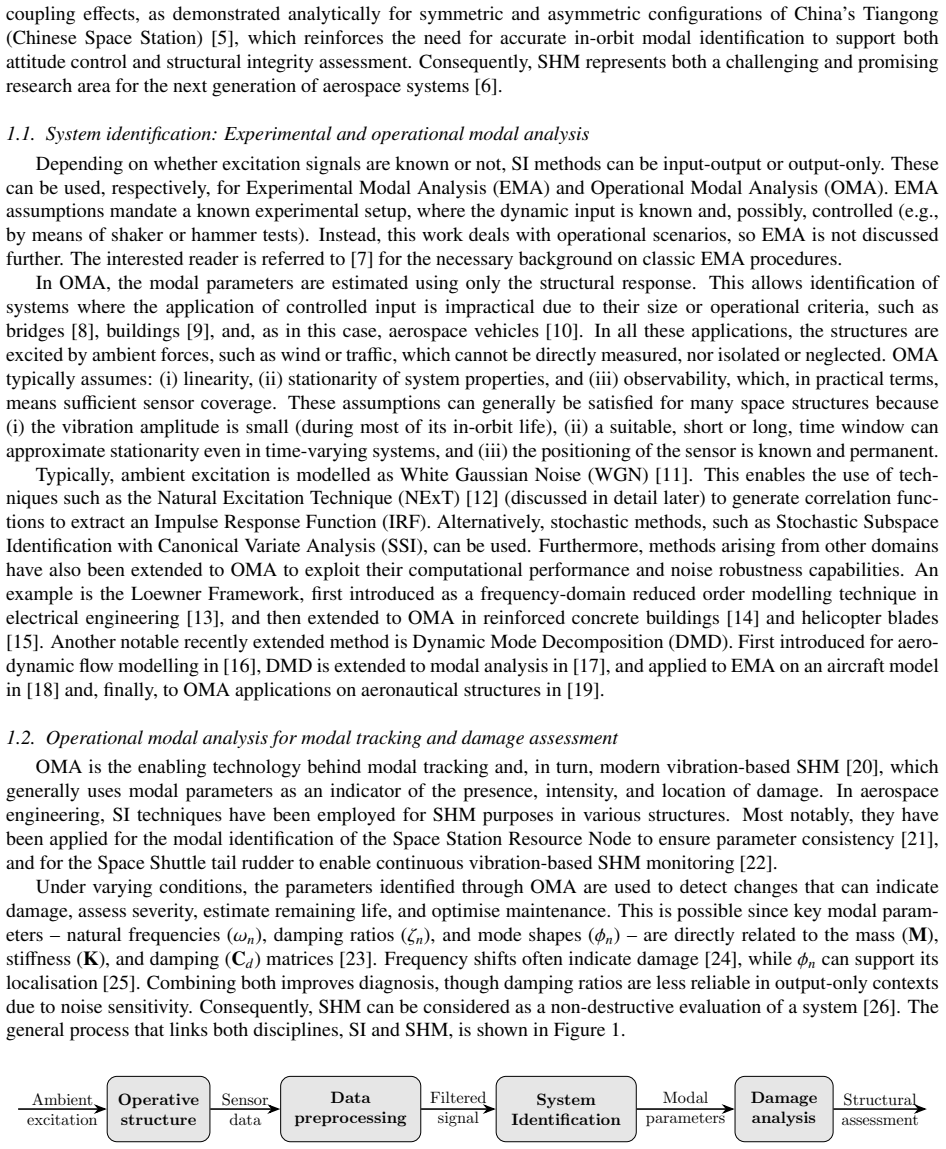
In recent years, increasing aerospace safety requirements have intensified the demand for reliable structural damage detection. This work presents an Operational Modal Analysis approach for accurate modal parameter estimation, with an application to space structure monitoring. The proposed System Identification (SI) method innovatively combines the Natural Excitation Technique (NExT) with the Fast and Relaxed Vector Fitting (FRVF) algorithm, which uses an iterative least-squares optimisation. A preliminary validation is first carried out on a numerical beam model, comparing results with analytical solutions and the established Natural Excitation Technique with Eigensystem Realisation Algorithm (NExT-ERA) and Stochastic Subspace Identification with Canonical Variate Analysis (SSI) methods. Then, operational validation is performed on real acceleration data from the Space Acceleration Measurement Systems aboard the International Space Station. Identified vibration modes from NExT-FRVF and NExT-ERA show comparable results after signal processing, with mode consistency assessed by repeated occurrence and physical interpretation, while SSI fails to identify most. The output-only algorithm proves to be highly reliable, outperforming benchmark methods under noisy conditions on a numerical system and offering reliable identifications on the experimental data.
Editorial analysis
A structured set of objections, weighed in public.
Referee Report
Summary. The paper proposes an output-only operational modal analysis method (NExT-FRVF) that combines the Natural Excitation Technique with Fast and Relaxed Vector Fitting for iterative pole relocation. It reports a preliminary validation on a numerical beam model against analytical poles and two benchmarks (NExT-ERA, SSI), followed by application to real acceleration data from the ISS Space Acceleration Measurement System. The central claim is that NExT-FRVF is highly reliable, outperforms the benchmarks under noise on the numerical example, and yields reliable mode identifications on the experimental data where it matches NExT-ERA while SSI identifies fewer modes.
Significance. If the quantitative superiority on the numerical case and the robustness claims on real data hold after proper error metrics, the approach could contribute to improved structural health monitoring for space structures under operational conditions. The combination of NExT with an iterative least-squares fitting procedure is a reasonable technical direction, but the current validation strategy limits the strength of the reliability conclusion.
major comments (3)
- [Abstract / numerical validation] Abstract and § on numerical validation: the claim of outperformance under noisy conditions is stated without any reported quantitative metrics (e.g., pole error norms, MAC values, or tables comparing identified vs. analytical frequencies/damping across noise levels), making the superiority assertion impossible to assess from the given material.
- [Experimental validation / ISS data] § on experimental ISS validation: mode quality is assessed solely by repeated occurrence across data segments and physical plausibility after signal processing; because no independent ground-truth modal parameters exist for the real structure, this criterion does not quantitatively demonstrate either superior accuracy or robustness relative to NExT-ERA (which the text states produces comparable results).
- [Benchmark comparisons] Comparison with SSI: the statement that SSI 'fails to identify most' modes is presented without details on the specific implementation parameters (e.g., model order, stabilization criteria) or any cross-validation that would allow the reader to judge whether the difference is methodological or due to tuning.
minor comments (2)
- [Method] Notation for the FRVF iteration and the precise definition of the 'relaxed' vector-fitting cost function should be expanded with at least one equation block to allow reproducibility.
- [Figures / tables] Figure captions for the numerical and experimental mode tables should explicitly state the noise levels used and the exact consistency metric (e.g., frequency tolerance) applied to count 'repeated occurrence'.
Simulated Author's Rebuttal
We thank the referee for the constructive comments on our manuscript. We address each major point below and will make revisions to improve the quantitative support for our claims and the transparency of our comparisons.
read point-by-point responses
-
Referee: [Abstract / numerical validation] Abstract and § on numerical validation: the claim of outperformance under noisy conditions is stated without any reported quantitative metrics (e.g., pole error norms, MAC values, or tables comparing identified vs. analytical frequencies/damping across noise levels), making the superiority assertion impossible to assess from the given material.
Authors: We agree that the absence of explicit quantitative metrics weakens the outperformance claim. The manuscript currently presents results primarily through figures without tabulated error norms, MAC values, or direct comparisons of identified versus analytical parameters at each noise level. We will add a dedicated table (and associated discussion) reporting frequency and damping errors, pole error norms, and MAC values for NExT-FRVF, NExT-ERA, and SSI across the tested noise levels to enable objective assessment. revision: yes
-
Referee: [Experimental validation / ISS data] § on experimental ISS validation: mode quality is assessed solely by repeated occurrence across data segments and physical plausibility after signal processing; because no independent ground-truth modal parameters exist for the real structure, this criterion does not quantitatively demonstrate either superior accuracy or robustness relative to NExT-ERA (which the text states produces comparable results).
Authors: We acknowledge that, without independent ground-truth parameters for the ISS, quantitative accuracy or robustness claims relative to NExT-ERA cannot be made. The validation follows common practice for real operational data by using cross-segment consistency and physical plausibility. We will revise the relevant section and abstract to explicitly note this limitation, remove any implication of superiority on the experimental data, and state that NExT-FRVF and NExT-ERA yield comparable identifications while SSI identifies fewer modes. revision: yes
-
Referee: [Benchmark comparisons] Comparison with SSI: the statement that SSI 'fails to identify most' modes is presented without details on the specific implementation parameters (e.g., model order, stabilization criteria) or any cross-validation that would allow the reader to judge whether the difference is methodological or due to tuning.
Authors: We agree that the lack of implementation details for SSI prevents readers from evaluating whether the observed difference is due to the method itself or to parameter choices. We will add a subsection describing the SSI implementation, including the model-order range, stabilization criteria, and any cross-validation steps used, so that the comparison can be reproduced and assessed. revision: yes
Circularity Check
No circularity in derivation or validation chain
full rationale
The paper combines the established NExT technique with the FRVF algorithm for operational modal analysis and validates it first against analytical solutions on a numerical beam model, then via repeated mode occurrence and physical consistency on real ISS acceleration data. No equations, fitting procedures, or self-citation chains are presented in the abstract or description that reduce any claimed result to its own inputs by construction. The numerical validation uses independent analytical poles as reference, while the experimental assessment relies on external physical expectations rather than tautological re-derivation. This constitutes a standard application and benchmarking workflow with no detectable self-definitional, fitted-input, or uniqueness-imported circularity.
Axiom & Free-Parameter Ledger
Reference graph
Works this paper leans on
-
[1]
R. Chakraborty, H. Jain, G.-S. Seo, A review of active probing-based system identification techniques with applications in power systems, International Journal of Electrical Power & Energy Systems 140 (September 2021) (2022) 108008.doi: 10.1016/j.ijepes.2022.108008. URLhttps://www.sciencedirect.com/science/article/abs/pii/S0142061522000539
-
[2]
A. J. Elliott, A. Nakhaeezadeh Gutierrez, L. Felicetti, L. Zanotti Fragonara, In-orbit system identification of a flexible satellite with variable mass using dual Unscented Kalman filters, Acta Astronautica 226 (P2) (2025) 71–86.doi:10.1016/j. actaastro.2024.11.014. URLhttps://linkinghub.elsevier.com/retrieve/pii/S009457652400660X
work page doi:10.1016/j 2025
-
[3]
M. Sabatini, P. Gasbarri, G. B. Palmerini, R. Monti, Operational modal analysis via image based technique of very flexible space structures, Acta Astronautica 89 (2013) 139–148.doi:10.1016/j.actaastro.2013.04.005. URLhttps://linkinghub.elsevier.com/retrieve/pii/S0094576513001173
-
[4]
H. Djojodihardjo, Structural integrity of spacecraft structures subject to motion, thermo-structural dynamics and environmen- tal effects - An overview, Acta Astronautica 222 (December 2023) (2024) 219–243.doi:10.1016/j.actaastro.2024. 05.034. URLhttps://linkinghub.elsevier.com/retrieve/pii/S0094576524002881
-
[5]
M. Yang, W. Hu, Z. Han, H. Hou, Z. Deng, Dynamic modeling and global modal analysis of symmetric/asymmetric flexible spatial structures, Acta Astronautica 245 (2026) 529–553.doi:10.1016/j.actaastro.2026.03.001. URLhttps://linkinghub.elsevier.com/retrieve/pii/S0094576526001554
-
[6]
P. Iannelli, F. Angeletti, P. Gasbarri, M. Panella, A. Rosato, Deep learning-based Structural Health Monitoring for damage detection on a large space antenna, Acta Astronautica 193 (July 2021) (2022) 635–643.doi:10.1016/j.actaastro. 2021.08.003. URLhttps://linkinghub.elsevier.com/retrieve/pii/S0094576521004082
-
[7]
P. Avitabile, Modal Testing: A Practitioner’s Guide, John Wiley & Sons, Chichester, UK, 2017.doi:10.1002/ 9781119222989. URLhttp://doi.wiley.com/10.1002/9781119222989
-
[8]
F. Magalhães, Á. Cunha, Explaining operational modal analysis with data from an arch bridge, Mechanical Systems and Signal Processing 25 (5) (2011) 1431–1450.doi:10.1016/j.ymssp.2010.08.001
-
[9]
G. Dessena, M. Civera, L. Zanotti Fragonara, D. I. Ignatyev, J. F. Whidborne, A Loewner-Based System Identification and Structural Health Monitoring Approach for Mechanical Systems, Structural Control and Health Monitoring 2023 (2023) 1– 22.doi:10.1155/2023/1891062. URLhttps://onlinelibrary.wiley.com/doi/10.1155/2023/1891062
-
[10]
L. Sibille, M. Civera, L. Zanotti Fragonara, R. Ceravolo, Automated Operational Modal Analysis of a Helicopter Blade with a Density-Based Cluster Algorithm, AIAA Journal 61 (3) (2023) 1411–1427.doi:10.2514/1.J062084. URLhttps://arc.aiaa.org/doi/10.2514/1.J062084
-
[11]
E. Reynders, System Identification Methods for (Operational) Modal Analysis: Review and Comparison, Archives of Com- putational Methods in Engineering 19 (1) (2012) 51–124.doi:10.1007/s11831-012-9069-x. URLhttp://link.springer.com/10.1007/s11831-012-9069-x
-
[12]
G. H. James III, T. G. Carne, J. P. Lauffer, The Natural Excitation Technique (NExT) for Modal Parameter Extraction From Operating Wind Turbines, Tech. rep., Sandia National Laboratories, Albuquerque, NM (1993). URLhttp://energy.sandia.gov/download/23492/
1993
-
[13]
S. Lefteriu, A. C. Antoulas, A new approach to modeling multiport systems from frequency-domain data, IEEE Transactions on Computer-Aided Design of Integrated Circuits and Systems 29 (1) (2010) 14–27.doi:10.1109/TCAD.2009.2034500. URLhttp://ieeexplore.ieee.org/document/5356286/
-
[14]
G. Dessena, M. Civera, A. Yousefi, C. Surace, NExT-LF: A Novel Operational Modal Analysis Method via Tangential Interpolation, International Journal of Mechanical System Dynamics 5 (3) (2025) 401–414.doi:10.1002/msd2.70016. URLhttps://onlinelibrary.wiley.com/doi/10.1002/msd2.70016 25
-
[15]
G. Dessena, M. Civera, O. E. Bonilla-Manrique, Operational Modal Analysis of Aeronautical Structures via Tangential Interpolation, Aerospace 13 (4) (2026) 378.doi:10.3390/aerospace13040378. URLhttps://www.mdpi.com/2226-4310/13/4/378
-
[16]
P. J. Schimid, Dynamic mode decomposition of numerical and experimental data, Journal of Fluid Mechanics 656 (2010) 5–28.doi:10.1017/S0022112010001217. URLhttps://www.cambridge.org/core/journals/journal-of-fluid-mechanics/article/abs/ dynamic-mode-decomposition-of-numerical-and-experimental-data/AA4C763B525515AD4521A6CC5E10DBD4
-
[17]
A. Saito, T. Kuno, Data-driven experimental modal analysis by Dynamic Mode Decomposition, Journal of Sound and Vibra- tion 481 (2020) 115434.doi:10.1016/j.jsv.2020.115434. URLhttps://linkinghub.elsevier.com/retrieve/pii/S0022460X20302662
-
[18]
C. Wu, Z. Yang, S. He, Efficient modal parameter identification using DMD-DBSCAN and rank stabilization diagrams, Aerospace Science and Technology 161 (March) (2025) 110112.doi:10.1016/j.ast.2025.110112. URLhttps://linkinghub.elsevier.com/retrieve/pii/S127096382500183X
-
[19]
C. Wu, S. He, B. Yuan, Z. Yang, An improved NExT-DMD for efficient automated operational modal analysis, Applied Mathematical Modelling 156 (February) (2026) 116823.doi:10.1016/j.apm.2026.116823. URLhttps://doi.org/10.1016/j.apm.2026.116823
-
[20]
C. R. Farrar, N. Dervilis, K. Worden, The Past, Present and Future of Structural Health Monitoring: An Overview of Three Ages, Strain 61 (1) (feb 2025).doi:10.1111/str.12495. URLhttps://onlinelibrary.wiley.com/doi/10.1111/str.12495
-
[21]
R. S. Pappa, Independent Analysis of the Space Station Node Modal Test Data, Journal of Guidance, Control, and Dynamics 22 (1) (1999) 22–27.doi:10.2514/2.4366. URLhttps://arc.aiaa.org/doi/10.2514/2.4366
-
[22]
R. S. Pappa, G. H. James, D. C. Zimmerman, Autonomous Modal Identification of the Space Shuttle Tail Rudder, Journal of Spacecraft and Rockets 35 (2) (1998) 163–169.doi:10.2514/2.3324. URLhttps://arc.aiaa.org/doi/10.2514/2.3324
-
[23]
M. Civera, G. Calamai, L. Zanotti Fragonara, System identification via Fast Relaxed Vector Fitting for the Structural Health Monitoring of masonry bridges, Structures 30 (January) (2021) 277–293.doi:10.1016/j.istruc.2020.12.073. URLhttps://linkinghub.elsevier.com/retrieve/pii/S2352012420307979
-
[24]
Z. Hong-ping, H. Bo, C. Xiao-qiang, Detection of structural damage through changes in frequency, Wuhan University Journal of Natural Sciences 10 (6) (2005) 1069–1073.doi:10.1007/BF02832469. URLhttp://link.springer.com/10.1007/BF02832469
-
[25]
M. Porcu, D. Patteri, S. Melis, F. Aymerich, Effectiveness of the FRF curvature technique for structural health monitoring, Construction and Building Materials 226 (2019) 173–187.doi:10.1016/j.conbuildmat.2019.07.123. URLhttps://linkinghub.elsevier.com/retrieve/pii/S0950061819317957
-
[26]
Balageas, Introduction to Structural Health Monitoring, in: D
D. Balageas, Introduction to Structural Health Monitoring, in: D. Balageas, C. Fritzen, A. Güemes (Eds.), Structural Health Monitoring, Wiley, 2006, Ch. 1, pp. 665–674.doi:10.1002/9780470612071. URLhttps://onlinelibrary.wiley.com/doi/book/10.1002/9780470612071
-
[27]
B. Gustavsen, Improving the pole relocating properties of vector fitting, in: 2006 IEEE Power Engineering Society General Meeting, V ol. 21, IEEE, 2006, p. 1 pp.doi:10.1109/PES.2006.1708940. URLhttp://ieeexplore.ieee.org/document/1708940/
-
[28]
M. Civera, G. Calamai, L. Zanotti Fragonara, Experimental modal analysis of structural systems by using the fast relaxed vector fitting method, Structural Control and Health Monitoring 28 (4) (2021) 1–23.doi:10.1002/stc.2695. URLhttps://onlinelibrary.wiley.com/doi/10.1002/stc.2695
-
[29]
Civera, G
M. Civera, G. Dessena, B. Chiaia, Fast and relaxed vector fitting: an application to a fighter jet aircraft, in: M. Döhler, A. Mélot, M. López Aenlle (Eds.), Proceedings of the 11th International Operational Modal Analysis Conference (IOMAC 2025), International Group of Operational Modal Analysis, Rennes, France, 2025, pp. 74–80. URLhttps://hal.science/ha...
2025
-
[30]
G. Dessena, M. Civera, A. Pontillo, D. I. Ignatyev, J. F. Whidborne, L. Zanotti Fragonara, Noise-robust modal parameter identification and damage assessment for aero-structures, Aircraft Engineering and Aerospace Technology 96 (11) (2024) 27–36.doi:10.1108/AEAT-06-2024-0178. URLhttps://www.emerald.com/insight/content/doi/10.1108/AEAT-06-2024-0178/full/html
-
[31]
D. M. Siringoringo, Y . Fujino, System identification of suspension bridge from ambient vibration response, Engineering Structures 30 (2) (2008) 462–477.doi:10.1016/j.engstruct.2007.03.004. URLhttps://linkinghub.elsevier.com/retrieve/pii/S0141029607001253
-
[32]
P. Van Overschee, B. De Moor, Subspace Identification for Linear Systems, no. November 2014, Springer US, Boston, MA, 1996.doi:10.1007/978-1-4613-0465-4. URLhttp://link.springer.com/10.1007/978-1-4613-0465-4
-
[33]
H. Moncayo, J. Marulanda, P. Thomson, Identification and Monitoring of Modal Parameters in Aircraft Structures Using the Natural Excitation Technique (NExT) Combined with the Eigensystem Realization Algorithm (ERA), Journal of Aerospace Engineering 23 (2) (2010) 99–104.doi:10.1061/(ASCE)AS.1943-5525.0000011. URLhttps://ascelibrary.org/doi/10.1061/%28ASCE%...
-
[34]
M. Laible, K. Fitzpatrick, M. Grygier, International Space Station 2A Array Modal Analysis, in: Topics in Nonlinear Dy- namics, V olume 1, V ol. 1, River Publishers, New York, 2025, pp. 1–14.doi:10.1007/978-1-4614-6570-6_1. URLhttps://www.taylorfrancis.com/books/9788743802426/chapters/10.1007/978-1-4614-6570-6_1
-
[35]
K. Fitzpatrick, M. Grygier, M. Laible, S. Sugavanam, International Space Station Modal Correlation Analysis, in: Con- ference Proceedings of the Society for Experimental Mechanics Series, V ol. 5, 2013, pp. 221–242.doi:10.1007/ 978-1-4614-6564-5_22. URLhttps://link.springer.com/10.1007/978-1-4614-6564-5_22
-
[36]
N. Sáez, J. Gavaldà, X. Ruiz, V . Shevtsova, Detecting accelerometric nonlinearities in the international space station, Acta Astronautica 103 (2014) 16–25.doi:10.1016/j.actaastro.2014.06.025. URLhttps://linkinghub.elsevier.com/retrieve/pii/S0094576514002240
-
[37]
C. Sanathanan, J. Koerner, Transfer function synthesis as a ratio of two complex polynomials, IEEE Transactions on Auto- matic Control 8 (1) (1963) 56–58.doi:10.1109/TAC.1963.1105517. URLhttp://ieeexplore.ieee.org/document/1105517/
-
[38]
B. Gustavsen, A. Semlyen, Rational approximation of frequency domain responses by vector fitting, IEEE Transactions on Power Delivery 14 (3) (1999) 1052–1061.doi:10.1109/61.772353. URLhttp://ieeexplore.ieee.org/document/772353/
-
[39]
Figueiredo, G
E. Figueiredo, G. Park, J. Figueiras, C. Farrar, K. Worden, Structural health monitoring algorithm comparisons using standard data sets, Tech. rep., Los Alamos National Laboratory (LANL), Los Alamos, NM (United States) (mar 2009).doi:10.2172/ 961604. URLhttps://www.osti.gov/servlets/purl/961604/
2009
-
[40]
Charles R. Farrar, Phillip J. Cornwell, Scott W. Doebling, Michael B. Prime, Structural Health Monitoring Studies of the Alamosa Canyon and I-40 Bridges, Tech. rep., Los Alamos National Laboratory (LANL), Los Alamos, NM (jul 2000). doi:10.2172/766805. URLhttp://www.osti.gov/servlets/purl/766805-jldfA2/webviewable/
-
[41]
P. Verboven, E. Parloo, P. Guillaume, M. Van Overmeire, Autonomous structural health monitoring - Part I: Modal parameter estimation and tracking, Mechanical Systems and Signal Processing 16 (4) (2002) 637–657.doi:10.1006/mssp.2002. 1492. URLhttps://www.sciencedirect.com/science/article/pii/S0888327002914925
-
[42]
M. H. Richardson, D. L. Formenti, Global curve fitting of frequency response measurements using the rational fraction polynomial method., Proceedings of the 3rd International Modal Analysis Conference & Exhibit 1 (1985) 390–397. URLhttp://papers.vibetech.com/Paper05.pdf 27
1985
-
[43]
M. Civera, B. Chiaia, The fast relaxed vector fitting (FRVF) method and its applications for dynamic identification and structural health monitoring, Proceedings of XXVI AIMETA Conference 2024. AIMETA 2024. Lecture Notes in Mechanical Engineering (2026) 440–446.doi:10.1007/978-3-032-17231-0_56. URLhttps://link.springer.com/chapter/10.1007/978-3-032-17231-0_56
-
[44]
D. Deschrijver, M. Mrozowski, T. Dhaene, D. De Zutter, Macromodeling of multiport systems using a fast implementation of the vector fitting method, IEEE Microwave and Wireless Components Letters 18 (6) (2008) 383–385.doi:10.1109/LMWC. 2008.922585. URLhttps://ieeexplore.ieee.org/abstract/document/4530747/
-
[45]
B. Peeters, G. De Roeck, Reference-based stochastic subspace identification for output-only modal analysis, Mechanical Systems and Signal Processing 13 (6) (1999) 855–878.doi:10.1006/mssp.1999.1249. URLhttps://linkinghub.elsevier.com/retrieve/pii/S0888327099912499
-
[46]
M. Scionti, J. Lanslots, Stabilisation diagrams: Pole identification using fuzzy clustering techniques, Advances in Engineering Software 36 (11-12) (2005) 768–779.doi:10.1016/j.advengsoft.2005.03.029. URLhttps://linkinghub.elsevier.com/retrieve/pii/S0965997805001250
-
[47]
Gustavsen, User’s Guide for vectfit3.m (Fast, Relaxed Vector Fitting) for Matlab, Tech
B. Gustavsen, User’s Guide for vectfit3.m (Fast, Relaxed Vector Fitting) for Matlab, Tech. rep., SINTEF Energy Research, Trondheim, Norway (2008). URLhttps://www.sintef.no/en/software/vector-fitting/downloads/vfit3/#menu
2008
-
[48]
McPherson, K
K. McPherson, K. Hrovat, E. Kelly, J. Keller, A Researcher’s Guide to: Acceleration Environment, Tech. rep., National Aeronautics and Space Administration (2015). URLhttps://www.nasa.gov/sites/default/files/atoms/files/acceleration-environment-iss-mini-book_ detail-508c.pdf
2015
-
[49]
URLhttps://gipoc.grc.nasa.gov/pims/pub/pad/
NASA Glenn Research Center, Power and Attitude Determination (PAD) System (2024). URLhttps://gipoc.grc.nasa.gov/pims/pub/pad/
2024
-
[50]
S. Pereira, E. Reynders, F. Magalhães, Á. Cunha, J. P. Gomes, The role of modal parameters uncertainty estimation in automated modal identification, modal tracking and data normalization, Engineering Structures 224 (2020) 111208.doi: 10.1016/j.engstruct.2020.111208. URLhttps://linkinghub.elsevier.com/retrieve/pii/S026772612030612X
-
[51]
S. Pereira, F. Magalhães, J. P. Gomes, Á. Cunha, Modal tracking under large environmental influence, Journal of Civil Structural Health Monitoring 12 (2022) 179–190.doi:10.1007/s13349-021-00536-2. URLhttps://link.springer.com/article/10.1007/s13349-021-00536-2
-
[52]
M. R. Laible, K. Fitzpatrick, J. Hodge, M. Grygier, International Space Station Model Correlation Analysis, in: Proceedings of the International Modal Analysis Conference (IMAC), Society for Experimental Mechanics, Orlando, FL, USA, 2018. URLhttps://ntrs.nasa.gov/api/citations/20180002013/downloads/20180002013.pdf
arXiv 2018
-
[53]
K. McPherson, J. Kenol, R. DeLombard, K. Hrovat, N. Lugasy, International Space Station PIMS Acceleration Data File Description Document, Tech. rep., NASA Glenn Research Center, Cleveland, OH (2002). URLhttps://web.archive.org/web/20140404000001/http://pims.grc.nasa.gov/reports/PIMS-ISS-101_ revBaseline.pdf 28
arXiv 2002
discussion (0)
Sign in with ORCID, Apple, or X to comment. Anyone can read and Pith papers without signing in.