Constraining the Supernova Remnant Environment of FRB 190520B with Dispersion Measure and Scattering Timescale
Pith reviewed 2026-06-29 16:15 UTC · model grok-4.3
The pith
FRB 190520B is embedded in a young supernova remnant expanding into a stellar wind, with the source age between 80 and 170 years.
A machine-rendered reading of the paper's core claim, the machinery that carries it, and where it could break.
Core claim
Only six of the twenty combinations of ejecta profiles and scattering prescriptions yield acceptable fits; all six require a shallow ejecta profile and a young source age of 79.8 to 169.8 years, with the secular evolution of dispersion measure matched better than the scattering evolution.
What carries the argument
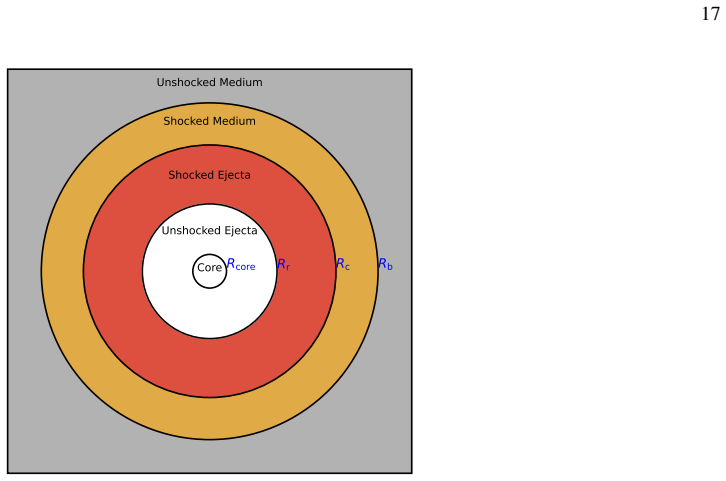
Self-similar solution for a supernova remnant expanding into a stellar wind, used to compute time-dependent dispersion measure and scattering timescale from ejecta mass, kinetic energy, and mass-loss rate.
If this is right
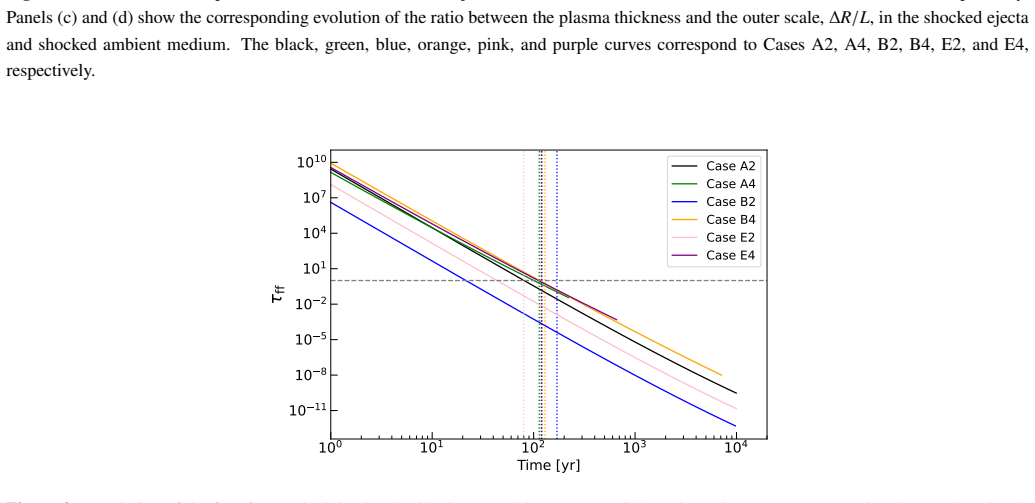
- The circum-burst medium becomes transparent for GHz bursts before the inferred source ages in all retained cases.
- Ejecta mass is large while kinetic energy and mass-loss rate span wide ranges in the surviving models.
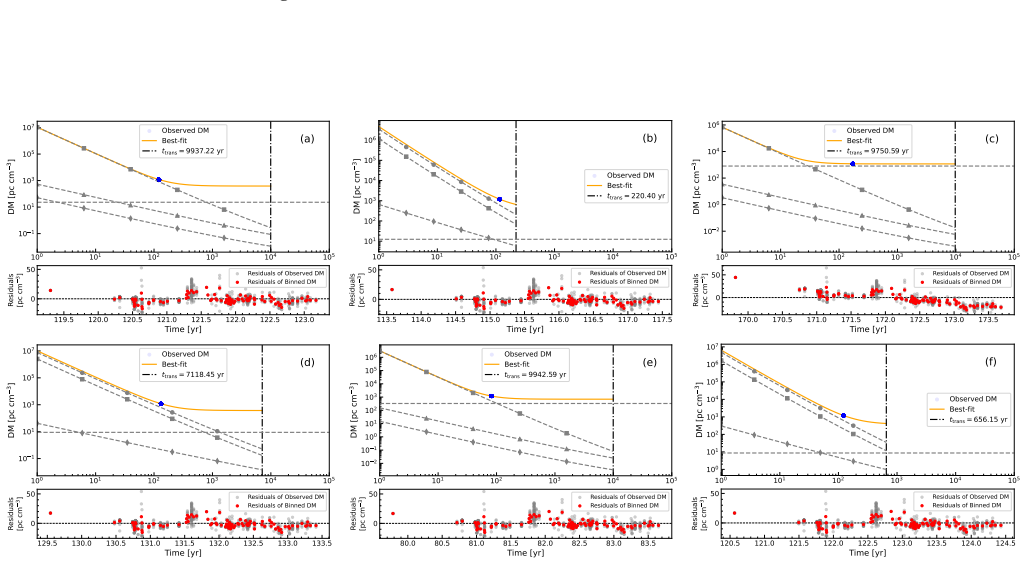
- Secular DM evolution is reproduced more cleanly than the detailed scattering evolution.
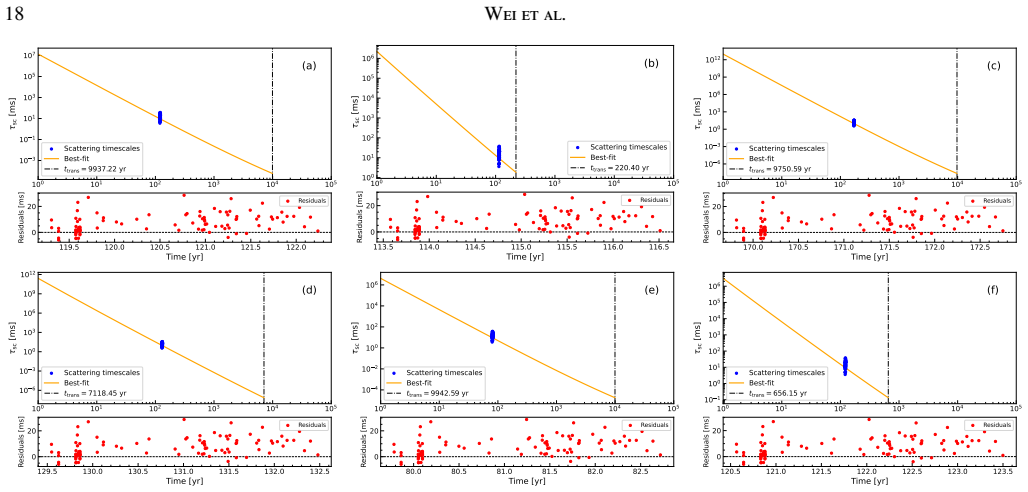
- The up-drift behavior of the scattering residual indicates an additional component or more complicated structures inside the SNR.
Where Pith is reading between the lines
- The same modeling approach could be applied to other repeating FRBs that show large and evolving dispersion measures.
- Continued monitoring that reveals a DM decrease rate inconsistent with the predicted transparency transition would require changes to the wind-environment assumption.
- Radio or X-ray observations could test for the presence of a young supernova remnant at the inferred ages.
Load-bearing premise
That FRB 190520B originates from the core-collapse of a massive star so that its central engine is embedded in a supernova remnant expanding into a wind environment.
What would settle it
An independent measurement showing the source age is substantially older than 170 years would rule out all retained models.
Figures
read the original abstract
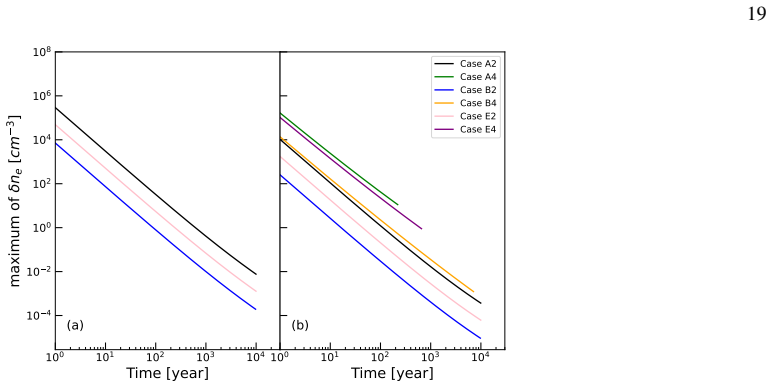
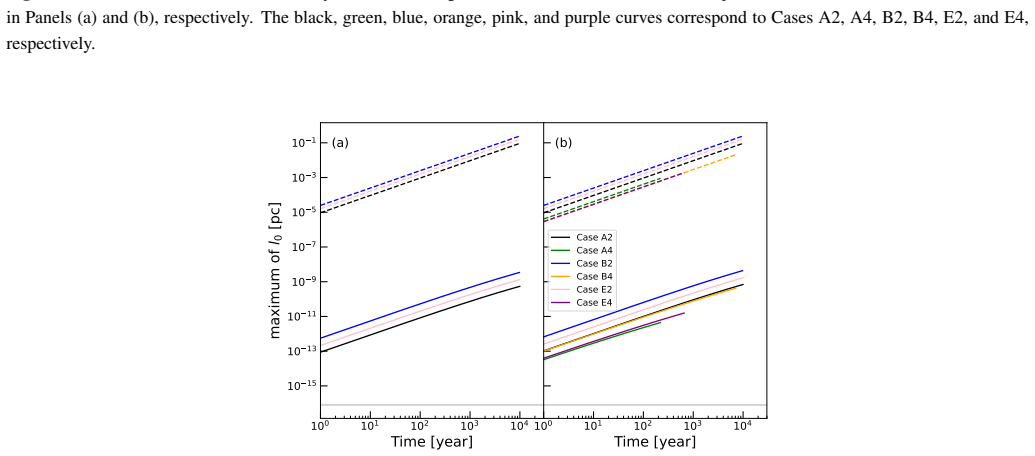
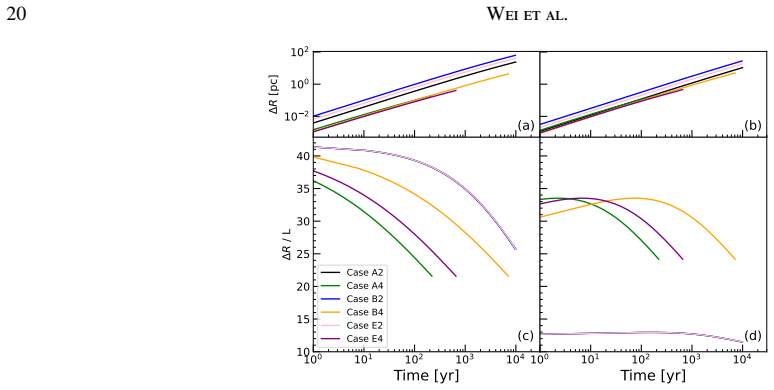
FRB 190520B is a repeating fast radio burst source whose large dispersion measure (DM) and temporal broadening suggest a dense and evolving local environment. In this work, we test the possibility that FRB 190520B originates from the core-collapse of a massive star so that its central engine is embedded in a supernova remnant (SNR) expanding into a wind environment, whose evolution is described by the self-similar solution. We use the observed DM and scattering timescale of FRB 190520B to constrain the physical parameters of its surrounding SNR and host-galaxy DM. Twenty typical cases are considered, arising from four ejecta profiles and five scattering prescriptions. It is found that only 6 cases are retained and provide acceptable fits. All retained cases have a shallow ejecta profile and a young source age of $t_0=79.8$--$169.8~{\rm yr}$. The ejecta mass is inferred to be large for all six cases, while the kinetic energy and mass-loss rate span a wide range. The secular DM evolution is reproduced better than the detailed scattering evolution. The up-drift behavior of the scattering residual suggests an additional component or more complicated structures inside the SNR. All retained cases are self-consistent within the adopted scattering theory and the circum-burst medium becomes transparent for GHz bursts before the inferred source ages.
Editorial analysis
A structured set of objections, weighed in public.
Referee Report
Summary. The manuscript tests whether FRB 190520B originates from core-collapse with its engine in a supernova remnant expanding into a wind, modeled via Chevalier-type self-similar solutions. It examines 20 cases (4 ejecta profiles × 5 scattering prescriptions), retains 6 that fit the observed DM and scattering timescale, and reports that all retained cases require shallow ejecta profiles, young ages t0 = 79.8–169.8 yr, large ejecta mass, and a range of kinetic energies and mass-loss rates. Secular DM evolution is reproduced better than detailed scattering evolution; all retained cases are stated to be self-consistent within the adopted theory, with the circum-burst medium transparent to GHz bursts before the inferred ages.
Significance. If the model assumptions hold, the work supplies concrete parameter constraints on the local environment of this repeating FRB and demonstrates that only a narrow subset of ejecta profiles and scattering prescriptions are compatible with the data. The multi-prescription survey is a positive feature. However, because the retained solutions are obtained by direct fitting to DM and scattering, the constraints are equivalent to the best-fit values rather than independent predictions, and the poorer scattering fit plus residual up-drift indicate that additional medium structure may be required.
major comments (2)
- [model description and retained cases] The retained solutions adopt the self-similar SNR solution at t0 = 79.8–169.8 yr with large Mej. For a wind environment the transition time to the self-similar regime scales as t_trans ~ (Mej / ρ_wind)^{1/3} / v_ej and can exceed 200 yr; if the actual age lies before t_trans the forward shock remains in free expansion and both the DM(t) and scattering evolution formulae used in the fits are invalid. This must be verified explicitly for the six retained parameter sets.
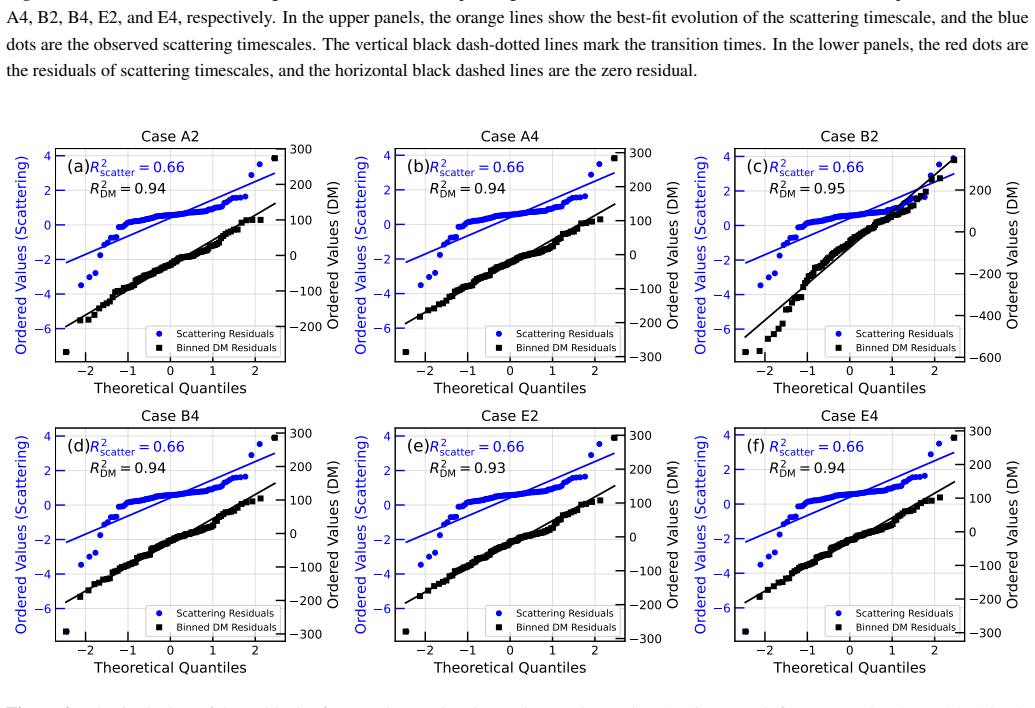
- [results on retained cases] Only 6 of the 20 cases are retained after fitting. The secular DM evolution is stated to be reproduced better than the detailed scattering evolution, and the up-drift in scattering residuals is noted. These facts together indicate that the model does not fully support the scattering data for the retained cases and that the selection criterion may be post-hoc; the central claim that the six cases are acceptable therefore requires a quantitative statement of the fit quality (e.g., reduced χ² or residual statistics) for both observables.
minor comments (2)
- The criteria used to decide which of the 20 cases are 'acceptable' and the precise definitions of the four ejecta profiles and five scattering prescriptions should be stated explicitly (with equation or table numbers) rather than summarized.
- The abstract refers to 'the up-drift behavior of the scattering residual' without a figure or table reference; add such a reference so readers can locate the relevant data.
Simulated Author's Rebuttal
We thank the referee for the careful and constructive review. We address the two major comments point by point below. Where the comments identify needed additions or verifications, we will revise the manuscript accordingly.
read point-by-point responses
-
Referee: [model description and retained cases] The retained solutions adopt the self-similar SNR solution at t0 = 79.8–169.8 yr with large Mej. For a wind environment the transition time to the self-similar regime scales as t_trans ~ (Mej / ρ_wind)^{1/3} / v_ej and can exceed 200 yr; if the actual age lies before t_trans the forward shock remains in free expansion and both the DM(t) and scattering evolution formulae used in the fits are invalid. This must be verified explicitly for the six retained parameter sets.
Authors: We agree that explicit verification of the transition time is required to confirm the validity of the self-similar solutions for the retained cases. Although the manuscript states that all retained cases are self-consistent within the adopted theory, we will compute t_trans for each of the six parameter sets using the scaling relation and the corresponding values of Mej, wind density, and ejecta velocity, and report the comparison t0 > t_trans in the revised manuscript. revision: yes
-
Referee: [results on retained cases] Only 6 of the 20 cases are retained after fitting. The secular DM evolution is stated to be reproduced better than the detailed scattering evolution, and the up-drift in scattering residuals is noted. These facts together indicate that the model does not fully support the scattering data for the retained cases and that the selection criterion may be post-hoc; the central claim that the six cases are acceptable therefore requires a quantitative statement of the fit quality (e.g., reduced χ² or residual statistics) for both observables.
Authors: The six cases were retained because they reproduce the observed DM and scattering timescale within the reported measurement uncertainties while satisfying the model assumptions. The manuscript already notes that secular DM evolution is reproduced better than the detailed scattering evolution and that the up-drift in scattering residuals suggests additional medium structure. To provide the requested quantitative assessment, we will include reduced χ² values and residual statistics for both observables in the revised manuscript. revision: yes
Circularity Check
No significant circularity; standard parameter fitting to data
full rationale
The paper assumes the self-similar SNR solution for ejecta-wind interaction and derives expressions for DM(t) and scattering timescale from it, then fits the free parameters (age t0, Mej, kinetic energy, mass-loss rate, host DM) to the observed DM and scattering values across 20 discrete cases defined by ejecta profiles and scattering prescriptions. Only 6 cases yield acceptable fits, with the reported t0 range and other values being the direct numerical outputs of those fits. This is ordinary model-to-data comparison with no step that reduces a claimed prediction or central result to its own inputs by definition, no load-bearing self-citation, and no renaming or smuggling of ansatzes; the derivation chain remains independent of the target observables once the external model is adopted.
Axiom & Free-Parameter Ledger
free parameters (5)
- source age t_0 =
79.8-169.8 yr
- ejecta mass
- kinetic energy
- mass-loss rate
- host-galaxy DM
axioms (2)
- domain assumption FRB 190520B originates from the core-collapse of a massive star embedded in an SNR expanding into a wind environment described by the self-similar solution
- ad hoc to paper The 20 cases from 4 ejecta profiles and 5 scattering prescriptions cover the relevant model space
Reference graph
Works this paper leans on
-
[1]
, " * write output.state after.block = add.period write newline
ENTRY address archivePrefix author booktitle chapter doi edition editor eprint howpublished institution journal key month number organization pages publisher school series title misctitle type volume year version url label extra.label sort.label short.list INTEGERS output.state before.all mid.sentence after.sentence after.block FUNCTION init.state.consts ...
-
[2]
write newline
" write newline "" before.all 'output.state := FUNCTION format.url url empty "" new.block "" url * "" * if FUNCTION format.eprint eprint empty "" archivePrefix empty "" archivePrefix "arXiv" = new.block " " eprint * " " * new.block " " eprint * " " * if if if FUNCTION format.doi doi empty "" " " doi * " " * if FUNCTION format.pid doi empty eprint empty ur...
-
[3]
A bright millisecond radio burst of extragalactic origin
thebibliography [1] 20pt to REFERENCES 6pt =0pt -12pt 10pt plus 3pt =0pt =0pt =1pt plus 1pt =0pt =0pt -12pt =13pt plus 1pt =20pt =13pt plus 1pt \@M =10000 =-1.0em =0pt =0pt 0pt =0pt =1.0em @enumiv\@empty 10000 10000 `\.\@m \@noitemerr \@latex@warning Empty `thebibliography' environment \@ifnextchar \@reference \@latexerr Missing key on reference command E...
work page internal anchor Pith review Pith/arXiv arXiv doi:10.5281/zenodo.831784 2021
discussion (0)
Sign in with ORCID, Apple, or X to comment. Anyone can read and Pith papers without signing in.