Vibroacoustic Underwater Noise from Fixed and Floating Offshore Wind Turbines
Pith reviewed 2026-06-29 16:01 UTC · model grok-4.3
The pith
Floating offshore wind turbines produce up to 15% higher low-frequency underwater noise than monopile structures due to rigid-body motions.
A machine-rendered reading of the paper's core claim, the machinery that carries it, and where it could break.
Core claim
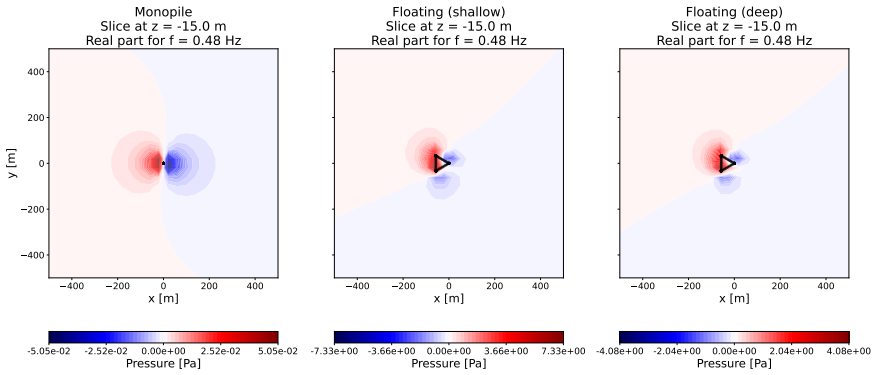
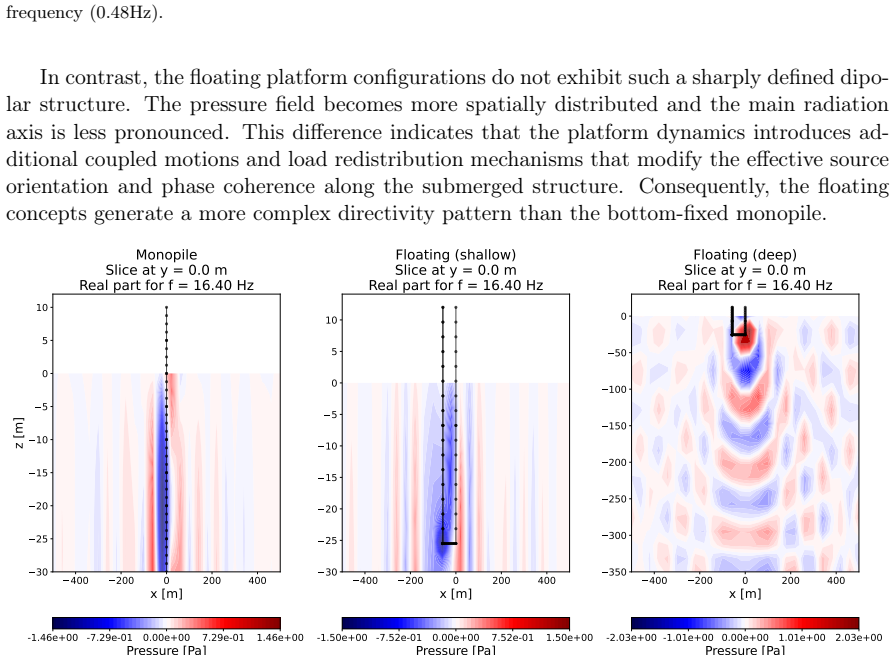
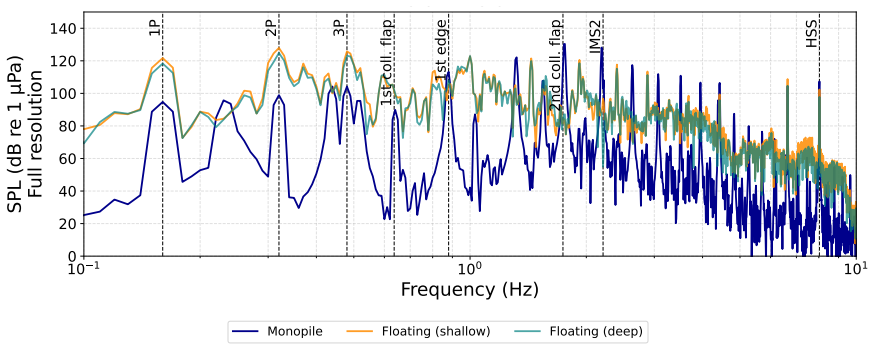
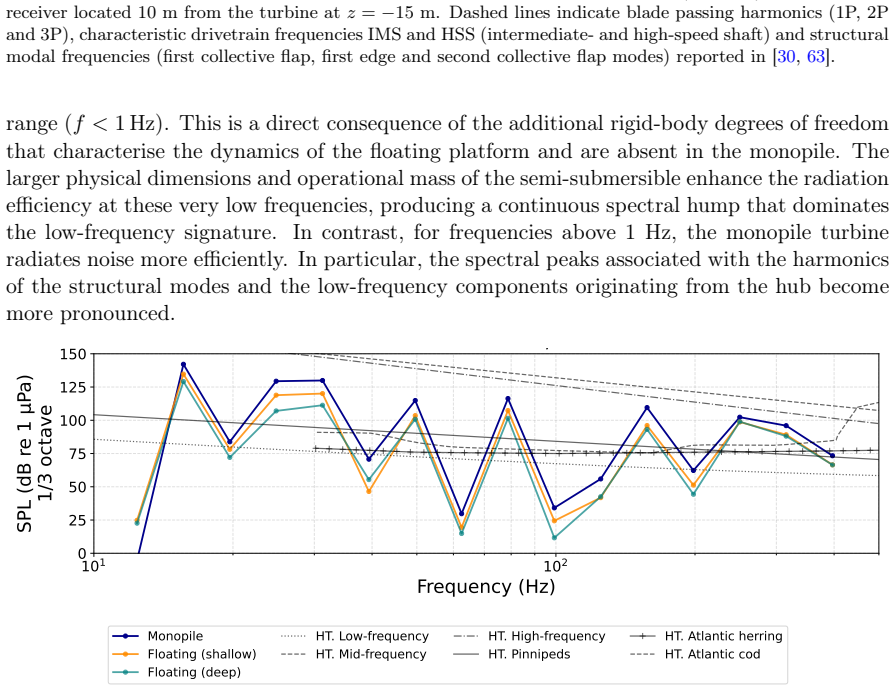
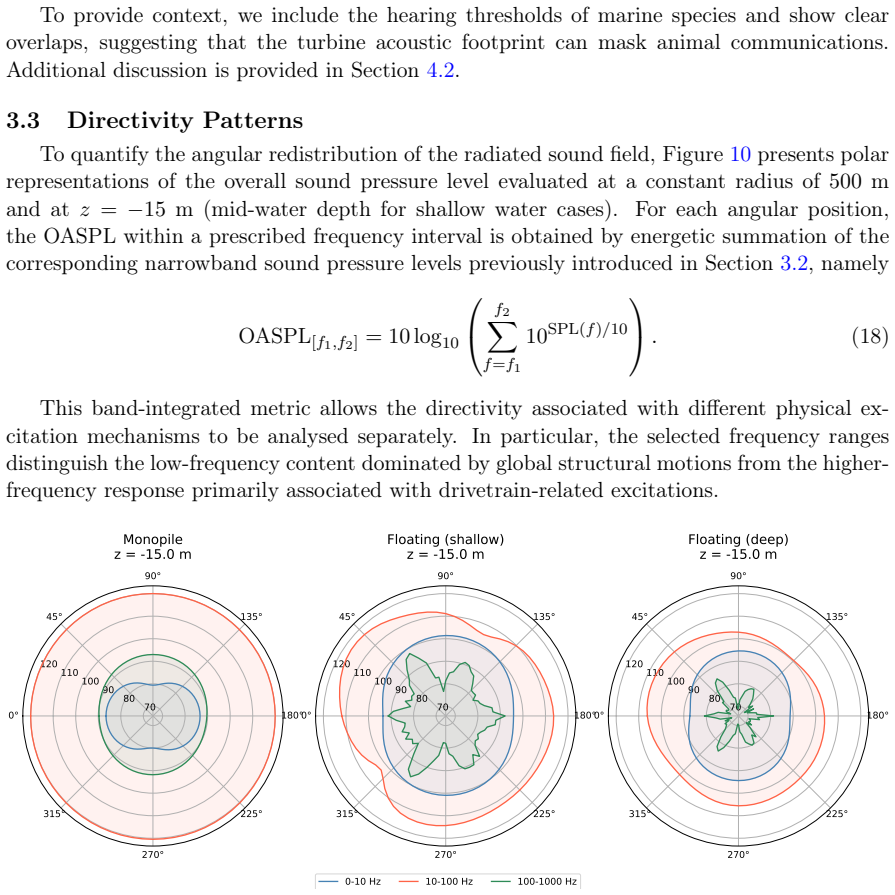
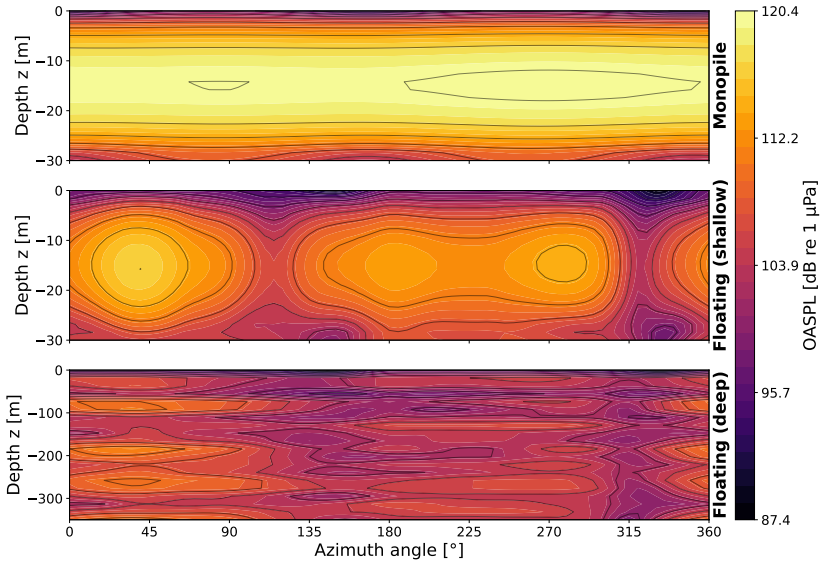
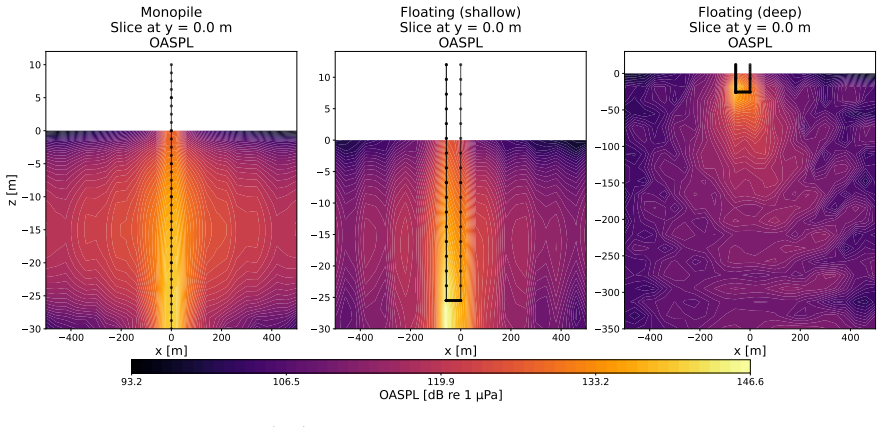
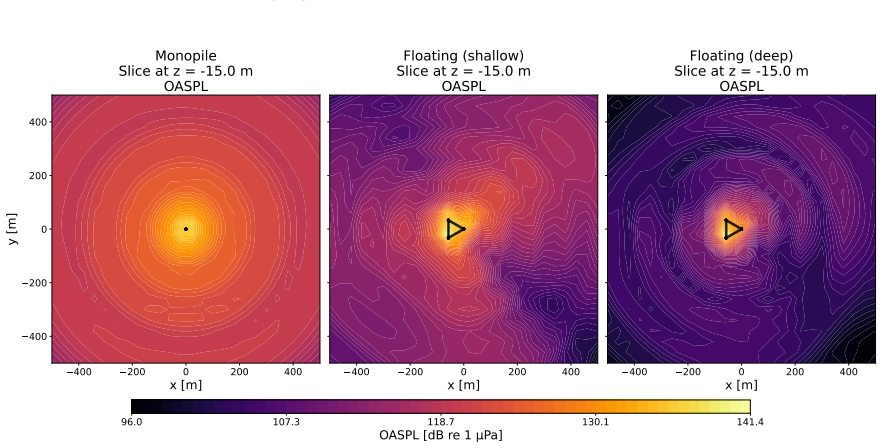
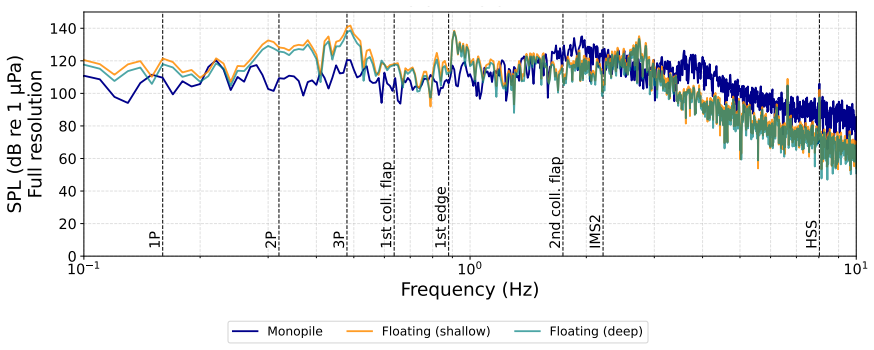
The study shows that floating configurations exhibit enhanced low-frequency acoustic emissions, producing up to 15% higher overall sound pressure level than monopile structures under equivalent water depths for frequencies below 10 Hz due to additional rigid-body motions, while monopile structures radiate more efficiently at higher frequencies associated with drivetrain excitations. Floating platforms also display more complex three-dimensional radiation patterns with stronger direction-dependent variations of 20-25 dB in the 100-1000 Hz band, in contrast to the smoother, nearly axisymmetric response of monopile configurations. Water depth strongly influences propagation regimes, with shallo
What carries the argument
The vibroacoustic framework that combines time-domain aero-hydro-servo-elastic simulations with a frequency-domain acoustic formulation using equivalent dipole sources, Green's function solutions, and the method of images to account for free-surface and seabed boundaries.
If this is right
- The framework allows quantification of vibro-acoustic noise during the turbine design phase.
- Floating platforms produce more complex spatial sound distributions than monopiles.
- Water depth affects overall sound levels, with shallow floating cases differing by up to 7% from deep-water cases.
- The approach supports selection between fixed and floating designs based on frequency-specific noise targets.
Where Pith is reading between the lines
- Site-specific water depth could be used as a design variable to reduce noise impact on marine life near floating installations.
- Cumulative noise from arrays of turbines may require separate modeling for mixed fixed and floating layouts.
- The frequency split between the two designs suggests that monitoring programs could focus on different bands depending on platform type.
Load-bearing premise
The time-domain simulations supply accurate vibration inputs and the dipole sources plus Green's functions with the method of images correctly model sound radiation and propagation between the sea surface and seabed.
What would settle it
A side-by-side comparison of the model's predicted overall sound pressure levels and directivity patterns against field measurements of underwater noise from an operating 10 MW floating or monopile turbine at the same water depth and frequencies.
Figures
read the original abstract
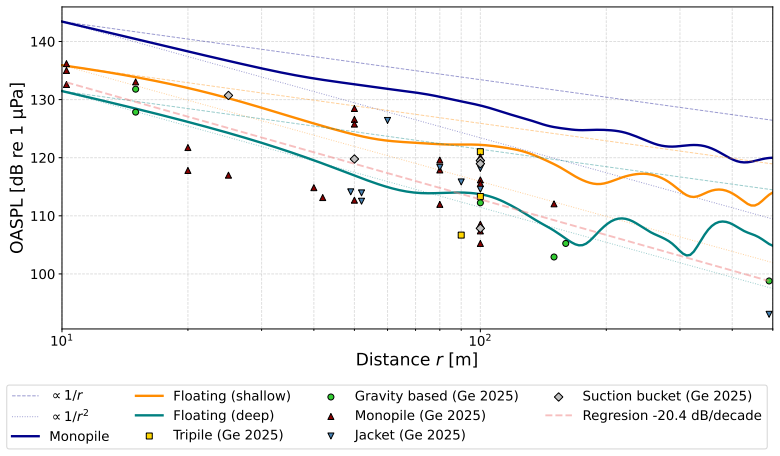
Anthropogenic underwater noise from offshore wind turbines is a growing environmental concern, particularly with the large-scale deployment of bottom-fixed and floating devices. This study presents a physics-based vibroacoustic framework to predict operational underwater noise emissions from offshore wind turbines and compares monopile-supported and floating configurations for a 10 MW turbine. The methodology combines time-domain aero-hydro-servo-elastic simulations with a frequency-domain acoustic formulation based on equivalent dipole sources and Green's function solutions, accounting for underwater confinement between the free surface and seabed through the method of images. Results show that floating configurations exhibit enhanced low-frequency acoustic emissions, producing up to 15% higher OASPL than the monopile structures under equivalent water depths for frequencies below 10 Hz due to additional rigid-body motions, while monopile structures radiate more efficiently at higher frequencies associated with drivetrain excitations. Significant differences in the spatial distribution and directivity of the radiated sound field are also observed, with floating platforms displaying more complex three-dimensional radiation patterns and stronger direction-dependent variations, reaching approximately 20-25 dB in the 100-1000 Hz band, compared with the smoother and nearly axisymmetric response of monopile configurations. Water depth strongly influences propagation regimes and overall sound levels, with shallow-water floating configurations showing variations of up to 7% in OASPL relative to deep-water cases. The proposed framework enables quantification of vibro-acoustic noise and provides a predictive tool for assessing underwater acoustic impacts during the design phase, supporting environmentally informed offshore wind turbine design and future regulatory and monitoring strategies.
Editorial analysis
A structured set of objections, weighed in public.
Referee Report
Summary. The paper presents a physics-based vibroacoustic framework combining time-domain aero-hydro-servo-elastic simulations of a 10 MW turbine with a frequency-domain acoustic model that uses equivalent dipole sources, Green's functions, and the method of images to enforce free-surface and seabed boundaries. It claims that floating configurations produce up to 15% higher OASPL than monopiles below 10 Hz due to additional rigid-body motions, while monopiles radiate more at higher frequencies from drivetrain excitations; floating platforms also show more complex directivity with 20-25 dB variations in the 100-1000 Hz band, and water depth affects levels by up to 7%.
Significance. If validated, the framework would offer a useful predictive tool for quantifying underwater noise from both fixed and floating offshore wind turbines, addressing an emerging environmental concern as deployments scale. The explicit comparison of configurations and the inclusion of rigid-body effects provide a basis for design-stage impact assessment, though the lack of supporting validation data in the abstract reduces immediate applicability.
major comments (2)
- [Abstract] Abstract (methodology description): The quantitative claims of a 15% OASPL increase below 10 Hz and 20-25 dB directivity variations rest on the frequency-domain step that places equivalent dipoles from time-domain outputs and propagates them via Green's functions with the method of images. At frequencies <10 Hz (wavelengths >150 m), this enters the waveguide regime where discrete normal modes and cutoff effects typically dominate; the image-sum construction may therefore produce an artifactual enhancement from rigid-body motions rather than a robust physical result. A benchmark against normal-mode or finite-element propagation is required to confirm the difference is not model-dependent.
- [Abstract] Abstract (results paragraph): The manuscript states specific quantitative outcomes (15% OASPL difference, 20-25 dB directivity variations, 7% depth effect) without any accompanying validation data, error bars, sensitivity studies, or comparison to field measurements or alternative acoustic models. This absence directly undermines in the central floating-vs-monopile claims.
minor comments (1)
- [Abstract] The abstract supplies no equations, parameter definitions, or implementation details for the dipole-to-Green's-function step, making it impossible to assess independence from fitted inputs or reproduction of the reported numbers.
Simulated Author's Rebuttal
We thank the referee for the constructive review and the recommendation for major revision. We address the two major comments point by point below, offering clarifications on the acoustic model and acknowledging limitations in validation. Where feasible, we indicate revisions to the manuscript.
read point-by-point responses
-
Referee: [Abstract] Abstract (methodology description): The quantitative claims of a 15% OASPL increase below 10 Hz and 20-25 dB directivity variations rest on the frequency-domain step that places equivalent dipoles from time-domain outputs and propagates them via Green's functions with the method of images. At frequencies <10 Hz (wavelengths >150 m), this enters the waveguide regime where discrete normal modes and cutoff effects typically dominate; the image-sum construction may therefore produce an artifactual enhancement from rigid-body motions rather than a robust physical result. A benchmark against normal-mode or finite-element propagation is required to confirm the difference is not model-dependent.
Authors: The method of images with Green's functions satisfies the free-surface and seabed boundary conditions exactly for a constant-depth environment and does not introduce artifacts; it correctly represents the physical multipath interference. The additional low-frequency radiation in floating cases originates from the rigid-body modes obtained in the time-domain aero-hydro-servo-elastic simulations, which are absent in the monopile model. We nevertheless recognize the referee's point about the waveguide regime. In the revised manuscript we will add a dedicated paragraph on low-frequency applicability and include a benchmark comparison against a normal-mode solver for a simplified source to confirm that the reported floating-monopile differences are robust. revision: partial
-
Referee: [Abstract] Abstract (results paragraph): The manuscript states specific quantitative outcomes (15% OASPL difference, 20-25 dB directivity variations, 7% depth effect) without any accompanying validation data, error bars, sensitivity studies, or comparison to field measurements or alternative acoustic models. This absence directly undermines in the central floating-vs-monopile claims.
Authors: We agree that the absence of direct field validation reduces immediate applicability of the quantitative claims. The study presents a physics-based framework rather than site-specific validated predictions. The full manuscript already compares monopile results with published measurements; floating-turbine data remain scarce. In revision we will incorporate additional sensitivity studies on water depth and source parameters, plus uncertainty estimates based on the dipole approximation. Comprehensive experimental validation lies beyond the present scope and is identified as future work. revision: partial
Circularity Check
No circularity detected; derivation chain not visible for inspection
full rationale
The abstract and provided text describe a high-level methodology combining time-domain simulations with frequency-domain acoustics via equivalent dipoles, Green's functions, and the method of images, but contain no equations, fitted parameters, self-citations, or derivation steps that could be checked for reduction to inputs by construction. No self-definitional, fitted-input, or self-citation patterns are present, so the framework is treated as self-contained against external benchmarks with no load-bearing circular steps identified.
Axiom & Free-Parameter Ledger
axioms (1)
- domain assumption Underwater acoustic propagation between free surface and seabed can be modeled via Green's functions and the method of images
Reference graph
Works this paper leans on
-
[1]
International Renewable Energy Agency, Future of wind: Deployment, investment, tech- nology, grid integration and socio-economic aspects (2019)
2019
-
[2]
J. A. Hildebrand, Anthropogenic and natural sources of ambient noise in the ocean, Marine Ecology Progress Series 395 (2009) 5–20.doi:10.3354/meps08353
-
[3]
H. Slabbekoorn, N. Bouton, I. van Opzeeland, A. Coers, C. ten Cate, A. N. Popper, A noisy spring: the impact of globally rising underwater sound levels on fish, Trends in Ecology & Evolution 25 (7) (2010) 419–427.doi:10.1016/j.tree.2010.04.005
-
[4]
J. Tougaard, L. Hermannsen, P. T. Madsen, How loud is the underwater noise from operating offshore wind turbines?, The Journal of the Acoustical Society of America 148 (5) (2020) 2885–2893.doi:10.1121/10.0002453
- [5]
-
[6]
Jonkman, Dynamics modeling and loads analysis of an offshore floating wind tur- bine, Tech
J. Jonkman, Dynamics modeling and loads analysis of an offshore floating wind tur- bine, Tech. Rep. NREL/TP-500-41958, National Renewable Energy Laboratory (NREL) (2009)
2009
-
[7]
P. T. Madsen, M. Wahlberg, J. Tougaard, K. Lucke, P. Tyack, Wind turbine underwater noise and marine mammals: implications of current knowledge and data needs, Marine Ecology Progress Series 309 (2006) 279–295.doi:10.3354/meps309279
-
[9]
T. Pangerc, P. D. Theobald, L. S. Wang, S. P. Robinson, P. A. Lepper, Measurement and characterisation of radiated underwater sound from a 3.6 mw monopile wind turbine, The Journal of the Acoustical Society of America 140 (4) (2016) 2913–2922.doi:10.1121/1. 4964824
work page doi:10.1121/1 2016
-
[10]
U. Stöber, F. Thomsen, How could operational underwater sound from future offshore wind turbines impact marine life?, The Journal of the Acoustical Society of America 149 (3) (2021) 1791–1795.doi:10.1121/10.0003760. 28
-
[11]
Y. G. Yoon, D.-G. Han, J. W. Choi, Measurements of underwater operational noise caused by offshore wind turbine off the southwest coast of korea, Frontiers in Marine Science 10 (2023) 1153843.doi:10.3389/fmars.2023.1153843
-
[12]
Q. Ge, H. Yao, S. Qian, X. Zhang, H. Guo, Dependencies of underwater noise from offshore wind farms on distance, wind speed, and turbine power, Acoustics 7 (4) (2025) 71.doi:10.3390/acoustics7040071. URLhttps://doi.org/10.3390/acoustics7040071
-
[13]
J. R. Nedwell, S. J. Parvin, B. Edwards, R. Workman, A. G. Brooker, J. Kynoch, Mea- surements and interpretation of underwater sound during construction and operation of offshore windfarms in uk waters, Tech. Rep. SOUND 03-2003, COWRIE / Subacoustech (2007)
2003
-
[14]
B. Marmo, I. Roberts, M. P. Buckingham, S. King, C. Booth, Modelling of noise effects of operational offshore wind turbines including noise transmission through various founda- tion types, Tech. Rep. 5, Scottish Government, Scottish Marine and Freshwater Science, iSBN 9781782568513 (2013).doi:10.7489/1521-1
-
[15]
HDR, Field observations during wind turbine operations at the block island wind farm, rhode island, Tech. Rep. OCS Study BOEM 2018-047, U.S. Department of the Interior, Bureau of Ocean Energy Management, Office of Renewable Energy Programs (2019)
2018
-
[16]
HDR,Fieldobservationsduringoffshorewindstructureinstallationandoperation, volume i, Tech. Rep. OCS Study BOEM 2021-025, U.S. Department of the Interior, Bureau of Ocean Energy Management, Office of Renewable Energy Programs (2020)
2021
-
[17]
J. L. Amaral, A. S. Frankel, A. A. Khan, Y.-T. Lin, J. H. Miller, A. E. Newhall, G. R. Potty, K. J. Vigness-Raposa, Underwater acoustic monitoring data analyses for the block island wind farm, rhode island, Tech. Rep. OCS Study BOEM 2019-029, U.S. Department of the Interior, Bureau of Ocean Energy Management (2019)
2019
-
[18]
Environmentalimpactsofoffshorewindfarmsinthebelgianpartofthenorthsea: Getting readyforoffshorewindfarmexpansioninthenorthsea, Tech.rep., RoyalBelgianInstitute of Natural Sciences, Brussels, Belgium (2021)
2021
-
[19]
Norro, B
A. Norro, B. Rumes, S. Degraer, Characterisation of the operational noise generated by offshore wind parks in the belgian part of the north sea, in: Proceedings of the Underwater Acoustics Conference and Exhibition, Crete, Greece, 2015, pp. 507–514
2015
-
[20]
C. A. F. de Jong, M. A. Ainslie, G. Blacquiere, Standard for measurement and monitoring of underwater noise, part ii: Procedures for measuring underwater noise in connection with offshore wind farm licensing, Tech. rep., TNO (2011)
2011
-
[21]
rep., TNO (2016)
TNO, Underwater noise measurements in the north sea in and near the princess amalia wind park, Tech. rep., TNO (2016)
2016
-
[22]
M. A. Bellmann, J. Brinkmann, M. Schuster, T. Steinhauer, M. Weirathmueller, et al., Experience report on operational noise: Cross-project evaluation of underwater noise measurements from offshore wind farms, Tech. rep., itap GmbH (2024)
2024
-
[23]
R. D. J. Burns, S. B. Martin, M. A. Wood, C. C. Wilson, C. E. Lumsden, F. Pace, Hywind scotland floating offshore wind farm: Sound source characterisation of operational floating turbines, Tech. rep., JASCO Applied Sciences, report prepared for Equinor Energy AS, document 02521, Version 3.0 FINAL (2022). 29
2022
-
[24]
F. Pace, R. Burns, B. Martin, M. Wood, C. Wilson, E. Lumsden, K. Murvoll, J. Weis- senberger, Underwater sound emissions from the moorings of floating wind turbines: Hy- wind scotland case study, in: The Effects of Noise on Aquatic Life, Springer, 2024, pp. 179–201.doi:10.1007/978-3-031-50256-9_121
-
[25]
Risch, G
D. Risch, G. Favill, B. Marmo, N. van Geel, S. Benjamins, P. Thompson, A. Wittich, B. Wilson, Characterisation of underwater operational noise of two types of floating off- shore wind turbines, Tech. rep., Scottish Association for Marine Science, Xi Engineering Consultants and University of Aberdeen; report for Supergen Offshore Renewable Energy Hub (2023)
2023
-
[26]
Baldachini, et al., Modeling the underwater sound of floating offshore windfarms in the central mediterranean sea, Journal of Marine Science and Engineering 12 (9) (2024) 1495
M. Baldachini, et al., Modeling the underwater sound of floating offshore windfarms in the central mediterranean sea, Journal of Marine Science and Engineering 12 (9) (2024) 1495
2024
-
[27]
Baldachini, F
M. Baldachini, F. Pace, G. Buscaino, R. Racca, M. A. Wood, R. D. J. Burns, E. Papale, Assessing the potential acoustic impact of floating offshore wind farms in the central mediterranean sea, Marine Pollution Bulletin 212 (2025) 117615
2025
-
[28]
rep., Marine Scotland (2022)
Pentland Floating Offshore Wind Farm, Offshore environmental impact assessment re- port: Appendix 10.1 underwater noise modelling, Tech. rep., Marine Scotland (2022)
2022
-
[29]
rep., Marine Scotland (2022)
Pentland Floating Offshore Wind Farm, Offshore environmental impact assessment re- port: Appendix 11.1 underwater noise impact assessment, Tech. rep., Marine Scotland (2022)
2022
-
[30]
C. Bak, F. Zahle, R. Bitsche, T. Kim, A. Yde, L. C. Henriksen, A. Natarajan, M. H. Hansen, Description of the dtu 10 mw reference wind turbine, Tech. Rep. DTU Wind Energy Report-I-0092, DTU Wind Energy, Denmark (July 2013)
2013
-
[31]
Njomo Wandji, A
W. Njomo Wandji, A. Natarajan, N. K. Dimitrov, T. Buhl, Design of monopiles for multi-megawatt wind turbines at 50 m water depth, Technical report, DTU Wind Energy, Roskilde, Denmark, specific design for the DTU 10 MW Reference Wind Turbine (2015)
2015
-
[32]
F. J. Madsen, A. Pegalajar-Jurado, M. Borg, H. Bredmose, Experimental analysis of the scaled dtu 10mw tlp floating wind turbine, Renewable Energy 163 (2020) 1298–1319. doi:10.1016/j.renene.2020.03.145
-
[33]
M. Johannessen, Concept study and design of floating offshore wind turbine support structures, Master’s thesis, Norwegian University of Science and Technology (NTNU), uses DTU 10 MW reference turbine for floating concepts (2018)
2018
-
[34]
Bortolotti, H
P. Bortolotti, H. C. Tarres, K. Dykes, K. Merz, L. Sethuraman, D. Verelst, F. Zahle, Iea wind task 37 on systems engineering in wind energy – wp2.1 reference wind turbines, Tech. rep., International Energy Agency (2019). URLhttps://www.nrel.gov/docs/fy19osti/73492.pdf
2019
-
[35]
CENER, Innwind, DeltaWind, Definition of the 10mw reference wind turbine, Tech. Rep. Report: 45.0006.0 – D1, National Renewable Energy Centre (CENER), Spain, deliverable D1. Project: Innwind / DeltaWind. Reference wind turbine: 10MW (2015)
2015
-
[36]
INNWIND.EU Consortium, Definition of the reference wind turbine – analysis of rotor design parameters, Tech. Rep. Deliverable 1.2.1, INNWIND.EU Project, EU, agreement n.: 308974. Duration: 60 months from 1st November 2012. Co-ordinator: Peter Hjuler Jensen. Funded by the EU 7th Framework Programme. (May 2013). 30
2012
-
[37]
USTUTT, DTU, CENER, NTUA, RAW, Deliverable d4.3.3 – innovative concepts for floating structures, Tech. Rep. Deliverable D4.3.3, INNWIND.EU Project, EU, agreement n.: 308974. Project duration: November 2012 – October 2017. Co-ordinator: Danmarks Tekniske Universitet (DTU). Funded by the European Community’s Seventh Framework Programme (FP7-ENERGY-2012-1-2S...
2012
-
[38]
National Renewable Energy Laboratory (NREL), Openfast: Wind turbine simulation code,https://openfast.readthedocs.io/en/main/(Aug. 2025)
2025
-
[39]
E. Branlard, et al., Superelement reduction of substructures for sequential load cal- culations in openfast, Journal of Physics: Conference Series 1452 (1) (2020) 012033. doi:10.1088/1742-6596/1452/1/012033
-
[40]
Betke, M
K. Betke, M. S. von Glahn, R. Matuschek, Underwater noise emissions from offshore wind turbines, Technical report, ITAP – Institut für technische und angewandte Physik GmbH, Oldenburg, Germany (2004)
2004
-
[41]
Lindell, Utgrunden offshore wind farm - measurements of underwater noise, Technical report, Vindkompaniet AB (Jan
H. Lindell, Utgrunden offshore wind farm - measurements of underwater noise, Technical report, Vindkompaniet AB (Jan. 2003)
2003
-
[42]
Odegaard & Dannesjiold-Samsoe A/S, Offshore wind turbines - vvm: Underwater noise measurements, analysis and predictions, Tech. Rep. Report no. 00.729 rev.1, ODS ref 99.1314, SEAS Distribution A.m.b.A, Denmark (March 2020)
2020
-
[43]
S. Wang, A. R. Nejad, T. Moan, On design, modelling, and analysis of a 10-mw medium- speed drivetrain for offshore wind turbines, Wind Energy 23 (4) (2020) 1099–1117, received: 16 April 2019; Revised: 8 December 2019; Accepted: 15 December 2019. doi:10.1002/we.2476
-
[44]
S. Wang, A. R. Nejad, T. Moan, Design and dynamic analysis of a compact 10 mw medium speed gearbox for offshore wind turbines, Journal of Offshore Mechanics and Arctic Engineering 143 (3) (Nov. 2020).doi:10.1115/1.4048608. URLhttp://dx.doi.org/10.1115/1.4048608
-
[45]
A. Kahraman, Load sharing characteristics of planetary transmissions, Mechanism and Machine Theory 29 (8) (1994) 1151–1165.doi:10.1016/0094-114X(94)90006-X
-
[46]
J. L. M. Peeters, D. Vandepitte, P. Sas, Analysis of internal drive train dynamics in a wind turbine, Wind Energy 9 (1-2) (2006) 141–161.doi:10.1002/we.173. URLhttps://doi.org/10.1002/we.173
-
[47]
A. R. Nejad, E. E. Bachynski, L. Li, T. Moan, Correlation between acceleration and drivetrain load effects for monopile offshore wind turbines, Energy Procedia 94 (2016) 487–496.doi:10.1016/j.egypro.2016.09.219. URLhttps://doi.org/10.1016/j.egypro.2016.09.219
-
[48]
Y. Guo, J. Keller, W. LaCava, Combined effects of gravity, bending moment, bearing clearance, and input torque on wind turbine planetary gear load sharing, Tech. Rep. NREL/CP-5000-55968, National Renewable Energy Laboratory (NREL), Golden, CO, presented at the American Gear Manufacturers Association Fall Technical Meeting, 2012 (2012)
2012
-
[49]
D. J. Inman, Engineering Vibration, 4th Edition, Pearson, Boston, MA, 2014. 31
2014
-
[50]
Wagner, R
S. Wagner, R. Bareiss, G. Guidati, Wind Turbine Noise, Springer, Berlin, 1996
1996
-
[51]
M. J. Lighthill, On sound generated aerodynamically i. general theory, Proceedings of the Royal Society of London. Series A. Mathematical and Physical Sciences 211 (1107) (1952) 564–587.doi:10.1098/rspa.1952.0060
-
[52]
N. Curle, The influence of solid boundaries upon aerodynamic sound, Proceedings of the Royal Society of London. Series A 231 (1187) (1955) 505–514.doi:10.1098/rspa.1955. 0191
-
[53]
J. E. Ffowcs Williams, D. L. Hawkings, Sound generation by turbulence and surfaces in arbitrary motion, Philosophical Transactions of the Royal Society of London. Series A 264 (1151) (1969) 321–342.doi:10.1098/rsta.1969.0031
-
[54]
M. C. Junger, D. Feit, Sound, Structures, and Their Interaction, 2nd Edition, MIT Press, Cambridge, MA, 1986
1986
-
[55]
J. B. Allen, D. A. Berkley, Image method for efficiently simulating small-room acoustics, The Journal of the Acoustical Society of America 65 (4) (1979) 943–950.doi:10.1121/ 1.382599. URLhttps://doi.org/10.1121/1.382599
-
[56]
R. J. Urick, Principles of Underwater Sound, 3rd Edition, McGraw-Hill, New York, 1983
1983
-
[57]
E. L. Hamilton, Geoacoustic modeling of the sea floor, The Journal of the Acoustical Society of America 68 (5) (1980) 1313–1340.doi:10.1121/1.385100
-
[58]
F. B. Jensen, W. A. Kuperman, M. B. Porter, H. Schmidt, Computational Ocean Acous- tics, 2nd Edition, Modern Acoustics and Signal Processing, Springer, New York, 2011
2011
-
[59]
S. M. Kirkup, The Boundary Element Method in Acoustics, Integrated Sound Software, Hebden Bridge, UK, 2007
2007
-
[60]
R. D. Ciskowski, C. A. Brebbia (Eds.), Boundary Element Methods in Acoustics, Com- putational Mechanics Publications, Southampton, UK, 1991
1991
-
[61]
S. Kirkup, The boundary element method in acoustics: A survey, Applied Sciences 9 (8) (2019) 1642.doi:10.3390/app9081642
-
[62]
Sehgal, I
A. Sehgal, I. Tumar, J. Sch"onw"alder, Variability of available capacity due to the ef- fects of depth and temperature in the underwater acoustic communication channel, in: Proceedings of IEEE OCEANS 2010, IEEE, 2010
2010
-
[63]
M. Borg, M. Mirzaei, H. Bredmose, Lifes50+ d1.2: Wind turbine models for the de- sign, Technical Report E-0101, DTU Wind Energy, Technical University of Denmark, deliverable D1.2 of the LIFES50+ project, funded by the European Union Horizon 2020 programme under Grant Agreement No. 640741 (Dec. 2015). URLhttp://lifes50plus.eu/wp-content/uploads/2015/12/D1.2.pdf
2020
-
[64]
Tougaard, Thresholds for noise-induced hearing loss in marine mammals, Tech
J. Tougaard, Thresholds for noise-induced hearing loss in marine mammals, Tech. Rep. Scientific Note No. 2021|28, Aarhus University, DCE - Danish Centre for Environment and Energy (2021). URLhttps://dce.au.dk/fileadmin/dce.au.dk/Udgivelser/Notater_2021/N2021_ 28.pdf 32
2021
-
[65]
National Marine Fisheries Service, Technical guidance for assessing the effects of an- thropogenic sound on marine mammal hearing (version 2.0), Tech. Rep. NMFS-OPR-59, National Oceanic and Atmospheric Administration (NOAA) (2024)
2024
-
[66]
C. Erbe, C. Reichmuth, K. Cunningham, K. Lucke, R. Dooling, Communication masking in marine mammals: A review and research strategy, Marine Pollution Bulletin 103 (1-2) (2016) 15–38.doi:10.1016/j.marpolbul.2015.12.007
-
[67]
International Organization for Standardization, Iso 266: Acoustics — preferred frequen- cies (1997)
1997
-
[68]
NREL, Turbsim user’s guide (2006).doi:10.2172/891594
-
[69]
B. L. Southall, A. E. Bowles, W. T. Ellison, J. J. Finneran, R. L. Gentry, C. R. Greene, D. Kastak, D. R. Ketten, J. H. Miller, P. E. Nachtigall, W. J. Richardson, J. A. Thomas, P. L. Tyack, Marine mammal noise exposure criteria: Initial scientific recommendations, Aquatic Mammals 33 (4) (2007) 411–509.doi:10.1578/AM.33.4.2007.411
-
[70]
B. L. Southall, J. J. Finneran, C. Reichmuth, P. E. Nachtigall, D. R. Ketten, A. E. Bowles, W. T. Ellison, D. P. Nowacek, P. L. Tyack, Marine mammal noise exposure criteria: Updated scientific recommendations for residual hearing effects, Aquatic Mammals 45 (2) (2019) 125–232.doi:10.1578/AM.45.2.2019.125
-
[71]
R. A. Kastelein, P. J. Wensveen, L. Hoek, W. C. Verboom, J. M. Terhune, Underwater detection of tonal signals between 0.125 and 100 khz by harbor seals (phoca vitulina), The Journal of the Acoustical Society of America 125 (2) (2009) 1222–1229.doi:10. 1121/1.3050283
2009
-
[72]
T. W. Cranford, P. Krysl, Fin whale skull vibrations imply a bone conduction mechanism for low-frequency hearing, Bioinspiration & Biomimetics 10 (1) (2015) 016019.doi: https://doi.org/10.1371/journal.pone.0122298
-
[73]
L. Roberts, S. Cheesman, T. Breithaupt, M. Elliott, Sensitivity of the mussel mytilus edulis to substrate-borne vibration in relation to anthropogenically generated noise, Ma- rine Ecology Progress Series 538 (2015) 185–195.doi:10.3354/meps11468
-
[74]
L. Roberts, T. Breithaupt, M. Williams, M. Elliott, Sensitivity of pagurus bernhardus (l.) to substrate-borne vibration and anthropogenic noise, Journal of Experimental Marine Biology and Ecology 474 (2016) 185–194.doi:10.1016/j.jembe.2015.09.014
-
[75]
L. Roberts, M. Elliott, Sensitivity of marine invertebrates to mud-borne vibrations, Pro- ceedings of Meetings on Acoustics 27 (1) (2017) 010029.doi:10.1121/2.0000324
-
[76]
M. S. Longuet-Higgins, A theory of the origin of microseisms, Philosophical Transactions of the Royal Society of London. Series A, Mathematical and Physical Sciences 243 (857) (1950) 1–35.doi:10.1098/rsta.1950.0012
-
[77]
R. K. Andrew, B. M. Howe, J. A. Mercer, M. A. Dzieciuch, Ocean ambient sound: Com- paring the 1960s with the 1990s, The Journal of the Acoustical Society of America 111 (2) (2002) 982–993.doi:10.1121/1.1461915
-
[78]
G. M. Wenz, Acoustic ambient noise in the ocean: Spectra and sources, The Journal of the Acoustical Society of America 34 (12) (1962) 1936–1956.doi:10.1121/1.1909155. 33
-
[79]
A. D. Pierce, Acoustics: An Introduction to Its Physical Principles and Applications, 3rd Edition, Springer, Cham, Switzerland, 2019
2019
-
[80]
E. G. Williams, Fourier Acoustics: Sound Radiation and Nearfield Acoustical Holography, Academic Press, San Diego, CA, 1999
1999
-
[81]
P.M.Morse, K.U.Ingard, TheoreticalAcoustics, InternationalSeriesinPureandApplied Physics, McGraw-Hill, New York, 1968
1968
discussion (0)
Sign in with ORCID, Apple, or X to comment. Anyone can read and Pith papers without signing in.