Sub-surface turbulence and free-surface features
Pith reviewed 2026-06-29 15:58 UTC · model grok-4.3
The pith
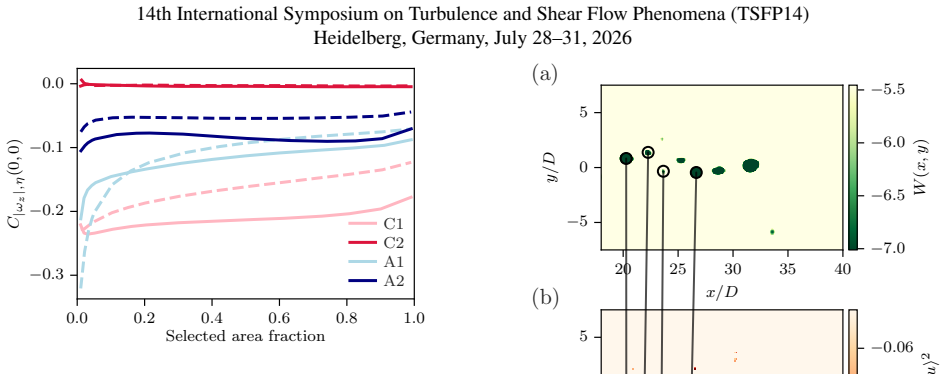
Free-surface deformations correlate only weakly with sub-surface vorticity in turbulent flows.
A machine-rendered reading of the paper's core claim, the machinery that carries it, and where it could break.
Core claim
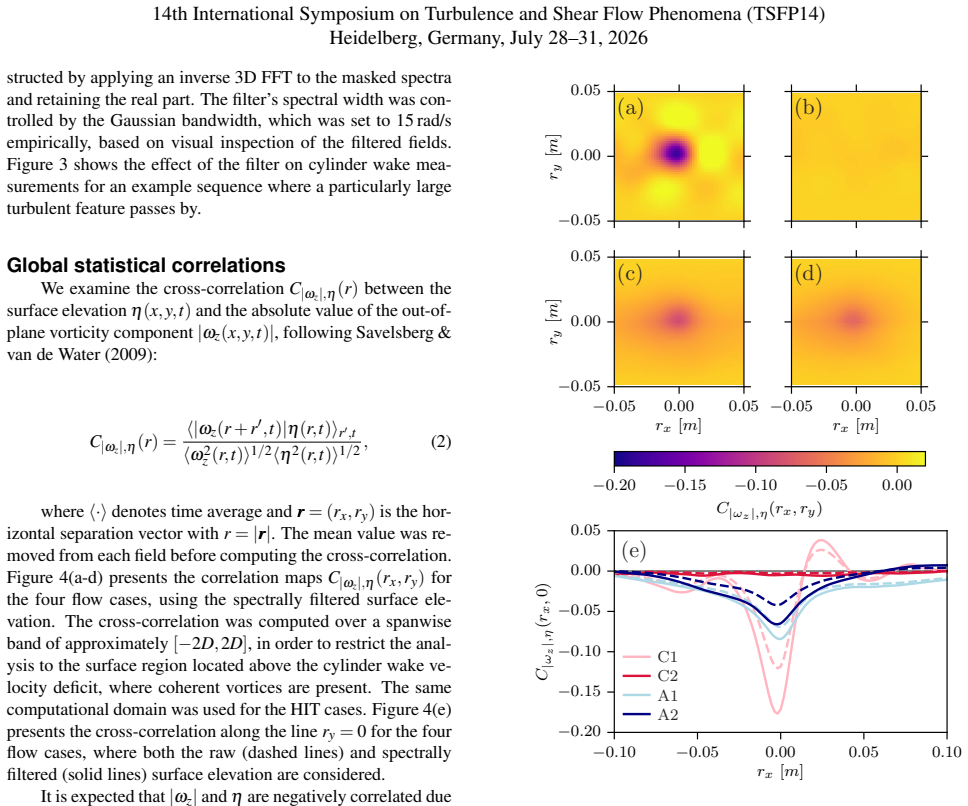
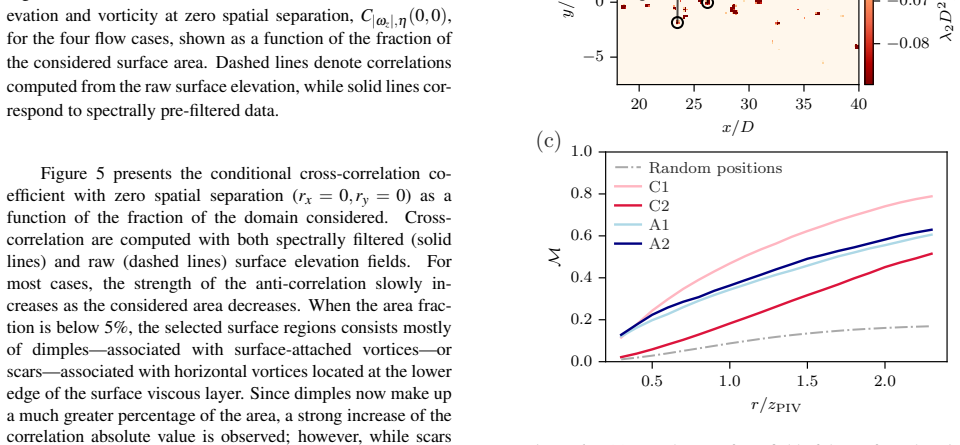
The global surface elevation field exhibits weak cross-correlation with the vorticity field, and conditioning the surface on specific regions produces only slightly stronger correlations, even for three-dimensional homogeneous isotropic turbulence.
What carries the argument
Cross-correlation between the vorticity field and surface elevation field, with additional conditioning on specific surface regions.
If this is right
- Surface observations alone supply limited information about sub-surface coherent structures without region-specific conditioning.
- Statistical properties of velocity and surface motion can be recorded but do not produce strong field-to-field links.
- The same weak-to-modest correlation pattern appears in both cylinder-wake flows and homogeneous isotropic turbulence.
- Remote inference of sub-surface turbulence from surface data requires additional constraints or measurements beyond global elevation.
Where Pith is reading between the lines
- Surface deformation may be dominated by dynamics other than the measured sub-surface vortices, limiting direct inversion from surface data.
- Improved detection of specific flow features might require choosing conditioning regions based on expected coherent-structure signatures.
- The result suggests that multi-point or time-resolved surface measurements could be tested next to strengthen the observed links.
Load-bearing premise
Instantaneous surface indentations are produced primarily by the sub-surface coherent structures being measured rather than by other surface dynamics, measurement artifacts, or uncaptured flow features.
What would settle it
An experiment that measures strong global cross-correlation between vorticity and surface elevation under similar flow conditions would falsify the weak-correlation result.
Figures
read the original abstract
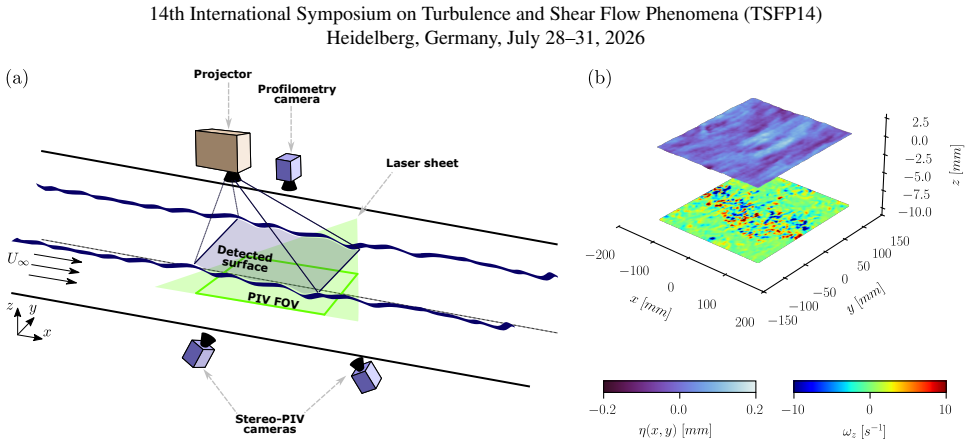
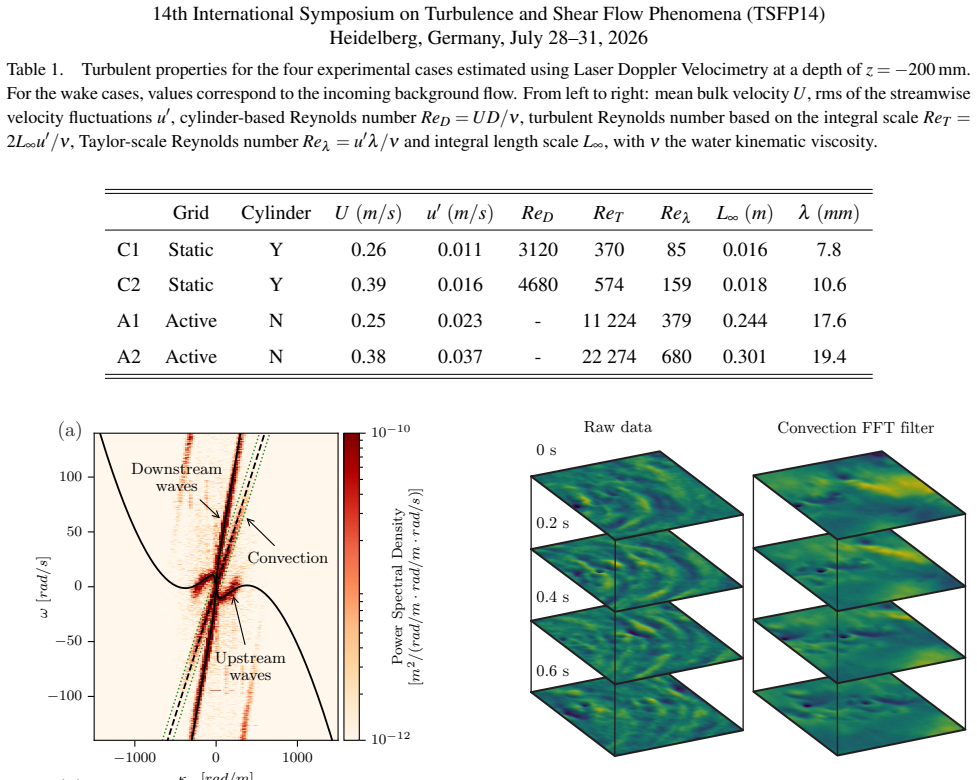
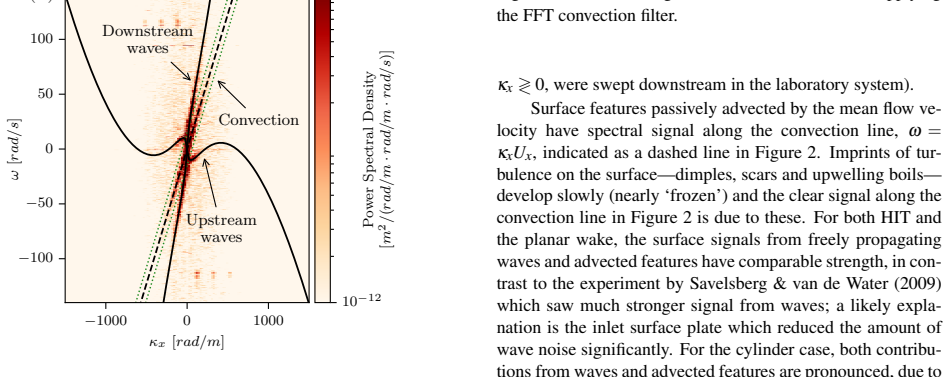
Many turbulent flows encountered in nature -- seas, oceans and rivers -- are bounded by a deformable free surface. A question that remained to be fully explored is to what extent the underlying turbulent flow field can be revealed solely by observing the surface deformations. In this study, we attempt to correlate free-surface topological deformations with the underlying turbulent flow field. We report an experimental investigation of the free surface in the wake of a surface-piercing cylinder and turbulence created by an active grid in an open-channel flow. We are able to study instantaneous events of surface indentations and their related sub-surface coherent structures, as well as statistical properties of velocity and surface motion. We observe weak cross-correlation between the vorticity field and the surface when considering the global surface elevation field. Slightly stronger correlations emerge when conditioning the surface on specific regions, even in the case of three-dimensional homogeneous isotropic turbulence.
Editorial analysis
A structured set of objections, weighed in public.
Referee Report
Summary. The manuscript reports an experimental investigation of correlations between free-surface deformations and sub-surface vorticity fields in two setups: the wake of a surface-piercing cylinder and active-grid-generated homogeneous isotropic turbulence (HIT) in an open-channel flow. It claims weak global cross-correlations between vorticity and surface elevation, with modestly stronger correlations obtained by conditioning the surface on specific regions, even in the HIT case.
Significance. If the reported correlations prove robust after addressing methodological details, the work could contribute observational evidence on how sub-surface coherent structures imprint on free surfaces, with relevance to environmental fluid dynamics. The direct experimental comparison between a wake flow and HIT is a positive aspect, as is the focus on instantaneous events alongside statistics.
major comments (2)
- [Abstract] Abstract, final paragraph: the central claim that 'slightly stronger correlations emerge when conditioning the surface on specific regions' is load-bearing yet unsupported by any quantitative values, error bars, sample sizes, or description of how the conditioning regions were selected or justified a priori; without these, the magnitude and reliability of the reported increase cannot be assessed.
- [Abstract] Abstract, final paragraph: in the HIT case, conditioning on 'specific regions' introduces a risk of selection bias because homogeneity makes arbitrary choices equivalent unless the criterion is fixed independently of the surface data (e.g., from flow geometry alone) and tested against null models of random regions; the current description leaves open whether the modest strengthening reflects a physical link or post-hoc selection.
minor comments (1)
- The abstract states observational findings but omits all numerical correlation coefficients, statistical significance, or details on measurement techniques and conditioning procedure; these should be added for reproducibility even at the abstract level.
Simulated Author's Rebuttal
We thank the referee for their careful reading of the manuscript and for highlighting these points about the abstract. We address each major comment below and will revise the manuscript accordingly.
read point-by-point responses
-
Referee: [Abstract] Abstract, final paragraph: the central claim that 'slightly stronger correlations emerge when conditioning the surface on specific regions' is load-bearing yet unsupported by any quantitative values, error bars, sample sizes, or description of how the conditioning regions were selected or justified a priori; without these, the magnitude and reliability of the reported increase cannot be assessed.
Authors: We agree that the abstract would be strengthened by the inclusion of quantitative support. In the revised manuscript we will update the final paragraph of the abstract to report the specific correlation values (with uncertainties), the number of independent realizations, and a concise statement of how the conditioning regions were defined, with a cross-reference to the methods and results sections where the full procedure and statistics are presented. revision: yes
-
Referee: [Abstract] Abstract, final paragraph: in the HIT case, conditioning on 'specific regions' introduces a risk of selection bias because homogeneity makes arbitrary choices equivalent unless the criterion is fixed independently of the surface data (e.g., from flow geometry alone) and tested against null models of random regions; the current description leaves open whether the modest strengthening reflects a physical link or post-hoc selection.
Authors: We acknowledge the referee's concern regarding potential selection bias in the homogeneous case. The regions were in fact defined from independent geometric and flow features of the facility rather than from the surface data itself. We will revise the manuscript to state this criterion explicitly in the abstract and main text, and we will add a supplementary comparison against randomly chosen regions of equivalent size to demonstrate that the observed modest increase is not reproduced by arbitrary selection. revision: yes
Circularity Check
No significant circularity: purely experimental observations with direct measurements
full rationale
This is an experimental fluid-dynamics study reporting measured cross-correlations between vorticity fields and surface elevation in cylinder-wake and active-grid HIT flows. No derivation chain, first-principles predictions, fitted parameters presented as predictions, or self-citation load-bearing arguments exist. The central claims are direct statistical computations from experimental data; region conditioning is an analysis choice without reduction to self-definition or fitted inputs. The paper is self-contained against external benchmarks and receives the default non-finding.
Axiom & Free-Parameter Ledger
Reference graph
Works this paper leans on
-
[1]
R., Babiker, O
Aarnes, J. R., Babiker, O. M., Xuan, A., Shen, L. & Ellingsen, S. . 2025 Vortex structures under dimples and scars in turbulent free-surface flows. J. Fluid Mech.\/ 1007 , A38
2025
-
[2]
Experimental investigation relating free-surface features to sub-surface turbulence
Babiker, O. M., Aarnes, J. R., Semati, A., Ferran, A., Tee, Y. H., Hearst, R. J. & Ellingsen, S. . 2026 The relationship between surface features and sub-surface turbulence: simulations and experiments. Phys. Rev. Fluids\/ Accepted, in press, https://doi.org/10.48550/arXiv.2510.03732
work page internal anchor Pith review Pith/arXiv arXiv doi:10.48550/arxiv.2510.03732 2026
-
[3]
M., Bjerkeb k, I., Xuan, A., Shen, L
Babiker, O. M., Bjerkeb k, I., Xuan, A., Shen, L. & Ellingsen, S. . 2023 Vortex imprints on a free surface as proxy for surface divergence. J. Fluid Mech.\/ 964 , R2
2023
-
[4]
1994 Upwellings, downdrafts, and whirlpools: Dominant structures in free surface turbulence
Banerjee, S. 1994 Upwellings, downdrafts, and whirlpools: Dominant structures in free surface turbulence. Appl. Mech. Rev.\/ 47 (6S), S166--S172
1994
-
[5]
& Peregrine, D
Brocchini, M. & Peregrine, D. H. 2001 The dynamics of strong turbulence at free surfaces. Part 1. Description . J. Fluid Mech.\/ 449 , 225--254
2001
-
[6]
Caldwell, D. R. & Mourn, J. N. 1995 Turbulence and mixing in the ocean. Rev. Geophys.\/ 33 (S2), 1385--1394
1995
-
[7]
J., Maurel, A., Pagneux, V
Cobelli, P. J., Maurel, A., Pagneux, V. & Petitjeans, P. 2009 Global measurement of water waves by Fourier transform profilometry. Exp.Fluids\/ 46 (6), 1037--1047
2009
-
[8]
2003 On the interaction of a vertical shear layer with a free surface
Dabiri, D. 2003 On the interaction of a vertical shear layer with a free surface. J. Fluid Mech.\/ 480 , 217--232
2003
-
[9]
D'Asaro, E. A. 2014 Turbulence in the upper-ocean mixed layer. Annu. Rev. Marine Sci.\/ 6 , 101--115
2014
-
[10]
DiBenedetto, M. H. 2026 The fluid mechanics of ocean microplastics. Annu. Rev. Fluid Mech.\/ 58 (1), 355--382
2026
-
[11]
Gakhar, S., Koseff, J. R. & Ouellette, N. T. 2022 Extracting free-surface expressions of underwater features. Exp. Fluids\/ 63 (9), 138
2022
-
[12]
S., Rusconi, R
Guasto, J. S., Rusconi, R. & Stocker, R. 2012 Fluid mechanics of planktonic microorganisms. Annu. Rev. Fluid Mech.\/ 44 , 373--400
2012
-
[13]
& Hearst, R
Jooss, Y., Li, L., Bracchi, T. & Hearst, R. J. 2021 Spatial development of a turbulent boundary layer subjected to freestream turbulence. J. Fluid Mech.\/ 911 , A4
2021
-
[14]
A., Ellingsen, S
Li, L., Bullee, P. A., Ellingsen, S. . & Hearst, R. J. 2025 Sub-surface turbulence or non-breaking capillary waves: which dominates air–water gas transfer? J. Fluid Mech.\/ 1009
2025
-
[15]
Longuet-Higgins, M. S. 1996 Surface manifestations of turbulent flow. J. Fluid Mech.\/ 308 , 15--29
1996
-
[16]
1991 Realization of a large-scale turbulence field in a small wind tunnel
Makita, H. 1991 Realization of a large-scale turbulence field in a small wind tunnel. Fluid Dyn. Res.\/ 8 (1-4), 53--64
1991
-
[17]
L., Gakhar, S., Chung, H., Rosenzweig, I
Mandel, T. L., Gakhar, S., Chung, H., Rosenzweig, I. & Koseff, J. R. 2019 On the surface expression of a canopy-generated shear instability. J. Fluid Mech.\/ 867 , 633--660
2019
-
[18]
Muraro, F., Dolcetti, G., Nichols, A., Tait, S. J. & Horoshenkov, K. V. 2021 Free-surface behaviour of shallow turbulent flows. J. Hydraul. Res.\/ 59 (1), 1--20
2021
-
[19]
& van de Water , W
Savelsberg, R. & van de Water , W. 2008 Turbulence of a Free Surface . Phys. Rev. Lett.\/ 100 (3), 034501
2008
-
[20]
& van de Water , W
Savelsberg, R. & van de Water , W. 2009 Experiments on free-surface turbulence. J. Fluid Mech.\/ 619 , 95--125
2009
-
[21]
& Riethmuller, M
Schram, C., Rambaud, P. & Riethmuller, M. L. 2004 Wavelet based eddy structure eduction from a backward facing step flow investigated using particle image velocimetry. Exp. Fluids\/ 36 , 233--245
2004
-
[22]
Semati, A., Shankaran, A., Smeltzer, B. K., s y, E., Hearst, R. J. & Ellingsen, S. . 2026 Simultaneous measurement of surface topology and sub-surface velocity field in free-surface turbulent flow. Submitted manuscript, https://doi.org/10.48550/arXiv.2512.22641
-
[23]
Shen, L., Zhang, X., Yue, D. K. P. & Triantafyllou, G. S. 1999 The surface layer for free-surface turbulent flows. J. Fluid Mech.\/ 386 , 167--212
1999
-
[24]
, " * write output.state after.block = add.period write newline
ENTRY address author booktitle chapter edition editor howpublished institution journal key month note number organization pages publisher school series title type volume year label extra.label sort.label short.list INTEGERS output.state before.all mid.sentence after.sentence after.block FUNCTION init.state.consts #0 'before.all := #1 'mid.sentence := #2 '...
-
[25]
write newline
" write newline "" before.all 'output.state := FUNCTION n.dashify 't := "" t empty not t #1 #1 substring "-" = t #1 #2 substring "--" = not "--" * t #2 global.max substring 't := t #1 #1 substring "-" = "-" * t #2 global.max substring 't := while if t #1 #1 substring * t #2 global.max substring 't := if while FUNCTION word.in bbl.in capitalize " " * FUNCT...
discussion (0)
Sign in with ORCID, Apple, or X to comment. Anyone can read and Pith papers without signing in.