A Dynamic Deontic Simplicial Logic for Joint Commitments
Pith reviewed 2026-06-29 15:04 UTC · model grok-4.3
The pith
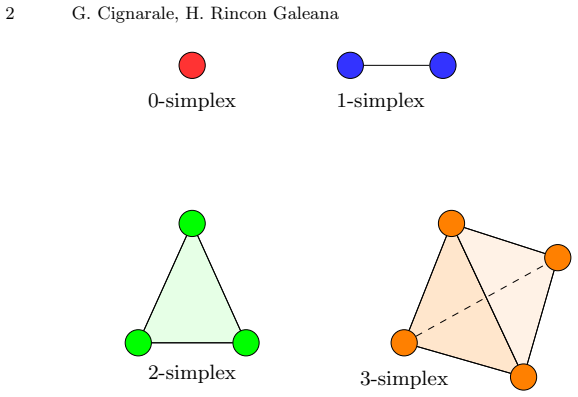
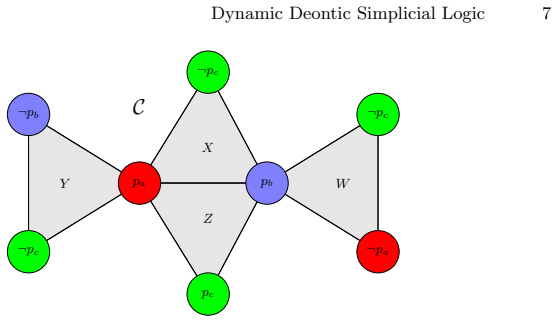
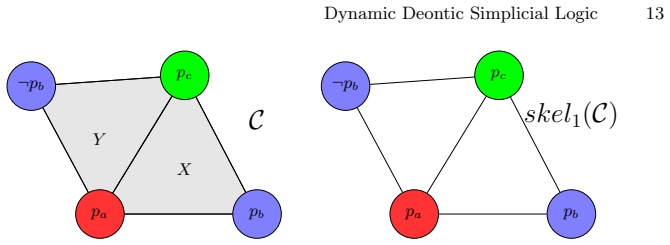
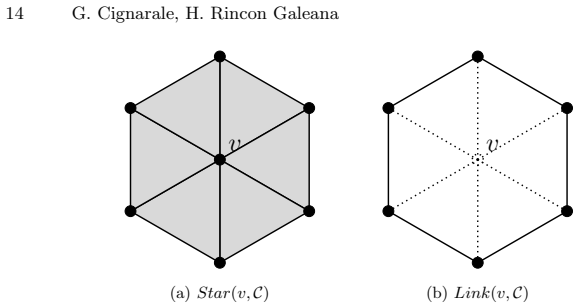
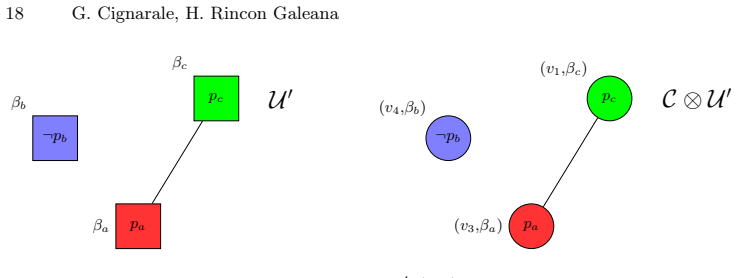
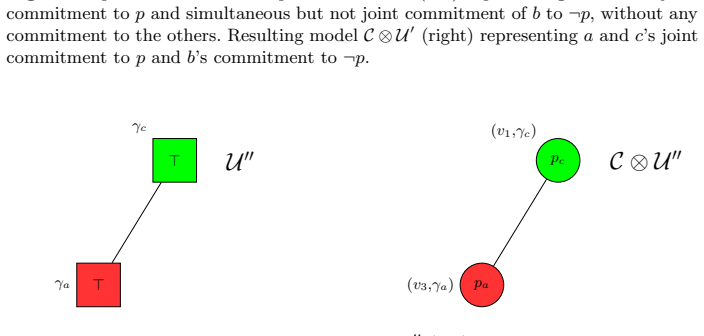
Simplicial complexes receive a deontic interpretation in which vertices stand for individual commitments and higher simplices stand for joint group obligations.
A machine-rendered reading of the paper's core claim, the machinery that carries it, and where it could break.
Core claim
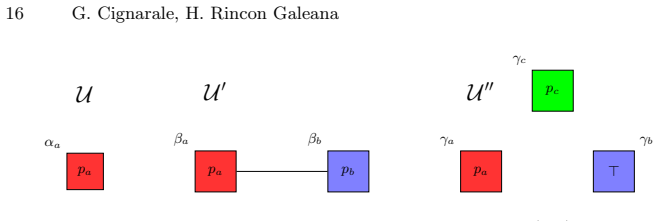
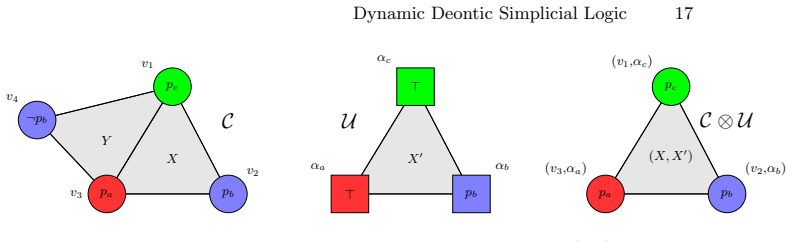
The paper establishes the first deontic interpretation of simplicial models in which vertices represent individual commitments and higher-dimensional simplices represent joint obligations of groups of agents. It extends this to Dynamic Deontic Simplicial Logic, the first dynamic logic based on simplicial complexes, that models agents' choices among mutually exclusive commitments and captures the effects of individual and joint actions via update operations on simplicial models, with soundness and completeness proved for both logics.
What carries the argument
Simplicial complexes under a deontic interpretation, with vertices as individual commitments and higher simplices as joint obligations, plus update operations that model the effects of actions.
If this is right
- Group obligations receive a direct geometric representation as higher-dimensional simplices rather than derived constructs.
- Changes to commitments due to actions are handled uniformly through model updates that preserve the simplicial structure.
- Reasoning about choices among alternative commitments becomes possible within the same framework.
- Both the static and dynamic logics admit sound and complete axiomatizations relative to the simplicial semantics.
Where Pith is reading between the lines
- The simplicial approach could be combined with existing epistemic simplicial logics to reason simultaneously about knowledge and obligation.
- Verification tools for distributed protocols might adopt the update operations to check preservation of joint commitments after collective actions.
- The geometric view may suggest new axioms or frame conditions for other deontic operators by exploiting topological properties of simplicial complexes.
Load-bearing premise
Simplicial complexes can serve as a semantic domain in which the distinction between vertices and higher simplices directly aligns with the distinction between individual and joint commitments, and the defined updates correctly reflect the results of actions.
What would settle it
An explicit counter-model in which an update operation on a simplicial complex fails to produce the structure expected after a described individual or joint action, or a formula valid under the intended semantics that the logic cannot derive.
Figures
read the original abstract
In this paper we introduce the novel Deontic Simplicial Logic (DSL), a deontic logic for group obligations based on simplicial complexes. We provide the first deontic interpretation of simplicial models in which vertices represent individual commitments and higher-dimensional simplices represent joint obligations of groups of agents. We further extend DSL to the Dynamic Deontic Simplicial Logic (DDSL), resulting in the first dynamic logic based on simplicial complexes. DDSL models agents' choices among mutually exclusive commitments and captures the effects of individual and joint actions via update operations on simplicial models. We prove soundness and completeness for both the static and dynamic deontic simplicial logics. We motivate our results with multiple examples, both in the static and dynamic settings.
Editorial analysis
A structured set of objections, weighed in public.
Referee Report
Summary. The paper introduces Deontic Simplicial Logic (DSL), a novel deontic logic interpreting simplicial complexes such that vertices represent individual agent commitments and higher-dimensional simplices represent joint group obligations. It extends the framework to Dynamic Deontic Simplicial Logic (DDSL) by defining update operations that model agents' choices among mutually exclusive commitments and the effects of individual and joint actions. Soundness and completeness are claimed for both the static and dynamic logics, motivated by examples in both settings.
Significance. If the claimed soundness and completeness results hold, the work supplies the first deontic reading of simplicial models and the first dynamic logic based on them. This could provide a geometrically grounded semantics for joint commitments that is distinct from standard Kripke or neighborhood models, with potential applications in multi-agent deontic reasoning. The explicit construction of update operations on simplicial complexes is a notable technical contribution.
minor comments (3)
- [Abstract] The abstract and introduction should explicitly state the language signature (propositional atoms, modalities, and any group operators) before presenting the semantics.
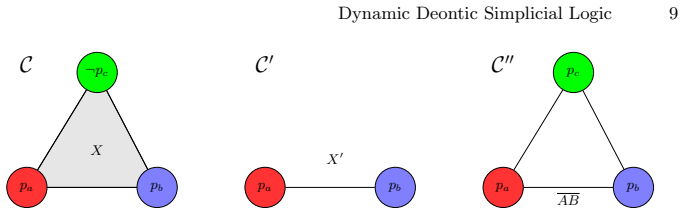
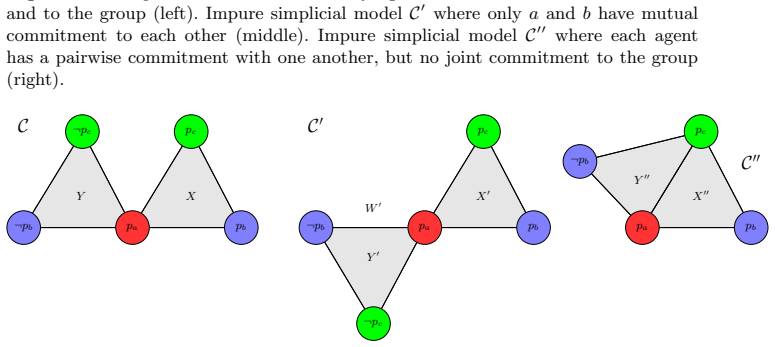
- Examples illustrating the update operations would benefit from a side-by-side comparison of the simplicial complex before and after the action to make the geometric effect of the update visually clear.
- Notation for the simplicial complex (e.g., the distinction between faces and the full complex) should be introduced once and used consistently; occasional shifts between set-theoretic and geometric descriptions can be confusing.
Simulated Author's Rebuttal
We thank the referee for their positive summary of the paper, recognition of its potential significance as the first deontic interpretation of simplicial models and the first dynamic logic on them, and recommendation of minor revision. No specific major comments were listed in the report.
Circularity Check
No significant circularity
full rationale
The paper defines a novel DSL semantics on simplicial complexes (vertices as individual commitments, higher simplices as joint obligations) and extends it to DDSL with explicit update operations, then proves soundness and completeness. No equations reduce by construction to inputs, no parameters are fitted then relabeled as predictions, and no load-bearing steps rest on self-citations or imported uniqueness theorems. The construction is presented as original with motivating examples and formal proofs, making the derivation self-contained against external benchmarks.
Axiom & Free-Parameter Ledger
axioms (2)
- standard math Background axioms and rules of deontic and modal logic
- domain assumption Simplicial complexes admit a deontic reading where dimension corresponds to group size for obligations
invented entities (1)
-
Deontic simplicial models
no independent evidence
Reference graph
Works this paper leans on
-
[1]
Moss, and Slawomir Solecki
Alexandru Baltag, Lawrence S. Moss, and Slawomir Solecki. The logic of public announcements, common knowledge, and private suspicions. InProceedings of the 7th Conference on Theoretical Aspects of Rationality and Knowledge (TARK ’98), Evanston, Illinois, 1998. Morgan Kaufmann
1998
-
[2]
Cambridge University Press, 2005
Cristina Bicchieri.The Grammar of Society: The Nature and Dynamics of Social Norms. Cambridge University Press, 2005
2005
-
[3]
Bisimulation for impure simplicial complexes, 2024
Marta B´ ılkov´ a, Hans van Ditmarsch, Roman Kuznets, and Rojo Randri- anomentsoa. Bisimulation for impure simplicial complexes, 2024. URL:https: //arxiv.org/abs/2406.16785,arXiv:2406.16785
-
[4]
Armando Casta˜ neda, Hans van Ditmarsch, Roman Kuznets, Yoram Moses, and Ulrich Schmid. Epistemic and Topological Reasoning in Distributed Systems (Dagstuhl Seminar 23272).Dagstuhl Reports, 13(7):34–65, 2024. URL:https://drops.dagstuhl.de/entities/document/10.4230/DagRep.13.7. 34,doi:10.4230/DagRep.13.7.34
-
[5]
Commitments: From individual intentions to groups and organizations
Cristiano Castelfranchi. Commitments: From individual intentions to groups and organizations. InProc. of ICMAS, page 528–535. MIT press,, 1995
1995
-
[6]
Logical formalization of social commitments: application to agent communication languages
Benoit Gaudou, Andreas Herzig, and Dominique Longin. Logical formalization of social commitments: application to agent communication languages. InProceedings of The 8th International Conference on Autonomous Agents and Multiagent Sys- tems - Volume 2, AAMAS ’09, page 1293–1294, Richland, SC, 2009. International Foundation for Autonomous Agents and Multiag...
2009
-
[7]
Routledge, 1989
Margaret Gilbert.On Social Facts. Routledge, 1989
1989
-
[8]
A Many-Sorted Epistemic Logic for Chromatic Hypergraphs
´Eric Goubault, Roman Kniazev, and J´ er´ emy Ledent. A Many-Sorted Epistemic Logic for Chromatic Hypergraphs. In Aniello Murano and Alexandra Silva, ed- itors,32nd EACSL Annual Conference on Computer Science Logic (CSL 2024), volume 288 ofLeibniz International Proceedings in Informatics (LIPIcs), pages 30:1–30:18, Dagstuhl, Germany, 2024. Schloss Dagstuh...
-
[9]
´Eric Goubault, J´ er´ emy Ledent, and Sergio Rajsbaum. A simplicial complex model for dynamic epistemic logic to study distributed task computability.Information and Computation, 278, June 2021.doi:10.1016/j.ic.2020.104597
-
[10]
A Simplicial Model for KB4: Epistemic Logic with Agents That May Die
´Eric Goubault, J´ er´ emy Ledent, and Sergio Rajsbaum. A Simplicial Model for KB4: Epistemic Logic with Agents That May Die. In Petra Berenbrink and Ben- jamin Monmege, editors,39th International Symposium on Theoretical Aspects of Computer Science (STACS 2022), volume 219 ofLeibniz International Proceed- ings in Informatics (LIPIcs), pages 33:1–33:20, D...
-
[11]
Semi- simplicial set models for distributed knowledge
´Eric Goubault, Roman Kniazev, J´ er´ emy Ledent, and Sergio Rajsbaum. Semi- simplicial set models for distributed knowledge. In2023 38th Annual ACM/IEEE Symposium on Logic in Computer Science (LICS), pages 1–13, 2023.doi:10. 1109/LICS56636.2023.10175737
-
[12]
Morgan Kaufmann, San Francisco, CA, 2014
Maurice Herlihy, Dmitry Kozlov, and Sergio Rajsbaum.Distributed Computing Through Combinatorial Topology. Morgan Kaufmann, San Francisco, CA, 2014. doi:10.1016/C2011-0-07032-1
-
[13]
Maurice Herlihy and Nir Shavit. The topological structure of asynchronous com- putability.Journal of the ACM, 46(6):858–923, 1999.doi:10.1145/331524. 331529. Dynamic Deontic Simplicial Logic 23
-
[14]
Properties of logics of individ- ual and group agency
Andreas Herzig and Fran¸ cois Schwarzentruber. Properties of logics of individ- ual and group agency. In Carlos Areces and Robert Goldblatt, editors,Ad- vances in Modal Logic, vol. 7 ; ISBN-13: 978-1904987680, volume 7, pages 133– 149, Nancy, France, September 2008. College Publications. URL:https://hal. science/hal-03526736
2008
-
[15]
Horty.Agency and Deontic Logic
John F. Horty.Agency and Deontic Logic. Oxford University Press, New York, 2001
2001
-
[16]
John F. Horty and Nuel Belnap. The deliberative stit: A study of action, omission, ability, and obligation.Journal of Philosophical Logic, 24(6):583–644, 1995.doi: 10.1007/bf01306968
-
[17]
Moral conflicts between groups of agents.Journal of Philosophical Logic, 37(1):1–21, 2008.doi:10.1007/ s10992-007-9049-z
Barteld Kooi and Allard Tamminga. Moral conflicts between groups of agents.Journal of Philosophical Logic, 37(1):1–21, 2008.doi:10.1007/ s10992-007-9049-z
2008
-
[18]
A logical analysis of commitment dynamics
Emiliano Lorini. A logical analysis of commitment dynamics. InProceedings of the 10th International Conference on Deontic Logic in Computer Science, DEON’10, page 288–305, Berlin, Heidelberg, 2010. Springer-Verlag
2010
-
[19]
Meyer, W
J.-J.Ch. Meyer, W. van der Hoek, and B. van Linder. A logical approach to the dynamics of commitments.Artificial Intelligence, 113(1):1–40, 1999. URL:https: //www.sciencedirect.com/science/article/pii/S0004370299000612,doi:10. 1016/S0004-3702(99)00061-2
1999
-
[20]
Armando Casta neda, Hans van Ditmarsch, David A. Rosenblueth, and Diego A. Vel´ azquez. Communication pattern logic: Epistemic and topological views.Journal of Philosophical Logic, 52(5):1445–1473, 2023.doi:10.1007/s10992-023-09713-8
-
[21]
Logics of public communications.Synthese, 158(2):165–179, September
Jan Plaza. Logics of public communications.Synthese, 158(2):165–179, September
-
[22]
Originally published in 1989.doi:10.1007/s11229-007-9168-7
-
[23]
Rojo Randrianomentsoa, Hans van Ditmarsch, and Roman Kuznets. Impure sim- plicial complexes: Complete axiomatization.Logical Methods in Computer Science, 19(4):3:1–3:35, 2023.doi:10.48550/arXiv.2211.13543
-
[24]
The Logic of Action
Krister Segerberg, John-Jules Meyer, and Marcus Kracht. The Logic of Action. In Edward N. Zalta and Uri Nodelman, editors,The Stanford Encyclopedia of Philosophy. Metaphysics Research Lab, Stanford University, Summer 2024 edition, 2024
2024
-
[25]
Deontic logic for strategic games.Erkenntnis, 78(1):183–200, 2013.doi:10.1007/s10670-011-9349-0
Allard Tamminga. Deontic logic for strategic games.Erkenntnis, 78(1):183–200, 2013.doi:10.1007/s10670-011-9349-0
-
[26]
Allard Tamminga and Hein Duijf. Collective obligations, group plans and in- dividual actions.Economics and Philosophy, 33(2):187–214, July 2017.doi: 10.1017/S0266267116000213
-
[27]
Allard Tamminga, Hein Duijf, and Frederik Van De Putte. Expressivity results for deontic logics of collective agency.Synthese, 198(9):8733–8753, 2021.doi: 10.1007/s11229-020-02597-0
-
[28]
The irreducibility of collective obligations.Philosophical Studies, 177(4):1085–1109, 2020.doi:10.1007/ s11098-018-01236-2
Allard Tamminga and Frank Hindriks. The irreducibility of collective obligations.Philosophical Studies, 177(4):1085–1109, 2020.doi:10.1007/ s11098-018-01236-2
2020
-
[29]
Oxford University Press, United Kingdom, 2007
Raimo Tuomela.The philosophy of sociality: the shared point of view. Oxford University Press, United Kingdom, 2007
2007
-
[30]
van Ditmarsch, J.Y
H. van Ditmarsch, J.Y. Halpern, W. van der Hoek, and B.P. Kooi.Handbook of Epistemic Logic. College Publications, 2015
2015
-
[31]
Springer, May 2022.doi:10.1007/978-3-030-75267-5\_1
Hans van Ditmarsch, ´Eric Goubault, J´ er´ emy Ledent, and Sergio Rajsbaum.Knowl- edge and simplicial complexes, volume 143 ofPhilosophical Studies Series, pages 1–50. Springer, May 2022.doi:10.1007/978-3-030-75267-5\_1. 24 G. Cignarale, H. Rincon Galeana
-
[32]
Hans van Ditmarsch and Roman Kuznets. Wanted dead or alive: epistemic logic for impure simplicial complexes.Journal of Logic and Computation, 35(6):31–46, 10 2024.doi:10.1093/logcom/exae055
-
[33]
On two- and three-valued semantics for impure simplicial complexes
Hans van Ditmarsch, Roman Kuznets, and Rojo Randrianomentsoa. On two- and three-valued semantics for impure simplicial complexes. InInternational Symposium on Games, Automata, Logics and Formal Verification, 2023. URL: https://api.semanticscholar.org/CorpusID:263285073
2023
-
[34]
Springer, 2007.doi:10.1007/ 978-1-4020-5839-4
Hans van Ditmarsch, Wiebe van der Hoek, and Barteld Kooi.Dynamic Epis- temic Logic, volume 337 ofSynthese Library. Springer, 2007.doi:10.1007/ 978-1-4020-5839-4
2007
-
[35]
Hans van Ditmarsch, ´Eric Goubault, Marijana Lazi´ c, J´ er´ emy Ledent, and Sergio Rajsbaum. A dynamic epistemic logic analysis of equality negation and other epis- temic covering tasks.Journal of Logical and Algebraic Methods in Programming, 121:100662, 2021.doi:10.1016/j.jlamp.2021.100662
discussion (0)
Sign in with ORCID, Apple, or X to comment. Anyone can read and Pith papers without signing in.