Load Management of Distribution Systems via Online Dynamic Pricing
Pith reviewed 2026-06-29 15:43 UTC · model grok-4.3
The pith
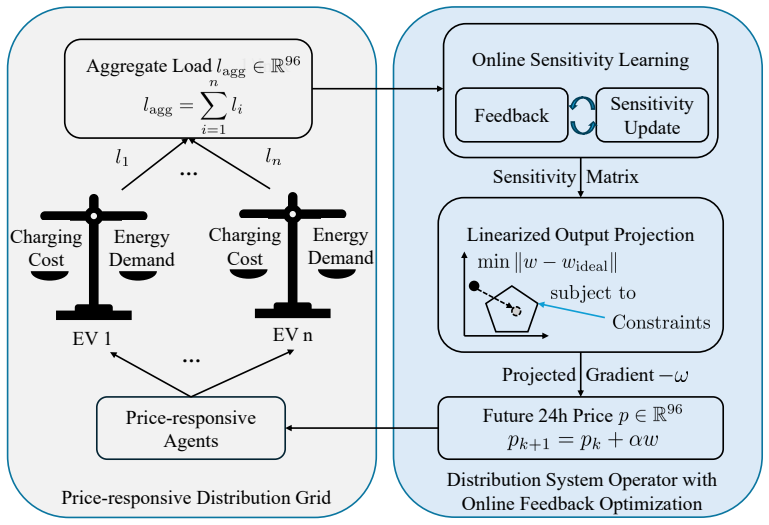
An online feedback optimization algorithm designs day-ahead electricity prices to cut distribution peaks using only aggregate load measurements.
A machine-rendered reading of the paper's core claim, the machinery that carries it, and where it could break.
Core claim
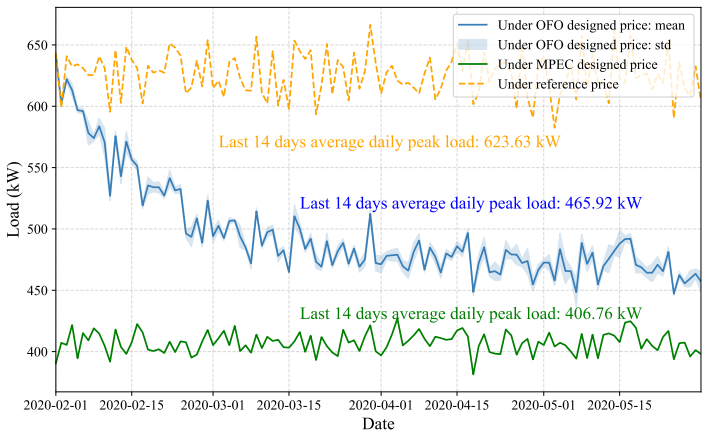
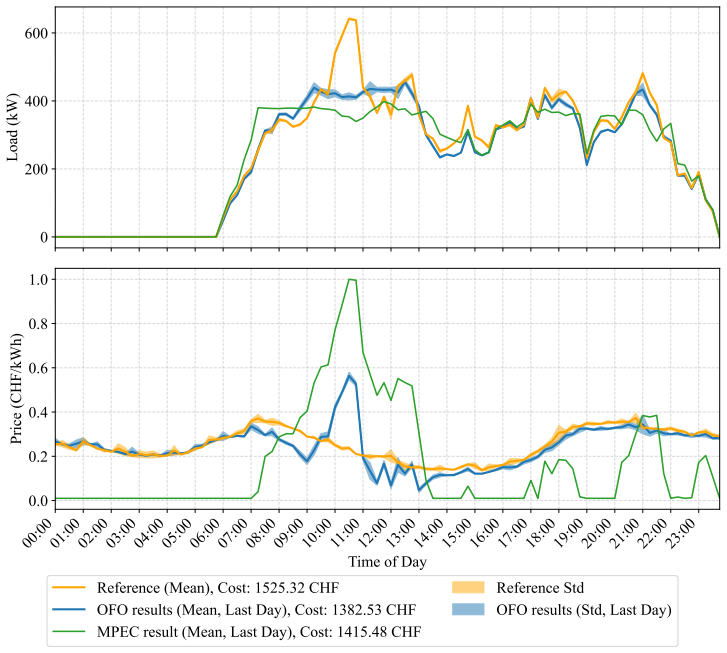
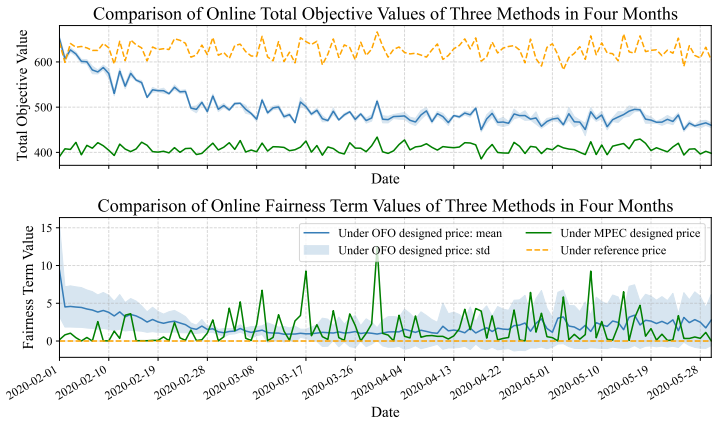
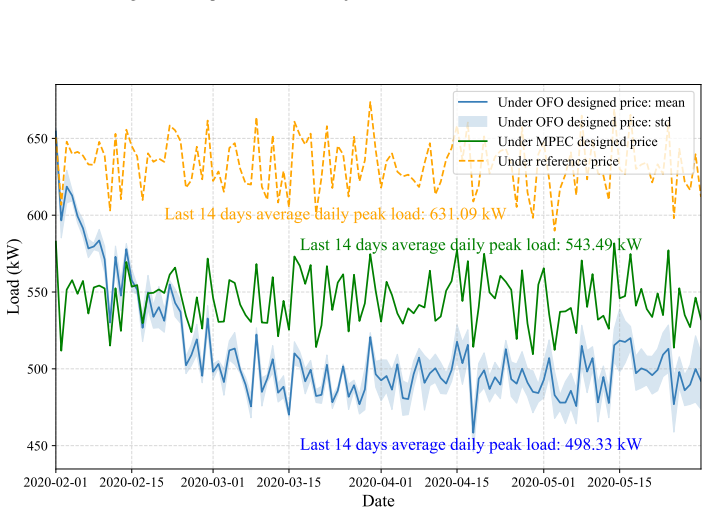
The OFO algorithm updates prices iteratively from aggregate load measurements alone and converges to the optimal day-ahead price vector, delivering peak reduction performance comparable to a Stackelberg benchmark that requires full model information while incurring substantially lower computational cost.
What carries the argument
The Online Feedback Optimization (OFO) algorithm, which performs iterative price updates via feedback from aggregate load measurements.
If this is right
- Peak-demand management becomes feasible in grids where only feeder-level measurements are available.
- Privacy concerns from collecting individual user data can be avoided while still achieving near-optimal load shifting.
- Day-ahead price setting requires far lower online computation than model-based game-theoretic methods.
- The approach remains effective under realistic mismatches in charging windows.
Where Pith is reading between the lines
- The same aggregate-feedback loop could be tested on real-time pricing rather than day-ahead tariffs.
- If the convergence holds under network constraints, OFO might extend to voltage or congestion management.
- Scaling the method to larger networks would require checking whether the number of iterations stays practical.
Load-bearing premise
Iterative price updates driven only by total load measurements are enough to reach the optimal price without knowing individual user behavior or consumption patterns.
What would settle it
Run the OFO price updates on a distribution system where the resulting peak demand remains substantially higher than the Stackelberg benchmark across multiple initial conditions and charging schedules.
Figures
read the original abstract
The growing adoption of electric vehicles (EVs) is increasing peak demand in distribution systems, which can threaten grid stability and reduce operational efficiency. Dynamic electricity pricing is a promising means of mitigating these peaks by shifting flexible demand. However, most existing approaches rely on detailed user-level consumption data and behavioral models, which are often difficult to obtain in practice and may raise privacy concerns. This paper proposes an Online Feedback Optimization (OFO) algorithm for day-ahead price design with limited data, where only aggregate loads are observed. OFO updates prices iteratively using aggregate load measurements, enabling effective peak reduction without access to individual user data. The formulation also includes a term that penalizes deviations in total electricity cost relative to a reference tariff. Although relying only on aggregate load measurements, the OFO price updates efficiently converge to the optimal price. In finite-horizon simulations, OFO achieves peak reduction close to that of the Stackelberg benchmark with full model information. Meanwhile, its computational effort is substantially lower. Additional tests under multiple initial conditions and delayed charging-window mismatch further confirm the robustness of the proposed method. Overall, these results show that OFO is a scalable and computationally efficient approach for peak-demand management in distribution systems with limited observability.
Editorial analysis
A structured set of objections, weighed in public.
Referee Report
Summary. The paper introduces an Online Feedback Optimization (OFO) algorithm for designing day-ahead dynamic electricity prices to manage peak demand from electric vehicles in distribution systems. The method relies solely on aggregate load measurements to iteratively update prices, incorporates a penalty term for deviations in total electricity cost from a reference tariff, and is claimed to converge to the optimal price. Simulations show it achieves peak reduction close to a full-information Stackelberg benchmark with significantly lower computational effort and demonstrates robustness to different initial conditions and charging window mismatches.
Significance. Should the convergence properties hold, this work would offer a scalable, privacy-preserving approach to load management that does not require individual user consumption data or behavioral models, addressing practical challenges in distribution system operation amid rising EV adoption. The comparison to the benchmark and robustness tests provide evidence of its potential effectiveness and efficiency.
major comments (1)
- [Abstract] Abstract: The assertion that 'the OFO price updates efficiently converge to the optimal price' using only aggregate load measurements lacks any supporting convergence theorem, sufficient conditions (e.g., strong monotonicity of the aggregate price-to-load map or step-size rules), or analysis of the penalized cost function, with all evidence limited to finite-horizon simulations under specific EV scenarios.
minor comments (1)
- The abstract would benefit from including at least one key equation for the OFO update rule or the penalized objective to allow initial assessment of the claimed properties.
Simulated Author's Rebuttal
We thank the referee for this constructive comment on the abstract. We agree that the current wording overstates the theoretical support for convergence and will revise the manuscript accordingly.
read point-by-point responses
-
Referee: [Abstract] Abstract: The assertion that 'the OFO price updates efficiently converge to the optimal price' using only aggregate load measurements lacks any supporting convergence theorem, sufficient conditions (e.g., strong monotonicity of the aggregate price-to-load map or step-size rules), or analysis of the penalized cost function, with all evidence limited to finite-horizon simulations under specific EV scenarios.
Authors: We agree with the referee. The manuscript contains no convergence theorem, no sufficient conditions such as strong monotonicity or step-size rules, and no analysis of the penalized cost function; all supporting evidence is from the finite-horizon simulations. We will revise the abstract to replace the claim of convergence with the statement that the OFO updates 'numerically achieve peak reduction close to the Stackelberg benchmark in simulations.' We will also add a clarifying sentence in Section IV or the conclusion noting that formal convergence analysis is beyond the scope of the present work. These changes will appear in the revised manuscript. revision: yes
Circularity Check
No significant circularity; claims rest on external simulations
full rationale
The abstract and skeptic summary describe OFO convergence and peak-reduction performance as demonstrated via finite-horizon simulations under specific EV scenarios, without any quoted equations, fitted parameters renamed as predictions, or self-citation chains that reduce the central claim to its own inputs by construction. No self-definitional steps, ansatz smuggling, or uniqueness theorems imported from the authors appear in the provided text. The derivation is therefore treated as self-contained against external benchmarks.
Axiom & Free-Parameter Ledger
free parameters (1)
- weight on total electricity cost deviation penalty
Reference graph
Works this paper leans on
-
[1]
H. P. Lee, Integrating distributed energy resources in power distribution systems: A comprehensive review of impacts, challenges, and opportuni- ties from a distribution system operator’s perspective, Applied Energy 403 (2026) 127052. doi: https://doi.org/10.1016/j.apenergy.2025. 127052
-
[2]
P. Jaruwatanachai, Y . Sukamongkol, T. Samanchuen, Predicting and managing ev charging demand on electrical grids: A simulation-based approach, Energies 16 (2023). doi:10.3390/en16083562
-
[4]
K. K. Mehmood, R. A. A. Moura, A. van der Molen, R. Tonkoski, P. Tzscheutschler, P. van der Wielen, P. H. Nguyen, A review of con- gestion management methods for power distribution networks: Current practices and future challenges, Applied Energy 407 (2026) 127342. doi:https://doi.org/10.1016/j.apenergy.2025.127342
-
[5]
N. G. Paterakis, O. Erdinc ¸, A. G. Bakirtzis, J. P. S. Catal˜ao, Optimal house- hold appliances scheduling under day-ahead pricing and load-shaping demand response strategies, IEEE Transactions on Industrial Informatics 11 (2015) 1509–1519. doi:10.1109/TII.2015.2438534
-
[6]
D. S. Callaway, I. A. Hiskens, Achieving controllability of electric loads, Proceedings of the IEEE 99 (2011) 184–199. doi:10.1109/JPROC.2010. 2081652
-
[7]
Z. Ma, D. S. Callaway, I. A. Hiskens, Decentralized charging control of large populations of plug-in electric vehicles, IEEE Transactions on Control Systems Technology 21 (2013) 67–78. doi:10.1109/TCST.2011. 2174059
- [8]
-
[9]
R. J. Hennig, L. J. de Vries, S. H. Tindemans, Congestion management in electricity distribution networks: Smart tariffs, local markets and direct control, Utilities Policy 85 (2023) 101660. doi: 10.1016/j.jup.2023. 101660
-
[10]
M. Schreiber, M. E. Wainstein, P. Hochloff, R. Dargaville, Flexible elec- tricity tariffs: Power and energy price signals designed for a smarter grid, Energy 93 (2015) 2568–2581. doi:10.1016/j.energy.2015.10.067
-
[11]
M. B. Rasheed, M. A. Qureshi, N. Javaid, T. Alquthami, Dynamic Pricing Mechanism With the Integration of Renewable Energy Source in Smart Grid, IEEE Access 8 (2020) 16876–16892. doi: 10.1109/ACCESS.2020. 2967798
-
[12]
M. S. Nazir, I. A. Hiskens, Load synchronization and sustained oscillations induced by transactive control, in: 2017 IEEE Power & Energy Society General Meeting, 2017, pp. 1–5. doi:10.1109/PESGM.2017.8273922
-
[13]
A. Faruqui, S. Sergici, Household response to dynamic pricing of elec- tricity: A survey of 15 experiments, Journal of Regulatory Economics 38 (2010) 193–225. doi:10.1007/s11149-010-9127-y
-
[14]
J. Lin, W. Yu, X. Yang, Towards Multistep Electricity Prices in Smart Grid Electricity Markets, IEEE Transactions on Parallel and Distributed Systems 27 (2016) 286–302. doi:10.1109/TPDS.2015.2388479
-
[15]
J. Cui, W. Jiang, C. Wu, Pricing mechanism design for future ev charging station with hybrid fixed and mobile charging modes, Applied Energy 380 (2025) 125033. doi: https://doi.org/10.1016/j.apenergy.2024. 125033
-
[16]
Y . Li, J. Li, J. He, S. Zhang, The real-time pricing optimization model of smart grid based on the utility function of the logistic function, Energy 224 (2021) 120172. doi:10.1016/j.energy.2021.120172
-
[17]
P. Tarasak, Optimal real-time pricing under load uncertainty based on util- ity maximization for smart grid, in: 2011 IEEE International Conference on Smart Grid Communications (SmartGridComm), 2011, pp. 321–326. doi:10.1109/SmartGridComm.2011.6102341
-
[18]
S. Subramanian, S. Ghosh, J. R. M. Hosking, R. Natarajan, X. Zhang, Dynamic price optimization models for managing time-of-day electric- ity usage, in: 2013 IEEE International Conference on Smart Grid Communications (SmartGridComm), 2013, pp. 163–168. doi:10.1109/ SmartGridComm.2013.6687951
- [19]
- [21]
-
[22]
T.-C. Chiu, Y .-Y . Shih, A.-C. Pang, C.-W. Pai, Optimized Day-Ahead Pricing With Renewable Energy Demand-Side Management for Smart Grids, IEEE Internet of Things Journal 4 (2017) 374–383. doi: 10.1109/ JIOT.2016.2556006
-
[24]
B. Palaniyappan, S. K. R, V . T, Dynamic pricing for load shifting: Re- ducing electric vehicle charging impacts on the grid through machine learning-based demand response, Sustainable Cities and Society 103 (2024) 105256. doi:10.1016/j.scs.2024.105256
-
[25]
H. Taherian, M. R. Aghaebrahimi, L. Baringo, S. R. Goldani, Optimal dynamic pricing for an electricity retailer in the price-responsive environ- ment of smart grid, International Journal of Electrical Power & Energy Systems 130 (2021) 107004. doi:10.1016/j.ijepes.2021.107004
-
[26]
Z. Guo, W. Xu, Y . Yan, M. Sun, How to realize the power demand side actively matching the supply side? ——a virtual real-time electricity prices optimization model based on credit mechanism, Applied Energy 343 (2023) 121223. doi: https://doi.org/10.1016/j.apenergy.2023. 121223
-
[27]
R. Poli, J. Kennedy, T. Blackwell, Particle swarm optimiza- tion: An overview, Swarm Intelligence 1 (2007). doi: 10.1007/ s11721-007-0002-0
2007
- [28]
-
[29]
L. Jia, L. Tong, Dynamic Pricing and Distributed Energy Management for Demand Response, IEEE Transactions on Smart Grid 7 (2016) 1128–1136. doi:10.1109/TSG.2016.2515641
-
[30]
G. Behnke, M. Steinmetz, On the computational complexity of stackelberg planning and meta-operator verification, Proceedings of the International Conference on Automated Planning and Scheduling 34 (2024) 20–24. doi:10.1609/icaps.v34i1.31456
- [31]
-
[32]
A. Hauswirth, Z. He, S. Bolognani, G. Hug, F. D ¨orfler, Optimization algorithms as robust feedback controllers, Annual Reviews in Control 57 (2024) 100941. doi:https://doi.org/10.1016/j.arcontrol.2024. 100941
-
[33]
S. Grammatico, Dynamic control of agents playing aggregative games with coupling constraints, IEEE Transactions on Automatic Control 62 (2017) 4537–4548. doi:10.1109/TAC.2017.2672902. 17
-
[34]
G. Belgioioso, S. Grammatico, Semi-decentralized generalized nash equi- librium seeking in monotone aggregative games, IEEE Transactions on Au- tomatic Control 68 (2023) 140–155. doi:10.1109/TAC.2021.3135360
-
[35]
A. Simonetto, E. Dall’Anese, S. Paternain, G. Leus, G. B. Giannakis, Time- varying convex optimization: Time-structured algorithms and applications, Proceedings of IEEE 108 (2020) 2032–2048. URL: https://arxiv. org/abs/2006.08500
-
[36]
A. D. Dom ´ınguez-Garc´ıa, M. Zholbaryssov, T. Amuda, O. Ajala, An online feedback optimization approach to voltage regulation in inverter- based power distribution networks, in: 2023 American Control Con- ference (ACC), 2023, pp. 1868–1873. doi:10.23919/ACC55779.2023. 10156309
- [38]
-
[39]
J. Fortuny-Amat, B. McCarl, A representation and economic interpretation of a two-level programming problem, The Journal of the Operational Research Society 32 (1981) 783–792. URL: http://www.jstor.org/ stable/2581394
-
[40]
Mitsos, B
A. Mitsos, B. Chachuat, P. I. Barton, Mccormick-based relaxations of algorithms, SIAM Journal on Optimization 20 (2009) 573–601. doi: 10. 1137/080717341
2009
-
[41]
URL:https://www.gurobi.com
Gurobi Optimization, LLC, Gurobi Optimizer Reference Manual, 2026. URL:https://www.gurobi.com
2026
-
[42]
S. Boyd, L. Vandenberghe, Convex Optimization, Cambridge Uni- versity Press, 2004. URL: https://books.google.nl/books?id= mYm0bLd3fcoC
2004
-
[43]
J. Nocedal, S. J. Wright, Numerical Optimization, Springer, 2006. doi:https://doi.org/10.1007/978-0-387-40065-5
-
[44]
M. Picallo, L. Ortmann, S. Bolognani, F. D¨orfler, Adaptive real-time grid operation via Online Feedback Optimization with sensitivity estimation, Electric Power Systems Research 212 (2022) 108405. doi: 10.1016/j. epsr.2022.108405
work page doi:10.1016/j 2022
-
[45]
R. L. Karandikar, M. Vidyasagar, Convergence rates for stochastic ap- proximation: Biased noise with unbounded variance, and applications, Journal of Optimization Theory and Applications 203 (2024) 2412–2450. doi:10.1007/s10957-024-02547-7
-
[46]
H. J. Kushner, G. G. Yin, Stochastic approximation and recursive al- gorithms and applications, Springer, 2003. doi: https://doi.org/10. 1007/b97441
2003
-
[47]
M. Borowski, B. Miasojedow, Convergence of projected stochastic ap- proximation algorithm (2025). URL: https://arxiv.org/abs/2501. 08256.arXiv:2501.08256
-
[48]
Madden, S
L. Madden, S. Becker, High probability convergence bounds for non-convex stochastic gradient descent with sub-weibull noise, J. Mach. Learn. Res. 25 (2024). URL: http://jmlr.org/papers/v25/ 23-0466.html
2024
-
[49]
Kushner, Stochastic approximation: a survey, WIREs Computational Statistics 2 (2010) 87–96
H. Kushner, Stochastic approximation: a survey, WIREs Computational Statistics 2 (2010) 87–96. doi:https://doi.org/10.1002/wics.57
-
[50]
ch/fr/electricite/vario, 2025
Groupe E, Vario: Dynamic electricity tariff,https://www.groupe-e. ch/fr/electricite/vario, 2025. Accessed: 2025-05-29. 18
2025
discussion (0)
Sign in with ORCID, Apple, or X to comment. Anyone can read and Pith papers without signing in.