Copula and spatial-regularized variational autoencoder for mapping disease comorbidity in West Africa
Pith reviewed 2026-06-29 15:34 UTC · model grok-4.3
The pith
A spatially regularized VAE combined with a Gumbel copula maps asymmetric dependencies among diarrhea, fever, and ARI in West African children and identifies high-risk zones.
A machine-rendered reading of the paper's core claim, the machinery that carries it, and where it could break.
Core claim
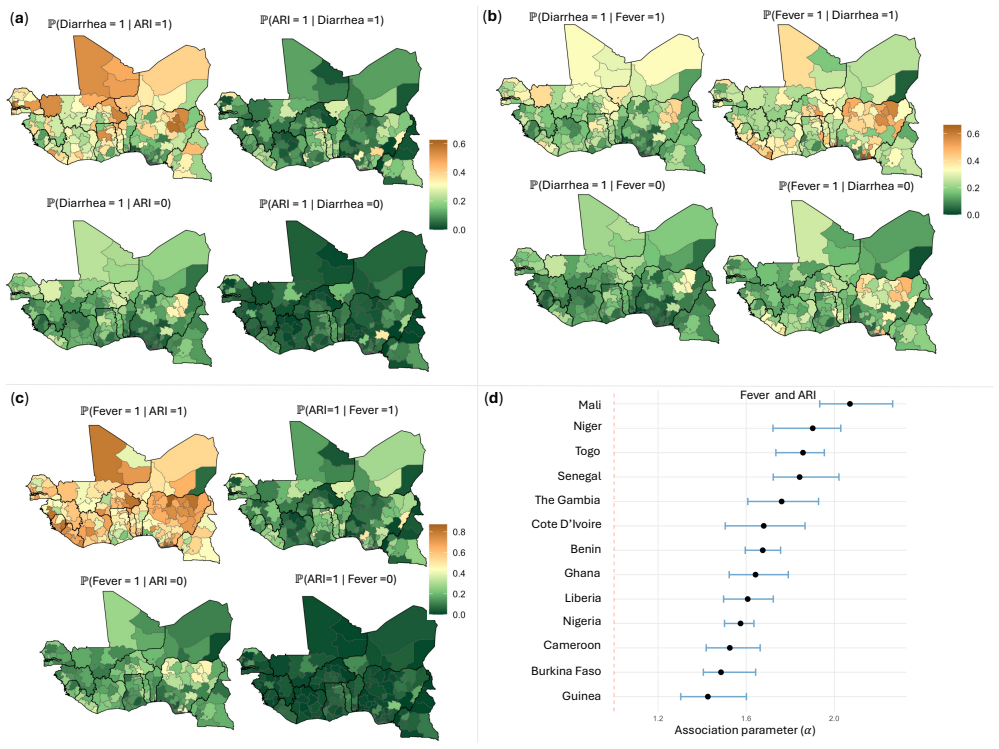
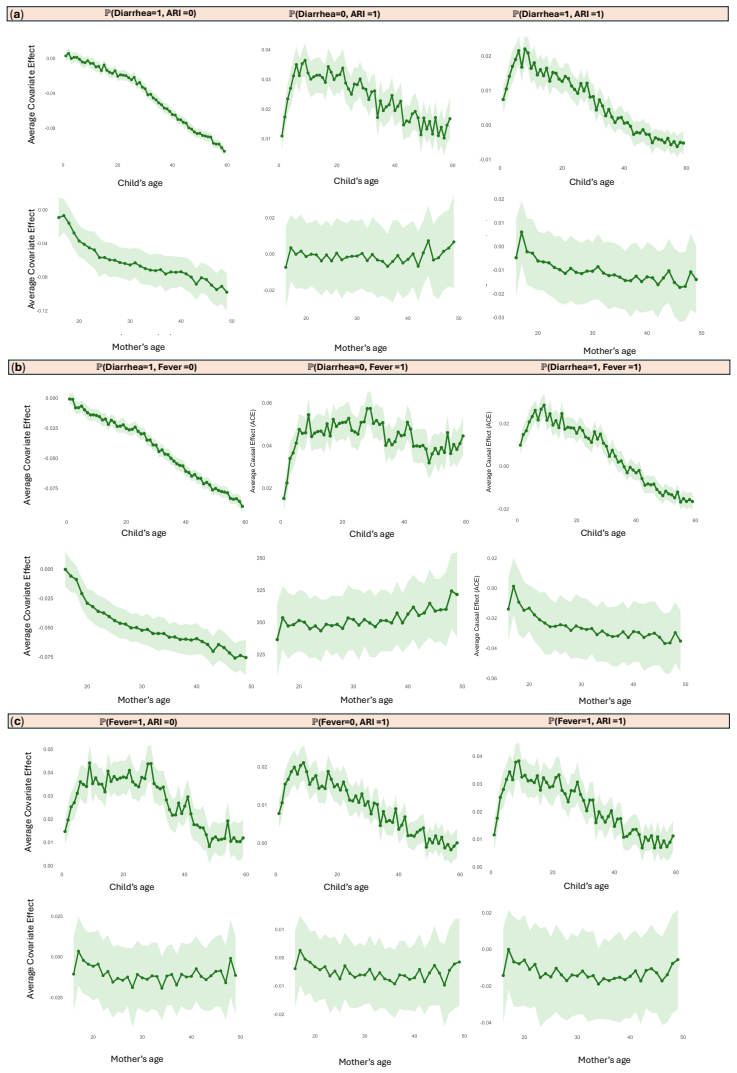
The spatially regularized VAE with bivariate Gumbel copula enables flexible modeling of asymmetric dependence and quantification of joint and conditional morbidity risks, revealing pronounced spatial heterogeneity in the likelihood of comorbidity among West African children, with the strongest co-occurrence observed between fever and ARI. Household wealth, maternal education, and access to improved water sources were associated with the likelihood of comorbidity.
What carries the argument
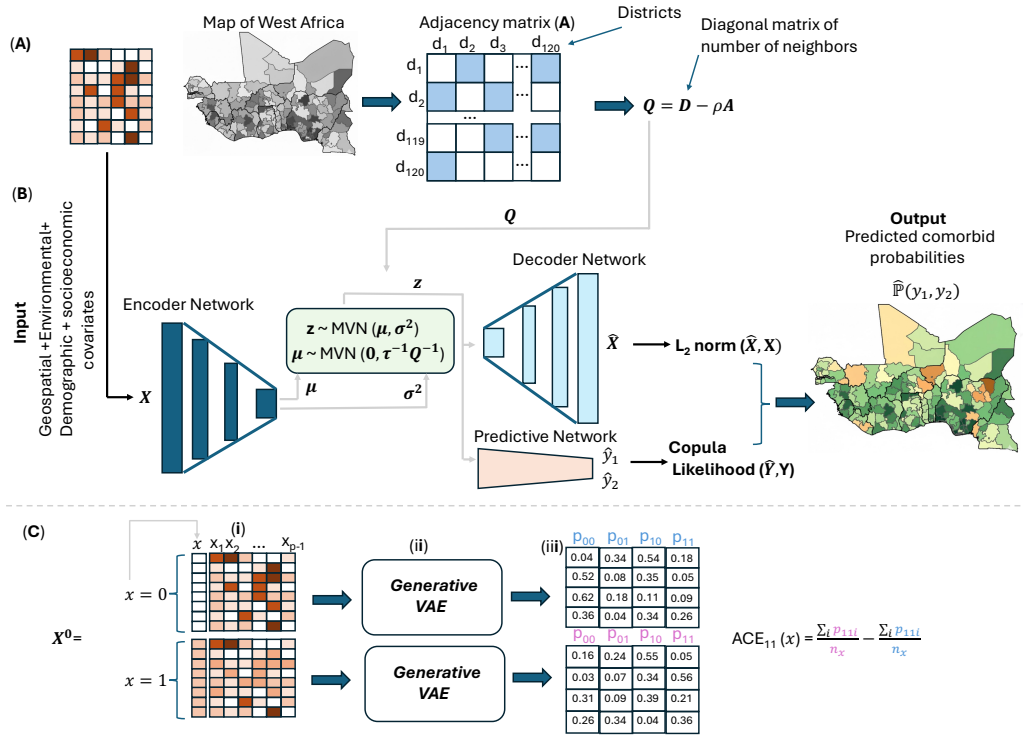
Spatially regularized variational autoencoder integrated with bivariate Gumbel copula, which embeds location-based penalties into the latent space while using the copula to capture upper-tail dependence between binary disease indicators.
If this is right
- Joint and conditional probabilities of the three diseases can be computed directly from the fitted copula parameters.
- Covariate effects on comorbidity risk can be read out from the decoder network for epidemiological interpretation.
- Maps of predicted comorbidity likelihood highlight locations where overlapping illnesses are most probable.
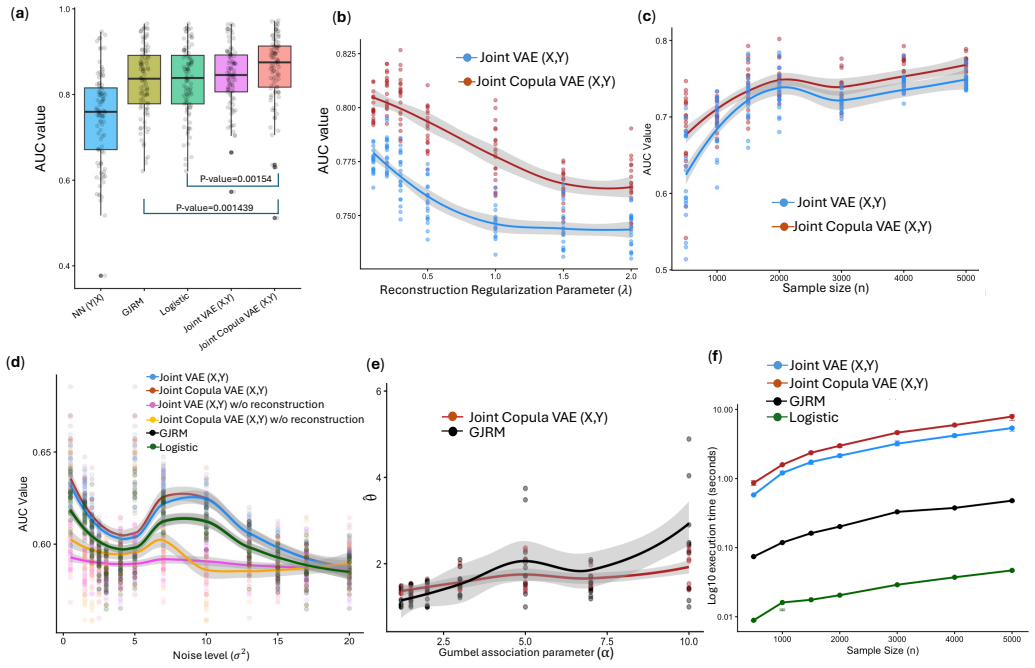
- Benchmark comparisons show the proposed model outperforms standard non-spatial or non-copula alternatives on the same data.
Where Pith is reading between the lines
- The same architecture could be retrained on data from other regions to test whether similar spatial clusters appear elsewhere.
- Extending the copula to three or more diseases would allow direct estimation of triple comorbidity risk.
- If the spatial regularization term is removed, the model would likely produce smoother but less accurate risk surfaces.
Load-bearing premise
The Demographic and Health Survey responses accurately reflect true spatial patterns of comorbidity and that the Gumbel copula plus spatial penalty terms capture the underlying dependence structure without large bias.
What would settle it
Independent household survey data collected in the same West African countries that shows materially different joint probabilities or spatial clusters for fever-ARI co-occurrence than the fitted model produces.
Figures
read the original abstract
Geospatial health disproportionality remains a critical public health concern, as communities face heterogeneous illness risks due to varying exposures to adverse socioeconomic and environmental conditions. While statistical models have been adopted to identify risk factors, studies that account for the complex, non-linear dependencies and spatial regularities inherent in comorbid disease patterns are underdeveloped. In this work, we propose a novel spatially regularized variational autoencoder (VAE) to characterize and map the geospatial disproportion of childhood comorbidity in West Africa, focusing on diarrhea, fever, and acute respiratory infection (ARI). To model dependence between these conditions, this study integrates a bivariate Gumbel copula into the VAE framework, enabling flexible modeling of asymmetric dependence and quantification of joint and conditional morbidity risks. Additionally, covariate effects within the framework were quantified to facilitate epidemiological interpretation of risk factors. The proposed method was benchmarked against commonly used methods and applied to characterize comorbidity in West Africa using the Demographic and Health Survey data. Findings reveal pronounced spatial heterogeneity in the likelihood of comorbidity among West African children, with the strongest co-occurrence observed between fever and ARI. Household wealth, maternal education, and access to improved water sources were associated with the likelihood of comorbidity. These patterns highlight high-risk areas and underscore the need for targeted, location-specific public health interventions.
Editorial analysis
A structured set of objections, weighed in public.
Referee Report
Summary. The paper proposes a spatially regularized variational autoencoder (VAE) integrated with a bivariate Gumbel copula to model asymmetric dependencies among diarrhea, fever, and acute respiratory infection (ARI) in West African children. Applied to Demographic and Health Survey data and benchmarked against standard methods, the approach is claimed to quantify joint/conditional morbidity risks, reveal pronounced spatial heterogeneity in comorbidity (strongest between fever and ARI), and identify associations with household wealth, maternal education, and improved water sources.
Significance. If the central claims hold after validation, the work would contribute a flexible framework for geospatial comorbidity modeling that handles non-linear dependencies and spatial structure, potentially supporting targeted public health interventions in West Africa. The explicit benchmarking against commonly used methods is a strength for comparative assessment.
major comments (2)
- [Abstract] Abstract: the claims of 'pronounced spatial heterogeneity in the likelihood of comorbidity' and 'strongest co-occurrence observed between fever and ARI' are presented without any quantitative support (e.g., estimated copula dependence parameters, spatial map summary statistics, or cross-validation metrics), which is load-bearing for the primary empirical contribution.
- [Data and Methods] Data section (implied by application description): the spatial heterogeneity and risk-factor findings rest on the assumption that DHS 2-week maternal recall accurately captures true joint morbidity patterns without systematic spatial or socioeconomic bias in reporting or sampling. No sensitivity analysis to differential recall rates by region or wealth is described; this directly risks confounding the copula parameters and spatial maps with artifacts rather than true dependencies.
minor comments (1)
- [Abstract] Abstract: 'geospatial health disproportionality' is introduced without definition; consider replacing with 'disparities' or providing a brief clarification.
Simulated Author's Rebuttal
We thank the referee for their constructive comments, which have helped us improve the manuscript. We address each major comment point by point below.
read point-by-point responses
-
Referee: [Abstract] Abstract: the claims of 'pronounced spatial heterogeneity in the likelihood of comorbidity' and 'strongest co-occurrence observed between fever and ARI' are presented without any quantitative support (e.g., estimated copula dependence parameters, spatial map summary statistics, or cross-validation metrics), which is load-bearing for the primary empirical contribution.
Authors: We agree that the abstract would benefit from quantitative backing for these key claims. The manuscript's results section provides the supporting details, including copula dependence parameters and spatial map analyses. In the revised version, we will update the abstract to include specific quantitative support, such as the estimated copula parameters and summary statistics on spatial heterogeneity, to strengthen the presentation of the empirical contribution. revision: yes
-
Referee: [Data and Methods] Data section (implied by application description): the spatial heterogeneity and risk-factor findings rest on the assumption that DHS 2-week maternal recall accurately captures true joint morbidity patterns without systematic spatial or socioeconomic bias in reporting or sampling. No sensitivity analysis to differential recall rates by region or wealth is described; this directly risks confounding the copula parameters and spatial maps with artifacts rather than true dependencies.
Authors: This point highlights an important potential limitation of the data source. The DHS surveys are widely used for morbidity studies in low-resource settings, and the 2-week recall is the standard protocol. However, we recognize that unaccounted biases could affect the modeled dependencies. We will revise the manuscript to include an explicit discussion of this assumption in a new limitations section, citing relevant literature on DHS data quality. A full sensitivity analysis is not feasible without external validation data on recall accuracy, but we will note this as a direction for future work. revision: partial
Circularity Check
No significant circularity; method presented as independent construction
full rationale
The paper proposes a novel spatially regularized VAE integrated with bivariate Gumbel copula as a new framework for modeling asymmetric dependence and spatial heterogeneity in comorbidity patterns. The abstract frames the approach as an original methodological innovation benchmarked against standard methods and applied to DHS data, without any reduction of predictions to fitted inputs by definition, self-citation load-bearing premises, or renaming of known results. The derivation chain is self-contained as a constructed model rather than tautological equivalence to its inputs.
Axiom & Free-Parameter Ledger
free parameters (2)
- Gumbel copula dependence parameter
- spatial regularization strength
axioms (1)
- domain assumption DHS survey responses provide unbiased representation of true disease comorbidity and spatial structure.
Reference graph
Works this paper leans on
-
[1]
doi: 10.1371/journal. pone.0271685. URLhttp://dx.doi.org/10.1371/journal.pone.0271685. Shahinur Akter, Aranya Siriphon, Arratee Ayuttacorn, and Waraporn Boonchieng. Prevalence of ari, fever, and diarrhea among under-five children and the influencing factors in southwestern coastal region of bangladesh.BMC Public Health, 25(1):2951,
-
[2]
doi: 10.1371/journal.pone.0283826. Julian Besag. Spatial interaction and the statistical analysis of lattice systems.Journal of the Royal Statistical Society: Series B (Methodological), 36(2):192–225,
-
[3]
URLhttp://dx.doi.org/10.1007/ s11150-020-09478-y
doi: 10.1007/s11150-020-09478-y. URLhttp://dx.doi.org/10.1007/ s11150-020-09478-y. Olalekan A. Bolarinwa, Zelalem Tadesse Tessema, Joseph B. Frimpong, Abdul-Aziz A. Seidu, and Bright Opoku Ahinkorah. Multi-level analysis and spatial interpolation of distributions and pre- dictors of childhood diarrhea in nigeria.Environmental Health Insights, 15:117863022...
-
[4]
Guillermo Brise˜ no Sanchez, Nadja Klein, Hannah Klinkhammer, and Andreas Mayr
doi: 10.1177/11786302211045286. Guillermo Brise˜ no Sanchez, Nadja Klein, Hannah Klinkhammer, and Andreas Mayr. Boosting distributional copula regression for bivariate binary, discrete and mixed responses.Statistical Methods in Medical Research, 34(5):887–902,
-
[5]
Deep Unsupervised Clustering with Gaussian Mixture Variational Autoencoders
doi: 10.1186/s13052-025-01866-3. URLhttps://doi.org/10.1186/s13052-025-01866-3. Nat Dilokthanakul, Pedro AM Mediano, Marta Garnelo, Matthew CH Lee, Hugh Salimbeni, Kai Arulkumaran, and Murray Shanahan. Deep unsupervised clustering with gaussian mixture vari- ational autoencoders.arXiv preprint arXiv:1611.02648,
work page internal anchor Pith review Pith/arXiv arXiv doi:10.1186/s13052-025-01866-3
-
[6]
Spatially varying relation- ships between risk factors and child diarrhea in west africa, 2008-2013.Mathematical Population Studies, 27(1):8–33,
Gillian Dunn, Glen D Johnson, Deborah L Balk, and Grace Sembajwe. Spatially varying relation- ships between risk factors and child diarrhea in west africa, 2008-2013.Mathematical Population Studies, 27(1):8–33,
2008
-
[7]
Hailu Fekadu, Wubegzier Mekonnen, Aynalem Adugna, Helmut Kloos, and Damen Hailemariam. Trends of inequities in healthcare seeking behavior for diarrhea, fever, and ari symptoms among women in reproductive age groups for their under-five children in ethiopian: A multilevel analysis of edhs surveys from 2000 to 2016.Plos One, 20(4):e0318651,
2000
-
[8]
Ezra Gayawan, Osafu Augustine Egbon, and Oyelola Adegboye. Copula based trivariate spa- tial modeling of childhood illnesses in western african countries.Spatial and Spatio-temporal Epidemiology, 46:100591, 2023a. ISSN 1877-5845. doi: 10.1016/j.sste.2023.100591. URL https://www.sciencedirect.com/science/article/pii/S187758452300028X. Ezra Gayawan, Osafu A...
-
[9]
doi: 10.2471/blt. 07.048512. M. T. Hira, M. A. Razzaque, C. Angione, et al. Integrated multi-omics analysis of ovarian cancer us- ing variational autoencoders.Scientific Reports, 11:6265,
-
[10]
URLhttps://doi.org/10.1038/s41598-021-85285-4
doi: 10.1038/s41598-021-85285-4. URLhttps://doi.org/10.1038/s41598-021-85285-4. Harry Joe.Dependence modeling with copulas. CRC press,
-
[11]
doi: 10.1016/j.healthplace.2008.03.009. Epub 2008 Apr
-
[12]
Adam: A Method for Stochastic Optimization
doi: 10.3390/life14111493. URL http://dx.doi.org/10.3390/life14111493. Diederik P Kingma. Adam: A method for stochastic optimization.arXiv preprint arXiv:1412.6980,
work page internal anchor Pith review Pith/arXiv arXiv doi:10.3390/life14111493
-
[13]
Auto-Encoding Variational Bayes
Diederik P Kingma and Max Welling. Auto-encoding variational bayes.arXiv preprint arXiv:1312.6114,
work page internal anchor Pith review Pith/arXiv arXiv
-
[14]
doi: 10.1186/s12889-022-14469-y. URLhttp://dx.doi.org/10.1186/s12889-022-14469-y. Alireza Makhzani and Brendan Frey. K-sparse autoencoders.arXiv preprint arXiv:1312.5663,
work page internal anchor Pith review Pith/arXiv arXiv doi:10.1186/s12889-022-14469-y
-
[15]
doi: 10.1177/ 2150132720925190
Journal of Primary Care & Community Health, 11:2150132720925190, 2020a. doi: 10.1177/ 2150132720925190. Diana Mutuku Mulatya and Faith Wayua Mutuku. Assessing comorbidity of diarrhea and acute respiratory infections in children under 5 years: Evidence from kenya’s demographic health survey 2014.Journal of Primary Care & amp; Community Health, 11, Jan 2020...
-
[16]
doi: 10.11604/pamj.2020.37.115.17735. Michael Larbi Odame, Rexford Kweku Asiama, Margaret Appiah, Grace Frempong Afrifa-Anane, and Frank Kyei-Arthur. Household smoke exposure risk and acute respiratory infection among children under five years in sub-saharan africa: evidence from the demographic and health surveys.BMC Public Health, 25(1), Oct
-
[17]
URL http://dx.doi.org/10.1186/s12889-025-24708-7
doi: 10.1186/s12889-025-24708-7. URL http://dx.doi.org/10.1186/s12889-025-24708-7. O.S. Orunmoluyi, E. Gayawan, and S. Manda. Spatial co-morbidity of childhood acute respiratory infection, diarrhoea and stunting in nigeria.International Journal of Environmental Research and Public Health, 19(3):1838,
-
[18]
Variational autoencoders for cancer data integration: De- sign principles and computational practice.Frontiers in Genetics, Volume 10 - 2019,
Nikola Simidjievski, Cristian Bodnar, Ifrah Tariq, Paul Scherer, Helena Andres Terre, Zohreh Shams, Mateja Jamnik, and Pietro Li` o. Variational autoencoders for cancer data integration: De- sign principles and computational practice.Frontiers in Genetics, Volume 10 - 2019,
2019
-
[19]
ISSN 1664-8021. doi: 10.3389/fgene.2019.01205. URLhttps://www.frontiersin.org/journals/ genetics/articles/10.3389/fgene.2019.01205. 24 Pascal Ssentongo, Vernon M. Chinchilli, Kiran Shah, Thomas Harbaugh, and Delali M. Ba. Factors associated with pediatric febrile illnesses in 27 countries of sub-saharan africa.BMC Infectious Diseases, 23(1):391, Jun 12
-
[20]
doi: 10.1186/s12879-023-08350-5. B. Tekeba, D. A. Gebrehana, E. G. Mekonnen, and et al. The comorbidities of diarrhea and acute respiratory tract infection and risk factors among under-five children in 45 low- and middle- income countries.Scientific Reports, 15:30139, 2025a. doi: 10.1038/s41598-025-15705-2. URL https://doi.org/10.1038/s41598-025-15705-2. ...
-
[21]
URLhttps://doi.org/10.1186/ s12887-025-05463-5
doi: 10.1186/s12887-025-05463-5. URLhttps://doi.org/10.1186/ s12887-025-05463-5. Pascal Vincent, Hugo Larochelle, Yoshua Bengio, and Pierre-Antoine Manzagol. Extracting and composing robust features with denoising autoencoders. InProceedings of the 25th international conference on Machine learning, pages 1096–1103. ACM,
-
[22]
URLhttp://dx.doi.org/10.1371/journal.pmed.1000428
doi: 10.1371/journal.pmed.1000428. URLhttp://dx.doi.org/10.1371/journal.pmed.1000428. Sanni Yaya, Alzahra Hudani, Ogochukwu Udenigwe, Vaibhav Shah, Michael Ekholuenetale, and Ghose Bishwajit. Improving water, sanitation and hygiene practices, and housing quality to prevent diarrhea among under-five children in nigeria.Tropical Medicine and Infectious Dise...
-
[23]
URLhttp://dx.doi.org/10.1016/j.cegh.2025.102136
doi: 10.1016/j.cegh.2025.102136. URLhttp://dx.doi.org/10.1016/j.cegh.2025.102136. 25
discussion (0)
Sign in with ORCID, Apple, or X to comment. Anyone can read and Pith papers without signing in.