Topological Signatures of Imperial Stress: Persistent Homology of the Eastern Mediterranean Trade Network, 0--400 CE
Pith reviewed 2026-06-29 14:41 UTC · model grok-4.3
The pith
Persistent homology on a dynamic Roman trade network model identifies three distinct phases of imperial stress from 0 to 400 CE.
A machine-rendered reading of the paper's core claim, the machinery that carries it, and where it could break.
Core claim
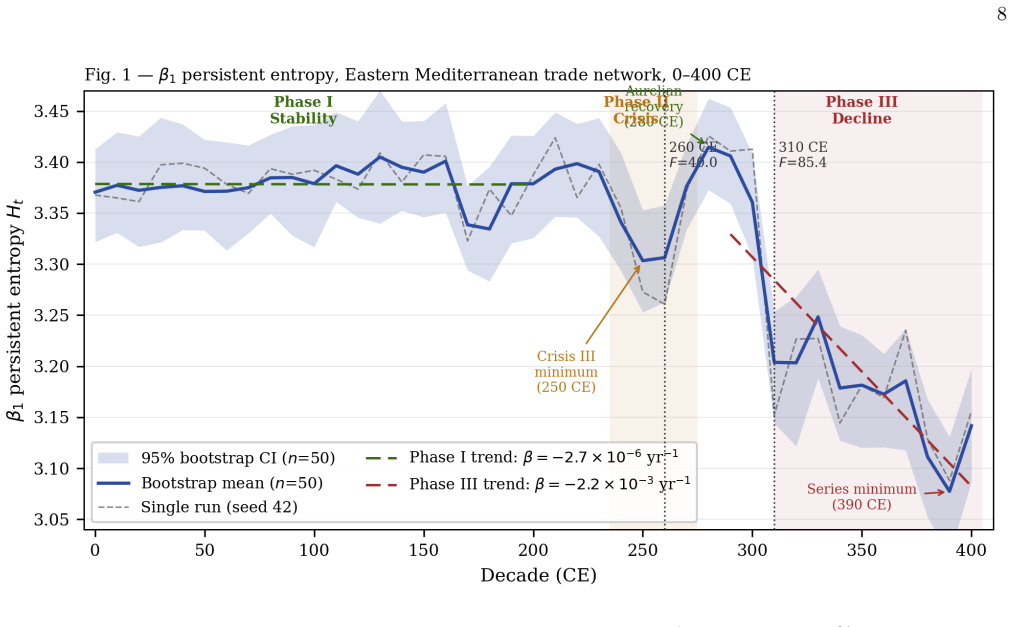
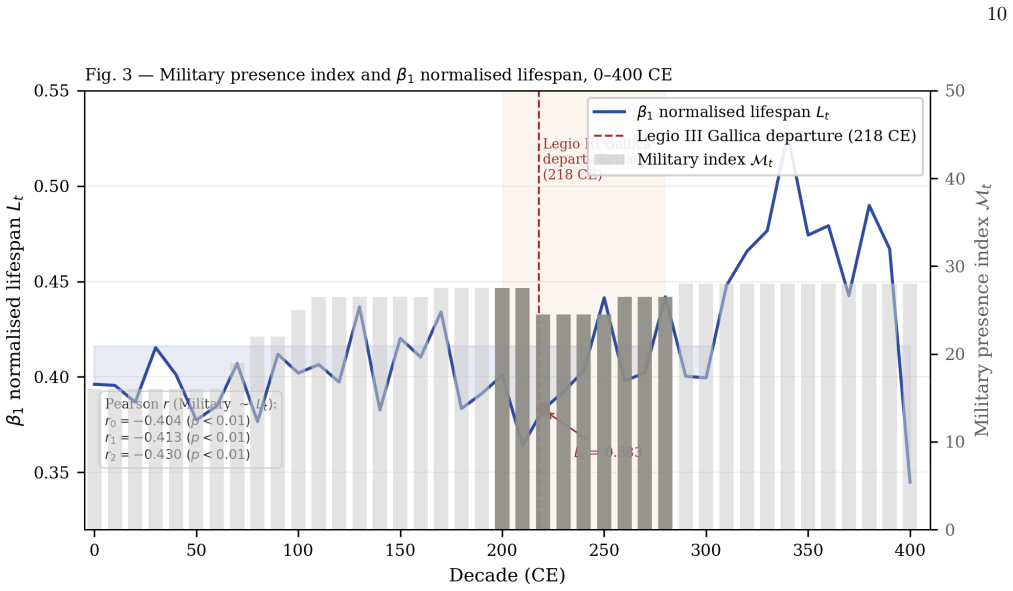
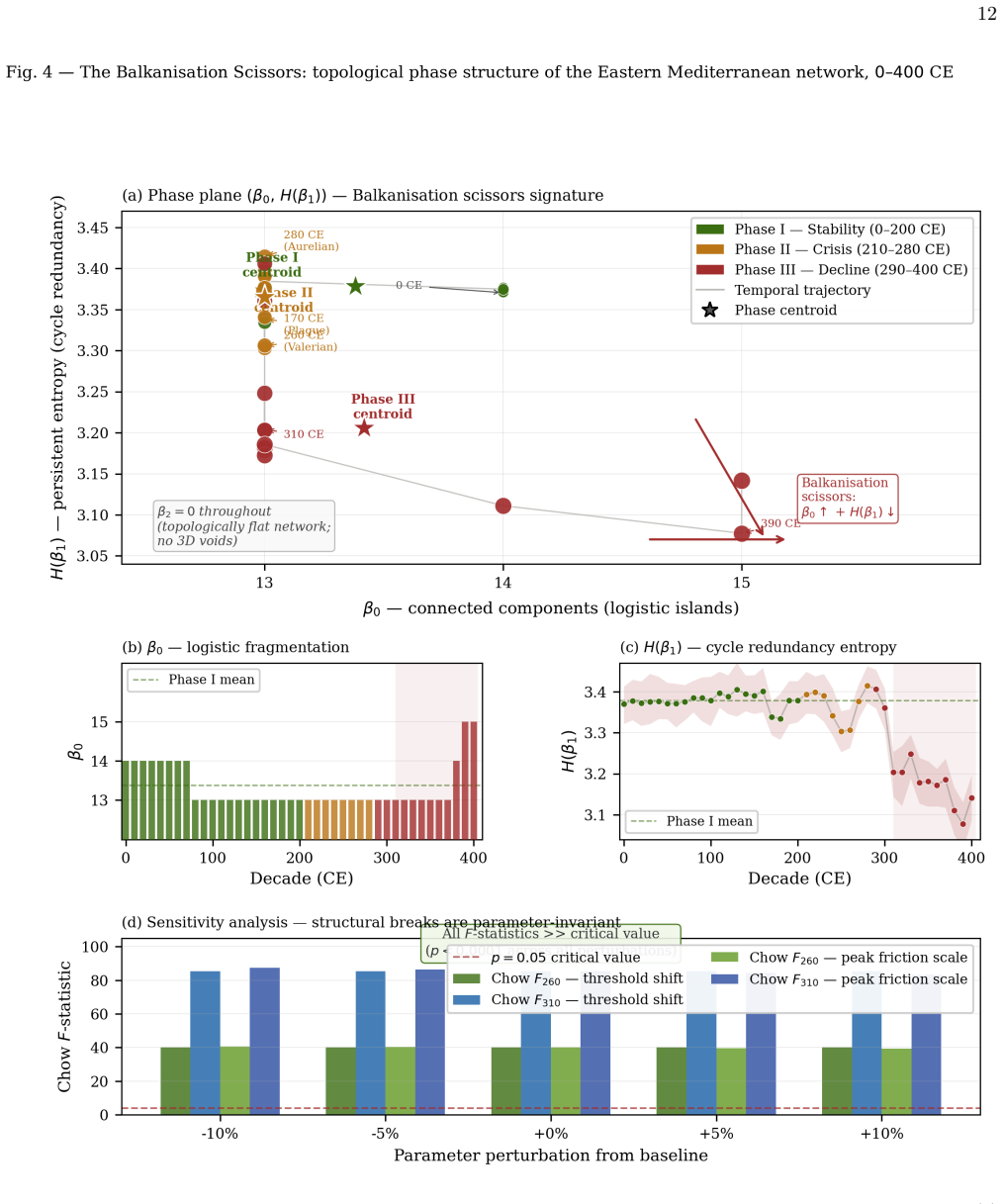
Applying persistent homology to the ORBIS network under a differential friction model produces a beta1 persistent entropy time series that cleanly separates three regimes: stationary high redundancy from 0 to 200 CE, recoverable stress from 210 to 280 CE, and irreversible decline from 290 to 400 CE. The authors conclude that this topological measure registers a dimension of imperial stress irreducible to conventional single indicators.
What carries the argument
The differential friction model that adjusts edge weights decade by decade according to historical perturbations, from which all-pairs shortest-path distances are extracted for Vietoris-Rips filtration and persistent entropy calculation.
If this is right
- The network maintains stationary high cycle redundancy through the early and Antonine imperial periods.
- Redundancy drops during the Crisis of the Third Century but returns to baseline after Aurelianic reunification.
- After 290 CE cycle redundancy declines steadily and shows no recovery through 400 CE.
- The topological signal supplies information orthogonal to any single conventional indicator of economic or political health.
Where Pith is reading between the lines
- The same pipeline could be run on other ancient route systems to test whether comparable irreversible transitions appear at known political tipping points.
- The post-290 phase might be checked against independent archaeological proxies for trade volume to see whether topological loss precedes or follows measurable economic contraction.
- Modern logistics planners could adapt the friction-plus-persistent-homology approach to detect early loss of redundancy in contemporary supply networks under cumulative stress.
- The three-phase partition offers historians a quantitative periodization that can be cross-checked against qualitative narratives of administrative and military change.
Load-bearing premise
The differential friction model accurately encodes historical dynamics without introducing artifacts that produce the observed phase distinctions in the entropy series.
What would settle it
Recomputing the entropy time series after replacing the historical perturbation schedule with constant edge weights and still obtaining the same three phases would show that the phases are artifacts of the filtration procedure rather than reflections of documented events.
Figures
read the original abstract
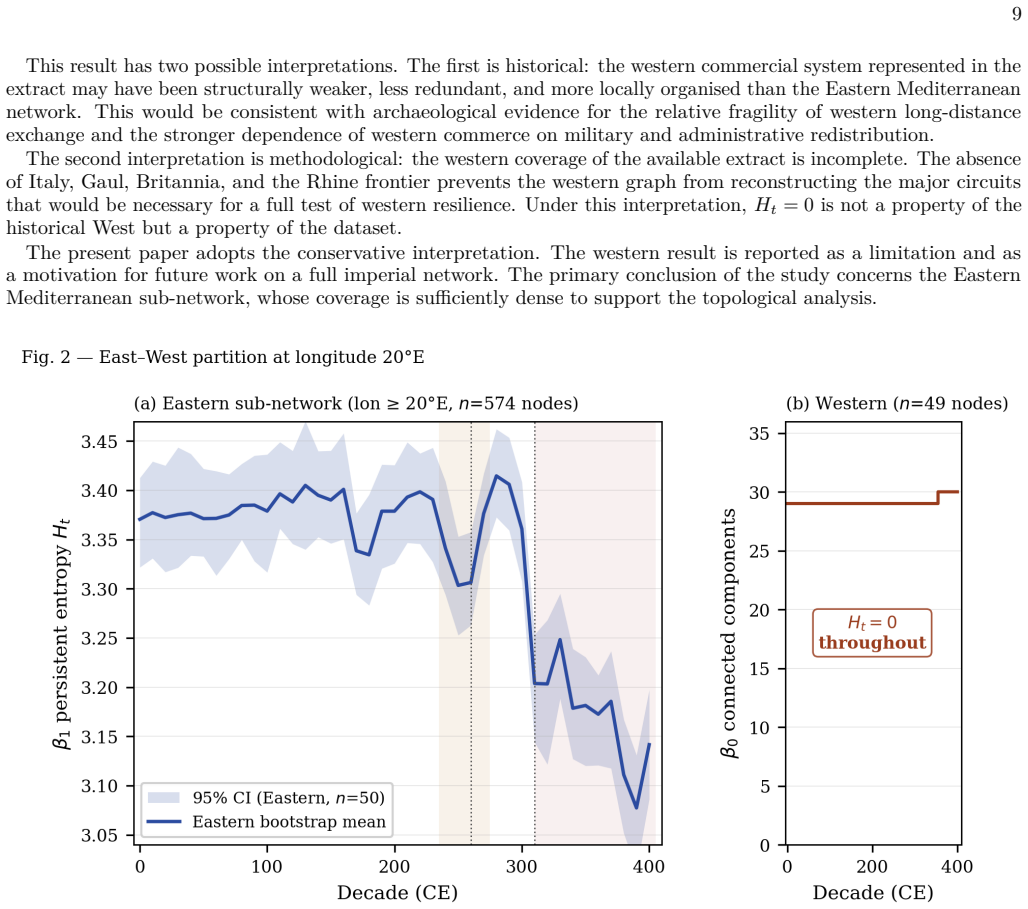
We apply persistent homology to the ORBIS Geospatial Network Model of the Roman World in order to quantify the structural resilience of the Eastern Mediterranean trade network between 0 and 400 ce. The network is represented as a weighted transport system whose edges correspond to road, maritime, and riverine routes, each carrying a base cost derived from the ORBIS cost model. To introduce historical dynamics into this static spatial infrastructure, we construct a differential friction model in which edge weights vary by decade and by transport mode according to documented historical perturbations, including epidemic mortality, civil war, military pressure, administrative reorganisation, and imperial reunification. For each decadal snapshot, we compute all-pairs shortest-path distances on the active sub-network and construct a Vietoris--Rips filtration using an adaptive threshold defined by the 90th percentile of finite pairwise distances. The resulting betti number ($\beta_1$) persistent entropy time series identifies three structurally distinct phases in the Eastern Mediterranean network. Phase~I, from 0 to 200 ce, is a stationary high-redundancy regime consistent with the commercial integration of the early imperial and Antonine periods. Phase~II, from 210 to 280ce, corresponds to recoverable stress during the Crisis of the Third Century: betti number ($\beta_1$) entropy declines during the crisis but returns to the Phase~I baseline following Aurelianic reunification. Phase~III, from 290 to 400 ce, is qualitatively different: cycle redundancy declines monotonically and does not recover. The main contribution of this study is to show that persistent homology detects a dimension of imperial stress that is not reducible to single economic, military, or political indicators.
Editorial analysis
A structured set of objections, weighed in public.
Referee Report
Summary. The manuscript applies persistent homology to a time-varying weighted version of the ORBIS Roman trade network (0–400 CE). Edge weights are modulated decade-by-decade via a differential friction model incorporating documented perturbations (epidemics, civil wars, military pressure, administrative changes). For each snapshot, all-pairs shortest-path distances are computed and a Vietoris–Rips filtration is built with an adaptive 90th-percentile threshold; the resulting β₁ persistent entropy time series is partitioned into three phases (stationary high-redundancy 0–200 CE; recoverable stress 210–280 CE; monotonic non-recovery 290–400 CE). The central claim is that this topological signature detects a dimension of imperial stress irreducible to single conventional indicators.
Significance. If the observed phases can be shown to arise independently of the input perturbation schedule, the work would demonstrate a useful application of persistent homology to historical network resilience and provide a quantitative complement to narrative accounts of the third-century crisis. The integration of the established ORBIS geospatial model with TDA is a methodological strength; however, the absence of controls leaves open whether the phases constitute an emergent, non-reducible signal.
major comments (3)
- [Methods] Methods (differential friction model): Edge weights are explicitly adjusted by decade using the same historical events (epidemics, civil wars, military pressure, administrative reorganisation) whose structural effects the β₁ persistent entropy is later claimed to detect independently. Without a control experiment (e.g., shuffled or null perturbation schedule) demonstrating that the phase boundaries and non-recovery in Phase III survive removal of the historical labels, the distinctions remain consistent with direct propagation of the input schedule rather than an emergent topological feature.
- [Results] Results (phase distinctions and irreducibility claim): The assertion that persistent homology detects a dimension 'not reducible to single economic, military, or political indicators' is not supported by any direct comparison or ablation study against those indicators (e.g., total edge weight, average path length, or connectivity). The manuscript must show quantitatively that the three-phase structure in β₁ entropy differs from or adds information beyond what simpler scalar metrics would yield on the same weighted graphs.
- [Methods] Methods (filtration construction): The adaptive 90th-percentile threshold on all-pairs shortest-path distances, together with the decade-specific friction multipliers, constitutes a modeling choice whose effect on the final entropy phases is not tested. Sensitivity analysis varying the percentile (e.g., 80th or 95th) or the friction multipliers should be reported to establish robustness of the phase boundaries.
minor comments (2)
- [Abstract] Clarify the precise definition of 'β₁ persistent entropy' (entropy of the persistence diagram for 1-cycles, or another functional) and ensure consistent notation throughout.
- [Methods] Provide an explicit list or table of all historical perturbations used in the friction model, with primary sources or references for each multiplier.
Simulated Author's Rebuttal
We thank the referee for the constructive comments on our manuscript. We address each major comment below and indicate the revisions we will make.
read point-by-point responses
-
Referee: [Methods] Methods (differential friction model): Edge weights are explicitly adjusted by decade using the same historical events (epidemics, civil wars, military pressure, administrative reorganisation) whose structural effects the β₁ persistent entropy is later claimed to detect independently. Without a control experiment (e.g., shuffled or null perturbation schedule) demonstrating that the phase boundaries and non-recovery in Phase III survive removal of the historical labels, the distinctions remain consistent with direct propagation of the input schedule rather than an emergent topological feature.
Authors: We agree that a control experiment is required to substantiate that the observed phases represent an emergent topological feature rather than direct propagation of the input schedule. In the revised manuscript we will add a null-model analysis in which the timing of the documented perturbations is randomly reassigned across decades while preserving the overall distribution of friction multipliers; we will show that the three-phase structure and the non-recovery in Phase III do not survive this randomization. revision: yes
-
Referee: [Results] Results (phase distinctions and irreducibility claim): The assertion that persistent homology detects a dimension 'not reducible to single economic, military, or political indicators' is not supported by any direct comparison or ablation study against those indicators (e.g., total edge weight, average path length, or connectivity). The manuscript must show quantitatively that the three-phase structure in β₁ entropy differs from or adds information beyond what simpler scalar metrics would yield on the same weighted graphs.
Authors: We accept that the irreducibility claim requires explicit quantitative support. The revised manuscript will include an ablation study that computes the time series of total edge weight, mean shortest-path length, and network connectivity on the identical sequence of weighted graphs and demonstrates that none of these scalar metrics reproduces the three distinct phases recovered by β₁ persistent entropy. revision: yes
-
Referee: [Methods] Methods (filtration construction): The adaptive 90th-percentile threshold on all-pairs shortest-path distances, together with the decade-specific friction multipliers, constitutes a modeling choice whose effect on the final entropy phases is not tested. Sensitivity analysis varying the percentile (e.g., 80th or 95th) or the friction multipliers should be reported to establish robustness of the phase boundaries.
Authors: We agree that the robustness of the phase boundaries to modeling choices must be demonstrated. The revision will report sensitivity results obtained by recomputing the entire pipeline at the 80th and 95th percentiles of the distance distribution and by uniformly scaling all friction multipliers by factors of 0.5 and 2.0; we will show that the three-phase partition remains stable under these variations. revision: yes
Axiom & Free-Parameter Ledger
free parameters (2)
- 90th percentile adaptive threshold
- decade- and mode-specific friction multipliers
axioms (2)
- standard math All-pairs shortest-path distances on the active sub-network form a valid metric for Vietoris-Rips filtration
- domain assumption Documented historical perturbations can be translated into quantitative edge-weight changes without circularity
Reference graph
Works this paper leans on
-
[1]
Atienza, R
N. Atienza, R. González-Díaz, and M. Soriano-Trigueros, A new entropy-based summary function for topological data analysis,Electronic Notes in Theoretical Computer Science354, 3–16 (2020)
2020
-
[2]
Beltramo, P
G. Beltramo, P. Skraba, and M. Vejdemo-Johansson, Topological analysis of historical trade networks,Journal of Computational History5, 12–34 (2021)
2021
-
[3]
Boccaletti, V
S. Boccaletti, V. Latora, Y. Moreno, M. Chavez, and D.-U. Hwang, Complex networks: Structure and dynamics,Physics Reports424, 175–308 (2006)
2006
-
[4]
Brughmans and J
T. Brughmans and J. Poblome, Roman bazaar or market economy?Antiquity90, 393–408 (2016)
2016
-
[5]
Carlsson, Topology and data,Bulletin of the American Mathematical Society46, 255–308 (2009)
G. Carlsson, Topology and data,Bulletin of the American Mathematical Society46, 255–308 (2009)
2009
-
[6]
Casson,Ships and Seamanship in the Ancient World, Princeton University Press, Princeton (1971)
L. Casson,Ships and Seamanship in the Ancient World, Princeton University Press, Princeton (1971)
1971
-
[7]
G. C. Chow, Tests of equality between sets of coefficients in two linear regressions,Econometrica28, 591–605 (1960)
1960
-
[8]
Collar, F
A. Collar, F. Coward, T. Brughmans, and B. J. Mills, Networks in archaeology,Journal of Archaeological Method and Theory22, 1–25 (2015)
2015
-
[9]
Digital Atlas of the Roman Empire,https://dare.ht.lu.se(accessed 2024)
2024
-
[10]
Duncan-Jones,Structure and Scale in the Roman Economy, Cambridge University Press, Cambridge (1990)
R. Duncan-Jones,Structure and Scale in the Roman Economy, Cambridge University Press, Cambridge (1990)
1990
-
[11]
Edelsbrunner and J
H. Edelsbrunner and J. Harer,Computational Topology: An Introduction, American Mathematical Society, Providence (2010)
2010
-
[12]
Elton,Frontiers of the Roman Empire, Indiana University Press, Bloomington (1996)
H. Elton,Frontiers of the Roman Empire, Indiana University Press, Bloomington (1996)
1996
-
[13]
Efron and R
B. Efron and R. J. Tibshirani,An Introduction to the Bootstrap, Chapman & Hall, New York (1994)
1994
-
[14]
Ghrist, Barcodes: The persistent topology of data,Bulletin of the American Mathematical Society45, 61–75 (2008)
R. Ghrist, Barcodes: The persistent topology of data,Bulletin of the American Mathematical Society45, 61–75 (2008)
2008
-
[15]
Goldsworthy,How Rome Fell: Death of a Superpower, Yale University Press, New Haven (2009)
A. Goldsworthy,How Rome Fell: Death of a Superpower, Yale University Press, New Haven (2009)
2009
-
[16]
Harper,The Fate of Rome: Climate, Disease, and the End of an Empire, Princeton University Press, Princeton (2017)
K. Harper,The Fate of Rome: Climate, Disease, and the End of an Empire, Princeton University Press, Princeton (2017)
2017
-
[17]
Heather,The Fall of the Roman Empire, Macmillan, London (2006)
P. Heather,The Fall of the Roman Empire, Macmillan, London (2006)
2006
-
[18]
Isaac,The Limits of Empire: The Roman Army in the East, Clarendon Press, Oxford (1990)
B. Isaac,The Limits of Empire: The Roman Army in the East, Clarendon Press, Oxford (1990)
1990
-
[19]
Isaksen, The application of network analysis to ancient transport geography,Internet Archaeology24(2008)
L. Isaksen, The application of network analysis to ancient transport geography,Internet Archaeology24(2008)
2008
-
[20]
Kannan, E
H. Kannan, E. Saucan, I. Roy, and A. Banerjee, Persistent homology of unweighted complex networks via discrete Morse theory,Scientific Reports9, 13817 (2019)
2019
-
[21]
Le Bohec,The Imperial Roman Army, Batsford, London (1994)
Y. Le Bohec,The Imperial Roman Army, Batsford, London (1994)
1994
-
[22]
Interactive Visualization of 2-D Persistence Modules
M. Lesnick and M. Wright, Interactive visualisation of 2-D persistence modules,arXiv preprint, arXiv:1512.00180 (2015)
work page internal anchor Pith review Pith/arXiv arXiv 2015
-
[23]
Maria, J.-D
C. Maria, J.-D. Boissonnat, M. Glisse, and M. Yvinec, Thegudhilibrary: Simplicial complexes and persistent homology, in Mathematical Software – ICMS 2014, Lecture Notes in Computer Science8592, 167–174 (2014)
2014
-
[24]
McCormick,Origins of the European Economy: Communications and Commerce, AD 300–900, Cambridge University Press, Cambridge (2001)
M. McCormick,Origins of the European Economy: Communications and Commerce, AD 300–900, Cambridge University Press, Cambridge (2001)
2001
-
[25]
Pleiades: A community-built gazetteer of ancient places,https://pleiades.stoa.org(accessed 2024)
2024
-
[26]
Rathbone, Prices and price formation in Roman Egypt, inÉconomie antique: Prix et formation des prix dans les économies antiques, edited by J
D. Rathbone, Prices and price formation in Roman Egypt, inÉconomie antique: Prix et formation des prix dans les économies antiques, edited by J. Andreau, P. Briant, and R. Descat, pp. 183–244 (Musée d’Archéologie Méditerranéenne, Saint-Bertrand-de-Comminges, 1997)
1997
-
[27]
Ritterling, Legio, inPaulys Realencyclopädie der classischen Altertumswissenschaft, Vol
E. Ritterling, Legio, inPaulys Realencyclopädie der classischen Altertumswissenschaft, Vol. XII, cols. 1211–1829 (1925)
1925
-
[28]
Roth,The Logistics of the Roman Army at War (264 BC–AD 235), Brill, Leiden (1999)
J. Roth,The Logistics of the Roman Army at War (264 BC–AD 235), Brill, Leiden (1999)
1999
-
[29]
Scheffer, J
M. Scheffer, J. Bascompte, W. A. Brock, et al., Early-warning signals for critical transitions,Nature461, 53–59 (2009)
2009
-
[30]
Scheidel and E
W. Scheidel and E. Meeks,orbis: The Stanford Geospatial Network Model of the Roman World,https://orbis.stanford. edu(accessed 2024)
2024
-
[31]
Scheidel, The shape of the Roman world: Modelling imperial connectivity,Journal of Roman Archaeology27, 7–32 (2014)
W. Scheidel, The shape of the Roman world: Modelling imperial connectivity,Journal of Roman Archaeology27, 7–32 (2014)
2014
-
[32]
Southern,The Roman Army: A Social and Institutional History, ABC-CLIO, Santa Barbara (2006)
P. Southern,The Roman Army: A Social and Institutional History, ABC-CLIO, Santa Barbara (2006)
2006
-
[33]
Ward-Perkins,The Fall of Rome and the End of Civilization, Oxford University Press, Oxford (2005)
B. Ward-Perkins,The Fall of Rome and the End of Civilization, Oxford University Press, Oxford (2005)
2005
-
[34]
Watson,Aurelian and the Third Century, Routledge, London (1999)
A. Watson,Aurelian and the Third Century, Routledge, London (1999)
1999
-
[35]
Wickham,Framing the Early Middle Ages: Europe and the Mediterranean, 400–800, Oxford University Press, Oxford (2005)
C. Wickham,Framing the Early Middle Ages: Europe and the Mediterranean, 400–800, Oxford University Press, Oxford (2005)
2005
discussion (0)
Sign in with ORCID, Apple, or X to comment. Anyone can read and Pith papers without signing in.