PINNsur: Physics-Informed Neural Networks for PDEs on Curved Surfaces
Pith reviewed 2026-06-29 14:27 UTC · model grok-4.3
The pith
A neural field approximating surface normals lets PINNs solve PDEs on curved surfaces by projecting operators from R^3.
A machine-rendered reading of the paper's core claim, the machinery that carries it, and where it could break.
Core claim
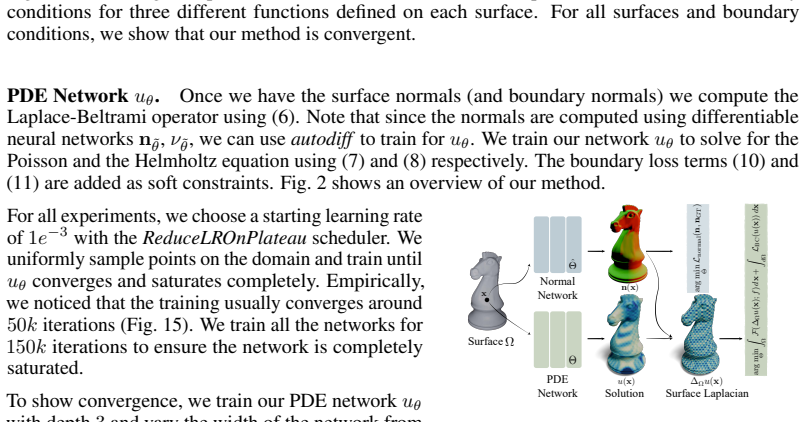
PINNSur trains a neural field to approximate the surface's normals and expresses surface differential operators using their projection from R^3 onto the surface. This construction works for all orientable manifolds regardless of curvature or topology and is accompanied by an empirical convergence test that examines whether the combined approximation of function and geometry still yields the correct PDE solution.
What carries the argument
Projection of differential operators from R^3 onto the surface using a neural approximation of the normals.
If this is right
- Surface PDEs can be solved without generating or refining a mesh.
- The same framework applies to surfaces with arbitrary topology.
- Both the unknown function and the surface geometry are approximated together inside one training loop.
- An empirical test now exists to monitor convergence for surface PINNs.
Where Pith is reading between the lines
- The projection idea could be reused for other surface operators beyond the Laplacian or gradient.
- If the normal field is learned jointly with the PDE solution, the method might handle cases where the surface itself is only approximately known.
- Time-dependent surface PDEs would require only an additional time coordinate in the same projection setup.
Load-bearing premise
The neural field produces normals accurate enough that the projected operators still drive the PINN training to the true surface PDE solution.
What would settle it
On a surface PDE with a known analytic solution, the numerical error fails to decrease as network capacity or training time increases.
Figures
read the original abstract
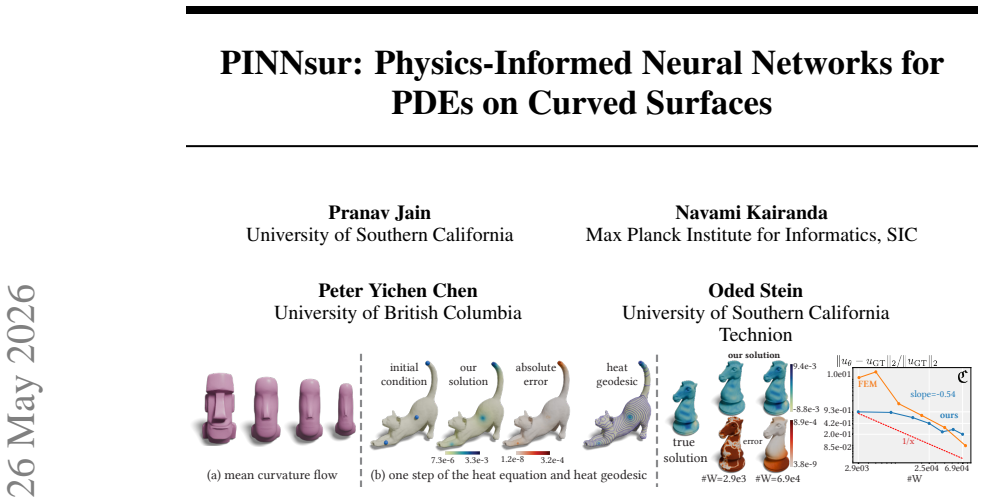
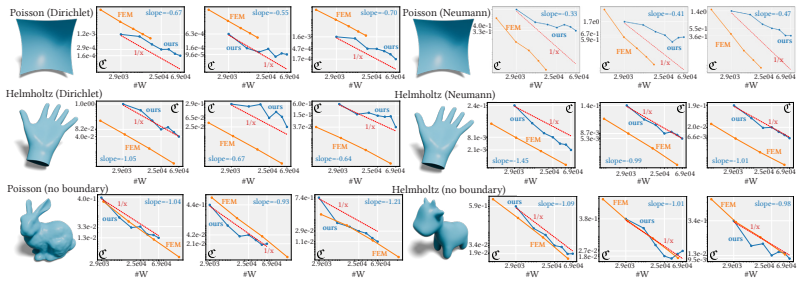
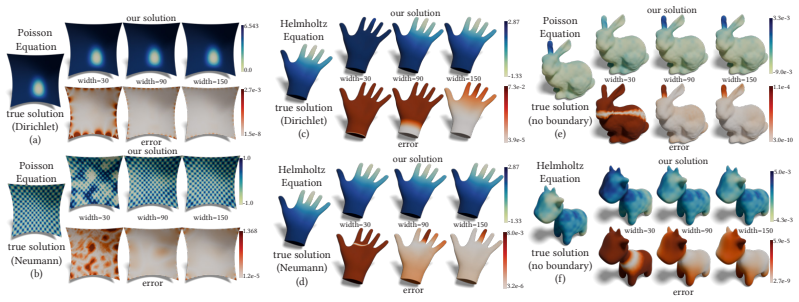
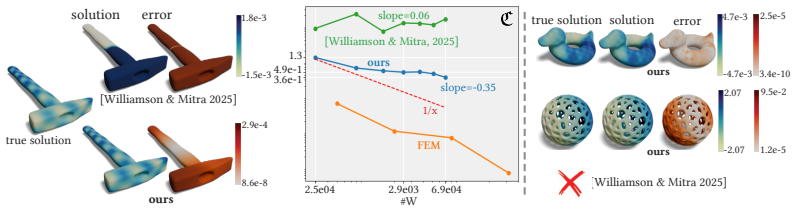
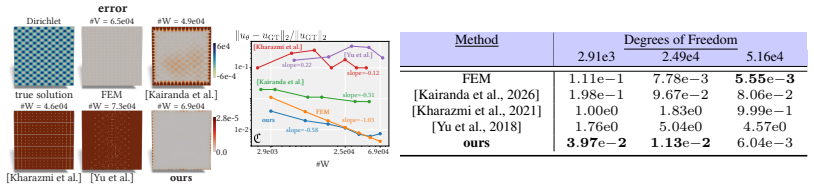
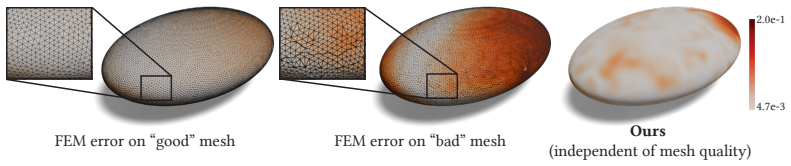
Partial differential equations (PDEs) on surfaces are fundamental to scientific computing and geometry processing. A popular approach to solving PDEs on surfaces is the finite element method (FEM), where the surface is divided into discrete geometric elements (usually triangles). Recently, physics-informed neural networks (PINNs) have emerged as a continuous, mesh-free alternative that does not suffer from FEM's sensitivity to mesh quality or geometric discretization errors. We present PINNSur, a simple framework for using PINNs on curved surfaces: we train a neural field to approximate the surface's normals, and then we express surface differential operators using their projection from $\mathbb{R}^3$ onto the surface. Since every orientable manifold has well-defined normals, our method is suitable for all such surfaces, regardless of curvature or topology, enabling many geometry processing applications. Moreover, despite their empirical success in solving PDEs in flat Euclidean domains, PINNs lack convergence guarantees to the true solution of the underlying PDE, and there is limited systematic experimental evidence demonstrating such convergence. This gap restricts their adoption as reliable solvers compared to established methods like FEM, where convergence to the true solution is well understood and theoretically grounded. These surface PDEs are particularly challenging to solve convergently, as one must not only deal with the convergence of the function approximation, but also with the convergence of the geometric approximation of the surface itself. In this work, we empirically investigate the convergence behavior of PINNs for solving surface PDEs by introducing a simple empirical convergence test.
Editorial analysis
A structured set of objections, weighed in public.
Referee Report
Summary. The manuscript introduces PINNSur, a framework for solving PDEs on curved surfaces with PINNs: a neural field is trained to approximate surface normals, after which surface differential operators (gradient, divergence) are obtained by projecting Euclidean derivatives via P = I - n n^T. The approach is claimed to apply to any orientable manifold independent of curvature or topology. The paper additionally presents a simple empirical convergence test for PINNs on surface PDEs, motivated by the known absence of convergence guarantees for PINNs even in Euclidean domains and the extra difficulty of simultaneous geometric approximation.
Significance. If the projection-based operator construction and the empirical convergence test can be shown to produce reliable solutions, the method would supply a mesh-free alternative to FEM for surface PDEs that avoids meshing artifacts and extends immediately to arbitrary topologies. The explicit focus on convergence behavior is a positive step beyond typical PINN papers, but the absence of error propagation analysis between normal approximation and operator accuracy limits the strength of the claims.
major comments (2)
- [Abstract / method description] Abstract and method description: the central construction defines surface operators via the projected Euclidean derivatives of the solution network using the learned normal field N(x). No a-priori estimate or bound is supplied relating the normal approximation error ||N - n_true|| to the resulting operator error ||P_N abla u_N - P_true abla u_true||, nor is it shown that this composite error remains controlled relative to the PDE residual during joint (or sequential) optimization. This directly affects whether the empirical convergence test can establish convergence to the true surface PDE solution.
- [Empirical convergence test] Empirical convergence test section: the test is performed on the composite system (learned normals + learned solution) without isolating the contribution of normal approximation error. Consequently the reported convergence behavior does not separate geometry-induced operator error from function-approximation error, weakening the claim that the method addresses the additional convergence challenge of surface PDEs.
minor comments (1)
- [Abstract] The abstract states that the method is 'suitable for all such surfaces, regardless of curvature or topology' but does not discuss how the neural normal field is initialized or regularized on surfaces with high curvature or genus changes; a brief clarification would improve readability.
Simulated Author's Rebuttal
We thank the referee for the constructive comments. Below we address each major point.
read point-by-point responses
-
Referee: [Abstract / method description] Abstract and method description: the central construction defines surface operators via the projected Euclidean derivatives of the solution network using the learned normal field N(x). No a-priori estimate or bound is supplied relating the normal approximation error ||N - n_true|| to the resulting operator error ||P_N abla u_N - P_true abla u_true||, nor is it shown that this composite error remains controlled relative to the PDE residual during joint (or sequential) optimization. This directly affects whether the empirical convergence test can establish convergence to the true surface PDE solution.
Authors: We agree that the manuscript supplies no theoretical a-priori bound relating normal-field error to projected-operator error. The work is framed as an empirical investigation; we will revise the abstract and method description to state explicitly that no such guarantee is claimed and that the reported test evaluates the composite system in practice only. revision: yes
-
Referee: [Empirical convergence test] Empirical convergence test section: the test is performed on the composite system (learned normals + learned solution) without isolating the contribution of normal approximation error. Consequently the reported convergence behavior does not separate geometry-induced operator error from function-approximation error, weakening the claim that the method addresses the additional convergence challenge of surface PDEs.
Authors: The test evaluates the end-to-end pipeline that would be deployed. To address the isolation concern we will add an ablation that compares results obtained with the learned normal field against results obtained with ground-truth normals (where available) so that geometry-induced and function-approximation contributions can be distinguished. revision: yes
Circularity Check
No circularity; direct construction with empirical test only.
full rationale
The paper defines PINNSur by training a neural field on normals then projecting Euclidean operators; this is an explicit ansatz presented as the method itself, not derived from prior results or fits. The convergence investigation is introduced as a new empirical test without any equations, fitted parameters, or self-citations that reduce a claimed prediction back to the input. No load-bearing steps equate outputs to inputs by construction, and the text supplies no uniqueness theorems or renamings. The derivation chain is therefore self-contained as a proposed framework plus separate empirical check.
Axiom & Free-Parameter Ledger
Reference graph
Works this paper leans on
-
[1]
URLhttps://arxiv.org/abs/1804.10904. I. Baran and J. Popovi´c. Automatic rigging and animation of 3d characters.ACM Trans. Graph., 26 (3):72–es,
work page internal anchor Pith review Pith/arXiv arXiv
-
[2]
ISSN 0001-0782. doi: 10.1145/3131280. URL https://doi. org/10.1145/3131280. M. Desbrun, M. Meyer, P. Schröder, and A. H. Barr. Implicit fairing of irregular meshes using diffusion and curvature flow. InProceedings of the 26th Annual Conference on Computer Graphics and Interactive Techniques, page 317–324,
-
[3]
Edavamadathil Sivaram, T.-M
10 V . Edavamadathil Sivaram, T.-M. Li, and R. Ramamoorthi. Neural geometry fields for meshes. In ACM SIGGRAPH 2024 Conference Papers,
2024
-
[4]
ISBN 9781470411442. doi: 10.1090/gsm/019. URLhttp://dx.doi.org/10.1090/gsm/019. G. Fargion and O. Weber. Learning Metric Fields for Fast Low-Distortion Mesh Parameterizations. Computer Graphics Forum,
-
[5]
Ferguson, P
Z. Ferguson, P. Jain, D. Zorin, T. Schneider, and D. Panozzo. High-order incremental potential contact for elastodynamic simulation on curved meshes. InACM SIGGRAPH 2023 Conference Proceedings,
2023
-
[6]
Asset li- censed under CC BY-NC
https://sketchfab.com/3d- models/wooden-head-from-above-a-fireplace-2-aacc5088078743b39844b9331bb41eab. Asset li- censed under CC BY-NC. Z. Hao, S. Liu, Y . Zhang, C. Ying, Y . Feng, H. Su, and J. Zhu. Physics-informed machine learning: A survey on problems, methods and applications.arXiv preprint arXiv:2211.08064,
-
[7]
URL https://hal.science/ hal-01297648. P. Jain, Z. Qu, P. Y . Chen, and O. Stein. Neural monte carlo fluid simulation. InACM SIGGRAPH 2024 Conference Papers,
2024
-
[8]
ISSN 1557-7368. doi: 10.1145/2487228.2487237. URL http://dx.doi.org/10.1145/2487228.2487237. E. Kharazmi, Z. Zhang, and G. E. Karniadakis. hp-vpinns: Variational physics-informed neural networks with domain decomposition.Computer Methods in Applied Mechanics and Engineering, 374:113547, Feb
-
[9]
ISSN 0045-7825. doi: 10.1016/j.cma.2020.113547. URL http://dx. doi.org/10.1016/j.cma.2020.113547. J. Lai, S. Wang, C. Wang, and Y . Lu. Unveiling the scaling law of PINNs under non-euclidean geometry,
-
[10]
URL http://dx.doi.org/10.21136/AM.2018.0095-18
doi: 10.21136/am.2018.0095-18. URL http://dx.doi.org/10.21136/AM.2018.0095-18. 11 Z. Lu, H. Pu, F. Wang, Z. Hu, and L. Wang. The expressive power of neural networks: a view from the width. InProceedings of the 31st International Conference on Neural Information Processing Systems, NIPS’17, page 6232–6240,
-
[11]
Loper, N
Downloaded modified version from odedstein- meshes github.com/odedstein/meshes/tree/master/objects/hand, adapted from M. Loper, N. Mahmood, J. Romero, G. Pons-Moll, M. Black "SMPL" (SIGGRAPH Asia 2015). Asset licensed under CC BY 4.0. I. Mehta, M. Chandraker, and R. Ramamoorthi. A level set theory for neural implicit evolution under explicit flows. InEuro...
2015
- [12]
-
[13]
Sorkine, D
O. Sorkine, D. Cohen-Or, Y . Lipman, M. Alexa, C. Rössl, and H.-P. Seidel. Laplacian surface editing. InProceedings of the 2004 Eurographics/ACM SIGGRAPH Symposium on Geometry Processing, page 175–184,
2004
-
[14]
com/odedstein/meshes/tree/master/objects/hammer, originally from sketchfab.com/ 3d-models/hammer-rawscan-01e5b5acad9843818529d15663df5b9e
Downloaded modified version from odedstein-meshes github. com/odedstein/meshes/tree/master/objects/hammer, originally from sketchfab.com/ 3d-models/hammer-rawscan-01e5b5acad9843818529d15663df5b9e . Asset licensed under CC BY 4.0. R. Sugimoto, N. King, T. Hachisuka, and C. Batty. Projected walk on spheres: A monte carlo closest point method for surface pde...
2024
-
[15]
Z. Tang and Z. Fu. Physics-informed neural networks for elliptic partial differential equations on 3d manifolds.arXiv preprint arXiv:2103.02811,
-
[16]
Learning to Solve PDEs on Neural Shape Representations
L. Welschinger, Y . Liu, Z. Wang, and N. Mitra. Learning to solve pdes on neural shape representations. arXiv preprint arXiv:2512.21311,
work page internal anchor Pith review Pith/arXiv arXiv
-
[17]
good” mesh FEM error on “bad
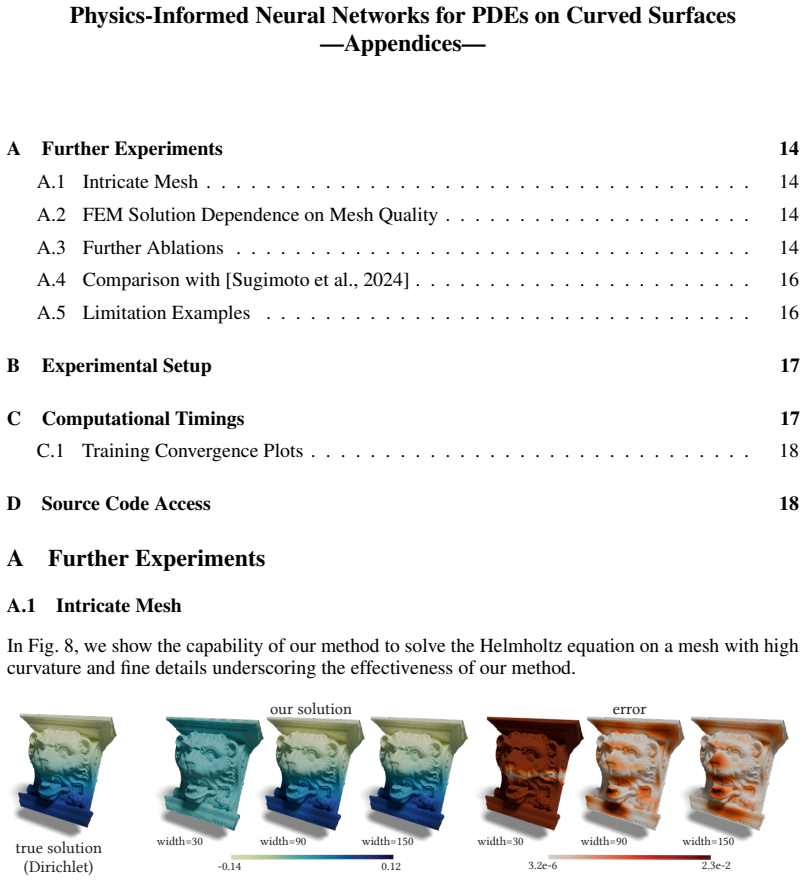
13 Physics-Informed Neural Networks for PDEs on Curved Surfaces —Appendices— A Further Experiments 14 A.1 Intricate Mesh . . . . . . . . . . . . . . . . . . . . . . . . . . . . . . . . . . . . . 14 A.2 FEM Solution Dependence on Mesh Quality . . . . . . . . . . . . . . . . . . . . . 14 A.3 Further Ablations . . . . . . . . . . . . . . . . . . . . . . . . ...
2024
discussion (0)
Sign in with ORCID, Apple, or X to comment. Anyone can read and Pith papers without signing in.