BlackHoleWeather -- Jet-regulated chaotic cold accretion across the meso scale: Morphology and thermodynamics
Pith reviewed 2026-06-29 16:55 UTC · model grok-4.3
The pith
Ambient turbulence controls jet-regulated chaotic cold accretion, yielding extended stormy phases with inefficient fueling at high levels and coherent rainy cycles at low levels.
A machine-rendered reading of the paper's core claim, the machinery that carries it, and where it could break.
Core claim
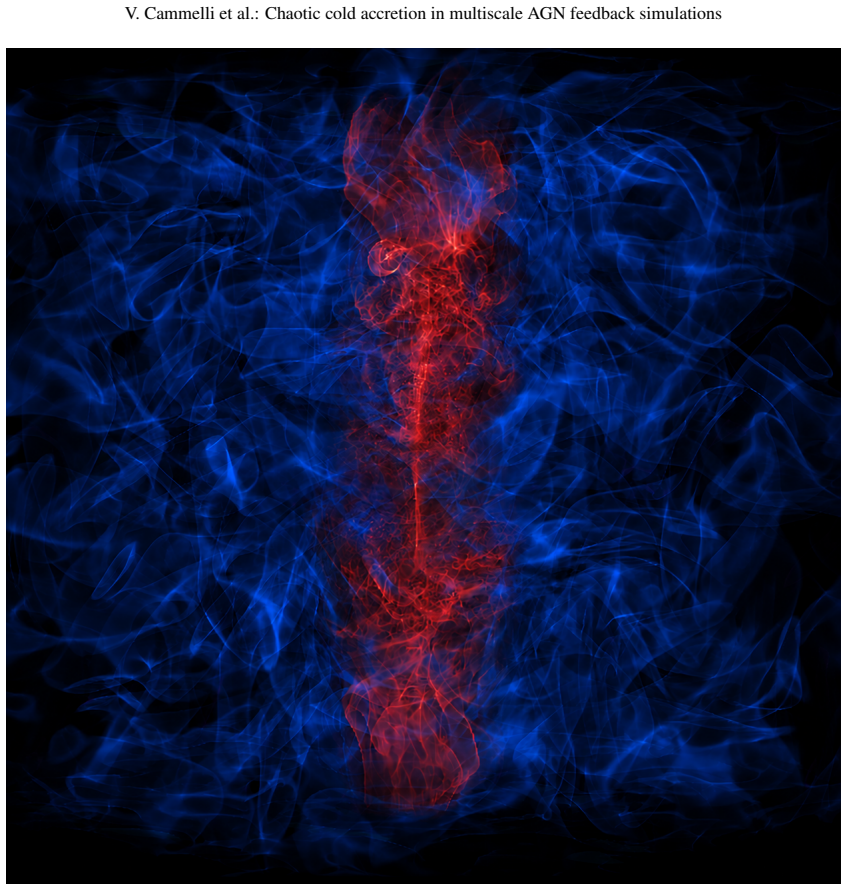
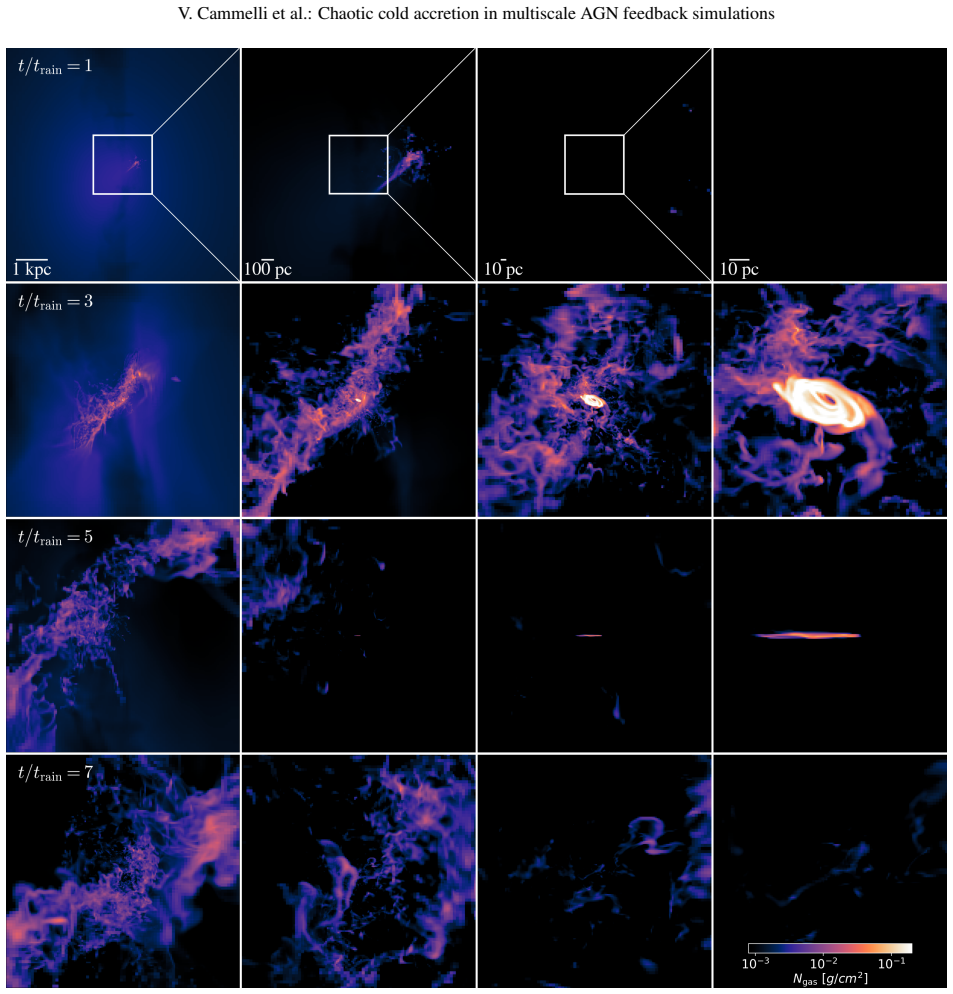
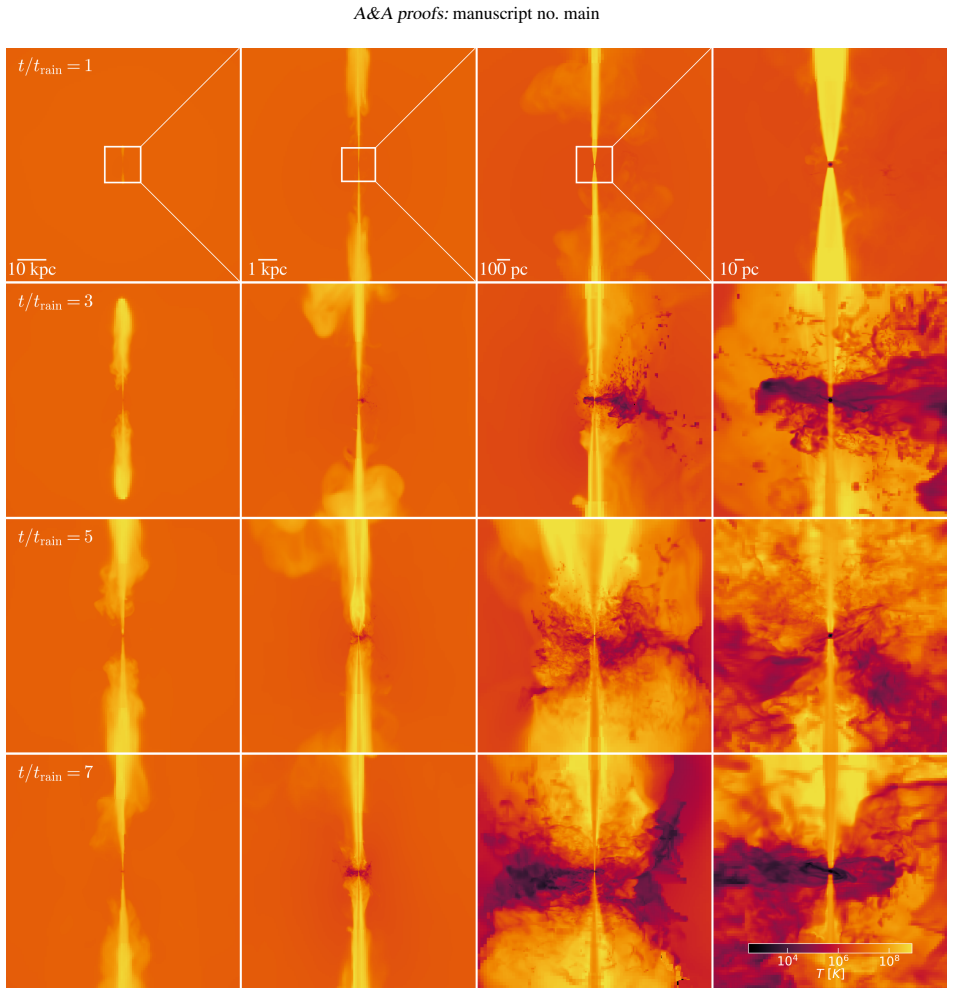
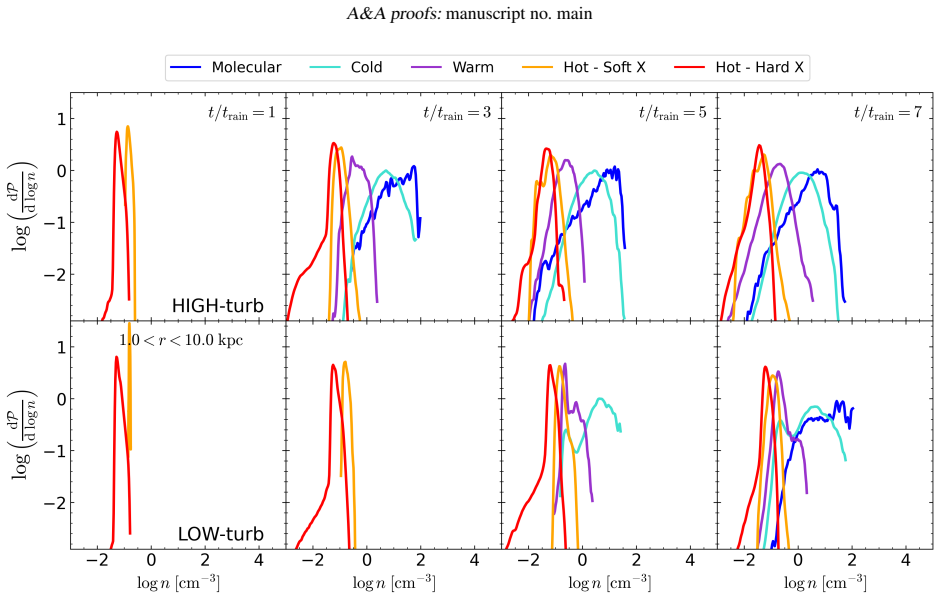
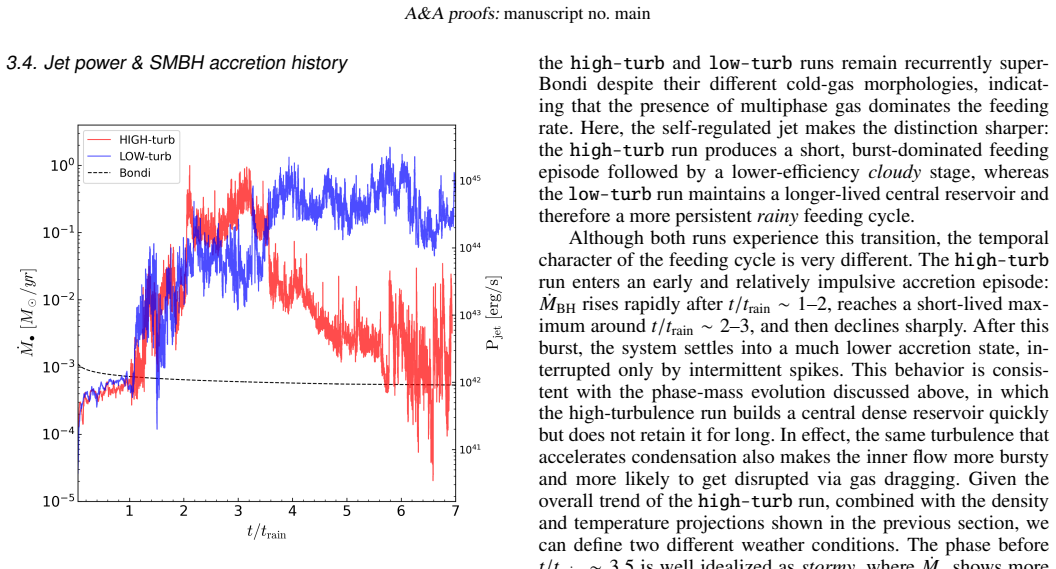
In the stronger-turbulence simulation condensation begins later, becomes extended and filamentary with a broader hot-warm-cold temperature bridge and porous cocoon, and evolves into a cloud-dominated state featuring inefficient central accretion; in the weaker-turbulence run condensation starts earlier, remains coherent and centrally confined inside a regular cocoon, and sustains a longer-lived inner cold reservoir with steady fueling. Condensation is suppressed inside the jet channel yet survives in the surrounding atmosphere and along the jet-ambient interface. Once condensation begins, supermassive-black-hole fueling becomes super-Bondi in both runs.
What carries the argument
Jet-regulated chaotic cold accretion (CCA) cycle, in which the kinetic jet heats, compresses, entrains and mixes the gas while ambient turbulence acts as the control parameter that organizes condensation into distinct weather states (stormy, rainy, cloudy).
If this is right
- Higher ambient turbulence produces later but more spatially extended, filamentary condensation with a broader temperature distribution and burst-dominated fueling.
- Lower ambient turbulence produces earlier, coherent, centrally confined condensation that maintains a longer-lived inner cold reservoir and steadier fueling.
- Condensation is always suppressed inside the jet channel but persists at the jet-ambient interface and in the surrounding atmosphere.
- Supermassive black hole fueling exceeds the classical Bondi rate once multiphase condensation appears.
- In the high-turbulence regime the system evolves toward a cloud-dominated state with inefficient central accretion.
Where Pith is reading between the lines
- Differences in observed filamentary structures and cold-gas distributions across galaxy groups may trace variations in ambient turbulence levels.
- The meso-scale layer identified here provides a concrete bridge between large-scale halo thermodynamics and the small-scale accretion that grows supermassive black holes.
- Adding magnetic fields or cosmic-ray physics to similar simulations could test whether they modify the turbulence-controlled transition between stormy and rainy states.
Load-bearing premise
The chosen jet model, turbulence driving scheme, and numerical resolution are sufficient to determine the dominant processes that set condensation morphology and accretion rates.
What would settle it
Observations of multiphase gas morphology and central accretion variability in galaxy groups that differ in measured turbulence strength, checked against the predicted differences in filament extent, temperature bridges, and fueling burstiness.
Figures








read the original abstract
How mechanical AGN feedback couples to multiphase condensation across scales remains a problem in galaxy groups and clusters. It is unclear how jets reshape the chaotic cold accretion (CCA) cycle and regulate black-hole fueling. BlackHoleWeather aims to build a unified description of the AGN baryon cycle across horizon, galactic, and group scales. Here we focus on how weather states shape the morphology and thermodynamics of jet-regulated CCA. We perform two hydrodynamical simulations of a turbulent, radiatively cooling galaxy-group atmosphere with self-regulated AGN feedback. The runs are initialized in two turbulence regimes and evolved with a kinetic mass-loaded jet. The jet prevents cooling via heating, but anisotropically reorganizes condensation through compression, entrainment, and turbulent mixing. In the stronger-turbulence case, condensation starts later but becomes extended, filamentary, and mixed, with a broader hot-warm-cold bridge, a porous cocoon, and burst-dominated fueling. This run evolves toward a cloud-dominated state with inefficient central accretion. In the weaker-turbulence case, condensation starts earlier and remains coherent and centrally confined, yielding a regular cocoon, a longer-lived inner cold reservoir with sustained fueling. In both runs, condensation is suppressed inside the jet channel and survives in the surrounding atmosphere and along the jet-ambient interface. Once condensation begins, SMBH fueling becomes super-Bondi. These results extend CCA from a pure cooling + turbulence problem to a jet-regulated weather process. Ambient turbulence acts as a control parameter, producing an extended stormy phase, a centrally retained rainy cycle, and, in the high-turbulence case, a later cloudy state with inefficient central fueling. The meso scale emerges as the layer linking halo thermodynamics to SMBH feeding within the broader BlackHoleWeather framework.
Editorial analysis
A structured set of objections, weighed in public.
Referee Report
Summary. The manuscript presents two hydrodynamical simulations of a turbulent, radiatively cooling galaxy-group atmosphere with self-regulated kinetic mass-loaded AGN jet feedback, initialized in two different turbulence regimes. It claims that ambient turbulence level acts as the decisive control parameter for jet-regulated chaotic cold accretion (CCA), producing an extended stormy phase with filamentary mixed condensation, a broader hot-warm-cold bridge, porous cocoon, and bursty inefficient fueling in the high-turbulence case, versus earlier, coherent, centrally confined condensation with sustained fueling in the low-turbulence case. Condensation is suppressed inside the jet channel but occurs along the jet-ambient interface and surrounding atmosphere, leading to super-Bondi SMBH fueling once initiated; the work frames this as extending CCA to a jet-regulated weather process within the BlackHoleWeather framework.
Significance. If the morphology and thermodynamic differences prove robust, the results would usefully extend CCA models by demonstrating how jets anisotropically reorganize multiphase condensation via compression, entrainment, and turbulent mixing, with turbulence level modulating the transition between stormy, rainy, and cloudy states. This could strengthen links between halo-scale thermodynamics and central fueling in galaxy groups. The self-regulated feedback and explicit comparison of turbulence strengths are positive elements, though the hydro-only setup and limited run count constrain the strength of the control-parameter claim.
major comments (3)
- [Simulation setup / methods] Simulation setup: only a single run is presented per turbulence regime (stronger vs. weaker driving amplitude), with no resolution study, convergence test, or variation in the jet mass-loading factor reported. This makes it difficult to establish that the reported differences in filamentary extent, cocoon porosity, and fueling burstiness are attributable to turbulence level rather than numerical or parameter choices.
- [Simulation setup / results] Physics content: the runs are purely hydrodynamical and omit magnetic fields and cosmic rays. Processes controlled by these (suppression or channeling of mixing at the jet-ambient interface, anisotropic conduction, cosmic-ray pressure support) could modify the hot-warm-cold bridge width, condensation morphology, and central accretion efficiency, directly affecting the claim that turbulence is the decisive control parameter.
- [Methods / abstract] Validation and numerics: the abstract and available text provide no details on grid resolution, numerical methods, or direct comparison to observed group/cluster properties. Without these, the central morphological and thermodynamic claims rest on unverified assumptions about the dominant processes captured by the chosen jet model and turbulence driving.
minor comments (1)
- [Abstract / results] The distinction between 'stormy', 'rainy', and 'cloudy' states is introduced in the abstract but would benefit from explicit quantitative definitions (e.g., thresholds on condensation extent, velocity dispersion, or accretion rate variability) in the results section for reproducibility.
Simulated Author's Rebuttal
We thank the referee for the constructive and detailed report. We address each major comment point by point below, indicating the revisions that will be incorporated.
read point-by-point responses
-
Referee: [Simulation setup / methods] Simulation setup: only a single run is presented per turbulence regime (stronger vs. weaker driving amplitude), with no resolution study, convergence test, or variation in the jet mass-loading factor reported. This makes it difficult to establish that the reported differences in filamentary extent, cocoon porosity, and fueling burstiness are attributable to turbulence level rather than numerical or parameter choices.
Authors: We agree that a single run per regime without dedicated resolution or parameter-variation tests limits the strength of the attribution to turbulence level alone. In the revised manuscript we will add a dedicated 'Limitations and future extensions' subsection that explicitly discusses the current setup constraints, the rationale for the chosen jet mass-loading, and plans for follow-up convergence and parameter studies. We will also include any available internal checks on numerical sensitivity from the existing data. revision: partial
-
Referee: [Simulation setup / results] Physics content: the runs are purely hydrodynamical and omit magnetic fields and cosmic rays. Processes controlled by these (suppression or channeling of mixing at the jet-ambient interface, anisotropic conduction, cosmic-ray pressure support) could modify the hot-warm-cold bridge width, condensation morphology, and central accretion efficiency, directly affecting the claim that turbulence is the decisive control parameter.
Authors: The work is presented as a hydrodynamical study, as stated in the abstract and methods. We concur that magnetic fields and cosmic rays could alter mixing, the hot-warm-cold bridge, and accretion efficiency. In the revision we will add a paragraph in the discussion that acknowledges these omissions, cites relevant literature on their expected effects, and qualifies the language from 'decisive control parameter' to 'key control parameter within the hydrodynamical regime'. revision: yes
-
Referee: [Methods / abstract] Validation and numerics: the abstract and available text provide no details on grid resolution, numerical methods, or direct comparison to observed group/cluster properties. Without these, the central morphological and thermodynamic claims rest on unverified assumptions about the dominant processes captured by the chosen jet model and turbulence driving.
Authors: We will expand the abstract to include a brief statement on the numerical resolution and hydrodynamical methods. The full methods section already specifies the grid, code, and turbulence driving; we will ensure these details are cross-referenced clearly. In addition, we will insert a short comparison of simulated condensation timescales, jet powers, and accretion rates to observed galaxy-group properties in the results or discussion section. revision: yes
Circularity Check
No circularity: outcomes emerge from hydrodynamical evolution
full rationale
The manuscript reports results from two hydrodynamical simulations initialized with different turbulence driving strengths and evolved under a fixed kinetic mass-loaded jet model with self-regulated feedback. The central claims (ambient turbulence as control parameter producing stormy/rainy/cloudy states, extended filamentary condensation in high-turbulence run, centrally retained cycle in low-turbulence run, super-Bondi fueling once condensation begins) are direct numerical outputs, not analytic derivations, fitted parameters renamed as predictions, or self-citation chains. No equations reduce by construction to inputs; no uniqueness theorems or ansatzes are imported from prior author work to force the morphology or thermodynamics. The paper is a numerical experiment whose results are independent of any self-definitional loop.
Axiom & Free-Parameter Ledger
free parameters (2)
- turbulence driving amplitude
- jet mass-loading factor
axioms (1)
- domain assumption Ideal hydrodynamics plus radiative cooling and a subgrid kinetic jet model capture the dominant meso-scale processes.
Forward citations
Cited by 1 Pith paper
-
Active galactic nucleus driven jet feedback in cosmologically forming cool-core galaxy clusters I: The effect of hierarchical assembly on intra-cluster medium properties
Cosmological simulations with AGN jet feedback reproduce observed cool-core cluster ICM properties more accurately than isolated simulations or IllustrisTNG due to merger-driven effects on gas velocity and warm gas abundance.
Reference graph
Works this paper leans on
-
[1]
Abramowicz, M. A. & Fragile, P. C. 2013, Living Reviews in Relativity, 16, 1
2013
-
[2]
A., Bureau, M., et al
Alatalo, K., Davis, T. A., Bureau, M., et al. 2013, MNRAS, 432, 1796
2013
-
[3]
2017, Quinoa, Version 0.2, U.S
Bakosi, J., Junghans, C., Bird, R., et al. 2017, Quinoa, Version 0.2, U.S. Depart- ment of Energy (DOE) Software
2017
-
[4]
2023, MNRAS, 524, 4091
Barbani, F., Pascale, R., Marinacci, F., et al. 2023, MNRAS, 524, 4091
2023
-
[5]
2025, A&A, 697, A121
Barbani, F., Pascale, R., Marinacci, F., et al. 2025, A&A, 697, A121
2025
-
[6]
2019, ARA&A, 57, 467 Brüggen, M., Scannapieco, E., & Grete, P
Blandford, R., Meier, D., & Readhead, A. 2019, ARA&A, 57, 467 Brüggen, M., Scannapieco, E., & Grete, P. 2023, ApJ, 951, 113
2019
-
[7]
Butcher, J. C. 2008, Numerical Methods for Ordinary Differential Equations, 2nd edn. (John Wiley & Sons)
2008
-
[8]
2026, A&A, Submitted
Cammelli, V ., Gaspari, M., Barbani, F., & et al. 2026, A&A, Submitted
2026
-
[9]
C., et al
Cammelli, V ., Monaco, P., Tan, J. C., et al. 2025, MNRAS, 536, 851
2025
-
[10]
2025, arXiv e-prints, arXiv:2504.20538
Castignani, G., Combes, F., Salomé, P., Edge, A., & Jablonka, P. 2025, arXiv e-prints, arXiv:2504.20538
-
[11]
Chevalier, R. A. & Clegg, A. W. 1985, Nature, 317, 44
1985
-
[12]
S., Su, K.-Y ., Narayan, R., & Natarajan, P
Cho, H., Prather, B. S., Su, K.-Y ., Narayan, R., & Natarajan, P. 2024, The Astro- physical Journal, 977, 200
2024
-
[13]
Choi, J., Richards, D. F., & Kale, L. V . 2022, arXiv e-prints, arXiv:2202.11819
-
[14]
2014, A&A, 562, A21
Cicone, C., Maiolino, R., Sturm, E., et al. 2014, A&A, 562, A21
2014
-
[15]
& Ostriker, J
Ciotti, L. & Ostriker, J. P. 2007, ApJ, 665, 1038
2007
-
[16]
P., O’Sullivan, E., Jones, C., et al
David, L. P., O’Sullivan, E., Jones, C., et al. 2011, ApJ, 728, 162
2011
-
[17]
2015, ApJ, 805, 177
Donahue, M., Connor, T., Fogarty, K., et al. 2015, ApJ, 805, 177
2015
-
[18]
Eckert, D., Gaspari, M., Gastaldello, F., Le Brun, A. M. C., & O’Sullivan, E. 2021, Universe, 7, 142
2021
-
[19]
2014, Journal of Parallel and Dis- tributed Computing, 74
Edwards, H., Trott, C., & Sunderland, D. 2014, Journal of Parallel and Dis- tributed Computing, 74
2014
-
[20]
2022, Monthly Notices of the Royal Astronomical Society, 518, 4622–4645
Ehlert, K., Weinberger, R., Pfrommer, C., Pakmor, R., & Springel, V . 2022, Monthly Notices of the Royal Astronomical Society, 518, 4622–4645
2022
-
[21]
2012, Annual Review of Astronomy and Astrophysics, 50, 455 Faucher-Giguère, C.-A
Fabian, A. 2012, Annual Review of Astronomy and Astrophysics, 50, 455 Faucher-Giguère, C.-A. & Quataert, E. 2012, MNRAS, 425, 605
2012
-
[22]
Field, G. B. 1965, ApJ, 142, 531
1965
-
[23]
2017, A&A, 601, A143
Fiore, F., Feruglio, C., Shankar, F., et al. 2017, A&A, 601, A143
2017
-
[24]
2015, ApJ, 813, 117
Fogarty, K., Postman, M., Connor, T., Donahue, M., & Moustakas, J. 2015, ApJ, 813, 117
2015
-
[25]
W., & O’Shea, B
Fournier, M., Grete, P., Brüggen, M., Glines, F. W., & O’Shea, B. W. 2024, A&A, 691, A239
2024
-
[26]
2025, A&A, 698, A121
Fournier, M., Grete, P., Brüggen, M., et al. 2025, A&A, 698, A121
2025
-
[27]
2012, Monthly Notices of the Royal Astronomical Society, 425, 438
Gaibler, V ., Khochfar, S., Krause, M., & Silk, J. 2012, Monthly Notices of the Royal Astronomical Society, 425, 438
2012
-
[28]
2015, A&A, 579, A62
Gaspari, M., Brighenti, F., & Temi, P. 2015, A&A, 579, A62
2015
-
[29]
& Churazov, E
Gaspari, M. & Churazov, E. 2013, A&A, 559, A78
2013
-
[30]
2019, ApJ, 884, 169
Gaspari, M., Eckert, D., Ettori, S., et al. 2019, ApJ, 884, 169
2019
-
[31]
L., et al
Gaspari, M., McDonald, M., Hamer, S. L., et al. 2018, ApJ, 854, 167
2018
-
[32]
Gaspari, M., Ruszkowski, M., & Oh, S. P. 2013, MNRAS, 432, 3401
2013
-
[33]
2012, ApJ, 746, 94
Gaspari, M., Ruszkowski, M., & Sharma, P. 2012, ApJ, 746, 94
2012
-
[34]
& S˛ adowski, A
Gaspari, M. & S˛ adowski, A. 2017, ApJ, 837, 149
2017
-
[35]
2017, MNRAS, 466, 677
Gaspari, M., Temi, P., & Brighenti, F. 2017, MNRAS, 466, 677
2017
-
[36]
2020, Nature Astronomy, 4, 10
Gaspari, M., Tombesi, F., & Cappi, M. 2020, Nature Astronomy, 4, 10
2020
-
[37]
Gitti, M., Brighenti, F., & McNamara, B. R. 2012, Advances in Astronomy, 2012, 950641
2012
-
[38]
Godunov, S. K. 1959, Math. Sbornik, 47, 271
1959
-
[39]
C., Miller, J
Grete, P., Dolence, J. C., Miller, J. M., et al. 2023, The International Journal of High Performance Computing Applications, 37, 465
2023
-
[40]
W., Glines, F
Grete, P., O’Shea, B. W., Glines, F. W., et al. 2025, ApJ, 988, 155
2025
-
[41]
M., Kim, C.-G., & Quataert, E
Guo, M., Stone, J. M., Kim, C.-G., & Quataert, E. 2023, The Astrophysical Jour- nal, 946, 26
2023
-
[42]
Harrison, C. M. 2017, Nature Astronomy, 1, 0165
2017
-
[43]
S., Nandra, K., Clerc, N., & Gaspari, M
Hofmann, F., Sanders, J. S., Nandra, K., Clerc, N., & Gaspari, M. 2016, A&A, 585, A130
2016
-
[44]
2017, in Practice and Experience in Advanced Research Computing 2017: Sustainability, Success and Impact, 1–8
Holmen, J., Humphrey, A., Sunderland, D., & Berzins, M. 2017, in Practice and Experience in Advanced Research Computing 2017: Sustainability, Success and Impact, 1–8
2017
-
[45]
& Pounds, K
King, A. & Pounds, K. 2015, ARA&A, 53, 115
2015
-
[46]
Li, J., Emonts, B. H. C., Cai, Z., et al. 2021, ApJ, 922, L29
2021
-
[47]
& Bryan, G
Li, Y . & Bryan, G. L. 2014, The Astrophysical Journal, 789, 54
2014
-
[48]
M., Serra, P., Gaspari, M., et al
Maccagni, F. M., Serra, P., Gaspari, M., et al. 2021, A&A, 656, A45
2021
-
[49]
2021, The Messenger, 182, 45
Mainieri, V ., Circosta, C., Kakkad, D., et al. 2021, The Messenger, 182, 45
2021
-
[50]
R., Fabian, A
Maiolino, R., Russell, H. R., Fabian, A. C., et al. 2017, Nature, 544, 202
2017
-
[51]
McCourt, M., Sharma, P., Quataert, E., & Parrish, I. J. 2012, MNRAS, 419, 3319
2012
-
[52]
R., & Tremblay, G
McDonald, M., Gaspari, M., McNamara, B. R., & Tremblay, G. R. 2018, ApJ, 858, 45
2018
-
[53]
McNamara, B. R. & Nulsen, P. E. J. 2012, New Journal of Physics, 14, 055023
2012
-
[54]
2019, ApJ, 877, 74
Menci, N., Fiore, F., Feruglio, C., et al. 2019, ApJ, 877, 74
2019
-
[55]
2008, ApJ, 686, 219
Menci, N., Fiore, F., Puccetti, S., & Cavaliere, A. 2008, ApJ, 686, 219
2008
-
[56]
2017, Frontiers in Astronomy and Space Sciences, 4, 42
Morganti, R. 2017, Frontiers in Astronomy and Space Sciences, 4, 42
2017
-
[57]
2025, Nature Astronomy, 9, 449
Olivares, V ., Picquenot, A., Su, Y ., et al. 2025, Nature Astronomy, 9, 449
2025
-
[58]
2019, A&A, 631, A22
Olivares, V ., Salome, P., Combes, F., et al. 2019, A&A, 631, A22
2019
-
[59]
L., et al
Olivares, V ., Salomé, P., Hamer, S. L., et al. 2022, A&A, 666, A94
2022
-
[60]
A., et al
Omoruyi, O., Tremblay, G., Baum, S. A., et al. 2026, ApJ, 997, 114
2026
-
[61]
Piana, O., Dayal, P., V olonteri, M., & Choudhury, T. R. 2021, MNRAS, 500, 2146
2021
-
[62]
& Soker, N
Pizzolato, F. & Soker, N. 2005, ApJ, 632, 821
2005
-
[63]
W., et al
Prasad, D., Grete, P., O’Shea, B. W., et al. 2026, MNRAS, 545, staf2155
2026
-
[64]
2015, The Astrophysical Journal, 811, 108
Prasad, D., Sharma, P., & Babul, A. 2015, The Astrophysical Journal, 811, 108
2015
-
[65]
2025, arXiv e-prints, arXiv:2501.08527
Reefe, M., McDonald, M., Chatzikos, M., et al. 2025, arXiv e-prints, arXiv:2501.08527
-
[66]
E., Gaspari, M., Schellenberger, G., et al
Romero, C. E., Gaspari, M., Schellenberger, G., et al. 2025, ApJ, 985, 248
2025
-
[67]
R., McNamara, B
Russell, H. R., McNamara, B. R., Fabian, A. C., et al. 2019, MNRAS, 490, 3025
2019
-
[68]
A., Goldbaum, N
Schive, H.-Y ., ZuHone, J. A., Goldbaum, N. J., et al. 2018, MNRAS, 481, 4815
2018
-
[69]
Sharma, P., McCourt, M., Quataert, E., & Parrish, I. J. 2012, MNRAS, 420, 3174
2012
-
[70]
& Rees, M
Silk, J. & Rees, M. J. 1998, A&A, 331, L1 S˛ adowski, A. & Gaspari, M. 2017, MNRAS, 468, 1398
1998
-
[71]
M., Tomida, K., White, C
Stone, J. M., Tomida, K., White, C. J., & Felker, K. G. 2020, ApJS, 249, 4
2020
-
[72]
M., Donahue, M., et al
Sun, M., V oit, G. M., Donahue, M., et al. 2009, ApJ, 693, 1142
2009
-
[73]
C., & Narayan, R
Tchekhovskoy, A., McKinney, J. C., & Narayan, R. 2012, in Journal of Physics Conference Series, V ol. 372, Journal of Physics Conference Series (IOP), 012040
2012
-
[74]
Tchekhovskoy, A., Narayan, R., & McKinney, J. C. 2011, MNRAS, 418, L79
2011
-
[75]
2018, ApJ, 858, 17
Temi, P., Amblard, A., Gitti, M., et al. 2018, ApJ, 858, 17
2018
-
[76]
2022, ApJ, 928, 150
Temi, P., Gaspari, M., Brighenti, F., et al. 2022, ApJ, 928, 150
2022
-
[77]
2026, The Astrophysical Journal, Submitted
Temi, P., Ubertosi, F., Brighenti, F., & et al. 2026, The Astrophysical Journal, Submitted
2026
-
[78]
N., et al
Tombesi, F., Cappi, M., Reeves, J. N., et al. 2013, MNRAS, 430, 1102
2013
-
[79]
N., et al
Tombesi, F., Cappi, M., Reeves, J. N., et al. 2011, ApJ, 742, 44
2011
-
[80]
N., et al
Tombesi, F., Cappi, M., Reeves, J. N., et al. 2010, A&A, 521, A57
2010
discussion (0)
Sign in with ORCID, Apple, or X to comment. Anyone can read and Pith papers without signing in.