BlackHoleWeather -- Jet-regulated chaotic cold accretion across the meso scale: Variability and kinematics
Pith reviewed 2026-06-29 15:32 UTC · model grok-4.3
The pith
Jet-regulated chaotic cold accretion is controlled by meso-scale transport of cold gas rather than its production alone.
A machine-rendered reading of the paper's core claim, the machinery that carries it, and where it could break.
Core claim
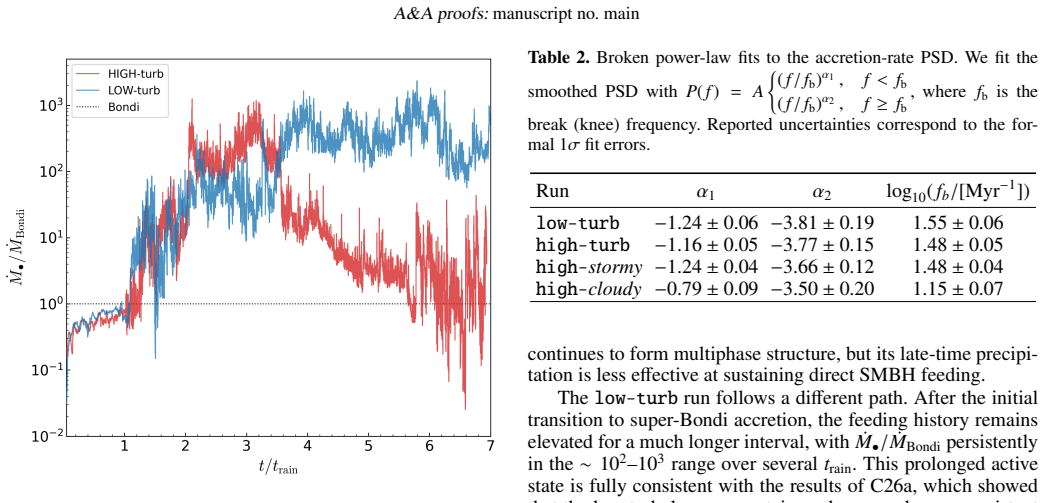
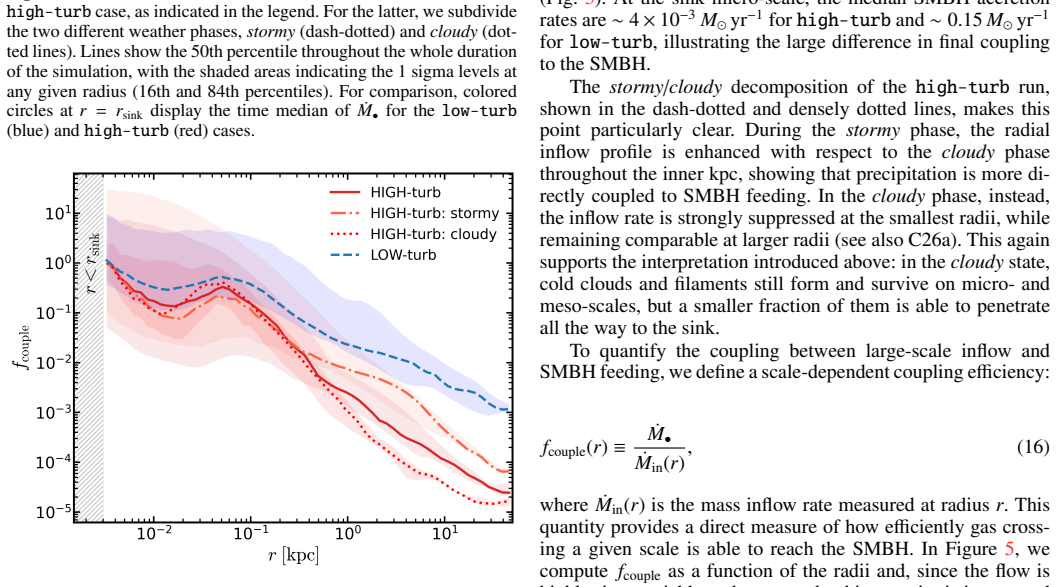
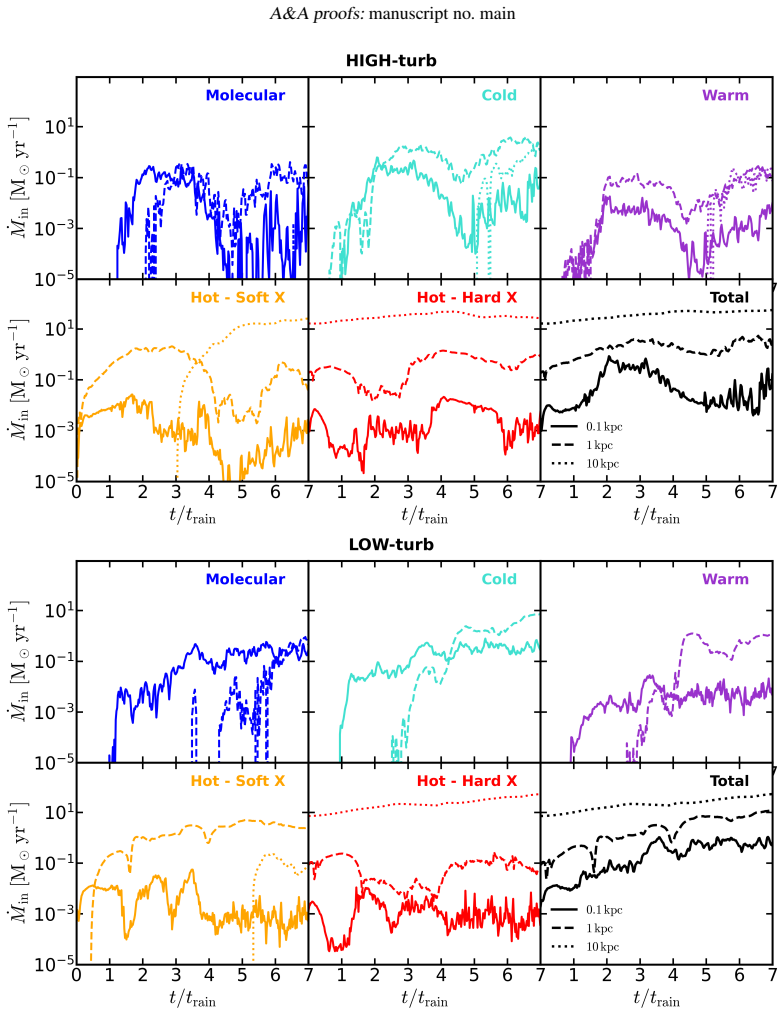
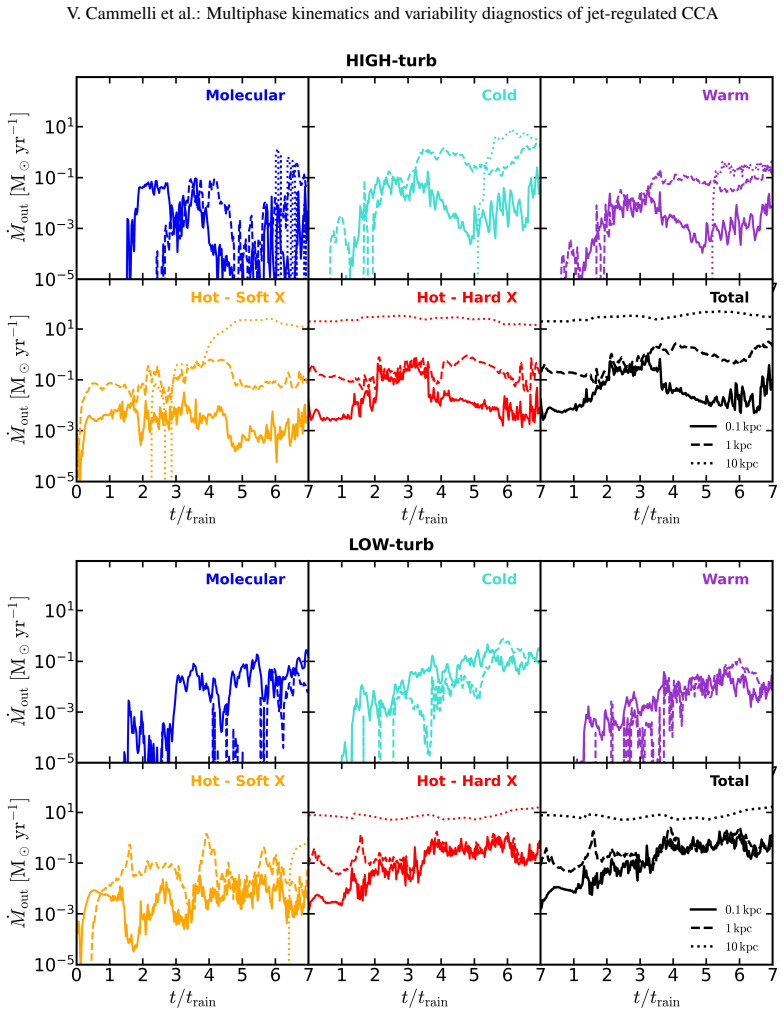
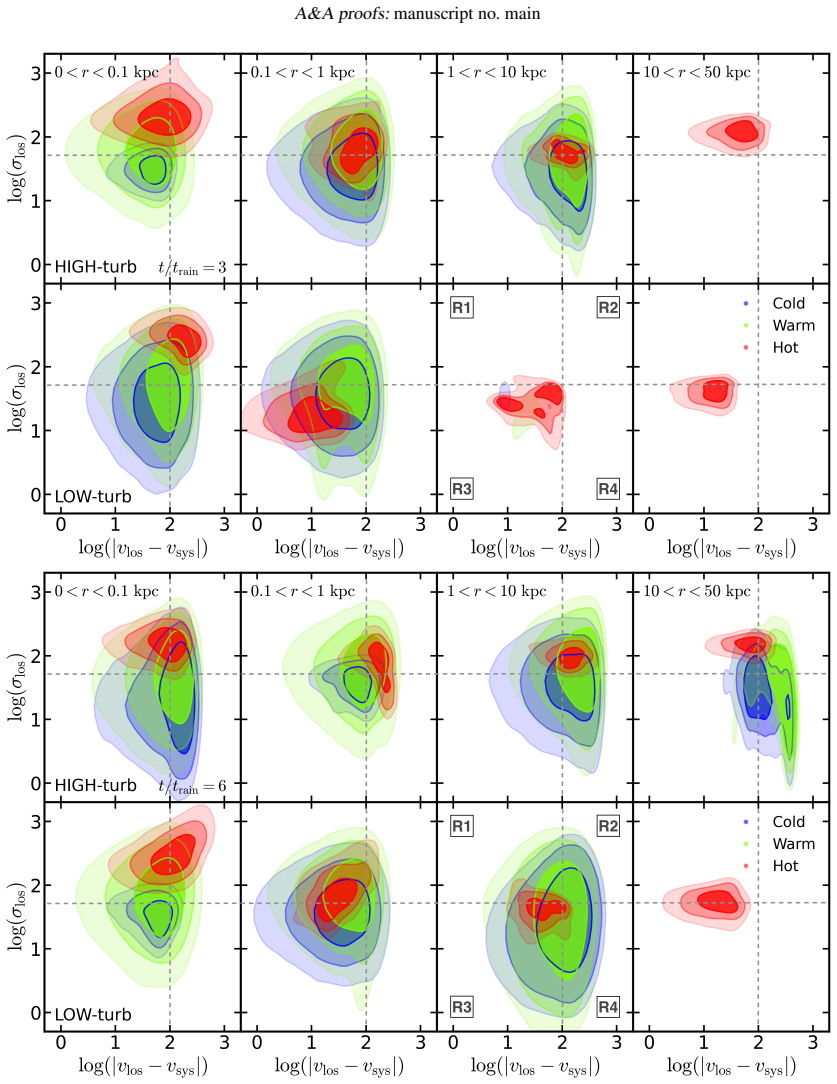
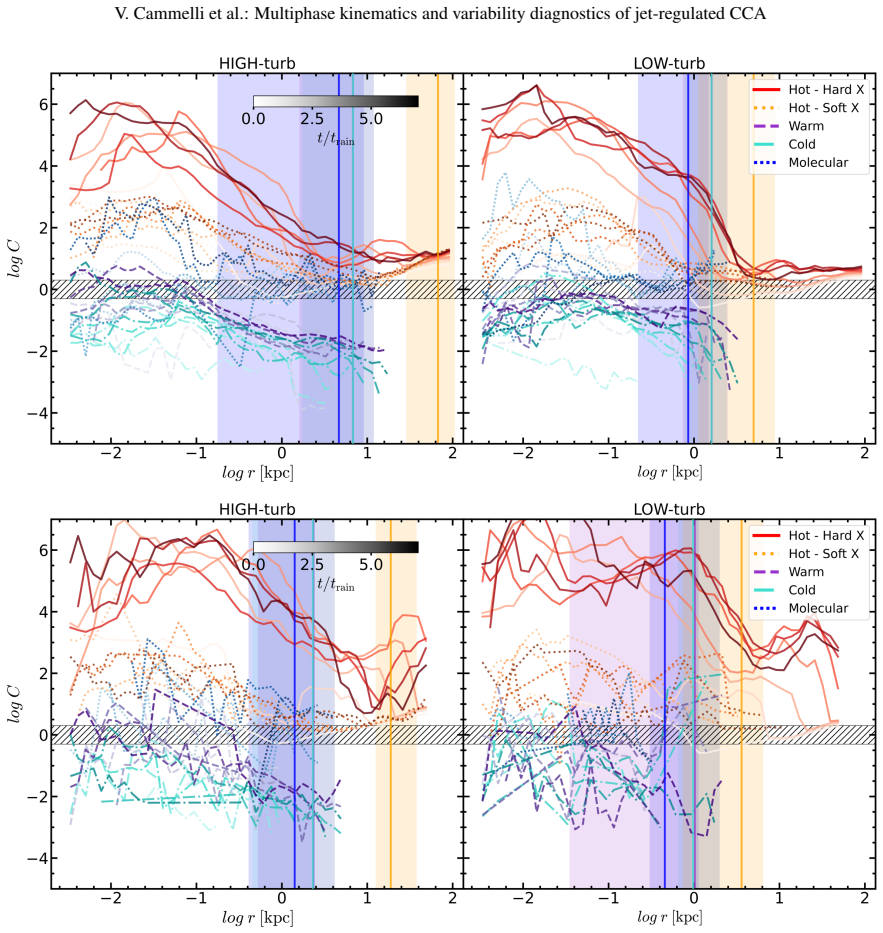
Jet-regulated CCA is controlled by meso-scale transport, not only by cold-gas production. Within the BlackHoleWeather framework, combined k-plot and C-ratio diagnostics are crucial to distinguish cold gas that is merely present from cold gas dynamically linked to SMBH feeding. Both runs become CCA-fed once precipitation begins, with accretion rising from Bondi-like to strongly super-Bondi values while remaining mostly low-Eddington and mechanically dominated. The strongly stirred run develops an early stormy phase with extended condensation, bursty feeding, and strong inflow/outflow variability, but later enters a cloudy phase in which cold and warm gas persist at meso- and inner macro-scale
What carries the argument
self-regulated kinetic jet model using k-plots and cooling-to-eddy-time (C-ratio) profiles to measure phase-separated mass fluxes, accretion histories, and variability across meso-scales
If this is right
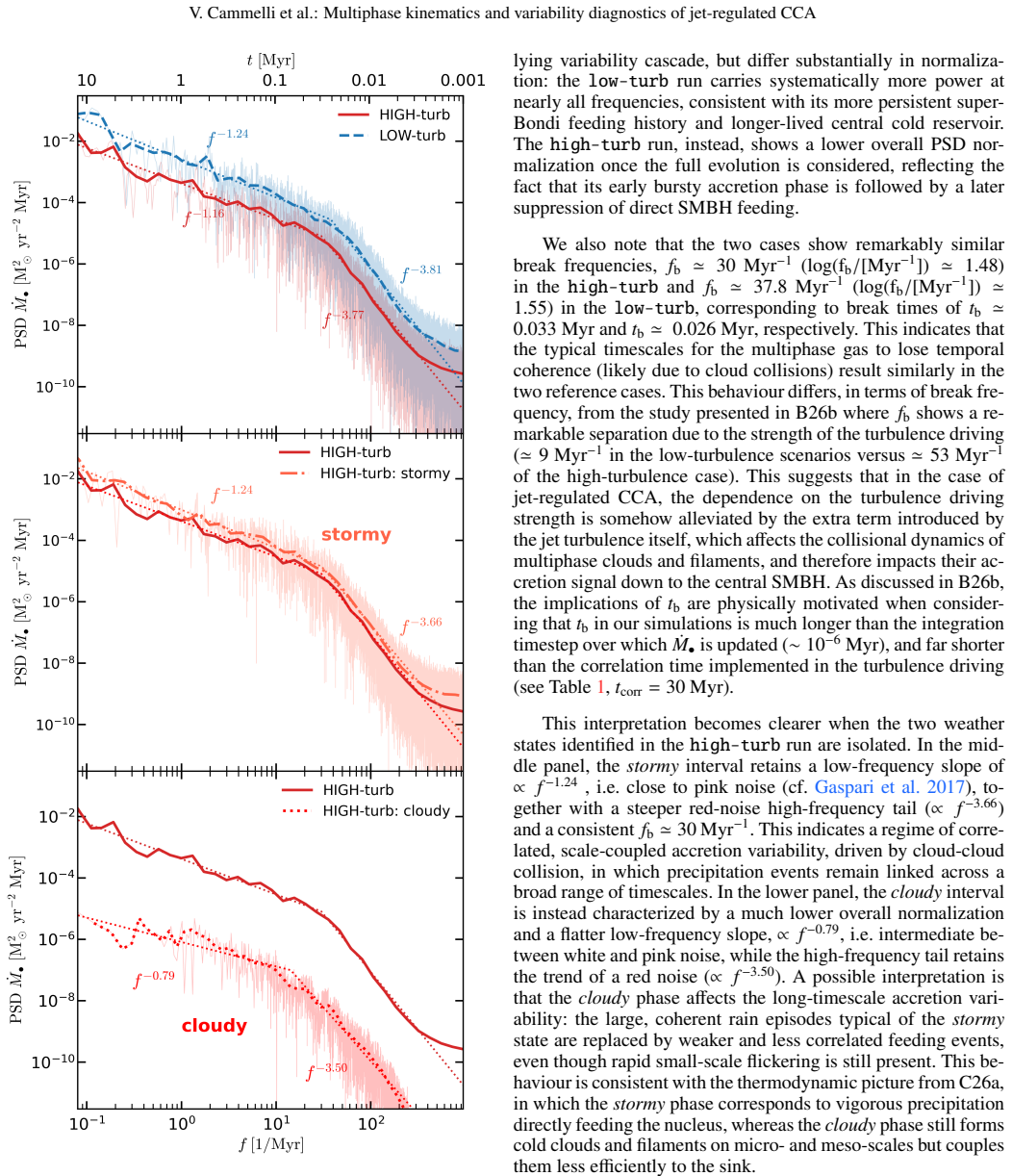
- Accretion-rate power spectra exhibit flicker-like low-frequency slopes and red-noise tails, with normalization dropping and slopes flattening in the cloudy phase.
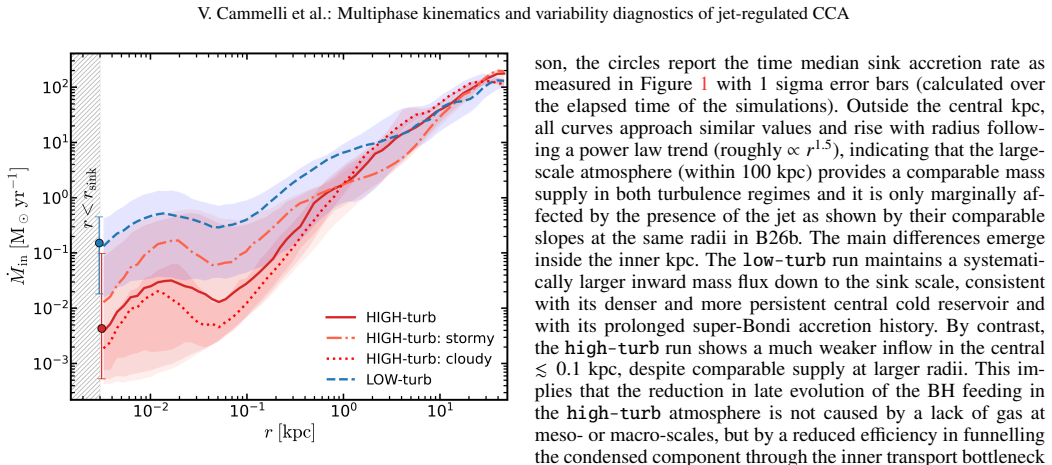
- Phase-separated mass fluxes reveal fountain-like recycling in the strongly stirred run versus inner-kpc recycling in the calmer run.
- The jet creates a hot channel where sustained condensation is suppressed, while C~1 is reached mostly outside the cone and near the jet-ambient interface.
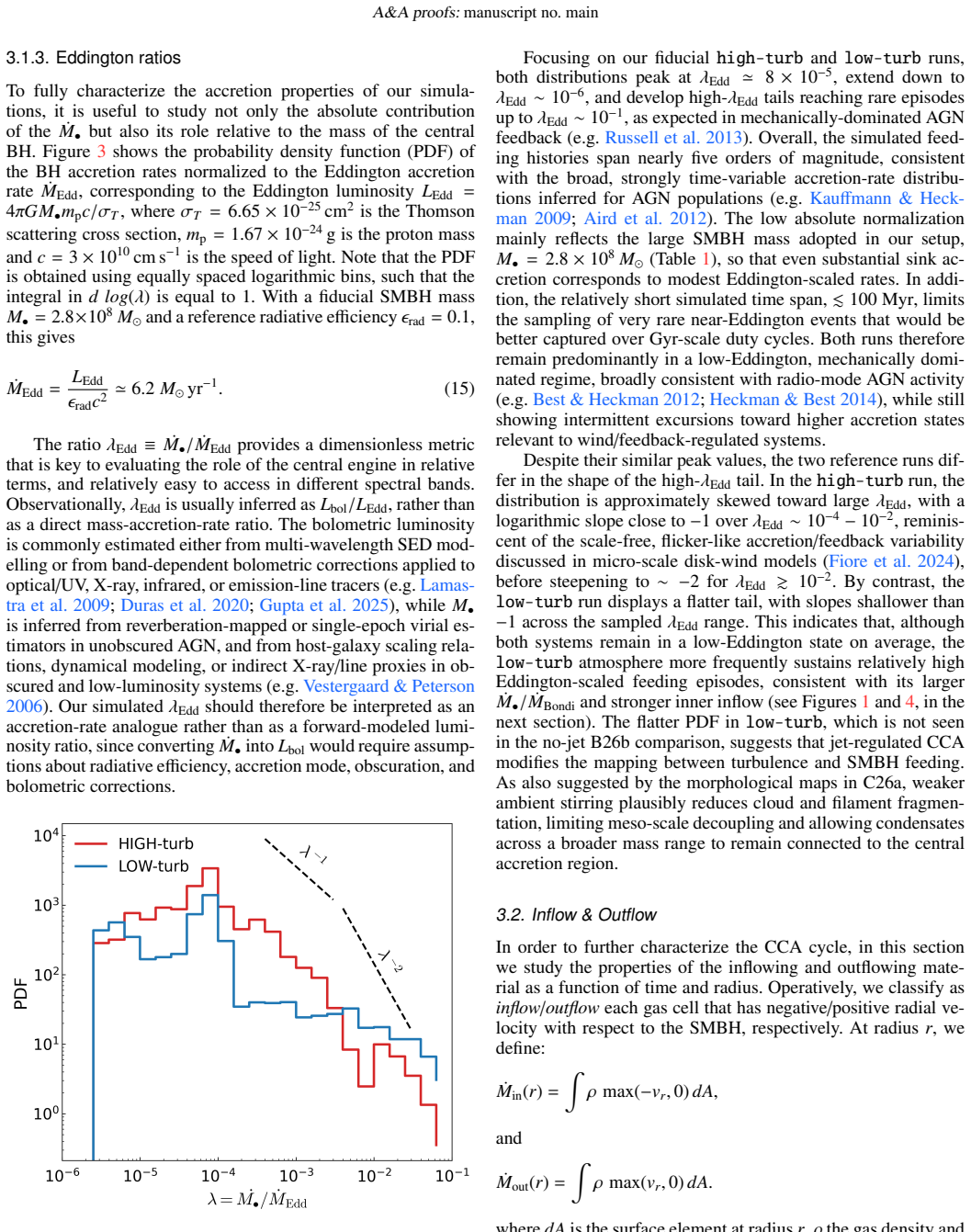
- Accretion remains mostly low-Eddington and mechanically dominated even as it becomes strongly super-Bondi once precipitation begins.
Where Pith is reading between the lines
- The distinction between stormy and cloudy phases could map onto different observed levels of turbulence or jet activity in galaxy groups.
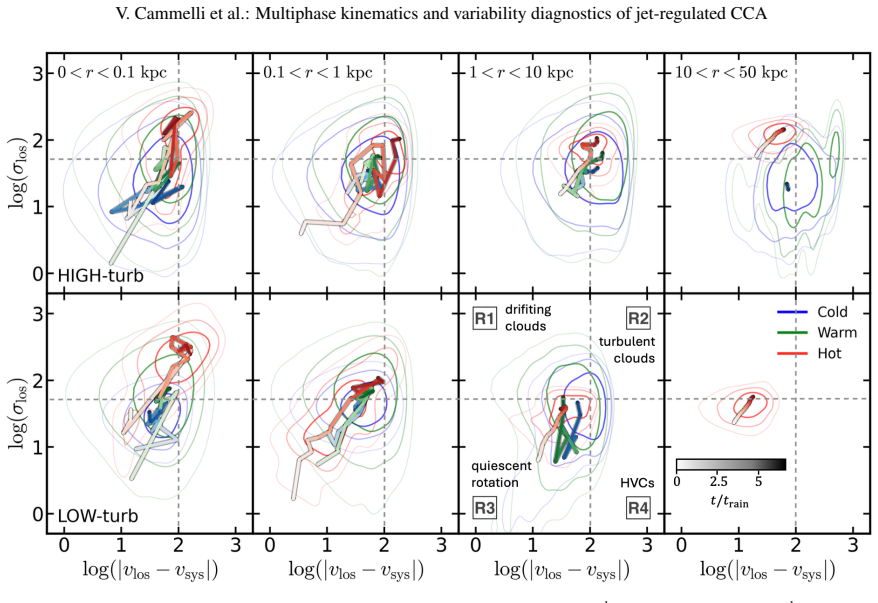
- k-plot and C-ratio diagnostics might be adapted to X-ray and radio observations to identify which multiphase structures are actively feeding the black hole.
- This implies jet feedback structures inflow pathways in addition to providing heating, affecting how cold gas reaches the center over time.
Load-bearing premise
The self-regulated kinetic jet model and runs differing only in turbulent driving strength accurately isolate the effects of jet regulation on CCA without other unmodeled variables dominating the meso-scale transport and condensation outcomes.
What would settle it
Observing whether the spatial distribution of C~1 regions in real galaxy groups aligns with jet-ambient interfaces and correlates with measured accretion variability would test if meso-scale transport governs feeding.
Figures
read the original abstract
Chaotic cold accretion (CCA) predicts that supermassive black holes are fed by multiphase clouds condensing from turbulent hot atmospheres. In jet-regulated systems cold gas must also remain dynamically connected to the central accretion region. We investigate how a self-regulated kinetic jet modifies the kinematics, radial transport, and variability of CCA across the meso-scale of a typical galaxy-group atmosphere. The runs differ only in turbulent driving strength. We measure accretion histories, Eddington ratios, power spectra, phase-separated mass fluxes, projected k-plots, and cooling-to-eddy-time (C-ratio) profiles. Both runs become CCA-fed once precipitation begins, with accretion rising from Bondi-like to strongly super-Bondi values while remaining mostly low-Eddington and mechanically dominated. The strongly stirred run develops an early stormy phase with extended condensation, bursty feeding, and strong inflow/outflow variability, but later enters a cloudy phase in which cold and warm gas persist at meso- and inner macro-scales while sink coupling weakens. The calmer run maintains a compact rainy state with a longer-lived central reservoir. Accretion-rate spectra show flicker-like low-frequency slopes and red-noise tails; in the cloudy phase, the normalization drops and the low-frequency slope flattens. Phase-separated fluxes show fountain-like recycling in the strongly stirred run, but inner-kpc recycling in the calmer run. The jet excavates a hot channel where sustained condensation is suppressed, while C~1 is reached mostly outside the cone and near the jet-ambient interface. Jet-regulated CCA is controlled by meso-scale transport, not only by cold-gas production. Within the BlackHoleWeather framework, combined k-plot and C-ratio diagnostics are crucial to distinguish cold gas that is merely present from cold gas dynamically linked to SMBH feeding.
Editorial analysis
A structured set of objections, weighed in public.
Referee Report
Summary. The paper simulates jet-regulated chaotic cold accretion (CCA) across the meso-scale in galaxy-group atmospheres using the BlackHoleWeather framework. Two runs differing only in turbulent driving strength are compared via accretion histories, Eddington ratios, power spectra, phase-separated mass fluxes, projected k-plots, and C-ratio profiles. Both become CCA-fed with super-Bondi accretion that remains mechanically dominated; the strongly stirred run shows an early stormy phase transitioning to a cloudy phase with fountain recycling and hot-channel suppression, while the calmer run maintains a compact rainy state. The authors conclude that meso-scale transport, not merely cold-gas production, controls jet-regulated CCA, and that combined k-plot and C-ratio diagnostics are needed to link cold gas to SMBH feeding.
Significance. If the results hold after addressing the isolation of jet effects, the work would strengthen CCA theory by demonstrating the role of meso-scale kinematics and jet excavation in regulating feeding variability and recycling. The multi-diagnostic approach (power spectra, phase fluxes, k-plots, C-ratios) offers a concrete way to distinguish present versus dynamically connected cold gas, which could be useful for interpreting observations of multiphase atmospheres.
major comments (1)
- [Abstract] Abstract: The central claim that jet-regulated CCA is controlled by meso-scale transport (rather than cold-gas production alone) rests on differences between the strongly stirred and calmer runs. However, these runs differ in turbulent driving strength, which directly modulates eddy turnover times, condensation rates, and radial fluxes that enter the C-ratio and k-plot diagnostics. This leaves open whether the observed differences in stormy/rainy phases, fountain recycling, and hot-channel suppression arise primarily from the self-regulated jet or from the driving altering the underlying turbulence spectrum and precipitation thresholds.
minor comments (1)
- The abstract introduces specialized diagnostics (projected k-plots, C-ratio profiles) without brief definitions; ensure these are defined on first use in the main text with reference to prior work if applicable.
Simulated Author's Rebuttal
We thank the referee for their constructive comments. We address the single major comment below, indicating where a partial revision will be made for clarity.
read point-by-point responses
-
Referee: [Abstract] Abstract: The central claim that jet-regulated CCA is controlled by meso-scale transport (rather than cold-gas production alone) rests on differences between the strongly stirred and calmer runs. However, these runs differ in turbulent driving strength, which directly modulates eddy turnover times, condensation rates, and radial fluxes that enter the C-ratio and k-plot diagnostics. This leaves open whether the observed differences in stormy/rainy phases, fountain recycling, and hot-channel suppression arise primarily from the self-regulated jet or from the driving altering the underlying turbulence spectrum and precipitation thresholds.
Authors: Both simulations employ the identical self-regulated kinetic jet prescription, with jet power and orientation determined instantaneously by the SMBH accretion rate. The intentional difference in turbulent driving strength is used to vary the meso-scale eddy turnover and radial transport while keeping the jet feedback mechanism fixed. In both runs cold-gas production occurs via thermal instability, yet the resulting feeding variability, fountain recycling, and hot-channel suppression differ because the stronger driving enhances meso-scale fluxes that interact with the jet-excavated region. This comparison therefore isolates the modulating role of meso-scale transport within an otherwise identical jet-regulated CCA framework, rather than claiming to separate the jet from all turbulence effects. We will revise the abstract to state explicitly that the jet is self-regulated in both runs and that the driving variation probes meso-scale control of the coupled system. revision: partial
Circularity Check
No significant circularity; claims rest on simulation outputs
full rationale
The paper derives its conclusions on jet-regulated CCA, meso-scale transport, and diagnostics (k-plots, C-ratios, phase-separated fluxes) directly from the outputs of two hydrodynamical runs that differ only in turbulent driving strength. Accretion histories, power spectra, and variability measures are computed from the simulated data rather than fitted parameters renamed as predictions. No self-definitional loops, fitted-input predictions, or load-bearing self-citation chains appear in the derivation; the BlackHoleWeather framework is invoked only as context while the specific meso-scale results follow from the described simulation measurements. This is self-contained against external benchmarks.
Axiom & Free-Parameter Ledger
free parameters (1)
- turbulent driving strength
axioms (1)
- domain assumption CCA predicts that supermassive black holes are fed by multiphase clouds condensing from turbulent hot atmospheres.
Reference graph
Works this paper leans on
-
[1]
L., Moustakas, J., et al
Aird, J., Coil, A. L., Moustakas, J., et al. 2012, ApJ, 746, 90
2012
-
[2]
A., Bureau, M., et al
Alatalo, K., Davis, T. A., Bureau, M., et al. 2013, MNRAS, 432, 1796
2013
-
[3]
W., Dunn, R
Allen, S. W., Dunn, R. J. H., Fabian, A. C., Taylor, G. B., & Reynolds, C. S. 2006, MNRAS, 372, 21
2006
-
[4]
2023, MNRAS, 524, 4091
Barbani, F., Pascale, R., Marinacci, F., et al. 2023, MNRAS, 524, 4091
2023
-
[5]
2025, A&A, 697, A121
Barbani, F., Pascale, R., Marinacci, F., et al. 2025, A&A, 697, A121
2025
-
[6]
Best, P. N. & Heckman, T. M. 2012, MNRAS, 421, 1569
2012
-
[7]
1952, MNRAS, 112, 195
Bondi, H. 1952, MNRAS, 112, 195
1952
-
[8]
Booth, C. M. & Schaye, J. 2009, MNRAS, 398, 53
2009
-
[9]
2026, A&A, Submitted
Cammelli, V ., Gaspari, M., Piana, O., & et al. 2026, A&A, Submitted
2026
-
[10]
C., Young, A
Cammelli, V ., Tan, J. C., Young, A. R., et al. 2025, ApJ, 991, 141
2025
-
[11]
2014, A&A, 562, A21
Cicone, C., Maiolino, R., Sturm, E., et al. 2014, A&A, 562, A21
2014
-
[12]
P., & Proga, D
Ciotti, L., Ostriker, J. P., & Proga, D. 2010, ApJ, 717, 708
2010
-
[13]
2020, A&A, 636, A73
Duras, F., Bongiorno, A., Ricci, F., et al. 2020, A&A, 636, A73
2020
-
[14]
Eckert, D., Gaspari, M., Gastaldello, F., Le Brun, A. M. C., & O’Sullivan, E. 2021, Universe, 7, 142
2021
-
[15]
2014, Journal of Parallel and Dis- tributed Computing, 74
Edwards, H., Trott, C., & Sunderland, D. 2014, Journal of Parallel and Dis- tributed Computing, 74
2014
-
[16]
S., Davis, T
Elford, J. S., Davis, T. A., Ruffa, I., et al. 2024, MNRAS, 528, 319
2024
-
[17]
2026, The Open Journal of Astrophysics, 9, 58379
Eskenasy, R., Olivares, V ., & Su, Y . 2026, The Open Journal of Astrophysics, 9, 58379
2026
-
[18]
2024, MNRAS, 527, 1317
Eskenasy, R., Olivares, V ., Su, Y ., & Li, Y . 2024, MNRAS, 527, 1317
2024
-
[19]
2012, Annual Review of Astronomy and Astrophysics, 50, 455 Faucher-Giguère, C.-A
Fabian, A. 2012, Annual Review of Astronomy and Astrophysics, 50, 455 Faucher-Giguère, C.-A. & Quataert, E. 2012, MNRAS, 425, 605
2012
-
[20]
2017, A&A, 601, A143
Fiore, F., Feruglio, C., Shankar, F., et al. 2017, A&A, 601, A143
2017
-
[21]
2024, A&A, 686, A36
Fiore, F., Gaspari, M., Luminari, A., Tozzi, P., & de Arcangelis, L. 2024, A&A, 686, A36
2024
-
[22]
2025, A&A, 698, A121
Fournier, M., Grete, P., Brüggen, M., et al. 2025, A&A, 698, A121
2025
-
[23]
2011, MNRAS, 415, 1549
Gaspari, M., Brighenti, F., D’Ercole, A., & Melioli, C. 2011, MNRAS, 415, 1549
2011
-
[24]
2015, A&A, 579, A62
Gaspari, M., Brighenti, F., & Temi, P. 2015, A&A, 579, A62
2015
-
[25]
& Churazov, E
Gaspari, M. & Churazov, E. 2013, A&A, 559, A78
2013
-
[26]
L., et al
Gaspari, M., McDonald, M., Hamer, S. L., et al. 2018, ApJ, 854, 167
2018
-
[27]
Gaspari, M., Ruszkowski, M., & Oh, S. P. 2013, MNRAS, 432, 3401
2013
-
[28]
& S˛ adowski, A
Gaspari, M. & S˛ adowski, A. 2017, ApJ, 837, 149
2017
-
[29]
2017, MNRAS, 466, 677
Gaspari, M., Temi, P., & Brighenti, F. 2017, MNRAS, 466, 677
2017
-
[30]
2020, Nature Astronomy, 4, 10
Gaspari, M., Tombesi, F., & Cappi, M. 2020, Nature Astronomy, 4, 10
2020
-
[31]
E., Bianchi, S., Petrucci, P.-O., et al
Gianolli, V . E., Bianchi, S., Petrucci, P.-O., et al. 2024, A&A, 687, A235
2024
-
[32]
Gitti, M., Brighenti, F., & McNamara, B. R. 2012, Advances in Astronomy, 2012, 950641
2012
-
[33]
C., Miller, J
Grete, P., Dolence, J. C., Miller, J. M., et al. 2023, The International Journal of High Performance Computing Applications, 37, 465
2023
-
[34]
K., Ricci, C., Tortosa, A., et al
Gupta, K. K., Ricci, C., Tortosa, A., et al. 2025, ApJ, 990, 86
2025
-
[35]
Heckman, T. M. & Best, P. N. 2014, ARA&A, 52, 589
2014
-
[36]
The major cluster merger in Abell 2034 as seen by XRISM: Strong turbulence and spectral anomalies?
Heinrich, A., Zhuravleva, I., Churazov, E., et al. 2026, arXiv e-prints, arXiv:2604.27161 Hitomi Collaboration, Aharonian, F., Akamatsu, H., et al. 2016, Nature, 535, 117
work page internal anchor Pith review Pith/arXiv arXiv 2026
-
[37]
S., Nandra, K., Clerc, N., & Gaspari, M
Hofmann, F., Sanders, J. S., Nandra, K., Clerc, N., & Gaspari, M. 2016, A&A, 585, A130 Juráˇnová, A., Werner, N., Nulsen, P. E. J., et al. 2020, MNRAS, 499, 5163
2016
-
[38]
& Heckman, T
Kauffmann, G. & Heckman, T. M. 2009, MNRAS, 397, 135
2009
-
[39]
& Pounds, K
King, A. & Pounds, K. 2015, ARA&A, 53, 115
2015
-
[40]
1941, Akademiia Nauk SSSR Doklady, 30, 301
Kolmogorov, A. 1941, Akademiia Nauk SSSR Doklady, 30, 301
1941
-
[41]
2009, A&A, 504, 73
Lamastra, A., Bianchi, S., Matt, G., et al. 2009, A&A, 504, 73
2009
-
[42]
2025, A&A, 694, A115
Lepore, M., Pinto, C., Tozzi, P., et al. 2025, A&A, 694, A115
2025
-
[43]
M., Serra, P., Gaspari, M., et al
Maccagni, F. M., Serra, P., Gaspari, M., et al. 2021, A&A, 656, A45
2021
-
[44]
2021, The Messenger, 182, 45
Mainieri, V ., Circosta, C., Kakkad, D., et al. 2021, The Messenger, 182, 45
2021
-
[45]
R., Fabian, A
Maiolino, R., Russell, H. R., Fabian, A. C., et al. 2017, Nature, 544, 202
2017
-
[46]
McNamara, B. R. & Nulsen, P. E. J. 2012, New Journal of Physics, 14, 055023
2012
-
[47]
A., Brusa, M., et al
Mehdipour, M., Kriss, G. A., Brusa, M., et al. 2023, A&A, 670, A183
2023
-
[48]
2008, ApJ, 686, 219
Menci, N., Fiore, F., Puccetti, S., & Cavaliere, A. 2008, ApJ, 686, 219
2008
-
[49]
2017, Frontiers in Astronomy and Space Sciences, 4, 42
Morganti, R. 2017, Frontiers in Astronomy and Space Sciences, 4, 42
2017
-
[50]
V ., Wagner, A
Mukherjee, D., Bicknell, G. V ., Wagner, A. Y ., Sutherland, R. S., & Silk, J. 2018, Monthly Notices of the Royal Astronomical Society, 479, 5544
2018
-
[51]
2025, Nature Astronomy, 9, 449
Olivares, V ., Picquenot, A., Su, Y ., et al. 2025, Nature Astronomy, 9, 449
2025
-
[52]
2019, A&A, 631, A22
Olivares, V ., Salome, P., Combes, F., et al. 2019, A&A, 631, A22
2019
-
[53]
L., et al
Olivares, V ., Salomé, P., Hamer, S. L., et al. 2022, A&A, 666, A94
2022
-
[54]
2023, ApJ, 954, 56
Olivares, V ., Su, Y ., Forman, W., et al. 2023, ApJ, 954, 56
2023
-
[55]
& Papadakis, I
Paolillo, M. & Papadakis, I. 2025, Nuovo Cimento Rivista Serie, 48, 537
2025
-
[56]
C., Combes, F., et al
Rose, T., Edge, A. C., Combes, F., et al. 2019, MNRAS, 489, 349
2019
-
[57]
R., McNamara, B
Russell, H. R., McNamara, B. R., Edge, A. C., et al. 2013, MNRAS, 432, 530
2013
-
[58]
R., McNamara, B
Russell, H. R., McNamara, B. R., Fabian, A. C., et al. 2019, MNRAS, 490, 3025
2019
-
[59]
2019, A&A, 627, A121
Serafinelli, R., Tombesi, F., Vagnetti, F., et al. 2019, A&A, 627, A121
2019
-
[60]
& Rees, M
Silk, J. & Rees, M. J. 1998, A&A, 331, L1
1998
-
[61]
2023, ApJ, 959, 107 S˛ adowski, A
Singha, M., Winkel, N., Vaddi, S., et al. 2023, ApJ, 959, 107 S˛ adowski, A. & Gaspari, M. 2017, MNRAS, 468, 1398
2023
-
[62]
2005, MNRAS, 361, 776
Springel, V ., Di Matteo, T., & Hernquist, L. 2005, MNRAS, 361, 776
2005
-
[63]
M., Tomida, K., White, C
Stone, J. M., Tomida, K., White, C. J., & Felker, K. G. 2020, ApJS, 249, 4
2020
-
[64]
C., & Narayan, R
Tchekhovskoy, A., McKinney, J. C., & Narayan, R. 2012, in Journal of Physics Conference Series, V ol. 372, Journal of Physics Conference Series (IOP), 012040
2012
-
[65]
2018, ApJ, 858, 17
Temi, P., Amblard, A., Gitti, M., et al. 2018, ApJ, 858, 17
2018
-
[66]
2022, ApJ, 928, 150
Temi, P., Gaspari, M., Brighenti, F., et al. 2022, ApJ, 928, 150
2022
-
[67]
2026, The Astrophysical Journal, Submitted
Temi, P., Ubertosi, F., Brighenti, F., & et al. 2026, The Astrophysical Journal, Submitted
2026
-
[68]
N., et al
Tombesi, F., Cappi, M., Reeves, J. N., et al. 2013, MNRAS, 430, 1102
2013
-
[69]
N., et al
Tombesi, F., Cappi, M., Reeves, J. N., et al. 2010, A&A, 521, A57
2010
-
[70]
2022, A&A, 667, L12
Tozzi, G., Lusso, E., Casetti, L., et al. 2022, A&A, 667, L12
2022
-
[71]
R., Combes, F., Oonk, J
Tremblay, G. R., Combes, F., Oonk, J. B. R., et al. 2018, ApJ, 865, 13
2018
-
[72]
R., Oonk, J
Tremblay, G. R., Oonk, J. B. R., Combes, F., et al. 2016, Nature, 534, 218 Trindade Falcão, A., Kraemer, S., Feuillet, L., et al. 2026, ApJ, 1000, 242
2016
-
[73]
N., McNamara, B
Vantyghem, A. N., McNamara, B. R., Russell, H. R., et al. 2019, ApJ, 870, 57
2019
-
[74]
2012, A&A, 544, A103
Vazza, F., Roediger, E., & Brüggen, M. 2012, A&A, 544, A103
2012
-
[75]
D., & Aalto, S
Veilleux, S., Maiolino, R., Bolatto, A. D., & Aalto, S. 2020, A&A Rev., 28, 2
2020
-
[76]
& Peterson, B
Vestergaard, M. & Peterson, B. M. 2006, ApJ, 641, 689
2006
-
[77]
Y ., Umemura, M., & Bicknell, G
Wagner, A. Y ., Umemura, M., & Bicknell, G. V . 2013, ApJ, 763, L18 XRISM Collaboration, Audard, M., Awaki, H., et al. 2025, ApJ, 982, L5
2013
-
[78]
& King, A
Zubovas, K. & King, A. R. 2012, in Astronomical Society of the Pacific Confer- ence Series, V ol. 460, AGN Winds in Charleston, ed. G. Chartas, F. Hamann, & K. M. Leighly, 235
2012
-
[79]
& King, A
Zubovas, K. & King, A. R. 2014, MNRAS, 439, 400 Article number, page 22 of 24 V . Cammelli et al.: Multiphase kinematics and variability diagnostics of jet-regulated CCA Appendix A: Synthetic observational mapping Table A.1.Synthetic mapping between simulation diagnostics and observational proxies. The entries summarize how jet-regulated CCA weather state...
2014
-
[80]
CO, Hα, [Nii] centroids; absorp- tion components Offsets of order 10 2 km s−1 are com- mon in cold/warm filaments and nu- clear absorbers, often below pure free-fall expectations.b Large offsets with modest dis- persion suggest uplift, fallback, or weakly coupledcloudycircu- lation. Velocity dispersion/k- plot CO and optical line widths; kine- matic phase...
2016
discussion (0)
Sign in with ORCID, Apple, or X to comment. Anyone can read and Pith papers without signing in.