Radiative Response of Atomic Systems Illuminated with Approximate Spherical Vector Waves
Pith reviewed 2026-06-29 14:20 UTC · model grok-4.3
The pith
A formalism calculates atomic multipole transition rates via superposition of spherical vector waves with boundary modes.
A machine-rendered reading of the paper's core claim, the machinery that carries it, and where it could break.
Core claim
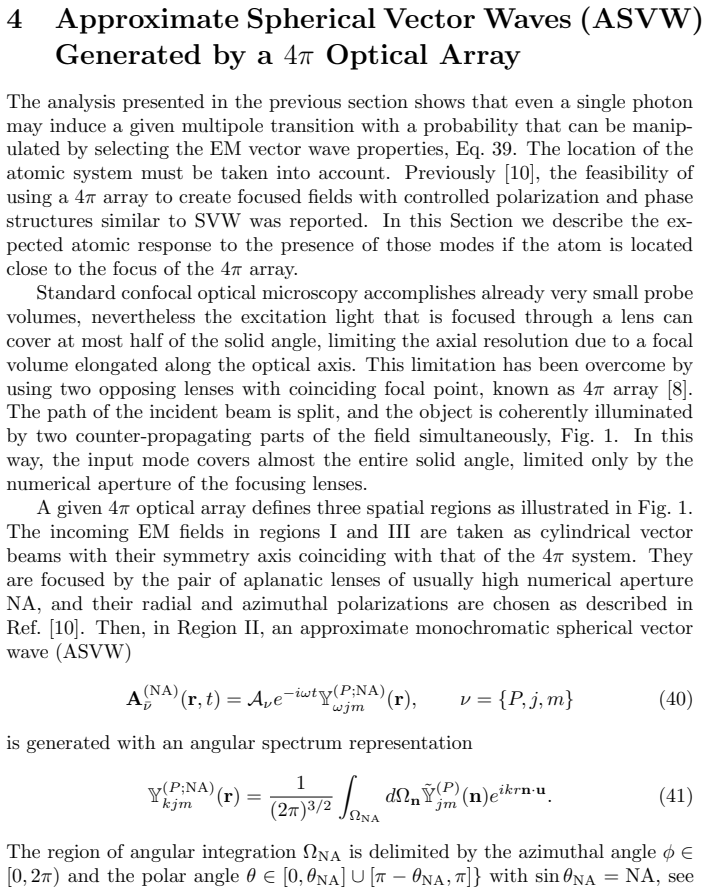
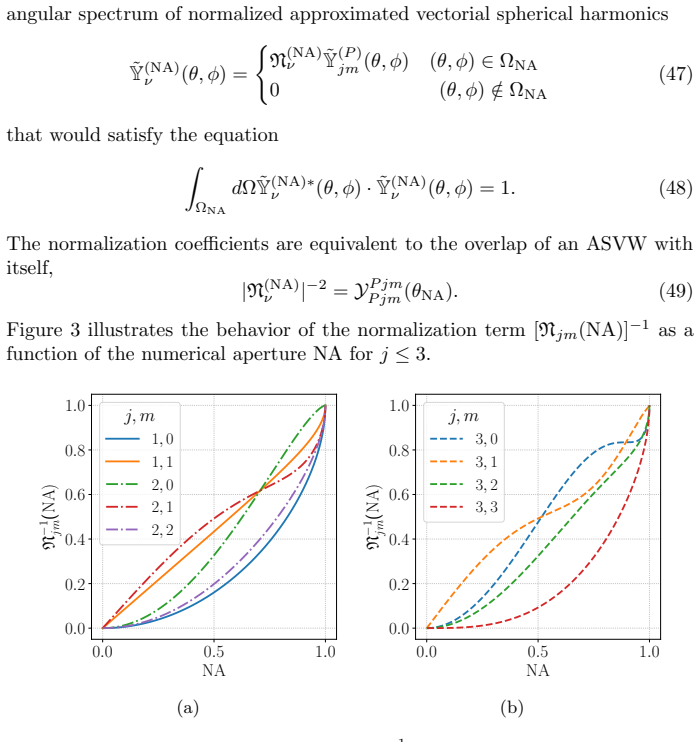
We introduce a general formalism for evaluating spherical multipole transition rates under different boundary conditions, considering the superposition between a given SVW and the modes resulting from the boundary conditions. This formalism is applied to study the radiative properties of an atomic system trapped near the focus of a 4π optical array. By appropriately selecting the external light field, the juxtaposed lenses of the optical array allow the atom to be illuminated with approximate spherical vector waves. Explicit expressions for the resulting multipole transition rates are presented as a function of the numerical aperture of the lenses. The feasibility of enhancing and inhibiting
What carries the argument
The superposition of a given spherical vector wave with the electromagnetic modes imposed by the boundary conditions, which determines the modified multipole transition rates.
If this is right
- Explicit expressions for the multipole transition rates are obtained that depend on the numerical aperture of the lenses.
- The 4π array can be used to enhance or inhibit electric dipole-forbidden transitions.
- The approach remains feasible with existing experimental capabilities for constructing and driving the lens array.
Where Pith is reading between the lines
- Varying the numerical aperture in an actual 4π setup would provide a direct test of how boundary modes alter specific transition probabilities.
- The same superposition approach could be applied to other optical boundary conditions, such as those created by mirrors or dielectric structures.
- Control over forbidden transitions might allow selective enhancement of higher-order multipole processes in precision spectroscopy experiments.
Load-bearing premise
An external light field can be chosen so the 4π array lenses produce illumination with approximate spherical vector waves whose superposition with boundary modes produces the stated transition rates.
What would settle it
Measure the multipole transition rates of an atom trapped at the focus of a 4π optical array for several values of lens numerical aperture and check whether the values match the explicit expressions derived in the paper.
Figures
read the original abstract
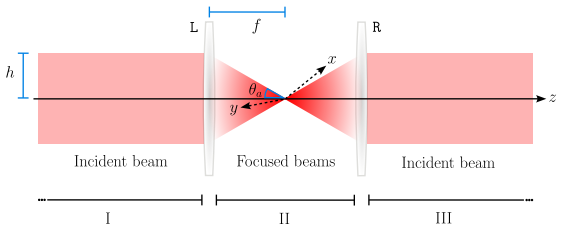
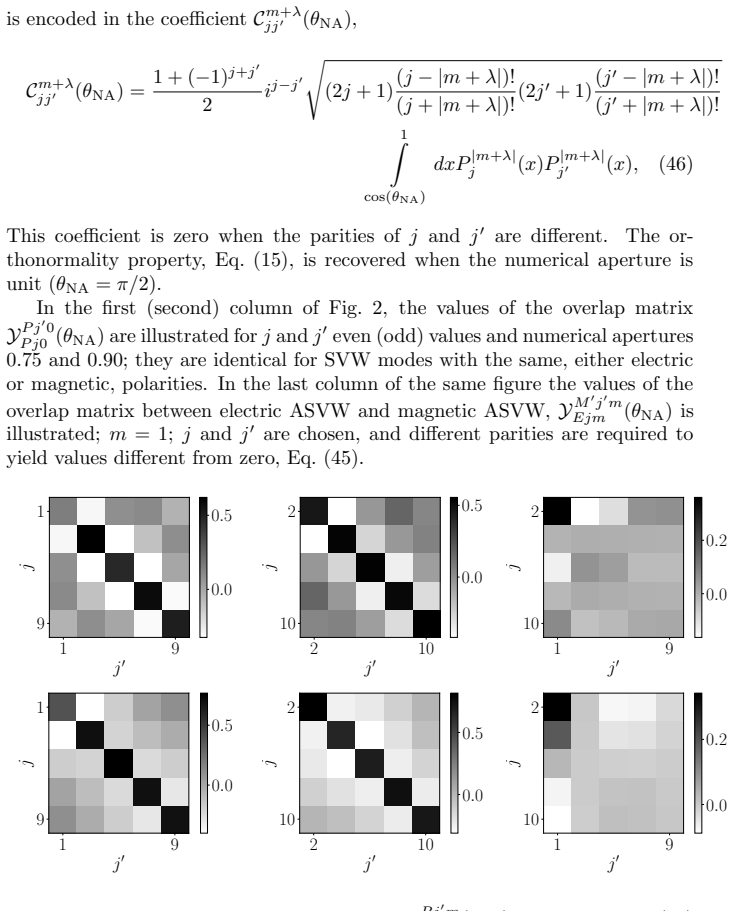
The natural electromagnetic modes spontaneously emitted by an atom in free space are spherical vector waves (SVWs). Each SVW mode is uniquely linked to a specific dynamical--spherical--multipole--moment of the atomic system. In this work, we introduce a general formalism for evaluating spherical multipole transition rates under different boundary conditions, considering the superposition between a given SVW and the modes resulting from the boundary conditions. This formalism is applied to study the radiative properties of an atomic system trapped near the focus of a 4$\pi$ optical array. By appropriately selecting the external light field, the juxtaposed lenses of the optical array allow the atom to be illuminated with approximate spherical vector waves. Explicit expressions for the resulting multipole transition rates are presented as a function of the numerical aperture of the lenses. The feasibility of enhancing and inhibiting electric dipole-forbidden transitions using such an array, under current experimental capabilities, is briefly discussed.
Editorial analysis
A structured set of objections, weighed in public.
Referee Report
Summary. The paper introduces a general formalism for spherical multipole transition rates under boundary conditions via superposition of a given spherical vector wave (SVW) with boundary-induced modes. It applies the formalism to an atom trapped near the focus of a 4π optical array, asserting that suitable external fields allow illumination with approximate SVWs through the array's lenses, yielding explicit numerical-aperture-dependent expressions for the resulting transition rates, and briefly discusses feasibility of enhancing or inhibiting electric-dipole-forbidden transitions under current experimental capabilities.
Significance. If the formalism is correctly derived and the SVW approximation holds with sufficient fidelity, the approach could enable controlled modification of atomic radiative properties using high-NA optics, offering a route to manipulate forbidden transitions without additional fitting parameters. The parameter-free character of the derived rates (once the boundary superposition is fixed) and the direct link to experimental NA values would be strengths if supported by explicit overlap calculations or limits checks.
major comments (2)
- [Abstract] Abstract (application paragraph): the central claim that 'by appropriately selecting the external light field, the juxtaposed lenses of the optical array allow the atom to be illuminated with approximate spherical vector waves' whose superposition then yields the stated NA-dependent multipole rates is load-bearing, yet no overlap integral, fidelity metric, or error bound is supplied for the NA values considered. Without this, it is impossible to confirm that multipole-order mixing remains negligible or that the predicted enhancement/inhibition follows.
- [Abstract] Abstract (formalism paragraph): the general formalism is presented as derived from boundary conditions, but the manuscript supplies no explicit check against known free-space limits (e.g., recovery of standard Einstein A coefficients when boundary modes vanish) or against a simple analytic case such as a perfect mirror. Such a verification would be required to establish that the superposition procedure is free of hidden assumptions.
Simulated Author's Rebuttal
We thank the referee for the careful reading of the manuscript and the constructive comments. We address each major comment below.
read point-by-point responses
-
Referee: [Abstract] Abstract (application paragraph): the central claim that 'by appropriately selecting the external light field, the juxtaposed lenses of the optical array allow the atom to be illuminated with approximate spherical vector waves' whose superposition then yields the stated NA-dependent multipole rates is load-bearing, yet no overlap integral, fidelity metric, or error bound is supplied for the NA values considered. Without this, it is impossible to confirm that multipole-order mixing remains negligible or that the predicted enhancement/inhibition follows.
Authors: We agree that explicit quantitative validation of the approximation is required to support the central claim. In the revised manuscript we will add calculations of the overlap integrals between the field produced by the 4π array and the target SVWs, together with fidelity metrics and error bounds evaluated at the numerical apertures under consideration. revision: yes
-
Referee: [Abstract] Abstract (formalism paragraph): the general formalism is presented as derived from boundary conditions, but the manuscript supplies no explicit check against known free-space limits (e.g., recovery of standard Einstein A coefficients when boundary modes vanish) or against a simple analytic case such as a perfect mirror. Such a verification would be required to establish that the superposition procedure is free of hidden assumptions.
Authors: We concur that such limit checks are necessary. The revised manuscript will include an explicit demonstration that the formalism recovers the standard Einstein A coefficients when boundary-induced modes vanish, as well as a comparison against the analytic case of a perfect mirror. revision: yes
Circularity Check
No significant circularity; derivation is self-contained from boundary conditions and SVW superposition.
full rationale
The paper introduces a formalism for multipole transition rates via superposition of a given SVW with boundary-condition modes, then applies it to a 4π array by positing that external fields can be chosen to produce approximate SVWs. Explicit NA-dependent rate expressions follow directly from this construction. No quoted step reduces a prediction to a fitted parameter by construction, renames a known result, or relies on a load-bearing self-citation whose content is unverified. The central expressions are derived from the stated superposition principle rather than from re-labeling inputs. The feasibility assumption about the 4π array is an external physical claim, not a definitional loop inside the derivation chain.
Axiom & Free-Parameter Ledger
Reference graph
Works this paper leans on
-
[1]
R. Grimm, M. Weidem¨ uller, and Y. B. Ovchinnikov,Optical dipole traps for neutral atoms,Adv. At. Mol. Opt. Phys.42, 95 (2000), doi: 10.1016/S1049- 250X(08)60186-X
-
[2]
J. D. Thompson, T. G. Tiecke, A. S. Zibrov, V. Vuleti´ c, and M. D. Lukin,Coherence and Raman sideband cooling of a single 17 atom in an optical tweezer, Phys. Rev. Lett.110, 133001 (2013), doi:10.1103/PhysRevLett.110.133001
-
[3]
M. Endres, H. Bernien, A. Keesling, H. Levine, E. R. Anschuetz, A. Kra- jebrink, C. Senko, V. Vuleti´ c, M. Greiner, and M. D. Lukin,Atom-by-atom assembly of defect-free one-dimensional cold atom arrays,Science354, 1024 (2016), doi: 10.1126/science.aah3752
-
[4]
D. Barredo, S. de L´ es´ eleuc, V. Lienhard, T. Lahaye, and A. Browaeys, An atom-by-atom assembler of defect-free arbitrary two-dimensional atomic arrays,Science354, 1021 (2016), doi: 10.1126/science.aah3778
-
[5]
A. M. Kaufman and K. K. Ni,Quantum science with optical tweezer ar- rays of ultracold atoms and molecules,Nat. Phys.17, 1324 (2021), doi: 10.1038/s41567-021-01357-2
-
[6]
T. Langen, G. Valtolina, D. Wang, and J. Ye,Quantum state manipula- tion and cooling of ultracold molecules,Nat. Phys.20, 702 (2024), doi: 10.48550/arXiv.2305.13445
-
[7]
V. B. Berestetskii, E. M. Lifshitz and L. P. Pitaevskii,Relativistic Quantum Theory. Pergamon Press, Oxford (1971)
1971
-
[8]
S. W. Hell, E.H.K. Stelzer, S. Lindek and C. Cremer,Confocal microscopy with an increased detection aperture: type-B 4Pi confocal microscopy, Opt. Lett.19222 (1994), doi: 10.1364/ol.19.000222
-
[9]
Steiner and Christian Kurtsiefer,Nonlinear photon- atom coupling with 4Pi microscopy, Nat
Yue-Sum Chin, M. Steiner and Christian Kurtsiefer,Nonlinear photon- atom coupling with 4Pi microscopy, Nat. Comms.8, 1200 (2017)
2017
-
[10]
F. Camas-Aquino, P. Quinto-Su, and R. J´ auregui,Spherical vector waves: their generation using a 4πoptical array, J. Opt.25, 034002 (2023), doi: 10.1088/2040-8986/acb82e
-
[11]
J. D. Jackson,Classical Electrodynamics, 2nd Edition (John Wiley and Sons, U.S.A., 1975)
1975
-
[12]
Labzowsky, G
L. Labzowsky, G. Klimchitskaya, and Yu. Dmitriev,Relativistic Effects in the Spectra of Atomic Systems(IOP, Bristol, 1993)
1993
-
[13]
W.R. Johnson, D.R. Plante, and J. Sapirstein,Relativistic Calculations of Transition Amplitudes in the Helium Isoelectronic Sequence, Adv. At. Mol. Opt. Phys.35, 255 (1995), doi: 10.1016/S1049-250X(08)60165-2
-
[14]
O. Jitrik and C. F. Bunge,Transition probabilities for Hydrogen- like atoms, J. Phys. Chem. Ref. Data,33(2004), doi: 10.1063/1.1796671
-
[15]
T. A. Zalialiutdinov, D. A. Solovyev, L. N. Labzowsky, G. Plunien,QED theory of multiphoton transitions in atoms and ions, Phys. Rep.737, 1 (2018), doi: 10.1016/j.physrep.2018.02.003 18
-
[16]
K. N. Lyashchenko, and O. Yu. Andreev,Calculation of differential cross section for dielectronic recombination with two-electron uranium, Phys. Rev A94, 042513 (2016), doi: 10.1103/PhysRevA.94.042513
-
[17]
M. Bilal, A. V. Volotka, R. Beerwerth, J. Rothhardt, V. Hilbert, and S. Fritzsche,High-precision calculations of the1s 22s2p 1P1 →1s 22s2 1 S0 spin-allowed E1 transition in C IIIPhys. Rev. A99, 062511 (2019), doi: 10.1103/PhysRevA.99.062511
-
[18]
Greiner,Relativistic Quantum Mechanics(Springer-Verlag, Berlin, 1987)
W. Greiner,Relativistic Quantum Mechanics(Springer-Verlag, Berlin, 1987)
1987
-
[19]
Kl¨ usener, A.J
J.Trautmann , D.Yankelev,V. Kl¨ usener, A.J. Park, I. Bloch, and S. Blatt 1S0 - 3P2 magnetic quadrupole transition in neutral strontium, Phys. Rev. Research5,013219 (2023)
2023
-
[20]
C. Mojica-Casique, F. Ponciano-Ojeda, S. Hern´ andez-G´ omez, O L´ opez- Hern´ andez, J Flores-Mijangos, F Ram´ ırez-Mart´ ınez, D Sahag´ un, R J´ auregui, J Jim´ enez-Mier,Control of electronic magnetic state population via light polarization in the 5p 3/2 →6p 3/2 electric quadrupole transition in atomic Rubidium, J. Phys B: At., Mol. and Opt. Phys.50, 0...
discussion (0)
Sign in with ORCID, Apple, or X to comment. Anyone can read and Pith papers without signing in.