Strong-field Photoionization: Analysis of Overlapping Above-Threshold Ionization and Laser-Assisted Photoemission Structures
Pith reviewed 2026-06-29 14:16 UTC · model grok-4.3
The pith
The photoelectron spectrum in combined high- and low-frequency fields decomposes into distinct ATI and LAPE contributions even when peaks overlap.
A machine-rendered reading of the paper's core claim, the machinery that carries it, and where it could break.
Core claim
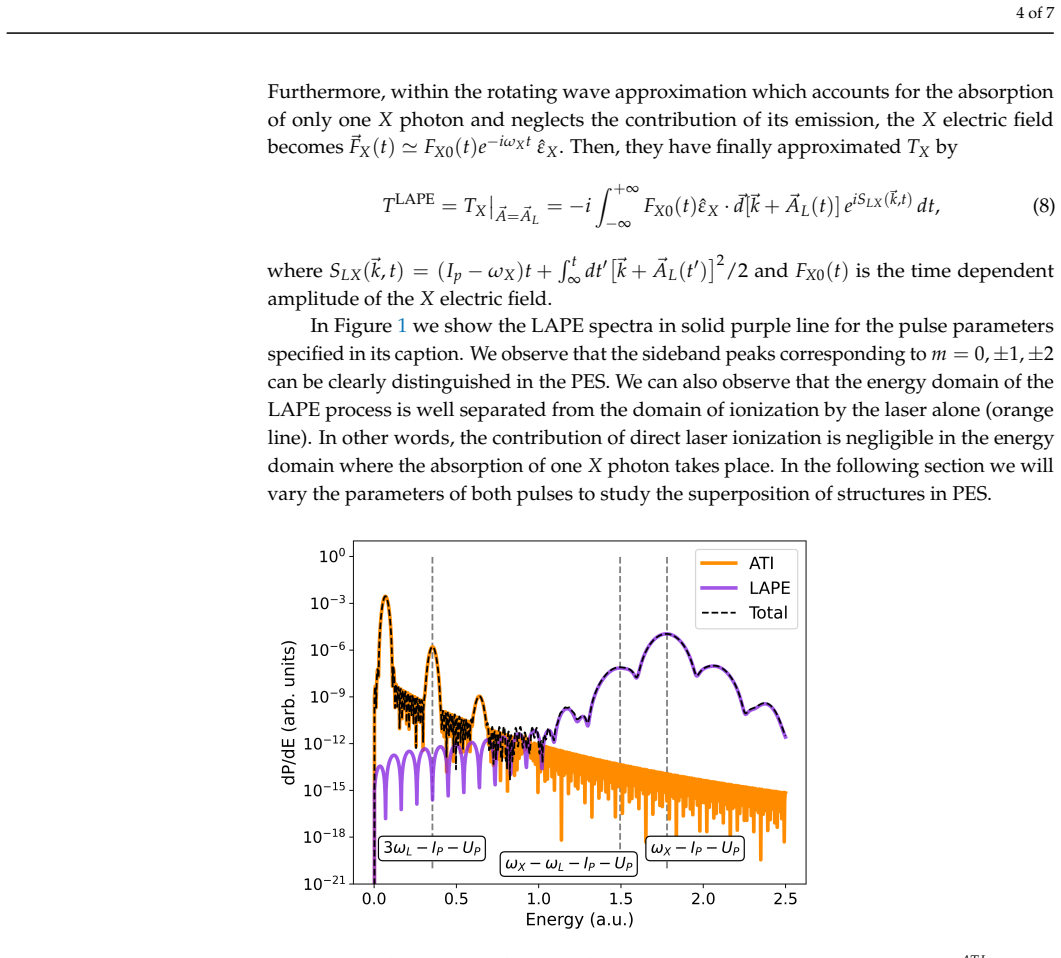
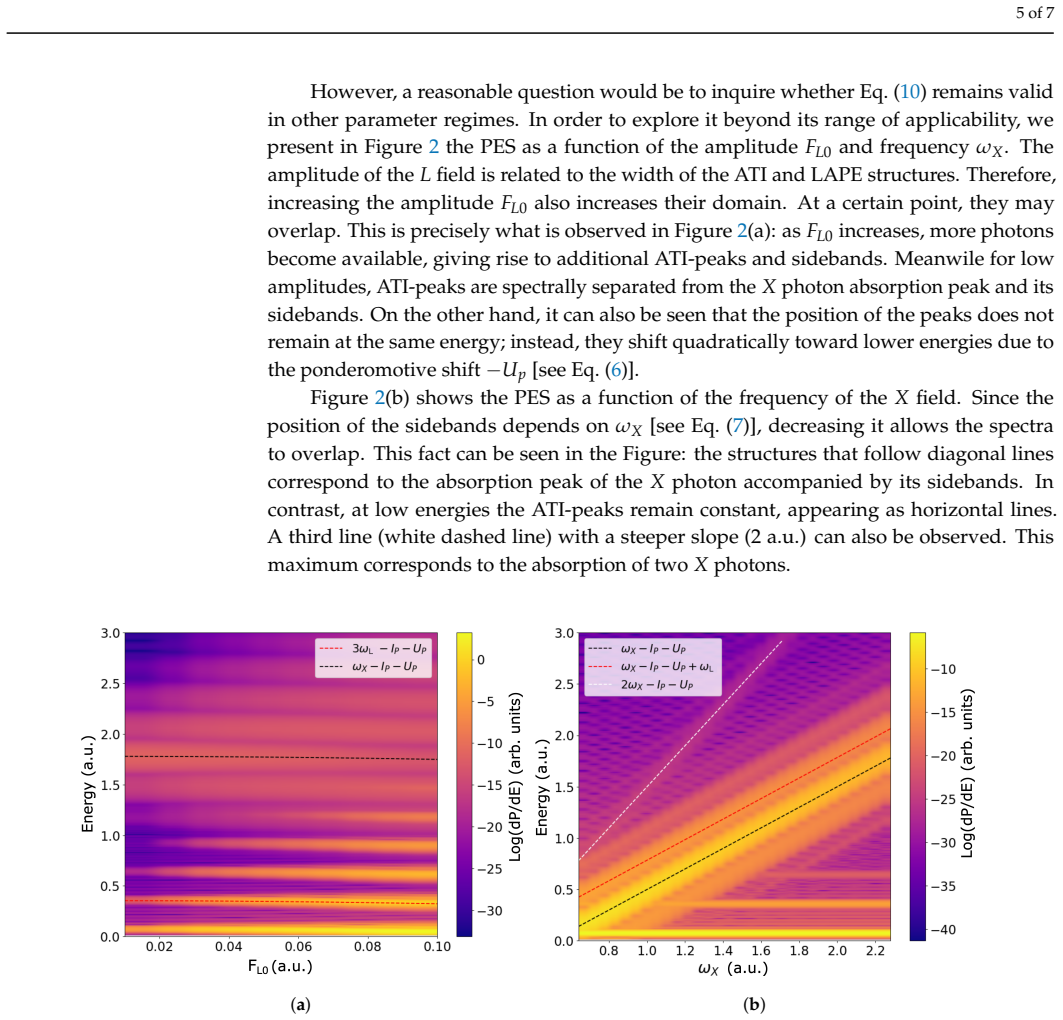
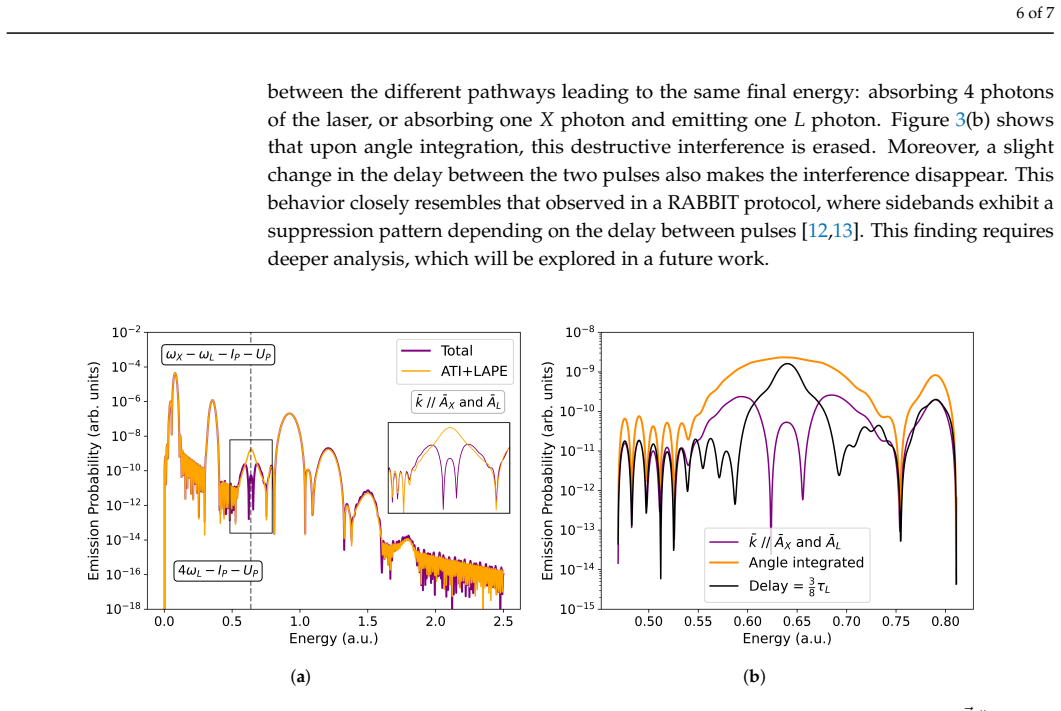
We present a theoretical description of atomic strong-field photoionization. Specifically, we consider an atom driven by a combination of two electromagnetic fields: a high-frequency field assisted by an intense, low-frequency laser. We investigate the photoelectron spectrum (PES) as the sum of two contributions: direct ionization due to the laser field and the photoionization term associated with the high-frequency field. We identify the contributions of above-threshold ionization (ATI) and laser-assisted photoemission (LAPE) structures in the total spectra, even when they overlap. As a particular case, we investigate the situation where an ATI-peak coincides with a sideband. Our theoretica
What carries the argument
Decomposition of the photoelectron spectrum into direct-ionization (ATI) and photoionization (LAPE) terms under the strong-field approximation for hydrogen 1s.
Load-bearing premise
The strong field approximation remains valid for the hydrogen 1s state under the combined high- and low-frequency fields, and the photoelectron spectrum can be decomposed into independent direct-ionization and photoionization contributions without significant interference terms beyond the model.
What would settle it
An experimental measurement of the photoelectron spectrum for hydrogen in two-color fields, compared against the model's predicted decomposition when an ATI peak coincides with a LAPE sideband.
Figures
read the original abstract
We present a theoretical description of atomic strong-field photoionization. Specifically, we consider an atom driven by a combination of two electromagnetic fields: a high-frequency field assisted by an intense, low-frequency laser. We investigate the photoelectron spectrum (PES) as the sum of two contributions: direct ionization due to the laser field and the photoionization term associated with the high-frequency field. We identify the contributions of above-threshold ionization (ATI) and laser-assisted photoemission (LAPE) structures in the total spectra, even when they overlap. As a particular case, we investigate the situation where an ATI-peak coincides with a sideband. Our theoretical scheme for the hydrogen initially in the 1s quantum state and based on strong field approximation, is general enough to be applied to other atomic species and field configurations.
Editorial analysis
A structured set of objections, weighed in public.
Referee Report
Summary. The manuscript develops a theoretical description of strong-field photoionization for hydrogen initially in the 1s state, driven by a high-frequency field combined with an intense low-frequency laser. Using the strong-field approximation (SFA), the photoelectron spectrum is expressed as the sum of a direct-ionization (ATI) contribution from the low-frequency field and a photoionization (LAPE) contribution from the high-frequency field. The central claim is that the ATI and LAPE structures can be identified separately in the total spectrum even when they overlap, with a specific analysis of the case in which an ATI peak coincides with a LAPE sideband. The scheme is stated to be generalizable to other atoms and field configurations.
Significance. If the SFA decomposition is shown to remain accurate under overlap, the work would provide a practical tool for interpreting two-color photoelectron spectra where ATI and LAPE features interfere in energy. The approach builds on a standard approximation and targets a concrete experimental situation (coincident peaks), which could be useful if accompanied by explicit validation. The abstract, however, supplies no equations, numerical spectra, error estimates, or comparisons, limiting assessment of whether the identification succeeds.
major comments (1)
- [Abstract] Abstract: The central claim that ATI and LAPE contributions remain identifiable even at overlap (including the ATI-peak/sideband coincidence case) rests on an additive decomposition inside the SFA. No equations, parameter scans, or error analysis are supplied to show that neglected Coulomb or channel-coupling interference terms remain small for the intensities and frequencies considered, exactly as flagged by the stress-test concern. This omission is load-bearing because the identification procedure is defined by that decomposition.
minor comments (1)
- [Abstract] Abstract: The statement that the scheme 'is general enough to be applied to other atomic species and field configurations' is asserted without any supporting example or extension.
Simulated Author's Rebuttal
We thank the referee for the careful review and constructive feedback on our manuscript. We address the major comment below.
read point-by-point responses
-
Referee: [Abstract] Abstract: The central claim that ATI and LAPE contributions remain identifiable even at overlap (including the ATI-peak/sideband coincidence case) rests on an additive decomposition inside the SFA. No equations, parameter scans, or error analysis are supplied to show that neglected Coulomb or channel-coupling interference terms remain small for the intensities and frequencies considered, exactly as flagged by the stress-test concern. This omission is load-bearing because the identification procedure is defined by that decomposition.
Authors: Within the strong-field approximation (SFA) framework of the manuscript, the photoelectron amplitude is explicitly constructed as the coherent sum of the direct ATI contribution (from the low-frequency laser) and the LAPE contribution (from the high-frequency field). This additive decomposition is exact by construction inside the SFA, which permits the separate identification of ATI and LAPE structures in the spectrum even when they overlap or when an ATI peak coincides with a LAPE sideband. The full manuscript derives the SFA expressions for hydrogen in the 1s state and presents explicit numerical spectra demonstrating the separation. The abstract is intentionally concise, as is conventional, but we agree it could better foreground the SFA decomposition and the overlap analysis; we will revise the abstract accordingly. The manuscript does not include Coulomb corrections or channel-coupling terms because these lie outside the SFA by definition; the central claim concerns separability within this standard approximation rather than its absolute accuracy relative to exact treatments. Parameter scans or error estimates against full calculations would require a different, more computationally intensive study and are outside the present scope. revision: partial
Circularity Check
No circularity; SFA decomposition is a standard modeling choice with no self-referential reduction
full rationale
The paper applies the established strong-field approximation to hydrogen 1s under combined fields, writing the PES as the sum of direct-ionization (ATI) and photoionization (LAPE) terms. The abstract and description present this as a theoretical scheme based on SFA without any equations that reduce a claimed prediction to a fitted input, without self-citation chains, and without renaming known results. The decomposition is an explicit modeling assumption of the SFA framework rather than a derived result that loops back on itself. No load-bearing step is shown to be equivalent to its inputs by construction.
Axiom & Free-Parameter Ledger
axioms (1)
- domain assumption Strong field approximation is applicable to the hydrogen 1s state in the combined fields
Reference graph
Works this paper leans on
-
[1]
Joachain, C.; Kylstra, N.; Potvliege, R.Atoms in Intense Laser Fields, 1rd ed.; Publisher: Cambridge University Press, UK, 2012
2012
-
[2]
Faster than a speeding bullet - the 2023 Physics Nobel Prize.J
Vrakking, M. Faster than a speeding bullet - the 2023 Physics Nobel Prize.J. Phys. B: At. Mol. Opt. Phys.2024,57, 090201. 7 of 7
2023
-
[3]
B.; Paulus, G
Miloševi´ c, D. B.; Paulus, G. G.; Bauer, D.; Becker, W. Above-threshold ionization by few-cycle pulses.J. Phys. B: At. Mol. Opt. Phys.2006,39, R203
2006
-
[4]
G.; Ishikawa, K
Arbó, D. G.; Ishikawa, K. L.; Schiessl, K.; Persson, E.; Burgdörfer, J. Intracycle and intercycle interferences in above-threshold ionization: The time gratingPhys. Rev. A2010,81, 021403(R)
-
[5]
A.; Della Picca, R.; López, S
Gramajo, A. A.; Della Picca, R.; López, S. D.; Arbó, D. G. Intra- and intercycle interference of angle-resolved electron emission in laser-assisted XUV atomic ionization.J. Phys. B: At. Mol. Opt. Phys.2018,51, 055603
2018
-
[6]
F.; Lewenstein, M.; Arbó, D
Della Picca, R.; Ciappina, M. F.; Lewenstein, M.; Arbó, D. G. Laser-assisted photoionization: Streaking, sideband, and pulse-train cases.Phys. Rev. A2020,102, 043106
-
[7]
A.; Miraglia, J
Macri, P . A.; Miraglia, J. E.; Gravielle, M. S. Ionization of hydrogen targets by short laser pulses.J. Opt. Soc. Am. B200320, 1801–1806
-
[8]
, Della Picca, R.; Fiol, J.;Fainstein, P . D. Factorization of laser–pulse ionization probabilities in the multiphotonic regime.J. Phys. B: At. Mol. Opt. Phys.2013,46, 175603
2013
-
[9]
Amini, K.; et. al. Symphony on strong field approximation.Rep. Progr. Phys.2019,82, 116001
2019
-
[10]
Coulomb-Volkov approach of ionization by extreme-ultraviolet laser pulses in the subfemtosecond regime.Phys
Duchateau, G.; Cormier, E.; Gayet, R. Coulomb-Volkov approach of ionization by extreme-ultraviolet laser pulses in the subfemtosecond regime.Phys. Rev. A2002,66, 023412
-
[11]
A.; Della Picca, R.; Garibotti, C
Gramajo, A. A.; Della Picca, R.; Garibotti, C. R.; Arbó, D. G. Intra- and intercycle interference of electron emissions in laser-assisted XUV atomic ionization.Phys. Rev. A2016,94, 053404
-
[12]
D.; Ocello, M
López, S. D.; Ocello, M. L.; Arbó, D. G. Time-dependent theory of reconstruction of attosecond harmonic beating by interference of multiphoton transitions.Phys. Rev. A2024,110, 013104
-
[13]
L.; López, S
Ocello, M. L.; López, S. D.; Barlari, M.; Arbó, D. G. Time-Dependent Theory of Electron Emission Perpendicular to Laser Polarization for Reconstruction of Attosecond Harmonic Beating by Interference of Multiphoton Transitions.Atoms2025,13, 99
discussion (0)
Sign in with ORCID, Apple, or X to comment. Anyone can read and Pith papers without signing in.