Characterizing the Configuration of Starlink Queuing
Pith reviewed 2026-06-29 14:52 UTC · model grok-4.3
The pith
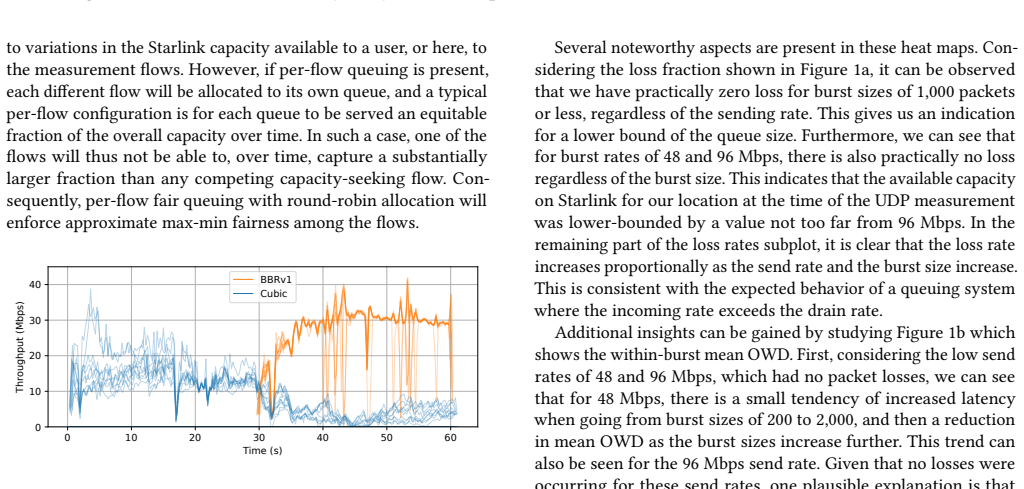
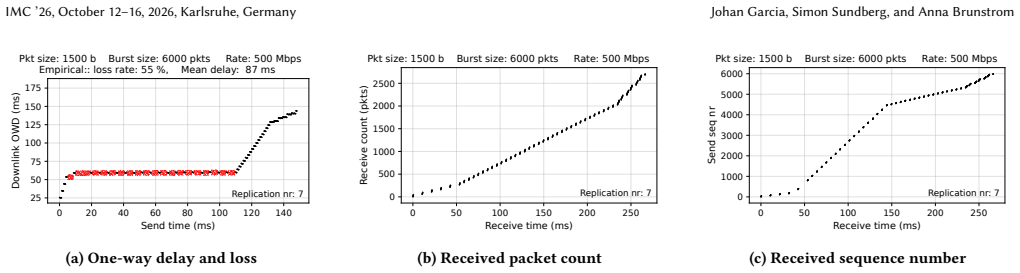
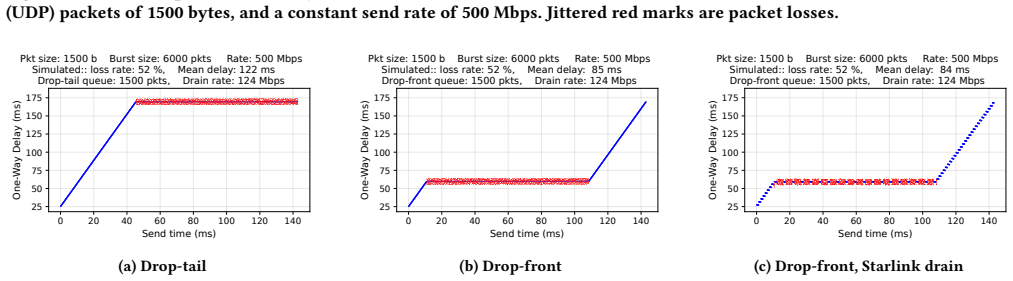
Starlink uses drop-front buffer management rather than per-flow fair queuing or drop-tail buffers.
A machine-rendered reading of the paper's core claim, the machinery that carries it, and where it could break.
Core claim
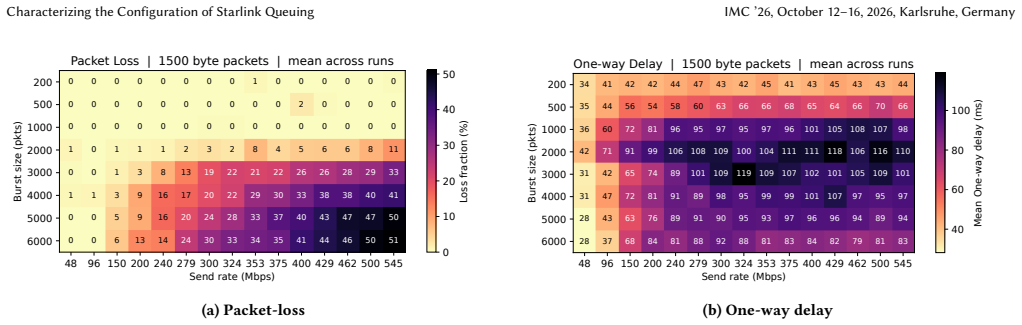
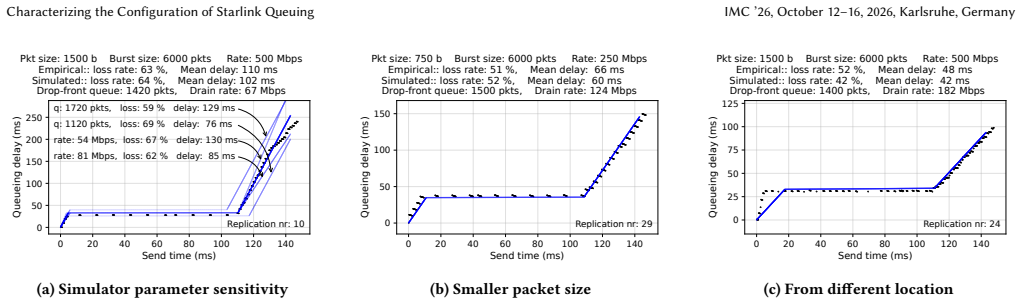
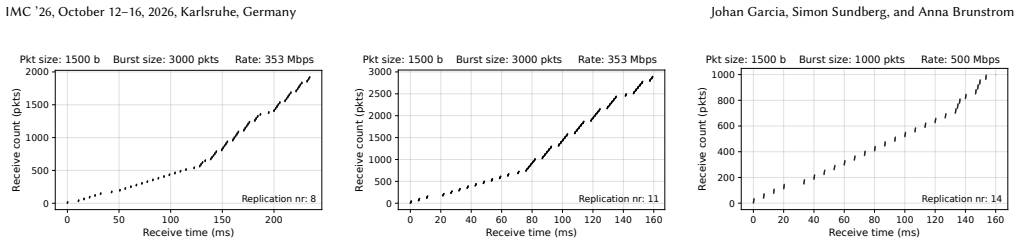
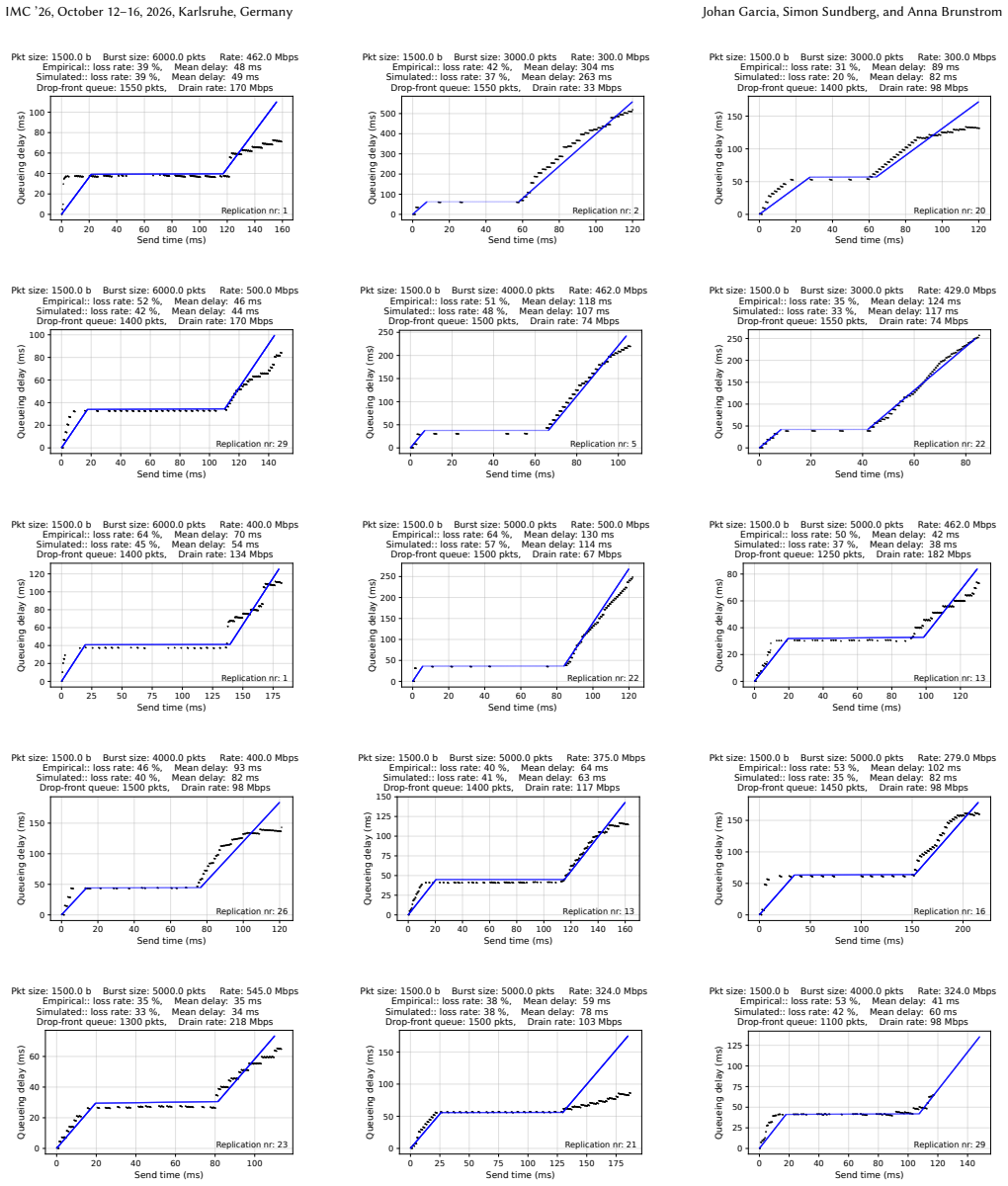
By analyzing the delay and loss in conjunction with a queue simulator we find that Starlink does not employ per-flow fair queuing or drop-tail buffers, but it does use drop-front buffer management.
What carries the argument
High-precision burst-pattern controlled traffic generation for one-way delay measurement, matched against a queue simulator to distinguish buffer disciplines.
If this is right
- Drop-front management lowers packet delay relative to drop-tail.
- Loss signals arrive earlier than they would under drop-tail, altering the behavior of loss-based congestion controls.
- Throughput degradation can occur when loss-based congestion controls interact with the earlier loss signals produced by drop-front.
- Queuing configuration remains central to resource utilization under Starlink's dynamic capacity.
Where Pith is reading between the lines
- End users or applications may benefit from switching to delay-based or hybrid congestion controls on Starlink.
- The same measurement approach could be used to characterize queuing in other satellite or variable-capacity access networks.
- Network designers might need to reconsider loss thresholds in protocols if drop-front becomes more common.
Load-bearing premise
The queue simulator and measured delay/loss patterns are sufficient to uniquely identify the internal queuing discipline without interference from other Starlink mechanisms such as capacity variation or scheduling.
What would settle it
A set of delay and loss traces whose patterns match simulations of drop-tail or per-flow fair queuing instead of drop-front would contradict the identification.
Figures
read the original abstract
In all networking systems, queuing is important to ensure appropriate resource utilization in the presence of bursty traffic and varying traffic demands. The Starlink access network is additionally also dynamic in terms of the capacity it can provide, and thus queuing plays an even greater role to ensure appropriate communication performance for the end-users while maintaining high resource utilization. However, for Starlink most system design details, along with the setup of the internal queuing, is private information and not publicly available. To address this we have developed a high-precision, burst-pattern controlled, traffic generation approach allowing us to precisely measure the one-way delay for Starlink. By analyzing the delay and loss in conjunction with a queue simulator we find that Starlink does not employ per-flow fair queuing or drop-tail buffers, but it does use drop-front buffer management. While drop-front reduces delay, it may also interfere with the assumptions made by loss-based congestion controls, potentially contributing to throughput degradation.
Editorial analysis
A structured set of objections, weighed in public.
Referee Report
Summary. The paper introduces a high-precision, burst-pattern controlled traffic generation method to measure one-way delay on Starlink. By comparing observed delay and loss traces against output from a queue simulator, the authors conclude that Starlink employs drop-front buffer management and does not use per-flow fair queuing or drop-tail buffers. The work notes that drop-front may interfere with loss-based congestion control assumptions.
Significance. If the queuing discipline identification is robust, the result is significant because it exposes an internal mechanism in a large-scale satellite access network that affects end-to-end performance and congestion control behavior. The controlled traffic generation approach is a methodological strength that enables precise external inference about proprietary systems.
major comments (2)
- [Abstract] Abstract: the central claim that delay/loss patterns uniquely identify drop-front (while ruling out per-flow fair queuing and drop-tail) rests on the queue simulator producing distinguishable signatures. No description is given of whether the simulator incorporates time-varying capacity schedules consistent with satellite handoff, beam loading, or weather; without this, multiple disciplines could produce overlapping external patterns.
- [Abstract] The manuscript states the conclusion from simulator matching but supplies no quantitative details on the fitting procedure, parameter ranges explored, or statistical tests used to reject alternative disciplines. This makes it impossible to evaluate whether the identification is unique or merely consistent with one hypothesis.
minor comments (1)
- [Abstract] The abstract refers to 'high-precision' measurements without defining the precision target or how clock synchronization and timestamping are achieved.
Simulated Author's Rebuttal
We thank the referee for the constructive comments on our manuscript. The concerns about simulator assumptions and quantitative fitting details are valid given the brevity of the original submission. We have revised the manuscript to incorporate additional description and analysis, as detailed below.
read point-by-point responses
-
Referee: [Abstract] Abstract: the central claim that delay/loss patterns uniquely identify drop-front (while ruling out per-flow fair queuing and drop-tail) rests on the queue simulator producing distinguishable signatures. No description is given of whether the simulator incorporates time-varying capacity schedules consistent with satellite handoff, beam loading, or weather; without this, multiple disciplines could produce overlapping external patterns.
Authors: We agree that the original manuscript provided insufficient detail on the queue simulator. The simulator is a discrete-event model of a single shared buffer with constant service rate over each short (sub-second to few-second) measurement interval; capacity is set to the empirically observed rate from the same trace. This design isolates the queuing discipline signature because our burst-pattern traffic generation completes before typical satellite handoff or beam-loading timescales. We have added a new subsection in the methods describing the simulator, its constant-capacity assumption during each trial, and supplementary simulations with synthetic time-varying capacity (linear ramps and step changes matching reported Starlink dynamics) confirming that drop-front, drop-tail, and per-flow fair queuing retain distinguishable delay/loss signatures. The revised text also notes that all primary experiments were conducted under stable link conditions with <5% capacity variation. revision: yes
-
Referee: [Abstract] The manuscript states the conclusion from simulator matching but supplies no quantitative details on the fitting procedure, parameter ranges explored, or statistical tests used to reject alternative disciplines. This makes it impossible to evaluate whether the identification is unique or merely consistent with one hypothesis.
Authors: The original submission indeed omitted quantitative fitting details. In the revised manuscript we have expanded the evaluation section with: (i) the explored parameter space (queue depths 50–2000 packets, service rates 50–600 Mbps in 10 Mbps steps for each discipline); (ii) the matching procedure (minimum mean-squared error between empirical and simulated one-way delay CDFs plus loss rate, with a secondary check on the location of the first loss event); and (iii) the statistical test (two-sample Kolmogorov–Smirnov test on delay distributions, rejecting alternatives at p<0.01 while drop-front yields p>0.2 and MSE within measurement noise). These additions demonstrate that only the drop-front model produces a statistically acceptable match across the collected traces. revision: yes
Circularity Check
No significant circularity; empirical inference from measurements and simulation
full rationale
The paper derives its queuing discipline conclusions from high-precision one-way delay and loss measurements combined with comparisons to an external queue simulator. No equations, fitted parameters presented as predictions, or self-citations are shown in the provided text that would reduce the central claim to a definitional or constructional identity. The identification step relies on matching observed patterns to simulator outputs rather than any self-referential loop or imported uniqueness theorem from the authors' prior work. This is a standard empirical characterization approach that remains self-contained against external benchmarks.
Axiom & Free-Parameter Ledger
Reference graph
Works this paper leans on
- [1]
-
[2]
George Barbosa, Sirapop Theeranantachai, Beichuan Zhang, and Lixia Zhang
-
[3]
InProceedings of the 18th Asian Internet Engineering Conference
A comparative evaluation of TCP congestion control schemes over low- Earth-orbit (LEO) satellite networks. InProceedings of the 18th Asian Internet Engineering Conference. 105–112
-
[4]
Claes Beckman, Johan Garcia, Herman Mikkelsen, and Patrik Persson. 2024. Starlink and Cellular Connectivity under Mobility: Drive Testing Across the Arctic Circle. In2024 Wireless Telecommunications Symposium (WTS). IEEE, 1–9
2024
-
[5]
Xuyang Cao and Xinyu Zhang. 2023. SaTCP: Link-Layer Informed TCP Adapta- tion for Highly Dynamic LEO Satellite Networks. InIEEE INFOCOM 2023-IEEE Conference on Computer Communications. IEEE, 1–10
2023
-
[6]
Gregory Detal, Benjamin Hesmans, Olivier Bonaventure, Yves Vanaubel, and Benoit Donnet. 2013. Revealing middlebox interference with tracebox. InPro- ceedings of the 2013 Conference on Internet Measurement Conference(Barcelona, Spain)(IMC ’13). Association for Computing Machinery, New York, NY, USA, 1–8. doi:10.1145/2504730.2504757
-
[7]
Jörg Deutschmann, Saeid Jahandar, Kai-Steffen Hielscher, and Reinhard German
-
[8]
LEO, OpenVPN vs
Internet via Satellite: GEO vs. LEO, OpenVPN vs. Wireguard, and CUBIC vs. BBR. InProceedings of the 1st ACM MobiCom Workshop on Satellite Networking and Computing. 19–24
-
[9]
Hao Fang, Haoyuan Zhao, Jianxin Shi, Miao Zhang, Guanzhen Wu, Yi Ching Chou, Feng Wang, and Jiangchuan Liu. 2024. Robust Live Streaming over LEO Satellite Constellations: Measurement, Analysis, and Handover-Aware Adaptation. In Proceedings of the 32nd ACM International Conference on Multimedia. 5958–5966
2024
-
[10]
Sally Floyd, Dr. K. K. Ramakrishnan, and David L. Black. 2001. The Addition of Explicit Congestion Notification (ECN) to IP. RFC 3168. doi:10.17487/RFC3168
-
[11]
Johan Garcia, Matthias Beckerle, Simon Sundberg, and Anna Brunstrom. 2025. Modeling and predicting starlink throughput with fine-grained burst characteri- zation.Computer Communications(2025), 108090
2025
-
[12]
Characterizing the Config- uration of Starlink Queuing
Johan Garcia and Simon Sundberg. 2026.Data set for "Characterizing the Config- uration of Starlink Queuing",. doi:10.5281/zenodo.18868451
-
[13]
Johan Garcia, Simon Sundberg, and Anna Brunstrom. 2024. Fine-grained starlink throughput variation examined with state-transition modeling. In2024 19th Wireless On-Demand Network Systems and Services Conference (WONS). IEEE, 69–76. doi:10.23919/WONS60642.2024.10449629
-
[14]
Johan Garcia, Simon Sundberg, and Anna Brunstrom. 2024. Inferring Starlink Physical Layer Transmission Rates Through Receiver Packet Timestamps. In Proceedings of the 25th IEEE Wireless Communications and Networking Conference (WCNC)
2024
-
[15]
Johan Garcia, Simon Sundberg, and Anna Brunstrom. 2025. A detailed character- ization of starlink one-way delay. InProceedings of the 2025 3rd Workshop on LEO Networking and Communication. 43–49
2025
-
[16]
Johan Garcia, Simon Sundberg, and Anna Brunstrom. 2025. TCP Congestion Control Performance over Starlink. InProceedings of the 2025 Applied Networking Research Workshop. 70–77
2025
-
[17]
Johan Garcia, Simon Sundberg, Giuseppe Caso, and Anna Brunstrom. 2023. Multi- Timescale Evaluation of Starlink Throughput. InProceedings of the 1st ACM Workshop on LEO Networking and Communication. 31–36
2023
-
[18]
Amirreza Ghafoori, Alireza Famili, and Angelos Stavrou. 2024. Stars and towers on the wheels: Global perspective on satellite networks vs. terrestrial 5G. In GLOBECOM 2024-2024 IEEE Global Communications Conference. IEEE, 301–306
2024
-
[19]
Sarah-Michelle Hammer, Vamsi Addanki, Max Franke, and Stefan Schmid. 2024. Starlink performance through the edge router lens. InProceedings of the 2nd International Workshop on LEO Networking and Communication. 67–72
2024
-
[20]
Pete Heist. [n. d.]. irtt: Isochronous Round-Trip Tester. https://github.com/heistp/ irtt. Accessed November 17, 2025
2025
-
[21]
Cristina Hervella, Luis Diez, Fátima Fernández, Néstor J Hernández Marcano, Rune Hylsberg Jacobsen, and Ramón Agüero. 2022. Realistic Assessment of Trans- port Protocols Performance over LEO-based Communications. InProceedings of the 19th ACM International Symposium on Performance Evaluation of Wireless Ad Hoc, Sensor, & Ubiquitous Networks. 91–98
2022
-
[22]
Morley Mao, Feng Qian, and Zhi-Li Zhang
Bin Hu, Xumiao Zhang, Qixin Zhang, Nitin Varyani, Z. Morley Mao, Feng Qian, and Zhi-Li Zhang. 2023. LEO Satellite vs. Cellular Networks: Exploring the Potential for Synergistic Integration. InCompanion of the 19th International Conference on Emerging Networking EXperiments and Technologies (CoNEXT 2023). 45–51
2023
-
[23]
Todd E Humphreys, Peter A Iannucci, Zacharias M Komodromos, and Andrew M Graff. 2023. Signal structure of the Starlink Ku-band downlink.IEEE Trans. Aerospace Electron. Systems(2023)
2023
-
[24]
Liz Izhikevich, Reese Enghardt, Te-Yuan Huang, and Renata Teixeira. 2024. A Global Perspective on the Past, Present, and Future of Video Streaming over Starlink.Proceedings of the ACM on Measurement and Analysis of Computing Systems8, 3 (2024), 1–22
2024
-
[25]
Li Jiang, Yihang Zhang, Jinyu Yin, Xinggong Zhang, and Bin Liu. 2023. Leotp: An information-centric transport layer protocol for LEO satellite networks. In2023 IEEE 43rd International Conference on Distributed Computing Systems (ICDCS). IEEE, 579–590
2023
-
[26]
Victor Kamel, Jinwei Zhao, Daoping Li, and Jianping Pan. 2024. StarQUIC: Tuning Congestion Control Algorithms for QUIC over LEO Satellite Networks. InProceed- ings of the 2nd International Workshop on LEO Networking and Communication. 43–48
2024
-
[27]
Minoo Kargar Bideh, Andreas Petlund, Carsten Griwodz, Iffat Ahmed, Razieh Beh- jati, Anna Brunstrom, and Stefan Alfredsson. 2016. Tada: An active measurement tool for automatic detection of AQM. InProceedings of the 9th EAI International Conference on Performance Evaluation Methodologies and Tools. 55–60
2016
-
[28]
Mohamed M Kassem, Aravindh Raman, Diego Perino, and Nishanth Sastry. 2022. A browser-side view of Starlink connectivity. In22nd ACM Internet Measurement Conference (IMC ’22). 151–158
2022
-
[29]
Fátima Khan, Cristina Hervella, Luis Diez, Fátima Fernández, Néstor J Hernández Marcano, Rune Hylsberg Jacobsen, and Ramón Agüero. 2023. Realistic assessment of transport protocols performance over LEO-based communications.Computer Networks236 (2023), 110008
2023
-
[30]
Jonathan Kua, Philip Branch, and Grenville Armitage. 2020. Detecting bottle- neck use of pie or fq-codel active queue management during dash-like content streaming. In2020 IEEE 45th conference on local computer networks (LCN). IEEE, 445–448
2020
-
[31]
Zeqi Lai, Zonglun Li, Qian Wu, Hewu Li, Jihao Li, Xin Xie, Yuanjie Li, Jun Liu, and Jianping Wu. 2025. LeoCC: Making Internet Congestion Control Robust to LEO Satellite Dynamics. InProceedings of the ACM SIGCOMM 2025 Conference. 129–146
2025
-
[32]
Zeqi Lai, Zonglun Li, Qian Wu, Hewu Li, Weisen Liu, Yijie Liu, Xin Xie, Yuanjie Li, and Jun Liu. 2024. Mind the Misleading Effects of LEO Mobility on End-to-End Congestion Control. InProceedings of the 23rd ACM Workshop on Hot Topics in Networks. 34–42
2024
-
[33]
Eric Lanfer, Dominic Laniewski, Daniel Otten, and Nils Aschenbruck. 2024. Weather-Based Link Prediction for LEO-Satellite Networks using the WetLinks Dataset. In2024 IFIP Networking Conference (IFIP Networking). IEEE, 586–588
2024
-
[34]
Dominic Laniewski, Eric Lanfer, and Nils Aschenbruck. 2025. Measuring Mo- bile Starlink Performance: A Comprehensive Look.IEEE Open Journal of the Communications Society(2025)
2025
- [35]
- [36]
- [37]
-
[38]
Melisa López, Sebastian Bro Damsgaard, Ignacio Rodríguez, and Preben Mo- gensen. 2022. An Empirical Analysis of Multi-Connectivity between 5G Terres- trial and LEO Satellite Networks. In2022 IEEE Globecom Workshops (GC Wkshps). IEEE, 1115–1120
2022
-
[39]
Melisa López, Sebastian Bro Damsgaard, Ignacio Rodríguez, and Preben Mo- gensen. 2023. Connecting Rural Areas: An Empirical Assessment of 5G Terrestrial- LEO Satellite Multi-Connectivity. InIEEE 97th Vehicular Technology Conference (VTC2023-Spring). 1–5
2023
-
[40]
Sami Ma, Yi Ching Chou, Haoyuan Zhao, Long Chen, Xiaoqiang Ma, and Jiangchuan Liu. 2023. Network Characteristics of LEO Satellite Constellations: A Starlink-Based Measurement from End Users. InIEEE INFOCOM Conference on Computer Communications. 1–10
2023
-
[41]
Ferguson, Hendrik Cech, Rohan Bose, Prakita Rayyan Renatin, Mahesh K
Nitinder Mohan, Andrew E. Ferguson, Hendrik Cech, Rohan Bose, Prakita Rayyan Renatin, Mahesh K. Marina, and Jörg Ott. 2024. A Multifaceted Look at Starlink Performance. InProceedings of the ACM on Web Conference 2024. 2723–2734. doi:10.1145/3589334.3645328
-
[42]
2018.Controlled Delay Active Queue Man- agement
Kathleen Nichols and Van Jacobson. 2018.Controlled Delay Active Queue Man- agement. RFC 8289. IETF. doi:10.17487/RFC8289
-
[43]
Robin Ohs, Gregory F Stock, Juan A Fraire, Holger Hermanns, and Andreas Schmidt. 2025. PhantomLink: Emulating virtual end-to-end links on ground and in orbit. InProceedings of the 2025 Applied Networking Research Workshop. 39–46
2025
-
[44]
Jianping Pan, Jinwei Zhao, and Lin Cai. 2023. Measuring a low-earth-orbit satellite network. InIEEE 34th Annual International Symposium on Personal, Indoor and Mobile Radio Communications (PIMRC). 1–6
2023
-
[45]
Jianping Pan, Jinwei Zhao, and Lin Cai. 2024. Measuring the Satellite Links of a LEO Network. InIEEE International Conference on Communications
2024
-
[46]
Constantin Sander, Ike Kunze, Leo Blöcher, Mike Kosek, and Klaus Wehrle. 2023. ECN with QUIC: Challenges in the Wild. InProceedings of the 2023 ACM on Internet Measurement Conference(Montreal QC, Canada)(IMC ’23). 540–553. doi:10.1145/3618257.3624821
-
[47]
2024.Improving Starlink’s latency
SpaceX. 2024.Improving Starlink’s latency. Retrieved June 25, 2024 from https: //api.starlink.com/public-files/StarlinkLatency.pdf
2024
-
[48]
Starlink. 2025. Starlink Stories. https://stories.starlink.com/. Accessed November 17, 2025. IMC ’26, October 12–16, 2026, Karlsruhe, Germany Johan Garcia, Simon Sundberg, and Anna Brunstrom
2025
-
[49]
Simon Sundberg. 2026. nanoprobe: UDP packet generator with hardware times- tamp support based on nanoping. https://github.com/simosund/nanoprobe
2026
- [50]
-
[51]
2018.nanoping
Yojiro UO. 2018.nanoping. https://github.com/iij/nanoping Accessed November 17, 2025
2018
-
[52]
Yanbo Wu, Mingxin Cui, Gaopeng Gou, Yuhao Wei, Gang Xiong, Zhen Li, Xinlei Ju, and Wei Xia. 2025. Beneath the Heavens: A Thorough Measurement Study of the Starlink Terrestrial Network. In2025 IEEE/ACM 33rd International Symposium on Quality of Service (IWQoS). IEEE, 1–10
2025
-
[53]
Wenjun Yang, Lin Cai, Shengjie Shu, and Jianping Pan. 2024. Mobility-aware congestion control for multipath QUIC in integrated terrestrial satellite networks. IEEE Transactions on Mobile Computing(2024)
2024
-
[54]
Miao Zhang, Jiaxing Li, Haoyuan Zhao, Linfeng Shen, and Jiangchuan Liu. 2024. StarStream: Live Video Analytics over Space Networking. InProceedings of the 32nd ACM International Conference on Multimedia. 7909–7917. A Ethics This work does not raise any ethical issues. B ECN behavior We also attempted to investigate if Starlink supports using Explicit Cong...
2024
discussion (0)
Sign in with ORCID, Apple, or X to comment. Anyone can read and Pith papers without signing in.