A Vertical Look at UAV Connectivity in the Wild: Cellular vs. Starlink, 3D Characterization, and Performance Prediction
Pith reviewed 2026-06-29 14:48 UTC · model grok-4.3
The pith
Simultaneous UAV flight tests show LEO satellite links deliver lower latency and higher downlink speeds than cellular networks in rural areas.
A machine-rendered reading of the paper's core claim, the machinery that carries it, and where it could break.
Core claim
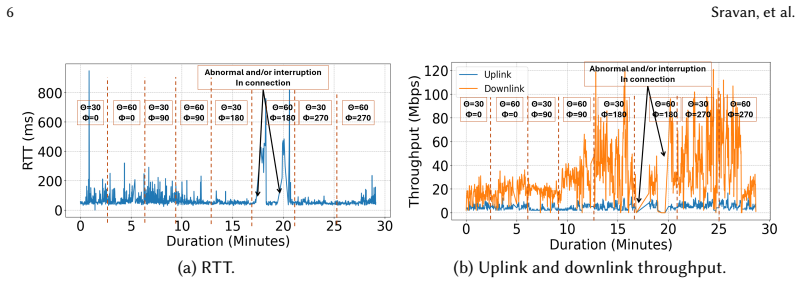
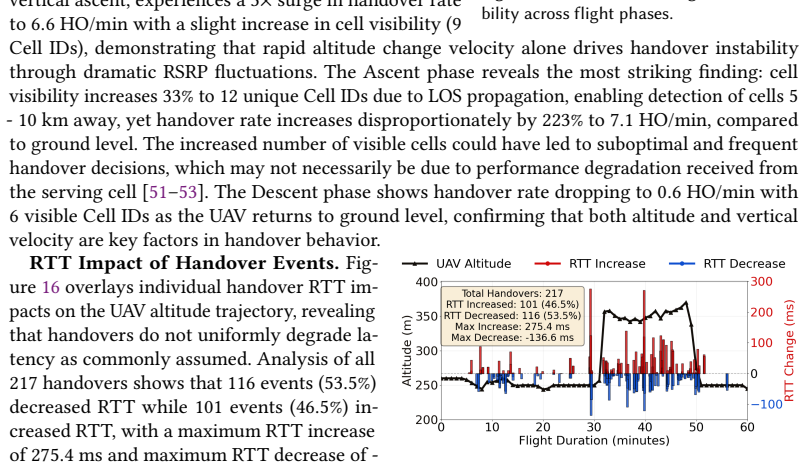
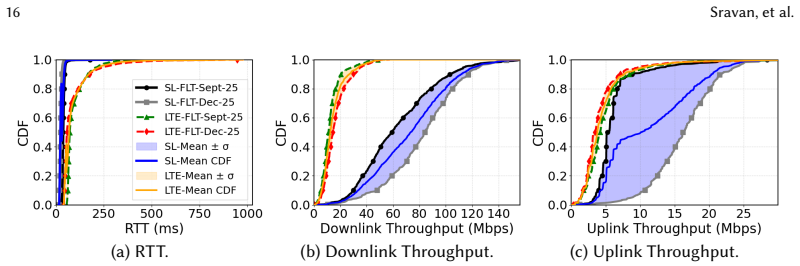
Through more than 10 flight tests and 18K samples collected simultaneously, the LEO satellite link achieves 95% of RTT measurements below 50 ms compared to 80% under 150 ms for cellular, and 95% downlink exceeding 25 Mbps versus 5 Mbps for cellular. Higher altitudes improve cellular signal by 15-20 dB but increase handover rates by 3-4 times, with asymmetric effects on RTT where 53.5% of handovers improve performance but worst-case degradation reaches 275 ms.
What carries the argument
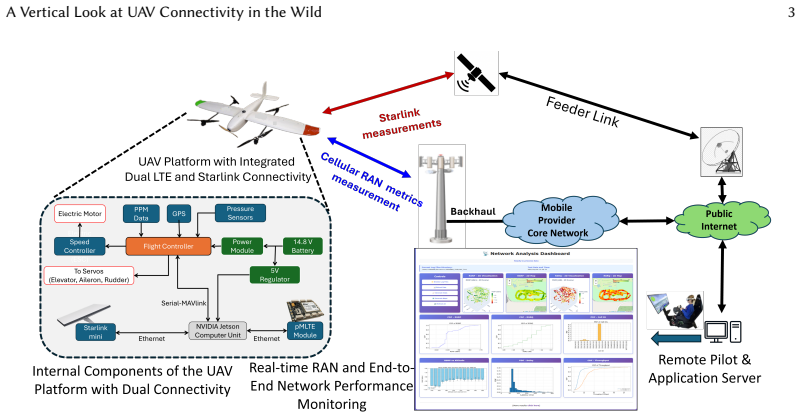
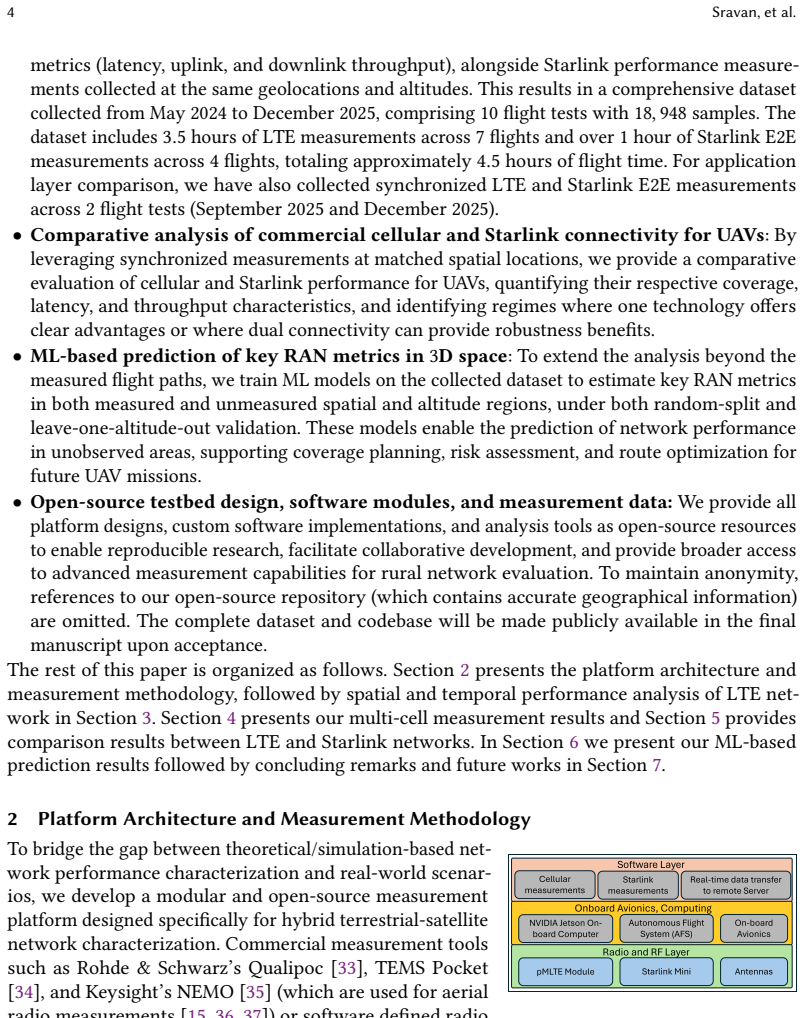
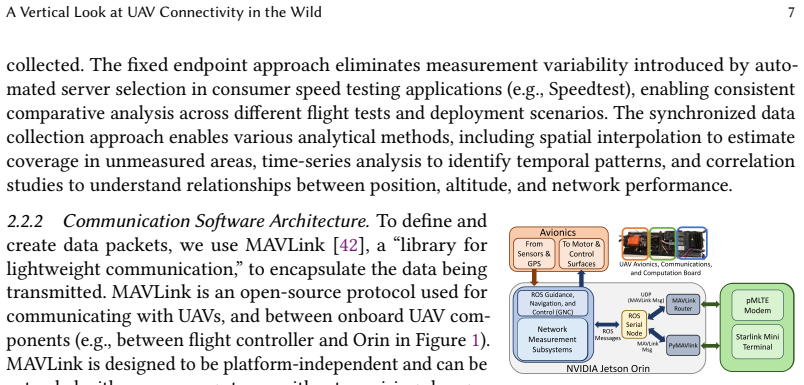
The open-source multi-layer measurement platform that collects physical layer metrics, multi-cell network topology, and end-to-end application performance during simultaneous UAV flights.
If this is right
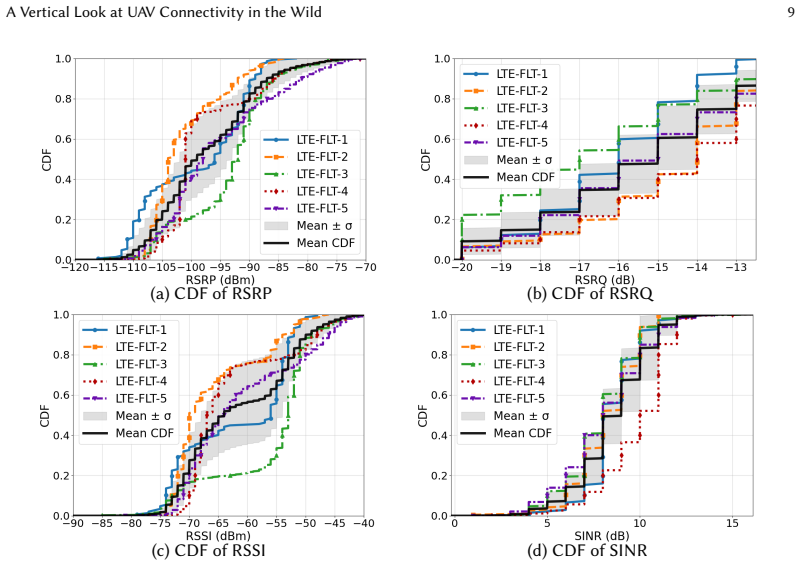
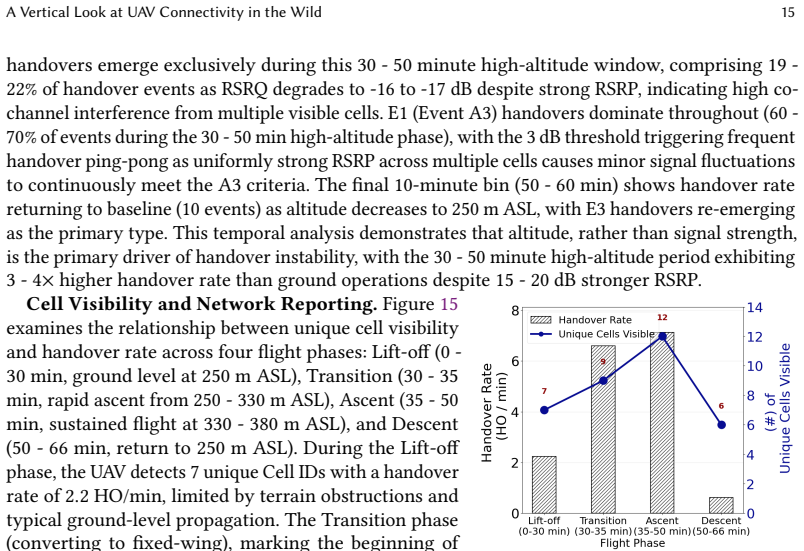
- Higher UAV altitudes improve cellular signal power via line-of-sight but cause a 3-4 times increase in handover rates due to greater multi-cell visibility.
- Handovers impact RTT asymmetrically, with most improving latency but the largest degradations being twice the size of the largest improvements.
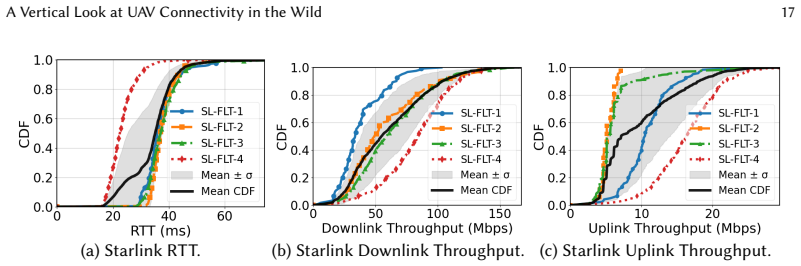
- LEO satellite connections maintain more consistent low latency and high downlink capacity across the tested conditions compared to cellular.
- The simultaneous collection method eliminates time and location biases in the cellular versus LEO comparison.
Where Pith is reading between the lines
- UAV network selection in rural settings could prioritize LEO satellite for applications sensitive to latency and throughput.
- Cellular network models for UAVs need to incorporate altitude-dependent handover increases rather than assuming signal degradation alone.
- The open dataset supports development of prediction models for UAV connectivity under varying altitudes and network conditions.
Load-bearing premise
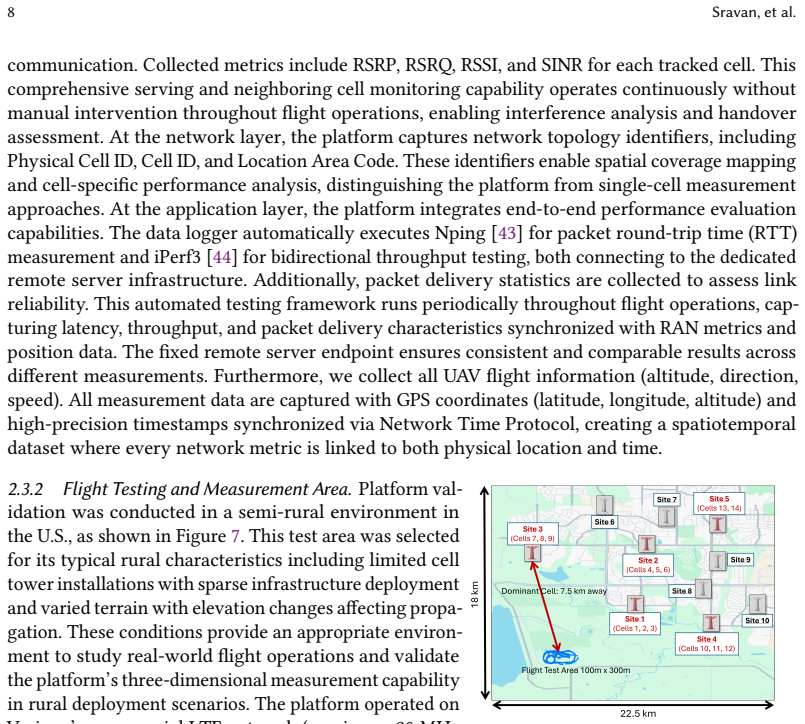
The rural flight tests with more than 10 tests and 18K samples are representative of typical low-altitude UAV operations without location or time biases.
What would settle it
Additional flight tests in varied environments or with different providers showing cellular RTT and downlink matching or exceeding LEO satellite levels would challenge the reported performance differences.
Figures
read the original abstract
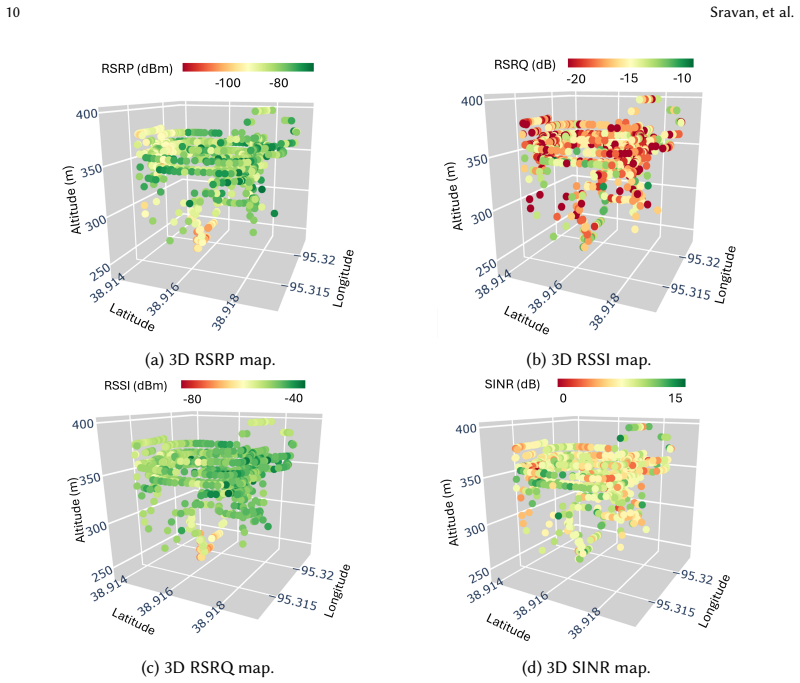
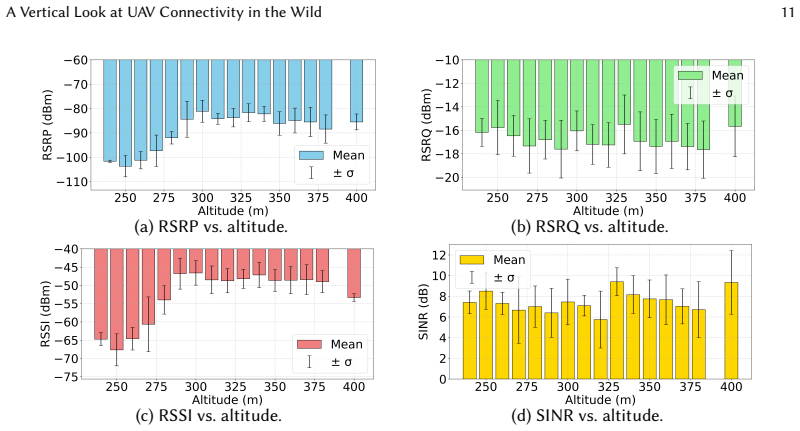
In this paper, we present an open-source measurement platform designed to characterize the performance of commercial cellular (Verizon, a major US provider) and LEO satellite (Starlink) networks through real-world flight tests in rural environments. We implement a comprehensive multi-layer measurement approach spanning physical layer signal metrics, multi-cell network topology, and end-to-end (E2E) application performance. Through an extensive flight campaign with more than $10$ flight tests, $4.5$+ hours of flight time resulting in more than $18$K samples, we present the first detailed, open-source dataset analyzing dual cellular and Starlink performance for low-altitude UAV operations. Our cellular-Starlink comparative results, which are collected \emph{simultaneously at the same time and location}, demonstrate significant performance differences between the two technologies: the LEO satellite link achieves superior latency performance with $95\%$ of Round-Trip Time (RTT) measurements below $50$ ms compared to $80\%$ under $150$ ms for cellular, and exceptional downlink capacity with $95\%$ exceeding $25$ Mbps versus only $5$ Mbps for cellular. Our analysis on cellular network performance demonstrates that while higher altitudes (e.g., $330+$ m above the sea level) improve signal power by $15-20$ dB via line-of-sight (LOS) propagation, it causes a $3-4$ $\times$ increase in handover rates, which is due to excessive multi-cell visibility rather than signal degradation. Furthermore, we observe asymmetric impacts on the RTT performance due to handovers such that $53.5$\% of handovers improve RTT, but worst-case degradation ($275$ ms) is $2$ $\times$ larger than best-case improvement ($137$ ms).
Editorial analysis
A structured set of objections, weighed in public.
Referee Report
Summary. The paper introduces an open-source multi-layer measurement platform for low-altitude UAVs and reports results from >10 rural flight tests (>18K samples, 4.5+ hours) comparing simultaneous Verizon cellular and Starlink LEO links. It claims Starlink superiority in latency (95% RTT <50 ms vs. 80% <150 ms) and downlink throughput (95% >25 Mbps vs. 5 Mbps), plus cellular-specific findings that higher altitudes improve signal by 15-20 dB but increase handovers 3-4x, with asymmetric RTT effects from handovers (53.5% improve, worst degradation 275 ms vs. 137 ms improvement).
Significance. If the comparative measurements are valid, the work supplies the first substantial open-source dual-network UAV dataset and platform, enabling reproducible study of aerial connectivity trade-offs in rural settings where both technologies are relevant. The simultaneous-collection design and multi-layer metrics (PHY to E2E) are strengths that go beyond single-network studies.
major comments (2)
- [Abstract and §3] Abstract and §3 (platform and flight campaign): the headline comparative claims rest on simultaneous collection 'at the same time and location,' yet the hardware description does not specify synchronization method, antenna mounting/orientation, or power/processing isolation between the Verizon modem and Starlink terminal; residual differential bias would directly undermine the RTT and throughput percentiles.
- [§4.2] §4.2 (handover analysis): the reported 53.5% improvement rate and 2x asymmetry in RTT change (275 ms degradation vs. 137 ms improvement) are load-bearing for the cellular altitude/handover claims, but the text does not detail the exact event-detection window, RTT sampling relative to handover, or statistical test used to establish the percentages.
minor comments (2)
- [Figures 4-7] Figure captions and axis labels should explicitly state whether percentiles are computed per flight or pooled across all 18K samples.
- [Abstract and §3] The abstract states 'more than 10 flight tests' and '4.5+ hours'; the methods section should clarify whether these figures are totals or broken down by network and environment.
Simulated Author's Rebuttal
We thank the referee for the constructive feedback highlighting areas where additional methodological detail would strengthen the paper. We address each major comment below and commit to revisions that enhance clarity and reproducibility without altering the core claims or results.
read point-by-point responses
-
Referee: [Abstract and §3] Abstract and §3 (platform and flight campaign): the headline comparative claims rest on simultaneous collection 'at the same time and location,' yet the hardware description does not specify synchronization method, antenna mounting/orientation, or power/processing isolation between the Verizon modem and Starlink terminal; residual differential bias would directly undermine the RTT and throughput percentiles.
Authors: We agree that explicit hardware and synchronization details are essential to support the simultaneous-collection claims. The current manuscript describes the platform at a high level but omits these specifics. In the revised version we will expand §3 with a new subsection detailing: (1) GPS-based time synchronization between the two modems with sub-second alignment verified via NTP cross-checks, (2) antenna mounting geometry (cellular patch antenna at 45° elevation, Starlink phased array flat-mounted with 10 cm separation to avoid mutual interference), and (3) power/processing isolation via separate batteries and dedicated single-board computers with no shared processes. These additions will directly address potential bias concerns while preserving the reported performance percentiles. revision: yes
-
Referee: [§4.2] §4.2 (handover analysis): the reported 53.5% improvement rate and 2x asymmetry in RTT change (275 ms degradation vs. 137 ms improvement) are load-bearing for the cellular altitude/handover claims, but the text does not detail the exact event-detection window, RTT sampling relative to handover, or statistical test used to establish the percentages.
Authors: We concur that the handover-impact statistics require fuller methodological transparency for reproducibility. The manuscript currently states the 53.5 % figure and asymmetry without the supporting procedure. In revision we will augment §4.2 to specify: the detection window (RTT samples collected in the 10 s interval centered on each handover event), sampling (1 Hz RTT probes with linear interpolation for missing values), and statistical test (one-sided binomial test against 50 % null with reported p < 0.01, plus explicit counts of improving vs. degrading events). A supplementary figure will illustrate the before/after RTT traces for representative handovers. revision: yes
Circularity Check
No circularity; empirical measurement paper with no derivations or fitted predictions.
full rationale
The paper reports results from an open-source measurement platform and >10 rural UAV flights yielding >18K simultaneous cellular/Starlink samples. All headline statistics (95% RTT <50 ms and 95% DL >25 Mbps for Starlink; 80% RTT <150 ms and 5 Mbps for cellular) are direct empirical quantiles of the collected data. No equations, parameter fitting, self-citation chains, or 'prediction' steps appear in the abstract or described content that could reduce claims to inputs by construction. The title's mention of 'Performance Prediction' is not instantiated in the provided text as any model or derivation. This is a standard non-circular empirical study.
Axiom & Free-Parameter Ledger
axioms (1)
- domain assumption The measurement platform accurately records physical layer, network, and application performance metrics during flights.
Reference graph
Works this paper leans on
-
[1]
Experimental Evaluation of the Performance of UAV-assisted Data Collection for Wake-up Radio-enabled Wireless Networks,
A. V. Sheshashayee, M. Bordin, P. B. del Prever, D. Villa, H. Cheng, C. Petrioli, T. Melodia, and S. Basagni, “Experimental Evaluation of the Performance of UAV-assisted Data Collection for Wake-up Radio-enabled Wireless Networks, ” in 2024 IEEE 99th Vehicular Technology Conference (VTC2024-Spring), 2024, pp. 01–06
2024
-
[2]
What will the future of UAV cellular communications be? A flight from 5G to 6G,
Geraci, Giovanni and Garcia-Rodriguez, Adrian and Azari, M Mahdi and Lozano, Angel and Mezzavilla, Marco and Chatzinotas, Symeon and Chen, Yun and Rangan, Sundeep and Di Renzo, Marco, “What will the future of UAV cellular communications be? A flight from 5G to 6G, ”IEEE communications surveys & tutorials, vol. 24, no. 3, pp. 1304–1335, 2022
2022
-
[3]
3GPP-based verification of latency measurements in operational cellular networks with low-altitude drones,
S. Homayouni, M. Paier, T. Berisha, S. Woblistin, and J. Rehak, “3GPP-based verification of latency measurements in operational cellular networks with low-altitude drones, ” in2022 International Conference on Smart Applications, Communications and Networking (SmartNets). IEEE, 2022, pp. 01–05
2022
-
[4]
6G wireless communications networks: A comprehensive survey,
Alsabah, Muntadher and Naser, Marwah Abdulrazzaq and Mahmmod, Basheera M and Abdulhussain, Sadiq H and Eissa, Mohammad R and Al-Baidhani, Ahmed and Noordin, Nor K and Sait, Sadiq M and Al-Utaibi, Khaled A and Hashim, Fazirul, “6G wireless communications networks: A comprehensive survey, ”IEEE Access, vol. 9, pp. 148 191–148 243, 2021
2021
-
[5]
Reliable and efficient data collection in uav based iot networks,
J. Poorvi, A. Kalita, and M. Gurusamy, “Reliable and efficient data collection in uav based iot networks, ”IEEE Commu- nications Surveys & Tutorials, 2025
2025
-
[6]
Accessing from the sky: A tutorial on uav communications for 5g and beyond,
Y. Zeng, Q. Wu, and R. Zhang, “Accessing from the sky: A tutorial on uav communications for 5g and beyond, ” Proceedings of the IEEE, vol. 107, no. 12, pp. 2327–2375, 2019
2019
-
[7]
Cellular-Enabled UAV Communication: A Connectivity-Constrained Trajectory Optimization Perspective,
S. Zhang, Y. Zeng, and R. Zhang, “Cellular-Enabled UAV Communication: A Connectivity-Constrained Trajectory Optimization Perspective, ”IEEE Transactions on Communications, vol. 67, no. 3, pp. 2580–2604, 2019
2019
-
[8]
John Wiley & Sons, 2020
Zeng, Yong and Guvenc, Ismail and Zhang, Rui and Geraci, Giovanni and Matolak, David W,UA V Communications for 5G and Beyond. John Wiley & Sons, 2020
2020
-
[9]
Communications standards for unmanned aircraft systems: The 3gpp perspective and research drivers,
A. S. Abdalla and V. Marojevic, “Communications standards for unmanned aircraft systems: The 3gpp perspective and research drivers, ”IEEE Communications Standards Magazine, vol. 5, no. 1, pp. 70–77, 2021
2021
-
[10]
An overview of 3gpp release-15 study on enhanced lte support for connected drones,
S. D. Muruganathan, X. Lin, H.-L. Määttänen, J. Sedin, Z. Zou, W. A. Hapsari, and S. Yasukawa, “An overview of 3gpp release-15 study on enhanced lte support for connected drones, ”IEEE Communications Standards Magazine, vol. 5, no. 4, pp. 140–146, 2022
2022
-
[11]
The sky is not the limit: Lte for unmanned aerial vehicles,
X. Lin, V. Yajnanarayana, S. D. Muruganathan, S. Gao, H. Asplund, H.-L. Maattanen, M. Bergstrom, S. Euler, and Y.-P. E. Wang, “The sky is not the limit: Lte for unmanned aerial vehicles, ”IEEE Communications Magazine, vol. 56, no. 4, pp. 204–210, 2018
2018
-
[12]
Measured uplink interference caused by aerial vehicles in lte cellular networks,
R. Amorim, H. Nguyen, J. Wigard, I. Z. Kovács, T. B. Sørensen, D. Z. Biro, M. Sørensen, and P. Mogensen, “Measured uplink interference caused by aerial vehicles in lte cellular networks, ”IEEE Wireless Communications Letters, vol. 7, no. 6, pp. 958–961, 2018
2018
-
[13]
Verification of Standardized Rel-15 Requirements for Drone’s Command-and-Control Link Reliability,
Homayouni, Samira and Berisha, Taulant and Paier, Mario and Woblistin, Sebastian and Rehak, Johannes and Neubauer, Thomas, “Verification of Standardized Rel-15 Requirements for Drone’s Command-and-Control Link Reliability, ” in 2023 IEEE 97th Vehicular Technology Conference (VTC2023-Spring). IEEE, 2023, pp. 1–5
2023
-
[14]
UAV-based coverage measurement method for 5G,
V. Platzgummer, V. Raida, G. Krainz, P. Svoboda, M. Lerch, and M. Rupp, “UAV-based coverage measurement method for 5G, ” in2019 IEEE 90th Vehicular Technology Conference (VTC2019-Fall). IEEE, 2019, pp. 1–6
2019
-
[15]
Public LTE network measurements with drones in rural environment,
J. Sae, R. Wirén, J. Kauppi, H.-L. Maattanen, J. Torsner, and M. Valkama, “Public LTE network measurements with drones in rural environment, ” in2019 IEEE 89th Vehicular Technology Conference (VTC2019-Spring). IEEE, 2019, pp. 1–5
2019
-
[16]
Pathloss measurements and modeling for UAVs connected to cellular networks,
R. Amorim, P. Mogensen, T. Sorensen, I. Z. Kovács, and J. Wigard, “Pathloss measurements and modeling for UAVs connected to cellular networks, ” in2017 IEEE 85th Vehicular Technology Conference (VTC Spring). IEEE, 2017, pp. 1–6
2017
-
[17]
Mobile network-connected drones: Field trials, simulations, and design insights,
X. Lin, R. Wiren, S. Euler, A. Sadam, H.-L. Määttänen, S. Muruganathan, S. Gao, Y.-P. E. Wang, J. Kauppi, Z. Zouet al., “Mobile network-connected drones: Field trials, simulations, and design insights, ”IEEE Vehicular Technology Magazine, vol. 14, no. 3, pp. 115–125, 2019
2019
-
[18]
Exploring the 5G Digital Divide in the Non-Contiguous US: LEO Satellites to the Rescue?
Wang, Sizhe and Ghoshal, Moinak and Feng, Yufei and Khan, Imran and Dinh, Phuc and Basit, Omar and Yu, Zhekun and Hu, Y Charlie and Koutsonikolas, Dimitrios, “Exploring the 5G Digital Divide in the Non-Contiguous US: LEO Satellites to the Rescue?”Proceedings of the ACM on Measurement and Analysis of Computing Systems, vol. 9, no. 3, pp. 1–25, 2025
2025
-
[19]
Stars and towers on the wheels: Global perspective on satellite networks vs. terrestrial 5G,
Ghafoori, Amirreza and Famili, Alireza and Stavrou, Angelos, “Stars and towers on the wheels: Global perspective on satellite networks vs. terrestrial 5G, ” inGLOBECOM 2024-2024 IEEE Global Communications Conference. IEEE, 2024, pp. 301–306
2024
-
[20]
Replication: Performance of Cellular Networks on the Wheels,
Ghoshal, Moinak and Basit, Omar and Khan, Imran and Kong, Z Jonny and Wang, Sizhe and Feng, Yufei and Dinh, Phuc and Hu, Y Charlie and Koutsonikolas, Dimitrios, “Replication: Performance of Cellular Networks on the Wheels, ” inProceedings of the 2025 ACM Internet Measurement Conference, 2025, pp. 381–396. , Vol. 1, No. 1, Article . Publication date: May 2...
2025
-
[21]
A survey of wireless networks for future aerial communications (FACOM),
Baltaci, Aygün and Dinc, Ergin and Ozger, Mustafa and Alabbasi, Abdulrahman and Cavdar, Cicek and Schupke, Dominic, “A survey of wireless networks for future aerial communications (FACOM), ”IEEE Communications Surveys & Tutorials, vol. 23, no. 4, pp. 2833–2884, 2021
2021
-
[22]
Aerospace integrated networks innovation for empowering 6G: A survey and future challenges,
Zhou, Di and Sheng, Min and Li, Jiandong and Han, Zhu, “Aerospace integrated networks innovation for empowering 6G: A survey and future challenges, ”IEEE Communications Surveys & Tutorials, vol. 25, no. 2, pp. 975–1019, 2023
2023
-
[23]
LEO satellite vs. cellular networks: Exploring the potential for synergistic integration,
Hu, Bin and Zhang, Xumiao and Zhang, Qixin and Varyani, Nitin and Mao, Z Morley and Qian, Feng and Zhang, Zhi-Li, “LEO satellite vs. cellular networks: Exploring the potential for synergistic integration, ” inCompanion of the 19th International Conference on emerging Networking EXperiments and Technologies, 2023, pp. 45–51
2023
-
[24]
An analysis of the short-term time stability of the starlink ku-band downlink frame clock,
W. Qin, Z. M. Komodromos, and T. E. Humphreys, “An analysis of the short-term time stability of the starlink ku-band downlink frame clock, ” in2024 IEEE International Conference on Wireless for Space and Extreme Environments (WiSEE). IEEE, 2024, pp. 106–111
2024
-
[25]
Democratizing leo satellite network measurement,
L. Izhikevich, M. Tran, K. Izhikevich, G. Akiwate, and Z. Durumeric, “Democratizing leo satellite network measurement, ” Proceedings of the ACM on Measurement and Analysis of Computing Systems, vol. 8, no. 1, pp. 1–26, 2024
2024
-
[26]
A multifaceted look at starlink performance,
N. Mohan, A. E. Ferguson, H. Cech, R. Bose, P. R. Renatin, M. K. Marina, and J. Ott, “A multifaceted look at starlink performance, ” inProceedings of the ACM Web Conference 2024, 2024, pp. 2723–2734
2024
-
[27]
Starlink on the road: A first look at mobile starlink performance in central europe,
D. Laniewski, E. Lanfer, S. Beginn, J. Dunker, M. DÞckers, and N. Aschenbruck, “Starlink on the road: A first look at mobile starlink performance in central europe, ”arXiv preprint arXiv:2403.13497, 2024
-
[28]
Measuring mobile starlink performance: A comprehensive look,
D. Laniewski, E. Lanfer, and N. Aschenbruck, “Measuring mobile starlink performance: A comprehensive look, ”IEEE Open Journal of the Communications Society, 2025
2025
-
[29]
5g from space: An overview of 3gpp non-terrestrial networks,
X. Lin, S. Rommer, S. Euler, E. A. Yavuz, and R. S. Karlsson, “5g from space: An overview of 3gpp non-terrestrial networks, ”IEEE Communications Standards Magazine, vol. 5, no. 4, pp. 147–153, 2021
2021
-
[30]
An overview of 3GPP release-15 study on enhanced LTE support for connected drones,
S. D. Muruganathan, X. Lin, H.-L. Maattanen, J. Sedin, Z. Zou, and W. A. Hapsari, “An overview of 3GPP release-15 study on enhanced LTE support for connected drones, ”IEEE Communications Standards Magazine, vol. 5, no. 4, pp. 140–146, 2021
2021
-
[31]
Evolution of non-terrestrial networks from 5G to 6G: A survey,
M. Vaezi, A. Azari, S. R. Khosravirad, M. Shirvanimoghaddam, M. M. Azari, D. Chasaki, and P. Popovski, “Evolution of non-terrestrial networks from 5G to 6G: A survey, ”IEEE Communications Surveys & Tutorials, vol. 24, no. 4, pp. 2634–2703, 2022
2022
-
[32]
Multi-connectivity between terrestrial and non-terrestrial mimo systems,
B. Shang, X. Li, Z. Li, J. Ma, X. Chu, and P. Fan, “Multi-connectivity between terrestrial and non-terrestrial mimo systems, ”IEEE Open Journal of the Communications Society, vol. 5, pp. 3245–3262, 2024
2024
-
[33]
QualiPoc Tool for Networking Testing and Measurement
“QualiPoc Tool for Networking Testing and Measurement. ” [Online]. Available: https://www.rohde-schwarz.com/us/ products/test-and-measurement/network-data-collection/qualipoc-android_63493-55430.html
-
[34]
TEMS Pocket – Portable Mobile Network Testing
“TEMS Pocket – Portable Mobile Network Testing. ” [Online]. Available: https://www.infovista.com/tems/pocket
-
[35]
Online,
K. Nemo, “Online, ” Available https://www.keysight.com/zz/en/products/nemo-wireless-network-solutions.html
-
[36]
Pathloss Measurements and Modeling for UAVs Connected to Cellular Networks,
R. Amorim, P. Mogensen, T. Sorensen, I. Z. Kovacs, and J. Wigard, “Pathloss Measurements and Modeling for UAVs Connected to Cellular Networks, ” in2017 IEEE 85th Vehicular Technology Conference (VTC Spring), 2017, pp. 1–6
2017
-
[37]
Measured Uplink Interference Caused by Aerial Vehicles in LTE Cellular Networks,
R. Amorim, H. Nguyen, J. Wigard, I. Z. Kovács, T. B. Sørensen, D. Z. Biro, M. Sørensen, and P. Mogensen, “Measured Uplink Interference Caused by Aerial Vehicles in LTE Cellular Networks, ”IEEE Wireless Communications Letters, vol. 7, no. 6, pp. 958–961, 2018
2018
-
[38]
Spectrum activity monitoring and analysis for sub-6 GHz bands using a Helikite,
Maeng, Sung Joon and Ozdemir, O and Nandakumar, HN and Güvenç, İ and Sichitiu, Mihail L and Dutta, Rudra and Mushi, Magreth, “Spectrum activity monitoring and analysis for sub-6 GHz bands using a Helikite, ” in2023 15th International Conference on COMmunication Systems & NETworkS (COMSNETS). IEEE, 2023, pp. 857–862
2023
-
[39]
AERIQ: SDR-Based LTE I/Q Measurement and Analysis Framework for Air-to-Ground Propagation Modeling,
Maeng, S. J. and Ozdemir, O. and Güvenç, İ. and Sichitiu, M. L. and Dutta, R. and Mushi, M., “AERIQ: SDR-Based LTE I/Q Measurement and Analysis Framework for Air-to-Ground Propagation Modeling, ” in2023 IEEE Aerospace Conference, 2023, pp. 1–11
2023
-
[40]
Online,
Nvidia, “Online, ” Available https://www.nvidia.com/en-us/autonomous-machines/embedded-systems/jetson-orin/
-
[41]
Online,
pMLTE, “Online, ” Available https://www.microhardcorp.com/pMLTE.php
-
[42]
Micro Air Vehicle Link (MAVLink)
“Micro Air Vehicle Link (MAVLink). ” [Online]. Available: https://mavlink.io/en/
-
[43]
Online,
Nping, “Online, ” Available https://nmap.org/nping/
-
[44]
Online,
iPerf, “Online, ” Available https://iperf.fr/
-
[45]
Unmanned Aircraft System Traffic Management (UTM) concept of operations,
P. Kopardekar, J. Rios, T. Prevot, M. Johnson, J. Jung, and J. E. Robinson, “Unmanned Aircraft System Traffic Management (UTM) concept of operations, ” 2016
2016
-
[46]
Online,
T. Networks, “Online, ” Available https://wiki.teltonika-networks.com/view/Mobile_Signal_Strength_ Recommendations
-
[47]
Key performance indicators analysis for 4 g-lte cellular networks based on real measurements,
Z. Shakir, A. Mjhool, A. Al-Thaedan, A. Al-Sabbagh, and R. Alsabah, “Key performance indicators analysis for 4 g-lte cellular networks based on real measurements, ”International Journal of Information Technology, vol. 15, pp. 1–9, 03 2023
2023
-
[48]
Online,
CellMapper, “Online, ” Available https://www.cellmapper.net. , Vol. 1, No. 1, Article . Publication date: May 2026. A Vertical Look at UAV Connectivity in the Wild 23
2026
-
[49]
Evolved Universal Terrestrial Radio Access (E-UTRA); Requirements for support of radio resource management,
3GPP, “Evolved Universal Terrestrial Radio Access (E-UTRA); Requirements for support of radio resource management, ” 3rd Generation Partnership Project (3GPP), Technical Specification (TS) 36.133, 2025. [Online]. Available: https://www.3gpp.org/dynareport/36133.htm
2025
-
[50]
Flight direction-based handover in cellular-connected UAV communications,
Lai, Lifeng and Zheng, Fu-Chun and Luo, Jingjing, “Flight direction-based handover in cellular-connected UAV communications, ”IEEE Transactions on Vehicular Technology, vol. 73, no. 11, pp. 17 771–17 775, 2024
2024
-
[51]
Evolved Universal Terrestrial Radio Access (E-UTRA); Radio Resource Control (RRC); Protocol specification,
3GPP, “Evolved Universal Terrestrial Radio Access (E-UTRA); Radio Resource Control (RRC); Protocol specification, ” 3rd Generation Partnership Project, Tech. Rep. TS 36.331, Available at: https://www.3gpp.org/dynareport/36331.htm
-
[52]
Mobility robustness optimization in future mobile heterogeneous networks: A survey,
Tashan, Waheeb and Shayea, Ibraheem and Aldirmaz-Colak, Sultan and Ergen, Mustafa and Azmi, Marwan Hadri and Alhammadi, Abdulraqeb, “Mobility robustness optimization in future mobile heterogeneous networks: A survey, ”IEEE Access, vol. 10, pp. 45 522–45 541, 2022
2022
-
[53]
Load balancing in downlink LTE self-optimizing networks,
Lobinger, Andreas and Stefanski, Szymon and Jansen, Thomas and Balan, Irina, “Load balancing in downlink LTE self-optimizing networks, ” in2010 IEEE 71st vehicular technology conference, 2010, pp. 1–5. , Vol. 1, No. 1, Article . Publication date: May 2026
2010
discussion (0)
Sign in with ORCID, Apple, or X to comment. Anyone can read and Pith papers without signing in.