Can COSI detect γ-ray lines from rare isotopes produced in the astrophysical intermediate neutron-capture process?
Pith reviewed 2026-06-29 11:16 UTC · model grok-4.3
The pith
COSI has up to a 5% chance of detecting gamma-ray lines from 22Na produced in the i-process, and 11% for 89Sr if observed promptly.
A machine-rendered reading of the paper's core claim, the machinery that carries it, and where it could break.
Core claim
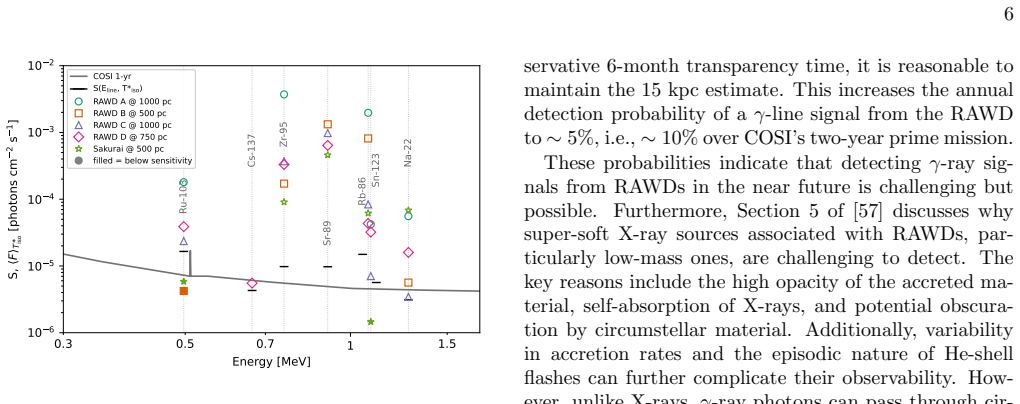
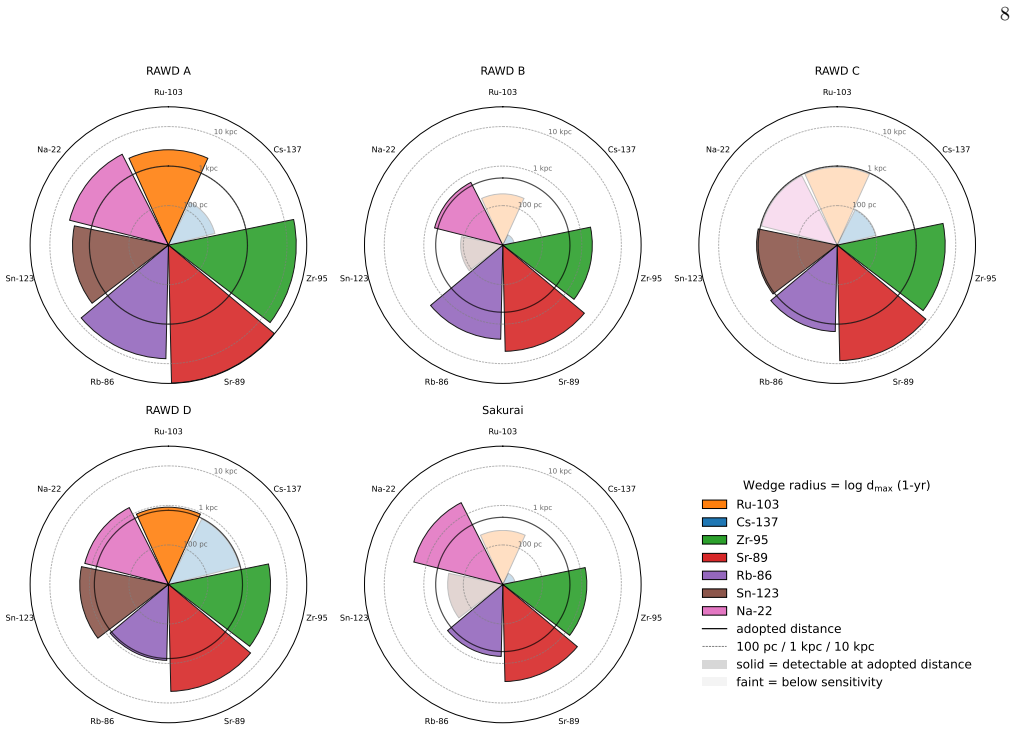
The central claim is that the probability of observing i-process emission lines during COSI's operational period is up to approximately 1%, rising to 11% for 89Sr if observed within a few days after ejection. Due to its long lifetime and large production from proton-capture reactions, 22Na has a higher detection probability of about 5%. Detection of long-lived neutron-rich isotopes such as 137Cs would provide the first direct gamma-ray signature of intermediate neutron-density nucleosynthesis, distinguishing the i process from classical s- and r-process pathways.
What carries the argument
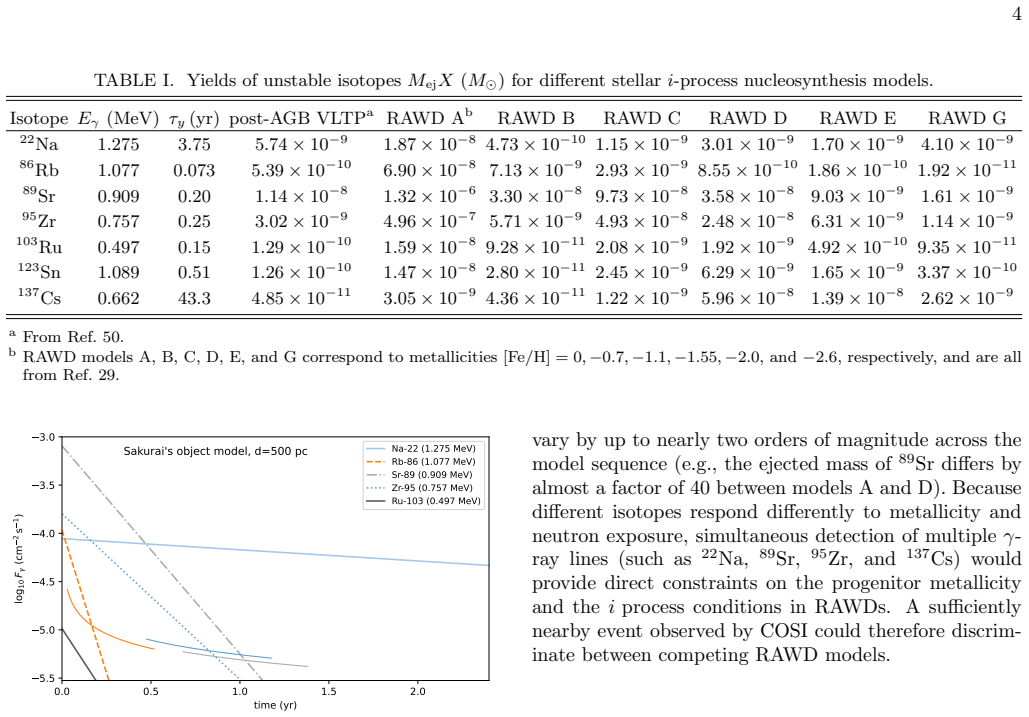
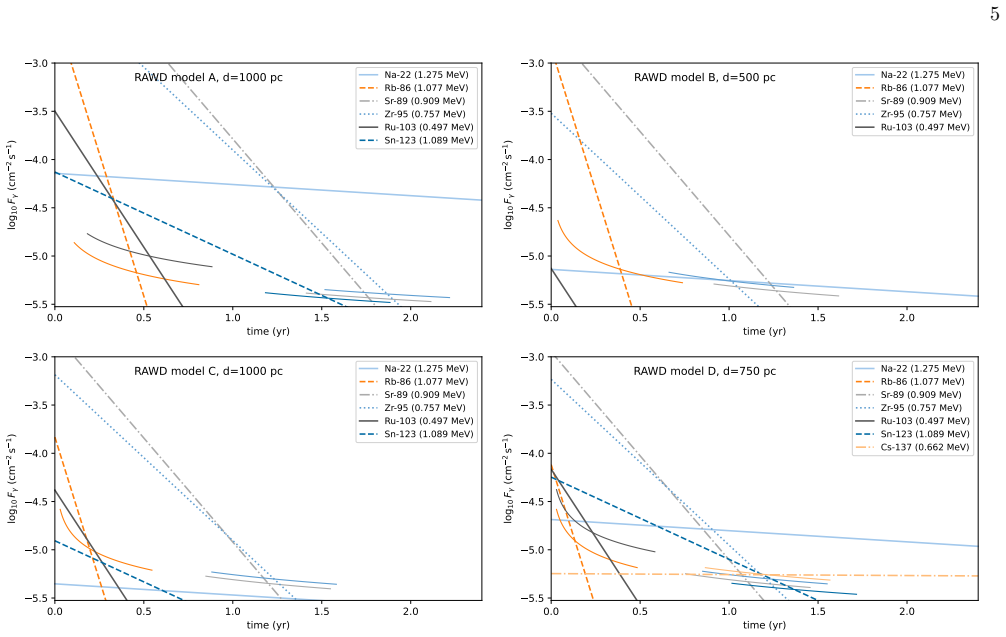
Ejected yields of rare isotopes (22Na, 89Sr, 95Zr) from 1D and 3D simulations of convective-reactive fluid dynamics in post-AGB stars and RAWDs, combined with estimated source formation rates and distances within 1000 parsecs.
If this is right
- Future space missions could increase the observation probability to several tens of percent.
- Observing 89Sr lines soon after an event boosts the chance to 11%.
- 22Na is more detectable due to its production via proton captures and longer lifetime.
- Detection of 137Cs would distinguish i-process from s- and r-processes.
Where Pith is reading between the lines
- Such detections could help pinpoint the astrophysical sites of the i-process by linking gamma-ray observations to specific stellar events.
- Non-detection might require revising the assumed ejection rates or yields from current simulations.
- Extending the analysis to other isotopes or different distances could refine the probabilities further.
Load-bearing premise
The simulations of convective-reactive fluid dynamics accurately predict the ejected yields of i-process products and the formation rates of the source events.
What would settle it
A survey of the sky within 1000 parsecs during COSI's lifetime that finds no gamma-ray lines from 22Na or 89Sr at the predicted levels would challenge the detection probabilities.
Figures
read the original abstract
We investigate the nuclear $\gamma$-ray line emission from rare isotopes produced in the astrophysical intermediate neutron-capture process ($i$ process) and assess the prospects of observing these emissions with $\gamma$-ray telescopes. The astrophysical sites of the $i$ process remain uncertain, but two candidates with predicted rapid mass ejections at metallicities of stars in the solar neighborhood are post-asymptotic giant branch (post-AGB) stars, such as Sakurai's object (V4334 Sagittarii), and rapidly-accreting white dwarfs (RAWDs). Detailed 1D and 3D simulations indicate that the convective-reactive fluid dynamics responsible for $i$-process nucleosynthesis can lead to violent, non-radial outbursts resulting in mass ejections of $i$-process products. We calculate ejected yields of rare isotopes whose radioactive decays may produce detectable $\gamma$-ray lines, particularly in the 0.5-2 MeV range, focusing on $^{22}$Na, $^{89}$Sr, and $^{95}$Zr. We estimate the formation rates of these sources and the likelihood of detecting their $\gamma$-ray emissions within 1000 parsecs of the Sun. The probability of observing $i$-process emission lines during COSI's operational period is up to $\approx 1\%$, rising to $11\%$ for $^{89}$Sr if observed within a few days. Due to the long lifetime and large production of $^{22}$Na from proton-capture reactions its detection is more likely, with a probability of $\approx 5\%$. Future space missions could increase the observation probability to several tens of percent. Detection of long-lived neutron-rich isotopes such as $^{137}$Cs would provide the first direct $\gamma$-ray signature of intermediate neutron-density nucleosynthesis, distinguishing the $i$ process from classical s- and r-process pathways. (abridged)
Editorial analysis
A structured set of objections, weighed in public.
Referee Report
Summary. The paper calculates ejected yields of rare i-process isotopes (primarily 22Na, 89Sr, 95Zr) from 1D/3D simulations of post-AGB stars and RAWDs, folds these with estimated source formation rates within 1000 pc, and derives detection probabilities for gamma-ray lines with COSI (up to ~1% overall, 11% for 89Sr if observed promptly, ~5% for 22Na). It argues that detection of long-lived species such as 137Cs would furnish the first direct gamma-ray signature distinguishing the i-process from s- and r-process pathways.
Significance. If the simulation-derived yields and rates prove reliable, the work supplies a concrete, falsifiable forecast for an observational test of i-process nucleosynthesis with an approved mission (COSI), thereby linking nuclear astrophysics simulations to high-energy gamma-ray astronomy and highlighting the diagnostic power of neutron-rich isotopes.
major comments (2)
- [Abstract / probability estimates] Abstract and probability-calculation section: the headline probabilities (~1%, 11%, ~5%) are obtained by folding simulation yields with formation rates, yet no Monte-Carlo variation, no range on ejected masses, and no observational anchor for outburst frequency are supplied; every quoted percentage therefore scales directly with these two unquantified inputs.
- [Simulation yields and mass ejection] Section describing 1D/3D convective-reactive models: the premise that these simulations accurately predict ejected yields and violent mass ejections is load-bearing for all detection probabilities, but no sensitivity study or comparison to alternative yield sets is presented.
minor comments (1)
- [Abstract] The abstract states it is abridged; the full text should clarify whether any quantitative details on error propagation or rate assumptions were omitted in the abridgement.
Simulated Author's Rebuttal
We thank the referee for the constructive comments, which highlight important aspects of uncertainty quantification in our probability estimates. We address each major comment below and will revise the manuscript accordingly to strengthen the presentation of limitations.
read point-by-point responses
-
Referee: [Abstract / probability estimates] Abstract and probability-calculation section: the headline probabilities (~1%, 11%, ~5%) are obtained by folding simulation yields with formation rates, yet no Monte-Carlo variation, no range on ejected masses, and no observational anchor for outburst frequency are supplied; every quoted percentage therefore scales directly with these two unquantified inputs.
Authors: We agree that the headline probabilities are directly proportional to the adopted yields and source rates, which carry substantial uncertainties. The formation rates rely on the observed occurrence of post-AGB events like Sakurai's object and theoretical estimates for RAWDs, while ejected masses are taken from specific published simulations without explicit variation. In revision we will add a dedicated subsection in the methods and results that (i) tabulates the central values and plausible ranges drawn from the literature (e.g., factor-of-3–10 variations in outburst frequency and ejected mass), (ii) shows how the detection probabilities scale with these inputs, and (iii) presents the headline numbers as order-of-magnitude estimates rather than precise forecasts. This will make the dependence explicit without altering the central conclusions. revision: yes
-
Referee: [Simulation yields and mass ejection] Section describing 1D/3D convective-reactive models: the premise that these simulations accurately predict ejected yields and violent mass ejections is load-bearing for all detection probabilities, but no sensitivity study or comparison to alternative yield sets is presented.
Authors: The yields and mass-ejection events are taken from the 1D and 3D convective-reactive calculations reported in the cited literature for post-AGB stars and RAWDs; these remain the most detailed models available for i-process nucleosynthesis in these sites. We acknowledge, however, that no dedicated sensitivity study or systematic comparison to alternative yield sets (e.g., different nuclear rates or mixing prescriptions) is included. In revision we will expand the relevant section to (i) briefly summarize the key assumptions of the adopted models, (ii) note the absence of a full sensitivity analysis as a limitation, and (iii) include a short comparison, where data exist, to other published yield estimates for the same isotopes. A comprehensive sensitivity study would require new simulations beyond the scope of the present work. revision: partial
Circularity Check
No significant circularity detected
full rationale
The paper derives its headline detection probabilities (≈1% overall, 11% for 89Sr, ≈5% for 22Na) by folding ejected yields of 22Na/89Sr/95Zr with estimated source formation rates inside 1000 pc. These yields are taken from cited 1D/3D convective-reactive simulations of post-AGB and RAWD outbursts, which are external inputs rather than quantities defined or fitted inside the probability calculation itself. No equation or step reduces a claimed prediction to its own inputs by construction, and no self-citation chain is invoked as a uniqueness theorem that forces the result. The derivation chain is therefore self-contained against external simulation benchmarks.
Axiom & Free-Parameter Ledger
free parameters (2)
- Ejected isotope yields
- Source formation rates and distances
axioms (2)
- domain assumption Convective-reactive fluid dynamics in post-AGB stars and RAWDs produce violent mass ejections of i-process products.
- domain assumption COSI sensitivity allows detection of lines in 0.5-2 MeV range from decays of these isotopes.
Reference graph
Works this paper leans on
-
[1]
E. Burns, C. L. Fryer, I. Agullo, J. Andrews, E. Aydi, M. G. Baring, E. Baron, P. G. Boorman, M. A. Boroumand, E. Borowski, F. S. Broekgaarden, P. Chan- dra, E. Chatzopoulos, H.-Y. Chen, K. A. Chipps, F. Civano, L. Comisso, A. C´ ardenas-Avenda˜ no, P. Dang, C. M. Deibel, T. Eftekhari, C. Elliott, R. J. Foley, C. J. Fontes, C. L. Fryer, A. Gall, G. R. Gal...
-
[2]
J. Tomsick, S. Boggs, A. Zoglauer, D. H. Hartmann, M. Ajello, E. Burns, C. Fryer, C. Karwin, C. Kier- ans, A. Lowell, J. Malzac, J. Roberts, P. Saint-Hilaire, A. Shih, T. Siegert, C. Sleator, T. Takahashi, F. Tavec- chio, E. Wulf, J. Beechert, H. Gulick, A. Joens, H. Lazar, E. Neights, J. C. Martinez Oliveros, S. Matsumoto, T. Melia, H. Yoneda, M. Amman, ...
-
[3]
Vassh, X
N. Vassh, X. Wang, M. Larivi` ere, T. Sprouse, M. R. Mumpower, R. Surman, Z. Liu, G. C. McLaughlin, P. Denissenkov, and F. Herwig, Phys. Rev. Lett.132, 052701 (2024)
2024
-
[4]
Sch¨ onfelder, K
V. Sch¨ onfelder, K. Bennett, J. J. Blom, H. Bloe- men, W. Collmar, A. Connors, R. Diehl, W. Hermsen, A. Iyudin, R. M. Kippen, J. Kn¨ odlseder, L. Kuiper, G. G. Lichti, M. McConnell, D. Morris, R. Much, U. Oberlack, J. Ryan, G. Stacy, H. Steinle, A. Strong, R. Suleiman, R. van Dijk, M. Varendorff, C. Winkler, and O. R. Williams, Astron. Astrophys. Suppl.1...
2000
-
[5]
Bouchet, E
L. Bouchet, E. Jourdain, and J.-P. Roques, Astrophys. J. 801, 142 (2015)
2015
-
[6]
M. M. M. Pleintinger, R. Diehl, T. Siegert, J. Greiner, and M. G. H. Krause, Astron. Astrophys.672, A53 (2023)
2023
-
[7]
Siegert, R
T. Siegert, R. Diehl, A. C. Vincent, F. Guglielmetti, M. G. H. Krause, and C. Boehm, Astron. Astrophys. 595, A25 (2016)
2016
-
[8]
Siegert, A
T. Siegert, A. Coc, L. Delgado, R. Diehl, J. Greiner, M. Hernanz, P. Jean, J. Jos´ e, P. Molaro, M. M. M. Pleintinger, V. Savchenko, S. Starrfield, V. Tatis- cheff, and C. Weinberger, Astron. Astrophys.615, A107 (2018)
2018
-
[9]
Foug` eres, F
C. Foug` eres, F. de Oliveira Santos, J. Jos´ e, C. Michelagnoli,et al., Nature Communications 14, 4536 (2023)
2023
-
[10]
Busso, R
M. Busso, R. Gallino, and G. J. Wasserburg, Annu. Rev. Astron. Astrophys.37, 239 (1999). 10
1999
- [11]
-
[12]
J. J. Cowan and W. K. Rose, Astrophys. J.212, 149 (1977)
1977
-
[13]
R. A. Malaney, Mon. Not. R. Astron. Soc.223, 683 (1986)
1986
-
[14]
K¨ appeler, R
F. K¨ appeler, R. Gallino, S. Bisterzo, and W. Aoki, Re- views of Modern Physics83, 157 (2011)
2011
-
[15]
F. K. Thielemann, A. Arcones, R. K¨ appeli, M. Liebend¨ orfer, T. Rauscher, C. Winteler, C. Fr¨ ohlich, I. Dillmann, T. Fischer, G. Martinez-Pinedo, K. Lan- ganke, K. Farouqi, K. L. Kratz, I. Panov, and I. K. Korneev, Progress in Particle and Nuclear Physics66, 346 (2011)
2011
-
[16]
Wiedeking, S
M. Wiedeking, S. Goriely, M. Guttormsen, F. Herwig, A.-C. Larsen, S. N. Liddick, D. M¨ ucher, A. L. Richard, S. Siem, and A. Spyrou, Nature Reviews Physics7, 696 (2025)
2025
-
[17]
Asplund, D
M. Asplund, D. L. Lambert, T. Kipper, D. Pollacco, and M. D. Shetrone, Astron. Astrophys.343, 507 (1999)
1999
-
[18]
Evanset al., MNRAS493, 1277 (2020)
A. Evanset al., MNRAS493, 1277 (2020)
2020
-
[19]
Herwig, Astrophys
F. Herwig, Astrophys. Space Sci.275, 15 (2001)
2001
-
[20]
H. W. Duerbeck, W. Liller, C. Sterken, S. Benetti, A. M. van Genderen, J. Arts, J. D. Kurk, M. Janson, T. Voskes, E. Brogt, T. Arentoft, A. van der Meer, and R. Dijkstra, Astron. J.119, 2360 (2000)
2000
-
[21]
Herwig, M
F. Herwig, M. Pignatari, P. R. Woodward, D. H. Porter, G. Rockefeller, C. L. Fryer, M. Bennett, and R. Hirschi, Astrophys. J.727, 89 (2011)
2011
-
[22]
Battich, M
T. Battich, M. M. Miller Bertolami, A. M. Serenelli, S. Justham, and A. Weiss, Astron. Astrophys.680, L13 (2023)
2023
-
[23]
T. C. Beers and N. Christlieb, Annu. Rev. Astron. Astrophys.43, 531 (2005)
2005
-
[24]
Bisterzo, R
S. Bisterzo, R. Gallino, O. Straniero, S. Cristallo, and F. K¨ appeler, Mon. Not. R. Astron. Soc.422, 849 (2012)
2012
-
[25]
Dardelet, C
L. Dardelet, C. Ritter, P. Prado, E. Heringer, C. Higgs, S. Sandalski, S. Jones, P. Denisenkov, K. Venn, M. Bertolli, M. Pignatari, P. Woodward, and F. Herwig, inXIII Nuclei in the Cosmos (NIC XIII)(2014) p. 145
2014
-
[26]
Hampel, R
M. Hampel, R. J. Stancliffe, M. Lugaro, and B. S. Meyer, Astrophys. J.831, 171 (2016)
2016
-
[27]
Hampel, A
M. Hampel, A. I. Karakas, R. J. Stancliffe, B. S. Meyer, and M. Lugaro, Astrophys. J.887, 11 (2019)
2019
-
[28]
Choplin, L
A. Choplin, L. Siess, and S. Goriely, Astron. Astrophys. 667, A155 (2022)
2022
-
[29]
P. A. Denissenkov, F. Herwig, P. Woodward, R. Andrassy, M. Pignatari, and S. Jones, Mon. Not. R. Astron. Soc.488, 4258 (2019)
2019
-
[30]
Stephens, F
D. Stephens, F. Herwig, P. Woodward, P. Denissenkov, R. Andrassy, and H. Mao, Mon. Not. R. Astron. Soc. 504, 744 (2021)
2021
-
[31]
Jadhav, M
M. Jadhav, M. Pignatari, F. Herwig, E. Zinner, R. Gallino, and G. R. Huss, Astrophys. J. Lett.777, L27 (2013)
2013
-
[32]
Fujiya, P
W. Fujiya, P. Hoppe, E. Zinner, M. Pignatari, and F. Herwig, Astrophys. J. Lett.776, L29 (2013)
2013
-
[33]
N. Liu, M. R. Savina, A. M. Davis, R. Gallino, O. Straniero, F. Gyngard, M. J. Pellin, D. G. Willing- ham, N. Dauphas, M. Pignatari, S. Bisterzo, S. Cristallo, and F. Herwig, Astrophys. J.786, 66 (2014)
2014
-
[34]
Mishenina, M
T. Mishenina, M. Pignatari, G. Carraro, V. Kovtyukh, L. Monaco, S. Korotin, E. Shereta, I. Yegorova, and F. Herwig, Mon. Not. R. Astron. Soc.446, 3651 (2015)
2015
-
[35]
Choplin, S
A. Choplin, S. Goriely, and L. Siess, Astron. Astrophys. 667, L13 (2022)
2022
-
[36]
P. A. Denissenkov, F. Herwig, U. Battino, C. Rit- ter, M. Pignatari, S. Jones, and B. Paxton, Astrophys. J. Lett.834, L10 (2017)
2017
-
[37]
Hajduk, A
M. Hajduk, A. A. Zijlstra, F. Herwig, P. A. M. van Hoof, F. Kerber, S. Kimeswenger, D. L. Pollacco, A. Evans, J. A. Lop´ ez, M. Bryce, S. P. S. Eyres, and M. Matsuura, Science308, 231 (2005)
2005
-
[38]
Herwig, T
F. Herwig, T. Bl¨ ocker, N. Langer, and T. Driebe, Astron. Astrophys.349, L5 (1999)
1999
-
[39]
Herwig, Astrophys
F. Herwig, Astrophys. J. Lett.554, L71 (2001)
2001
-
[40]
Herwig, P
F. Herwig, P. R. Woodward, P.-H. Lin, M. Knox, and C. Fryer, Astrophys. J. Lett.792, L3 (2014)
2014
-
[41]
Wesson, X.-W
R. Wesson, X.-W. Liu, and M. J. Barlow, Monthly No- tices of the Royal Astronomical Society340, 253 (2003)
2003
-
[42]
Wesson, M
R. Wesson, M. J. Barlow, X.-W. Liu, P. J. Storey, B. Er- colano, and O. De Marco, Monthly Notices of the Royal Astronomical Society383, 1639 (2008)
2008
-
[43]
Montoro-Molina, M
B. Montoro-Molina, M. A. Guerrero, and J. A. Toal´ a, Monthly Notices of the Royal Astronomical Society526, 4359 (2023)
2023
-
[44]
X. Fang, E. Garc´ ıa-Berro, M. A. Guerrero, A. Chiotel- lis, M. R. Schreiber, T. Bl¨ ocker, J. A. Toal´ a, and L. G. Althaus, The Astrophysical Journal797, 100 (2014)
2014
-
[45]
M. M. Miller Bertolami, Galaxies12, 83 (2024)
2024
-
[46]
G´ omez-Gomar, M
J. G´ omez-Gomar, M. Hernanz, J. Jos´ e, and J. Isern, Monthly Notices of the Royal Astronomical Society296, 913 (1998)
1998
-
[47]
Han and P
Z. Han and P. Podsiadlowski, Mon. Not. R. Astron. Soc. 350, 1301 (2004)
2004
-
[48]
We use the standard stellar spectroscopy notation [A/B] = log 10[N⋆(A)/N⋆(B)]−log 10[N⊙(A)/N⊙(B)], whereN ⋆ andN ⊙ are number densities of elements A and B in a star and the Sun
-
[49]
Choplin, L
A. Choplin, L. Siess, and S. Goriely, Astron. Astrophys. 648, A119 (2021)
2021
-
[50]
Denissenkov, G
P. Denissenkov, G. Perdikakis, F. Herwig, H. Schatz, C. Ritter, M. Pignatari, S. Jones, S. Nikas, and A. Spy- rou, Journal of Physics G Nuclear Physics45, 055203 (2018)
2018
-
[51]
Weiss and J
A. Weiss and J. W. Truran, Astron. Astrophys.238, 178 (1990)
1990
-
[52]
R. D. Gehrz, J. W. Truran, R. E. Williams, and S. Star- rfield, Publ. Astron. Soc. Pacific110, 3 (1998)
1998
-
[53]
Jos´ e, A
J. Jos´ e, A. Coc, and M. Hernanz, Astrophys. J.520, 347 (1999)
1999
-
[54]
A. F. Iyudin, K. Bennett, H. Bloemen, R. Diehl, W. Hermsen, J. Kn¨ odlseder, G. G. Lichti, J. Ryan, V. Sch¨ onfelder, A. W. Strong, and C. Winkler, Astro- physical Letters and Communications38, 371 (1999)
1999
-
[55]
Starrfield, M
S. Starrfield, M. Bose, C. Iliadis, W. R. Hix, C. E. Wood- ward, and R. M. Wagner, Astrophys. J.962, 191 (2024)
2024
-
[56]
E. P. J. van den Heuvel, D. Bhattacharya, K. Nomoto, and S. A. Rappaport, Astron. Astrophys.262, 97 (1992)
1992
-
[57]
T. E. Woods and M. Gilfanov, Mon. Not. R. Astron. Soc. 455, 1770 (2016)
2016
-
[58]
Cˆ ot´ e, P
B. Cˆ ot´ e, P. Denissenkov, F. Herwig, A. J. Ruiter, C. Rit- ter, M. Pignatari, and K. Belczynski, Astrophys. J.854, 105 (2018). 11
2018
-
[59]
M. A. Guerrero, X. Fang, M. M. Miller Bertolami, G. Ramos-Larios, H. Todt, A. Alarie, L. Sabin, L. F. Mi- randa, C. Morisset, C. Kehrig, and S. A. Zavala, Nature Astronomy2, 784 (2018)
2018
-
[60]
D. Elia, S. Molinari, E. Schisano, J. D. Soler, M. Merello, D. Russeil, M. Veneziani, A. Zavagno, A. Noriega- Crespo, L. Olmi, M. Benedettini, P. Hennebelle, R. S. Klessen, S. Leurini, R. Paladini, S. Pezzuto, A. Trafi- cante, D. J. Eden, P. G. Martin, M. Sormani, A. Coletta, T. Colman, R. Plume, Y. Maruccia, C. Mininni, and S. J. Liu, Astrophys. J.941, 1...
2022
-
[61]
M. A. Guerreroet al., ApJ857, 80 (2018)
2018
-
[62]
Reindlet al., MNRAS464, L51 (2017)
N. Reindlet al., MNRAS464, L51 (2017)
2017
-
[63]
G. C. Claytonet al., ApJ771, 130 (2013)
2013
-
[64]
Karinkuzhi, S
D. Karinkuzhi, S. Van Eck, S. Goriely, L. Siess, A. Joris- sen, A. Choplin, A. Escorza, S. Shetye, and H. Van Winckel, Astron. Astrophys.677, A47 (2023)
2023
-
[65]
B. S. Meyer, D. D. Clayton, and L.-S. The, Astrophys. J. Lett.540, L49 (2000)
2000
-
[66]
S. Jones, C. Ritter, F. Herwig, C. Fryer, M. Pignatari, M. G. Bertolli, and B. Paxton, Mon. Not. R. Astron. Soc.455, 3848 (2016), arXiv:1510.07417 [astro-ph.SR]
work page internal anchor Pith review Pith/arXiv arXiv 2016
-
[67]
P. A. Denissenkov, F. Herwig, G. Perdikakis, and H. Schatz, Mon. Not. R. Astron. Soc.503, 3913 (2021)
2021
-
[68]
Martinet, A
S. Martinet, A. Choplin, S. Goriely, and L. Siess, Astron. Astrophys.684, A8 (2024)
2024
-
[69]
Frontera, arXiv e-prints , arXiv:2502.10845 (2025), arXiv:2502.10845 [astro-ph.IM]
F. Frontera, arXiv e-prints , arXiv:2502.10845 (2025), arXiv:2502.10845 [astro-ph.IM]
-
[70]
Virgilli, H
E. Virgilli, H. Halloin, and G. Skinner, inHandbook of X-ray and Gamma-ray Astrophysics, edited by C. Bambi and A. Sangangelo (2022) p. 44
2022
- [71]
discussion (0)
Sign in with ORCID, Apple, or X to comment. Anyone can read and Pith papers without signing in.