An efficient and stable diffusion generated method for quadrilateral mesh generation in general domains
Pith reviewed 2026-06-29 11:20 UTC · model grok-4.3
The pith
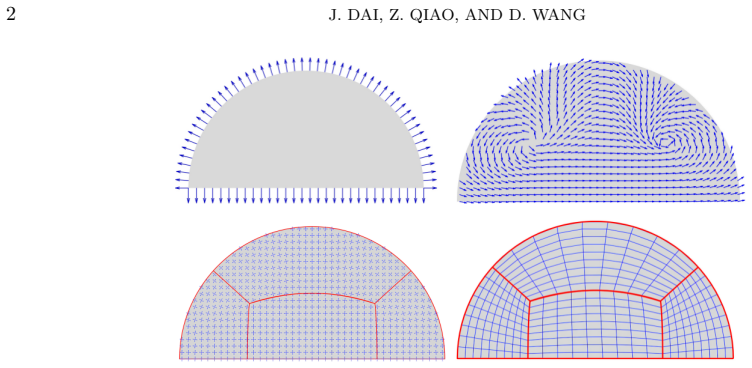
Extending complex domains to regular ones allows an FFT-based iterative scheme to minimize a relaxed Ginzburg-Landau energy and generate high-quality quadrilateral meshes without intermediate triangulations.
A machine-rendered reading of the paper's core claim, the machinery that carries it, and where it could break.
Core claim
The central claim is that the proposed iterative algorithm for cross-field computation, enabled by domain extension to a regular grid, guarantees unconditional monotonic decay of the objective functional and consistently generates high-quality quadrilateral meshes on general two-dimensional domains.
What carries the argument
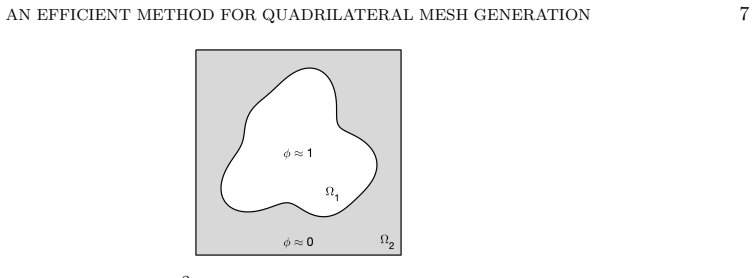
Domain extension to a larger regular computational domain, followed by an iteration that alternates FFT-solved linear diffusion with point-wise normalization to minimize the relaxed Ginzburg-Landau-type energy.
If this is right
- Quadrilateral meshes can be produced on arbitrary 2D geometries without first generating an intermediate triangular mesh.
- The FFT-based diffusion step replaces nonlinear optimization on irregular domains with two simple, globally efficient operations.
- Stability follows directly from the proven unconditional monotonic decay of the energy functional at every iteration.
- The same framework applies uniformly across a wide range of complex shapes without case-by-case adjustments to the solver.
Where Pith is reading between the lines
- The same domain-extension idea could be tested for surface or volumetric mesh generation if a suitable regular embedding can be constructed.
- Because each iteration is dominated by an FFT, the method may become fast enough for on-the-fly remeshing inside time-dependent simulations.
- The relaxation parameter in the energy functional offers a possible control knob for trading element size variation against orthogonality.
Load-bearing premise
That extending the original complex domain to a larger regular computational domain preserves the essential properties for cross field computation without introducing boundary artifacts or loss of quality on the original domain.
What would settle it
A side-by-side comparison showing that meshes produced after domain extension have measurably lower quality or element distortion near the original boundary than meshes produced by methods that operate directly on the irregular domain.
Figures
read the original abstract
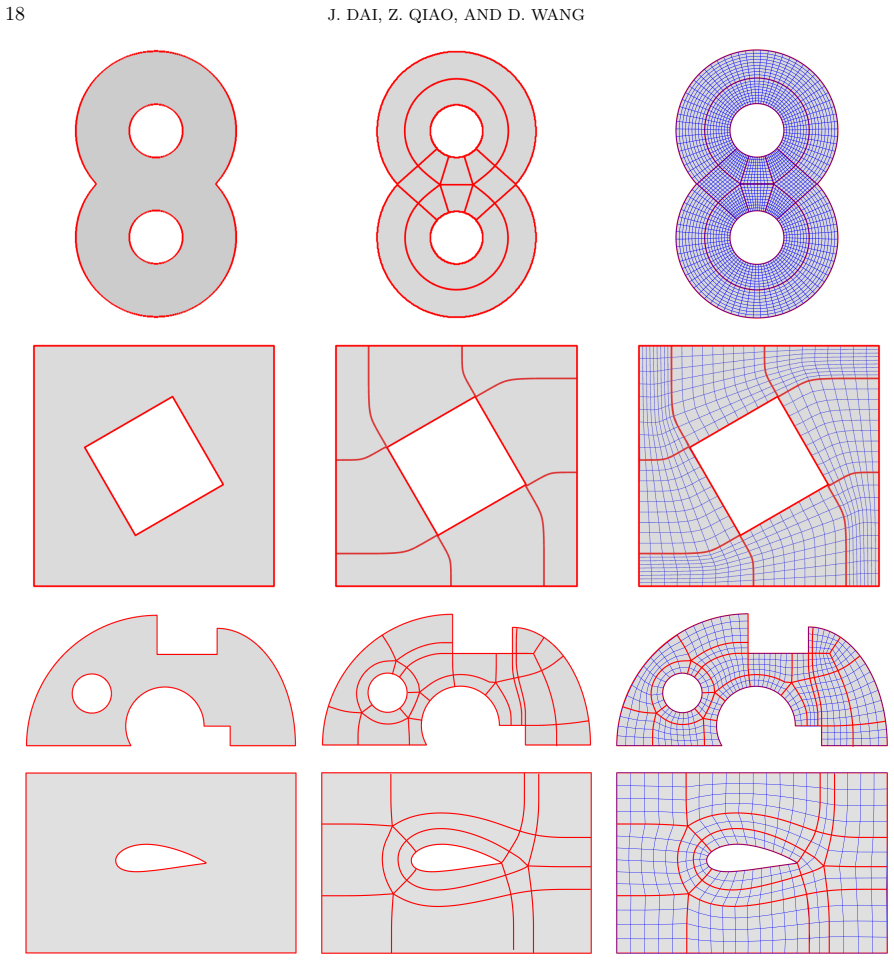
This paper introduces a novel, robust, and computationally efficient framework for high-quality quadrilateral mesh generation on general two-dimensional domains. The core of the proposed approach is a novel method for computing cross fields by minimizing a modified and relaxed Ginzburg--Landau-type energy functional. A key innovation is the extension of the problem from the original, potentially complex domain to a larger regular computational domain. This extension transforms the central computational procedure into an iterative scheme that requires only two straightforward and efficient operations: linear diffusion solved globally via the Fast Fourier Transform (FFT) and point-wise normalization. Notably, our method eliminates the conventional need for generating an intermediate triangular mesh or solving complex nonlinear optimization problems on the irregular domain. We provide a rigorous theoretical analysis, proving that the proposed iterative algorithm guarantees unconditional monotonic decay of the objective functional. Comprehensive numerical experiments demonstrate the method's robustness across a wide range of complex geometries, its significant computational efficiency afforded by the FFT-based diffusion, and its consistent generation of high-quality quadrilateral meshes. This work presents a reliable and theoretically sound alternative to existing mesh generation techniques, with strong potential for practical applications in scientific computing.
Editorial analysis
A structured set of objections, weighed in public.
Referee Report
Summary. The paper claims to introduce an efficient method for quadrilateral mesh generation on general 2D domains via cross-field computation. The approach extends the original irregular domain to a larger regular computational domain, then applies an iterative scheme consisting of global linear diffusion (solved via FFT) followed by pointwise normalization to minimize a modified and relaxed Ginzburg-Landau energy. A rigorous theoretical analysis is asserted to prove unconditional monotonic decay of the objective functional, and numerical experiments are presented to demonstrate robustness, efficiency, and high-quality meshes without requiring intermediate triangular meshes or nonlinear optimization on irregular domains.
Significance. If the claimed unconditional decay holds on the original domain (rather than only the extension) and the numerical results are reproducible across the tested geometries, the work would provide a computationally attractive, FFT-based alternative to existing cross-field methods, with potential impact in scientific computing applications requiring high-quality quadrilateral meshes.
major comments (1)
- [Abstract and theoretical analysis section] Abstract and theoretical analysis section: the central claim of unconditional monotonic decay of the objective functional on the geometry of interest rests on the iterative scheme (global FFT diffusion + normalization). However, the analysis is described as establishing decay on the extended regular domain, with the original-domain functional recovered only by restriction. No explicit argument is supplied showing that the global diffusion operator commutes with restriction or that artificial boundaries introduce no additional interface contributions to the Dirichlet energy or potential terms. This directly affects whether the sequence decreases the original functional.
Simulated Author's Rebuttal
We thank the referee for the careful reading and constructive feedback on our manuscript. We address the single major comment below and indicate the planned revision.
read point-by-point responses
-
Referee: [Abstract and theoretical analysis section] Abstract and theoretical analysis section: the central claim of unconditional monotonic decay of the objective functional on the geometry of interest rests on the iterative scheme (global FFT diffusion + normalization). However, the analysis is described as establishing decay on the extended regular domain, with the original-domain functional recovered only by restriction. No explicit argument is supplied showing that the global diffusion operator commutes with restriction or that artificial boundaries introduce no additional interface contributions to the Dirichlet energy or potential terms. This directly affects whether the sequence decreases the original functional.
Authors: We appreciate the referee highlighting this important detail in the theoretical analysis. The proof of unconditional monotonic decay is carried out on the extended regular domain, where the global FFT diffusion step is well-defined and the iteration operates. The functional on the original domain is recovered by restriction. We agree that the current manuscript does not supply an explicit argument establishing that the decrease on the extended energy implies a corresponding decrease on the restricted functional without additional interface contributions from the artificial boundaries. In the revised manuscript we will add a dedicated lemma in the theoretical analysis section that decomposes the energy, shows that the restriction commutes with the diffusion-plus-normalization step under our extension construction, and confirms that no spurious Dirichlet or potential terms arise at the artificial interfaces. This will directly link the proven decay to the geometry of interest. revision: yes
Circularity Check
No significant circularity; derivation is self-contained with independent theoretical analysis
full rationale
The paper introduces a new iterative scheme for cross-field computation via domain extension, global FFT diffusion, and normalization, then claims a rigorous proof of unconditional monotonic decay of the modified Ginzburg-Landau energy. No quoted equations or steps reduce the central guarantee to a fitted parameter, self-definition, or load-bearing self-citation chain; the analysis is presented as establishing the decay property directly from the scheme on the extended domain. The method avoids triangular meshing and nonlinear optimization by construction of the algorithm itself, but this is an explicit design choice rather than a hidden circular reduction. External benchmarks and numerical experiments are invoked as independent validation.
Axiom & Free-Parameter Ledger
axioms (2)
- standard math The Fast Fourier Transform can be used to solve the linear diffusion equation globally and efficiently.
- domain assumption The extension of the domain to a regular computational domain preserves the essential properties for cross field computation.
Reference graph
Works this paper leans on
-
[1]
H. Abels, K. F. Lam, and B. Stinner , Analysis of the diffuse domain approach for a bulk-surface coupled PDE system , SIAM J. Math. Anal., 47 (2015), pp. 3687--3725, https://doi.org/10.1137/15M1009093
-
[2]
C. G. Armstrong, H. J. Fogg, C. M. Tierney, and T. T. Robinson , Common themes in multi-block structured quad/hex mesh generation , Procedia Eng., 124 (2015), pp. 70--82, https://doi.org/10.1016/j.proeng.2015.10.123
-
[3]
P.-A. Beaufort, J. Lambrechts, F. Henrotte, C. Geuzaine, and J.-F. Remacle , Computing cross fields: A PDE approach based on the Ginzburg-Landau theory , Procedia Engineering, 203 (2017), pp. 219--231, https://doi.org/10.1016/j.proeng.2017.09.799
-
[4]
F. Bethuel, H. Brezis, and F. H \'e lein , Ginzburg-- L andau V ortices , vol. 13 of Progr. Nonlinear Differential Equations Appl., Birkh \"a user, Boston, 1994, https://doi.org/10.1007/978-1-4612-0287-5
-
[5]
T. D. Blacker and M. B. Stephenson , Paving: A new approach to automated quadrilateral mesh generation , Internat. J. Numer. Methods Engrg., 32 (1991), pp. 811--847, https://doi.org/10.1002/nme.1620320410
-
[6]
V. Blanchi, \'E . Corman, N. Ray, and D. Sokolov , Global parametrization based on G inzburg-- L andau functional , in Numerical Geometry, Grid Generation and Scientific Computing, V. A. Garanzha, L. Kamenski, and H. Si, eds., vol. 143 of Lect. Notes Comput. Sci. Engrg., Springer, Cham, 2021, pp. 251--262, https://doi.org/10.1007/978-3-030-76798-3_16
-
[7]
In: IEEE/CVF International Conference on Computer Vision
A. Bokhovkin, S. Tulsiani, and A. Dai , Mesh2Tex : Generating mesh textures from image queries , in Proc. IEEE/CVF Int. Conf. Comput. Vis. (ICCV), 2023, pp. 8884--8894, https://doi.org/10.1109/ICCV51070.2023.00819
-
[8]
D. Bommes, B. L \'e vy, N. Pietroni, E. Puppo, C. Silva, M. Tarini, and D. Zorin , Quad-mesh generation and processing: A survey , Comput. Graph. Forum, 32 (2013), pp. 51--76, https://doi.org/10.1111/cgf.12014
-
[9]
D. Bommes, H. Zimmer, and L. Kobbelt , Mixed-integer quadrangulation , ACM Trans. Graph., 28 (2009), p. 77, https://doi.org/10.1145/1531326.1531383
-
[10]
M. Burger, O. L. Elvetun, and M. Schlottbom , Analysis of the diffuse domain method for second order elliptic boundary value problems , Found. Comput. Math., 17 (2017), pp. 627--674, https://doi.org/10.1007/s10208-015-9292-6
-
[11]
M. Campen, D. Bommes, and L. Kobbelt , Quantized global parametrization , ACM Trans. Graph., 34 (2015), pp. 1--12, https://doi.org/10.1145/2816795.2818140
-
[12]
Q. Du, L. Ju, X. Li, and Z. Qiao , Maximum bound principles for a class of semilinear parabolic equations and exponential time-differencing schemes , SIAM Rev., 63 (2021), pp. 317--359, https://doi.org/10.1137/19M1243750
-
[13]
F. Durst and M. Sch \"a fer , A parallel block-structured multigrid method for the prediction of incompressible flows , Internat. J. Numer. Methods Fluids, 22 (1996), pp. 549--565, https://doi.org/10.1002/(SICI)1097-0363(19960330)22:6<549::AID-FLD366>3.0.CO;2-7
-
[14]
S. Esedo\= g lu and F. Otto , Threshold dynamics for networks with arbitrary surface tensions , Comm. Pure Appl. Math., 68 (2014), pp. 808--864, https://doi.org/10.1002/cpa.21527
-
[15]
H. J. Fogg, C. G. Armstrong, and T. T. Robinson , Automatic generation of multiblock decompositions of surfaces , Internat. J. Numer. Methods Engrg., 101 (2015), pp. 965--991, https://doi.org/10.1002/nme.4825
-
[16]
H. J. Fogg, L. Sun, J. E. Makem, C. G. Armstrong, and T. T. Robinson , A simple formula for quad mesh singularities , Procedia Eng., 203 (2017), pp. 14--26, https://doi.org/10.1016/j.proeng.2017.09.781
-
[17]
J. Geusebroek, A. W. M. Smeulders, and J. van de Weijer , Fast anisotropic Gauss filtering , IEEE Transactions on Image Processing, 12 (2003), pp. 938--943, https://doi.org/10.1109/tip.2003.812429
-
[18]
V. L. Ginzburg and L. D. Landau , On the theory of superconductivity , in On Superconductivity and Superfluidity, Springer, Berlin, Heidelberg, 2009, pp. 113--137, https://doi.org/10.1007/978-3-540-68008-6_4
-
[19]
Z. Guo, F. Yu, P. Lin, S. Wise, and J. Lowengrub , A diffuse domain method for two-phase flows with large density ratio in complex geometries , J. Fluid Mech., 907 (2021), p. A38, https://doi.org/10.1017/jfm.2020.790
-
[20]
K. He, J. Sun, and X. Tang , Guided image filtering , IEEE Trans. Pattern Anal. Mach. Intell., 35 (2013), pp. 1397--1409, https://doi.org/10.1109/TPAMI.2012.213
-
[21]
J. J. Jezdimirovi \'c , A. Chemin, and J. F. Remacle , Multi-block decomposition and meshing of 2D domain using Ginzburg-Landau PDE , in Proceedings of the 28th International Meshing Roundtable, Buffalo, NY, 2020, https://doi.org/10.5281/zenodo.3653432. Held Oct. 14--17, 2019
-
[22]
N. Kowalski, F. Ledoux, and P. Frey , A PDE based approach to multidomain partitioning and quadrilateral meshing , in Proc. 21st International Meshing Roundtable, Springer, Berlin, Heidelberg, 2013, pp. 137--154, https://doi.org/10.1007/978-3-642-33573-0_9
-
[23]
T. Laux and N. K. Yip , Analysis of diffusion generated motion for mean curvature flow in codimension two: A gradient-flow approach , Arch. Ration. Mech. Anal., 232 (2019), pp. 1113--1163, https://doi.org/10.1007/s00205-018-01340-x
-
[24]
L. Li, P. Zhang, D. Smirnov, S. M. Abulnaga, and J. Solomon , Interactive all-hex meshing via cuboid decomposition , ACM Trans. Graph., 40 (2021), pp. 1--17, https://doi.org/10.1145/3478513.3480568
-
[25]
R. Li, T. Tang, and P. Zhang , Moving mesh methods in multiple dimensions based on harmonic maps , J. Comput. Phys., 170 (2001), pp. 562--588, https://doi.org/10.1006/jcph.2001.6749
-
[26]
X. Li, J. Lowengrub, A. R \"a tz, and A. Voigt , Solving PDE s in complex geometries , Comm. Math. Sci., 7 (2009), pp. 81--107, https://doi.org/10.4310/cms.2009.v7.n1.a4
-
[27]
G. Marcias, N. Pietroni, D. Panozzo, E. Puppo, and O. Sorkine-Hornung , Animation-aware quadrangulation , Comput. Graph. Forum, 32 (2013), pp. 167--175, https://doi.org/10.1111/cgf.12183
-
[28]
Merriman, J
B. Merriman, J. Bence, and S. Osher , Diffusion generated motion by mean curvature , Tech. Report 92-18, University of California, Los Angeles, 1992. https://www.math.ucla.edu/applied/cam
1992
-
[29]
A. Myles, N. Pietroni, and D. Zorin , Robust field-aligned global parametrization , ACM Transactions on Graphics, 33 (2014), pp. 135:1--135:14, https://doi.org/10.1145/2601097.2601154
-
[30]
B. Osting and D. Wang , A diffusion generated method for orthogonal matrix-valued fields , Math. Comp., 89 (2019), pp. 515--550, https://doi.org/10.1090/mcom/3473
-
[31]
D. Peng, B. Merriman, S. Osher, H. Zhao, and M. Kang , A PDE -based fast local level set method , J. Comput. Phys., 155 (1999), pp. 410--438, https://doi.org/10.1006/jcph.1999.6345
-
[32]
C. Quan, T. Tang, and D. Wang , Unconditional energy dissipation of S trang splitting for the matrix-valued A llen-- C ahn equation , J. Differential Equations, 453 (2026), p. 113825, https://doi.org/10.1016/j.jde.2025.113825
-
[33]
J. Raddatz and J. K. Fassbender , Block structured Navier-Stokes solver FLOWer , in MEGAFLOW --- Numerical Flow Simulation for Aircraft Design, N. Kroll and J. K. Fassbender, eds., vol. 89 of Notes Numer. Fluid Mech. Multidiscip. Des., Springer, Berlin, Heidelberg, 2005, pp. 27--44, https://doi.org/10.1007/3-540-32382-1_2
-
[34]
N. Ray, W. C. Li, B. L \'e vy, A. Sheffer, and P. Alliez , Periodic global parameterization , ACM Trans. Graph., 25 (2006), pp. 1460--1485, https://doi.org/10.1145/1183287.1183297
-
[35]
J.-F. Remacle, C. Geuzaine, G. Comp \`e re, and E. Marchandise , High-quality surface remeshing using harmonic maps , Internat. J. Numer. Methods Engrg., 83 (2010), pp. 403--425, https://doi.org/10.1002/nme.2824
-
[36]
S. J. Ruuth, B. Merriman, J. Xin, and S. Osher , Diffusion-generated motion by mean curvature for filaments , J. Nonlinear Sci., 11 (2001), pp. 473--493, https://doi.org/10.1007/s00332-001-0404-x
-
[37]
M. Sussman and E. Fatemi , An efficient, interface-preserving level set redistancing algorithm and its application to interfacial incompressible fluid flow , SIAM J. Sci. Comput., 20 (1999), pp. 1165--1191, https://doi.org/10.1137/s1064827596298245
-
[38]
R. Viertel and B. Osting , An approach to quad meshing based on harmonic cross-valued maps and the G inzburg-- L andau theory , SIAM J. Sci. Comput., 41 (2019), pp. A452--A479, https://doi.org/10.1137/17M1142703
-
[39]
D. Wang , An efficient unconditionally stable method for D irichlet partitions in arbitrary domains , SIAM J. Sci. Comput., 44 (2022), pp. A2061--A2088, https://doi.org/10.1137/21M1443406
-
[40]
F. Yu, Z. Guo, and J. Lowengrub , Higher-order accurate diffuse-domain methods for partial differential equations with D irichlet boundary conditions in complex, evolving geometries , J. Comput. Phys., 406 (2020), p. 109174, https://doi.org/10.1016/j.jcp.2019.109174
-
[41]
Y. Zou, T. Li, L. Lu, J. Wang, S. Zou, L. Zhang, and X. Deng , Finite-difference-informed graph network for solving steady-state incompressible flows on block-structured grids , Phys. Fluids, 36 (2024), p. 105157, https://doi.org/10.1063/5.0228104
-
[42]
write newline
" write newline "" before.all 'output.state := FUNCTION fin.entry add.period write newline FUNCTION new.block output.state before.all = 'skip after.block 'output.state := if FUNCTION not #0 #1 if FUNCTION and 'skip pop #0 if FUNCTION or pop #1 'skip if FUNCTION new.block.checka empty 'skip 'new.block if FUNCTION field.or.null duplicate empty pop "" 'skip ...
discussion (0)
Sign in with ORCID, Apple, or X to comment. Anyone can read and Pith papers without signing in.