EyeSpy: Inferring Eye Gaze via Side-Channel Attacks Against Foveated Rendering
Pith reviewed 2026-06-29 10:40 UTC · model grok-4.3
The pith
Side-channel attacks can infer eye gaze positions in VR from foveated rendering performance metrics with accuracy comparable to eye trackers.
A machine-rendered reading of the paper's core claim, the machinery that carries it, and where it could break.
Core claim
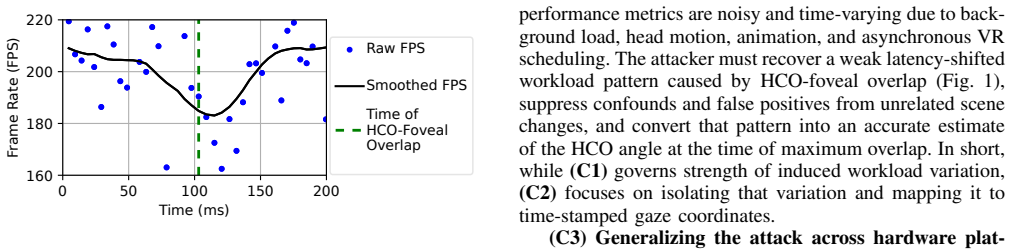
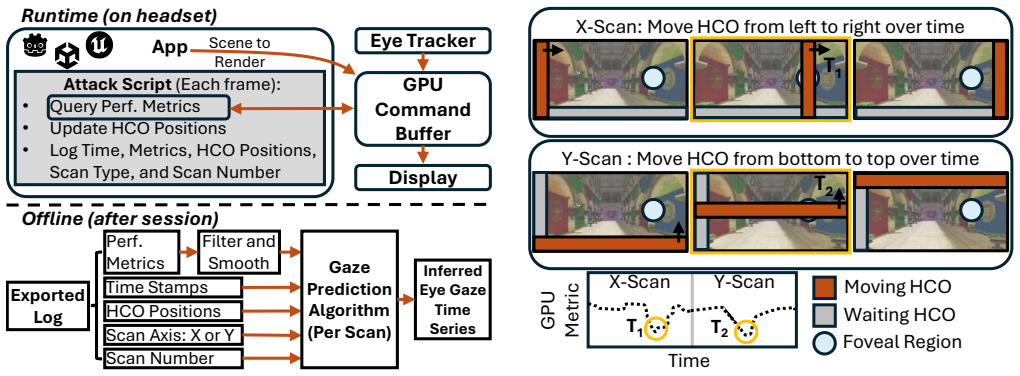
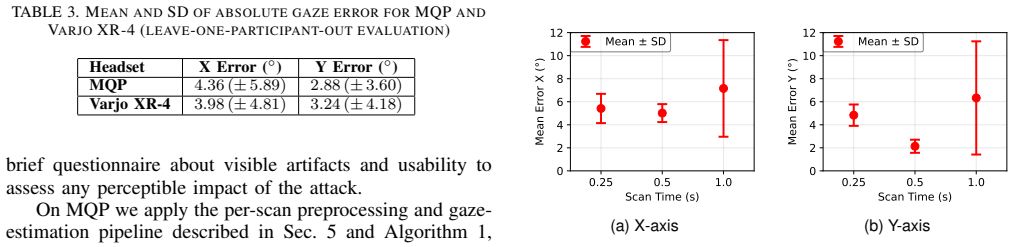
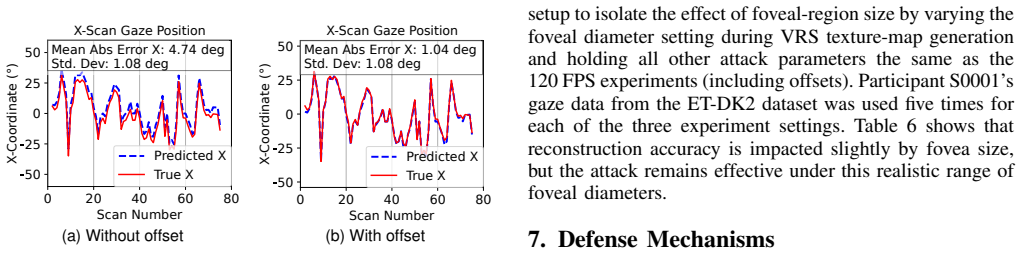
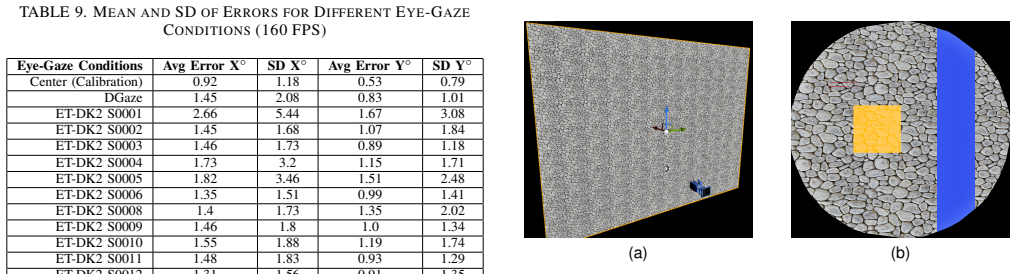
The central claim is that gaze position can be reconstructed by correlating known positions of imperceptible high-cost objects with measured changes in rendering performance metrics that occur only when an object overlaps the foveal region. The attack logs frame rate or frame time while the objects sweep the view, then solves for the gaze coordinate that best explains the observed performance spikes. Reported mean prediction errors fall between 1.1 and 4.4 degrees on the Meta Quest Pro, Varjo XR-4, and desktop systems, which the paper states is comparable to typical eye-tracker accuracy.
What carries the argument
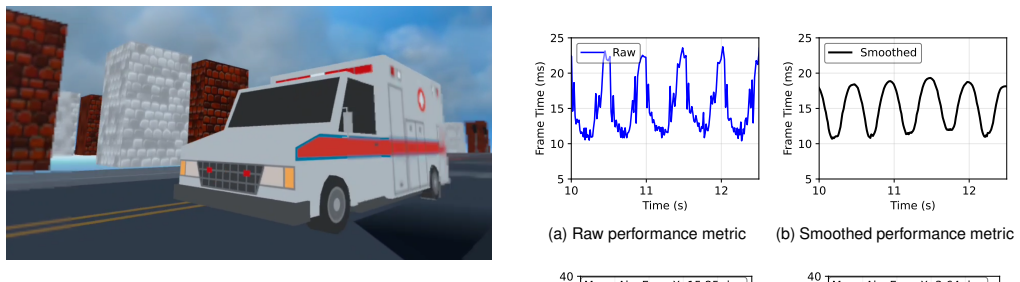
The correlation between imperceptible high-cost object positions and variations in exposed frame-rate or frame-time metrics caused by foveal overlap under dynamic foveated rendering.
If this is right
- Gaze inference remains possible even when eye-tracking APIs are blocked or require explicit permission.
- The attack succeeds on multiple VR headsets and desktop configurations using common game engines.
- Existing foveated rendering pipelines leak gaze location through ordinary performance counters.
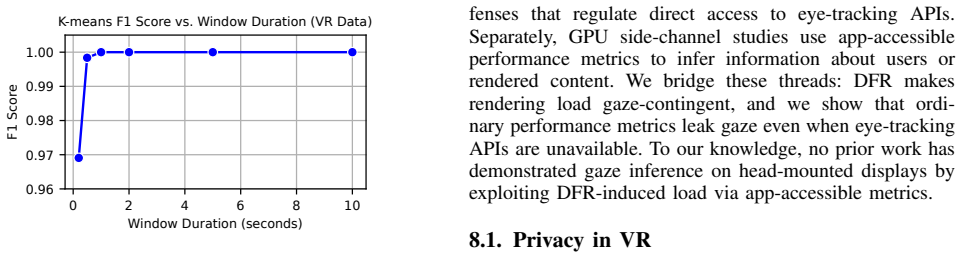
- Supervised and unsupervised detectors can identify the attack with F1 scores of 0.99 over short windows.
Where Pith is reading between the lines
- Applications that rely on foveated rendering for performance may need to add noise to performance metrics or hide object costs to limit leakage.
- Similar side channels could appear in any rendering technique that changes computational effort based on gaze location.
- The attack could be combined with other timing sources to improve accuracy or reduce the need for sweeping objects.
- Users might test for such inference by monitoring whether frame times change when known high-cost objects move across their view.
Load-bearing premise
Standard game engine APIs expose rendering performance metrics that vary detectably and consistently with the overlap between high-cost objects and the foveal region.
What would settle it
An experiment in which frame rate or frame time shows no consistent change when high-cost objects enter or leave the foveal region, or in which the resulting gaze prediction errors exceed 4.4 degrees on the tested platforms, would falsify reliable inference.
Figures



read the original abstract
While eye tracking provides valuable capabilities for virtual reality, such as gaze interaction and dynamic foveated rendering (DFR), eye-tracking data can inadvertently reveal sensitive user information if not properly protected. Current protections, such as adding permission prompts or gatekeeping gaze data, are insufficient on DFR-enabled systems because gaze data is used internally to drive DFR. When DFR is implemented, objects in the fovea (i.e., immediate gaze area) incur a higher GPU workload than those in the periphery. This gaze-contingent workload creates a novel side channel, which can be leveraged to reconstruct gaze positions. Specifically, we design a novel attack that sweeps imperceptible high-cost objects (HCOs) across the user's field of view and logs rendering performance metrics (e.g., frame rate or frame time) commonly exposed through standard game engines. Then, we correlate variation in these metrics (caused by HCO-foveal overlap) with the known HCOs' positions to infer gaze coordinates directly without using eye-tracking APIs. Our experimental results show that mean gaze prediction errors (1.1-4.4 degrees) across the Meta Quest Pro, Varjo XR-4, and desktop platforms are comparable to typical eye-tracker accuracy. We demonstrate that the attack generalizes across various hardware platforms, standard game engines, and foveated rendering pipelines. Finally, we design defense mechanisms based on supervised and unsupervised detectors that can flag the attack reliably (F1 of 0.99) over short time windows.
Editorial analysis
A structured set of objections, weighed in public.
Referee Report
Summary. The paper claims to introduce EyeSpy, a side-channel attack against foveated rendering in VR that infers eye gaze by sweeping imperceptible high-cost objects (HCOs) across the field of view and correlating variations in standard rendering performance metrics (frame rate or frame time) with the known HCO positions. Experimental results on Meta Quest Pro, Varjo XR-4, and desktop platforms show mean gaze prediction errors of 1.1-4.4 degrees, comparable to typical eye-tracker accuracy, with the attack generalizing across hardware, engines, and pipelines. Defenses based on supervised and unsupervised detectors achieve an F1 score of 0.99 over short time windows.
Significance. If the results hold, this work is significant as it identifies a novel privacy vulnerability in dynamic foveated rendering systems, demonstrating that gaze information can be leaked through commonly exposed performance metrics without needing direct eye-tracking API access. The cross-platform empirical evaluation with concrete error ranges and the proposal of effective defenses contribute to understanding and mitigating side-channel risks in VR. The purely empirical approach with direct hardware measurements is a strength.
major comments (2)
- [§4 (Attack Design and Implementation)] §4 (Attack Design and Implementation): The central claim depends on the assumption that variations in frame time/rate are dominantly and consistently caused by HCO-foveal overlap. However, the experimental methodology does not appear to include sufficient controls or ablations for other potential sources of GPU workload variation, such as concurrent dynamic objects, lighting changes, or background processes. This undermines the uniqueness of the correlation to gaze coordinates.
- [§5 (Evaluation)] §5 (Evaluation): The reported mean errors (1.1-4.4 degrees) are presented without accompanying statistical details such as standard deviations, number of trials per condition, or confidence intervals. Given the note on missing methodology details, this makes it difficult to verify the robustness of the generalization claim across platforms.
minor comments (3)
- [Abstract] Abstract: The abstract mentions 'standard game engines' but does not specify which ones were tested; this should be clarified for reproducibility.
- [§6 (Defense)] §6 (Defense): The defense mechanisms are described at a high level; more details on the features used for the detectors would improve clarity.
- Some figures showing the HCO sweep and metric variations would benefit from higher resolution or clearer annotations.
Simulated Author's Rebuttal
We thank the referee for the detailed and constructive feedback. We address each major comment below, indicating revisions to the manuscript where appropriate to strengthen the claims.
read point-by-point responses
-
Referee: §4 (Attack Design and Implementation): The central claim depends on the assumption that variations in frame time/rate are dominantly and consistently caused by HCO-foveal overlap. However, the experimental methodology does not appear to include sufficient controls or ablations for other potential sources of GPU workload variation, such as concurrent dynamic objects, lighting changes, or background processes. This undermines the uniqueness of the correlation to gaze coordinates.
Authors: We agree that explicit controls and ablations are needed to isolate the HCO-foveal effect. The original experiments used static scenes with no concurrent dynamic objects or lighting changes and minimized background processes; multiple runs averaged out residual noise. To address the concern directly, the revised manuscript will add ablation studies measuring frame-time variation without HCOs and under controlled confounders. revision: yes
-
Referee: §5 (Evaluation): The reported mean errors (1.1-4.4 degrees) are presented without accompanying statistical details such as standard deviations, number of trials per condition, or confidence intervals. Given the note on missing methodology details, this makes it difficult to verify the robustness of the generalization claim across platforms.
Authors: We acknowledge that the evaluation section omitted these statistical details. The reported means derive from repeated trials across platforms; the revision will include standard deviations, exact trial counts per condition, and confidence intervals to support the generalization claims. revision: yes
Circularity Check
Empirical side-channel attack demonstration with no derivation chain or self-referential predictions
full rationale
The paper presents a purely experimental attack: imperceptible high-cost objects are swept across the FOV while logging standard engine-exposed metrics (frame rate/time), then gaze is inferred by correlating metric variations with the known sweep positions. No equations, fitted parameters, uniqueness theorems, or ansatzes are invoked. The central result (1.1-4.4° mean error across platforms) is reported as direct measurement outcomes, not as a prediction derived from prior inputs. No self-citations form load-bearing steps. This is self-contained empirical work.
Axiom & Free-Parameter Ledger
axioms (2)
- domain assumption Rendering performance metrics such as frame rate and frame time are exposed through standard game engine APIs
- domain assumption Foveated rendering produces measurable workload differences when high-cost objects overlap the fovea
Reference graph
Works this paper leans on
-
[1]
(2025) Explore vr entertainment experiences: Vr movies & more
Meta. (2025) Explore vr entertainment experiences: Vr movies & more. Accessed: February 9, 2025. [Online]. Available: https://www.meta.com/quest/entertainment/
2025
-
[2]
Virtual reality and gamification in education: a systematic review,
G. Lampropoulos and Kinshuk, “Virtual reality and gamification in education: a systematic review,”Educational technology research and development, pp. 1–95, 2024
2024
-
[3]
Reviewing the current state of virtual reality integration in medical education-a scoping review,
M. Mergen, N. Graf, and M. Meyerheim, “Reviewing the current state of virtual reality integration in medical education-a scoping review,” BMC Medical Education, vol. 24, no. 1, p. 788, 2024
2024
-
[4]
From visual simulation to virtual reality to games,
M. Zyda, “From visual simulation to virtual reality to games,”Com- puter, vol. 38, no. 9, pp. 25–32, 2005
2005
-
[5]
Gaze+ pinch interaction in virtual reality,
K. Pfeuffer, B. Mayer, D. Mardanbegi, and H. Gellersen, “Gaze+ pinch interaction in virtual reality,” inProceedings of the 5th sympo- sium on spatial user interaction, 2017, pp. 99–108
2017
-
[6]
Gazeintent: Adapting dwell-time selection in vr interaction with real- time intent modeling,
A. S. Narkar, J. J. Michalak, C. E. Peacock, and B. David-John, “Gazeintent: Adapting dwell-time selection in vr interaction with real- time intent modeling,”Proceedings of the ACM on Human-Computer Interaction, vol. 8, no. ETRA, pp. 1–18, 2024
2024
-
[7]
Towards gaze-based prediction of the intent to interact in virtual reality,
B. David-John, C. Peacock, T. Zhang, T. S. Murdison, H. Benko, and T. R. Jonker, “Towards gaze-based prediction of the intent to interact in virtual reality,” inACM symposium on eye tracking research and applications, 2021, pp. 1–7
2021
-
[8]
Vrworks - variable rate shading (vrs),
NVIDIA, “Vrworks - variable rate shading (vrs),” 2024, [Accessed: 13-Oct-2024]. [Online]. Available: https://developer.nvidia.com/ vrworks/graphics/variablerateshading
2024
-
[9]
What does your gaze reveal about you? on the privacy implications of eye tracking,
J. L. Kr ¨oger, O. H.-M. Lutz, and F. M ¨uller, “What does your gaze reveal about you? on the privacy implications of eye tracking,” inIFIP International Summer School on Privacy and Identity Management. Springer, 2020, pp. 226–241
2020
-
[10]
What are you looking at? emergency privacy concerns with eye tracking in virtual reality,
R. Koch, “What are you looking at? emergency privacy concerns with eye tracking in virtual reality,”Colo. Tech. LJ, vol. 21, p. 109, 2023
2023
-
[11]
Eye-tracked virtual reality: a compre- hensive survey on methods and privacy challenges,
E. Bozkir, S. ¨Ozdel, M. Wang, B. David-John, H. Gao, K. Butler, E. Jain, and E. Kasneci, “Eye-tracked virtual reality: a compre- hensive survey on methods and privacy challenges,”arXiv preprint arXiv:2305.14080, 2023
-
[12]
Deceptive patterns and perceptual risks in an eye-tracked virtual reality,
G. N. Ramirez, J. Spivack, and B. David-John, “Deceptive patterns and perceptual risks in an eye-tracked virtual reality,” in2024 IEEE Conference on Virtual Reality and 3D User Interfaces Abstracts and Workshops (VRW), 2024, pp. 341–344
2024
-
[13]
From redirected navigation to forced attention: Uncover- ing manipulative and deceptive designs in augmented reality through retail shopping,
M. Ruocco, P. Saeghe, F. Kerber, J. Gugenheimer, M. McGill, and M. Khamis, “From redirected navigation to forced attention: Uncover- ing manipulative and deceptive designs in augmented reality through retail shopping,” in2024 IEEE International Symposium on Mixed and Augmented Reality (ISMAR), 2024, pp. 720–729
2024
-
[14]
What makes xr dark? examining emerging dark patterns in augmented and virtual reality through expert co- design,
V . Krauss, P. Saeghe, A. Boden, M. Khamis, M. McGill, J. Gugen- heimer, and M. Nebeling, “What makes xr dark? examining emerging dark patterns in augmented and virtual reality through expert co- design,”ACM Transactions on Computer-Human Interaction, 2024
2024
-
[15]
Susceptibility to spear-phishing emails: Effects of internet user demographics and email content,
T. Lin, D. E. Capecci, D. M. Ellis, H. A. Rocha, S. Dommaraju, D. S. Oliveira, and N. C. Ebner, “Susceptibility to spear-phishing emails: Effects of internet user demographics and email content,”ACM Trans- actions on Computer-Human Interaction (TOCHI), vol. 26, no. 5, pp. 1–28, 2019
2019
-
[16]
Eye movement and pupil measures: A review,
B. Mahanama, Y . Jayawardana, S. Rengarajan, G. Jayawardena, L. Chukoskie, J. Snider, and S. Jayarathna, “Eye movement and pupil measures: A review,”frontiers in Computer Science, vol. 3, p. 733531, 2022
2022
-
[17]
A privacy- preserving approach to streaming eye-tracking data,
B. David-John, D. Hosfelt, K. Butler, and E. Jain, “A privacy- preserving approach to streaming eye-tracking data,”IEEE Trans- actions on Visualization and Computer Graphics, vol. 27, no. 5, pp. 2555–2565, 2021
2021
-
[18]
Privaceye: privacy-preserving head-mounted eye tracking using egocentric scene image and eye movement features,
J. Steil, M. Koelle, W. Heuten, S. Boll, and A. Bulling, “Privaceye: privacy-preserving head-mounted eye tracking using egocentric scene image and eye movement features,” inProceedings of the 11th ACM symposium on eye tracking research & applications, 2019, pp. 1–10
2019
-
[19]
{Kalεido}:{Real- Time}privacy control for{Eye-Tracking}systems,
J. Li, A. R. Chowdhury, K. Fawaz, and Y . Kim, “{Kalεido}:{Real- Time}privacy control for{Eye-Tracking}systems,” in30th USENIX security symposium (USENIX security 21), 2021, pp. 1793–1810
2021
-
[20]
Differential privacy for eye-tracking data,
A. Liu, L. Xia, A. Duchowski, R. Bailey, K. Holmqvist, and E. Jain, “Differential privacy for eye-tracking data,” inProceedings of the 11th ACM Symposium on Eye Tracking Research & Applications, 2019, pp. 1–10
2019
-
[21]
Towards foveated rendering for gaze- tracked virtual reality,
A. Patney, M. Salvi, J. Kim, A. Kaplanyan, C. Wyman, N. Benty, D. Luebke, and A. Lefohn, “Towards foveated rendering for gaze- tracked virtual reality,”ACM Transactions on Graphics (TOG), vol. 35, no. 6, pp. 1–12, 2016
2016
-
[22]
User, metric, and computational eval- uation of foveated rendering methods,
N. T. Swafford, J. A. Iglesias-Guitian, C. Koniaris, B. Moon, D. Cosker, and K. Mitchell, “User, metric, and computational eval- uation of foveated rendering methods,” inProceedings of the ACM Symposium on Applied Perception, 2016, pp. 7–14
2016
-
[23]
Kernel foveated rendering,
X. Meng, R. Du, M. Zwicker, and A. Varshney, “Kernel foveated rendering,”Proceedings of the ACM on Computer Graphics and Interactive Techniques, vol. 1, no. 1, pp. 1–20, 2018
2018
-
[24]
Evaluation of eye tracking signal quality for virtual reality applications: A case study in the meta quest pro,
S. Aziz, D. J. Lohr, L. Friedman, and O. Komogortsev, “Evaluation of eye tracking signal quality for virtual reality applications: A case study in the meta quest pro,” inProceedings of the 2024 Symposium on Eye Tracking Research and Applications, 2024, pp. 1–8
2024
-
[25]
Sok: Data privacy in virtual reality,
G. M. Garrido, V . Nair, and D. Song, “Sok: Data privacy in virtual reality,”arXiv preprint arXiv:2301.05940, 2023
-
[26]
Eye-tracking in virtual reality: A visceral notice approach for protecting privacy,
E. Selinger, E. Altman, and S. Foster, “Eye-tracking in virtual reality: A visceral notice approach for protecting privacy,”Privacy Studies Journal, vol. 2, pp. 1–34, 2023
2023
-
[27]
Eye movements in the wild: Oculomotor control, gaze behavior & frames of reference,
O. Lappi, “Eye movements in the wild: Oculomotor control, gaze behavior & frames of reference,”Neuroscience & Biobehavioral Reviews, vol. 69, pp. 49–68, 2016
2016
-
[28]
Eye know you too: Toward viable end-to-end eye movement biometrics for user authentication,
D. Lohr and O. V . Komogortsev, “Eye know you too: Toward viable end-to-end eye movement biometrics for user authentication,”IEEE Transactions on Information Forensics and Security, vol. 17, pp. 3151–3164, 2022
2022
-
[29]
A score level fusion method for eye movement biometrics,
A. George and A. Routray, “A score level fusion method for eye movement biometrics,”Pattern Recognition Letters, vol. 82, pp. 207– 215, 2016
2016
-
[30]
Strategies for enhancing automatic fix- ation detection in head-mounted eye tracking,
M. Drews and K. Dierkes, “Strategies for enhancing automatic fix- ation detection in head-mounted eye tracking,”Behavior Research Methods, vol. 56, no. 6, pp. 6276–6298, 2024
2024
-
[31]
Behavr: User identification based on vr sensor data,
I. Jarin, Y . Duan, R. Trimananda, H. Cui, S. Elmalaki, and A. Markopoulou, “Behavr: User identification based on vr sensor data,”Proceedings on Privacy Enhancing Technologies, vol. 2025, no. 1, 2025
2025
-
[32]
Exploring the uncoordinated privacy protections of eye tracking and vr motion data for unauthorized user identification,
S. Aziz and O. Komogortsev, “Exploring the uncoordinated privacy protections of eye tracking and vr motion data for unauthorized user identification,” in2025 IEEE Conference Virtual Reality and 3D User Interfaces (VR). IEEE, 2025, pp. 217–227
2025
-
[33]
Eye tracking metrics to screen and assess cognitive impairment in patients with neurological disorders,
L. Tao, Q. Wang, D. Liu, J. Wang, Z. Zhu, and L. Feng, “Eye tracking metrics to screen and assess cognitive impairment in patients with neurological disorders,”Neurological Sciences, vol. 41, pp. 1697– 1704, 2020
2020
-
[34]
Eye-tracking for performance evaluation and workload estimation in space telerobotic training,
Y . Guo, D. Freer, F. Deligianni, and G.-Z. Yang, “Eye-tracking for performance evaluation and workload estimation in space telerobotic training,”IEEE Transactions on Human-Machine Systems, vol. 52, no. 1, pp. 1–11, 2021
2021
-
[35]
Automatic classification of eye activity for cognitive load measurement with emotion interference,
S. Chen and J. Epps, “Automatic classification of eye activity for cognitive load measurement with emotion interference,”Computer methods and programs in biomedicine, vol. 110, no. 2, pp. 111–124, 2013
2013
-
[36]
Cultural variations in global and local attention and eye-movement patterns during the perception of complex visual scenes: Comparison of czech and taiwanese university students,
J. ˇCenˇek, J.-L. Tsai, and ˇC. ˇSaˇsinka, “Cultural variations in global and local attention and eye-movement patterns during the perception of complex visual scenes: Comparison of czech and taiwanese university students,”Plos one, vol. 15, no. 11, p. e0242501, 2020
2020
-
[37]
Advances in relating eye movements and cognition,
M. M. Hayhoe, “Advances in relating eye movements and cognition,” Infancy, vol. 6, no. 2, pp. 267–274, 2004
2004
-
[38]
Eye movements during everyday behavior predict personality traits,
S. Hoppe, T. Loetscher, S. A. Morey, and A. Bulling, “Eye movements during everyday behavior predict personality traits,”Frontiers in human neuroscience, vol. 12, p. 328195, 2018
2018
-
[39]
Eye-tracking-based per- sonality prediction with recommendation interfaces,
L. Chen, W. Cai, D. Yan, and S. Berkovsky, “Eye-tracking-based per- sonality prediction with recommendation interfaces,”User Modeling and User-Adapted Interaction, vol. 33, no. 1, pp. 121–157, 2022
2022
-
[40]
Cultural variation in eye movements during scene perception,
H. F. Chua, J. E. Boland, and R. E. Nisbett, “Cultural variation in eye movements during scene perception,”Proceedings of the national academy of sciences, vol. 102, no. 35, pp. 12 629–12 633, 2005
2005
-
[41]
Attention deployment to the eye region of emotional faces among adolescents with and without social anxiety disorder,
N. N. Capriola-Hall, T. H. Ollendick, and S. W. White, “Attention deployment to the eye region of emotional faces among adolescents with and without social anxiety disorder,”Cognitive therapy and research, vol. 45, pp. 456–467, 2021
2021
-
[42]
From abstract symbols to emotional (in-) sights: An eye tracking study on the effects of emotional vignettes and pictures,
F. Us ´ee, A. M. Jacobs, and J. L ¨udtke, “From abstract symbols to emotional (in-) sights: An eye tracking study on the effects of emotional vignettes and pictures,”Frontiers in Psychology, vol. 11, p. 905, 2020
2020
-
[43]
The investigation of simultaneous eeg and eye track- ing characteristics during fixation task in mild alzheimer’s disease,
M. Moghadami, S. Moghimi, A. Moghimi, G. R. Malekzadeh, and J. S. Fadardi, “The investigation of simultaneous eeg and eye track- ing characteristics during fixation task in mild alzheimer’s disease,” Clinical EEG and Neuroscience, vol. 52, no. 3, pp. 211–220, 2021
2021
-
[44]
Automating the analysis of eye movement for different neurodegenerative disorders,
D. Li, A. A. Butala, L. Moro-Velazquez, T. Meyer, E. S. Oh, C. Motley, J. Villalba, and N. Dehak, “Automating the analysis of eye movement for different neurodegenerative disorders,”Computers in Biology and Medicine, vol. 170, p. 107951, 2024
2024
-
[45]
Attention and choice: A review on eye movements in decision making,
J. L. Orquin and S. M. Loose, “Attention and choice: A review on eye movements in decision making,”Acta psychologica, vol. 144, no. 1, pp. 190–206, 2013
2013
-
[46]
Eye tracking for visual marketing,
M. Wedel, R. Pieterset al., “Eye tracking for visual marketing,” Foundations and Trends® in Marketing, vol. 1, no. 4, pp. 231–320, 2008
2008
-
[47]
The effect of visual attention process and thinking styles on environmental aesthetic pref- erence: An eye-tracking study,
W. Chen, R. Ruan, W. Deng, and J. Gao, “The effect of visual attention process and thinking styles on environmental aesthetic pref- erence: An eye-tracking study,”Frontiers in Psychology, vol. 13, p. 1027742, 2023
2023
-
[48]
Perifoveal display: combining foveal and peripheral vision in one visualization,
V . Heun, A. von Kapri, and P. Maes, “Perifoveal display: combining foveal and peripheral vision in one visualization,” inProceedings of the 2012 ACM Conference on Ubiquitous Computing, 2012, pp. 1150–1155
2012
-
[49]
Vision and art: The biology of seeing,
M. C. Barris, “Vision and art: The biology of seeing,” 2005
2005
-
[50]
Effect of frame rate on user experience, performance, and simulator sickness in virtual reality,
J. Wang, R. Shi, W. Zheng, W. Xie, D. Kao, and H.-N. Liang, “Effect of frame rate on user experience, performance, and simulator sickness in virtual reality,”IEEE Transactions on Visualization and Computer Graphics, vol. 29, no. 5, pp. 2478–2488, 2023
2023
-
[51]
Virtual reality induced symptoms and effects: concerns, causes, assessment & mitigation,
N. O. Conner, H. R. Freeman, J. A. Jones, T. Luczak, D. Carruth, A. C. Knight, and H. Chander, “Virtual reality induced symptoms and effects: concerns, causes, assessment & mitigation,” inVirtual Worlds, vol. 1, no. 2. MDPI, 2022, pp. 130–146
2022
-
[52]
It’s all in your head (set): Side-channel attacks on{AR/VR}systems,
Y . Zhang, C. Slocum, J. Chen, and N. Abu-Ghazaleh, “It’s all in your head (set): Side-channel attacks on{AR/VR}systems,” in32nd USENIX Security Symposium (USENIX Security 23), 2023, pp. 3979– 3996
2023
-
[53]
Latency requirements for foveated rendering in virtual reality,
R. Albert, A. Patney, D. Luebke, and J. Kim, “Latency requirements for foveated rendering in virtual reality,”ACM Transactions on Ap- plied Perception (TAP), vol. 14, no. 4, pp. 1–13, 2017
2017
-
[54]
Practical game performance analysis using intel graphics performance analyzers,
S. Guo, P. Gerasimov, and B. Aona, “Practical game performance analysis using intel graphics performance analyzers,”Intel Corpora- tion White Paper, vol. 2, 2011
2011
-
[55]
Rendered insecure: Gpu side channel attacks are practical,
H. Naghibijouybari, A. Neupane, Z. Qian, and N. Abu-Ghazaleh, “Rendered insecure: Gpu side channel attacks are practical,” inPro- ceedings of the 2018 ACM SIGSAC conference on computer and communications security, 2018, pp. 2139–2153
2018
-
[56]
Cracking randomized coalescing tech- niques with an efficient profiling-based side-channel attack to gpu,
X. Wang and W. Zhang, “Cracking randomized coalescing tech- niques with an efficient profiling-based side-channel attack to gpu,” inProceedings of the 8th International Workshop on Hardware and Architectural Support for Security and Privacy, 2019, pp. 1–8
2019
-
[57]
A novel gpu based geo-location inference attack on webgl framework,
W. Mai and Y . Xiao, “A novel gpu based geo-location inference attack on webgl framework,”High-Confidence Computing, vol. 3, no. 4, p. 100135, 2023
2023
-
[58]
Identifying manipulative advertising techniques in xr through scenario construction,
A. H. Mhaidli and F. Schaub, “Identifying manipulative advertising techniques in xr through scenario construction,” inProceedings of the 2021 chi conference on human factors in computing systems, 2021, pp. 1–18
2021
-
[59]
Ethics emerging: the story of privacy and security percep- tions in virtual reality,
D. Adams, A. Bah, C. Barwulor, N. Musaby, K. Pitkin, and E. M. Redmiles, “Ethics emerging: the story of privacy and security percep- tions in virtual reality,” inFourteenth symposium on usable privacy and security (SOUPS 2018), 2018, pp. 427–442
2018
-
[60]
Shockvertising, malware, and a lack of accountability: exploring consumer risks of virtual reality advertisements and marketing expe- riences,
A. Mhaidli, S. Rajaram, S. Fidan, G. Herakovic, and F. Schaub, “Shockvertising, malware, and a lack of accountability: exploring consumer risks of virtual reality advertisements and marketing expe- riences,”IEEE Security & Privacy, vol. 22, no. 1, pp. 43–52, 2023
2023
-
[61]
Intriguing, concerning, and questioning the impact on immersion: An exploration of vr users’ advertising experiences and attitudes,
A. Mhaidli, S. E. Fidan, and F. Schaub, “Intriguing, concerning, and questioning the impact on immersion: An exploration of vr users’ advertising experiences and attitudes,” inProceedings of the 2025 CHI Conference on Human Factors in Computing Systems, 2025, pp. 1–19
2025
-
[62]
Introducing app lab: A new way to distribute ocu- lus quest apps,
O. VR, “Introducing app lab: A new way to distribute ocu- lus quest apps,” 2025, https://developers.meta.com/horizon/blog/ introducing-app-lab-a-new-way-to-distribute-oculus-quest-apps/
2025
-
[63]
Supreyes: Super resolutin for eyes using implicit neural representation learning,
C. Jiao, Z. Hu, M. B ˆace, and A. Bulling, “Supreyes: Super resolutin for eyes using implicit neural representation learning,” inProceedings of the 36th Annual ACM Symposium on User Interface Software and Technology, 2023, pp. 1–13
2023
-
[64]
Eye-dominance-guided foveated rendering,
X. Meng, R. Du, and A. Varshney, “Eye-dominance-guided foveated rendering,”IEEE transactions on visualization and computer graph- ics, vol. 26, no. 5, pp. 1972–1980, 2020
1972
-
[65]
OpenXR 1.1 Spec: XrFoveatedViewConfiguration,
Khronos, “OpenXR 1.1 Spec: XrFoveatedViewConfiguration,” https://registry.khronos.org/OpenXR/specs/1.1/man/html/ XrFoveatedViewConfigurationViewV ARJO.html, accessed 1/10/2025
2025
-
[66]
Eyes, hands & privacy,
Apple, “Eyes, hands & privacy,” September 2024, accessed: 2025- 01-04. [Online]. Available: https://www.apple.com/legal/privacy/data/ en/eyes-hands/
2024
-
[67]
Eye tracking and foveated rendering,
Unity Technologies, “Eye tracking and foveated rendering,” 2025, unity OpenXR Android XR 1.1.0 documentation. Accessed: 2026-03-
2025
-
[68]
Available: https://docs.unity3d.com/Packages/com.unity
[Online]. Available: https://docs.unity3d.com/Packages/com.unity. xr.androidxr-openxr%401.1/manual/features/foveated-rendering.html
-
[69]
F. A. A. (FAA). (2024, September) Aeronautical information manual (aim), chapter 4, section 5: Surveillance systems. Accessed: 2024-11-
2024
-
[70]
Available: https://www.faa.gov/air traffic/publications/ atpubs/aim html/chap4 section 5.html
[Online]. Available: https://www.faa.gov/air traffic/publications/ atpubs/aim html/chap4 section 5.html
-
[71]
Smoothing and differentiation of data by simplified least squares procedures
A. Savitzky and M. J. Golay, “Smoothing and differentiation of data by simplified least squares procedures.”Analytical chemistry, vol. 36, no. 8, pp. 1627–1639, 1964
1964
-
[72]
Godot sponza,
H. Locurcio and contributors, “Godot sponza,” https://github.com/ Calinou/godot-sponza, 2018–present, mIT License
2018
-
[73]
Eye tracking in virtual reality: a broad review of applications and challenges,
I. B. Adhanom, P. MacNeilage, and E. Folmer, “Eye tracking in virtual reality: a broad review of applications and challenges,”Virtual Reality, vol. 27, no. 2, pp. 1481–1505, 2023
2023
-
[74]
Dgaze: Cnn-based gaze prediction in dynamic scenes,
Z. Hu, S. Li, C. Zhang, K. Yi, G. Wang, and D. Manocha, “Dgaze: Cnn-based gaze prediction in dynamic scenes,”IEEE Transactions on Visualization and Computer Graphics, vol. 26, no. 5, pp. 1902–1911, 2020
1902
-
[75]
B. David-John, R. Eiris, M. Gheisari, O. L. Meur, D. Hosfelt, K. Butler, and E. Jain, “Et-dk2 dataset,” Mar. 2021. [Online]. Available: https://doi.org/10.5281/zenodo.4642612
-
[76]
Simulator sickness questionnaire: An enhanced method for quan- tifying simulator sickness,
R. S. Kennedy, N. E. Lane, K. S. Berbaum, and M. G. Lilienthal, “Simulator sickness questionnaire: An enhanced method for quan- tifying simulator sickness,”The international journal of aviation psychology, vol. 3, no. 3, pp. 203–220, 1993
1993
-
[77]
Assessing the privacy risk of cross- platform identity linkage using eye movement biometrics,
S. Aziz and O. Komogortsev, “Assessing the privacy risk of cross- platform identity linkage using eye movement biometrics,” in2023 IEEE International Joint Conference on Biometrics (IJCB). IEEE, 2023, pp. 1–9
2023
-
[78]
Eye tracking in virtual reality: Vive pro eye spatial accuracy, precision, and calibration reliability,
I. Schuetz and K. Fiehler, “Eye tracking in virtual reality: Vive pro eye spatial accuracy, precision, and calibration reliability,”Journal of Eye Movement Research, vol. 15, no. 3, pp. 10–16 910, 2022
2022
-
[79]
Electronic deception jamming: False target generation in radars,
M. A. Ali, H. Ahmed, R. Saadia, W. Ahmed, and F. Tahir, “Electronic deception jamming: False target generation in radars,” in2022 Inter- national Conference on Recent Advances in Electrical Engineering & Computer Sciences (RAEE & CS). IEEE, 2022, pp. 1–6
2022
-
[80]
Privacy-aware eye tracking using differential privacy,
J. Steil, I. Hagestedt, M. X. Huang, and A. Bulling, “Privacy-aware eye tracking using differential privacy,” inProceedings of the 11th ACM Symposium on Eye Tracking Research & Applications, 2019, pp. 1–9
2019
discussion (0)
Sign in with ORCID, Apple, or X to comment. Anyone can read and Pith papers without signing in.