Perturbed Families of Symmetric Interval Exchange Maps
Pith reviewed 2026-06-29 10:02 UTC · model grok-4.3
The pith
For small perturbations, symmetric periodic orbits persist in families of interval exchange maps and can be located by one-dimensional searches along symmetry lines.
A machine-rendered reading of the paper's core claim, the machinery that carries it, and where it could break.
Core claim
Perturbed families of symmetric interval exchange maps inherit a time-reversal symmetry that remains intact under perturbation. This symmetry lets symmetric periodic orbits be located by a one-dimensional search along symmetry lines after the action variable ceases to be conserved. For sufficiently small perturbations the orbits persist while periodic intervals break into isolated elliptic or hyperbolic periodic orbits. The associated bifurcations that generate symmetric and asymmetric periodic orbits are described and shown to match those of the standard map when the latter is viewed as a perturbed family of two-interval exchange maps.
What carries the argument
Time-reversal symmetry preserved under perturbation, which characterizes periodic intervals in the unperturbed case and reduces the search for symmetric periodic orbits to symmetry lines.
If this is right
- Symmetric periodic orbits persist for sufficiently small perturbations.
- These orbits can be located by a one-dimensional search along symmetry lines.
- Periodic intervals break into isolated elliptic or hyperbolic periodic orbits.
- Bifurcations occur that generate both symmetric and asymmetric periodic orbits.
- The bifurcations match those of the standard map when viewed as a perturbed two-interval exchange family.
Where Pith is reading between the lines
- The symmetry reduction may allow efficient numerical location of periodic orbits in related iso-energy return maps from impact systems.
- The explicit link to the standard map opens the possibility of transferring twist-map techniques to interval-exchange families.
- The one-dimensional search method could be tested directly on concrete perturbed examples to confirm persistence thresholds.
Load-bearing premise
The perturbation preserves the time-reversal symmetry of the maps.
What would settle it
Numerical computation on an explicit small perturbation that shows no symmetric periodic orbits remain along the symmetry lines, or that such orbits cannot be recovered by the one-dimensional search, would falsify the persistence statement.
Figures
read the original abstract
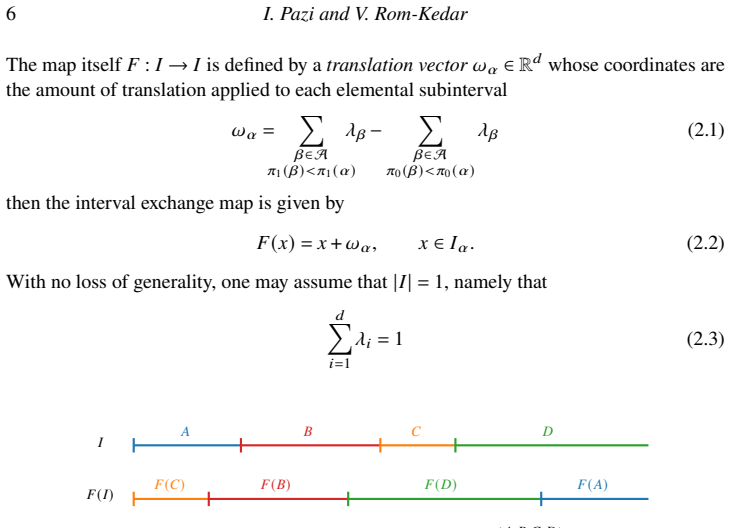
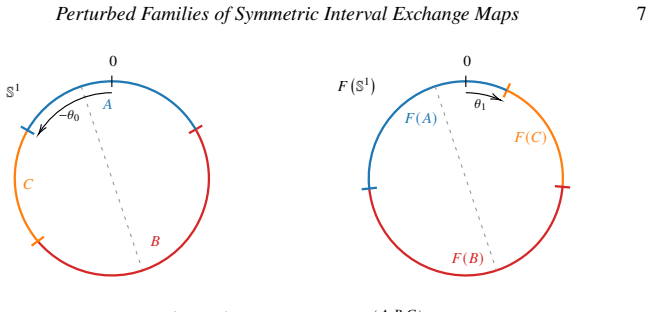
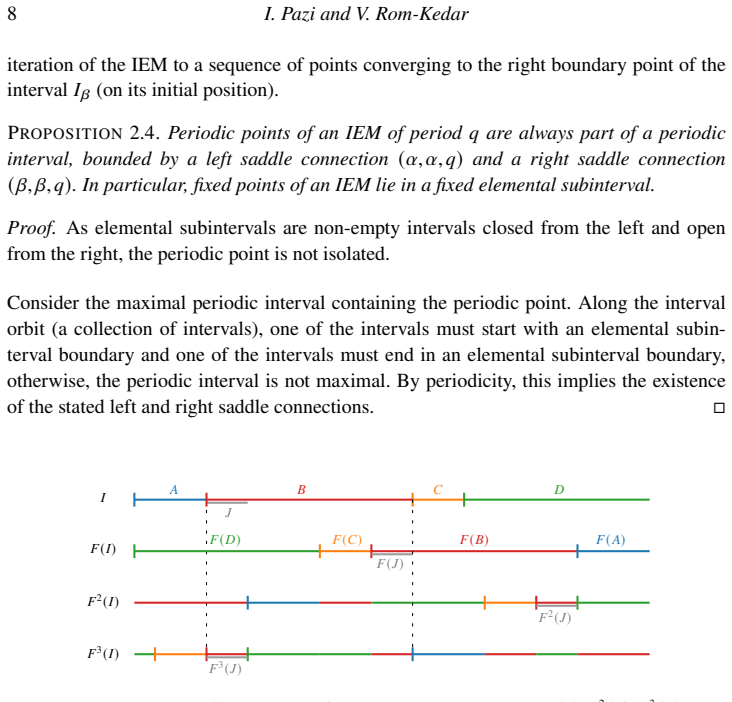
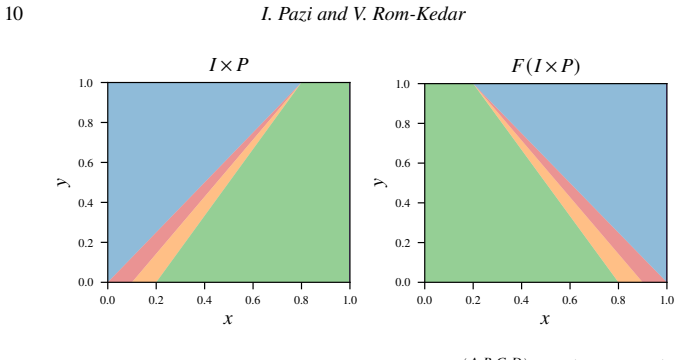
A perturbed family of interval exchange maps (FIEMs) provides a natural two-\linebreak{}dimensional area-preserving extension of interval exchange maps, with each IEM parameterized by an action variable $y$. Such families arise, for example, as models for iso-energy return maps of perturbed pseudointegrable Hamiltonian impact systems. These maps inherit a time-reversal symmetry, motivating the study of symmetric FIEMs. In the unperturbed case, the dynamics are generically uniquely ergodic for almost every value of $y$, while a dense set of action values supports periodic intervals. Exploiting time-reversal symmetry, we characterize these intervals and show that symmetric periodic orbits correspond to their midpoints. Under perturbation, the action variable is no longer conserved and generically periodic intervals break into isolated elliptic or hyperbolic periodic orbits. For sufficiently small perturbations, symmetric periodic orbits persist and can be located by a one-dimensional search along symmetry lines. Associated bifurcations generating symmetric and asymmetric periodic orbits are described and connected to those of the standard map, viewed here as a perturbed family of two-interval exchange maps.
Editorial analysis
A structured set of objections, weighed in public.
Referee Report
Summary. The manuscript introduces perturbed families of interval exchange maps (FIEMs) as two-dimensional area-preserving extensions of classical interval exchange maps, with each IEM parameterized by an action variable y. These arise as iso-energy return maps of perturbed pseudointegrable Hamiltonian impact systems. The maps inherit time-reversal symmetry, which is used to characterize periodic intervals in the unperturbed case (where dynamics are generically uniquely ergodic for almost every y, but a dense set supports periodic intervals) and to show that symmetric periodic orbits correspond to their midpoints. Under small perturbations, periodic intervals break into isolated elliptic or hyperbolic periodic orbits; symmetric orbits persist and can be located by a one-dimensional search along symmetry lines. Bifurcations generating symmetric and asymmetric orbits are described and connected to those of the standard map, interpreted as a perturbed family of two-interval exchange maps.
Significance. If the persistence and bifurcation results hold, the work supplies a symmetry-based framework for analyzing perturbations of interval exchange maps, with direct relevance to area-preserving maps and Hamiltonian systems. The reduction of symmetric-orbit search to symmetry lines via time-reversal symmetry is a concrete technical contribution that enables explicit computation. The explicit link to the standard map supplies a testable family of examples. No free parameters or ad-hoc axioms are introduced; the claims rest on standard reversible-map persistence arguments.
minor comments (3)
- [Abstract] Abstract: the token 'two-\linebreak{}dimensional' is a formatting artifact and should be replaced by 'two-dimensional'.
- [§2 or §3] The manuscript should include a precise definition of the perturbed FIEM family (including the explicit form of the perturbation) early in §2 or §3 so that the inheritance of time-reversal symmetry can be verified directly from the formulas.
- [Section on persistence] A short remark clarifying whether the one-dimensional search along symmetry lines remains valid only for sufficiently small perturbations or holds more generally would improve readability.
Simulated Author's Rebuttal
We thank the referee for the positive and accurate summary of our work on perturbed families of symmetric interval exchange maps, as well as the recommendation for minor revision. No major comments appear in the report.
Circularity Check
No significant circularity
full rationale
The paper's derivation rests on the inheritance of time-reversal symmetry under perturbation, which directly enables the characterization of periodic intervals via midpoints and the reduction of symmetric orbit searches to one-dimensional symmetry lines. Persistence for small perturbations follows from standard fixed-point arguments for reversible maps, with no equations or claims reducing by construction to fitted inputs, self-definitions, or self-citation chains. The standard-map example is introduced as an illustrative case of a perturbed two-interval exchange family rather than a load-bearing premise. The abstract and described claims contain independent mathematical content grounded in symmetry properties without internal circular reductions.
Axiom & Free-Parameter Ledger
Reference graph
Works this paper leans on
-
[1]
Embeddings of interval exchange transformations into planar piecewise isometries
P. Ashwin, A. Goetz, P. Peres, and A. Rodrigues. “Embeddings of interval exchange transformations into planar piecewise isometries”. In:Ergodic Theory and Dynamical Systems40.5 (2020), pp. 1153–1179. DOI: 10.1017/etds.2018.112
-
[2]
Ergodic properties of compositions of interval exchange maps and rotations
J. S. Athreya and M. Boshernitzan. “Ergodic properties of compositions of interval exchange maps and rotations”. In:Nonlinearity26.2 (2013), pp. 417–423
2013
-
[3]
Impact Hamiltonian sys- tems and polygonal billiards
L. Becker, S. Elliott, B. Firester, S. G. Cohen, M. Pnueli, and V. Rom-Kedar. “Impact Hamiltonian sys- tems and polygonal billiards”. In:Hamiltonian Systems: Dynamics, Analysis, Applications. Mathematical Sciences Research Institute Publications. Cambridge University Press, 2024, pp. 29–66.DOI: 10.1017/ 9781009320733
2024
-
[4]
On the ergodicity of anti-symmetric skew products with singularities and its applications
P. Berk, K. Fr ˛ aczek, and F. Trujillo. “On the ergodicity of anti-symmetric skew products with singularities and its applications”. In:Ergodic Theory and Dynamical Systems(2026), pp. 1–63
2026
-
[5]
C. Boldrighini, M. Keane, and F. Marchetti. “Billiards in Polygons”. In:The Annals of Probability6.4 (1978), pp. 532–540.URL: http://www.jstor.org/stable/2243120. 42I. Pazi and V. Rom-Kedar
-
[6]
Rank two interval exchange transformations
M. D. Boshernitzan. “Rank two interval exchange transformations”. In:Ergodic Theory and Dynamical Systems8.3 (1988), pp. 379–394.DOI: 10.1017/S0143385700004521
-
[7]
On the stability of periodic orbits of two-dimensional mappings
T. Bountis and R. H. G. Helleman. “On the stability of periodic orbits of two-dimensional mappings”. In: Journal of Mathematical Physics22.9 (1981), pp. 1867–1877.DOI: 10.1063/1.525159
-
[8]
On Periods of Interval Exchange Transformations
J. S. Cánovas, A. Linero Bas, and G. Soler López. “On Periods of Interval Exchange Transformations”. In:Mathematics10.9 (2022).DOI: 10.3390/math10091487
-
[9]
A generalization of the standard map and its statistical characterization
K. Cetin, U. Tirnakli, and B. M. Boghosian. “A generalization of the standard map and its statistical characterization”. In:Scientific Reports12.1 (2022), p. 8575
2022
-
[10]
Resonances and transport in the sawtooth map
Q. Chen, I. Dana, J. Meiss, N. Murray, and I. Percival. “Resonances and transport in the sawtooth map”. In:Physica D: Nonlinear Phenomena46.2 (1990), pp. 217–240.DOI: 10.1016/0167-2789(90)90037-p
-
[11]
A universal instability of many-dimensional oscillator systems
B. V. Chirikov. “A universal instability of many-dimensional oscillator systems”. In:Physics Reports 52.5 (1979), pp. 263–379.DOI: 10.1016/0370-1573(79)90023-1
-
[12]
Construction of invariant curves for some piecewise isometries
N. Cockram, P. Ashwin, and A. Rodrigues. “Construction of invariant curves for some piecewise isometries”. In:Dynamical Systems(2025), pp. 1–24.DOI: 10.1080/14689367.2025.2514193
-
[13]
On the Structure of Symmetric Periodic Solutions of Conservative Systems, with Applications
R. De Vogelaere. “On the Structure of Symmetric Periodic Solutions of Conservative Systems, with Applications”. In:Contributions to the Theory of Nonlinear Oscillations, Volume IV. Ed. by S. Lefschetz. Vol. 41. United States: Princeton University Press, 1958, pp. 53–84.ISBN: 0691079323
1958
-
[14]
On the existence of periodic invariant curves for analytic families of twist maps and billiards
C. Fierobe and A. Sorrentino. “On the existence of periodic invariant curves for analytic families of twist maps and billiards”. In:Revista Matemática Iberoamericana(Nov. 2025).DOI: 10.4171/rmi/1595.URL: http://dx.doi.org/10.4171/rmi/1595
-
[15]
Deviation of ergodic averages for area-preserving flows on surfaces of higher genus
G. Forni. “Deviation of ergodic averages for area-preserving flows on surfaces of higher genus”. In: Annals of Mathematics155.1 (2002), pp. 1–103.DOI: 10.2307/3062150
-
[16]
Solutions of the cohomological equation for area-preserving flows on compact surfaces of higher genus
G. Forni. “Solutions of the cohomological equation for area-preserving flows on compact surfaces of higher genus”. In:Annals of Mathematics. Second Series 146.2 (1997), pp. 295–344.DOI: 10 . 2307 / 2951840
1997
-
[17]
Non-uniform ergodic properties of Hamiltonian flows with impacts
K. Fr ˛ aczek and V. Rom-Kedar. “Non-uniform ergodic properties of Hamiltonian flows with impacts”. In: Ergodic theory and dynamical systems43.1 (2023), pp. 190–252.DOI: 10.1017/etds.2021.106
-
[18]
Dynamics of piecewise isometries
A. Goetz. “Dynamics of piecewise isometries”. In:Illinois Journal of Mathematics44.3 (2000), pp. 465– 478.DOI: 10.1215/ijm/1256060408
-
[19]
A method for determining a stochastic transition
J. M. Greene. “A method for determining a stochastic transition”. In:Journal of Mathematical Physics 20.6 (1979), pp. 1183–1201.DOI: 10.1063/1.524170
-
[20]
The Calculation of KAM Surfaces
J. M. Greene. “The Calculation of KAM Surfaces”. In:Annals of the New York Academy of Sciences 357.1 (1980), pp. 80–89.DOI: 10.1111/j.1749-6632.1980.tb29678.x
-
[21]
J. Guckenheimer and P. Holmes.Nonlinear Oscillations, Dynamical Systems, and Bifurcations of Vector Fields. Springer New York, 1983.DOI: 10.1007/978-1-4612-1140-2
-
[22]
Transitive circle exchange transfor- mations with flips
C. Gutierrez, S. Lloyd, V. Medvedev, B. Pires, and E. Zhuzhoma. “Transitive circle exchange transfor- mations with flips”. In:Discrete and Continuous Dynamical Systems26.1 (2010), pp. 251–263.DOI: 10.3934/dcds.2010.26.251
-
[23]
K. Inoue and H. Nakada. “A Piecewise Rotation of the Circle, IPR Maps and Their Connection with Translation Surfaces”. In:Ergodic Theory and Dynamical Systems in their Interactions with Arithmetics and Combinatorics. Springer International Publishing, 2018, pp. 393–431.DOI: 10.1007/978- 3- 319- 74908-2_19
-
[24]
Interval exchange transformations
M. Keane. “Interval exchange transformations”. In:Mathematische Zeitschrift141.1 (1975), pp. 25–31. DOI: 10.1007/BF01236981
-
[25]
Lyapunov exponents and Hodge theory
M. Kontsevich and A. Zorich. “Lyapunov exponents and Hodge theory”. In: ed. by C. Itzykson, J. Drouffe, and J. Zuber. Vol. 1. The Mathematical Beauty of Physics: A Memorial Volume for Claude Itzykson. World Scientific, 1997.URL: https://arxiv.org/abs/hep-th/9701164
work page internal anchor Pith review Pith/arXiv arXiv 1997
-
[26]
Time-reversal symmetry in dynamical systems: A survey
J. S. Lamb and J. A. Roberts. “Time-reversal symmetry in dynamical systems: A survey”. In:Physica D: Nonlinear Phenomena112.1 (1998). Proceedings of the Workshop on Time-Reversal Symmetry in Dynamical Systems, pp. 1–39.DOI: 10.1016/S0167-2789(97)00199-1
-
[27]
A. Lichtenberg and M. Lieberman.Regular and chaotic dynamics. 2nd ed. Vol. 38. Applied mathematical sciences. Springer, 1992.DOI: 10.1007/978-1-4757-2184-3
-
[28]
Lichtenberg.Determination of the transition between adiabatic and stochastic motion
A. Lichtenberg.Determination of the transition between adiabatic and stochastic motion. Ecole Polytech- nique., 1979, pp. 13–40
1979
-
[29]
Converse KAM: Theory and practice
R. S. MacKay and I. C. Percival. “Converse KAM: Theory and practice”. In:Communications in Mathematical Physics98.4 (1985), pp. 469–512.DOI: 10.1007/BF01209326. Perturbed Families of Symmetric Interval Exchange Maps43
-
[30]
MacKay.Renormalisation in Area-preserving Maps
R. MacKay.Renormalisation in Area-preserving Maps. Advanced series in nonlinear dynamics. World Scientific, 1993.DOI: 10.1142/2001
-
[31]
Linearization of generalized interval exchange maps
S. Marmi, P. Moussa, and J.-C. Yoccoz. “Linearization of generalized interval exchange maps”. In:Annals of Mathematics176.3 (2012), pp. 1583–1646.DOI: 10.4007/annals.2012.176.3.5
-
[32]
The cohomological equation for interval exchange maps
S. Marmi, P. Moussa, and J.-C. Yoccoz. “The cohomological equation for interval exchange maps”. In: Journal of the American Mathematical Society18.4 (2005), pp. 823–872.DOI: 10.1090/S0894-0347-05- 00490-X
-
[33]
A Short Introduction to Translation Surfaces, Veech Surfaces, and Teichmüller Dynamics
D. Massart. “A Short Introduction to Translation Surfaces, Veech Surfaces, and Teichmüller Dynamics”. In:Surveys in Geometry I. Ed. by A. Papadopoulos. Springer International Publishing, 2022, pp. 343– 388.DOI: 10.1007/978-3-030-86695-2_9
-
[34]
Interval exchange transformations and measured foliations
H. Masur. “Interval exchange transformations and measured foliations”. In:Annals of Mathematics115.1 (1982), pp. 169–200.DOI: 10.2307/1971341
-
[35]
Rational billiards and flat structures
H. Masur and S. Tabachnikov. “Rational billiards and flat structures”. In: ed. by B. Hasselblatt and A. Katok. Vol. 1. Handbook of Dynamical Systems. Elsevier Science, 2002, pp. 1015–1089.DOI: 10.1016/ S1874-575X(02)80015-7
2002
-
[36]
Symplectic maps, variational principles, and transport
J. D. Meiss. “Symplectic maps, variational principles, and transport”. In:Rev. Mod. Phys.64 (3 1992), pp. 795–848.DOI: 10.1103/RevModPhys.64.795
-
[37]
K. Meyer and D. Offin.Introduction to Hamiltonian Dynamical Systems and the N-Body Problem. Springer, 2017.DOI: 10.1007/978-3-319-53691-0
-
[38]
Bifurcation of the period-4 orbits in the standard map
W. Murakami, C. Murakami, and Y. Nomura. “Bifurcation of the period-4 orbits in the standard map”. In:Chaos, Solitons & Fractals12.10 (2001), pp. 1851–1859.DOI: 10.1016/S0960-0779(00)00151-X
-
[39]
Mechanically Inspired Foliation of the 3-Sphere by Higher-Genus Surfaces
I. Pazi, V. Rom-Kedar, and S. Tanny. “Mechanically Inspired Foliation of the 3-Sphere by Higher-Genus Surfaces”. In: (2025). preprint
2025
-
[40]
Hovering Sets in Near Pseudo-Integrable Hamiltonian Impact Systems
I. Pazi, A. Zobova, and V. Rom-Kedar. “Hovering Sets in Near Pseudo-Integrable Hamiltonian Impact Systems”. In: (2025). preprint
2025
-
[41]
On the symmetry lines of the standard mapping
E. Piña and L. J. Lara. “On the symmetry lines of the standard mapping”. In:Physica D: Nonlinear Phenomena26.1 (1987), pp. 369–378.DOI: 10.1016/0167-2789(87)90236-3
-
[42]
Poincaré.Les méthodes nouvelles de la mécanique céleste
H. Poincaré.Les méthodes nouvelles de la mécanique céleste. Vol. 1. Gauthier-Villars, 1892
-
[43]
Pseudointegrable systems in classical and quantum mechanics
P. Richens and M. Berry. “Pseudointegrable systems in classical and quantum mechanics”. In:Physica D: Nonlinear Phenomena2.3 (1981), pp. 495–512.DOI: 10.1016/0167-2789(81)90024-5
-
[44]
Dynamics of some piecewise smooth Fermi-Ulam models
J. de Simoi and D. Dolgopyat. “Dynamics of some piecewise smooth Fermi-Ulam models”. In:Chaos: An Interdisciplinary Journal of Nonlinear Science22.2 (2012).DOI: 10.1063/1.3695379
-
[45]
W. A. Strauss.Partial differential equations: An introduction. John Wiley & Sons, 2007
2007
-
[46]
Non-Symmetric Periodic Points in Reversible Maps: Examples from the Standard Map
K. Tanikawa and Y. Yamaguchi. “Non-Symmetric Periodic Points in Reversible Maps: Examples from the Standard Map”. In:Progress of Theoretical Physics108.6 (2002), pp. 987–997.DOI: 10.1143/PTP. 108.987
work page doi:10.1143/ptp 2002
-
[47]
Gauss measures for transformations on the space of interval exchange maps
W. A. Veech. “Gauss measures for transformations on the space of interval exchange maps”. In:Annals of Mathematics115.2 (1982), pp. 201–242.DOI: 10.2307/1971391
-
[48]
Ergodic theory of interval exchange maps
M. Viana. “Ergodic theory of interval exchange maps”. In:Revista Matemática Complutense19.1 (2006), pp. 7–100
2006
-
[49]
Continued Fraction Algorithms for Interval Exchange Maps: an Introduction
J.-C. Yoccoz. “Continued Fraction Algorithms for Interval Exchange Maps: an Introduction”. In:Fron- tiers in Number Theory, Physics, and Geometry I. Springer, 2006, pp. 401–435.ISBN: 9783540231899
2006
-
[50]
Deviation for interval exchange transformations
A. Zorich. “Deviation for interval exchange transformations”. In:Ergodic Theory and Dynamical Systems 17.6 (1997), pp. 1477–1499
1997
-
[51]
Flat Surfaces
A. Zorich. “Flat Surfaces”. In:Frontiers in Number Theory, Physics, and Geometry I. Springer, 2006, pp. 437–583.ISBN: 9783540231899
2006
discussion (0)
Sign in with ORCID, Apple, or X to comment. Anyone can read and Pith papers without signing in.