Efficient Algorithms for Interdicting Facilities in Trees and Bounded Treewidth Graphs
Pith reviewed 2026-06-29 09:55 UTC · model grok-4.3
The pith
An O(n r^2) dynamic programming algorithm solves the r-edge interdiction covering problem on trees.
A machine-rendered reading of the paper's core claim, the machinery that carries it, and where it could break.
Core claim
REIC on trees can be solved by a bottom-up dynamic program that, for each subtree, records the best covering value obtainable for every possible number of interdictions used and every possible status of the subtree root with respect to the nearest remaining facility. The same table-filling approach extends without change to bounded-treewidth graphs and to the facility-removal variant RFIC on trees.
What carries the argument
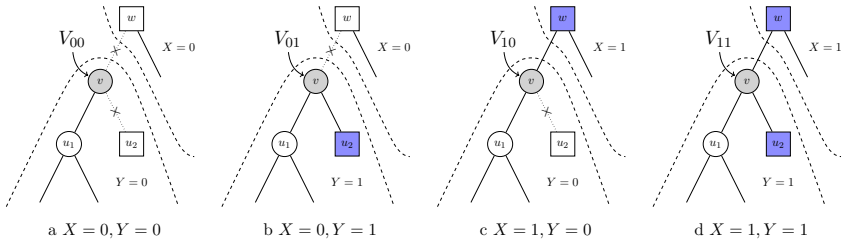
A dynamic programming table indexed by subtree, number of interdictions used, and connection status of the subtree root to the nearest surviving facility.
If this is right
- REIC is solvable in time linear in n for any fixed r on trees.
- The same linear dependence on n holds for every graph whose treewidth is bounded by a constant.
- RFIC on trees is solvable in O(n r^2) time even though the problem is NP-complete on general graphs.
- SSBVE on trees is solvable in O(n^3) time via the RFIC reduction.
Where Pith is reading between the lines
- The same table structure may be reusable for other interdiction objectives that depend on disconnection from a designated set of terminals.
- Because the algorithm is fixed-parameter linear in n, it becomes practical for very large trees once r is modest.
- The O(n^3) bound for SSBVE on trees suggests that similar expansion problems may admit efficient tree algorithms even when they remain hard on general graphs.
Load-bearing premise
The input graph must be a tree or have bounded treewidth so that the dynamic-programming recurrence can be evaluated in the stated time.
What would settle it
A tree on which the dynamic program returns a strictly suboptimal covering value for some choice of r, or a sequence of trees whose measured running times grow faster than linear in n for fixed r.
Figures
read the original abstract
Given a graph $G$ of $n$ nodes partitioned into facilities and customers, the $r$-edge interdiction covering problem (REIC) is to remove up to $r$ edges so as to maximize the total weight of customers disconnected from all facilities, which is called the covering objective function. While REIC is known to be NP-complete for general graphs, Fr\"ohlich and Ruzika show that the problem can be solved in polynomial time when $G$ is a tree, providing an $O(n^7 r)$-time algorithm. We give an efficient $O(nr^2)$-time dynamic programming algorithm for REIC on trees that is fixed-parameter linear in $n$. Evaluating our solution on a benchmark of randomly generated tree networks with baselines of the Fr\"ohlich and Ruzika algorithm and the Gurobi integer program solver, we demonstrate that in practice, our algorithm is both significantly faster and less sensitive to network topology and size. We extend our algorithm for REIC to graphs of bounded treewidth, a well-studied family of sparse graphs that generalizes trees, and obtain a matching runtime of $O(nr^2)$. We also consider the $r$-facility interdiction covering problem (RFIC), a novel variant of this network interdiction problem where the goal is to remove up to $r$ facilities to maximize the covering objective function over disconnected customers. We show that RFIC is NP-complete by observing it generalizes the small set bipartite vertex expansion problem (SSBVE), also known as the minimum $p$-union problem. We give an $O(nr^2)$-time algorithm for RFIC on trees, which also gives an $O(n^3)$-time algorithm for SSBVE on trees.
Editorial analysis
A structured set of objections, weighed in public.
Referee Report
Summary. The paper presents an O(nr^2)-time dynamic programming algorithm for the r-edge interdiction covering problem (REIC) on trees, improving the prior O(n^7 r) bound by Fröhlich and Ruzika, and shows it is fixed-parameter linear in n. The approach extends to bounded-treewidth graphs with the same runtime. For the r-facility interdiction covering problem (RFIC), the paper proves NP-completeness via generalization of the small set bipartite vertex expansion problem (SSBVE) and gives an O(nr^2)-time algorithm on trees (implying O(n^3) for SSBVE on trees). Experiments on random tree networks compare against the prior algorithm and Gurobi.
Significance. If the runtime claims hold, the reduction from O(n^7 r) to O(nr^2) with linear dependence on n constitutes a substantial algorithmic advance for interdiction problems on trees and bounded-treewidth graphs. The FPT-linear property and the extension to bounded treewidth are strengths. The NP-completeness result for RFIC together with the SSBVE connection and the O(n^3) tree algorithm are useful. The experimental comparison adds evidence of practical utility.
minor comments (1)
- [Abstract] Abstract: the statement that experiments demonstrate the algorithm is 'significantly faster and less sensitive' is made without any quantitative results, benchmark sizes, or specific metrics; adding one or two key numbers would improve the summary.
Simulated Author's Rebuttal
We thank the referee for the positive summary, significance assessment, and recommendation of minor revision. No major comments appear in the report.
Circularity Check
No significant circularity
full rationale
The paper's core contribution is the design of a new O(nr^2)-time dynamic programming algorithm for REIC (and RFIC) on trees, obtained by a direct recurrence construction that improves the prior O(n^7 r) bound of Fröhlich and Ruzika. No equations reduce to fitted parameters, no predictions are statistically forced by inputs, and the NP-completeness claim for RFIC is established by an explicit reduction to the known SSBVE problem rather than by self-citation. The bounded-treewidth extension follows the standard Courcelle-style DP template with the same runtime once treewidth is constant. All load-bearing steps are algorithmic constructions whose correctness is argued directly from the recurrence definitions; no self-citation chain or ansatz smuggling is required for the claimed runtime or correctness.
Axiom & Free-Parameter Ledger
axioms (1)
- standard math Dynamic programming on trees yields correct optimal solutions when the recurrence covers all subtrees and boundary conditions.
Reference graph
Works this paper leans on
-
[1]
Stefan Arnborg, Jens Lagergren, and Detlef Seese. Easy problems for tree-decomposable graphs.Journal of Algorithms, 12(2):308–340, 1991.doi:10.1016/0196-6774(91)90006-K
-
[2]
The complexity of finding most vital arcs and nodes
Amotz Bar-Noy, Samir Khuller, and Baruch Schieber. The complexity of finding most vital arcs and nodes. Technical report, University of Maryland at College Park, 1995
1995
-
[3]
Complexity of determining the most vital elements for the 1-median and 1-center location problems
Cristina Bazgan, Sonia Toubaline, and Daniel Vanderpooten. Complexity of determining the most vital elements for the 1-median and 1-center location problems. InProceedings of the 4th International Conference on Combinatorial Optimization and Applications - Volume Part I, COCOA’10, page 237–251, Berlin, Heidelberg, 2010. Springer-Verlag
2010
-
[4]
Cristina Bazgan, Sonia Toubaline, and Daniel Vanderpooten. Efficient determination of thek most vital edges for the minimum spanning tree problem.Computers & Operations Research, 39(11):2888–2898, 2012.doi:10.1016/j.cor.2012.02.023
-
[5]
Polynomial integrality gaps for strong SDP relaxations of densestk-subgraph
Aditya Bhaskara, Moses Charikar, Venkatesan Guruswami, Aravindan Vijayaraghavan, and Yuan Zhou. Polynomial integrality gaps for strong SDP relaxations of densestk-subgraph. InProceedings of the 2012 Annual ACM-SIAM Symposium on Discrete Algorithms (SODA), pages 388–405, 2012.doi:10.1137/1.9781611973099.34
-
[6]
A linear time algorithm for finding tree-decompositions of small treewidth
Hans L Bodlaender. A linear time algorithm for finding tree-decompositions of small treewidth. InProceedings of the twenty-fifth annual ACM symposium on Theory of computing, pages 226– 234, 1993
1993
-
[7]
Bonuccelli, Francesca Martelli, and Susanna Pelagatti
Maurizio A. Bonuccelli, Francesca Martelli, and Susanna Pelagatti. Optimal packet scheduling in tree-structured LEO satellite clusters.Mob. Networks Appl., 9(4):289–295, 2004.doi: 10.1023/B:MONE.0000031588.69327.34
-
[8]
Springer, 2003.doi:10.1007/0-306-48109-X_3
Carl Burch, Robert Carr, Sven Krumke, Madhav Marathe, Cynthia Phillips, and Eric Sund- berg.A Decomposition-Based Pseudoapproximation Algorithm for Network Flow Inhibition, chapter 3, pages 51–68. Springer, 2003.doi:10.1007/0-306-48109-X_3
-
[9]
Benjamin A. Burton and Rodney G. Downey. Courcelle’s theorem for triangulations.Journal of Combinatorial Theory, Series A, 146:264–294, 2017.doi:10.1016/j.jcta.2016.10.001
-
[10]
Chaudhry and Halim Yanikomeroglu
Aizaz U. Chaudhry and Halim Yanikomeroglu. Laser intersatellite links in a Starlink con- stellation: A classification and analysis.IEEE Veh. Technol. Mag., 16(2):48–56, 2021. doi:10.1109/MVT.2021.3063706
-
[11]
Stephen R. Chestnut and Rico Zenklusen. Hardness and approximation for network flow interdiction.Networks, 69(4):378–387, 2017.doi:10.1002/net.21739
-
[12]
Eden Chlamt´ aˇ c, Michael Dinitz, Christian Konrad, Guy Kortsarz, and George Rabanca. The densestk-subhypergraph problem.SIAM Journal on Discrete Mathematics, 32(2):1458–1477, 2018.doi:10.1137/16M1096402
-
[13]
Minimizing the union: Tight ap- proximations for small set bipartite vertex expansion
Eden Chlamt´ aˇ c, Michael Dinitz, and Yury Makarychev. Minimizing the union: Tight ap- proximations for small set bipartite vertex expansion. InProceedings of the 2017 An- nual ACM-SIAM Symposium on Discrete Algorithms (SODA), pages 881–899, 2017.doi: 10.1137/1.9781611974782.56. 22
-
[14]
The maximal covering location problem
Richard Church and Charles ReVelle. The maximal covering location problem. InPapers of the regional science association, volume 32, pages 101–118. Springer-Verlag Berlin/Heidelberg, 1974
1974
-
[15]
Richard L. Church, Maria P. Scaparra, and Richard S. Middleton. Identifying critical infras- tructure: The median and covering facility interdiction problems.Annals of the Association of American Geographers, 94(3):491–502, 2004.doi:10.1111/j.1467-8306.2004.00410.x
-
[16]
Herbert W. Corley and David Y. Sha. Most vital links and nodes in weighted networks.Oper. Res. Lett., 1(4):157–160, 1982.doi:10.1016/0167-6377(82)90020-7
-
[17]
The Monadic Second-Order Logic of Graphs
Bruno Courcelle. The Monadic Second-Order Logic of Graphs. I. Recognizable Sets of Finite Graphs.Information and Computation, 85(1):12–75, 1990.doi:10.1016/0890-5401(90) 90043-H
-
[18]
Linear time solvable optimization problems on graphs of bounded clique-width.Theory of Computing Systems, 33(2):125–150, 2000
Bruno Courcelle, Johann A Makowsky, and Udi Rotics. Linear time solvable optimization problems on graphs of bounded clique-width.Theory of Computing Systems, 33(2):125–150, 2000
2000
-
[19]
Fomin, Lukasz Kowalik, Daniel Lokshtanov, D´ aniel Marx, Marcin Pilipczuk, Micha l Pilipczuk, and Saket Saurabh.Parameterized Algorithms
Marek Cygan, F. Fomin, Lukasz Kowalik, Daniel Lokshtanov, D´ aniel Marx, Marcin Pilipczuk, Micha l Pilipczuk, and Saket Saurabh.Parameterized Algorithms. Springer, 2015
2015
-
[20]
Eylem Ekici, Ian F. Akyildiz, and Michael D. Bender. A multicast routing algorithm for LEO satellite IP networks.IEEE/ACM Trans. Netw., 10(2):183–192, 2002.doi:10.1109/90. 993300
work page doi:10.1109/90 2002
-
[21]
Application of Kuiper Systems LLC for Authority to Launch and Operate a Non-Geostationary Satellite Orbit System in Ka-band Frequencies
Federal Communications Commission. Application of Kuiper Systems LLC for Authority to Launch and Operate a Non-Geostationary Satellite Orbit System in Ka-band Frequencies. FCC Report, 2019. URL:https://fcc.report/IBFS/SAT-LOA-20190704-00057/1773885.pdf
2019
-
[22]
SPACEX NON-GEOSTATIONARY SATELLITE SYS- TEM
Federal Communications Commission. SPACEX NON-GEOSTATIONARY SATELLITE SYS- TEM. FCC Report, 2020. URL:https://fcc.report/IBFS/SAT-MOD-20200417-00037/ 2274316.pdf
2020
-
[23]
Improved approximation al- gorithms for minimum-weight vertex separators
Uriel Feige, MohammadTaghi Hajiaghayi, and James R Lee. Improved approximation al- gorithms for minimum-weight vertex separators. InProceedings of the thirty-seventh annual ACM symposium on Theory of computing, pages 563–572, 2005
2005
-
[24]
L. R. Ford and D. R. Fulkerson. Maximal flow through a network.Canadian Journal of Mathematics, 8:399–404, 1956.doi:10.4153/CJM-1956-045-5
-
[25]
Frederickson and Roberto Solis-Oba
Greg N. Frederickson and Roberto Solis-Oba. Increasing the weight of minimum spanning trees.J. Algorithms, 33(2):244–266, 1999.doi:10.1006/JAGM.1999.1026
-
[26]
On the hardness of covering-interdiction problems.Theor
Nicolas Fr¨ ohlich and Stefan Ruzika. On the hardness of covering-interdiction problems.Theor. Comput. Sci., 871:1–15, 2021.doi:10.1016/J.TCS.2021.04.007
-
[27]
Interdicting facilities in tree networks.Top, 30(1):95–118, 2022.doi:10.1007/s11750-021-00600-6
Nicolas Fr¨ ohlich and Stefan Ruzika. Interdicting facilities in tree networks.Top, 30(1):95–118, 2022.doi:10.1007/s11750-021-00600-6
-
[28]
Delbert Ray Fulkerson and Gary C. Harding. Maximizing the minimum source-sink path sub- ject to a budget constraint.Math. Program., 13(1):116–118, 1977.doi:10.1007/BF01584329. 23
-
[29]
An implicit enumeration algorithm for the hub interdiction median problem with fortification.Eur
Nader Ghaffari-Nasab and Reza Atayi. An implicit enumeration algorithm for the hub interdiction median problem with fortification.Eur. J. Oper. Res., 267(1):23–39, 2018. doi:10.1016/J.EJOR.2017.11.035
-
[30]
Reference Manual, 2025
Gurobi. Reference Manual, 2025. URL:https://www.gurobi.com
2025
-
[31]
Exploring network structure, dynamics, and function using networkx
Aric Hagberg, Pieter J Swart, and Daniel A Schult. Exploring network structure, dynamics, and function using networkx. Technical report, Los Alamos National Laboratory (LANL), Los Alamos, NM (United States), 2008
2008
-
[32]
S. L. Hakimi. Optimum locations of switching centers and the absolute centers and medians of a graph.Operations Research, 12(3):450–459, 1964.doi:10.1287/opre.12.3.450
-
[33]
Traffic engineer- ing for software-defined LEO constellations.IEEE Trans
Menglan Hu, Mai Xiao, Wenbo Xu, Tianping Deng, Yan Dong, and Kai Peng. Traffic engineer- ing for software-defined LEO constellations.IEEE Trans. Netw. Serv. Manag., 19(4):5090– 5103, 2022.doi:10.1109/TNSM.2022.3186716
-
[34]
Eitan Israeli and R. Kevin Wood. Shortest-path network interdiction.Networks, 40(2):97–111, 2002.doi:10.1002/NET.10039
-
[35]
Kellerer, U
H. Kellerer, U. Pferschy, and D. Pisinger.Knapsack Problems. Springer, 2004
2004
-
[36]
Treewidth, computations and approximations
Ton Kloks. Treewidth, computations and approximations. InLecture Notes in Computer Science, 1994
1994
-
[37]
Joachim Kneis and Alexander Langer. A practical approach to Courcelle’s theorem.Electronic Notes in Theoretical Computer Science, 251:65–81, 2009. Proceedings of the International Doc- toral Workshop on Mathematical and Engineering Methods in Computer Science (MEMICS 2008).doi:10.1016/j.entcs.2009.08.028
-
[38]
Joachim Kneis, Alexander Langer, and Peter Rossmanith. Courcelle’s theorem – a game- theoretic approach.Discrete Optimization, 8:568–594, 11 2011.doi:10.1016/j.disopt. 2011.06.001
-
[39]
Weifa Liang and Xiaojun Shen. Finding thekmost vital edges in the minimum spanning tree problem.Parallel Comput., 23(13):1889–1907, 1997.doi:10.1016/S0167-8191(97)00098-7
-
[40]
Almost-polynomial ratio ETH-hardness of approximating densestk- subgraph
Pasin Manurangsi. Almost-polynomial ratio ETH-hardness of approximating densestk- subgraph. InProceedings of the 49th Annual ACM SIGACT Symposium on Theory of Com- puting, STOC 2017, page 954–961, New York, NY, USA, 2017. Association for Computing Machinery.doi:10.1145/3055399.3055412
-
[41]
InProceedings of the 1st ACM Workshop on LEO Networking and Communication, pages 37–42, 2023
Joseph Mclaughlin, Jee Choi, and Ramakrishnan Durairajan.×grid: A location-oriented topology design for leo satellites. InProceedings of the 1st ACM Workshop on LEO Networking and Communication, pages 37–42, 2023
2023
-
[42]
Cynthia A. Phillips. The network inhibition problem. InProceedings of ACM Symposium on Theory of Computing (STOC), pages 776–785. ACM, 1993.doi:10.1145/167088.167286
-
[43]
Prasanna Ramamoorthy, Sachin Jayaswal, Ankur Sinha, and Navneet Vidyarthi. Multiple allo- cation hub interdiction and protection problems: Model formulations and solution approaches. Eur. J. Oper. Res., 270(1):230–245, 2018.doi:10.1016/J.EJOR.2018.03.031. 24
-
[44]
Neil Robertson and P.D Seymour. Graph minors. II. Algorithmic aspects of tree-width.Journal of Algorithms, 7(3):309–322, 1986.doi:10.1016/0196-6774(86)90023-4
-
[45]
Snyder, Z¨ umb¨ ul Atan, Peng Peng, Ying Rong, Amanda J
Lawrence V. Snyder, Z¨ umb¨ ul Atan, Peng Peng, Ying Rong, Amanda J. Schmitt, and Burcu Sinsoysal. OR/MS models for supply chain disruptions: A review.IIE Transactions, 48(2):89– 109, 2016.doi:10.1080/0740817X.2015.1067735
-
[46]
Continuous whole-earth coverage by circular-orbit satellite patterns
John G Walker. Continuous whole-earth coverage by circular-orbit satellite patterns. Technical report, 1977
1977
-
[47]
Li, M., Lin, S.-C., Oguz, B., Ghoshal, A., Lin, J., Mehdad, Y ., Yih, W.-t., and Chen, X
Yikun Wang, Hewu Li, Zeqi Lai, and Jihao Li. Starmaze: Ring-based attack in satellite internet constellations. InProceedings of IEEE/ACM IWQoS, pages 1–10. IEEE, 2024.doi: 10.1109/IWQOS61813.2024.10682867
-
[48]
Removing arcs from a network.Operations Research, 12(6):934–940, 1964
Richard Wollmer. Removing arcs from a network.Operations Research, 12(6):934–940, 1964. doi:10.1287/opre.12.6.934
-
[49]
Robustness of satellite constellation networks.Comput
Xin Xu, Zhixiang Gao, and Aijun Liu. Robustness of satellite constellation networks.Comput. Commun., 210:130–137, 2023.doi:10.1016/J.COMCOM.2023.07.036
-
[50]
Rico Zenklusen. Matching interdiction.Discret. Appl. Math., 158(15):1676–1690, 2010.doi: 10.1016/J.DAM.2010.06.006. A Constrained Multiple-Choice Knapsack Problem In this section, we describe the constrained multiple-choice knapsack problem (CMCKP) and give anO(N C 2)-time dynamic programming algorithm based on the algorithm for MCKP [35, Section 11.5]. I...
discussion (0)
Sign in with ORCID, Apple, or X to comment. Anyone can read and Pith papers without signing in.