Identifying Direct Causal Effects in Latent Factor Models by Accounting for Unidentified Parents
Pith reviewed 2026-06-29 11:09 UTC · model grok-4.3
The pith
A new identification criterion identifies more direct causal effects in latent factor models by explicitly tracking parents whose effects remain unidentified.
A machine-rendered reading of the paper's core claim, the machinery that carries it, and where it could break.
Core claim
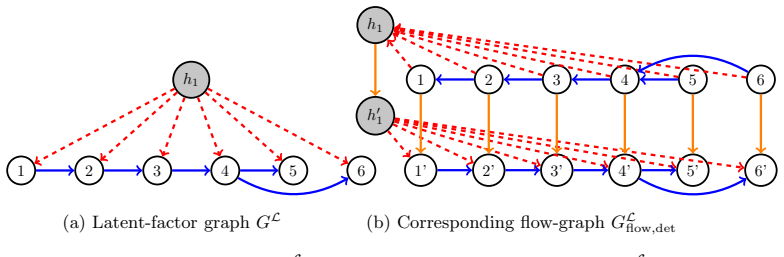
The paper claims that a new identification criterion, which generalizes recursive identification schemes by explicitly accounting for causal parents with yet-unidentified direct effects, enables certification of more direct effects in densely confounded latent factor models via network-flow computations.
What carries the argument
The generalized recursive identification criterion that tracks unidentified parents and reduces combinatorial search to network-flow computations.
If this is right
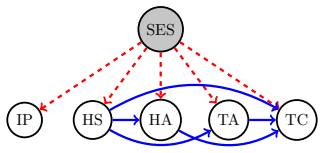
- Direct effects can be identified in graphs where latent-projection methods fail due to dense confounding by only a few latents.
- Rational formulas for the identified effects can be obtained from observed covariances.
- Combinatorial identification problems become solvable in practice through network-flow algorithms.
- The method yields a software tool that applies to denser causal graphs than prior explicit-latent algorithms.
Where Pith is reading between the lines
- The same accounting for unidentified parents might be useful in other identification frameworks if a suitable ordering can be defined.
- Explicit inclusion of latents appears preferable to projection when the number of latents is small but their connections are dense.
- The network-flow reduction suggests similar efficiency gains could be sought in related causal search problems.
Load-bearing premise
The linear SEM with explicit latents admits a recursive identification ordering once unidentified parents are explicitly tracked.
What would settle it
A concrete linear SEM with latents and observed covariances in which the criterion certifies an effect as identified but algebraic computation shows the effect is not a function of the covariances, or a graph where the criterion misses an effect that is known to be identifiable.
Figures




read the original abstract
We consider linear structural equation models with explicitly modelled latent variables. In such models, observed and latent variables solve linear equations including stochastic noise terms. The goal of our work is to identify the direct causal effects between the observed variables of interest by providing (rational) formulas in the observed covariances. Most prior identification approaches operate in the latent projection framework, where latent variables are projected away into dependent error terms. However, when the observed variables are densely confounded, even if only by a few latent variables, the projection-based approaches are unable to certify identifiability of most effects. For such problems, approaches that explicitly use the latent variables are more effective, but algorithms that were recently proposed for this purpose often remain inconclusive for denser causal graphs. We develop a new identification criterion that is able to better handle dense graphs by leveraging the key insight that recursive identification schemes can be generalized by explicitly accounting for causal parents with (yet) unidentified direct effects. Combinatorial search problems in our new criterion can be tackled with the help of network-flow computations, leading to a practical useful algorithmic tool that we also make available in software.
Editorial analysis
A structured set of objections, weighed in public.
Referee Report
Summary. The paper develops a new identification criterion for direct causal effects among observed variables in linear SEMs with explicit latent variables. It generalizes recursive identification by explicitly tracking causal parents whose direct effects remain unidentified, allowing certification of more effects in densely confounded graphs than latent-projection or prior explicit-latent methods. Combinatorial search is reduced to network-flow computations, yielding an algorithmic procedure and accompanying software that outputs rational formulas in the observed covariances.
Significance. If the central claims hold, the work meaningfully extends the scope of identifiable direct effects in latent-factor models, particularly for dense confounding structures where projection-based criteria are inconclusive. The reduction of the search problem to network flows and the public software implementation are concrete strengths that support practical use and reproducibility.
major comments (2)
- [§4, Definition 3 and Theorem 2] §4, Definition 3 and Theorem 2: The identification criterion presupposes that a recursive ordering exists once unidentified parents are explicitly tracked, yet no graphical or algebraic conditions are stated that guarantee the existence of such an ordering or establish completeness relative to the latent-projection framework (cf. the skeptic note on recursive ordering). Without these, it is unclear whether the reported gains on dense graphs recover all identifiable effects or only a subset found by the network-flow heuristic.
- [§5.2, Algorithm 1] §5.2, Algorithm 1 and the accompanying simulation study: The empirical comparison with prior explicit-latent methods reports higher identification rates, but the study does not include a completeness check against the full set of effects identifiable via the latent projection (e.g., via the IDA or other projection-based oracles on the same graphs). This leaves open whether the new criterion is strictly stronger or merely a different search procedure.
minor comments (2)
- Notation for the set of unidentified parents is introduced without an explicit running example that shows how the set evolves across identification steps; adding one would improve readability.
- The software repository link is given but the manuscript does not state the exact version or commit hash used for the reported experiments.
Simulated Author's Rebuttal
We thank the referee for the constructive comments, which help clarify the scope of our contribution. We respond to each major comment below and indicate planned revisions.
read point-by-point responses
-
Referee: [§4, Definition 3 and Theorem 2] §4, Definition 3 and Theorem 2: The identification criterion presupposes that a recursive ordering exists once unidentified parents are explicitly tracked, yet no graphical or algebraic conditions are stated that guarantee the existence of such an ordering or establish completeness relative to the latent-projection framework (cf. the skeptic note on recursive ordering). Without these, it is unclear whether the reported gains on dense graphs recover all identifiable effects or only a subset found by the network-flow heuristic.
Authors: Our criterion generalizes recursive identification by tracking unidentified parents to certify direct effects in denser graphs. The network-flow procedure searches over possible orderings and parent sets rather than assuming a fixed ordering exists a priori; when a valid flow is found, the corresponding rational formula is valid by construction of the recursive scheme. We do not claim or prove completeness relative to the latent-projection framework, as a full characterization of all identifiable effects remains open even for simpler models. The reported gains are therefore with respect to prior explicit-latent methods, not a claim of recovering every effect identifiable by projection. We will add a clarifying paragraph in Section 4 stating that the method is sound for the effects it identifies but is not asserted to be complete. revision: partial
-
Referee: [§5.2, Algorithm 1] §5.2, Algorithm 1 and the accompanying simulation study: The empirical comparison with prior explicit-latent methods reports higher identification rates, but the study does not include a completeness check against the full set of effects identifiable via the latent projection (e.g., via the IDA or other projection-based oracles on the same graphs). This leaves open whether the new criterion is strictly stronger or merely a different search procedure.
Authors: The simulation graphs were chosen precisely because they are densely confounded, a regime in which latent-projection methods (including IDA) are known to certify very few direct effects. On those instances a projection oracle would therefore return near-zero identifications, rendering the comparison uninformative for the paper's target setting. Nevertheless, to address the concern we will augment the simulation section with an additional experiment on sparser graphs where projection succeeds, verifying that our procedure recovers at least the effects found by the projection oracle while also identifying additional effects. This will make explicit that the new criterion is at least as strong as projection methods on graphs where the latter apply. revision: yes
Circularity Check
No significant circularity; identification criterion derivation is self-contained.
full rationale
The paper introduces a novel identification criterion for linear SEMs with explicit latents by generalizing recursive schemes to track unidentified parents and reducing combinatorial search to network-flow problems. No quoted equations, definitions, or algorithmic steps reduce the claimed formulas or identifiability results to fitted quantities, self-referential definitions, or load-bearing self-citations whose validity depends on the present work. The approach explicitly contrasts with latent-projection methods and prior algorithms without invoking uniqueness theorems or ansatzes from overlapping author citations as the sole justification. The central claim therefore rests on independent graphical and algebraic reasoning rather than constructional equivalence to its inputs.
Axiom & Free-Parameter Ledger
axioms (1)
- domain assumption The data-generating process is a linear structural equation model with explicitly modelled latent variables and stochastic noise terms.
Reference graph
Works this paper leans on
-
[1]
45 |DV|Total Rationally Det Det + rec LF-HTC LF-HTC + rec Det + LF-HTC 0 1 1 1 1 1 1 1 1 8 6 6 6 6 6 6 2 63 45 43 45 43 43 45 3 391 255 238 255 236 236 255 4 1983 1171 882 1164 1018 1018 1163 5 7570 3898 1789 3742 3028 3028 3691 6 21,029 8960 1882 7704 5861 5861 7783 |DV|Total Rationally Det + LF-HTC + rec eLF-HTC eLF-HTC + rec Det + eLF-HTC Det + eLF-HTC...
1983
-
[2]
Using time structure to estimate causal effects.arXiv preprint arXiv:2504.11076,
Tom Hochsprung, Jakob Runge, and Andreas Gerhardus. Using time structure to estimate causal effects.arXiv preprint arXiv:2504.11076,
-
[3]
Identification of conditional interventional distributions
Ilya Shpitser and Judea Pearl. Identification of conditional interventional distributions. InPro- ceedings of the Twenty-Second Conference on Uncertainty in Artificial Intelligence (UAI), pages 437–444, Arlington, VA, USA, 2006a. AUAI Press. Ilya Shpitser and Judea Pearl. Identification of joint interventional distributions in recursive semi- Markovian ca...
2018
-
[4]
Nils Sturma and Mathias Drton. Trek-based parameter identification for linear causal models with arbitrarily structured latent variables.arXiv preprint arXiv:2507.18170,
discussion (0)
Sign in with ORCID, Apple, or X to comment. Anyone can read and Pith papers without signing in.