REVIEW 2 major objections 1 minor 26 references
Data-efficient semi-supervised learning for flow estimation using unlabelled probe data
T0 review · 2 major / 1 minor · reviewed 2026-06-29 · grok-4.3
Pith's one-line read Incorporating unlabelled probe data improves PIV velocity reconstruction accuracy and enables better pressure estimates from the Navier-Stokes equations.
desk verdict The paper gives a workable semi-supervised route to fold unlabelled probe data into PIV reconstructions via advection time-marching and dual POD networks, with gains shown on both synthetic and experimental cases, though the advection enrichment step remains a potential weak point for turbulent flows. read the letter →
The pith
A machine-rendered reading of the paper's core claim, the machinery that carries it, and where it could break.
The reading
What carries the argument
Semi-supervised training of two neural networks on POD temporal coefficients and derivatives, using unlabelled probe data to enforce temporal consistency after advection-based dataset enrichment.
What would settle it
Observing no improvement or worse performance in velocity and pressure accuracy when the method is applied to a new flow case where the advection assumption does not hold.
Extended reading notes
Core claim
The authors claim that a framework enriching snapshot PIV datasets via advection time-marching and exploiting unlabelled probe data in a semi-supervised manner, through two neural networks for POD temporal coefficients and derivatives plus least-squares regularization, significantly improves the accuracy and temporal smoothness of velocity reconstruction and leads to more reliable pressure estimation via the Navier-Stokes equations.
Load-bearing premise
Time-marching a simple advection model sufficiently enriches the PIV training dataset to allow the semi-supervised strategy to extract useful temporal consistency from the unlabelled probe samples.
Editorial extensions
If this is right
- Velocity reconstructions become more accurate and temporally smoother.
- Pressure fields derived from Navier-Stokes are more reliable.
- The method applies to both synthetic channel flow and experimental airfoil wake without extra experimental cost.
- Coverage of flow scenarios expands beyond those in the original PIV snapshots.
Reading between the lines
- This approach could allow lower temporal resolution PIV systems to achieve high-fidelity time-resolved results when paired with probes.
- The reliance on advection models suggests testing on flows with stronger diffusion or other physics might reveal limits.
- Integration with other reduced-order modeling techniques beyond POD could be explored.
Editorial analysis
A structured set of objections, weighed in public.
Referee Report
Summary. The paper claims that enriching snapshot PIV training data via time-marching a simple advection model, combined with a semi-supervised strategy that trains two neural networks on POD temporal coefficients and their derivatives while exploiting unlabelled probe samples for temporal consistency, yields more accurate and temporally smooth velocity reconstructions. This in turn produces more reliable pressure fields from the Navier-Stokes equations. The approach is validated on synthetic turbulent channel flow and experimental airfoil wake data, with the central assertion that unlabelled probe data can be leveraged without increasing experimental cost.
Significance. If the central claim holds after addressing the noted gaps, the work would provide a practical, data-efficient route to time-resolved flow estimation in advection-dominated regimes by recycling existing high-frequency probe measurements. The dual validation on synthetic and experimental cases is a positive feature, as is the explicit use of the NS equations for pressure as a downstream test of physical consistency.
major comments (2)
- [Methods (advection enrichment and semi-supervised loss)] The advection enrichment step (described in the methods) generates pseudo-samples by time-marching a model that retains only the convective term. In the turbulent channel flow validation case this omits viscous diffusion and pressure-gradient contributions that govern evolution between PIV snapshots; if the resulting pseudo-samples lie outside the manifold of realizable states, the semi-supervised consistency loss between the two networks has no mechanism to detect the mismatch, and the subsequent least-squares reconciliation cannot correct it. A quantitative assessment of the approximation error (e.g., comparison against a full NS time-march on the same POD basis) is required to support the claim that the enrichment enables reliable temporal gradients.
- [Results and validation] The results section reports accuracy gains on both synthetic and experimental cases, yet provides neither error bars on the reported metrics, the precise number of POD modes retained, the regularization weights in the least-squares step, nor the neural-network hyperparameter values and data-exclusion rules. These omissions make it impossible to determine whether the observed improvements in velocity smoothness and NS-derived pressure are robust or sensitive to implementation choices that are free parameters in the method.
minor comments (1)
- [Methods] Notation for the two networks (one for coefficients, one for derivatives) and the precise form of the semi-supervised loss term should be stated explicitly with equation numbers to improve reproducibility.
Simulated Author's Rebuttal
We thank the referee for the constructive feedback. We address each major comment below, indicating planned revisions where appropriate.
read point-by-point responses
-
Referee: The advection enrichment step (described in the methods) generates pseudo-samples by time-marching a model that retains only the convective term. In the turbulent channel flow validation case this omits viscous diffusion and pressure-gradient contributions that govern evolution between PIV snapshots; if the resulting pseudo-samples lie outside the manifold of realizable states, the semi-supervised consistency loss between the two networks has no mechanism to detect the mismatch, and the subsequent least-squares reconciliation cannot correct it. A quantitative assessment of the approximation error (e.g., comparison against a full NS time-march on the same POD basis) is required to support the claim that the enrichment enables reliable temporal gradients.
Authors: The method targets advection-dominated regimes (as stated in the abstract), where the convective term dominates over the short intervals between PIV snapshots. The semi-supervised consistency loss with unlabelled probe data provides an indirect mechanism to penalize inconsistent temporal gradients. We agree a direct error assessment would strengthen the justification. We will add a quantitative comparison of advection-based enrichment versus full Navier-Stokes time-marching on the same POD basis for the synthetic turbulent channel case. revision: yes
-
Referee: The results section reports accuracy gains on both synthetic and experimental cases, yet provides neither error bars on the reported metrics, the precise number of POD modes retained, the regularization weights in the least-squares step, nor the neural-network hyperparameter values and data-exclusion rules. These omissions make it impossible to determine whether the observed improvements in velocity smoothness and NS-derived pressure are robust or sensitive to implementation choices that are free parameters in the method.
Authors: We agree these details are required for reproducibility and robustness assessment. In the revised manuscript we will report error bars on all metrics (from multiple random seeds), state the exact number of POD modes retained and energy criterion, list the least-squares regularization weights, provide neural-network hyperparameters (architecture, learning rate, epochs), and clarify data-exclusion rules for semi-supervised training. revision: yes
Circularity Check
No significant circularity; method is self-contained with external validation.
full rationale
The paper describes a semi-supervised framework that time-marches an advection model to enrich PIV snapshots and then trains two networks on POD coefficients and derivatives, using unlabelled probes plus least-squares reconciliation to enforce consistency. No step reduces by construction to its inputs: the advection enrichment and semi-supervised loss are explicit modeling choices whose benefit is demonstrated via independent validation on synthetic channel flow and experimental airfoil data rather than tautological fitting or self-citation chains. The central claim therefore rests on empirical performance outside the training procedure itself.
Assumptions & free parameters
free parameters (3)
- Number of POD modes
- Regularization weights in least-squares step
- Neural network hyperparameters
assumptions (2)
- domain assumption The flow is advection-dominated so that a simple advection model can time-march the training data effectively.
- domain assumption POD modes plus their temporal coefficients and derivatives suffice to reconstruct velocity and enable pressure via Navier-Stokes.
Cite this review
Pith. "Pith review of Data-efficient semi-supervised learning for flow estimation using unlabelled probe data." pith.science (2026). https://pith.science/paper/JFWDBLHQ
@misc{pith2026260528245,
  author       = {Pith},
  title        = {Pith review of: Data-efficient semi-supervised learning for flow estimation using unlabelled probe data},
  year         = {2026},
  howpublished = {\url{https://pith.science/paper/JFWDBLHQ}},
  note         = {Machine review of arXiv:2605.28245}
}
read the original abstract
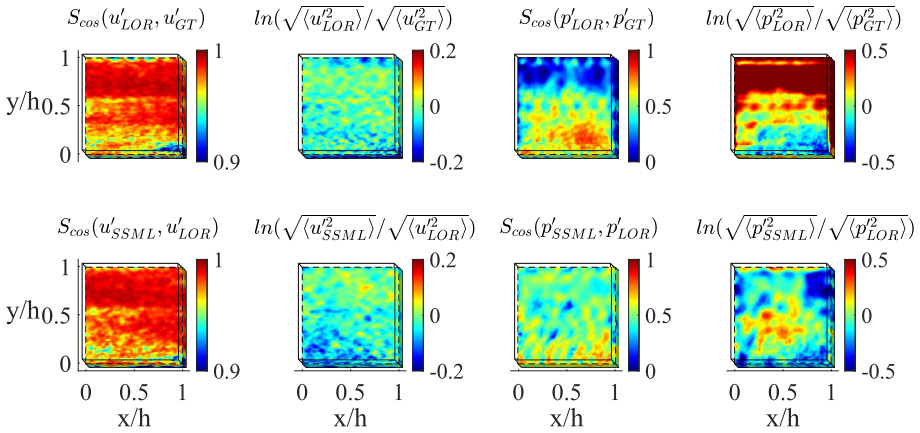
Estimating time-resolved velocity and pressure fields from Particle Image Velocimetry (PIV) remains challenging due to its limited temporal resolution in many applications. Data-driven approaches that combine snapshot PIV with high-frequency probe data have shown great promise in reconstructing the flow dynamics for advection-dominated flows; however, they typically exploit only the probe measurements directly synchronized with the PIV frames, leaving a large volume of probe-only data acquired between snapshots unused. In this work, we propose a framework that enriches the original PIV training dataset by time-marching a simple advection model and then exploits unlabelled probe data through a semi-supervised learning strategy. Two neural networks are trained to predict the temporal coefficients of Proper Orthogonal Decomposition (POD) modes of the flow fields, and their temporal derivatives, respectively. Unlabelled probe samples are leveraged to enforce temporal consistency and expand the coverage of flow scenarios beyond those captured by snapshot PIV, which is crucial for obtaining physically consistent temporal gradients required for pressure field reconstruction. A least-squares regularization step is further employed to reconcile the predictions and enforce consistency between temporal coefficients and their derivatives. The proposed approach is validated on both synthetic turbulent channel flow data and experimental PIV measurements of an airfoil wake. Results demonstrate that incorporating unlabelled probe data significantly improves the accuracy and temporal smoothness of velocity reconstruction, leading to more reliable pressure estimation via the Navier-Stokes equations, without increasing the experimental cost.
Figures


Figures from the paper (14 more)




Reference graph
Works this paper leans on
-
[1]
S. J. Beresh, Time-resolved particle image velocimetry , Measurement Science and Tech- nology 32 (10) (2021) 102003
2021
-
[2]
R. J. Adrian, P. Moin, Stochastic estimation of organize d turbulent structure: homo- geneous shear flow, Journal of Fluid Mechanics 190 (1988) 531 –559. 30
1988
-
[3]
Borée, Extended proper orthogonal decomposition: a t ool to analyse correlated events in turbulent flows, Experiments in Fluids 35 (2) (2003) 188–1 92
J. Borée, Extended proper orthogonal decomposition: a t ool to analyse correlated events in turbulent flows, Experiments in Fluids 35 (2) (2003) 188–1 92
2003
-
[4]
Tinney, L
C. Tinney, L. Ukeiley, M. N. Glauser, Low-dimensional ch aracteristics of a transonic jet. Part 2. Estimate and far-field prediction, Journal of Fl uid Mechanics 615 (2008) 53–92
2008
-
[5]
J. H. Tu, J. Griffin, A. Hart, C. W. Rowley, L. N. Cattafesta, L. S. Ukeiley, Integration of non-time-resolved PIV and time-resolved velocity point se nsors for dynamic estimation of velocity fields, Experiments in fluids 54 (2013) 1–20
2013
-
[6]
J. Chen, M. Raiola, S. Discetti, Pressure from data-driv en estimation of velocity fields using snapshot PIV and fast probes, Experimental Thermal an d Fluid Science 136 (2022) 110647
2022
-
[7]
Lusch, J
B. Lusch, J. N. Kutz, S. L. Brunton, Deep learning for univ ersal linear embeddings of nonlinear dynamics, Nature communications 9 (1) (2018) 495 0
2018
-
[8]
Duraisamy, Perspectives on machine learning-augmen ted Reynolds-averaged and large eddy simulation models of turbulence, Physical Revie w Fluids 6 (5) (2021) 050504
K. Duraisamy, Perspectives on machine learning-augmen ted Reynolds-averaged and large eddy simulation models of turbulence, Physical Revie w Fluids 6 (5) (2021) 050504
2021
Show all 26 references
-
[9]
Y. Mo, L. Magri, Reconstructing unsteady flows from spars e, noisy measurements with a physics-constrained convolutional neural network, Physi cal Review Fluids 10 (3) (2025) 034901
2025
-
[10]
B. A. Danciu, V. A. Pagone, B. Böhm, M. Schmidt, C. E. Frou zakis, Flow re- construction in time-varying geometries using graph neura l networks, arXiv preprint arXiv:2411.08764 (2024)
2024
-
[11]
N. K. Chaurasia, S. Chakraborty, Reconstruction of the turbulent flow field with sparse measurements using physics-informed neural network, Phys ics of Fluids 36 (8) (2024)
2024
-
[12]
Moreno Soto, A
Á. Moreno Soto, A. Güemes, S. Discetti, Complete flow cha racterization from snapshot piv, fast probes and physics-informed neural networks, Com puter Methods in Applied Mechanics and Engineering 419 (2024) 116652
2024
-
[13]
Eivazi, H
H. Eivazi, H. Veisi, M. H. Naderi, V. Esfahanian, Deep ne ural networks for nonlinear model order reduction of unsteady flows, Physics of Fluids 32 (10) (2020)
2020
-
[14]
Van der Kindere, A
J. Van der Kindere, A. Laskari, B. Ganapathisubramani, R. De Kat, Pressure from 2d snapshot piv, Experiments in fluids 60 (2) (2019) 32
2019
-
[15]
J. Chen, M. Raiola, S. Discetti, Advection-based multi frame iterative correction for pressure estimation from velocity fields, Experimental The rmal and Fluid Science 164 (2025) 111407. 31
2025
-
[16]
Ewing, J
D. Ewing, J. H. Citriniti, Examination of a LSE/POD comp lementary technique using single and multi-time information in the axisymmetric shea r layer, in: IUTAM Sympo- sium on Simulation and Identification of Organized Structur es in Flows: Proceedings of the IUTAM Symposium he...
1999
-
[17]
Sirovich, Turbulence and the dynamics of coherent st ructures
L. Sirovich, Turbulence and the dynamics of coherent st ructures. i. coherent structures, Quarterly of Applied Mathematics 45 (3) (1987) 561–571
1987
-
[18]
Discetti, M
S. Discetti, M. Raiola, A. Ianiro, Estimation of time-r esolved turbulent fields through correlation of non-time-resolved field measurements and ti me-resolved point measure- ments, Experimental Thermal and Fluid Science 93 (2018) 119 –130
2018
-
[19]
J. C. Del Alamo, J. Jiménez, Estimation of turbulent con vection velocities and correc- tions to Taylor’s approximation, Journal of Fluid Mechanic s 640 (2009) 5–26
2009
-
[20]
van der Kindere, A
J. van der Kindere, A. Laskari, B. Ganapathisubramani, R. De Kat, Pressure from 2D snapshot PIV, Experiments in Fluids 60 (2019) 1–18
2019
-
[21]
Apicella, F
A. Apicella, F. Donnarumma, F. Isgrò, R. Prevete, A surv ey on modern trainable activation functions, Neural Networks 138 (2021) 14–32
2021
-
[22]
Savitzky, M
A. Savitzky, M. J. Golay, Smoothing and differentiation of data by simplified least squares procedures., Analytical Chemistry 36 (8) (1964) 16 27–1639
1964
-
[23]
A. C. Aitken, IV.—On least squares and linear combinati on of observations, Proceedings of the Royal Society of Edinburgh 55 (1936) 42–48
1936
-
[24]
Tronchin, L
T. Tronchin, L. David, A. Farcy, Loads and pressure eval uation of the flow around a flapping wing from instantaneous 3D velocity measurements , Experiments in Fluids 56 (1) (2015) 7
2015
-
[25]
Y. Li, E. Perlman, M. Wan, Y. Yang, C. Meneveau, R. Burns, S. Chen, A. Szalay, G. Eyink, A public turbulence database cluster and applicat ions to study Lagrangian evolution of velocity increments in turbulence, Journal of Turbulence (9) (2008) N31
2008
-
[26]
Graham, K
J. Graham, K. Kanov, X. Yang, M. Lee, N. Malaya, C. Lalesc u, R. Burns, G. Eyink, A. Szalay, R. Moser, et al., A web services accessible databa se of turbulent channel flow and its use for testing a new integral wall model for LES, Jour nal of Turbulence 17 (2) (2016) 181–215. 32
2016
Reviewed June 29, 2026 · model on record in the stance chip above.
Discussion (0). Continue with ORCID to comment.