REVIEW 2 major objections 2 minor 62 references
Spectroscopic metallicities and first {\alpha}-element abundances of RR Lyrae stars in Baade's Window
T0 review · 2 major / 2 minor · reviewed 2026-06-29 · grok-4.3
Pith's one-line read RR Lyrae stars in the Galactic bulge are mostly metal-poor with alpha-element abundances around 0.25 dex.
desk verdict First spectroscopic [Fe/H] and [α/Fe] for bulge RR Lyrae from 78 stars, but full-spectrum fitting validation for pulsation phases is missing from the abstract. read the letter →
The pith
A machine-rendered reading of the paper's core claim, the machinery that carries it, and where it could break.
The reading
What carries the argument
Full-spectrum fitting technique applied to FLAMES/GIRAFFE spectra to derive [Fe/H] and overall [α/Fe]
What would settle it
Independent high-resolution spectroscopic abundances for the same 78 stars would directly test whether the reported metallicities and alpha ratios contain systematic offsets.
Extended reading notes
Core claim
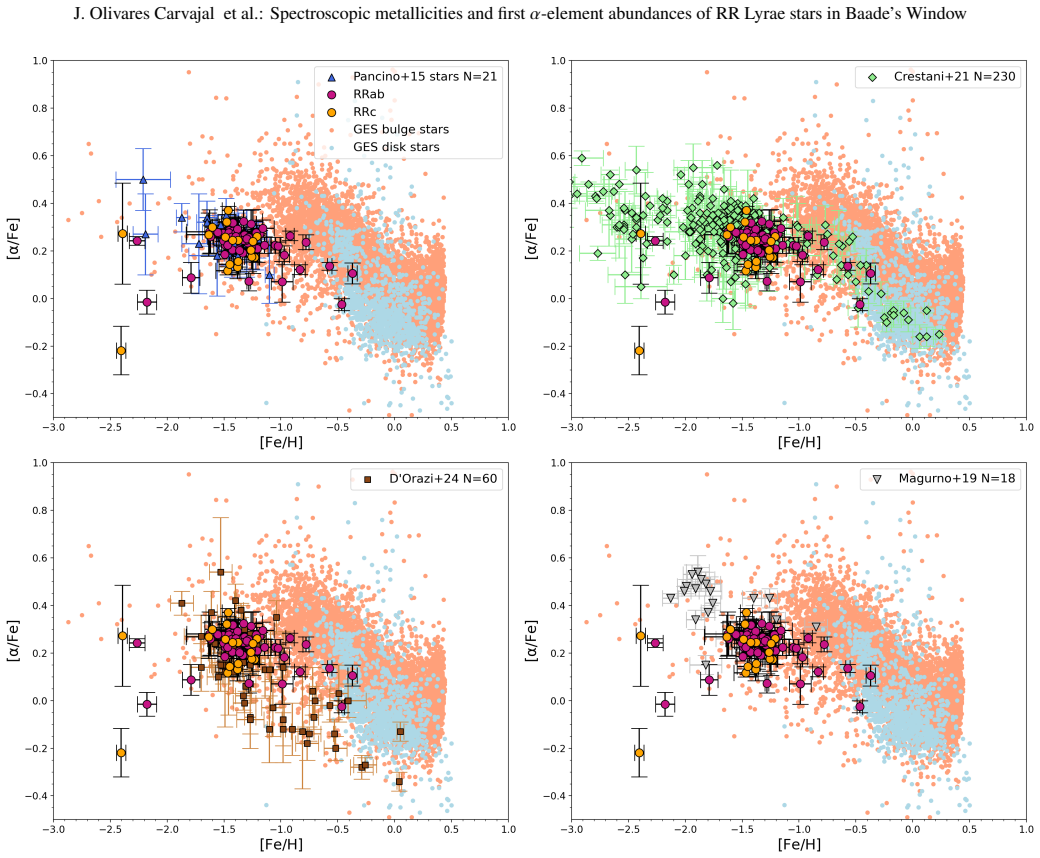
Spectroscopic full-spectrum fitting of FLAMES/GIRAFFE data shows that bulge RR Lyrae stars have median metallicities of -1.34 dex (ab-type) and -1.44 dex (c-type), with most stars displaying alpha-element enhancements of 0.25 dex; a subset with [Fe/H] greater than -1 dex and lower alpha ratios exhibits distinct kinematics suggestive of disk membership.
Load-bearing premise
The full-spectrum fitting technique applied to the spectra of pulsating RR Lyrae stars recovers unbiased [Fe/H] and [α/Fe] values without significant systematic errors from variable atmospheres or the data's wavelength coverage and resolution.
Editorial extensions
If this is right
- The spectroscopic values can calibrate photometric metallicity estimates based on Fourier parameters of RR Lyrae light curves.
- Kinematic orbits derived from the new radial velocities plus Gaia proper motions can map the spatial distribution of the metal-poor bulge component.
- The possible correlation between metallicity offsets and [α/Fe] ratios can be checked in larger samples to refine population assignments.
- The three higher-metallicity, low-alpha ab-type stars can be examined with additional data to confirm or rule out disk membership.
Reading between the lines
- If the alpha enhancement is confirmed as typical, it would strengthen the link between RR Lyrae and the oldest bulge population formed before significant iron enrichment.
- The benchmark abundances could be applied to RR Lyrae in other bulge fields to test whether the metal-poor component is uniformly distributed.
- Future work could combine these abundances with precise distances to refine the period-luminosity-metallicity relation for bulge RR Lyrae.
Editorial analysis
A structured set of objections, weighed in public.
Referee Report
Summary. The paper reports spectroscopic [Fe/H] and [α/Fe] abundances for 78 RR Lyrae stars (60 ab-type, 18 c-type) in Baade's Window derived from full-spectrum fitting of FLAMES/GIRAFFE spectra. Metallicities peak at median [Fe/H] = -1.34 ± 0.04 dex (ab) and -1.44 ± 0.08 dex (c), with the majority showing [α/Fe] ≈ 0.25 ± 0.03 dex. Distances are obtained via a period-luminosity-metallicity relation, orbits are computed using Gaia DR3 proper motions plus new radial velocities, and the abundances are used to test photometric metallicity estimators based on light-curve Fourier parameters. A subset of higher-metallicity ab-type stars is identified and interpreted kinematically as possible disk members.
Significance. If the abundance scale is robust, the work supplies the first medium-resolution spectroscopic benchmark for [Fe/H] and [α/Fe] in bulge RR Lyrae, enabling calibration of photometric indicators and population tagging of the old, metal-poor bulge component. The combination of abundances with Gaia kinematics adds value for distinguishing subpopulations.
major comments (2)
- [Section 3] Section 3 (spectral analysis): the full-spectrum fitting procedure is described without any reported recovery tests on synthetic spectra that incorporate the pulsation-phase variations in Teff (∼1000–2000 K) and log g (∼0.5–1 dex) at GIRAFFE resolution and wavelength coverage. Because the central abundance results (median [Fe/H] values and [α/Fe] ∼ 0.25 dex) are obtained directly from this fitting, the absence of such validation leaves open the possibility of systematic offsets comparable to the quoted uncertainties.
- [Section 4] Section 4 (results) and abstract: the claim that “the majority of the bulge RR Lyrae are metal-poor stars with relatively high α-element abundances around [α/Fe] ∼ 0.25 ± 0.03 dex” rests on the assumption that the fitting returns unbiased values; no phase-marginalized templates, error-budget breakdown, or comparison to literature standards for RR Lyrae are supplied to support this.
minor comments (2)
- [Abstract] Abstract: “FLAMES/GIRAFEE” is a typographical error for GIRAFFE.
- [Abstract] The uncertainty notation on the median metallicities (e.g., ±0.04 dex) should be clarified as to whether it represents the standard error of the median or the median of the individual uncertainties.
Simulated Author's Rebuttal
We thank the referee for their constructive and detailed comments, which help clarify the robustness of our analysis. We respond point-by-point to the major comments below.
read point-by-point responses
-
Referee: [Section 3] Section 3 (spectral analysis): the full-spectrum fitting procedure is described without any reported recovery tests on synthetic spectra that incorporate the pulsation-phase variations in Teff (∼1000–2000 K) and log g (∼0.5–1 dex) at GIRAFFE resolution and wavelength coverage. Because the central abundance results (median [Fe/H] values and [α/Fe] ∼ 0.25 dex) are obtained directly from this fitting, the absence of such validation leaves open the possibility of systematic offsets comparable to the quoted uncertainties.
Authors: We agree that dedicated recovery tests on synthetic spectra would provide stronger validation of the fitting procedure against phase-induced variations in atmospheric parameters. The original manuscript did not include these tests. Our approach fits Teff and log g as free parameters at the observed phase, which mitigates some of the variation, but we acknowledge this does not fully substitute for synthetic recovery tests. We will generate and analyze such synthetic spectra matching the GIRAFFE setup and include the results (showing recovery within quoted uncertainties) as a new subsection in the revised Section 3. revision: yes
-
Referee: [Section 4] Section 4 (results) and abstract: the claim that “the majority of the bulge RR Lyrae are metal-poor stars with relatively high α-element abundances around [α/Fe] ∼ 0.25 ± 0.03 dex” rests on the assumption that the fitting returns unbiased values; no phase-marginalized templates, error-budget breakdown, or comparison to literature standards for RR Lyrae are supplied to support this.
Authors: The median [α/Fe] and its uncertainty are computed directly from the per-star fits, with the quoted error reflecting the standard error of the median across the sample. We accept that the original text lacks an explicit error-budget breakdown, phase-marginalized templates, and direct comparison to non-bulge RR Lyrae literature standards. The internal consistency between ab- and c-type stars and the cross-check against photometric metallicity estimators (already in the paper) provide supporting evidence, but we will expand Section 4 with an error budget, a brief discussion of phase effects, and a comparison to existing medium-resolution RR Lyrae abundance studies to better substantiate the claim. revision: yes
Circularity Check
No significant circularity; results are direct spectroscopic measurements
full rationale
The paper obtains [Fe/H] and [α/Fe] values by applying full-spectrum fitting directly to the 78 FLAMES/GIRAFFE spectra of RR Lyrae stars. Metallicities are reported as empirical peaks from this fitting process, and the [α/Fe] mean follows from the same analysis. Distances use a standard PLZ relation and orbits combine the derived RVs with external Gaia DR3 proper motions. No steps reduce by construction to fitted inputs, self-definitions, or self-citation chains; the derivation chain is self-contained against the observed spectra and independent data.
Assumptions & free parameters
Cite this review
Pith. "Pith review of Spectroscopic metallicities and first {\alpha}-element abundances of RR Lyrae stars in Baade's Window." pith.science (2026). https://pith.science/paper/AFEJWBX7
@misc{pith2026260528497,
  author       = {Pith},
  title        = {Pith review of: Spectroscopic metallicities and first \alpha-element abundances of RR Lyrae stars in Baade's Window},
  year         = {2026},
  howpublished = {\url{https://pith.science/paper/AFEJWBX7}},
  note         = {Machine review of arXiv:2605.28497}
}
read the original abstract
RR Lyrae stars in the bulge have been reported to be associated with the spheroidal, relatively metal-poor component. They offer a way to trace this component with precise distances. While a few studies of RR Lyrae spectra with medium/high resolution are now available, none of them target stars in the Galactic bulge. We present here a spectroscopic determination of Fe and {\alpha}-element abundances for RR Lyrae stars in the Galactic bulge, with the main goal of providing a benchmark to calibrate other metallicity indicators, appropriate for this specific stellar population. We analyzed FLAMES/GIRAFEE spectra of 78 RR Lyrae stars (60 ab-type and 18 c-type). We applied a full-spectrum fitting technique to obtain the spectroscopic metallicity and overall {\alpha}-element abundance. Distances are derived by means of a period-luminosity-metallicity relation, and orbits are computed by combining the radial velocities derived here with the proper motions from DR3. Gaia The resulting metallicities peak at [Fe/H] _median = -1.34 +- 0.04 and -1.44 +- 0.08 dex for ab and c-types respectively. The majority of the bulge RR Lyrae are metal-poor stars with relatively high {\alpha}-element abundances around [{\alpha}/Fe] ~ 0.25 +- 0.03 dex. We used our spectroscopic measurements to test different methods for deriving metallicities based on photometry, which utilize Fourier parameters in the light curves of the RR Lyrae. The data suggest a possible correlation between the metallicity difference and the [{\alpha}/Fe] ratio, which needs to be investigated further. There are some ab-type RR Lyrae that show metallicities higher than -1 dex and low [{\alpha}/Fe] values. We studied these stars kinematically and found a difference between three stars with similar [{\alpha}/Fe] values and the main group, indicating that they may be slightly younger and correspond to the disk population.
Figures


Figures from the paper (10 more)




Reference graph
Works this paper leans on
-
[1]
2025, A&A, 695, L14 Allende Prieto, C., Beers, T
Abdollahi, H., Molnár, L., & Varga, V. 2025, A&A, 695, L14 Allende Prieto, C., Beers, T. C., Wilhelm, R., et al. 2006, ApJ, 636, 804 AstropyCollaboration,Price-Whelan,A.M.,Sipőcz,B.M.,etal.2018,AJ,156, 123 Astropy Collaboration, Robitaille, T. P., Tollerud, E. J., et al. 2013, A&A, 558, A33
2025
-
[2]
2022, Universe, 8, 122
Bhardwaj, A. 2022, Universe, 8, 122
2022
-
[3]
2024, AJ, 167, 247
Bhardwaj, A., Rejkuba, M., Ngeow, C.-C., et al. 2024, AJ, 167, 247
2024
-
[4]
2024, MNRAS, 527, 12196 Boch,T.&Fernique,P.2014,inAstronomicalSocietyofthePacificConference
Bobrick, A., Iorio, G., Belokurov, V., et al. 2024, MNRAS, 527, 12196 Boch,T.&Fernique,P.2014,inAstronomicalSocietyofthePacificConference
2024
-
[5]
Bonnarel, F. et al. 2000, A&AS, 143, 33
2000
-
[6]
2024, arXiv e-prints, arXiv:2410.22427
Cabrera-Gadea, M., Mateu, C., & Ramos, P. 2024, arXiv e-prints, arXiv:2410.22427
-
[7]
J., & Gould, A
Cao, L., Mao, S., Nataf, D., Rattenbury, N. J., & Gould, A. 2013, MNRAS, 434, 595 Carretta,E.,Bragaglia,A.,Gratton,R.,D’Orazi,V.,&Lucatello,S.2009,A&A, 508, 695
2013
-
[8]
& Smith, H
Catelan, M. & Smith, H. A. 2015, Pulsating Stars
2015
Show all 62 references
-
[9]
Chadid, M., Sneden, C., & Preston, G. W. 2017, ApJ, 835, 187
2017
-
[10]
2020, The Messenger, 180, 10
Cirasuolo, M., Fairley, A., Rees, P., et al. 2020, The Messenger, 180, 10
2020
-
[11]
2023, A&A, 674, A18 Contreras Ramos, R., Minniti, D., Gran, F., et al
Clementini, G., Ripepi, V., Garofalo, A., et al. 2023, A&A, 674, A18 Contreras Ramos, R., Minniti, D., Gran, F., et al. 2018, ApJ, 863, 79
2023
-
[12]
F., et al
Crestani, J., Fabrizio, M., Braga, V. F., et al. 2021b, ApJ, 908, 20 Cruz Reyes, M., Anderson, R. I., Johansson, L., Netzel, H., & Medaric, Z. 2024, A&A, 684, A173
2024
-
[13]
2024, arXiv e-prints, arXiv:2411.12741
Cuevas-Otahola, B., Mateu, C., Cabrera-Ziri, I., et al. 2024, arXiv e-prints, arXiv:2411.12741
2024
-
[14]
P., et al
Czesla, S., Schröter, S., Schneider, C. P., et al. 2019, PyA: Python astronomy- related packages D’Cruz, N. L., Dorman, B., Rood, R. T., & O’Connell, R. W. 1996, ApJ, 466, 359 de Jong, R. S., Agertz, O., Berbel, A. A., et al. 2019, The Messenger, 175, 3 De Leo, M., Zoccali, M....
2019
-
[15]
2020, MNRAS, 498, 5629
Du, H., Mao, S., Athanassoula, E., Shen, J., & Pietrukowicz, P. 2020, MNRAS, 498, 5629
2020
-
[16]
F., et al
Fabrizio, M., Bono, G., Braga, V. F., et al. 2019, ApJ, 882, 169
2019
-
[17]
For, B.-Q., Sneden, C., & Preston, G. W. 2011, ApJS, 197, 29
2011
-
[18]
Freeman, K. C. & Rodgers, A. W. 1975, ApJ, 201, L71 Gaia Collaboration, Vallenari, A., Brown, A. G. A., et al. 2023, A&A, 674, A1 Gozha,M.L.,Marsakov,V.A.,&Koval’,V.V.2024,AstrophysicalBulletin,79, 481 GRAVITY Collaboration, Abuter, R., Amorim, A., et al. 2021, A&A, 647, A59
1975
-
[19]
2008, A&A, 486, 951
Gustafsson, B., Edvardsson, B., Eriksson, K., et al. 2008, A&A, 486, 951
2008
-
[20]
2021, A&A, 645, A106
Heiter, U., Lind, K., Bergemann, M., et al. 2021, A&A, 645, A106
2021
-
[21]
1990, ApJ, 356, 359
Hernquist, L. 1990, ApJ, 356, 359
1990
-
[22]
Hunter, J. D. 2007, Computing In Science & Engineering, 9, 90
2007
-
[23]
& Belokurov, V
Iorio, G. & Belokurov, V. 2021, MNRAS, 502, 5686
2021
-
[24]
& Hajdu, G
Jurcsik, J. & Hajdu, G. 2023, MNRAS, 525, 3486
2023
-
[25]
R., et al
Kervella, P., Gallenne, A., Evans, N. R., et al. 2019, A&A, 623, A117
2019
-
[26]
M., et al
Kunder, A., Pérez-Villegas, A., Rich, R. M., et al. 2020, AJ, 159, 270
2020
-
[27]
2024, AJ, 168, 139
Kunder, A., Prudil, Z., Skaggs, C., et al. 2024, AJ, 168, 139
2024
-
[28]
Layden, A. C. 1994, AJ, 108, 1016
1994
-
[29]
W., Bovy, J., Mackereth, J
Leung, H. W., Bovy, J., Mackereth, J. T., et al. 2023, MNRAS, 519, 948
2023
-
[30]
C., & Zhang, H.-W
Li, X.-Y., Huang, Y., Liu, G.-C., Beers, T. C., & Zhang, H.-W. 2023, ApJ, 944, 88
2023
-
[31]
& Murali, C
Long, K. & Murali, C. 1992, ApJ, 397, 44
1992
-
[32]
2019, ApJ, 881, 104
Magurno, D., Sneden, C., Bono, G., et al. 2019, ApJ, 881, 104
2019
-
[33]
F., et al
Magurno, D., Sneden, C., Braga, V. F., et al. 2018, ApJ, 864, 57
2018
-
[34]
2022, ApJ, 925, 10
Matsunaga, N., Itane, A., Hattori, K., et al. 2022, ApJ, 925, 10
2022
-
[35]
McMillan, P. J. 2017, MNRAS, 465, 76
2017
-
[36]
W., Emerson, J
Minniti, D., Lucas, P. W., Emerson, J. P., et al. 2010, New A, 15, 433
2010
-
[37]
& Nagai, R
Miyamoto, M. & Nagai, R. 1975, PASJ, 27, 533
1975
-
[38]
P., Marengo, M., Martínez-Vázquez, C
Mullen, J. P., Marengo, M., Martínez-Vázquez, C. E., et al. 2022, ApJ, 931, 131
2022
-
[39]
P., Marengo, M., Martínez-Vázquez, C
Mullen, J. P., Marengo, M., Martínez-Vázquez, C. E., et al. 2021, ApJ, 912, 144
2021
-
[40]
M., Gould, A., Fouqué, P., et al
Nataf, D. M., Gould, A., Fouqué, P., et al. 2013, ApJ, 769, 88
2013
-
[41]
F., Frenk, C
Navarro, J. F., Frenk, C. S., & White, S. D. M. 1996, ApJ, 462, 563
1996
-
[42]
R., Marengo, M., Freedman, W
Neeley, J. R., Marengo, M., Freedman, W. L., et al. 2019, MNRAS, 490, 4254
2019
-
[43]
Ochsenbein, F. et al. 2000, A&AS, 143, 23 Olivares Carvajal, J., Zoccali, M., De Leo, M., et al. 2024, A&A, 687, A312
2000
-
[44]
2015, MNRAS, 447, 2404 pandas development team, T
Pancino, E., Britavskiy, N., Romano, D., et al. 2015, MNRAS, 447, 2404 pandas development team, T. 2020, pandas-dev/pandas: Pandas
2015
-
[45]
2002, The Messenger, 110, 1 Pérez, F
Pasquini, L., Avila, G., Blecha, A., et al. 2002, The Messenger, 110, 1 Pérez, F. & Granger, B. E. 2007, Computing in Science and Engineering, 9, 21
2002
-
[46]
2012, Turbospectrum: Code for spectral synthesis, Astrophysics Source Code Library, record ascl:1205.004
Plez, B. 2012, Turbospectrum: Code for spectral synthesis, Astrophysics Source Code Library, record ascl:1205.004
2012
-
[47]
2017, MNRAS, 465, 1621
Portail, M., Gerhard, O., Wegg, C., & Ness, M. 2017, MNRAS, 465, 1621
2017
-
[48]
Preston, G. W. 1959, ApJ, 130, 507
1959
-
[49]
2025, A&A, 695, A211
Prudil, Z., Kunder, A., Beraldo e Silva, L., et al. 2025, A&A, 695, A211
2025
-
[50]
Queiroz, A. B. A., Anders, F., Chiappini, C., et al. 2023, A&A, 673, A155
2023
-
[51]
K., Olszewski, E
Saha, A., Vivas, A. K., Olszewski, E. W., et al. 2019, ApJ, 874, 30 Savino,A.,Koch,A.,Prudil,Z.,Kunder,A.,&Smolec,R.2020,A&A,641,A96 Schönrich, R., Binney, J., & Dehnen, W. 2010, MNRAS, 403, 1829
2019
-
[52]
Z., et al
Shappee, B., Prieto, J., Stanek, K. Z., et al. 2014, in American Astronomical SocietyMeetingAbstracts,Vol.223,AmericanAstronomicalSocietyMeeting Abstracts #223, 236.03 Article number, page 14 of 18 J. Olivares Carvajal et al.: Spectroscopic metallicities and first𝛼-element abu...
2014
-
[53]
T., Belokurov, V., Irwin, M., et al
Simion, I. T., Belokurov, V., Irwin, M., et al. 2017, MNRAS, 471, 4323
2017
-
[54]
M., Soszyński, I., Udalski, A., et al
Skowron, D. M., Soszyński, I., Udalski, A., et al. 2016, Acta Astron., 66, 269
2016
-
[55]
W., Chadid, M., & Adamów, M
Sneden, C., Preston, G. W., Chadid, M., & Adamów, M. 2017, ApJ, 848, 68 Soszyński, I., Dziembowski, W. A., Udalski, A., et al. 2011, Acta Astron., 61, 1 Soszyński, I., Udalski, A., Wrona, M., et al. 2019, Acta Astron., 69, 321
2017
-
[56]
B., Kinman, T
Suntzeff, N. B., Kinman, T. D., & Kraft, R. P. 1991, ApJ, 367, 528 Taylor,M.B.2005,inAstronomicalSocietyofthePacificConferenceSeries,Vol. 347,AstronomicalDataAnalysisSoftwareandSystemsXIV,ed.P.Shopbell, M. Britton, & R. Ebert, 29
1991
-
[57]
K., & Szymański, G
Udalski, A., Szymański, M. K., & Szymański, G. 2015, Acta Astron., 65, 1
2015
-
[58]
A., et al
Valenti, E., Zoccali, M., Gonzalez, O. A., et al. 2016, A&A, 587, L6 van der Walt, S.; Colbert, S. C. & Varoquaux, G. 2011, Computing in Science and Engineering, 13, 22
2016
-
[59]
Walker, A. R. & Terndrup, D. M. 1991, ApJ, 378, 119
1991
-
[60]
Wenger, M. et al. 2000, A&AS, 143, 9
2000
-
[61]
2023, ApJ, 951, 114 Zhang,H.,Iorio,G.,Belokurov,V.,etal.2025,arXive-prints,arXiv:2504.06720 Zinn,R.,Chen,X.,Layden,A.C.,&Casetti-Dinescu,D.I.2020,MNRAS,492, 2161
Zgirski, B., Pietrzyński, G., Górski, M., et al. 2023, ApJ, 951, 114 Zhang,H.,Iorio,G.,Belokurov,V.,etal.2025,arXive-prints,arXiv:2504.06720 Zinn,R.,Chen,X.,Layden,A.C.,&Casetti-Dinescu,D.I.2020,MNRAS,492, 2161
2023
-
[62]
2024, A&A, 689, A240 Article number, page 15 of 18 A&A proofs:manuscript no
Zoccali, M., Quezada, C., Contreras Ramos, R., et al. 2024, A&A, 689, A240 Article number, page 15 of 18 A&A proofs:manuscript no. BW_RRL Appendix A: Atmospheric parameters for RRc stars We show here the variation of the atmospheric parameters for two RRc variables, with diffe...
2024
Reviewed June 29, 2026 · model on record in the stance chip above.
Discussion (0). Sign in to comment.