A Goal-Oriented Networking Approach for Intelligent IoT Service Deployment
Pith reviewed 2026-06-29 09:35 UTC · model grok-4.3
The pith
Goal-oriented communications let IoT devices pre-process data to cut network energy and latency while meeting task accuracy targets.
A machine-rendered reading of the paper's core claim, the machinery that carries it, and where it could break.
Core claim
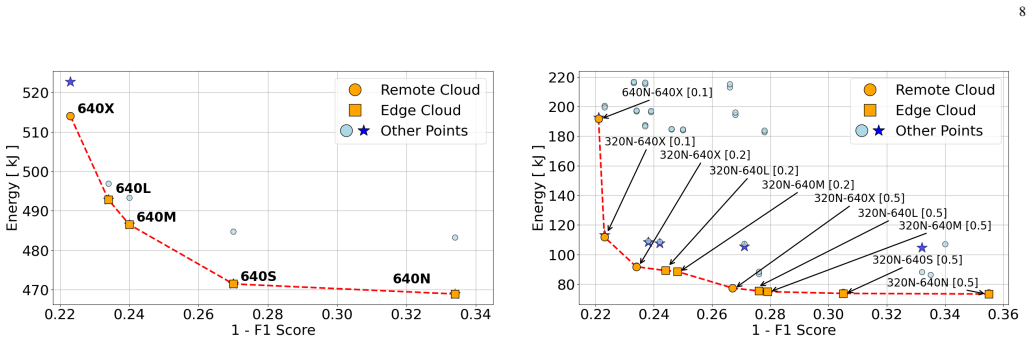
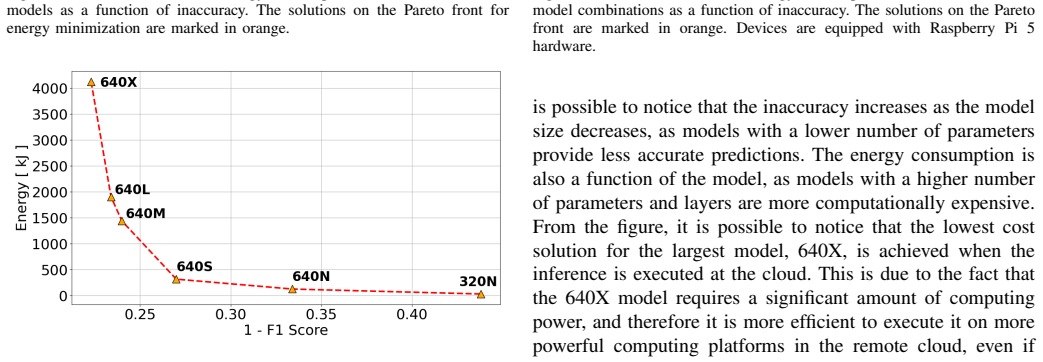
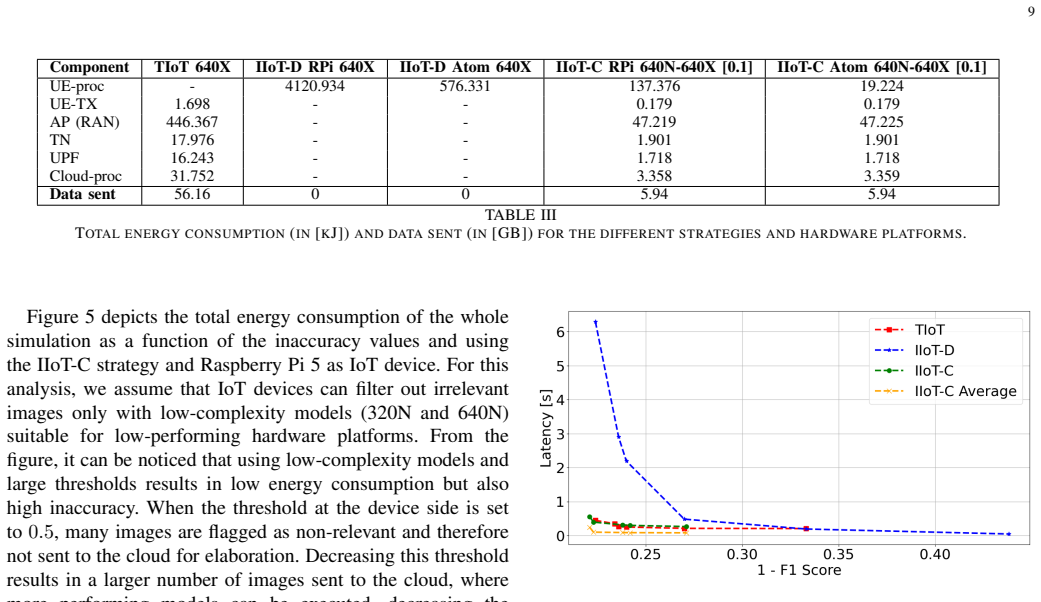
By shifting the communication objective from perfect data delivery to achieving a defined task accuracy, intelligent devices can pre-process data locally and transmit only what matters, which the paper shows through simulation improves network-level energy, latency, and accuracy outcomes via a multi-objective optimization model.
What carries the argument
A multi-objective optimization model that balances energy consumption, latency, and goal accuracy KPIs within an end-to-end GO networking framework for IoT service deployment.
If this is right
- Network operators can reduce transmitted data volume and associated energy costs by adopting task-focused rather than bit-perfect delivery.
- Service deployment decisions can explicitly trade off goal accuracy against energy and latency using the optimization model.
- 6G architectures may incorporate GO mechanisms to support immersive, massive, and hyper-reliable scenarios more efficiently.
- Intelligent devices gain an active role in network resource management through pre-processing choices.
Where Pith is reading between the lines
- The same framework could be applied to other sensing-plus-AI communication settings beyond the simulated IoT cases.
- Standardization efforts for IMT-2030 might need to define interfaces for goal accuracy as a network KPI.
- Real deployments would require testing how pre-processing overhead at the device affects the overall energy savings shown in simulation.
Load-bearing premise
The simulation accurately captures how intelligent IoT devices pre-process data in reality and how that changes network energy, latency, and goal accuracy.
What would settle it
Deploy the same IoT service on real devices, compare measured energy, latency, and task accuracy when using local pre-processing versus full data transmission, and check whether the measured gains match the simulation predictions.
Figures

read the original abstract
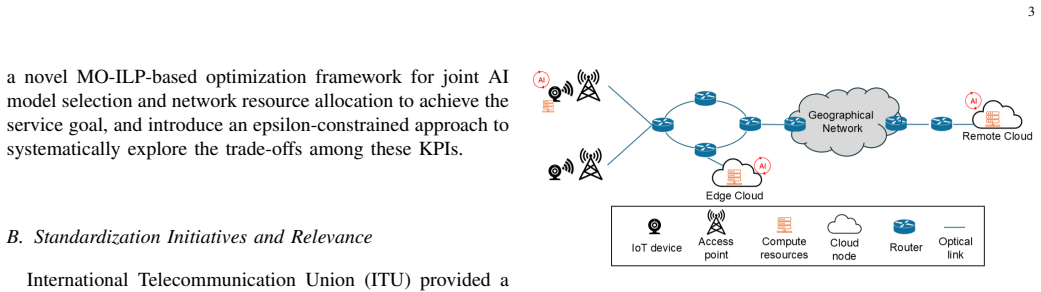
The first 6G standardization efforts are about to start, shaping the new generation of mobile networks. The IMT-2030 extends the IMT-2020 by expanding its usage scenarios to Immersive, Massive, and Hyper-Reliable and Low-Latency Communications. It also introduces novel scenarios by integrating Artificial Intelligence and Sensing with Communication and supporting Ubiquitous Connectivity. Compared to the previous generation, 6G is expected to improve not only throughput and latency, but also coverage and energy efficiency. A paradigm called Goal-Oriented (GO) communications has recently emerged as a promising solution to improve network efficiency. It relies on the fact that the goal of the communication network is to achieve a specific task with a defined accuracy, rather than creating perfect data delivery. Intelligent devices can pre-process data to send only what is relevant to achieve the task, thus saving precious network resources and energy. Recent works demonstrate that incorporating service- and application-level KPIs in the network allows to achieve higher communication efficiency for devices, but the consequence of using such techniques on the network itself has not yet been explored. This paper proposes a practical end-to-end framework to assess energy consumption, latency, and goal accuracy KPIs, which includes a Multi-Objective optimization model to evaluate the trade-offs between the multiple KPIs relevant to GO networking. We demonstrate, through simulation, that the network can benefit from the application of the GO paradigm, indicating its potential in future network architectures.
Editorial analysis
A structured set of objections, weighed in public.
Referee Report
Summary. The manuscript proposes a practical end-to-end framework for Goal-Oriented (GO) communications in intelligent IoT deployments targeting 6G scenarios. The framework incorporates a multi-objective optimization model to trade off energy consumption, latency, and goal accuracy. The central claim, demonstrated via simulation, is that applying the GO paradigm yields network-level benefits in these KPIs compared to conventional approaches.
Significance. If the underlying simulation model and optimization formulation prove sound and reproducible, the work would offer concrete evidence that GO pre-processing can improve network efficiency for task-oriented IoT services, extending beyond throughput-centric designs. This aligns with emerging 6G usage scenarios that integrate AI and sensing.
major comments (3)
- [Simulation] Simulation section: No equations, pseudocode, or parameter values are supplied for the device pre-processing filter (what fraction of data is discarded under realistic goal-oriented policies) or for the mapping from filtered traffic to the three reported KPIs. This directly undermines the central simulation-based claim that the network benefits from GO.
- [Framework / Optimization Model] Multi-objective optimization model: The formulation of the optimizer (objective functions, constraints, decision variables, or solution algorithm) is absent. Without it, the reported trade-offs between energy, latency, and goal accuracy cannot be verified or reproduced.
- [Evaluation / Results] Results: No baseline comparisons, confidence intervals, sensitivity analysis, or validation against real device traces are presented, leaving open whether observed gains are artifacts of the unspecified model rather than intrinsic to the GO paradigm.
minor comments (2)
- [Abstract] The abstract references 'recent works' on service-level KPIs without citations; explicit references would clarify the novelty claim.
- [Framework] Notation for the three KPIs is introduced but not consistently defined with units or ranges in the framework description.
Simulated Author's Rebuttal
We thank the referee for the constructive comments that identify key areas for improving reproducibility and rigor. We agree that the current manuscript lacks sufficient detail in the simulation, optimization, and evaluation sections, and we will revise accordingly to address each point.
read point-by-point responses
-
Referee: [Simulation] Simulation section: No equations, pseudocode, or parameter values are supplied for the device pre-processing filter (what fraction of data is discarded under realistic goal-oriented policies) or for the mapping from filtered traffic to the three reported KPIs. This directly undermines the central simulation-based claim that the network benefits from GO.
Authors: We acknowledge that the simulation section does not include the requested equations, pseudocode, or parameter values for the pre-processing filter and KPI mapping. In the revised manuscript we will add a dedicated subsection containing the mathematical definition of the filter (including the fraction of data discarded under the goal-oriented policy), pseudocode for the end-to-end simulation flow, and the explicit mapping from filtered traffic to energy, latency, and goal-accuracy KPIs, together with all numerical parameter values used. revision: yes
-
Referee: [Framework / Optimization Model] Multi-objective optimization model: The formulation of the optimizer (objective functions, constraints, decision variables, or solution algorithm) is absent. Without it, the reported trade-offs between energy, latency, and goal accuracy cannot be verified or reproduced.
Authors: The manuscript presents the multi-objective optimization model only at a high level. We will expand the framework section to include the complete mathematical formulation: the three objective functions, all constraints, the decision variables, and the solution algorithm (including any scalarization or Pareto-front method employed). This addition will make the reported KPI trade-offs fully verifiable and reproducible. revision: yes
-
Referee: [Evaluation / Results] Results: No baseline comparisons, confidence intervals, sensitivity analysis, or validation against real device traces are presented, leaving open whether observed gains are artifacts of the unspecified model rather than intrinsic to the GO paradigm.
Authors: We agree that the evaluation section requires strengthening. The revised version will add explicit baseline comparisons against conventional non-GO traffic, confidence intervals on all reported KPI values, sensitivity analysis on key parameters, and a discussion of validation strategies. While we do not currently possess real device traces, we will outline a concrete plan for such validation in future extensions. revision: partial
Circularity Check
No circularity: simulation-based framework with no derivation chain or fitted predictions
full rationale
The paper proposes an end-to-end framework and multi-objective optimization model for goal-oriented networking, then reports simulation outcomes on energy, latency, and goal accuracy. No equations, parameter-fitting steps, self-citations, or uniqueness theorems are described that would reduce any claimed result to its own inputs by construction. The central demonstration is a simulation exercise whose validity rests on modeling assumptions rather than algebraic self-reference. This matches the default expectation of no significant circularity.
Axiom & Free-Parameter Ledger
axioms (1)
- domain assumption Intelligent devices can pre-process data to send only what is relevant to achieve a defined task accuracy.
Reference graph
Works this paper leans on
-
[1]
Accessed: June 2025
NGMN alliance - 6G Key Messages – An Operator View. Accessed: June 2025. [Online]. Available: https://www.ngmn.org/wp-content/ uploads/2506 NGMN 6G-Key-Messages An-Operator-View V1.0.pdf
2025
-
[2]
Accessed: June
Hexa-X-II D2.5 - Final overall 6G system design. Accessed: June
-
[3]
Available: https://hexa-x-ii.eu/wp-content/uploads/2025/ 04/Hexa-X-II D2.5 Final v1.0.pdf
[Online]. Available: https://hexa-x-ii.eu/wp-content/uploads/2025/ 04/Hexa-X-II D2.5 Final v1.0.pdf
2025
-
[4]
A survey on intelligent internet of things: Applications, security, privacy, and future directions,
O. Aouedi, T.-H. Vu, A. Sacco, D. C. Nguyen, K. Piamrat, G. Marchetto, and Q.-V . Pham, “A survey on intelligent internet of things: Applications, security, privacy, and future directions,”IEEE Communications Surveys & Tutorials, vol. 27, no. 2, pp. 1238–1292, 2025
2025
-
[5]
[Online]
Recommendation ITU-R M.2160-0 (11/2023) - Framework and overall objectives of the future development of IMT for 2030 and beyond. [Online]. Available: https://www.itu.int/dms pubrec/itu-r/rec/ m/R-REC-M.2160-0-202311-I!!PDF-E.pdf
2023
-
[6]
6G networks: Beyond shannon towards semantic and goal-oriented communications,
E. Calvanese Strinati and S. Barbarossa, “6G networks: Beyond shannon towards semantic and goal-oriented communications,”Computer Networks, vol. 190, p. 107930, 2021. [Online]. Available: https: //www.sciencedirect.com/science/article/pii/S1389128621000773
2021
-
[7]
Goal-oriented communications for the IoT: System design and adaptive resource optimization,
P. Di Lorenzo, M. Merluzzi, F. Binucci, C. Battiloro, P. Banelli, E. C. Strinati, and S. Barbarossa, “Goal-oriented communications for the IoT: System design and adaptive resource optimization,”IEEE Internet of Things Magazine, vol. 6, no. 4, pp. 26–32, 2023
2023
-
[8]
Goal-oriented communications for the IoT and application to data compression,
C. Zhang, H. Zou, S. Lasaulce, W. Saad, M. Kountouris, and M. Bennis, “Goal-oriented communications for the IoT and application to data compression,”IEEE Internet of Things Magazine, vol. 5, no. 4, pp. 58– 63, 2022. 11
2022
-
[9]
Multi- user goal-oriented communications with energy-efficient edge resource management,
F. Binucci, P. Banelli, P. D. Lorenzo, and S. Barbarossa, “Multi- user goal-oriented communications with energy-efficient edge resource management,”IEEE Transactions on Green Communications and Net- working, vol. 7, no. 4, pp. 1709–1724, 2023
2023
-
[10]
Learning to com- municate with intent: An introduction,
M. A. Gutierrez-Estevez, Y . Wu, and C. Zhou, “Learning to com- municate with intent: An introduction,” in2023 IEEE 34th Annual International Symposium on Personal, Indoor and Mobile Radio Com- munications (PIMRC), 2023, pp. 1–7
2023
-
[11]
Effective goal-oriented 6G communications: the energy-aware edge inferencing case,
M. Merluzzi, M. C. Filippou, L. G. Baltar, and E. C. Strinati, “Effective goal-oriented 6G communications: the energy-aware edge inferencing case,” in2022 Joint European Conference on Networks and Communi- cations & 6G Summit (EuCNC/6G Summit), 2022, pp. 457–462
2022
-
[12]
Going green: benchmarking the energy efficiency of mobile,
GSMA, “Going green: benchmarking the energy efficiency of mobile,” 2021
2021
-
[13]
End-to-end performance analysis for intelligent IoT devices in goal- oriented networking,
F. Tonini, P. Lanci, D. Borsatti, W. Y . Poe, R. Trivisonno, and W. Cerroni, “End-to-end performance analysis for intelligent IoT devices in goal- oriented networking,” in2025 IEEE 11th International Conference on Network Softwarization (NetSoft), 2025, pp. 1–6
2025
-
[14]
[Online]
3GPP TR 38.769 V19.0.0 (2024-12) - Technical Specification Group Radio Access Network; Study on solutions for Ambient IoT (Internet of Things) in NR (Release 19). [Online]. Available: https://www.3gpp.org/ftp/Specs/archive/38 series/38.769/38769-j00.zip
2024
-
[15]
Summary of 3GPP 6G workshop (6gws-250238),
P. S. Puneet Jain, Ronald Borsato, “Summary of 3GPP 6G workshop (6gws-250238),” 2025. [Online]. Available: https://www.3gpp.org/ technologies/6gworkshop-2025
2025
-
[16]
[Online]
ETSI GR ISC 001 V1.1.1 (2025-03) - Integrated Sensing And Communications (ISAC); Use Cases and Deployment Scenarios. [Online]. Available: https://www.etsi.org/deliver/etsi gr/ISC/001 099/ 001/01.01.01 60/gr ISC001v010101p.pdf
2025
-
[17]
[Online]
3GPP TR 21.916 V16.2.0 (2022-06) - Technical Specification Group Services and System Aspects; Release 16 Description; Summary of Rel-16 Work Items (Release 16). [Online]. Available: https://www.3gpp.org/ftp/Specs/archive/21 series/21.916/21916-g20.zip
2022
-
[18]
[Online]
3GPP TR 21.917 V17.0.1 (2023-01) - Technical Specification Group Services and System Aspects; Release 17 Description; Summary of Rel-17 Work Items (Release 17). [Online]. Available: https://www.3gpp.org/ftp/Specs/archive/21 series/21.917/21917-h01.zip
2023
-
[19]
[Online]
3GPP TR 21.918 V18.0.0 (2025-03) - Technical Specification Group Services and System Aspects; Release 18 Description; Summary of Rel-18 Work Items (Release 18). [Online]. Available: https://www.3gpp.org/ftp/Specs/archive/21 series/21.918/21918-i00.zip
2025
-
[20]
Enabling edge artificial intelligence via goal-oriented deep neural network splitting,
F. Binucci, M. Merluzzi, P. Banelli, E. C. Strinati, and P. Di Lorenzo, “Enabling edge artificial intelligence via goal-oriented deep neural network splitting,” in2024 19th International Symposium on Wireless Communication Systems (ISWCS), 2024, pp. 1–6
2024
-
[21]
A flexible and future-proof power model for cellular base stations,
B. Debaillie, C. Desset, and F. Louagie, “A flexible and future-proof power model for cellular base stations,” in2015 IEEE 81st V ehicular Technology Conference (VTC Spring), 2015, pp. 1–7
2015
-
[22]
[Online]
3GPP TS 28.554 V18.4.0 - 5G end to end Key Performance Indicators (KPI) (Release 18). [Online]. Available: https://www.3gpp.org/ftp/ Specs/archive/28 series/28.554/28554-i40.zip
-
[23]
A measurement-based approach to analyze the power consumption of the softwarized 5G core,
A. Bellin, F. Granelli, and D. Munaretto, “A measurement-based approach to analyze the power consumption of the softwarized 5G core,” Computer Networks, vol. 244, p. 110312, 2024. [Online]. Available: https://www.sciencedirect.com/science/article/pii/S1389128624001440
2024
-
[24]
D. F. Jones and H. O. Florentino,Multi-Objective Optimization: Methods and Applications. Springer International Publishing, 2022, pp. 181–207
2022
-
[25]
Effective implementation of theϵ-constraint method in multi-objective mathematical programming problems,
G. Mavrotas, “Effective implementation of theϵ-constraint method in multi-objective mathematical programming problems,”Applied Mathematics and Computation, vol. 213, no. 2, pp. 455–465, 2009. [Online]. Available: https://www.sciencedirect.com/science/article/pii/ S0096300309002574
2009
-
[26]
Power- efficient baseband-function placement in latency-constrained 5G metro access,
L. M. Moreira Zorello, M. Sodano, S. Troia, and G. Maier, “Power- efficient baseband-function placement in latency-constrained 5G metro access,”IEEE Transactions on Green Communications and Networking, vol. 6, no. 3, pp. 1683–1696, 2022
2022
-
[27]
[Online]
AWS Latency Monitoring. [Online]. Available: https://www.cloudping. co/
-
[28]
[Online]
APP Metrics for Intel® Microprocessors - Intel® Core™ Processor. [Online]. Available: https://www.intel.com/content/dam/support/us/en/ documents/processors/APP-for-Intel-Core-Processors.pdf
-
[29]
[Online]
APP Metrics for Intel® Microprocessors - Intel® Atom™ Processor. [Online]. Available: https://www.intel.com/content/www/us/en/content-details/840303/ app-metrics-for-intel-microprocessors-intel-atom-processor.html
-
[30]
[Online]
Experimental evaluation of GFLOPS - University of Maine. [Online]. Available: https://github.com/deater/performance results
-
[31]
arXiv preprint arXiv:2405.14458 , year=
A. Wang, H. Chen, L. Liu, K. Chen, Z. Lin, J. Han, and G. Ding, “Yolov10: Real-time end-to-end object detection,” 2024. [Online]. Available: https://arxiv.org/abs/2405.14458
-
[32]
[Online]
YOLOv10: Real-Time End-to-End Object Detection. [Online]. Available: https://github.com/THU-MIG/yolov10
-
[33]
Microsoft COCO: Common objects in context,
T.-Y . Lin, M. Maire, S. Belongie, J. Hays, P. Perona, D. Ramanan, P. Doll ´ar, and C. L. Zitnick, “Microsoft COCO: Common objects in context,” inComputer Vision – ECCV 2014, D. Fleet, T. Pajdla, B. Schiele, and T. Tuytelaars, Eds. Cham: Springer International Publishing, 2014, pp. 740–755. [Online]. Available: https://cocodataset. org/
2014
-
[34]
[Online]
Gurobi v.12.0.0 - Gurobi Optimization, LLC. [Online]. Available: https://www.gurobi.com
discussion (0)
Sign in with ORCID, Apple, or X to comment. Anyone can read and Pith papers without signing in.