Optical cycling on thorium monoxide (ThO) for an improved test of fundamental symmetries
Pith reviewed 2026-06-29 09:14 UTC · model grok-4.3
The pith
ThO molecules cycle 11 photons on average with a single laser before losing population to other levels.
A machine-rendered reading of the paper's core claim, the machinery that carries it, and where it could break.
Core claim
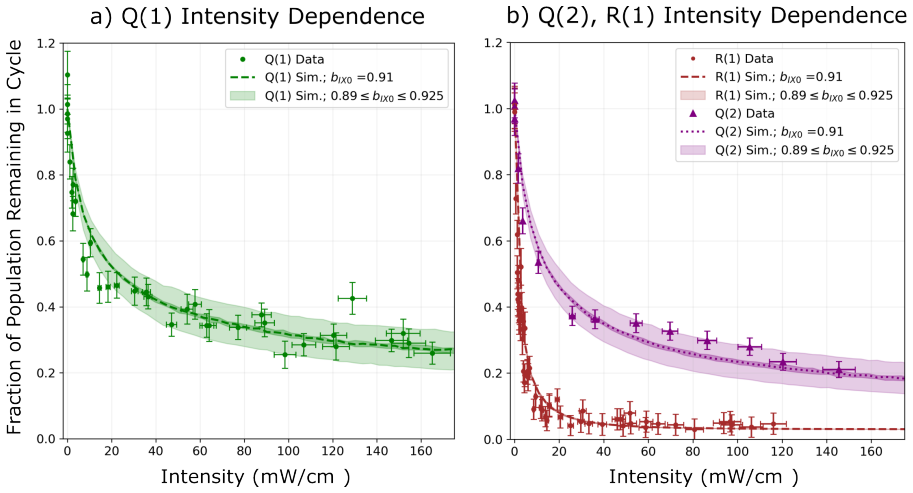
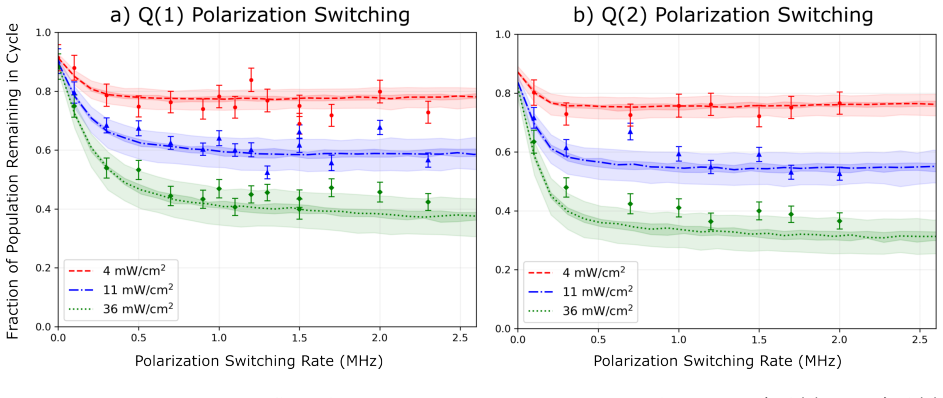
Both the J = 1, 2 rotational levels of ThO are capable of cycling 11(2) photons on average with a single laser, at 1.9(6) × 10^6 s^{-1} and 2.3(7)×10^6 s^{-1} scattering rate, respectively, before population is lost to other vibronic levels; this cycling can be applied in an ACME-style eEDM measurement to improve detection efficiency by over fourfold and statistical sensitivity by over twofold.
What carries the argument
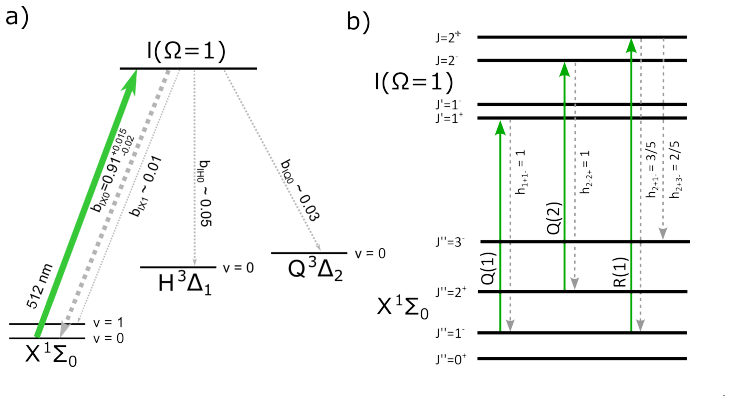
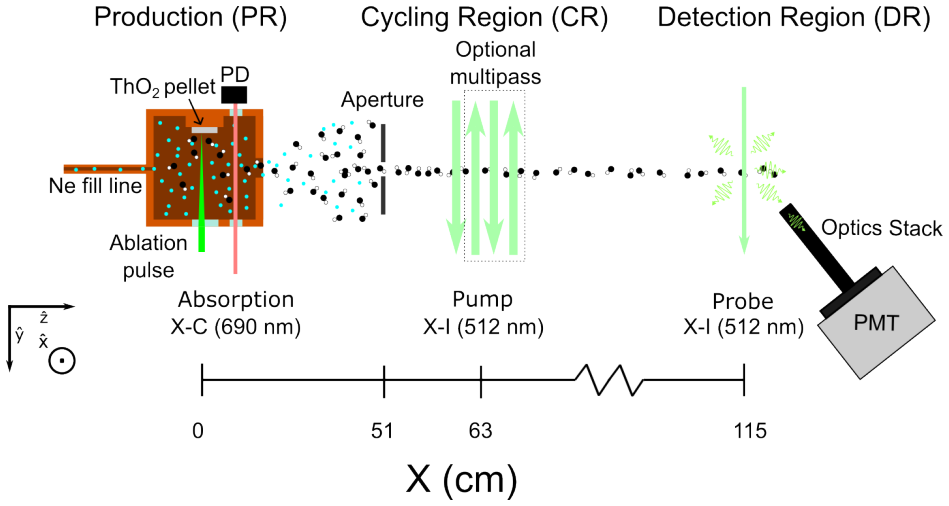
Single-laser optical cycling on the electronic transition of ThO for the J=1 and J=2 levels, demonstrated by counting scattered photons before vibronic loss.
If this is right
- Detection efficiency in ACME-style eEDM measurements rises more than fourfold relative to non-cycling fluorescence detection.
- Statistical sensitivity of the eEDM search improves by more than a factor of two.
- The same scheme can be extended to scatter about 100 photons, opening laser-based quantum control and sensing on ThO.
Where Pith is reading between the lines
- If the cycling works in the actual eEDM beam, the same lasers could be used for state preparation or readout steps that currently rely on multiple lasers.
- Repeating the measurement on other heavy polar molecules used in symmetry tests would test whether the demonstrated cycling is special to ThO or more general.
- The reported scattering rates set a practical limit on how many photons can be collected before a new laser or repump must be added.
Load-bearing premise
The photon numbers measured in the test setup will carry over to the full eEDM apparatus without extra decoherence or loss channels.
What would settle it
A direct measurement of detection efficiency and eEDM statistical uncertainty in an apparatus that actually incorporates the cycling lasers and polarization switching would show whether the claimed fourfold efficiency gain occurs.
Figures
read the original abstract
Optical cycling refers to repeated excitation and spontaneous emission on an electronic transition in an atom or molecule. Optical cycling in molecules can enable a wide range of quantum control and readout techniques, but unfortunately it has only been demonstrated on a small class of alkali-like or alkaline-earth-like molecules. Thorium monoxide (ThO), a molecule used in one of the most precise permanent electron electric dipole moment (eEDM) searches (ACME [1]), does not fall into this category. In this work, we demonstrate the first optical cycling on this non-conventional class over a range of experimental parameter space, including laser intensity, polarization switching rate, and interaction time. We show that both the $J = 1, 2$ rotational levels of ThO molecule are capable of cycling $11(2)$ photons on average with a single laser, at $1.9(6) \times 10^{6}~\mathrm{s}^{-1}$ and $2.3(7)\times 10^6~\mathrm{s}^{-1}$ scattering rate, respectively, before population is lost to other vibronic levels. We outline a scheme to apply this demonstrated optical cycling in an ACME-style eEDM measurement, improving the detection efficiency by over fourfold compared to non-cycling fluorescence detection. This would lead to over a twofold enhancement in the statistical sensitivity of the eEDM search. This optical cycling scheme can be further extended to scatter about 100 photons, which would enable a wider range of quantum control and sensing using ThO molecules. [1] V. Andreev, D. G. Ang, D. DeMille, J. M. Doyle, G. Gabrielse, J. Haefner, N. R. Hutzler, Z. Lasner, C. Meisenhelder, B. R. O`Leary, C. D. Panda, A. D. West, E. P. West, and X. Wu, Nature 562, 355 (2018).
Editorial analysis
A structured set of objections, weighed in public.
Referee Report
Summary. The manuscript reports the first demonstration of optical cycling in thorium monoxide (ThO) molecules, a species used in leading eEDM searches. Using a single laser, both the J=1 and J=2 rotational levels are shown to scatter an average of 11(2) photons at rates of 1.9(6)×10^6 s^{-1} and 2.3(7)×10^6 s^{-1}, respectively, before loss to other vibronic levels. The work varies laser intensity, polarization switching, and interaction time, and outlines a scheme to apply the cycling for over fourfold improvement in detection efficiency (and twofold statistical sensitivity gain) in an ACME-style eEDM measurement, with potential extension to ~100 photons.
Significance. If the central experimental result holds and translates to the target apparatus, the demonstration would be significant for extending optical cycling beyond alkali/alkaline-earth-like molecules to a non-conventional species central to precision fundamental symmetry tests. The provision of measured photon yields and scattering rates with uncertainties constitutes concrete, falsifiable experimental evidence rather than a parameter-free derivation.
major comments (2)
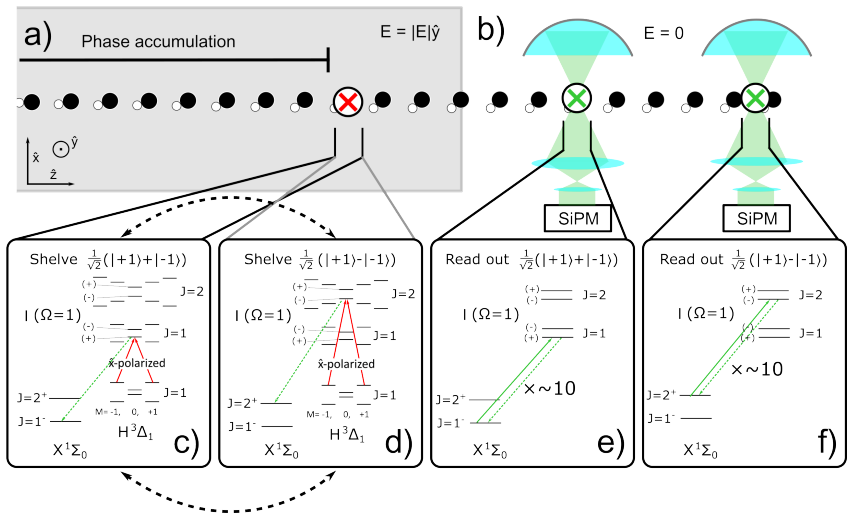
- [Application scheme outline] Application scheme section: the central claim that the demonstrated 11-photon cycling yields a fourfold detection gain (and twofold sensitivity improvement) in the ACME eEDM apparatus rests on the untested assumption that vibronic loss rates and scattering performance remain unchanged when the cycling laser is introduced into the actual molecular beam environment (~100 V/cm electric fields, magnetic shielding, H³Δ₁ state preparation); no data, modeling, or cross-check is provided to support this translation from the separate test apparatus.
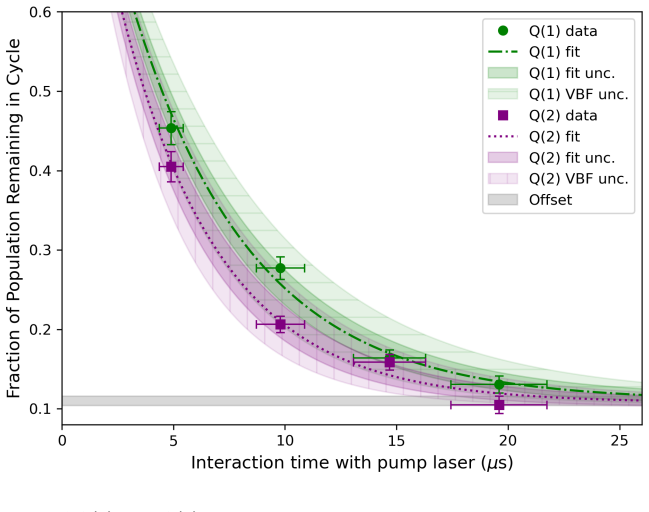
- [Results] Results section (measured values): the reported averages of 11(2) photons and the two scattering rates are presented with uncertainties, but the manuscript provides no figures, raw data, or full experimental details on how these quantities were extracted from the test setup, making it difficult to assess statistical support or systematic controls for the central experimental claim.
minor comments (1)
- [Introduction] The abstract and introduction cite Ref. [1] for the ACME experiment but do not discuss how the proposed cycling scheme interfaces with the specific state preparation and detection geometry already used in that work.
Simulated Author's Rebuttal
We thank the referee for their careful reading of the manuscript and for recognizing the significance of the first demonstration of optical cycling in ThO. We address each major comment below and outline revisions that will strengthen the presentation of our results and the application scheme.
read point-by-point responses
-
Referee: [Application scheme outline] Application scheme section: the central claim that the demonstrated 11-photon cycling yields a fourfold detection gain (and twofold sensitivity improvement) in the ACME eEDM apparatus rests on the untested assumption that vibronic loss rates and scattering performance remain unchanged when the cycling laser is introduced into the actual molecular beam environment (~100 V/cm electric fields, magnetic shielding, H³Δ₁ state preparation); no data, modeling, or cross-check is provided to support this translation from the separate test apparatus.
Authors: We agree that the application scheme relies on an extrapolation and that direct testing in the full ACME apparatus has not been performed. The vibronic branching ratios are set by molecular Franck-Condon factors and are insensitive to the moderate electric fields and magnetic environment of the ACME beam; the H³Δ₁ preparation is already incorporated into the outlined scheme. Nevertheless, to make the assumptions explicit and quantitative, we will add a rate-equation model in the revised manuscript that includes the known Stark and Zeeman shifts on the relevant rotational levels and estimates any residual impact on the scattering rate and loss. This will provide a clearer basis for the projected fourfold detection gain. revision: yes
-
Referee: [Results] Results section (measured values): the reported averages of 11(2) photons and the two scattering rates are presented with uncertainties, but the manuscript provides no figures, raw data, or full experimental details on how these quantities were extracted from the test setup, making it difficult to assess statistical support or systematic controls for the central experimental claim.
Authors: The photon yields and scattering rates were obtained by measuring fluorescence as a function of interaction time, laser intensity, and polarization switching rate, then fitting the data to a model that accounts for the finite cycling lifetime set by vibronic loss. We acknowledge that the current manuscript text is concise and would benefit from additional visual and procedural detail. In revision we will add a figure displaying the measured photon number versus interaction time for both J=1 and J=2 (with fits), together with an expanded methods subsection that details the fitting procedure, background subtraction, and systematic uncertainty evaluation. revision: yes
Circularity Check
No significant circularity; experimental results are direct measurements
full rationale
The paper reports direct experimental measurements of average photon cycling numbers (11(2)) and scattering rates for ThO J=1,2 levels under varying laser parameters. These quantities are obtained from observed fluorescence and population loss in the test apparatus, not from any model or fit that reuses the same data as a prediction. The outlined application scheme for ACME-style eEDM detection uses the measured photon yield to estimate a fourfold efficiency gain but introduces no self-referential equations or parameter fitting that would make the gain tautological. The single citation to prior ACME work [1] supplies background context for the target experiment and does not bear the load of proving the new cycling results. No self-citation chain, ansatz smuggling, or renaming of known results occurs; the central claims rest on independent laboratory data.
Axiom & Free-Parameter Ledger
axioms (2)
- standard math Standard assumptions of molecular quantum mechanics and selection rules for electronic transitions.
- domain assumption The population loss is primarily to other vibronic levels as stated.
Reference graph
Works this paper leans on
-
[1]
Andreev, D
V. Andreev, D. G. Ang, D. DeMille, J. M. Doyle, G. Gabrielse, J. Haefner, N. R. Hutzler, Z. Lasner, C. Meisenhelder, B. R. O’Leary, C. D. Panda, A. D. West, E. P. West, and X. Wu, Nature562, 355 (2018)
2018
-
[2]
Lasner and D
Z. Lasner and D. DeMille, Phys. Rev. A98, 053823 (2018)
2018
-
[3]
M. A. Joffe, W. Ketterle, A. Martin, and D. E. Pritchard, J. Opt. Soc. Am. B10(1993)
1993
-
[4]
E. S. Shuman, J. F. Barry, and D. Demille, Nature467(2010)
2010
-
[5]
Kozyryev, L
I. Kozyryev, L. Baum, K. Matsuda, B. L. Augenbraun, L. Anderegg, A. P. Sedlack, and J. M. Doyle, Phys. Rev. Lett.118(2017)
2017
-
[6]
S. F. V´ azquez-Carson, Q. Sun, J. Dai, D. Mitra, and T. Zelevinsky, New J. Phys.24, 083006 (2022)
2022
-
[7]
Kogel, T
F. Kogel, T. Garg, M. Rockenh¨ auser, and T. Langen, Phys. Rev. Res.7, L022041 (2025)
2025
-
[8]
S. V. Andreev, V. I. Balykin, V. S. Letekhov, and V. G. Minogin, J. Exp. Theor. Phys. Lett.34(1981)
1981
-
[9]
W. D. Phillips and H. Metcalf, Phys. Rev. Lett.48, 596 (1982)
1982
-
[10]
J. F. Barry, E. S. Shuman, E. B. Norrgard, and D. DeMille, Phys. Rev. Lett.108, 103002 (2012)
2012
-
[11]
E. L. Raab, M. Prentiss, A. Cable, S. Chu, and D. E. Pritchard, Phys. Rev. Lett.59, 2631 (1987)
1987
-
[12]
N. B. Vilas, C. Hallas, L. Anderegg, P. Robichaud, A. Winnicki, D. Mitra, and J. M. Doyle, Nature 606, 70 (2022)
2022
-
[13]
Manai, R
I. Manai, R. Horchani, H. Lignier, P. Pillet, D. Comparat, A. Fioretti, and M. Allegrini, Phys. Rev. Lett.109, 183001 (2012)
2012
-
[14]
Wakim, P
A. Wakim, P. Zabawa, M. Haruza, and N. P. Bigelow, Opt. Express20(2012)
2012
-
[15]
P. F. Staanum, K. Højbjerre, P. S. Skyt, A. K. Hansen, and M. Drewsen, Nat. Phys.6(2010)
2010
-
[16]
Schneider, B
T. Schneider, B. Roth, H. Duncker, I. Ernsting, and S. Schiller, Nat. Phys.6(2010)
2010
-
[17]
Kogel, T
F. Kogel, T. Garg, M. Rockenh¨ auser, S. A. Morales-Ram´ ırez, and T. Langen, New J. Phys.27, 055001 (2025)
2025
-
[18]
Grasdijk, D
O. Grasdijk, D. DeMille, J. Kastelic, S. Lamoreaux, O. Timgren, K. Wenz, T. Zelevinsky, and D. Kawall (CeNTREX Collaboration), Phys. Rev. A112, 022803 (2025)
2025
-
[19]
S. H. Youn, M. Lu, U. Ray, and B. L. Lev, Phys. Rev. A82, 043425 (2010)
2010
-
[20]
Inoue, Y
R. Inoue, Y. Miyazawa, and M. Kozuma, Phys. Rev. A97, 061607 (2018). 16
2018
-
[21]
Eustice, J
S. Eustice, J. Schrott, A. St¨ oltzel, J. Wolf, D. Novoa, K. Cassella, and D. M. Stamper-Kurn, Phys. Rev. Res.7, 023025 (2025)
2025
-
[22]
M. D. D. Rosa, Eur. Phys. J. D31, 395 (2004)
2004
-
[23]
B. K. Stuhl, B. C. Sawyer, D. Wang, and J. Ye, Phys. Rev. Lett.101, 243002 (2008)
2008
-
[24]
E. S. Shuman, J. F. Barry, D. R. Glenn, and D. DeMille, Phys. Rev. Lett.103, 223001 (2009)
2009
-
[25]
T. E. Wall, J. F. Kanem, J. J. Hudson, B. E. Sauer, D. Cho, M. G. Boshier, E. A. Hinds, and M. R. Tarbutt, Phys. Rev. A78, 062509 (2008)
2008
-
[26]
Pelegrini, C
M. Pelegrini, C. S. Vivacqua, O. Roberto-Neto, F. R. Ornellas, and F. B. Machado, Braz. J. Phys.35 (2005)
2005
-
[27]
S. M. Udrescu, S. G. Wilkins, A. A. Breier, M. Athanasakis-Kaklamanakis, R. F. G. Ruiz, M. Au, I. Beloˇ sevi´ c, R. Berger, M. L. Bissell, C. L. Binnersley, A. J. Brinson, K. Chrysalidis, T. E. Cocolios, R. P. de Groote, A. Dorne, K. T. Flanagan, S. Franchoo, K. Gaul, S. Geldhof, T. F. Giesen, D. Hanstorp, R. Heinke, Koszor´ us, S. Kujanp¨ a¨ a, L. Lalann...
2024
-
[28]
B. L. Augenbraun, Z. D. Lasner, A. Frenett, H. Sawaoka, C. Miller, T. C. Steimle, and J. M. Doyle, New J. Phys.22, 022003 (2020)
2020
-
[29]
Mitra, N
D. Mitra, N. B. Vilas, C. Hallas, L. Anderegg, B. L. Augenbraun, L. Baum, C. Miller, S. Raval, and J. M. Doyle, Science369, 1366 (2020)
2020
-
[30]
G. Z. Zhu, D. Mitra, B. L. Augenbraun, C. E. Dickerson, M. J. Frim, G. Lao, Z. D. Lasner, A. N. Alexandrova, W. C. Campbell, J. R. Caram, J. M. Doyle, and E. R. Hudson, Nat. Chem.14(2022)
2022
-
[31]
Mitra, Z
D. Mitra, Z. D. Lasner, G. Z. Zhu, C. E. Dickerson, B. L. Augenbraun, A. D. Bailey, A. N. Alexandrova, W. C. Campbell, J. R. Caram, E. R. Hudson, and J. M. Doyle, J. Phys. Chem. Lett.13(2022)
2022
-
[32]
A. L. Collopy, M. T. Hummon, M. Yeo, B. Yan, and J. Ye, New J. Phys.17(2015)
2015
-
[33]
Q. S. Yang, Y. F. Gao, Y. Yu, and T. Gao, Mol. Phys.114(2016)
2016
-
[34]
R. Yang, B. Tang, and T. Gao, Chin. Phys. B25(2016)
2016
-
[35]
Hofs¨ ass, M
S. Hofs¨ ass, M. Doppelbauer, S. C. Wright, S. Kray, B. G. Sartakov, J. P´ erez-R´ ıos, G. Meijer, and S. Truppe, New J. Phys.23, 075001 (2021)
2021
-
[36]
J. R. Daniel, C. Wang, K. Rodriguez, B. Hemmerling, T. N. Lewis, C. Bardeen, A. Teplukhin, and B. K. Kendrick, Phys. Rev. A104, 012801 (2021)
2021
- [37]
-
[38]
K. C. Stuntz, K. L. Rice, L. Cheng, and B. L. Augenbraun, Phys. Rev. A110, 042807 (2024)
2024
-
[39]
D. L. Kokkin, T. C. Steimle, and D. DeMille, Phys. Rev. A90, 062503 (2014)
2014
-
[40]
Zaitsevskii, A
A. Zaitsevskii, A. V. Oleynichenko, and E. Eliav, Mol. Phys.123(2025)
2025
-
[41]
Pauloviˇ c, T
J. Pauloviˇ c, T. Nakajima, K. Hirao, R. Lindh, and P. ˚A. Malmqvist, J. Chem. Phys.119(2003)
2003
-
[42]
Tecmer and C
P. Tecmer and C. E. Gonz´ alez-Espinoza, Phys. Chem. Chem. Phys.20(2018)
2018
-
[43]
Cesarotti, Q
C. Cesarotti, Q. Lu, Y. Nakai, A. Parikh, and M. Reece, J. High Energy Phys.2019, 59 (2019)
2019
-
[44]
T. E. Chupp, P. Fierlinger, M. J. Ramsey-Musolf, and J. T. Singh, Rev. Mod. Phys91(2019)
2019
-
[45]
F. Wang, A. Le, T. C. Steimle, and M. C. Heaven, J. Chem. Phys.134, 031102 (2011)
2011
-
[46]
D. L. Kokkin, T. C. Steimle, and D. DeMille, Phys. Rev. A91, 042508 (2015)
2015
-
[47]
Edvinsson, A
G. Edvinsson, A. von Bornstedt, and P. Nylen, Ark. Fys.38(1967)
1967
-
[48]
Wentink and R
T. Wentink and R. J. Spindler, J. Quant. Spectrosc. Radiat. Transfer12(1972)
1972
-
[49]
Kozyryev, L
I. Kozyryev, L. Baum, K. Matsuda, B. Hemmerling, and J. M. Doyle, J. Phys. B49(2016)
2016
-
[50]
Hansson and J
A. Hansson and J. K. Watson, J. Mol. Spectrosc.233(2005). 17
2005
-
[51]
Fitch and M
N. Fitch and M. Tarbutt, in Advances in atomic, molecular, and optical physics, Vol. 70, edited by L. F. Dimauro, H. Perrin, and S. F. Yelin (Academic Press, 2021), pp. 157–262
2021
-
[52]
D. J. Berkeland and M. G. Boshier, Phys. Rev. A65, 033413 (2002)
2002
-
[53]
X. Wu, Z. Han, J. Chow, D. G. Ang, C. Meisenhelder, C. D. Panda, E. P. West, G. Gabrielse, J. M. Doyle, and D. Demille, New J. Phys.22(2020)
2020
-
[54]
N. R. Hutzler, M. F. Parsons, Y. V. Gurevich, P. W. Hess, E. Petrik, B. Spaun, A. C. Vutha, D. Demille, G. Gabrielse, and J. M. Doyle, Phys. Chem. Chem. Phys.13(2011)
2011
-
[55]
Z. Han, Z. Lasner, C. Diver, P. Hu, T. Masuda, X. Wu, A. Hiramoto, M. Watts, S. Uetake, K. Yoshimura, X. Fan, G. Gabrielse, J. M. Doyle, and D. DeMille, APS Open Sci.1, 000016 (2026)
2026
-
[56]
Masuda, A
T. Masuda, A. Hiramoto, D. G. Ang, C. Meisenhelder, C. D. Panda, N. Sasao, S. Uetake, X. Wu, D. P. DeMille, J. M. Doyle, G. Gabrielse, and K. Yoshimura, Opt. Express31, 1943 (2023)
1943
-
[57]
D. G. Ang, C. Meisenhelder, C. D. Panda, X. Wu, D. DeMille, J. M. Doyle, and G. Gabrielse, Phys. Rev. A106, 022808 (2022)
2022
-
[58]
H. J. Williams, S. Truppe, M. Hambach, L. Caldwell, N. J. Fitch, E. A. Hinds, B. E. Sauer, and M. R. Tarbutt, New J. Phys.19(2017)
2017
-
[59]
A. L. Collopy, S. Ding, Y. Wu, I. A. Finneran, L. Anderegg, B. L. Augenbraun, J. M. Doyle, and J. Ye, Phys. Rev. Lett.121, 213201 (2018)
2018
-
[60]
C. D. Panda, C. Meisenhelder, M. Verma, D. G. Ang, J. Chow, Z. Lasner, X. Wu, D. DeMille, J. M. Doyle, and G. Gabrielse, J. Phys. B52, 235003 (2019)
2019
-
[61]
Masuda, D
T. Masuda, D. G. Ang, N. R. Hutzler, C. Meisenhelder, N. Sasao, S. Uetake, X. Wu, D. DeMille, G. Gabrielse, J. M. Doyle, and K. Yoshimura, Opt. Express29, 16914 (2021)
2021
-
[62]
X. Wu, P. Hu, Z. Han, D. G. Ang, C. Meisenhelder, G. Gabrielse, J. M. Doyle, and D. DeMille, New J. Phys.24, 073043 (2022)
2022
-
[63]
T. S. Roussy, L. Caldwell, T. Wright, W. B. Cairncross, Y. Shagam, K. B. Ng, N. Schlossberger, S. Y. Park, A. Wang, J. Ye, and E. A. Cornell, Science381, 46 (2023)
2023
-
[64]
Hiramoto, T
A. Hiramoto, T. Masuda, D. Ang, C. Meisenhelder, C. Panda, N. Sasao, S. Uetake, X. Wu, D. Demille, J. Doyle, G. Gabrielse, and K. Yoshimura, Nucl. Instrum. Methods Phys. Res., Sect. A1045, 167513 (2023)
2023
-
[65]
C. J. Ho, J. A. Devlin, I. M. Rabey, P. Yzombard, J. Lim, S. C. Wright, N. J. Fitch, E. A. Hinds, M. R. Tarbutt, and B. E. Sauer, New J. Phys.22, 043031 (2020). 18 A Rate Equation Model In this appendix, we first describe in detail the construction of the rate-equation model discussed in the main text (Sec. 2.2). Then, we describe what this model informs ...
2020
discussion (0)
Sign in with ORCID, Apple, or X to comment. Anyone can read and Pith papers without signing in.