Anisotropic magnetism and Kondo-lattice behavior in the frustrated antiferromagnet Ce3MgBi5
Pith reviewed 2026-06-29 09:56 UTC · model grok-4.3
The pith
Ce3MgBi5 exhibits antiferromagnetic order below 4.2 K with strong anisotropy and Kondo-lattice signatures.
A machine-rendered reading of the paper's core claim, the machinery that carries it, and where it could break.
Core claim
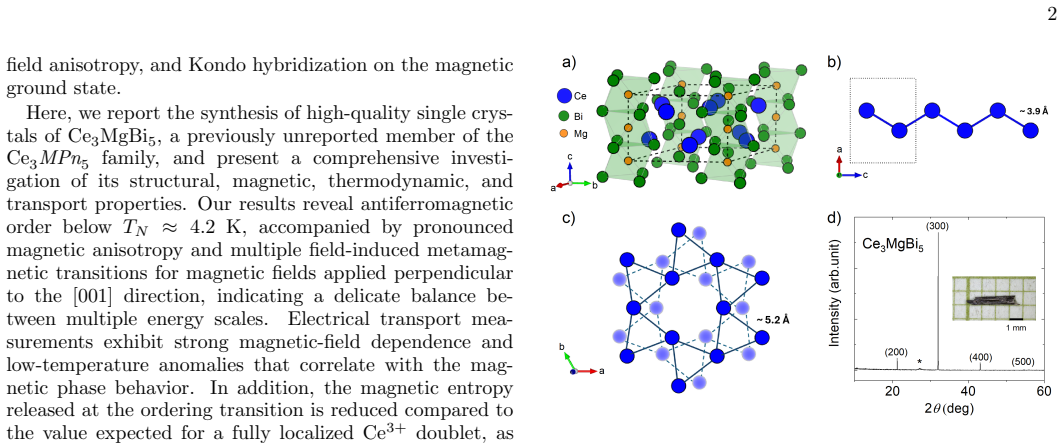
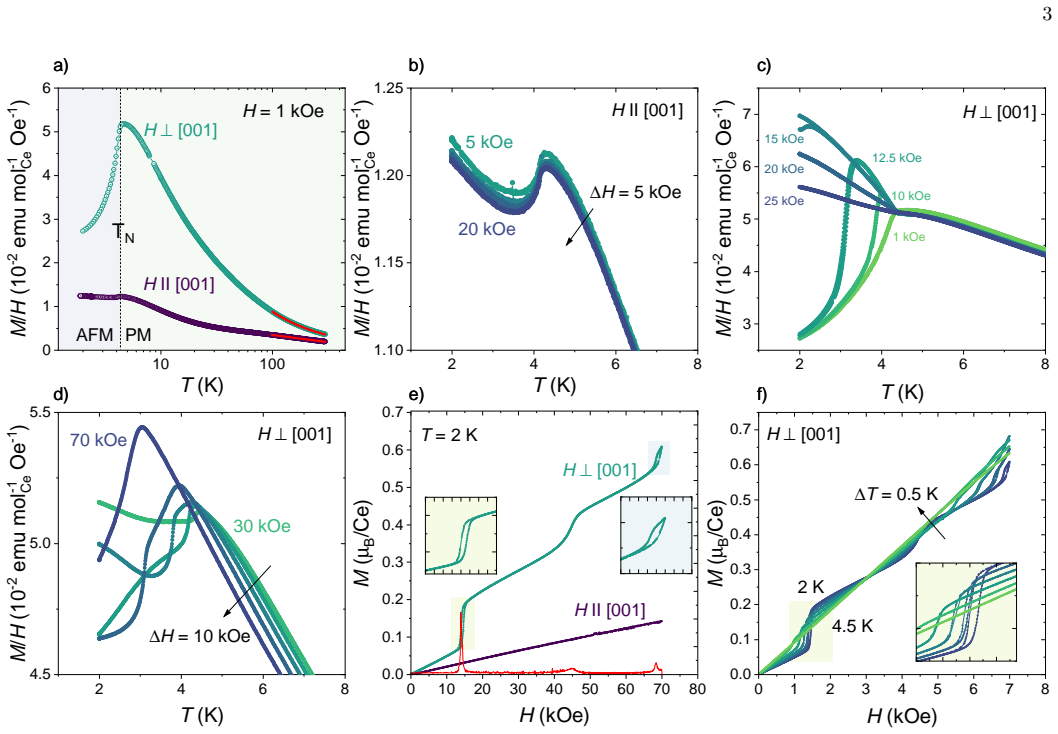
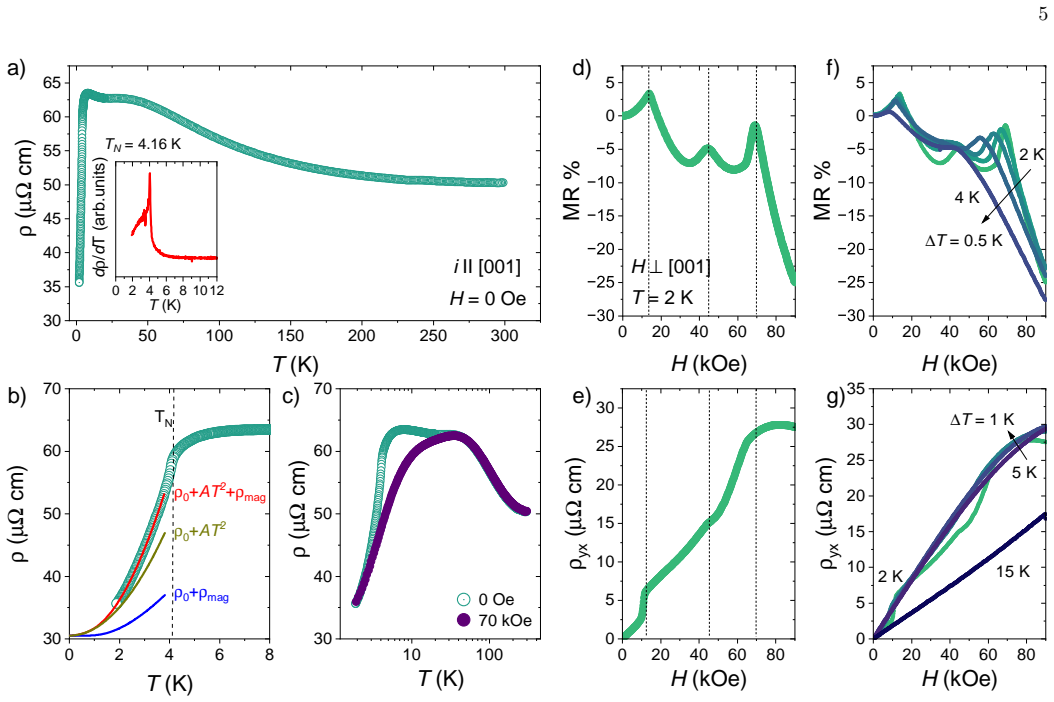
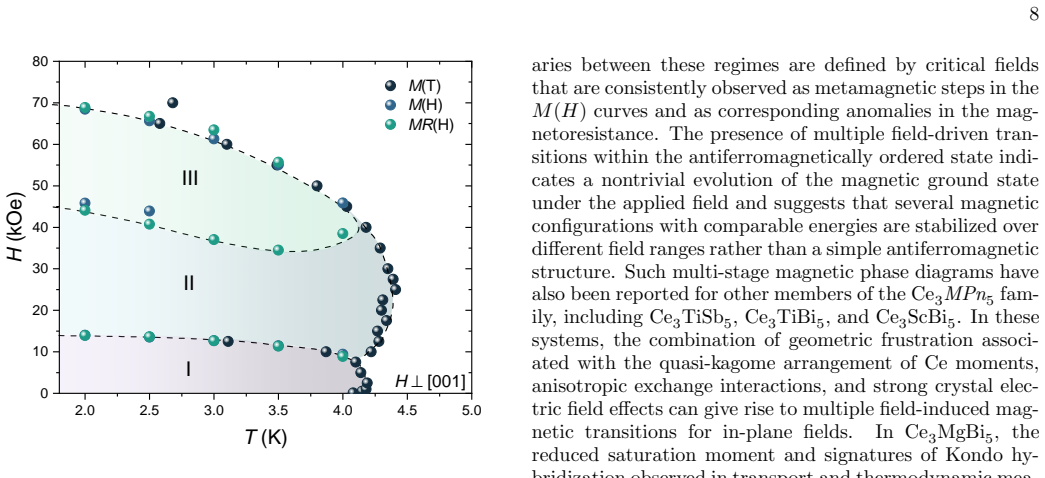
Ce3MgBi5 crystallizes in the hexagonal P63/mcm structure, featuring an anisotropic Ce sublattice composed of zig-zag chains along the c axis and a distorted kagome-like network in the basal plane. Magnetization measurements reveal antiferromagnetic order below TN approximately 4.2 K, accompanied by strong magnetic anisotropy and multiple field-induced metamagnetic transitions for fields applied perpendicular to [001], leading to a dome-shaped H-T phase diagram. Electrical transport exhibits characteristic signatures of a Ce-based Kondo lattice, including broad resistivity maxima and pronounced field-dependent anomalies in the magnetoresistance and Hall response that track the magnetic phase
What carries the argument
The anisotropic Ce sublattice in Ce3MgBi5, which produces geometric frustration in the basal plane, strong easy-axis anisotropy along [001], and the observed Kondo-lattice signatures in transport and thermodynamics.
If this is right
- The dome-shaped H-T phase diagram is produced by the sequence of metamagnetic transitions that appear only for fields applied perpendicular to [001].
- The field-dependent anomalies in magnetoresistance and Hall resistivity follow the boundaries of the magnetic phases.
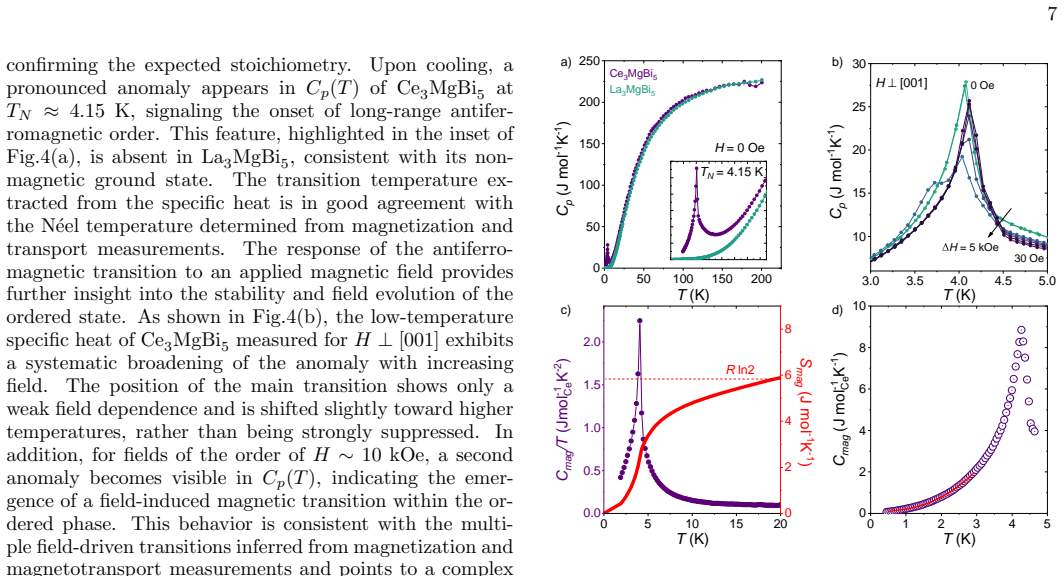
- Kondo correlations persist well above TN, as shown by the full R ln 2 entropy being recovered only by 20 K.
- Ce3MgBi5 provides a new platform inside the Ce3MPn5 family for studying the combined effects of frustration, anisotropy, and Kondo physics.
Where Pith is reading between the lines
- Chemical substitution on the Mg or Bi site could shift the balance between Kondo screening and the ordering temperature.
- Pressure or doping experiments might suppress the antiferromagnetic order and reveal a quantum critical point.
- The distorted kagome network in the basal plane suggests possible comparison with other frustrated Ce compounds to isolate the role of the zig-zag chains.
Load-bearing premise
The broad resistivity maxima, field-dependent magnetoresistance and Hall anomalies, and recovery of R ln 2 entropy by 20 K arise from Kondo-lattice correlations rather than other scattering or fluctuation mechanisms.
What would settle it
A measurement showing that the transport anomalies do not track the magnetic phase boundaries or that the R ln 2 entropy is recovered at a much lower temperature independent of field would undermine the Kondo-lattice assignment.
Figures
read the original abstract
We report the synthesis and physical characterization of single-crystalline Ce3MgBi5, a previously unexplored member of the Ce3MPn5 family. This compound crystallizes in the hexagonal P63/mcm structure, featuring an anisotropic Ce sublattice composed of zig-zag chains along the c axis and a distorted kagome-like network in the basal plane. Magnetization measurements reveal antiferromagnetic order below TN approximately 4.2 K, accompanied by strong magnetic anisotropy and multiple field-induced metamagnetic transitions for fields applied perpendicular to [001], leading to a dome-shaped H-T phase diagram. Electrical transport exhibits characteristic signatures of a Ce-based Kondo lattice, including broad resistivity maxima and pronounced field-dependent anomalies in the magnetoresistance and Hall response that track the magnetic phase boundaries. Specific-heat measurements confirm the magnetic transition and show that the full R ln 2 entropy expected for a Ce3+ Kramers doublet is recovered by 20 K, indicating an extended temperature range of magnetic fluctuations consistent with Kondo correlations. Our results establish Ce3MgBi5 as a platform within the Ce3MPn5 family for exploring the interplay of geometric frustration, magnetic anisotropy, and Kondo-lattice physics under applied magnetic fields.
Editorial analysis
A structured set of objections, weighed in public.
Referee Report
Summary. The manuscript reports the synthesis of single-crystalline Ce3MgBi5 (hexagonal P63/mcm structure with zig-zag Ce chains and distorted kagome network) and its characterization via magnetization, electrical transport, and specific-heat measurements. It claims antiferromagnetic order below TN ≈ 4.2 K with strong anisotropy, multiple field-induced metamagnetic transitions for H ⊥ [001] producing a dome-shaped H-T phase diagram, transport features (broad resistivity maxima, field-dependent MR and Hall anomalies tracking phase boundaries) interpreted as Ce-based Kondo-lattice signatures, and specific-heat data showing full R ln 2 entropy recovery by 20 K, establishing the material as a platform for frustration-anisotropy-Kondo interplay.
Significance. If substantiated, the work would add a new member to the Ce3MPn5 family with potentially interesting field-tunable magnetic phases. The reported anisotropy and dome-shaped diagram are of note for frustrated systems, but the overall significance is tempered by the qualitative and non-unique nature of the evidence for Kondo-lattice behavior.
major comments (2)
- [Abstract] Abstract: the interpretive claim of 'characteristic signatures of a Ce-based Kondo lattice' (broad resistivity maxima, field-dependent MR/Hall anomalies, R ln 2 entropy by 20 K) rests on features that are also consistent with CEF level population or incoherent magnetic scattering above TN; no quantitative modeling, resistivity fits to Kondo vs. CEF+scattering models, or independent CEF determination is referenced to discriminate between mechanisms.
- [Abstract] Abstract: the reported TN ≈ 4.2 K, metamagnetic transitions, and entropy recovery lack accompanying error bars, sample stoichiometry/impurity characterization, or details on how phase boundaries were determined from transport data, weakening the reliability of the central experimental claims.
minor comments (1)
- [Abstract] The abstract states that MR and Hall anomalies 'track the magnetic phase boundaries' without specifying the method of correlation (e.g., overlaid figures or quantitative comparison).
Simulated Author's Rebuttal
We are grateful to the referee for their thorough review and insightful comments on our manuscript concerning Ce3MgBi5. We address each of the major comments below and outline the revisions we will make to improve the clarity and reliability of our claims.
read point-by-point responses
-
Referee: [Abstract] Abstract: the interpretive claim of 'characteristic signatures of a Ce-based Kondo lattice' (broad resistivity maxima, field-dependent MR/Hall anomalies, R ln 2 entropy by 20 K) rests on features that are also consistent with CEF level population or incoherent magnetic scattering above TN; no quantitative modeling, resistivity fits to Kondo vs. CEF+scattering models, or independent CEF determination is referenced to discriminate between mechanisms.
Authors: We agree with the referee that the features cited are not unique to Kondo-lattice behavior and could arise from CEF effects or magnetic fluctuations. Our interpretation draws from the broader context of the Ce3MPn5 family, where similar transport anomalies are associated with Kondo physics, and the full entropy recovery by 20 K suggests significant fluctuations above TN. However, we acknowledge the lack of quantitative discrimination in the current work. We will revise the abstract to use more cautious language, such as 'features suggestive of Kondo-lattice behavior', and include a note in the main text that future studies involving CEF modeling or spectroscopy would be valuable to confirm the mechanism. This constitutes a partial revision. revision: partial
-
Referee: [Abstract] Abstract: the reported TN ≈ 4.2 K, metamagnetic transitions, and entropy recovery lack accompanying error bars, sample stoichiometry/impurity characterization, or details on how phase boundaries were determined from transport data, weakening the reliability of the central experimental claims.
Authors: The referee correctly identifies that the abstract is brief and omits important details present in the full manuscript. Sample stoichiometry was characterized via energy-dispersive X-ray spectroscopy, showing near-ideal composition with minimal impurities, and this is reported in the methods section. Error bars on TN and other quantities are included in the figures and discussed in the text. Phase boundaries were extracted from peaks and anomalies in dρ/dT, magnetization, and specific heat data. We will update the abstract to include error estimates (e.g., TN = 4.2 ± 0.1 K) and a brief reference to sample quality and determination methods. This will be a full revision of the abstract and minor clarifications in the main text. revision: yes
Circularity Check
No circularity: purely experimental reporting with no derivations or fitted predictions
full rationale
The manuscript is an experimental characterization of Ce3MgBi5 via synthesis, magnetization, resistivity, magnetoresistance, Hall effect, and specific-heat measurements. All central claims (TN ≈ 4.2 K, anisotropy, metamagnetic transitions, dome-shaped H-T diagram, resistivity maxima, entropy recovery by 20 K) are direct statements of observed data. No equations, parameter fitting, self-citations used as uniqueness theorems, or ansatze appear in the derivation chain. The interpretive label 'Kondo-lattice behavior' is presented as a qualitative reading of transport/entropy features rather than a quantitative prediction that reduces to the input data by construction. This is the normal case for a materials-discovery paper; the derivation chain is self-contained against external benchmarks.
Axiom & Free-Parameter Ledger
axioms (1)
- domain assumption The compound crystallizes in the hexagonal P63/mcm structure featuring zig-zag Ce chains and distorted kagome network
Reference graph
Works this paper leans on
-
[1]
ForH⊥[001], the magnetization exhibits three distinct metamagnetic transitions, indicating a com- plex field-driven evolution of the magnetic state
direction. ForH⊥[001], the magnetization exhibits three distinct metamagnetic transitions, indicating a com- plex field-driven evolution of the magnetic state. These transitions are further highlighted by pronounced anoma- lies in the field derivatived(M)/dH(red solid line). No- tably, the first and third transitions display clear hysteresis between incre...
-
[2]
Such antisymmetric exchange interactions can further in- fluence the in-plane spin configurations and contribute to the anisotropic magnetic response observed in Ce 3MgBi5
and Ce3TiBi5 [34], the absence of local inversion sym- metry at the Ce sites, together with strong spin–orbit cou- pling, allows for a finite Dzyaloshinskii–Moriya interaction. Such antisymmetric exchange interactions can further in- fluence the in-plane spin configurations and contribute to the anisotropic magnetic response observed in Ce 3MgBi5. The tem...
-
[3]
In zero magnetic field, Ce3MgBi5 undergoes a transition into an antiferromagnetically ordered state atT N ≈4.2 K
direction remains small and nearly linear over the entire investigated field range - confirming [001] as the magnetic hard axis - we focus here on the phase diagram forH⊥[001], where the magnetic response is most pro- nounced. In zero magnetic field, Ce3MgBi5 undergoes a transition into an antiferromagnetically ordered state atT N ≈4.2 K. Upon application...
-
[4]
This behavior reflects a competition between magnetic exchange interactions and the Zeeman energy in a strongly anisotropic system
direction, the ordering temperature shows a non- monotonic evolution and defines a dome-like ordered re- gion in theH−Tplane, rather than a simple field-driven suppression of antiferromagnetism. This behavior reflects a competition between magnetic exchange interactions and the Zeeman energy in a strongly anisotropic system. Within the ordered region, add...
-
[5]
Van Vleck, Note on the interactions between the spins of magnetic ions or nuclei in metals, Reviews of Modern Physics34, 681 (1962)
J. Van Vleck, Note on the interactions between the spins of magnetic ions or nuclei in metals, Reviews of Modern Physics34, 681 (1962)
1962
-
[6]
Kasuya, A theory of metallic ferro-and antiferromag- netism on Zener’s model, Progress of Theoretical Physics 16, 45 (1956)
T. Kasuya, A theory of metallic ferro-and antiferromag- netism on Zener’s model, Progress of Theoretical Physics 16, 45 (1956)
1956
-
[7]
M. A. Ruderman and C. Kittel, Indirect exchange cou- pling of nuclear magnetic moments by conduction electrons, Physical Review96, 99 (1954)
1954
-
[8]
Doniach, The Kondo lattice and weak antiferromag- netism, physica B+ C91, 231 (1977)
S. Doniach, The Kondo lattice and weak antiferromag- netism, physica B+ C91, 231 (1977)
1977
-
[9]
Y.-f. Yang, Z. Fisk, H.-O. Lee, J. Thompson, and D. Pines, Scaling the Kondo lattice, Nature454, 611 (2008)
2008
-
[10]
Gupta, D
L. Gupta, D. MacLaughlin, C. Tien, C. Godart, M. Ed- wards, and R. Parks, Magnetic behavior of the kondo- lattice system CeRu 2Si2, Physical Review B28, 3673 (1983)
1983
-
[11]
Mallik, E
R. Mallik, E. Sampathkumaran, P. Paulose, J. Dumschat, and G. Wortmann, Kondo-lattice behavior and multiple characteristic temperatures in CeIr 2Ge2, Physical Review B55, 3627 (1997)
1997
-
[12]
Zhang, J
J. Zhang, J. Wu, Y. Chen, R. Li, M. Smidman, Y. Liu, Y. Song, and H. Yuan, Structural and physical properties of the heavy fermion metal Ce 2NiAl6Si5, Chinese Physics Letters41, 127304 (2024)
2024
-
[13]
N. J. Ghimire, S. K. Cary, S. Eley, N. A. Wakeham, P. F. Rosa, T. Albrecht-Schmitt, Y. Lee, M. Janoschek, C. Brown, L. Civale,et al., Physical properties of the Ce2MAl7Ge4 heavy-fermion compounds (M= Co, Ir, Ni, Pd), Physical Review B93, 205141 (2016)
2016
-
[14]
Shishido, T
H. Shishido, T. Shibauchi, K. Yasu, T. Kato, H. Kontani, T. Terashima, and Y. Matsuda, Tuning the dimensionality of the heavy fermion compound CeIn 3, Science327, 980 (2010)
2010
-
[15]
R. T. Macaluso, S. Nakatsuji, H. Lee, Z. Fisk, M. Moldovan, D. Young, and J. Y. Chan, Synthesis, structure, and mag- netism of a new heavy-fermion antiferromagnet, CePdGa 6, Journal of Solid State Chemistry174, 296 (2003)
2003
-
[16]
H. Ye, T. Le, H. Su, Y. Zhang, S. Luo, M. Gutmann, H. Yuan, and M. Smidman, Magnetic properties of the layered heavy-fermion antiferromagnet CePdGa6, Physical Review B105, 014405 (2022)
2022
-
[17]
Zhang, B
Y. Zhang, B. Shen, F. Du, Y. Chen, J. Liu, H. Lee, M. Smidman, and H. Yuan, Structural and magnetic prop- erties of antiferromagnetic Ce 2IrGa12, Physical Review B 101, 024421 (2020)
2020
-
[18]
X. He, Y. Li, Y. Ge, H. Zeng, S.-J. Song, J. Liu, S. Zou, Z. Wang, Y. Li, W. Ding,et al., Rich unconventional Hall effects in a single quasi-kagome Kondo Weyl semimetal can- didate Ce3TiSb5, Communications Materials6, 206 (2025)
2025
-
[19]
M. F. Hundley, P. Canfield, J. D. Thompson, and Z. Fisk, Substitutional effects on the electronic transport of the kondo semiconductor Ce 3Bi4Pt3, Physical Review B50, 18142 (1994)
1994
-
[20]
Motoyama, M
G. Motoyama, M. Sezaki, J. Gouchi, K. Miyoshi, S. Nishig- ori, T. Mutou, K. Fujiwara, and Y. Uwatoko, Magnetic properties of new antiferromagnetic heavy-fermion com- pounds, Ce 3TiBi5 and CeTi 3Bi4, Physica B: Condensed Matter536, 142 (2018)
2018
-
[21]
J. F. Khoury, B. Han, M. Jovanovic, R. Queiroz, X. Yang, R. Singha, T. H. Salters, C. J. Pollak, S. B. Lee, N. Ong, et al., Towards 1D Transport in 3D Materials: SOC- Induced Charge-Transport Anisotropy in Sm 3ZrBi5, Ad- vanced Materials , 2404553 (2024)
2024
-
[22]
J. F. Khoury, X. Song, and L. M. Schoop, Ln 3MBi5 (Ln= Pr, Nd, Sm; M= Zr, Hf): Intermetallics with Hyperva- lent Bismuth Chains, Zeitschrift f¨ ur anorganische und all- gemeine Chemie648, e202200123 (2022)
2022
-
[23]
Zhang, Y
C. Zhang, Y. Wang, J. Zheng, L. Du, Y. Li, X. Han, E. Liu, Q. Wu, and Y. Shi, Crystal growth, transport, and mag- netic properties of quasi-one-dimensional La 3MnBi5, Phys- ical Review Materials8, 034402 (2024)
2024
-
[24]
Murakami, T
T. Murakami, T. Yamamoto, F. Takeiri, K. Nakano, and H. Kageyama, Hypervalent bismuthides La3MBi5 (M= Ti, Zr, Hf) and related antimonides: absence of superconduc- tivity, Inorganic chemistry56, 5041 (2017)
2017
-
[25]
S. D. Moore, L. Deakin, M. J. Ferguson, and A. Mar, Phys- ical Properties and Bonding in RE3TiSb5 (RE= La, Ce, Pr, Nd, Sm), Chemistry of materials14, 4867 (2002)
2002
-
[26]
X. Han, Y. Li, M. Yang, S. Miao, D. Yan, and Y. Shi, Complex magnetic and transport properties in Pr 3MgBi5: A material with distorted kagome lattice, Physical Review Materials7, 124406 (2023)
2023
-
[27]
P. Wang, G. Yu, Y. H. Kwan, Y. Jia, S. Lei, S. Kle- menz, F. A. Cevallos, R. Singha, T. Devakul, K. Watan- abe,et al., One-dimensional Luttinger liquids in a two- dimensional Moir´ e lattice, Nature605, 57 (2022)
2022
-
[28]
Z. Xu, Y. Wang, C. Zhang, H. Liu, X. Han, L. Wu, X. Zhang, Q. Wu, and Y. Shi, Magnetization plateau and anisotropic magnetoresistance in the frustrated Kondo- lattice compound Ce 3ScBi5, Physical Review B110, 165106 (2024). 10
2024
-
[29]
Gauthier, R
N. Gauthier, R. Sibille, V. Pomjakushin, Ø. S. Fjellv˚ ag, J. Fraser, M. Desmarais, A. D. Bianchi, and J. A. Quilliam, Magnetic structure of Ce3TiBi5 and its relation to current- induced magnetization, Physical Review B109, L140405 (2024)
2024
-
[30]
Nakagawa, M
K. Nakagawa, M. Shinozaki, G. Motoyama, S. Nishigori, K. Fujiwara, M. Manago, and K. Miyoshi, Single Crystal Growth of Ce 3ZrSb5 and Characterization of the Physical Properties, inProceedings of the 29th International Confer- ence on Low Temperature Physics (LT29)(2023) p. 011083
2023
-
[31]
O. Y. Zelinska and A. Mar, Ternary Rare-Earth Man- ganese Bismuthides: Structures and Physical Properties of RE 3MnBi5 (RE= La- Nd) and Sm 2Mn3Bi6, Inorganic chemistry47, 297 (2008)
2008
-
[32]
Ovchinnikov and S
A. Ovchinnikov and S. Bobev, Undistorted linear Bi chains with hypervalent bonding in La 3TiBi5 from single-crystal X-ray diffraction, Acta Crystallographica Section C: Struc- tural Chemistry74, 618 (2018)
2018
-
[33]
L. Fu, L. Shi, X. Chen, L. Duan, Y. Peng, J. Zhang, J. Song, Z. Deng, S. Zhang, J. Zhao,et al., High-pressure synthe- sis and characterizations of a new ternary Ce-based com- pound Ce 3TiAs5, Journal of Physics: Condensed Matter 37, 015803 (2024)
2024
-
[34]
B. Min, L. Fu, X. Chen, L. Shi, H. Zheng, J. Zhang, J. Song, Z. Deng, J. Zhao, L. Duan,et al., The synthesis, structure and physical properties of a ternary Ce-based compound of Ce3VAs5, Chinese Physics B (2025)
2025
-
[35]
Ritter, A
C. Ritter, A. Pathak, R. Filippone, A. Provino, S. Dhar, and P. Manfrinetti, Magnetic ground states of Ce 3TiSb5, Pr3TiSb5 and Nd 3TiSb5 determined by neutron powder diffraction and magnetic measurements, Journal of Physics: Condensed Matter33, 245801 (2021)
2021
-
[36]
J. F. Khoury, B. Han, M. Jovanovic, R. Singha, X. Song, R. Queiroz, N.-P. Ong, and L. M. Schoop, A class of mag- netic topological material candidates with hypervalent Bi chains, Journal of the American Chemical Society144, 9785 (2022)
2022
-
[37]
Matin, R
M. Matin, R. Kulkarni, A. Thamizhavel, S. Dhar, A. Provino, and P. Manfrinetti, Probing the magnetic ground state of single crystalline Ce 3TiSb5, Journal of Physics: Condensed Matter29, 145601 (2017)
2017
-
[38]
Hayami and H
S. Hayami and H. Kusunose, Magnetic toroidal moment un- der partial magnetic order in hexagonal zigzag-chain com- pound Ce 3TiBi5, Journal of the Physical Society of Japan 91, 123701 (2022)
2022
- [39]
-
[40]
P. C. Canfield, T. Kong, U. S. Kaluarachchi, and N. H. Jo, Use of frit-disc crucibles for routine and exploratory solution growth of single crystalline samples, Philosophical Magazine96, 84 (2016)
2016
-
[41]
Pan, Z.-M
D.-C. Pan, Z.-M. Sun, and J.-G. Mao, Synthesis and crystal structures of La3MgBi5 and LaLiBi2, Journal of Solid State Chemistry179, 1016 (2006)
2006
-
[42]
See Supplemental Material for Crystallographic Informa- tion Files.,providedbypublisher
-
[43]
Gornicka, B
K. Gornicka, B. R. Ortiz, H. Zhang, A. D. Christianson, and A. F. May, Anisotropic magnetic behavior of Nd3ScBi5 and Pr3ScBi5 single crystals, Physical Review Materials9, 064414 (2025)
2025
-
[44]
P. K. Das, N. Kumar, R. Kulkarni, and A. Thamizhavel, Magnetic properties of the heavy-fermion antiferromagnet CeMg3, Physical Review B—Condensed Matter and Mate- rials Physics83, 134416 (2011)
2011
-
[45]
Magnetocrystalline anisotropy in the Kondo lattice compound CeAgAs$_2$
R. Mondal, R. Bapat, S. Dhar, and A. Thamizhavel, Mag- netocrystalline anisotropy in the Kondo lattice compound CeAgAs2, arXiv preprint arXiv:1807.07265 (2018)
work page internal anchor Pith review Pith/arXiv arXiv 2018
-
[46]
Fontes, J
M. Fontes, J. Trochez, B. Giordanengo, S. Bud’ko, D. Sanchez, E. Baggio-Saitovitch, and M. Continentino, Electron-magnon interaction in RNiBC (R= Er, Ho, Dy, Tb, and Gd) series of compounds based on magnetoresis- tance measurements, Physical Review B60, 6781 (1999)
1999
-
[47]
Cornut and B
B. Cornut and B. Coqblin, Influence of the crystalline field on the kondo effect of alloys and compounds with cerium impurities, Physical Review B5, 4541 (1972)
1972
-
[48]
Nagaosa, J
N. Nagaosa, J. Sinova, S. Onoda, A. H. MacDonald, and N. P. Ong, Anomalous Hall effect, Reviews of Modern Physics82, 1539 (2010)
2010
-
[49]
Du, H.-Z
Z. Du, H.-Z. Lu, and X. Xie, Nonlinear hall effects, Nature Reviews Physics3, 744 (2021)
2021
-
[50]
C. Zeng, Y. Yao, Q. Niu, and H. H. Weitering, Linear mag- netization dependence of the intrinsic anomalous Hall ef- fect, Physical Review Letters96, 037204 (2006)
2006
-
[51]
W. Xie, M. Gutmann, J. Zhang, X. Zheng, Z. Shan, N. Zhao, L. Wu, T. Shang, M. Smidman, P. Miao, et al., Complex magnetic phase diagram in Ce 3Pd6Sb5 with a well-ordered superstructure, Physical Review B110, 184422 (2024)
2024
-
[52]
Kadowaki and S
K. Kadowaki and S. Woods, Universal relationship of the resistivity and specific heat in heavy-fermion compounds, Solid state communications58, 507 (1986)
1986
-
[53]
Jacko, J
A. Jacko, J. Fjærestad, and B. Powell, A unified explana- tion of the Kadowaki–Woods ratio in strongly correlated metals, Nature Physics5, 422 (2009)
2009
-
[54]
Falkowski and A
M. Falkowski and A. Strydom, Cooperative magnetic behaviour in the new valence fluctuating compound Ce2Rh3Ge, Journal of Physics: Condensed Matter27, 395601 (2015)
2015
-
[55]
Data supporting the findings of the study Anisotropic mag- netism and Kondo-lattice behavior in the frustrated antifer- romagnet Ce 3MgBi5,https://doi.org/10.5281/zenodo. 19951105
discussion (0)
Sign in with ORCID, Apple, or X to comment. Anyone can read and Pith papers without signing in.