Equidistribution of CM points and RM curves
Pith reviewed 2026-06-29 10:28 UTC · model grok-4.3
The pith
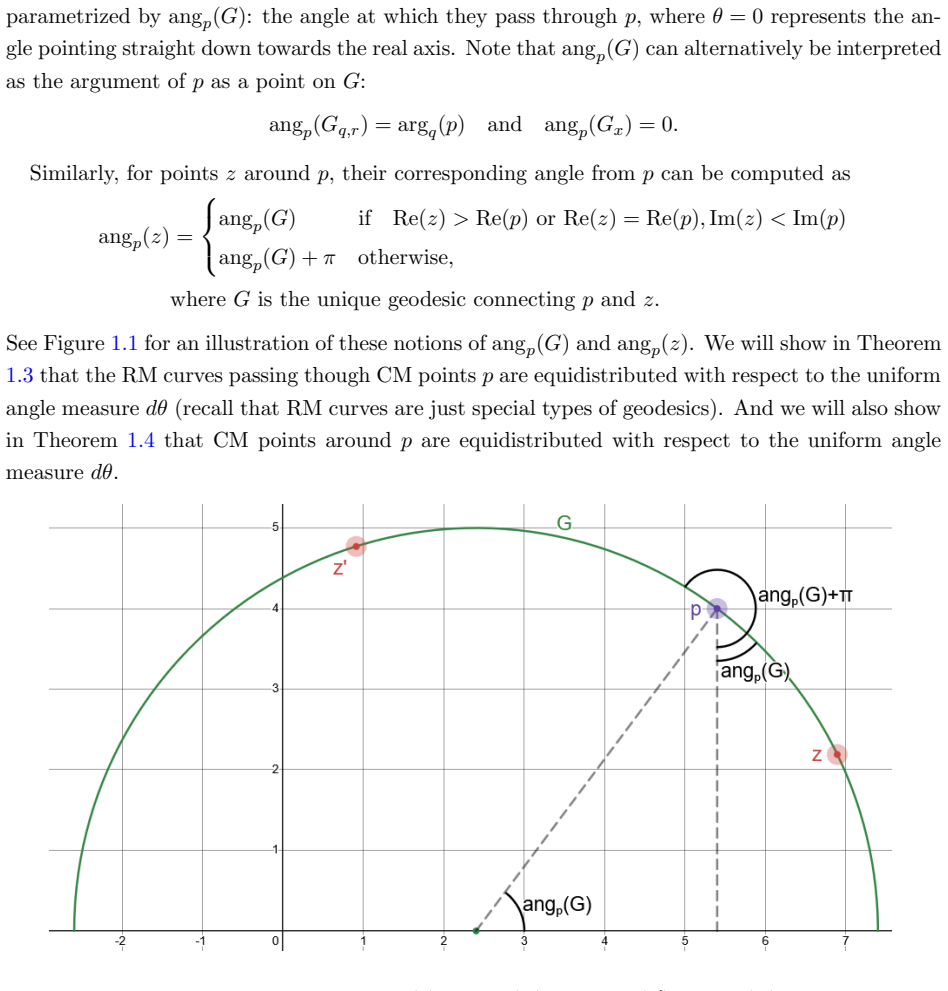
CM points and RM curves equidistribute along every fixed rational geodesic in the upper half-plane and around every fixed CM point.
A machine-rendered reading of the paper's core claim, the machinery that carries it, and where it could break.
Core claim
We show that CM points and RM curves are equidistributed along every fixed rational geodesic in H, and around every fixed CM point in H. To prove these results, we solve the aggregate Linnik problem for arbitrary binary quadratic forms.
What carries the argument
The solution to the aggregate Linnik problem for arbitrary binary quadratic forms, which reduces the equidistribution claims to this solvability statement.
If this is right
- CM points of fundamental discriminant D become equidistributed along any fixed rational geodesic as D tends to negative infinity.
- RM curves become equidistributed along any fixed rational geodesic as the positive discriminant tends to positive infinity.
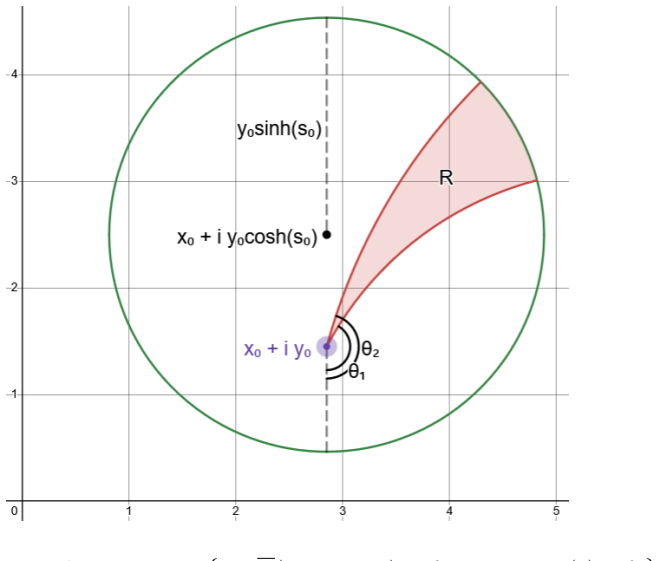
- Both CM points and RM curves become equidistributed in shrinking neighborhoods of any fixed CM point.
- The aggregate Linnik problem admits solutions for every binary quadratic form.
Where Pith is reading between the lines
- The same reduction technique may apply to equidistribution statements on other arithmetic curves or in higher-dimensional hyperbolic spaces.
- Effective versions with explicit rates could follow from quantitative bounds on the Linnik problem solutions.
- The results suggest that distribution questions for quadratic forms can be localized to submanifolds without losing the asymptotic uniformity.
Load-bearing premise
The equidistribution statements reduce directly to the solvability of the aggregate Linnik problem for arbitrary binary quadratic forms.
What would settle it
A concrete counterexample consisting of one fixed rational geodesic together with a sequence of fundamental discriminants along which the associated CM points fail to become equidistributed on that geodesic.
Figures
read the original abstract
In 1988, William Duke showed that CM points of fundamental discriminant $D$ are equidistributed in the complex upper half-plane $\mathcal H$ as $D \to -\infty$. He also showed a similar result for RM curves (a positive discriminant analog of CM points). In this paper, we investigate analogous problems concerning the distribution of CM points and RM curves along fixed geodesics in $\mathcal H$, and around fixed points in $\mathcal H$. Specifically, we show that CM points and RM curves are equidistributed along every fixed rational geodesic in $\mathcal H$, and around every fixed CM point in $\mathcal H$. To prove these results, we solve the aggregate Linnik problem for arbitrary binary quadratic forms.
Editorial analysis
A structured set of objections, weighed in public.
Referee Report
Summary. The paper extends Duke's 1988 equidistribution theorems for CM points (fundamental negative discriminant) and RM curves (positive discriminant) in the upper half-plane H. It claims that these objects are equidistributed along every fixed rational geodesic in H and around every fixed CM point in H. The proofs are obtained by solving an aggregate version of Linnik's problem that applies to arbitrary (not necessarily fundamental) binary quadratic forms.
Significance. If the reduction from the geometric statements to the aggregate Linnik counts is valid and the error terms are uniform in the fixed geodesic or base point, the results would constitute a genuine extension of Duke's work with potential applications to dynamics on hyperbolic surfaces and arithmetic statistics. The manuscript ships a solution to a non-fundamental-discriminant aggregate Linnik problem, which is a concrete technical contribution even if the geometric corollaries require further checking.
major comments (2)
- [Abstract] Abstract and introduction: the central claim that equidistribution along fixed rational geodesics and around fixed CM points follows from the aggregate Linnik solution for arbitrary binary quadratic forms is asserted without an explicit statement of the correspondence (geodesic/point ↔ quadratic form) or of the uniformity of the implied error terms with respect to the fixed object. This reduction is load-bearing; any hidden dependence on the size of the discriminant, class number, or rationality conditions would invalidate the passage from aggregate counts to individual equidistribution.
- [Main theorems (presumed §3–5)] The manuscript must supply, in the main theorems or in the section deriving the geometric statements from the Linnik counts, an explicit error bound that remains effective when the geodesic or base CM point is held fixed while the varying discriminant tends to infinity; without this, the claimed equidistribution statements are not justified.
minor comments (1)
- Notation for the aggregate Linnik problem should be introduced with a precise definition of the counting function and the error term before it is invoked in the geometric applications.
Simulated Author's Rebuttal
We thank the referee for the careful reading and for identifying the need to make the reduction from the aggregate Linnik counts to the geometric equidistribution statements fully explicit. We agree that both the correspondence and the uniformity of error terms must be stated clearly. We will revise the manuscript to address these points.
read point-by-point responses
-
Referee: [Abstract] Abstract and introduction: the central claim that equidistribution along fixed rational geodesics and around fixed CM points follows from the aggregate Linnik solution for arbitrary binary quadratic forms is asserted without an explicit statement of the correspondence (geodesic/point ↔ quadratic form) or of the uniformity of the implied error terms with respect to the fixed object. This reduction is load-bearing; any hidden dependence on the size of the discriminant, class number, or rationality conditions would invalidate the passage from aggregate counts to individual equidistribution.
Authors: We agree that the reduction requires an explicit statement. In the revised version we will insert a short subsection (new §2.3) that records the standard bijection: a fixed rational geodesic in H corresponds to a binary quadratic form of positive discriminant (up to SL(2,Z) equivalence), while a fixed CM point corresponds to a form of negative discriminant. Because the aggregate Linnik theorem is proved for arbitrary (not necessarily fundamental) forms, the error term depends only on the size of the varying discriminant and is therefore uniform in the fixed geodesic or base point. We will state this uniformity explicitly and note that no dependence on class number or rationality conditions enters the error once the geodesic/point is fixed. revision: yes
-
Referee: [Main theorems (presumed §3–5)] The manuscript must supply, in the main theorems or in the section deriving the geometric statements from the Linnik counts, an explicit error bound that remains effective when the geodesic or base CM point is held fixed while the varying discriminant tends to infinity; without this, the claimed equidistribution statements are not justified.
Authors: We accept the request for an explicit error bound. In the revision we will add, immediately after the statement of the aggregate Linnik theorem, a corollary that extracts the geometric equidistribution with an explicit error term of the form O( |D|^{-δ} ) where δ > 0 is absolute and the implied constant depends only on the fixed geodesic or fixed CM point (not on D). The derivation will cite the uniformity already present in the aggregate count for arbitrary forms and will verify that the passage to the individual equidistribution statement preserves effectivity when the base object is held fixed. revision: yes
Circularity Check
No circularity: equidistribution follows from independent solution of aggregate Linnik problem
full rationale
The paper states that the equidistribution of CM points and RM curves along fixed rational geodesics and around fixed CM points is proved by solving the aggregate Linnik problem for arbitrary binary quadratic forms. This is presented as a new technical result enabling the geometric statements, with no equations or definitions showing the target equidistribution statements being used to define, fit, or rename the Linnik solution. The only external citation is to Duke (1988), which is independent prior work. No self-citations, fitted inputs renamed as predictions, or reductions by construction appear in the abstract or claimed derivation chain.
Axiom & Free-Parameter Ledger
Reference graph
Works this paper leans on
-
[1]
Boundary CM points and class groups of small exponent
David Aiken, Erick Ross, Dmitriy Shvydkoy, and Hui Xue. Boundary CM points and class groups of small exponent. To appear inProceedings of the AMS, 2026
2026
-
[2]
Integer points on spheres and their orthogonal lattices.Invent
Menny Aka, Manfred Einsiedler, and Uri Shapira. Integer points on spheres and their orthogonal lattices.Invent. Math., 206(2):379–396, 2016
2016
-
[3]
Cycle integrals of modular functions, Markov geodesics and a con- jecture of Kaneko.Algebra Number Theory, 13(4):943–962, 2019
Paloma Bengoechea and ¨Ozlem Imamoglu. Cycle integrals of modular functions, Markov geodesics and a con- jecture of Kaneko.Algebra Number Theory, 13(4):943–962, 2019
2019
-
[4]
Joint Linnik problems, 2026.https://arxiv.org/ abs/2603.05609
Valentin Blomer, Farrell Brumley, and Maksym Radziwi l l. Joint Linnik problems, 2026.https://arxiv.org/ abs/2603.05609
-
[5]
Spatial statistics for lattice points on the sphere I: Individual results.Bull
Jean Bourgain, Ze´ ev Rudnick, and Peter Sarnak. Spatial statistics for lattice points on the sphere I: Individual results.Bull. Iranian Math. Soc., 43(4):361–386, 2017
2017
-
[6]
Local statistics of lattice points on the sphere
Jean Bourgain, Peter Sarnak, and Ze´ ev Rudnick. Local statistics of lattice points on the sphere. InModern trends in constructive function theory, volume 661 ofContemp. Math., pages 269–282. Amer. Math. Soc., Providence, RI, 2016
2016
-
[7]
Duke, ¨O
W. Duke, ¨O. Imamo¯ glu, and´A. T´ oth. Cycle integrals of thej-function and mock modular forms.Ann. of Math. (2), 173(2):947–981, 2011. 30
2011
-
[8]
Hyperbolic distribution problems and half-integral weight Maass forms.Invent
William Duke. Hyperbolic distribution problems and half-integral weight Maass forms.Invent. Math., 92(1):73– 90, 1988
1988
-
[9]
Distribution of periodic torus orbits and Duke’s theorem for cubic fields.Ann
Manfred Einsiedler, Elon Lindenstrauss, Philippe Michel, and Akshay Venkatesh. Distribution of periodic torus orbits and Duke’s theorem for cubic fields.Ann. of Math. (2), 173(2):815–885, 2011
2011
-
[10]
The distribution of closed geodesics on the modular surface, and Duke’s theorem.Enseign
Manfred Einsiedler, Elon Lindenstrauss, Philippe Michel, and Akshay Venkatesh. The distribution of closed geodesics on the modular surface, and Duke’s theorem.Enseign. Math. (2), 58(3-4):249–313, 2012
2012
-
[11]
Observations on the ‘values’ of the elliptic modular functionj(τ) at real quadratics.Kyushu Journal of Mathematics, 63(2):353–364, 2009
Masanobu Kaneko. Observations on the ‘values’ of the elliptic modular functionj(τ) at real quadratics.Kyushu Journal of Mathematics, 63(2):353–364, 2009
2009
-
[12]
Joint equidistribution of CM points.Ann
Ilya Khayutin. Joint equidistribution of CM points.Ann. of Math. (2), 189(1):145–276, 2019
2019
-
[13]
Zuckerman, and Hugh L
Ivan Niven, Herbert S. Zuckerman, and Hugh L. Montgomery.An introduction to the theory of numbers. John Wiley & Sons, Inc., New York, fifth edition, 1991
1991
-
[14]
Ratcliffe.Foundations of hyperbolic manifolds, volume 149 ofGraduate Texts in Mathematics
John G. Ratcliffe.Foundations of hyperbolic manifolds, volume 149 ofGraduate Texts in Mathematics. Springer, New York, second edition, 2006
2006
-
[15]
Aggregate Linnik problems
Erick Ross and Hui Xue. Aggregate Linnik problems. In preparation
-
[16]
Class numbers of indefinite binary quadratic forms.J
Peter Sarnak. Class numbers of indefinite binary quadratic forms.J. Number Theory, 15(2):229–247, 1982
1982
-
[17]
The Andr´ e-Oort conjecture.Notices Amer
Jacob Tsimerman. The Andr´ e-Oort conjecture.Notices Amer. Math. Soc., 71(10):1307–1313, 2024. (E. Ross)School of Mathematical and Statistical Sciences, Clemson University, Clemson, SC Email address:erickjohnross@gmail.com (H. Xue)School of Mathematical and Statistical Sciences, Clemson University, Clemson, SC Email address:huixue@clemson.edu 31
2024
discussion (0)
Sign in with ORCID, Apple, or X to comment. Anyone can read and Pith papers without signing in.