Role of Metastable Dicationic Intermediates in the Breakup of CH₄²⁺
Pith reviewed 2026-06-29 09:03 UTC · model grok-4.3
The pith
Methane dication CH4²⁺ breaks up sequentially through metastable intermediates CH3²⁺, CH2²⁺ and CH²⁺.
A machine-rendered reading of the paper's core claim, the machinery that carries it, and where it could break.
Core claim
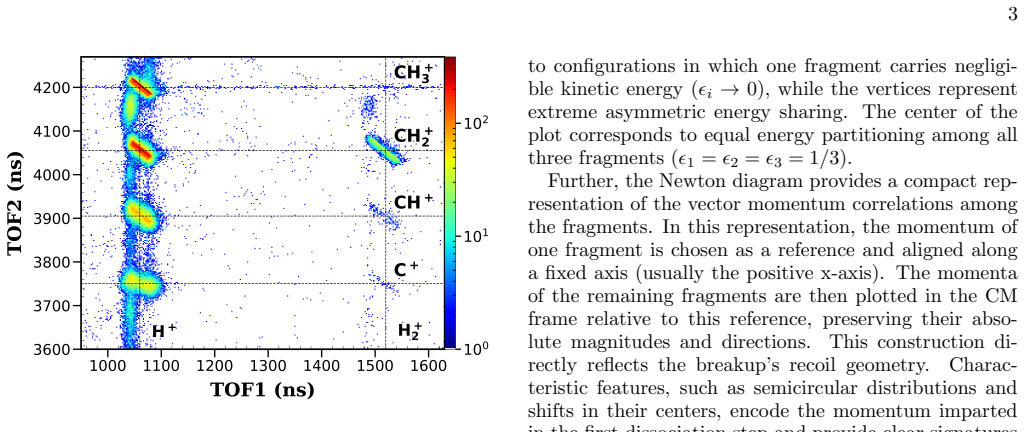
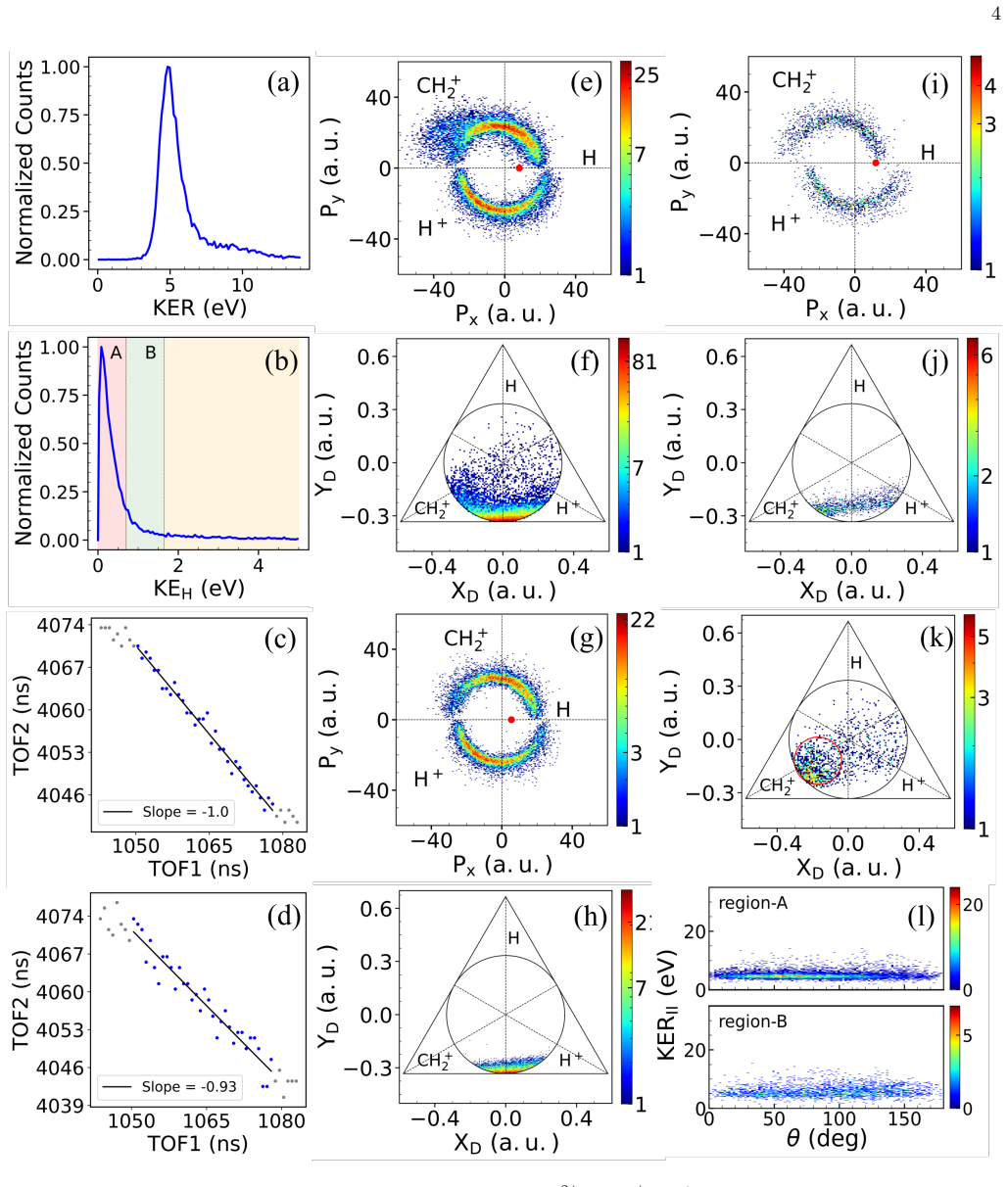
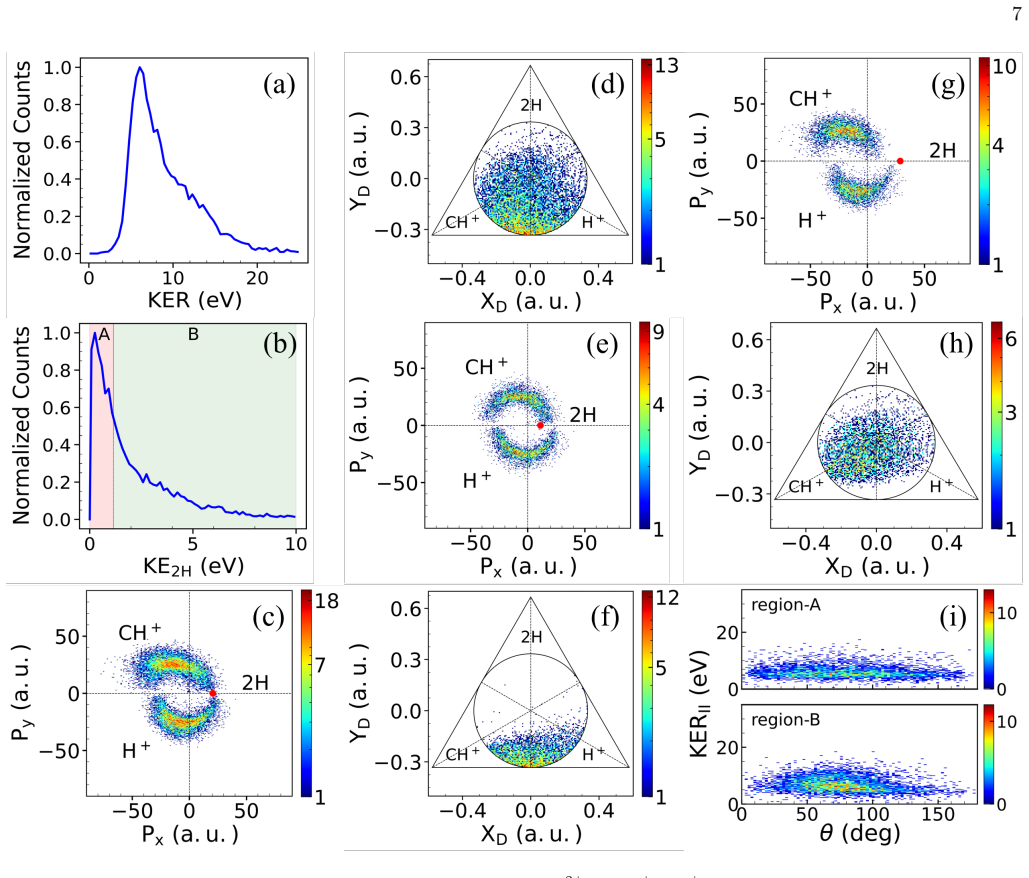
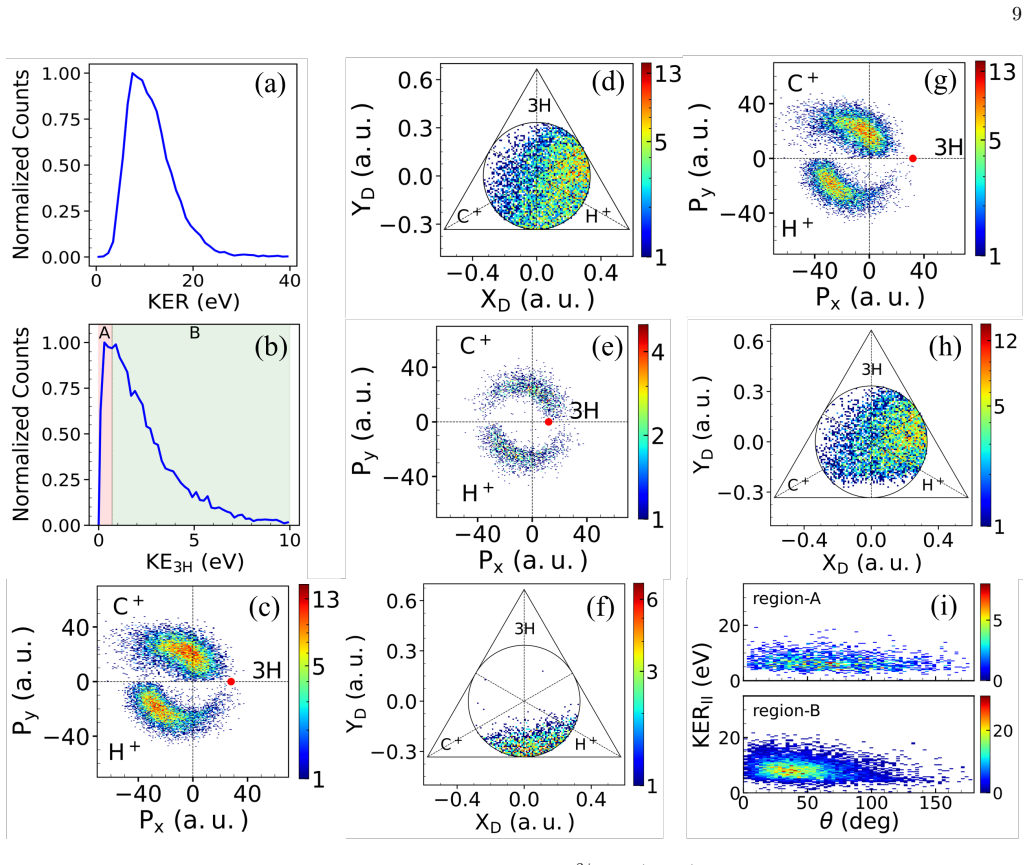
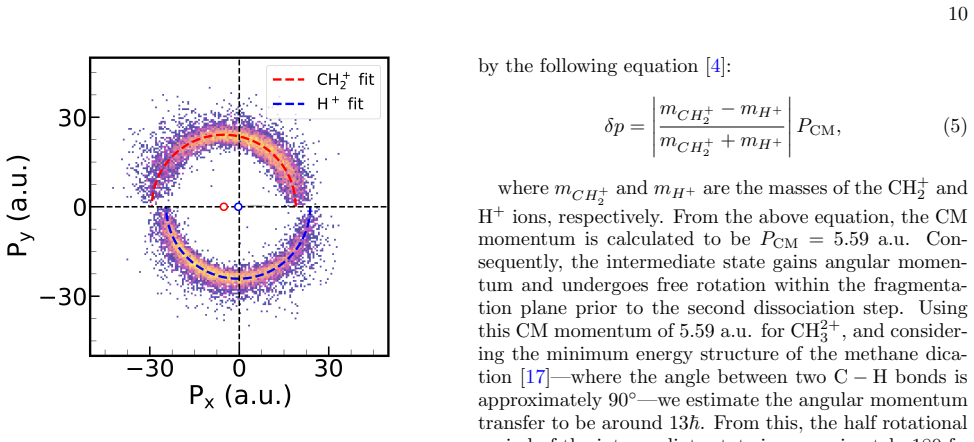
The data indicate the presence of sequential fragmentation pathways for the CH₄²⁺ → CH₂⁺ + H⁺ + H, CH₄²⁺ → CH⁺ + H⁺ + 2H, and CH₄²⁺ → C⁺ + H⁺ + 3H channels, consistent with dissociation via short-lived dicationic intermediates CH₃²⁺, CH₂²⁺, and CH²⁺, respectively. From the Newton-diagram momentum distributions, the half-rotational periods of the intermediate states are estimated, providing insight into their rotational dynamics and finite lifetimes prior to fragmentation.
What carries the argument
Newton diagrams derived from fragment momenta that reveal the sequential nature of dissociation by showing momentum vectors consistent with stepwise loss through metastable dicationic intermediates.
If this is right
- The CH4²⁺ → CH2⁺ + H⁺ + H channel proceeds via CH3²⁺ intermediate.
- The CH4²⁺ → CH⁺ + H⁺ + 2H channel proceeds via CH2²⁺ intermediate.
- The CH4²⁺ → C⁺ + H⁺ + 3H channel proceeds via CH²⁺ intermediate.
- The intermediates have finite lifetimes allowing them to rotate before dissociating further.
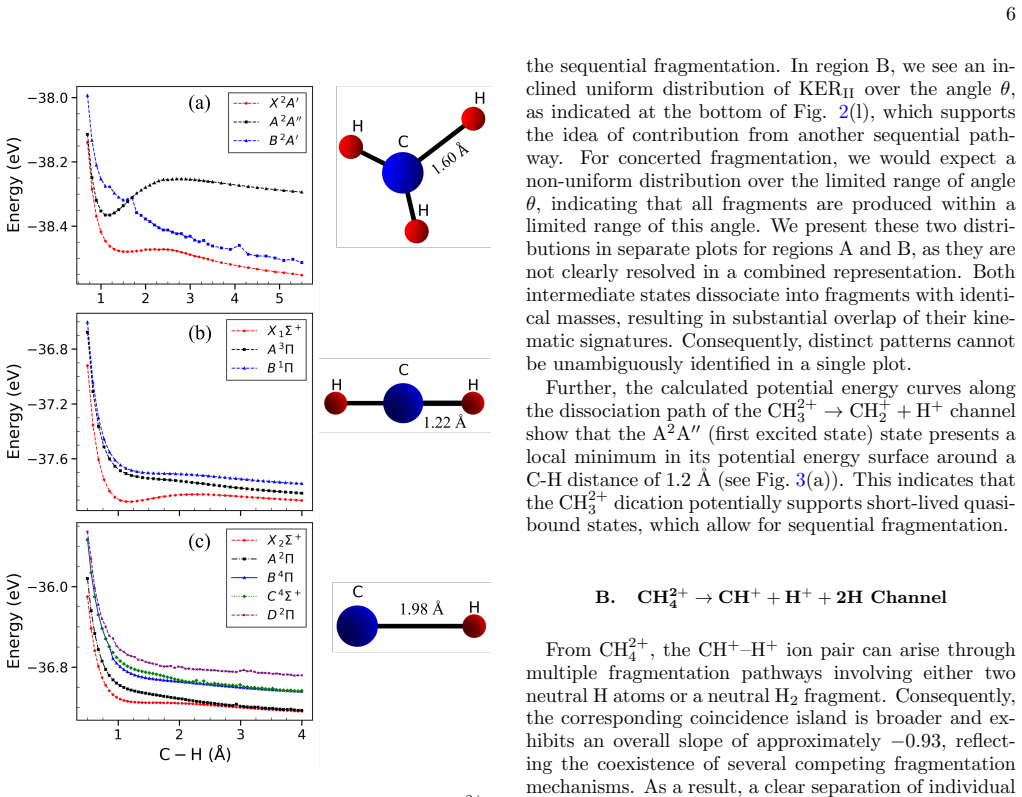
- Calculated potential-energy curves support the observed sequential pathways.
Where Pith is reading between the lines
- This stepwise mechanism could be common in other small molecular dications under similar high-energy ionization conditions.
- Lifetime estimates from rotation periods could be compared with direct time-resolved measurements in future experiments.
- The native-frame method used here might be applied to distinguish mechanisms in larger polyatomic ions.
Load-bearing premise
The momentum distributions in the Newton diagrams uniquely identify sequential dissociation through the named metastable intermediates without significant contributions from concerted mechanisms or other pathways.
What would settle it
An observation or simulation in which the same momentum correlations appear in a model that assumes only concerted dissociation without any intermediate states.
Figures
read the original abstract
We investigate the fragmentation dynamics of methane dication (CH$_4^{2+}$) produced in collisions with 50-MeV C$^{6+}$ ions using the COLTRIMS technique. The method provides complete three-dimensional momentum vectors of the charged fragments, enabling full kinematic reconstruction of the fragmentation process. The dynamics are analyzed using Dalitz plots, Newton diagrams, and the native-frame method to distinguish between concerted and sequential dissociation mechanisms. The data indicate the presence of sequential fragmentation pathways for the CH$_4^{2+}$ $\rightarrow$ CH$_2^+$ + H$^+$ + H, CH$_4^{2+}$ $\rightarrow$ CH$^+$ + H$^+$ + 2H, and CH$_4^{2+}$ $\rightarrow$ C$^+$ + H$^+$ + 3H channels, consistent with dissociation via short-lived dicationic intermediates CH$_3^{2+}$, CH$_2^{2+}$, and CH$^{2+}$, respectively. From the Newton-diagram momentum distributions, we further estimate the half-rotational periods of the intermediate states, providing insight into their rotational dynamics and finite lifetimes prior to fragmentation. The experimental observations are further supported by comparisons with calculated potential-energy curves.
Editorial analysis
A structured set of objections, weighed in public.
Referee Report
Summary. The manuscript reports a COLTRIMS study of CH4^{2+} fragmentation following 50-MeV C^{6+} collisions. Complete three-body momentum vectors are reconstructed for channels such as CH4^{2+} o CH2^{+} + H^{+} + H, CH4^{2+} o CH^{+} + H^{+} + 2H, and CH4^{2+} o C^{+} + H^{+} + 3H. Dalitz plots, Newton diagrams, and native-frame analysis are used to argue for sequential dissociation via short-lived intermediates CH3^{2+}, CH2^{2+}, and CH^{2+}. Half-rotational periods of the intermediates are estimated from the momentum distributions, and the observations are compared with calculated potential-energy curves.
Significance. If the sequential pathway assignments are robust, the work adds concrete experimental evidence for the role of metastable dicationic intermediates in three-body breakup of small hydrocarbons. The COLTRIMS kinematic completeness and the attempt to extract rotational timescales are positive features. The result would be of interest to the molecular-dynamics and radiation-chemistry communities, but its impact is limited by the absence of quantitative controls that would bound the contribution of concerted mechanisms.
major comments (2)
- [Newton diagrams and native-frame analysis] Newton diagrams and native-frame analysis (section on fragmentation dynamics): the claim that the observed momentum correlations uniquely indicate sequential breakup through the named intermediates (CH3^{2+}, CH2^{2+}, CH^{2+}) is not accompanied by Monte Carlo or classical-trajectory simulations of concerted three-body channels. Without such simulations, the degree of overlap between sequential and concerted signatures cannot be quantified, leaving the uniqueness of the intermediate identification untested.
- [Newton diagrams and native-frame analysis] Estimation of half-rotational periods (same analysis section): the procedure for extracting these periods from the Newton-diagram momentum distributions is not described in sufficient detail (no mention of fitting method, assumed lifetime distribution, or error analysis), making it impossible to assess whether the reported values are robust or model-dependent.
minor comments (2)
- The abstract and main text would benefit from explicit statements of the number of events analyzed per channel and the momentum resolution achieved.
- Figure captions for the Newton diagrams and Dalitz plots should include the precise kinematic cuts applied and any background subtraction method.
Simulated Author's Rebuttal
We thank the referee for the positive evaluation of the COLTRIMS experiment and the kinematic reconstruction. The two major comments focus on the fragmentation dynamics analysis. We respond point-by-point below and will revise the manuscript accordingly to strengthen the claims.
read point-by-point responses
-
Referee: [Newton diagrams and native-frame analysis] Newton diagrams and native-frame analysis (section on fragmentation dynamics): the claim that the observed momentum correlations uniquely indicate sequential breakup through the named intermediates (CH3^{2+}, CH2^{2+}, and CH^{2+}) is not accompanied by Monte Carlo or classical-trajectory simulations of concerted three-body channels. Without such simulations, the degree of overlap between sequential and concerted signatures cannot be quantified, leaving the uniqueness of the intermediate identification untested.
Authors: We agree that explicit Monte Carlo simulations of concerted three-body channels would allow a more quantitative bound on possible overlap with the sequential signatures. The native-frame analysis and Newton-diagram islands follow patterns established for sequential breakup in prior COLTRIMS studies of similar systems, and the Dalitz plots show features inconsistent with pure concerted dissociation. Nevertheless, to directly address the concern, we will add classical-trajectory Monte Carlo simulations of concerted channels in the revised manuscript. revision: yes
-
Referee: [Newton diagrams and native-frame analysis] Estimation of half-rotational periods (same analysis section): the procedure for extracting these periods from the Newton-diagram momentum distributions is not described in sufficient detail (no mention of fitting method, assumed lifetime distribution, or error analysis), making it impossible to assess whether the reported values are robust or model-dependent.
Authors: We concur that additional methodological detail is required. In the revised manuscript we will expand the relevant section to specify the fitting procedure applied to the Newton-diagram momentum distributions, the assumed exponential lifetime distribution for the intermediates, and the error analysis that incorporates both counting statistics and variations in the fit parameters. revision: yes
Circularity Check
No circularity: experimental kinematic analysis is self-contained
full rationale
The paper reports COLTRIMS momentum measurements of CH4^2+ fragmentation and interprets Dalitz plots, Newton diagrams, and native-frame correlations as evidence for sequential pathways via short-lived intermediates. No mathematical derivation, parameter fitting, or self-referential equations are present; the central claim rests on direct experimental signatures compared to external potential-energy curves. No self-citation is load-bearing for uniqueness, and no step reduces a claimed prediction to its own inputs by construction. This is the normal non-circular outcome for a data-driven experimental study.
Axiom & Free-Parameter Ledger
Reference graph
Works this paper leans on
-
[1]
Neumann, D
N. Neumann, D. Hant, L. P. H. Schmidt, J. Titze, T. Jahnke, A. Czasch, M. Sch¨ offler, K. Kreidi, O. Jagutzki, H. Schmidt-B¨ ocking,et al., Fragmentation dynamics of CO3+ 2 investigated by multiple electron cap- ture format in collisions with slow highly charged ions, Phys. Rev. Lett.104, 103201 (2010)
2010
-
[2]
C. Wu, C. Wu, D. Song, H. Su, Y. Yang, Z. Wu, X. Liu, H. Liu, M. Li, Y. Deng,et al., Nonsequential and sequen- tial fragmentation of CO 3+ 2 in intense laser fields, Phys. Rev. Lett.110, 103601 (2013)
2013
-
[3]
B. Wei, Y. Zhang, X. Wang, D. Lu, G. Lu, B. Zhang, Y. Tang, R. Hutton, and Y. Zou, Fragmentation mechanisms for methane induced by 55 eV, 75 eV, and 100 eV electron impact, J. Chem. Phys.140, https://doi.org/10.1063/1.4868651 (2014)
-
[4]
A. Khan, L. C. Tribedi, and D. Misra, Observation of a sequential process in charge-asymmetric dissociation of COq+ 2 (q= 4, 5) upon the impact of highly charged ions, Phys. Rev. A92, 030701 (2015)
2015
-
[5]
X. Ding, M. Haertelt, S. Schlauderer, M. Schuurman, A. Y. Naumov, D. Villeneuve, A. McKellar, P. Corkum, and A. Staudte, Ultrafast dissociation of metastable CO2+ in a dimer, Phys. Rev. Lett.118, 153001 (2017)
2017
-
[6]
Zhang, T
Y. Zhang, T. Jiang, L. Wei, D. Luo, X. Wang, W. Yu, R. Hutton, Y. Zou, and B. Wei, Three-body fragmen- tation of methane dications produced by slow Ar 8+-ion impact, Phys. Rev. A97, 022703 (2018)
2018
-
[7]
Severt, Z
T. Severt, Z. L. Streeter, W. Iskandar, K. A. Larsen, A. Gatton, D. Trabert, B. Jochim, B. Griffin, E. G. Champenois, M. M. Brister,et al., Step-by-step state- selective tracking of fragmentation dynamics of water di- cations by momentum imaging, Nat. Commun.13, 5146 (2022). 12
2022
-
[8]
Oceana, Greenhouse gases,http://oceana.org/ en/our-work/climate-energy/climate-change/ learn-act/greenhouse-gases(n.d.), accessed: 2026- 01-30
2026
-
[9]
Formisano, S
V. Formisano, S. Atreya, T. Encrenaz, N. Ignatiev, and M. Giuranna, Detection of methane in the atmosphere of mars, Science306, 1758 (2004)
2004
-
[10]
J. I. Lunine and S. K. Atreya, The methane cycle on titan, Nat. Geosci.1, 159 (2008)
2008
-
[11]
Thissen, O
R. Thissen, O. Witasse, O. Dutuit, C. S. Wedlund, G. Gronoff, and J. Lilensten, Doubly-charged ions in the planetary ionospheres: a review, Phys. Chem. Chem. Phys.13, 18264 (2011)
2011
-
[12]
D. K. B¨ ohme, Multiply-charged ions and interstellar chemistry, Phys. Chem. Chem. Phys.13, 18253 (2011)
2011
-
[13]
E. F. Van Dishoeck, Astrochemistry: overview and chal- lenges, Proc. IAU or Proc. Int. Astron. Union13, 3 (2017)
2017
-
[14]
Dujardin, D
G. Dujardin, D. Winkoun, and S. Leach, Double pho- toionization of methane, Phys. Rev. A31, 3027 (1985)
1985
-
[15]
Ben-Itzhak, K
I. Ben-Itzhak, K. Carnes, S. Ginther, D. Johnson, P. Nor- ris, and O. Weaver, Fragmentation of CH4 caused by fast- proton impact, Phys. Rev. A47, 3748 (1993)
1993
-
[16]
Z. Wu, C. Wu, Q. Liang, S. Wang, M. Liu, Y. Deng, and Q. Gong, Fragmentation dynamics of methane by few-cycle femtosecond laser pulses, J. Chem. Phys.126, https://doi.org/10.1063/1.2472341 (2007)
-
[17]
Flammini, M
R. Flammini, M. Satta, E. Fainelli, G. Alberti, F. Maracci, and L. Avaldi, The role of the methyl ion in the fragmentation of CH 2+ 4 , New J. Phys.11, 083006 (2009)
2009
-
[18]
M. D. Ward, S. J. King, and S. D. Price, Elec- tron ionization of methane: The dissociation of the methane monocation and dication, J. Chem. Phys.134, https://doi.org/10.1063/1.3519636 (2011)
-
[19]
J. B. Williams, C. Trevisan, M. Sch¨ offler, T. Jahnke, I. Bocharova, H. Kim, B. Ulrich, R. Wallauer, F. Sturm, T. Rescigno,et al., Imaging polyatomic molecules in three dimensions using molecular frame photoelectron angular distributions, Phys. Rev. Lett.108, 233002 (2012)
2012
-
[20]
Singh, P
R. Singh, P. Bhatt, N. Yadav, and R. Shanker, Ionic fragmentation of a CH 4 molecule induced by 10−keV electrons: Kinetic-energy-release distributions and disso- ciation mechanisms, Phys. Rev. A87, 062706 (2013)
2013
-
[21]
J. Rajput, D. Garg, A. Cassimi, A. M´ ery, X. Fl´ echard, J. Rangama, S. Guillous, W. Iskandar, A. Agnihotri, J. Matsumoto,et al., Unexplained dissociation pathways of two-body fragmentation of methane dication, J. Chem. Phys.156, https://doi.org/10.1063/5.0079851 (2022)
-
[22]
J. Rajput, D. Garg, A. Cassimi, X. Fl´ echard, J. Rangama, and C. Safvan, Addressing three- body fragmentation of methane dication using “na- tive frames”: evidence of internal excitation in fragments, The Journal of Chemical Physics159, https://doi.org/10.1063/5.0171881 (2023)
-
[23]
C. Cao, M. Li, K. Guo, Z. Li, Y. Liu, Y. Liu, K. Liu, Y. Zhou, and P. Lu, Intensity-dependent three-body coulomb explosion of methane in femtosecond laser pulses, Phys. Rev. A109, 023115 (2024)
2024
-
[24]
H. O. Folkerts, R. Hoekstra, and R. Morgenstern, Veloc- ity and charge state dependences of molecular dissocia- tion induced by slow multicharged ions, Phys. Rev. Lett. 77, 3339 (1996)
1996
-
[25]
A. Khan, L. C. Tribedi, and D. Misra, Velocity and charge-state dependence on the coulomb explosion of N2, under the impact of highly-charged ions at intermediate velocities, J. Phys. B: At. Mol. Opt. Phys.54, 135201 (2021)
2021
-
[26]
J. A. Pople, B. Tidor, and P. von Ragu´ e Schleyer, The structure and stability of dications derived from methane, Chemical Physics Letters88, 533 (1982)
1982
-
[27]
Ben-Itzhak, E
I. Ben-Itzhak, E. Sidky, I. Gertner, Y. Levy, and B. Ros- ner, Long lived CH 2+ and CD 2+ dications, Int. J. Mass Spectrom.192, 157 (1999)
1999
-
[28]
J.-P. Gu, G. Hirsch, R. Buenker, M. Kimura, C. Dutta, and P. Nordlander, Charge transfer in collisions of C 2+ ions with h atoms at low-kev energies: A possible bound state of CH 2+, Phys. Rev. A57, 4483 (1998)
1998
-
[29]
T. Ast, C. Porter, C. Proctor, and J. Beynon, Doubly charged molecular ions of methane, Chem. Phys. Lett. 78, 439 (1981)
1981
-
[30]
T. J. Gray, J. Legg, and V. Needham, Molecular ion colli- sion chemistry using particle accelerators, Nucl. Instrum. Methods Phys. Res., Sect. B10, 253 (1985)
1985
-
[31]
Mathur, C
D. Mathur, C. Badrinathan, F. Rajgara, and U. Raheja, Translational energy loss spectrometry of molecular di- cations from methane, Chem. Phys.103, 447 (1986)
1986
-
[32]
Y. Levy, A. Bar-David, I. Ben-Itzhak, I. Gertner, and B. Rosner, Formation of long-lived CD 2+ n and CH 2+ n di- cations, J. Phys. B: At. Mol. Opt. Phys.32, 3973 (1999)
1999
-
[33]
A. Khan, L. C. Tribedi, and D. Misra, A re- coil ion momentum spectrometer for molecular and atomic fragmentation studies, Rev. Sci. Instrum.86, https://doi.org/10.1063/1.4916680 (2015)
-
[34]
M. A. K. A. Siddiki, M. Nrisimhamurty, K. Kumar, J. Mukherjee, L. C. Tribedi, A. Khan, and D. Misra, Development of a cold target recoil ion momentum spec- trometer and a projectile charge state analyzer setup to study electron transfer processes in highly charged ion–atom/molecule collisions, Review of Scientific Instru- ments93, 113313 (2022)
2022
-
[35]
R. A. Kendall, T. H. Dunning, and R. J. Harrison, Elec- tron affinities of the first-row atoms revisited. systematic basis sets and wave functions, The Journal of Chemical Physics96, 6796 (1992)
1992
-
[36]
Q. Sun, T. C. Berkelbach, N. S. Blunt, G. H. Booth, S. Guo, Z. Li, J. Liu, J. D. McClain, E. R. Sayfut- yarova, S. Sharma, S. Wouters, and G. K. Chan, Pyscf: The python-based simulations of chemistry framework, WIREs Comput. Mol. Sci.8, 10.1002/wcms.1340 (2017)
-
[37]
L.-P. Wang and C. Song, Geometry optimization made simple with translation and rotation coordinates, J. Chem. Phys.144, 10.1063/1.4952956 (2016)
-
[38]
Eland, Dynamics of fragmentation reactions from peak shapes in multiparticle coincidence experiments, Laser Chem.11, 259 (1991)
J. Eland, Dynamics of fragmentation reactions from peak shapes in multiparticle coincidence experiments, Laser Chem.11, 259 (1991)
1991
-
[39]
Dalitz, Cxii
R. Dalitz, Cxii. on the analysis ofτ-meson data and the nature of theτ-meson, Lond. Edinb. Dubl. Phil. Mag. J. Sci.44, 1068 (1953)
1953
-
[40]
Severt, J
T. Severt, J. Rajput, B. Berry, B. Jochim, P. Feizollah, B. Kaderiya, M. Zohrabi, F. Ziaee, K. R. P., D. Rolles, A. Rudenko, K. D. Carnes, B. D. Esry, and I. Ben-Itzhak, Native frames: An approach for separating sequential and concerted three-body fragmentation, Phys. Rev. A 110, 053104 (2024)
2024
-
[41]
Eland, The dynamics of three-body dissociations of dications studied by the triple coincidence technique 13 pepipico, Mol
J. Eland, The dynamics of three-body dissociations of dications studied by the triple coincidence technique 13 pepipico, Mol. Phys.61, 725 (1987)
1987
-
[42]
York, Least-squares fitting of a straight line, Canadian Journal of Physics44, 1079 (1966)
D. York, Least-squares fitting of a straight line, Canadian Journal of Physics44, 1079 (1966)
1966
-
[43]
H. Yuan, Z. Xu, S. Xu, C. Ma, Z. Zhang, D. Guo, X. Zhu, D. Zhao, S. Zhang, S. Yan, Y. Gao, R. Zhang, and X. Ma, Three-body fragmentation dynamics of CH 3CCH3+ in- vestigated by 50 keV/u Ne 8+ impact: Comparison with its isomer ion CH 2CCH3+ 2 , Phys. Rev. A105, 022814 (2022)
2022
-
[44]
Z. He, J. Wang, Y. Zhang, B. Wang, J. Han, B. Ren, L. Wei, Z. Xia, P. Ma, T. Meng,et al., Sequential depro- tonation of the allene trication produced by 30−keV/u He2+ impact, Phys. Rev. A105, 022818 (2022)
2022
-
[45]
Ortenburger and P
I. Ortenburger and P. Bagus, Theoretical analysis of the auger spectra of CH 4, Phys. Rev. A11, 1501 (1975)
1975
-
[46]
N. D. Birell and P. C. W. Davies,Quantum Fields in Curved Space(Cambridge University Press, 1982)
1982
-
[47]
Severt, J
T. Severt, J. Rajput, B. Berry, B. Jochim, P. Feizollah, B. Kaderiya, M. Zohrabi, F. Ziaee, K. R. P, D. Rolles, et al., Native frames: An approach for separating sequen- tial and concerted three-body fragmentation, Phys. Rev. A110, 053104 (2024)
2024
-
[48]
D¨ orner, V
R. D¨ orner, V. Mergel, O. Jagutzki, L. Spielberger, J. Ull- rich, R. Moshammer, and H. Schmidt-B¨ ocking, Cold tar- get recoil ion momentum spectroscopy: a ‘momentum mi- croscope’ to view atomic collision dynamics, Phys. Rep. 330, 95 (2000)
2000
-
[49]
M´ ery, X
A. M´ ery, X. Fl´ echard, S. Guillous, V. Kumar, M. La- lande, J. Rangama, W. Wolff, and A. Cassimi, Investiga- tion of the carbon monoxide dication lifetime using (co) 2 dimer fragmentation, Phys. Rev. A104, 042813 (2021)
2021
-
[50]
S. Xu, X. L. Zhu, W. T. Feng, D. L. Guo, Q. Zhao, S. Yan, P. Zhang, D. M. Zhao, Y. Gao, S. F. Zhang, J. Yang, and X. Ma, Dynamics of C 2H3+ 2 →H + + H+ + C2+ in- vestigated by 50−keV/u Ne 8+ impact, Phys. Rev. A97, 062701 (2018)
2018
-
[51]
Lundqvist, D
M. Lundqvist, D. Edvardsson, P. Baltzer, and B. Wannberg, Doppler-free kinetic energy release spec- trum of N 2+ 2 , J. Phys. B: At. Mol. Opt. Phys.29, 1489 (1996)
1996
-
[52]
Mathur, Structure and dynamics of molecules in high charge states, Phys
D. Mathur, Structure and dynamics of molecules in high charge states, Phys. Rep.391, 1 (2004)
2004
discussion (0)
Sign in with ORCID, Apple, or X to comment. Anyone can read and Pith papers without signing in.