Efficient and Accurate Model Order Reduction for Integral Electromagnetic Formulations in Fusion Device Transient Analysis Toward AI-Enabled Modeling
Pith reviewed 2026-06-29 10:28 UTC · model grok-4.3
The pith
A model order reduction strategy for integral electromagnetic formulations constructs reduced spaces directly from transient excitations using wavelet compression and source-driven Krylov projections, avoiding repeated dense operator invers
A machine-rendered reading of the paper's core claim, the machinery that carries it, and where it could break.
Core claim
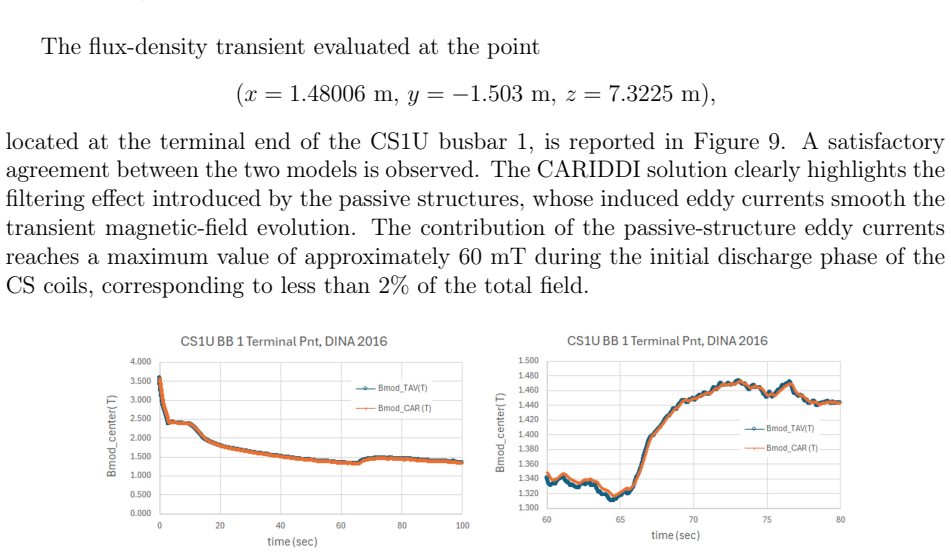
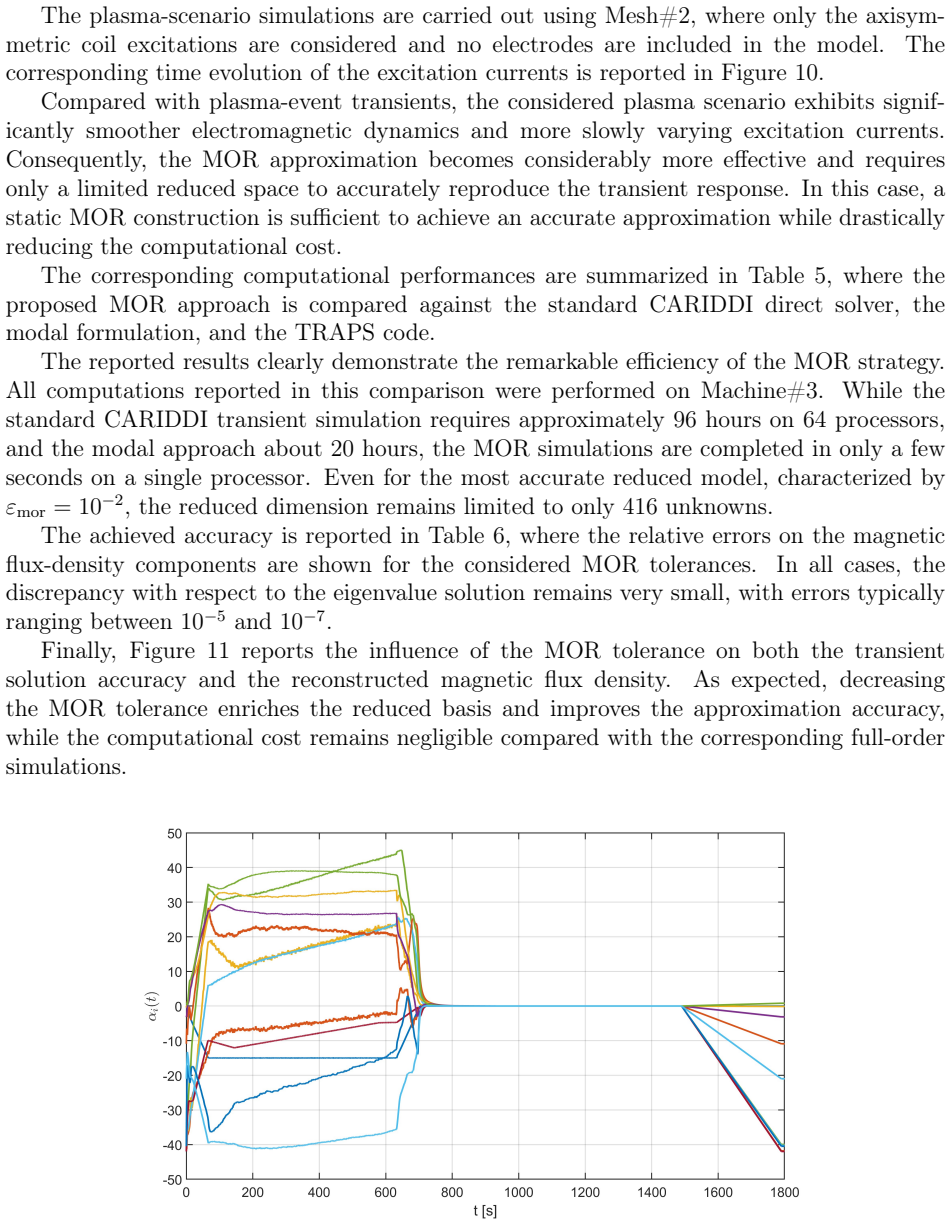
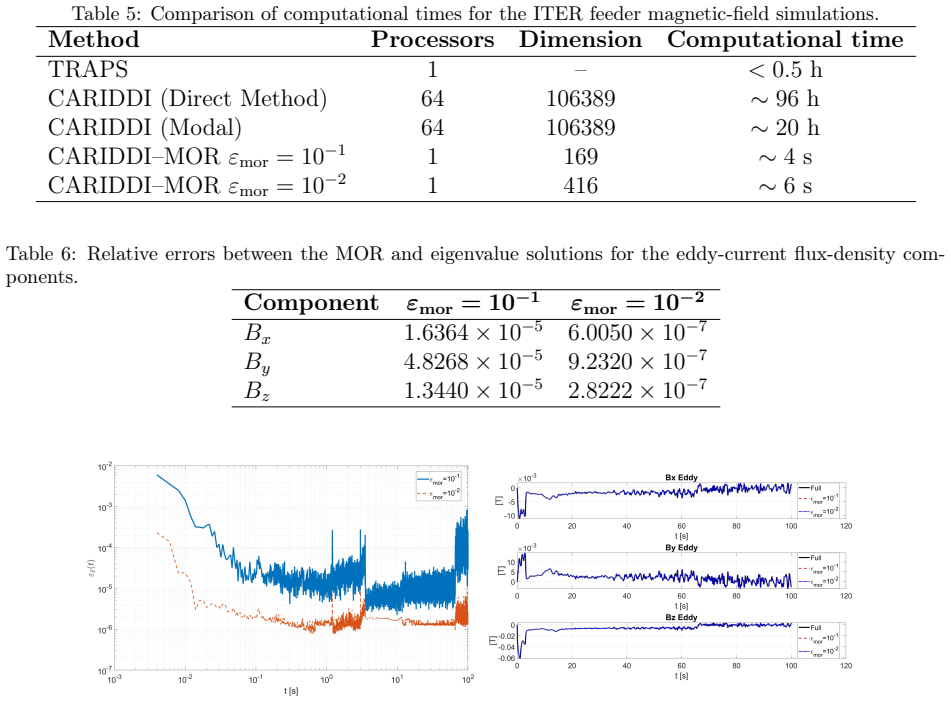
The central claim is that a model order reduction strategy based on integral formulations can generate reduced models by constructing the reduced space directly from the transient excitation, combining wavelet-based temporal compression with source-driven Krylov projections. This approach avoids repeated explicit inversions or factorizations of the dense integral operator during basis construction, produces models specific to the reachable responses of given excitation families, delivers substantial computational speedups, accurately preserves the transient electromagnetic response on various plasma events, and enables efficient generation of training data for neural-network surrogates in th
What carries the argument
Wavelet-based temporal compression combined with source-driven Krylov projections, which builds the reduced space directly from the prescribed transient excitations to match dynamically reachable responses.
If this is right
- Substantial computational speedups are obtained for transient electromagnetic simulations of fusion devices.
- The transient electromagnetic response is accurately preserved across various plasma events and fusion-relevant scenarios.
- Training data for neural-network surrogates can be generated efficiently for the null-field problem.
- The strategy applies without reliance on operator-based compression techniques such as H-matrices.
Where Pith is reading between the lines
- The same excitation-driven construction could be tested on integral formulations arising in other electromagnetic scattering or eddy-current problems outside fusion.
- If the speedups hold for real-time control loops, the reduced models could support online monitoring of disruptive plasma events.
- Pairing the reduced-order outputs with physics-informed neural networks might further reduce the amount of full-order data needed for surrogate training.
Load-bearing premise
The reduced space built directly from the transient excitation without repeated inversions of the dense integral operator remains accurate and robust for the full range of plasma events and the null-field problem.
What would settle it
Apply the reduced model to a plasma event whose excitation waveform differs markedly from the family used to build the basis and check whether the pointwise error in the computed transient fields stays below the tolerance reported in the paper's validations.
Figures
read the original abstract
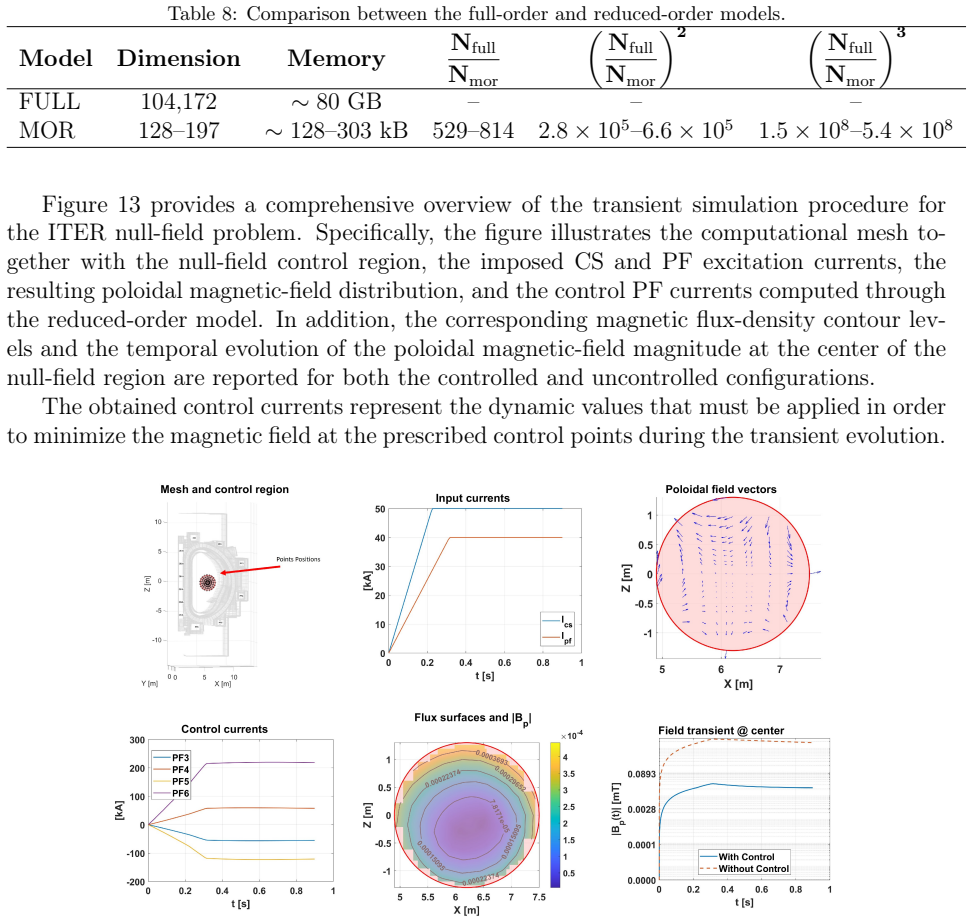
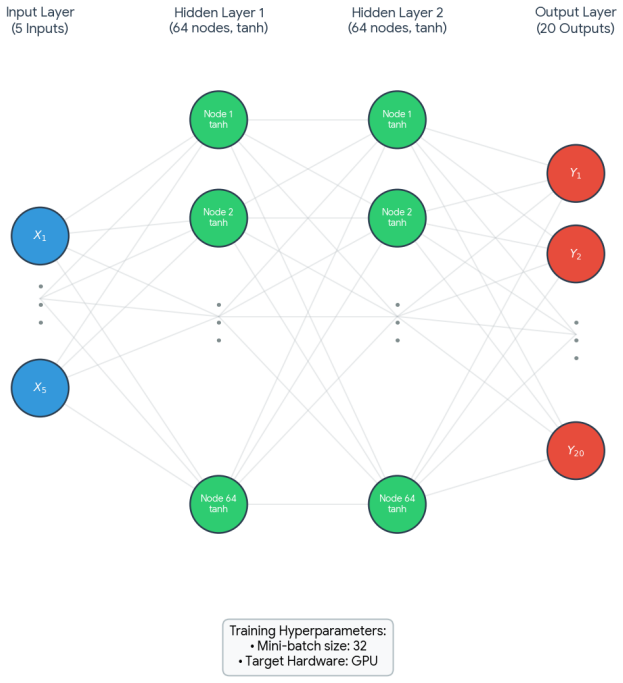
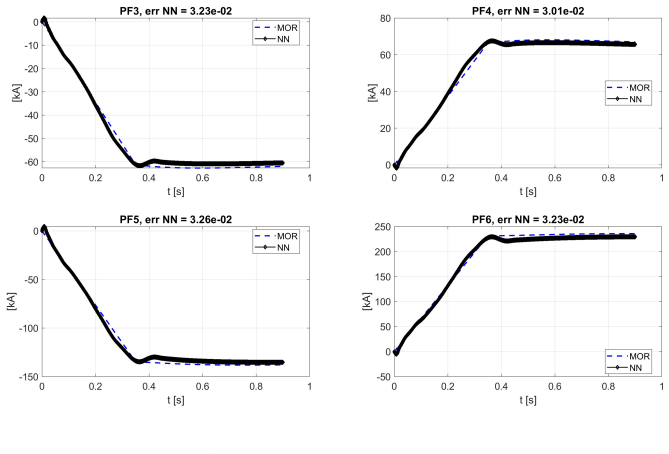
The numerical simulation of electromagnetic transients in fusion devices is essential for analyzing plasma stability and disruptive events. However, it remains computationally demanding due to the large-scale dense systems arising from integral formulations. This work proposes a model order reduction (MOR) strategy for transient electromagnetic problems based on integral formulations. Unlike operator-based compression techniques (such as $\mathcal{H}$-matrix approaches), the reduced space is constructed directly from the transient excitation. In contrast to classical snapshot- and transfer-function-based MOR approaches, the proposed formulation avoids repeated explicit inversions or factorizations of the dense integral operator during the MOR basis-construction stage. By combining wavelet-based temporal compression with source-driven Krylov projections, the method generates reduced models tailored to the dynamically reachable responses of the prescribed excitation families. Numerical validations on various plasma events and fusion-relevant scenarios demonstrate the robustness of the strategy, achieving substantial computational speedups while accurately preserving the transient electromagnetic response. Finally, the method is successfully applied to the null-field problem to efficiently generate training data for neural-network surrogates, contributing toward physics-consistent AI-enabled fusion modelling.
Editorial analysis
A structured set of objections, weighed in public.
Referee Report
Summary. The paper proposes a model order reduction (MOR) strategy for transient electromagnetic problems arising from integral formulations in fusion device analysis. Unlike operator-based or classical snapshot/transfer-function MOR methods, the reduced space is built directly from transient excitations via a combination of wavelet-based temporal compression and source-driven Krylov projections, explicitly avoiding repeated inversions or factorizations of the dense integral operator during basis construction. The approach is claimed to generate excitation-tailored reduced models that achieve substantial speedups while preserving accuracy for plasma events; it is further applied to the null-field problem to efficiently produce training data for neural-network surrogates in support of AI-enabled fusion modeling.
Significance. If the claimed accuracy and generalization hold under quantitative scrutiny, the work could meaningfully advance computational capabilities for large-scale fusion simulations by reducing the cost of integral-equation transients without sacrificing fidelity. The explicit avoidance of repeated dense-operator inversions during MOR construction is a concrete technical advantage over standard approaches, and the downstream use for generating physics-consistent training data directly supports AI integration in the field.
major comments (2)
- [Abstract / Numerical validations] Abstract / Numerical validations paragraph: the assertions that the method 'accurately preserv[es] the transient electromagnetic response' and that 'numerical validations on various plasma events [...] demonstrate the robustness' are unsupported by any reported error metrics (e.g., relative L2 errors, maximum deviations), baseline comparisons against full-order models or other MOR techniques, or tables quantifying speedup versus accuracy trade-offs. This directly undermines the central claim that the excitation-tailored subspace remains accurate and robust.
- [Method and validation description] Method and validation description: the core assumption that the reduced space constructed from prescribed excitation families (via wavelet compression + source-driven Krylov) generalizes to the full range of plasma events and the null-field problem lacks any explicit quantitative bounds on extrapolation error, coverage metrics for event diversity, or tests outside the exact families used for basis generation. This is load-bearing for the generalization and null-field application claims.
minor comments (1)
- [Abstract] The abstract would be strengthened by including at least one concrete quantitative indicator (e.g., observed speedup factor or error level) rather than qualitative statements alone.
Simulated Author's Rebuttal
We thank the referee for the constructive feedback highlighting the need for stronger quantitative support in our claims. We address the two major comments point-by-point below. Revisions will be made to incorporate explicit error metrics, tables, and additional discussion on event coverage.
read point-by-point responses
-
Referee: [Abstract / Numerical validations] Abstract / Numerical validations paragraph: the assertions that the method 'accurately preserv[es] the transient electromagnetic response' and that 'numerical validations on various plasma events [...] demonstrate the robustness' are unsupported by any reported error metrics (e.g., relative L2 errors, maximum deviations), baseline comparisons against full-order models or other MOR techniques, or tables quantifying speedup versus accuracy trade-offs. This directly undermines the central claim that the excitation-tailored subspace remains accurate and robust.
Authors: We acknowledge that the abstract and main text rely primarily on visual agreement in figures rather than tabulated quantitative metrics. The manuscript does contain direct comparisons to full-order models in the numerical section, but we agree these should be summarized with explicit relative L2 errors, maximum deviations, and speedup factors. We will add a dedicated table (and update the abstract to reference it) reporting these values for all tested plasma events, along with baseline timings against the unreduced integral formulation. revision: yes
-
Referee: [Method and validation description] Method and validation description: the core assumption that the reduced space constructed from prescribed excitation families (via wavelet compression + source-driven Krylov) generalizes to the full range of plasma events and the null-field problem lacks any explicit quantitative bounds on extrapolation error, coverage metrics for event diversity, or tests outside the exact families used for basis generation. This is load-bearing for the generalization and null-field application claims.
Authors: The reduced basis is intentionally constructed from excitation families representative of the targeted plasma events; the null-field application re-uses excitations drawn from the same families to produce consistent training data. We do not claim universal generalization outside these families. To strengthen the presentation we will add a paragraph quantifying the parameter ranges and event diversity covered in the numerical tests (e.g., current amplitudes, time scales, and spatial distributions) together with a coverage metric. Deriving rigorous a-priori extrapolation bounds for the nonlinear transient integral setting lies beyond the scope of the present work; we will explicitly note this limitation in the revised discussion. revision: partial
Circularity Check
No circularity: derivation is a combination of standard techniques validated externally
full rationale
The paper describes a MOR approach that constructs the reduced space directly from transient excitations using wavelet compression and source-driven Krylov projections, explicitly avoiding repeated dense-operator inversions. Accuracy and speedups are asserted via numerical validations on plasma events and the null-field problem, with no equations, fitted parameters, or self-citations presented that reduce the central claims to inputs by construction. The strategy is framed as a new combination of existing methods rather than a self-referential derivation, making the result self-contained against external benchmarks.
Axiom & Free-Parameter Ledger
Reference graph
Works this paper leans on
-
[1]
Integral formulation for 3D eddy-current computa- tion using edge elements,
R. Albanese and G. Rubinacci, “Integral formulation for 3D eddy-current computa- tion using edge elements,”IEE Proceedings A: Physical Science, Measurement and Instrumentation, Management and Education, Reviews, vol. 135, no. 7, p. 457, 1988. doi:10.1049/ip-a-1.1988.0072
-
[2]
Chapter 3: MHD stability, operational limits and disruptions,
T. C. Henderet al., “Chapter 3: MHD stability, operational limits and disruptions,” Nuclear Fusion, vol. 47, no. 6, pp. S128–S202, 2007
2007
-
[3]
Circuits/fields coupling and multiply connected domains in integral formulations,
G. Rubinacci, A. Tamburrino, and F. Villone, “Circuits/fields coupling and multiply connected domains in integral formulations,”IEEE Transactions on Magnetics, vol. 38, no. 2, pp. 581–584, 2002. doi:10.1109/20.996152
-
[4]
On the numerical analysis of eddy-current problems,
A. Bossavit, “On the numerical analysis of eddy-current problems,”Computer Methods in Applied Mechanics and Engineering, vol. 27, no. 3, pp. 303–318, 1981
1981
-
[5]
Bossavit,Computational Electromagnetism: Variational Formulations, Complemen- tarity, Edge Elements
A. Bossavit,Computational Electromagnetism: Variational Formulations, Complemen- tarity, Edge Elements. Academic Press, 1998. ISBN: 978-0-12-118710-1
1998
-
[6]
G. H. Golub and C. F. Van Loan,Matrix Computations, 4th ed. Johns Hopkins Univer- sity Press, 2013
2013
-
[7]
Saad,Iterative Methods for Sparse Linear Systems, 2nd ed
Y. Saad,Iterative Methods for Sparse Linear Systems, 2nd ed. SIAM, 2003
2003
-
[8]
MPI: A Message-Passing Interface Standard
Message Passing Interface Forum, “MPI: A Message-Passing Interface Standard.” Avail- able online:https://www.mpi-forum.org
-
[9]
ScaLAPACK – Scalable Linear Algebra PACKage
“ScaLAPACK – Scalable Linear Algebra PACKage.” Available online:https://netlib. org/scalapack/
-
[10]
An eddy current integral formulation on parallel computersystems,
R. Fresa, G. Rubinacci, and S. Ventre, “An eddy current integral formulation on parallel computersystems,”International Journal for Numerical Methods in Engineering, vol.62, pp. 1127–1147, 2005
2005
-
[11]
Foundations of volume integral methods for eddy current problems,
M. Passarotto, S. Pitassi, and R. Specogna, “Foundations of volume integral methods for eddy current problems,”Computer Methods in Applied Mechanics and Engineering, vol. 392, p. 114626, 2022. doi:10.1016/j.cma.2022.114626
-
[12]
The ITER Project
EFDA, European Fusion Development, “The ITER Project.” Available online:https: //www.iter.org
-
[13]
Disruptions in ITER and strategies for their control and mitigation,
M. Lehnen, P. A. Aleynikov, B. Alperet al., “Disruptions in ITER and strategies for their control and mitigation,”Journal of Nuclear Materials, vol. 463, pp. 39–48, 2015
2015
-
[14]
Joule losses in the ITER cold structures during plasma transients,
F. B. Cau, D. Bessette, G. D’Amico, A. Portone, G. Rubinacci, P. Testoni, S. Ventre, and F. Villone, “Joule losses in the ITER cold structures during plasma transients,” IEEE Transactions on Applied Superconductivity, vol. 26, no. 4, Art. no. 4204005, 2016. doi:10.1109/TASC.2016.2543743. 40
-
[15]
Numerical modeling of 3D halo current path in ITER structures,
P. Bettini, N. Marconato, M. F. Palumboet al., “Numerical modeling of 3D halo current path in ITER structures,”Fusion Engineering and Design, vol. 88, no. 6–8, pp. 529–532,
-
[16]
doi:10.1016/j.fusengdes.2012.11.017
-
[17]
Coupling JOREK and STARWALL codes for non-linear resistive-wall simulations,
M. Hölzl, P. Merkel, G. T. A. Huysmanset al., “Coupling JOREK and STARWALL codes for non-linear resistive-wall simulations,”Journal of Physics: Conference Series, vol. 401, no. 1, p. 012010, 2012. doi:10.1088/1742-6596/401/1/012010
-
[18]
N. Isernia, N. Schwarz, F. J. Artolaet al., “Self-consistent coupling of JOREK and CARIDDI: electromagnetic interaction of 3D tokamak plasmas with 3D volumetric con- ductors,”Physics of Plasmas, vol. 30, no. 11, p. 113901, 2023. doi:10.1063/5.0167271
-
[19]
A fast technique applied to the anal- ysis of resistive wall modes with 3D conducting structures,
G. Rubinacci, S. Ventre, F. Villone, and Y. Liu, “A fast technique applied to the anal- ysis of resistive wall modes with 3D conducting structures,”Journal of Computational Physics, vol. 228, pp. 1562–1572, 2008
2008
-
[20]
Afast3-Dmultipolemethodfor eddy-current computation,
G.Rubinacci, A.Tamburrino, S.Ventre, andF.Villone, “Afast3-Dmultipolemethodfor eddy-current computation,”IEEE Transactions on Magnetics, vol. 40, no. 2, pp. 1290– 1293, 2004. doi:10.1109/TMAG.2004.824585
-
[21]
F. Cau, A. G. Chiariello, G. Rubinacci, V. Scalera, A. Tamburrino, S. Ventre, and F. Villone, “A fast matrix compression method for large scale numerical modeling of rotationally symmetric 3D passive structures in fusion devices,”Energies, vol. 15, no. 9, p. 3214, 2022. doi:10.3390/en15093214
-
[22]
Application of n-fold ro- tational symmetries to eddy currents integral model in the time domain,
G. Rubinacci, A. Tamburrino, S. Ventre, and F. Villone, “Application of n-fold ro- tational symmetries to eddy currents integral model in the time domain,”IEEE Transactions on Magnetics, vol. 56, no. 1, pp. 1–4, Art. no. 7504804, 2020. doi:10.1109/TMAG.2019.2952824
-
[23]
Modal decompo- sition in numerical computation of eddy current transients,
S. Ventre, A. Chiariello, N. Isernia, V. Mottola, and A. Tamburrino, “Modal decompo- sition in numerical computation of eddy current transients,”Journal of Computational Physics, vol. 542, p. 114005, 2025. doi:10.1016/j.jcp.2025.114005
-
[24]
Introduction to hierarchical matrices with applications,
S. Börm, L. Grasedyck, and W. Hackbusch, “Introduction to hierarchical matrices with applications,”Engineering Analysis with Boundary Elements, vol. 27, no. 5, pp. 405–422,
-
[25]
doi:10.1016/S0955-7997(02)00087-6
-
[26]
A fast algorithm for particle simulations,
L. Greengard and V. Rokhlin, “A fast algorithm for particle simulations,”Journal of Computational Physics, vol. 73, pp. 325–348, 1987
1987
-
[27]
A fast adaptive multipole algorithm in three dimensions,
H. Cheng, L. Greengard, and V. Rokhlin, “A fast adaptive multipole algorithm in three dimensions,”Journal of Computational Physics, vol. 155, pp. 468–498, 1999
1999
-
[28]
Accuracy directly controlled fast direct solution of generalH2- matrices and its application to solving electrodynamic volume integral equations,
M. Ma and D. Jiao, “Accuracy directly controlled fast direct solution of generalH2- matrices and its application to solving electrodynamic volume integral equations,”IEEE Transactions on Microwave Theory and Techniques, vol. 66, no. 11, pp. 4808–4822, 2018. 41
2018
-
[29]
P. Benner, S. Grivet-Talocia, A. Quarteroni, G. Rozza, W. Schilders, and L. M. Sil- veira (Eds.),Model Order Reduction, Volume 1: System- and Data-Driven Methods and Algorithms. De Gruyter, Berlin/Boston, 2021. doi:10.1515/9783110498967
-
[30]
Reduced order modeling for real-time monitoring of structural displacements due to electromagnetic forces in large scale tokamaks,
F. Lucchini, A. Frescura, R. Torchio, P. Alotto, and P. Bettini, “Reduced order modeling for real-time monitoring of structural displacements due to electromagnetic forces in large scale tokamaks,”Plasma Physics and Controlled Fusion, vol. 66, no. 11, p. 115002,
-
[31]
doi:10.1088/1361-6587/ad7889
-
[32]
A. C. Antoulas,Approximation of Large-Scale Dynamical Systems. SIAM, Philadelphia, PA, 2005. doi:10.1137/1.9780898718713
-
[33]
Model reduction methods based on Krylov subspaces,
R. W. Freund, “Model reduction methods based on Krylov subspaces,”Acta Numerica, vol. 12, pp. 267–319, 2003. doi:10.1017/S0962492902000120
-
[34]
A survey of projection-based model reduction methods for parametric dynamical systems,
P. Benner, S. Gugercin, and K. Willcox, “A survey of projection-based model reduction methods for parametric dynamical systems,”SIAM Review, vol. 57, no. 4, pp. 483–531, 2015
2015
-
[35]
E. J. Grimme,Krylov Projection Methods for Model Reduction. PhD thesis, University of Illinois at Urbana-Champaign, 1997
1997
-
[36]
Krylov subspace methods for model or- der reduction in computational electromagnetics,
M. Bonotto, A. Cenedese, and P. Bettini, “Krylov subspace methods for model or- der reduction in computational electromagnetics,”IFAC-PapersOnLine, vol. 50, no. 1, pp. 6355–6360, 2017. doi:10.1016/j.ifacol.2017.08.1019
-
[37]
A. N. Kolmogorov,Foundations of the Theory of Probability, 2nd English ed. Chelsea Publishing Company, New York, 1956
1956
-
[38]
Advancing fusion with machine learning research needs workshop report,
N. M. Ferraroet al., “Advancing fusion with machine learning research needs workshop report,”Journal of Fusion Energy, vol. 39, no. 2, pp. 123–155, 2020. doi:10.1007/s10894- 020-00228-7
-
[39]
J. N. Kutz,Dynamic Mode Decomposition: Data-Driven Modeling of Complex Systems. SIAM, Philadelphia, PA, 2016. doi:10.1137/1.9781611974508
-
[40]
A numerical tool to optimize voltage waveforms for plasmabreakdownandearlyramp-upinthepresenceofconstraints,
L. E. Di Grazia and M. Mattei, “A numerical tool to optimize voltage waveforms for plasmabreakdownandearlyramp-upinthepresenceofconstraints,”Fusion Engineering and Design, vol. 176, p. 113027, 2022
2022
-
[41]
Modelling of plasma startup in ITER,
R. D. Pillsbury and J. H. Schultz, “Modelling of plasma startup in ITER,”IEEE Trans- actions on Magnetics, vol. 28, no. 2, pp. 1332–1335, 1992
1992
-
[42]
ITERplasma startupmodeling,
J. A.LeuerandJ.C. Wesley, “ITERplasma startupmodeling,” inProceedings of the 15th IEEE/NPSS Symposium on Fusion Engineering, Hyannis, MA,USA,vol.2, pp.629–632, 1993
1993
-
[43]
Model-based optimization of the field-null configuration for robust plasma breakdown on the HL-3 tokamak,
Y. Liu, Z. Zhong, L. Liet al., “Model-based optimization of the field-null configuration for robust plasma breakdown on the HL-3 tokamak,”Nuclear Fusion, 2024. 42
2024
-
[44]
New Features of the TRAPS Code for Accurate 3D Magnetic Field Calculations,
P. Hertoutet al., “New Features of the TRAPS Code for Accurate 3D Magnetic Field Calculations,”IEEE Transactions on Applied Superconductivity, vol. 34, no. 5, 2024. 43
2024
discussion (0)
Sign in with ORCID, Apple, or X to comment. Anyone can read and Pith papers without signing in.