Magnetic order, magnons, and crystal fields in van der Waals CeSiI
Pith reviewed 2026-06-29 09:50 UTC · model grok-4.3
The pith
Isotropic Heisenberg interactions on a quasi-two-dimensional lattice explain the low-energy magnon spectrum in CeSiI and stabilize a co-rotating spin cycloid.
A machine-rendered reading of the paper's core claim, the machinery that carries it, and where it could break.
Core claim
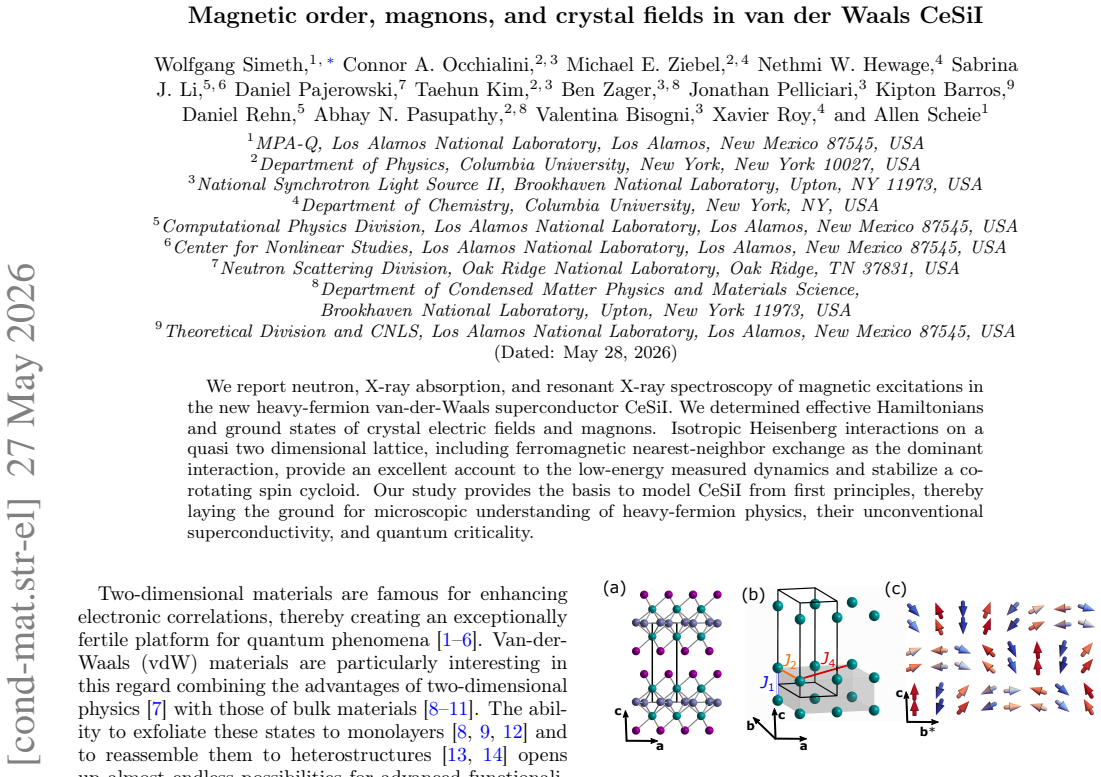
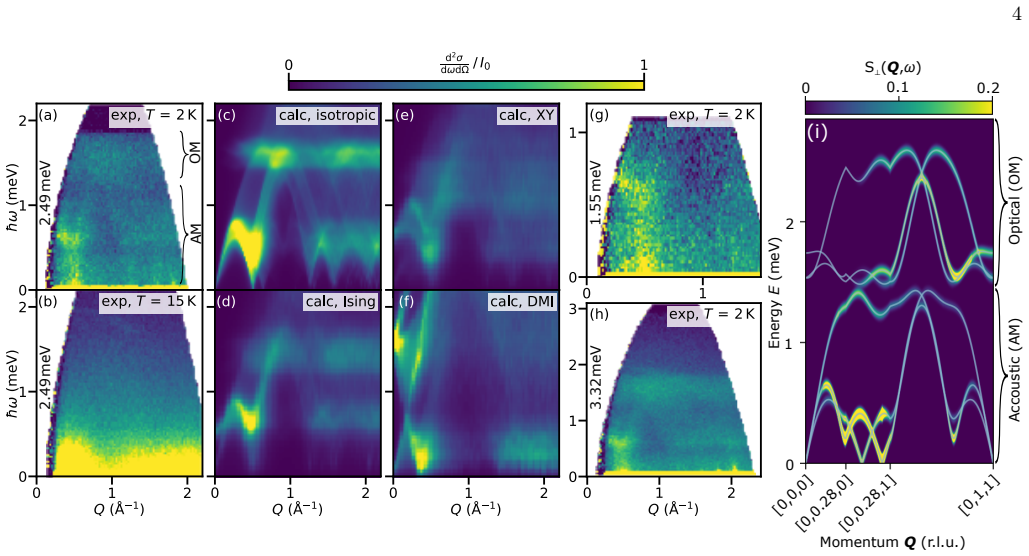
Isotropic Heisenberg interactions on a quasi two dimensional lattice, including ferromagnetic nearest-neighbor exchange as the dominant interaction, provide an excellent account to the low-energy measured dynamics and stabilize a co-rotating spin cycloid.
What carries the argument
The isotropic Heisenberg Hamiltonian on a quasi-2D lattice with dominant ferromagnetic nearest-neighbor exchange, which fits the magnon spectrum and selects the observed cycloidal order.
If this is right
- The extracted crystal-field levels and exchange parameters supply a concrete effective model that can be used for first-principles calculations of CeSiI.
- The same Hamiltonian provides a microscopic basis for modeling the material's heavy-fermion behavior, unconventional superconductivity, and quantum criticality.
- The co-rotating spin cycloid is a direct consequence of the dominant ferromagnetic nearest-neighbor coupling on the layered lattice.
- The quasi-two-dimensional character of the interactions implies that interlayer coupling is weak compared with in-plane exchange.
Where Pith is reading between the lines
- If the localized-moment description remains valid, then CeSiI offers a platform where heavy-fermion effects can be tuned by pressure or doping without immediately destroying the Heisenberg magnons.
- The co-rotating cycloid may produce characteristic signatures in the spin texture that could be detected by scanning tunneling microscopy or in transport under magnetic fields.
- Extending the same fitting procedure to higher-energy excitations could reveal the crossover from localized to itinerant behavior that is left outside the present low-energy window.
Load-bearing premise
The low-energy magnetic excitations are fully captured by a localized-moment Heisenberg Hamiltonian without significant Kondo screening or itinerant-electron effects at the energies probed by the neutron and resonant X-ray measurements.
What would settle it
A measured magnon dispersion that deviates substantially from the Heisenberg-model prediction at energies below 2 meV, or the appearance of Kondo-like broadening in the low-energy spectrum, would falsify the central claim.
Figures
read the original abstract
We report neutron, X-ray absorption, and resonant X-ray spectroscopy of magnetic excitations in the new heavy-fermion van-der-Waals superconductor CeSiI. We determined effective Hamiltonians and ground states of crystal electric fields and magnons. Isotropic Heisenberg interactions on a quasi two dimensional lattice, including ferromagnetic nearest-neighbor exchange as the dominant interaction, provide an excellent account to the low-energy measured dynamics and stabilize a co-rotating spin cycloid. Our study provides the basis to model CeSiI from first principles, thereby laying the ground for microscopic understanding of heavy-fermion physics, their unconventional superconductivity, and quantum criticality.
Editorial analysis
A structured set of objections, weighed in public.
Referee Report
Summary. The manuscript reports neutron scattering, X-ray absorption, and resonant inelastic X-ray scattering measurements on the van der Waals heavy-fermion superconductor CeSiI. It determines the crystal-electric-field level scheme and models the low-energy magnon excitations with an isotropic Heisenberg Hamiltonian on a quasi-two-dimensional lattice, in which ferromagnetic nearest-neighbor exchange is the dominant interaction. The model is stated to give an excellent account of the measured dynamics and to stabilize the observed co-rotating spin cycloid; the work is positioned as a foundation for first-principles modeling of the material’s heavy-fermion physics, superconductivity, and quantum criticality.
Significance. If the central claims are substantiated with quantitative evidence, the result supplies a concrete, low-parameter microscopic model for magnetic interactions in a new van der Waals heavy-fermion platform. The multi-technique constraint of both CEF and exchange parameters, together with the explicit restriction to low-energy localized-moment physics, constitutes a useful starting point for subsequent theoretical studies of superconductivity and quantum criticality in this class of materials.
major comments (2)
- [Magnon dispersion modeling and associated figures] The abstract and the sections presenting the magnon modeling assert that the isotropic Heisenberg model provides an 'excellent account' of the low-energy dynamics, yet no quantitative fit metrics (χ², R², residual analysis, or parameter uncertainties) or comparison against alternative models (e.g., with single-ion anisotropy or additional longer-range terms) are supplied. This absence makes the strength of the central claim difficult to evaluate independently.
- [Ground-state calculation from exchange parameters] The claim that the fitted interactions 'stabilize' the co-rotating spin cycloid is obtained from the same exchange parameters that were determined by fitting the measured magnon spectrum. The manuscript should clarify whether the cycloidal order itself was established independently (e.g., by elastic neutron diffraction Bragg peaks) or whether the ground-state calculation is solely a consistency check; without this distinction the stabilization statement risks circularity.
minor comments (2)
- [Exchange and CEF parameter sections] A table listing the two fitted exchange parameters, their uncertainties, and the CEF level scheme would improve clarity and reproducibility.
- [Figure captions] Figure captions for the dispersion plots should explicitly state the momentum paths, energy resolution, and temperature at which the neutron and RIXS data were acquired.
Simulated Author's Rebuttal
We thank the referee for the positive evaluation and the detailed, constructive comments. We respond to each major comment below.
read point-by-point responses
-
Referee: [Magnon dispersion modeling and associated figures] The abstract and the sections presenting the magnon modeling assert that the isotropic Heisenberg model provides an 'excellent account' of the low-energy dynamics, yet no quantitative fit metrics (χ², R², residual analysis, or parameter uncertainties) or comparison against alternative models (e.g., with single-ion anisotropy or additional longer-range terms) are supplied. This absence makes the strength of the central claim difficult to evaluate independently.
Authors: We agree that quantitative fit metrics and model comparisons are needed for independent assessment. In the revised manuscript we will report the χ² of the magnon dispersion fit, the estimated uncertainties on the exchange parameters, and a short comparison showing that adding single-ion anisotropy or longer-range couplings does not meaningfully improve the description within the resolution of the data. revision: yes
-
Referee: [Ground-state calculation from exchange parameters] The claim that the fitted interactions 'stabilize' the co-rotating spin cycloid is obtained from the same exchange parameters that were determined by fitting the measured magnon spectrum. The manuscript should clarify whether the cycloidal order itself was established independently (e.g., by elastic neutron diffraction Bragg peaks) or whether the ground-state calculation is solely a consistency check; without this distinction the stabilization statement risks circularity.
Authors: The co-rotating spin cycloid was determined independently from elastic neutron diffraction Bragg peaks (presented in the elastic scattering section). The Heisenberg parameters were obtained exclusively from the inelastic magnon spectrum; the subsequent classical ground-state calculation serves only as a consistency check that these parameters indeed favor the observed structure. We will revise the text to make this separation explicit and remove any ambiguity. revision: yes
Circularity Check
No significant circularity; model fit is consistency check against independently observed order
full rationale
The paper determines the magnetic order (co-rotating spin cycloid) from neutron and resonant X-ray measurements, extracts CEF levels and fits two exchange parameters of an isotropic Heisenberg model to the measured low-energy magnon dispersion, then verifies that the fitted model stabilizes the observed order. This is a standard consistency validation rather than a reduction by construction, as the order is not derived solely from the same fitted spectrum but reported as an independent experimental input. No self-definitional equations, fitted-input predictions, or load-bearing self-citations appear; the central claim remains self-contained with external data benchmarks.
Axiom & Free-Parameter Ledger
free parameters (2)
- nearest-neighbor Heisenberg exchange
- longer-range exchange parameters
axioms (1)
- domain assumption Magnetic excitations at the probed energies can be described by a localized-moment effective spin Hamiltonian
Forward citations
Cited by 1 Pith paper
-
A Validation Framework for Quantum Simulation of Spin Dynamics against Inelastic Neutron Scattering and Classical Simulation
Develops a validation framework for quantum spin dynamics simulations anchored by neutron scattering and classical methods, using observable maps, uncertainty propagation, robustness tests, and actuator-aware feedback.
Reference graph
Works this paper leans on
-
[1]
Quan- tum Fluctuations in Narrow-Band Systems
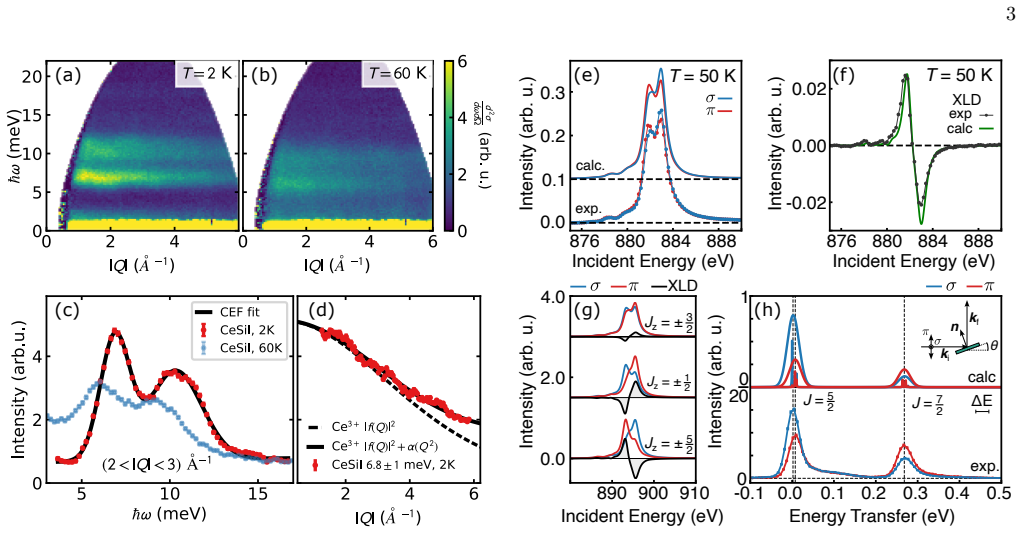
Fit- ting to the experimental data yields three possible Hamil- toniansandgroundstatewave-functions(seeSI[34])that describe the neutron data equally well but which display different sequences of excited state levels. Toadjudicatebetweenthesethreepossibilities, weturn to the XAS (circles) in Fig. 2(e). The pronounced double-peak centered around 882eV corre...
-
[2]
C. L. Kane and E. J. Mele, Quantum Spin Hall Effect in Graphene, Physical Review Letters95, 226801 (2005)
2005
-
[3]
Y. Cao, V. Fatemi, S. Fang, K. Watanabe, T. Taniguchi, E.Kaxiras,andP.Jarillo-Herrero,Unconventionalsuper- conductivity in magic-angle graphene superlattices, Na- ture556, 43 (2018)
2018
-
[4]
Park, J.-G
J.-U.Lee, S.Lee, J.H.Ryoo, S.Kang, T.Y.Kim, P.Kim, C.-H. Park, J.-G. Park, and H. Cheong, Ising-Type Mag- netic Ordering in Atomically Thin FePS3, Nano Letters 16, 7433 (2016)
2016
-
[5]
K. F. Mak and J. Shan, Photonics and optoelectronics of 2D semiconductor transition metal dichalcogenides, Na- ture Photonics10, 216 (2016)
2016
-
[6]
V. Vaňo, M. Amini, S. C. Ganguli, G. Chen, J. L. Lado, S. Kezilebieke, and P. Liljeroth, Artificial heavy fermions in a van der Waals heterostructure, Nature599, 582 (2021)
2021
-
[7]
Mizukami, H
Y. Mizukami, H. Shishido, T. Shibauchi, M. Shi- 6 mozawa, S. Yasumoto, D. Watanabe, M. Yamashita, H. Ikeda, T. Terashima, H. Kontani, and Y. Matsuda, Extremely strong-coupling superconductivity in artificial two-dimensional Kondo lattices, Nature Physics7, 849 (2011)
2011
-
[8]
Kosterlitz and D
J. Kosterlitz and D. Thouless, Chapter5 two-dimensional physics (Elsevier, 1978) pp. 371–433
1978
-
[9]
C. Gong, L. Li, Z. Li, H. Ji, A. Stern, Y. Xia, T. Cao, W. Bao, C. Wang, Y. Wang, Z. Q. Qiu, R. J. Cava, S. G. Louie, J. Xia, and X. Zhang, Discovery of intrinsic fer- romagnetism in two-dimensional van der Waals crystals, Nature546, 265 (2017)
2017
-
[10]
Huang, G
B. Huang, G. Clark, E. Navarro-Moratalla, D. R. Klein, R. Cheng, K. L. Seyler, D. Zhong, E. Schmidgall, M. A. McGuire, D. H. Cobden, W. Yao, D. Xiao, P. Jarillo- Herrero, and X. Xu, Layer-dependent ferromagnetism in a van der Waals crystal down to the monolayer limit, Nature546, 270 (2017)
2017
-
[11]
K. S. Burch, D. Mandrus, and J.-G. Park, Magnetism in two-dimensional van der Waals materials, Nature563, 47 (2018)
2018
-
[12]
M. E. Ziebel, M. L. Feuer, J. Cox, X. Zhu, C. R. Dean, and X. Roy, CrSBr: An Air-Stable, Two-Dimensional Magnetic Semiconductor, Nano Letters24, 4319 (2024)
2024
-
[13]
S. M. Thomas, A. E. Llacsahuanga, W. Simeth, C. S. Kengle, F. Orlandi, D. Khalyavin, P. Manuel, F. Ron- ning, E. D. Bauer, J. D. Thompson, J.-X. Zhu, A. O. Scheie, Y. P. Chen, and P. F. S. Rosa, Enhanced two- dimensional ferromagnetism in van der Waalsβ-UTe 3 monolayers (2025), arXiv:2506.15667 [cond-mat]
-
[14]
K. S. Novoselov, A. Mishchenko, A. Carvalho, and A. H. Castro Neto, 2D materials and van der Waals het- erostructures, Science353, aac9439 (2016)
2016
-
[15]
Y. Liu, N. O. Weiss, X. Duan, H.-C. Cheng, Y. Huang, and X. Duan, Van der Waals heterostructures and de- vices, Nature Reviews Materials1, 16042 (2016)
2016
-
[16]
Jariwala, A
D. Jariwala, A. R. Davoyan, J. Wong, and H. A. Atwa- ter, Van der Waals Materials for Atomically-Thin Photo- voltaics: Promise and Outlook, ACS Photonics4, 2962 (2017)
2017
-
[17]
P. G. Zotev, P. Bouteyre, Y. Wang, S. A. Rander- son, X. Hu, L. Sortino, Y. Wang, T. Shegai, S.-H. Gong, A. Tittl, I. Aharonovich, and A. I. Tartakovskii, Nanophotonics with multilayer van der Waals materials, Nature Photonics19, 788 (2025)
2025
-
[18]
B. G. Jang, C. Lee, J.-X. Zhu, and J. H. Shim, Exploring two-dimensional van der Waals heavy-fermion material: Data mining theoretical approach, npj 2D Materials and Applications6, 80 (2022)
2022
-
[19]
Kundu, C
V.A.Posey, S.Turkel, M.Rezaee, A.Devarakonda, A.K. Kundu, C. S. Ong, M. Thinel, D. G. Chica, R. A. Vi- talone, R. Jing,et al., Two-dimensional heavy fermions in the van der Waals metal CeSiI, Nature625, 483 (2024)
2024
- [20]
-
[21]
Kallin and J
C. Kallin and J. Berlinsky, Chiral superconductors, Re- ports on Progress in Physics79, 054502 (2016)
2016
-
[22]
S. D. Sarma, M. Freedman, and C. Nayak, Majorana zero modes and topological quantum computation, npj Quan- tum Information1, 15001 (2015)
2015
-
[23]
Karzig, C
T. Karzig, C. Knapp, R. M. Lutchyn, P. Bonder- son, M. B. Hastings, C. Nayak, J. Alicea, K. Flens- berg, S. Plugge, Y. Oreg, C. M. Marcus, and M. H. Freedman, Scalable designs for quasiparticle-poisoning- protected topological quantum computation with Majo- rana zero modes, Physical Review B95, 235305 (2017)
2017
-
[24]
Sato and Y
M. Sato and Y. Ando, Topological superconductors: A review, Reports on Progress in Physics80, 076501 (2017)
2017
-
[25]
Yadav, C
A. Yadav, C. M. Acosta, G. M. Dalpian, and O. I. Ma- lyi, First-principles investigations of 2D materials: Chal- lenges and best practices, Matter6, 2711 (2023)
2023
-
[26]
Stoudenmire and S
E. Stoudenmire and S. R. White, Studying two- dimensional systems with the density matrix renormal- ization group, Annual Review of Condensed Matter Physics3, 111 (2012)
2012
-
[27]
Quantum Monte Carlo studies of U(1) lattice gauge models of Kondo breakdown
G. Pan and F. F. Assaad, Quantum monte carlo studies of U(1) lattice gauge models of kondo breakdown, arXiv preprint arXiv:2512.17801 10.48550/arXiv.2512.17801 (2025)
work page internal anchor Pith review doi:10.48550/arxiv.2512.17801 2025
-
[28]
Monthoux, D
P. Monthoux, D. Pines, and G. G. Lonzarich, Supercon- ductivity without phonons, Nature450, 1177 (2007)
2007
-
[29]
Turkel, V
S. Turkel, V. A. Posey, C. S. Ong, S. Ghosh, X. Huang, A. K. Kundu, E. Vescovo, D. G. Chica, P. Thunström, O. Eriksson, W. Simeth, A. Scheie, A. Rubio, A. J. Millis, X. Roy, and A. N. Pasupathy, Nodal hybridization in a two-dimensional heavy-fermion material, Nature Physics 21, 1949 (2025)
1949
-
[30]
R.Okuma,MagneticfrustrationinavanderWaalsmetal CeSiI, Physical Review Materials5, 10.1103/PhysRev- Materials.5.L121401 (2021)
-
[31]
G. L. Squires,Introduction to the Theory of Thermal Neutron Scattering, 3rd ed. (Cambridge University Press, Cambridge, UK, 2012)
2012
-
[32]
Ehlers, A
G. Ehlers, A. A. Podlesnyak, J. L. Niedziela, E. B. Iver- son, and P. E. Sokol, The new cold neutron chopper spec- trometer at the spallation neutron source: Design and performance,ReviewofScientificInstruments82,085108 (2011)
2011
-
[33]
T. E. Mason, D. Abernathy, I. Anderson, J. Ankner, T. Egami, G. Ehlers, A. Ekkebus, G. Granroth, M. Ha- gen, K. Herwig, J. Hodges, C. Hoffmann, C. Horak, L. Horton, F. Klose, J. Larese, A. Mesecar, D. Myles, J. Neuefeind, M. Ohl, C. Tulk, X.-L. Wang, and J. Zhao, The Spallation Neutron Source in Oak Ridge: A pow- erful tool for materials research, Physica...
2006
-
[35]
See Supplemental Material at [URL will be inserted by publisher] for more details of the experiments and calcu- lations
-
[36]
Scheie, Pycrystalfield: software for calculation, analy- sis and fitting of crystal electric field hamiltonians, Jour- nal of Applied Crystallography54(2021)
A. Scheie, Pycrystalfield: software for calculation, analy- sis and fitting of crystal electric field hamiltonians, Jour- nal of Applied Crystallography54(2021)
2021
-
[37]
K. W. H. Stevens, Matrix elements and operator equiva- lentsconnectedwiththemagneticpropertiesofrareearth ions, Proceedings of the Physical Society. Section A65, 209 (1952)
1952
-
[38]
Hansmann, A
P. Hansmann, A. Severing, Z. Hu, M. W. Haverkort, C. F. Chang, S. Klein, A. Tanaka, H. H. Hsieh, H.-J. Lin, C. T. Chen, B. Fåk, P. Lejay, and L. H. Tjeng, Determin- ing the Crystal-Field Ground State in Rare Earth Heavy 7 Fermion Materials Using Soft-X-Ray Absorption Spec- troscopy, Physical Review Letters100, 066405 (2008)
2008
-
[39]
Willers, F
T. Willers, F. Strigari, Z. Hu, V. Sessi, N. B. Brookes, E. D. Bauer, J. L. Sarrao, J. D. Thompson, A. Tanaka, S. Wirth, L. H. Tjeng, and A. Severing, Correlation between ground state and orbital anisotropy in heavy fermion materials, Proceedings of the National Academy of Sciences112, 2384 (2015)
2015
-
[40]
D. S. Christovam, M. Ferreira-Carvalho, A. Marino, M. Sundermann, D. Takegami, A. Melendez-Sans, K. D. Tsuei, Z. Hu, S. Rößler, M. Valvidares, M. W. Haverkort, Y. Liu, E. D. Bauer, L. H. Tjeng, G. Zwicknagl, and A. Severing, Spectroscopic Evidence of Kondo-Induced Quasiquartet inCeRh2As2, Physical ReviewLetters132, 046401 (2024)
2024
-
[41]
M. W. Haverkort, M. Zwierzycki, and O. K. Ander- sen, Multiplet ligand-field theory using Wannier orbitals, Physical Review B85, 165113 (2012)
2012
-
[42]
Amorese, G
A. Amorese, G. Dellea, M. Fanciulli, S. Seiro, C. Geibel, C. Krellner, I. P. Makarova, L. Braicovich, G. Ghir- inghelli, D. V. Vyalikh, N. B. Brookes, and K. Kummer, 4fexcitations in Ce Kondo lattices studied by resonant inelastic x-ray scattering, Physical Review B93, 165134 (2016)
2016
-
[43]
S. Horn, E. Holland-Moritz, M. Loewenhaupt, F. Steglich, H. Scheuer, A. Benoit, and J. Flou- quet, Magnetic neutron scattering and crystal-field states in CeCu2Si2, Physical Review B23, 3171 (1981)
1981
-
[44]
W. a. C. Erkelens and R. Leiden (Netherlands),Elastic and Inelastic Neutron Scattering Studies on 3d and 4f Magnetic Compounds, Tech. Rep. INIS-mf–11365 (Rijk- suniversiteit Leiden (Netherlands), 1987)
1987
-
[45]
B. H. Grier, J. M. Lawrence, S. Horn, and J. D. Thomp- son, Inelastic magnetic neutron scattering in CeT 2Si2 (T=Au, Pd, Ru or Pt): Crystal fields and quasi-elastic scattering, Journal of Physics C: Solid State Physics21, 1099 (1988)
1988
-
[47]
A. Vijayvargia, H. Zhang, K. Barros, S.-Z. Lin, and O. Erten, Electric field driven spin textures in heavy fermion van der Waals magnets (2024), arXiv:2410.06344 [cond-mat]
-
[49]
J. W. Allen and C. Y. Young, Magnetic anisotropy due to spin-orbit and dipole-dipole interactions in spin- density-wave antiferromagnets, Physical Review B16, 1103 (1977)
1977
-
[50]
R. Chen, H. Ju, H.-C. Jiang, O. A. Starykh, and L. Ba- lents, Ground states of spin-1 2 triangular antiferromag- nets in a magnetic field, Physical Review B87, 165123 (2013)
2013
-
[51]
Facheris, K
L. Facheris, K. Yu. Povarov, S. D. Nabi, D. G. Mazzone, J. Lass, B. Roessli, E. Ressouche, Z. Yan, S. Gvasaliya, and A. Zheludev, Spin Density Wave versus Fractional Magnetization Plateau in a Triangular Antiferromagnet, Physical Review Letters129, 087201 (2022)
2022
-
[52]
P. Park, B. R. Ortiz, M. Sprague, A. P. Sakhya, S. A. Chen, M. D. Frontzek, W. Tian, R. Sibille, D. G. Maz- zone, C. Tabata, K. Kaneko, L. M. DeBeer-Schmitt, M. B. Stone, D. S. Parker, G. D. Samolyuk, H. Miao, M. Neupane, and A. D. Christianson, Spin density wave and van Hove singularity in the kagome metal CeTi3Bi4, Nature Communications16, 4384 (2025)
2025
-
[53]
O. A. Starykh, H. Katsura, and L. Balents, Extreme sensitivity of a frustrated quantum magnet: Cs2CuCl4, Physical Review B82, 014421 (2010)
2010
-
[55]
A. V. Chubukov and D. I. Golosov, Quantum theory of an antiferromagnet on a triangular lattice in a magnetic field, Journal of Physics: Condensed Matter3, 69 (1991)
1991
-
[56]
Coletta, T
T. Coletta, T. A. Tóth, K. Penc, and F. Mila, Semiclas- sical theory of the magnetization process of the triangu- lar lattice Heisenberg model, Phys. Rev. B94, 075136 (2016). Supplemental material for: Magnetic order, magnons, and crystal fields in van-der-Waals CeSiI Wolfgang Simeth1, Connor A. Occhialini 2,3, Michael E. Ziebel 2,4, Nethmi W. Hewage 4, S...
2016
-
[57]
UsingPyCrystalField[6] software, we fit theE i = 25 meV atT= 2 K powder inelastic neutron data over 1 ˚A −1 <|Q|<2 ˚A −1 . We began by calculating a point charge model [7] assuming effective charges Si to be −4eand I to be +e(ionic values assuming charge balance in CeSiI), and then scaling the CEF parameters by 0.1 so the CEF levels lie near the predicted...
-
[58]
For simulations on Hamiltonians including exclu- sively isotropic exchange, we worked with a system size that corresponds to the crystallo- graphic unit cell
were carried out with the Julia based packageSunny[26]. For simulations on Hamiltonians including exclu- sively isotropic exchange, we worked with a system size that corresponds to the crystallo- graphic unit cell. Here,Sunnysimulations were based on the rotating frame formalism [27]. For Hamiltonians including anisotropic exchange or DM interactions, we ...
1926
-
[59]
Ehlers, A
G. Ehlers, A. A. Podlesnyak, J. L. Niedziela, E. B. Iverson, and P. E. Sokol, The new cold neutron chopper spectrometer at the spallation neutron source: Design and performance, Review of Scientific Instruments82, 085108 (2011)
2011
-
[60]
T. E. Mason, D. Abernathy, I. Anderson, J. Ankner, T. Egami, G. Ehlers, A. Ekkebus, G. Granroth, M. Hagen, K. Herwig, J. Hodges, C. Hoffmann, C. Horak, L. Horton, F. Klose, J. Larese, A. Mesecar, D. Myles, J. Neuefeind, M. Ohl, C. Tulk, X.-L. Wang, and J. Zhao, The Spallation Neutron Source in Oak Ridge: A powerful tool for materials research, Physica B: ...
2006
-
[61]
P. J. Brown, Magnetic form factors, The Cambridge Crystallographic Subroutine Library (1998)
1998
-
[62]
V. A. Posey, S. Turkel, M. Rezaee, A. Devarakonda, A. K. Kundu, C. S. Ong, M. Thinel, D. G. Chica, R. A. Vitalone, R. Jing,et al., Two-dimensional heavy fermions in the van der Waals metal CeSiI, Nature625, 483 (2024)
2024
-
[63]
K. W. H. Stevens, Matrix elements and operator equivalents connected with the magnetic properties of rare earth ions, Proceedings of the Physical Society. Section A65, 209 (1952)
1952
-
[64]
Scheie, Pycrystalfield: software for calculation, analysis and fitting of crystal electric field hamiltonians, Journal of Applied Crystallography54(2021)
A. Scheie, Pycrystalfield: software for calculation, analysis and fitting of crystal electric field hamiltonians, Journal of Applied Crystallography54(2021)
2021
-
[65]
Hutchings, Point-charge calculations of energy levels of magnetic ions in crystalline electric fields, Solid State Physics Solid State Physics,16, 227 (1964)
M. Hutchings, Point-charge calculations of energy levels of magnetic ions in crystalline electric fields, Solid State Physics Solid State Physics,16, 227 (1964)
1964
-
[66]
A. O. Scheie, S. J. Li, S. D. Wilson, and D. A. Rehn, Explaining the extra crystal-field mode inaCeX 2 (a= k, rb, na;x= o, s, se, te), Phys. Rev. B112, 014415 (2025)
2025
-
[67]
Scheie, Quantifying uncertainties in crystal electric field Hamiltonian fits to neutron data, SciPost Phys
A. Scheie, Quantifying uncertainties in crystal electric field Hamiltonian fits to neutron data, SciPost Phys. Core5, 018 (2022)
2022
-
[68]
Scheie, V
A. Scheie, V. O. Garlea, L. D. Sanjeewa, J. Xing, and A. S. Sefat, Crystal-field hamiltonian and anisotropy in kerse 2 and cserse2, Phys. Rev. B101, 144432 (2020)
2020
-
[69]
L. C. Lopes and B. Coqblin, Neutron-scattering spectra of noncubic cerium kondo compounds, Phys. Rev. B38, 6807 (1988)
1988
-
[70]
Kresse and J
G. Kresse and J. Hafner, Ab initio molecular dynamics for liquid metals, Phys. Rev. B47, 558 (1993). 26
1993
-
[71]
Kresse and J
G. Kresse and J. Furthm¨ uller, Efficient iterative schemes forab initiototal-energy calculations using a plane-wave basis set, Phys. Rev. B54, 11169 (1996)
1996
-
[72]
Kresse and J
G. Kresse and J. Furthm¨ uller, Efficiency of ab-initio total energy calculations for metals and semiconductors using a plane-wave basis set, Comput. Mater. Sci.6, 15 (1996)
1996
-
[73]
Kresse and J
G. Kresse and J. Hafner, Norm-Conserving and Ultrasoft Pseudopotentials for First-Row and Transition Elements, J. Phys.: Condens.Matter6, 8245 (1994)
1994
-
[74]
P. E. Bl¨ ochl, Projector Augmented-Wave Method, Phys. Rev. B50, 17953 (1994)
1994
-
[75]
Kresse and D
G. Kresse and D. Joubert, From Ultrasoft Pseudopotentials to the Projector Augmented-Wave Method, Phys. Rev. B59, 1758 (1999)
1999
-
[76]
J. P. Perdew, K. Burke, and M. Ernzerhof, Generalized Gradient Approximation Made Simple, Phys. Rev. Lett.77, 3865 (1996)
1996
-
[77]
H. J. Monkhorst and J. D. Pack, Special points for brillouin-zone integrations, Phys. Rev. B 13, 5188 (1976)
1976
-
[78]
A. Togo, L. Chaput, T. Tadano, and I. Tanaka, Implementation strategies in phonopy and phono3py, J. Phys. Condens. Matter35, 353001 (2023)
2023
-
[79]
Togo, First-principles phonon calculations with phonopy and phono3py, J
A. Togo, First-principles phonon calculations with phonopy and phono3py, J. Phys. Soc. Jpn. 92, 012001 (2023)
2023
-
[80]
Grimme, J
S. Grimme, J. Antony, S. Ehrlich, and H. Krieg, A consistent and accurate ab initio parametrization of density functional dispersion correction (dft-d) for the 94 elements h-pu, The Journal of chemical physics132(2010)
2010
-
[81]
Thalmeier and P
P. Thalmeier and P. Fulde, Bound state between a crystal-field excitation and a phonon in CeAl2, Phys. Rev. Lett.49, 1588 (1982)
1982
-
[82]
Thalmeier, Theory of the bound state between phonons and a cef excitation in CeAl 2, Journal of Physics C: Solid State Physics17, 4153 (1984)
P. Thalmeier, Theory of the bound state between phonons and a cef excitation in CeAl 2, Journal of Physics C: Solid State Physics17, 4153 (1984)
1984
-
[83]
Dvorak, I
J. Dvorak, I. Jarrige, V. Bisogni, S. Coburn, and W. Leonhardt, Towards 10 meV resolution: The design of an ultrahigh resolution soft X-ray RIXS spectrometer, Review of Scientific Instruments87, 115109 (2016)
2016
-
[84]
Sunny.jl: A Julia Package for Spin Dynamics,
D. Dahlbom, H. Zhang, C. Miles, S. Quinn, A. Niraula, B. Thipe, M. Wilson, S. Matin, H. Mankad, S. Hahn, D. Pajerowski, S. Johnston, Z. Wang, H. Lane, Y. W. Li, X. Bai, M. Mourigal, C. D. Batista, and K. Barros, Sunny.jl: A Julia Package for Spin Dynamics (2025), arXiv:2501.13095 [quant-ph]. 27
discussion (0)
Sign in with ORCID, Apple, or X to comment. Anyone can read and Pith papers without signing in.