Delayed Radio Flares in Tidal Disruption Events from Star-Disk Collision Outflows
Pith reviewed 2026-06-29 10:32 UTC · model grok-4.3
The pith
Collisions between a spreading TDE disk and a pre-existing EMRI star eject massive outflows years later, powering delayed radio flares.
A machine-rendered reading of the paper's core claim, the machinery that carries it, and where it could break.
Core claim
Repeated star-disk collisions in TDE systems hosting an EMRI launch outflows with velocities comparable to the orbital speed, masses of 10^{-3} to 1 solar mass, and energies up to 10^{51} erg on timescales of years after the disruption; these outflows then produce radio emission through interaction with surrounding material.
What carries the argument
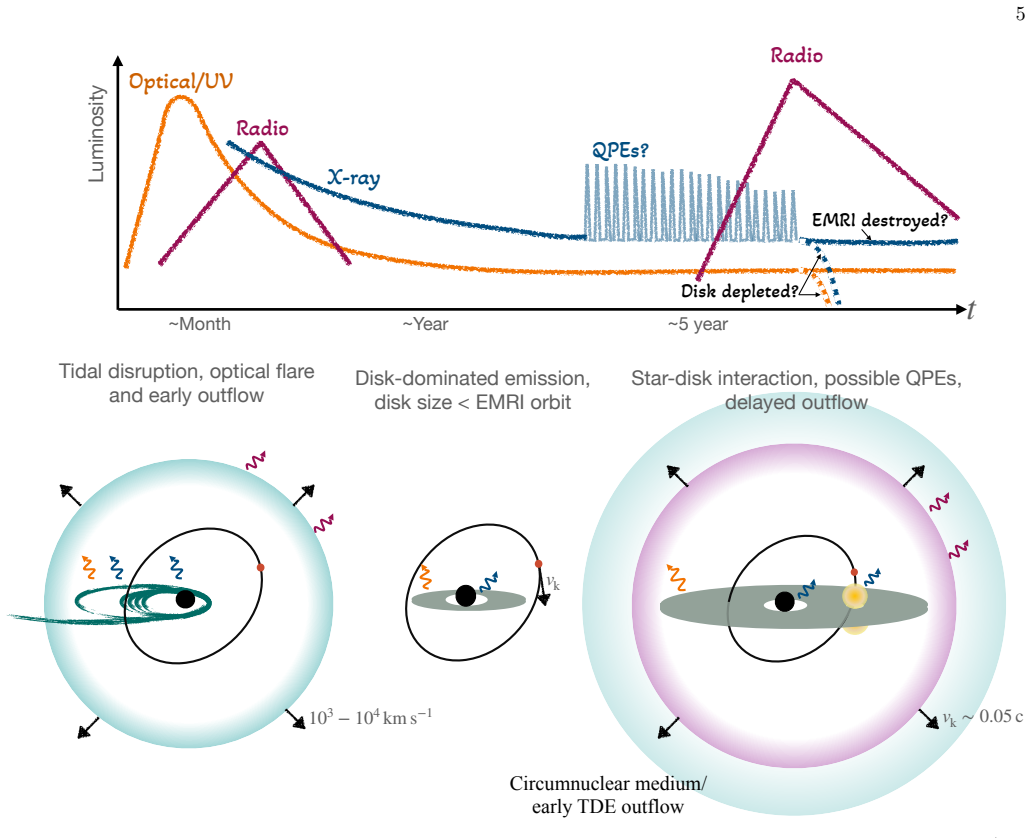
Viscous spreading of the initially compact TDE disk until it intercepts the EMRI orbit, triggering repeated collisions that eject disk or stellar material as outflows.
If this is right
- Delayed radio flares can occur independently of jet launching delays or off-axis geometry.
- Outflow properties depend on disk viscosity, EMRI orbital period, and collision efficiency.
- Some systems may show both delayed radio flares and quasi-periodic eruptions powered by the same collisions.
- Late radio emission arises from interaction with circumnuclear material or earlier TDE ejecta.
Where Pith is reading between the lines
- Late-time radio monitoring could serve as an indirect probe for EMRIs around supermassive black holes.
- The model implies that not all QPE-hosting TDEs will produce bright delayed radio flares, depending on outflow mass and environment.
- If the mechanism operates, radio light curves might exhibit modulations tied to the EMRI orbital period.
Load-bearing premise
A pre-existing EMRI sits at an orbital radius the TDE disk can reach within years, and the collisions efficiently eject the required massive outflows.
What would settle it
A TDE with a confirmed delayed radio flare but no detectable periodicity or other signature of a stellar EMRI at the expected radius, or direct modeling showing collisions eject far less mass than needed.
Figures
read the original abstract
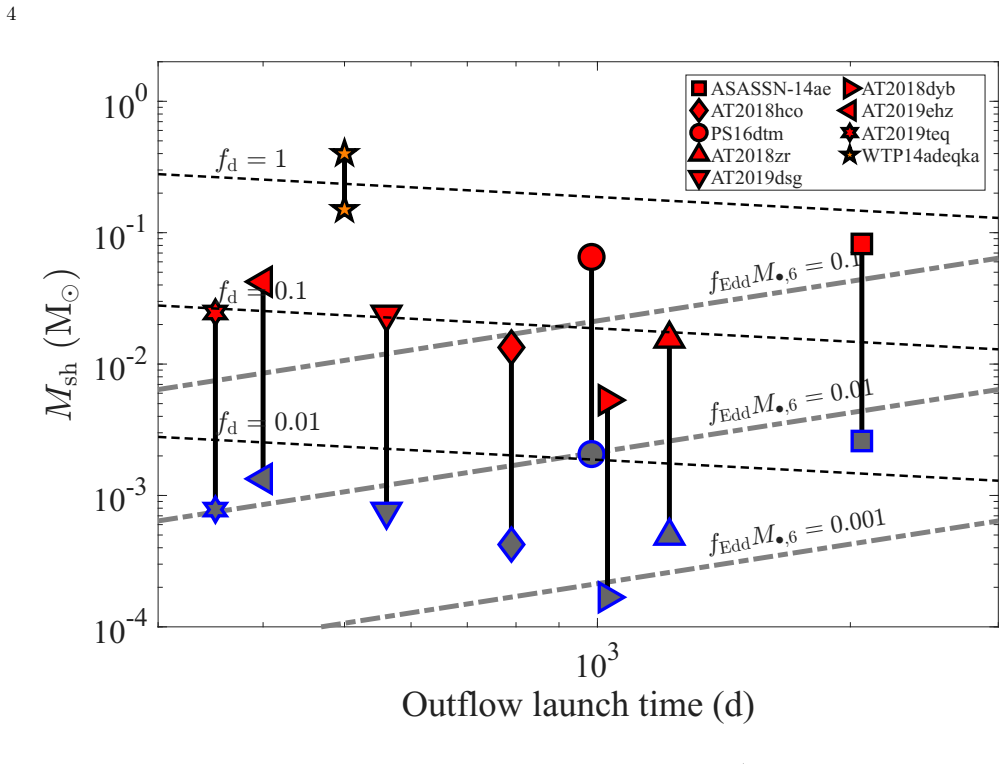
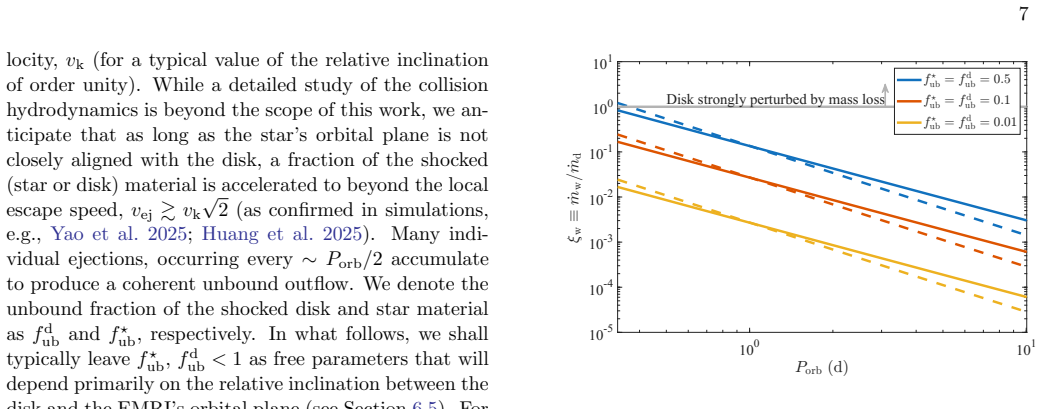
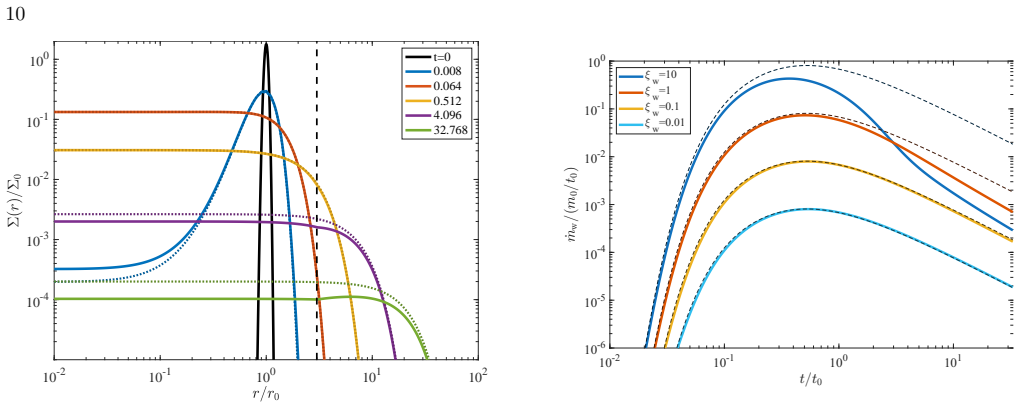
A growing fraction of tidal disruption events (TDEs) exhibit radio emission that rises only years after the optical or infrared flare, indicating delayed outflow activity. In some events the outflow is inferred to be slow ($\sim 0.02 \, c$) and massive ($\gtrsim 0.01-0.1 M_{\odot}$), challenging models such as delayed jets and disk state transitions. We propose a new mechanism for such delayed outflows: repeated collisions between a TDE accretion disk and a pre-existing stellar extreme-mass-ratio-inspiral (EMRI) orbiting the black hole. In this scenario, the delay reflects the viscous time required for the initially compact TDE disk to expand and intercept the EMRI orbit, rather than delayed jet launching or off-axis viewing effects. Once star-disk collisions commence, repeated impacts eject outflows with velocities comparable to the orbital speed, $v_{\rm w} \sim 0.02-0.1c$. We develop a time-dependent model for the coupled evolution of the spreading disk and EMRI-induced mass-loss, identifying regimes where the outflow is dominated by disk material or ablated stellar debris. Depending on disk viscosity, orbital period, and collision efficiency, masses $\sim (10^{-3}-1) \, \rm M_\odot$ can be launched with energies up to $10^{51} \rm \, erg$, years after the TDE. These outflows produce radio emission through interaction with circumnuclear material or earlier TDE ejecta, consistent with observed late-time radio re-brightening. This model predicts a connection between delayed radio flares and EMRI-hosting systems, potentially including those exhibiting quasi-periodic eruptions (QPEs) powered by star-disk collisions, though the conditions for bright radio flares may not always match those necessary for detectable QPEs.
Editorial analysis
A structured set of objections, weighed in public.
Referee Report
Summary. The paper claims that delayed radio flares in some TDEs arise from outflows produced by repeated collisions between a viscously spreading TDE accretion disk and a pre-existing stellar EMRI. The observed delay reflects the viscous time for the disk to expand and intercept the EMRI orbit; once collisions begin, they eject outflows with v_w ~0.02-0.1c, masses ~(10^{-3}-1) M_odot and energies up to 10^51 erg that produce radio emission via interaction with circumnuclear material. The model identifies disk- versus star-dominated outflow regimes and notes a possible connection to QPE-hosting systems.
Significance. If the result holds, the work supplies a concrete alternative to delayed-jet or disk-state-transition explanations for the slow, massive outflows inferred from late-time radio re-brightenings in TDEs. It directly links a subset of radio-loud TDEs to EMRI systems and offers a unified picture connecting delayed radio flares to the same star-disk collisions that may power QPEs, thereby generating falsifiable multi-wavelength predictions for future observations.
major comments (3)
- [Abstract] Abstract (paragraph describing the delay mechanism and collision outcomes): the outflow masses, velocities, and energies are stated to depend on disk viscosity, orbital period, and an unspecified collision efficiency; these parameters can be adjusted to reproduce the observed delays and radio-inferred masses, rendering the quantitative predictions adjustable rather than derived.
- [Abstract] Abstract: the ejection efficiency, unbound fraction, and velocity distribution from star-disk impacts are tied directly to orbital speed and collision efficiency without derivation from first-principles hydrodynamics or citation of impact simulations; this step is load-bearing for the claimed outflow properties (v_w ~0.02-0.1c, masses 10^{-3}-1 M_odot, energies ~10^51 erg) that are required to match the radio data.
- [Abstract] Abstract: the model presupposes a pre-existing EMRI at an orbital radius reachable by the viscously spreading TDE disk on a timescale of years, yet provides no occurrence-rate estimate, dynamical capture argument, or population synthesis to support the required EMRI abundance and orbital distribution.
Simulated Author's Rebuttal
We thank the referee for their careful reading and constructive comments on our manuscript. We address each major comment below, indicating where revisions will be made to improve clarity and acknowledge limitations of the model.
read point-by-point responses
-
Referee: [Abstract] Abstract (paragraph describing the delay mechanism and collision outcomes): the outflow masses, velocities, and energies are stated to depend on disk viscosity, orbital period, and an unspecified collision efficiency; these parameters can be adjusted to reproduce the observed delays and radio-inferred masses, rendering the quantitative predictions adjustable rather than derived.
Authors: We agree that the outflow properties in the model are functions of disk viscosity, orbital period, and collision efficiency. This parametric dependence is inherent to a semi-analytic framework that identifies physical regimes rather than providing unique numerical predictions. The manuscript explores how outcomes vary across plausible ranges of these quantities to match observed delays and radio properties. We will revise the abstract to explicitly state the parameter dependence and the explored ranges, clarifying that the model supplies a mechanism and scaling relations rather than fixed values. revision: partial
-
Referee: [Abstract] Abstract: the ejection efficiency, unbound fraction, and velocity distribution from star-disk impacts are tied directly to orbital speed and collision efficiency without derivation from first-principles hydrodynamics or citation of impact simulations; this step is load-bearing for the claimed outflow properties (v_w ~0.02-0.1c, masses 10^{-3}-1 M_odot, energies ~10^51 erg) that are required to match the radio data.
Authors: The outflow velocity is taken to be comparable to the local orbital speed on energetic grounds, with the ejected mass fraction parameterized by a collision efficiency. This is a simplified treatment that does not derive the unbound fraction or velocity distribution from first-principles hydrodynamics. We will expand the methods section to discuss the physical motivation for these assumptions, cite available literature on star-disk and star-star impact simulations where relevant, and explicitly note the limitations of the approximation as a first exploration of the mechanism. revision: yes
-
Referee: [Abstract] Abstract: the model presupposes a pre-existing EMRI at an orbital radius reachable by the viscously spreading TDE disk on a timescale of years, yet provides no occurrence-rate estimate, dynamical capture argument, or population synthesis to support the required EMRI abundance and orbital distribution.
Authors: The model assumes an EMRI at radii reachable within years, motivated by the existence of QPEs and theoretical expectations for stellar capture in galactic nuclei. A dedicated occurrence-rate calculation or population synthesis lies outside the scope of this work, which focuses on the time-dependent dynamics and radio signatures once collisions occur. We will add a short paragraph in the introduction referencing existing studies on EMRI formation channels and capture rates to better frame the assumption. revision: partial
Circularity Check
Outflow masses/velocities set by adjustable collision efficiency and viscosity rather than derived
specific steps
-
fitted input called prediction
[Abstract]
"Depending on disk viscosity, orbital period, and collision efficiency, masses ∼(10^{-3}-1) M_⊙ can be launched with energies up to 10^{51} erg, years after the TDE. These outflows produce radio emission through interaction with circumnuclear material or earlier TDE ejecta, consistent with observed late-time radio re-brightening."
The quoted statement shows that the model outputs (masses, energies, velocities ~ orbital speed) are produced by choosing the listed parameters to achieve consistency with the target observations; the radio-emission match is therefore achieved by construction once the efficiency and viscosity are selected to fit the delays and outflow scales.
full rationale
The paper develops a time-dependent model coupling disk spreading to EMRI-induced mass loss and states that outflow properties depend on viscosity, orbital period, and collision efficiency. These parameters are not derived from first-principles hydrodynamics within the paper but are instead varied to produce masses, velocities, and energies matching the observed delayed radio flares. This constitutes a moderate instance of fitted inputs presented as explanatory predictions, without reducing the central mechanism to pure self-definition or self-citation. No load-bearing self-citation chain or ansatz smuggling is evident from the provided text.
Axiom & Free-Parameter Ledger
free parameters (3)
- disk viscosity
- orbital period
- collision efficiency
axioms (2)
- domain assumption TDE accretion disks spread viscously outward on timescales of years
- domain assumption Star-disk collisions eject material at speeds comparable to the local orbital velocity
Reference graph
Works this paper leans on
-
[1]
D., Berger, E., Guillochon, J., Zauderer, B
Alexander, K. D., Berger, E., Guillochon, J., Zauderer, B. A., & Williams, P. K. G. 2016, ApJL, 819, L25, doi: 10.3847/2041-8205/819/2/L25
-
[2]
D., van Velzen, S., Horesh, A., & Zauderer, B
Alexander, K. D., van Velzen, S., Horesh, A., & Zauderer, B. A. 2020, SSRv, 216, 81, doi: 10.1007/s11214-020-00702-w
-
[3]
Alexander, K. D., Wieringa, M. H., Berger, E., Saxton, R. D., & Komossa, S. 2017, ApJ, 837, 153, doi: 10.3847/1538-4357/aa6192
-
[4]
D., Margutti, R., Gomez, S., et al
Alexander, K. D., Margutti, R., Gomez, S., et al. 2026, ApJ, 1000, 139, doi: 10.3847/1538-4357/ae40ab
-
[5]
2005, PhR, 419, 65, doi: 10.1016/j.physrep.2005.08.002
Alexander, T. 2005, PhR, 419, 65, doi: 10.1016/j.physrep.2005.08.002
-
[6]
Alush, Y., & Stone, N. C. 2025, ApJ, 993, 14, doi: 10.3847/1538-4357/adf217
-
[7]
Andreoni, I., Coughlin, M. W., Perley, D. A., et al. 2022, Nature, 612, 430, doi: 10.1038/s41586-022-05465-8
-
[8]
2021, Nature, 592, 704, doi: 10.1038/s41586-021-03394-6
Arcodia, R., Merloni, A., Nandra, K., et al. 2021, Nature, 592, 704, doi: 10.1038/s41586-021-03394-6
-
[9]
2024a, A&A, 690, A80, doi: 10.1051/0004-6361/202451218
Arcodia, R., Linial, I., Miniutti, G., et al. 2024a, A&A, 690, A80, doi: 10.1051/0004-6361/202451218
-
[10]
2024b, A&A, 684, A64, doi: 10.1051/0004-6361/202348881
Arcodia, R., Liu, Z., Merloni, A., et al. 2024b, A&A, 684, A64, doi: 10.1051/0004-6361/202348881
-
[11]
2025, ApJ, 989, 13, doi: 10.3847/1538-4357/adec9b
Arcodia, R., Baldini, P., Merloni, A., et al. 2025, ApJ, 989, 13, doi: 10.3847/1538-4357/adec9b
-
[12]
2026, A&A, 706, L15, doi: 10.1051/0004-6361/202558241 Barniol Duran, R., & Piran, T
Baldini, P., Rau, A., Merloni, A., et al. 2026, A&A, 706, L15, doi: 10.1051/0004-6361/202558241 Barniol Duran, R., & Piran, T. 2013, ApJ, 770, 146, doi: 10.1088/0004-637X/770/2/146
-
[13]
2023, MNRAS, 524, 1386, doi: 10.1093/mnras/stad1950
Beniamini, P., Piran, T., & Matsumoto, T. 2023, MNRAS, 524, 1386, doi: 10.1093/mnras/stad1950
-
[14]
Berger, E., Zauderer, A., Pooley, G. G., et al. 2012, ApJ, 748, 36, doi: 10.1088/0004-637X/748/1/36
-
[15]
Bloom, J. S., Giannios, D., Metzger, B. D., et al. 2011, Science, 333, 203, doi: 10.1126/science.1207150
-
[16]
Bonnerot, C., Rossi, E. M., & Lodato, G. 2017, Mon. Not. Roy. Astron. Soc., 464, 2816, doi: 10.1093/mnras/stw2547
-
[17]
Brown, G. C., Levan, A. J., Stanway, E. R., et al. 2015, MNRAS, 452, 4297, doi: 10.1093/mnras/stv1520
-
[18]
Burrows, D. N., et al. 2011, Nature, 476, 421, doi: 10.1038/nature10374
-
[19]
Medvedev, P. S. 2025, MNRAS, 540, 30, doi: 10.1093/mnras/staf686
-
[20]
Cannizzo, J. K., Lee, H. M., & Goodman, J. 1990, ApJ, 351, 38, doi: 10.1086/168442
-
[21]
2014, ApJ, 783, 91, doi: 10.1088/0004-637X/783/2/91
Caprioli, D., & Spitkovsky, A. 2014, ApJ, 783, 91, doi: 10.1088/0004-637X/783/2/91
-
[22]
Cendes, Y., Berger, E., Alexander, K. D., et al. 2022, ApJ, 938, 28, doi: 10.3847/1538-4357/ac88d0 —. 2024, ApJ, 971, 185, doi: 10.3847/1538-4357/ad5541
-
[23]
Cenko, S. B., Krimm, H. A., Horesh, A., et al. 2012, ApJ, 753, 77, doi: 10.1088/0004-637X/753/1/77 20
-
[24]
2021, ApJL, 921, L40, doi: 10.3847/2041-8213/ac313b
Chakraborty, J., Kara, E., Masterson, M., et al. 2021, ApJL, 921, L40, doi: 10.3847/2041-8213/ac313b
-
[25]
2025a, ApJL, 983, L39, doi: 10.3847/2041-8213/adc2f8
Chakraborty, J., Kara, E., Arcodia, R., et al. 2025a, ApJL, 983, L39, doi: 10.3847/2041-8213/adc2f8
-
[26]
2025b, ApJ, 984, 124, doi: 10.3847/1538-4357/adb972
Chakraborty, J., Kosec, P., Kara, E., et al. 2025b, ApJ, 984, 124, doi: 10.3847/1538-4357/adb972
-
[27]
Chakraborty, J., Rappaport, S. A., Arcodia, R., et al. 2026, ApJL, 1001, L6, doi: 10.3847/2041-8213/ae548b
-
[28]
2007, A&A Rv, 15, 1, doi: 10.1007/s00159-007-0006-1
Done, C., Gierli´ nski, M., & Kubota, A. 2007, A&A Rv, 15, 1, doi: 10.1007/s00159-007-0006-1
-
[29]
2023, A&A, 675, A100, doi: 10.1051/0004-6361/202346565
Franchini, A., Bonetti, M., Lupi, A., et al. 2023, A&A, 675, A100, doi: 10.1051/0004-6361/202346565
-
[30]
2021, ARA&A, 59, 21, doi: 10.1146/annurev-astro-111720-030029
Gezari, S. 2021, ARA&A, 59, 21, doi: 10.1146/annurev-astro-111720-030029
-
[31]
Gezari, S., Cenko, S. B., & Arcavi, I. 2017, ApJL, 851, L47, doi: 10.3847/2041-8213/aaa0c2
-
[32]
Giannios, D., & Metzger, B. D. 2011, MNRAS, 416, 2102, doi: 10.1111/j.1365-2966.2011.19188.x
-
[33]
Giustini, M., Miniutti, G., & Saxton, R. D. 2020, A&A, 636, L2, doi: 10.1051/0004-6361/202037610
-
[34]
W., Berger, E., Cendes, Y., et al
Golay, W. W., Berger, E., Cendes, Y., et al. 2025, arXiv e-prints, arXiv:2508.16756, doi: 10.48550/arXiv.2508.16756
-
[35]
J., Arcodia, R., Miniutti, G., Miller-Jones, J
Goodwin, A. J., Arcodia, R., Miniutti, G., Miller-Jones, J. C. A., & van Velzen, S. 2025a, PASA, 42, e130, doi: 10.1017/pasa.2025.10083
-
[36]
Goodwin, A. J., & Mummery, A. 2026, arXiv e-prints, arXiv:2602.14838, doi: 10.48550/arXiv.2602.14838
-
[37]
Goodwin, A. J., Alexander, K. D., Miller-Jones, J. C. A., et al. 2023, MNRAS, 522, 5084, doi: 10.1093/mnras/stad1258
-
[38]
J., Mummery, A., Laskar, T., et al
Goodwin, A. J., Mummery, A., Laskar, T., et al. 2025b, ApJ, 981, 122, doi: 10.3847/1538-4357/adb0b1
-
[39]
2024, ApJ, 966, 160, doi: 10.3847/1538-4357/ad2f9f
Guolo, M., Gezari, S., Yao, Y., et al. 2024, ApJ, 966, 160, doi: 10.3847/1538-4357/ad2f9f
-
[40]
2025a, ApJ, 985, 146, doi: 10.3847/1538-4357/adcbac —
Guolo, M., Mummery, A., Wevers, T., et al. 2025a, ApJ, 985, 146, doi: 10.3847/1538-4357/adcbac —. 2025b, ApJ, 985, 146, doi: 10.3847/1538-4357/adcbac
-
[41]
Hajela, A., Alexander, K. D., Margutti, R., et al. 2025, ApJ, 983, 29, doi: 10.3847/1538-4357/adb620 Hern´ andez-Garc´ ıa, L., Chakraborty, J., S´ anchez-S´ aez, P., et al. 2025, Nature Astronomy, 9, 895, doi: 10.1038/s41550-025-02523-9
-
[42]
Hills, J. G. 1988, Nature, 331, 687, doi: 10.1038/331687a0
-
[43]
Horesh, A., Cenko, S. B., & Arcavi, I. 2021a, Nature Astronomy, 5, 491, doi: 10.1038/s41550-021-01300-8
-
[44]
2021b, ApJL, 920, L5, doi: 10.3847/2041-8213/ac25fe
Horesh, A., Sfaradi, I., Fender, R., et al. 2021b, ApJL, 920, L5, doi: 10.3847/2041-8213/ac25fe
-
[45]
Hu, F. F., Goodwin, A., Price, D. J., et al. 2025, ApJL, 988, L24, doi: 10.3847/2041-8213/adeb79
-
[46]
2025, ApJ, 993, 186, doi: 10.3847/1538-4357/ae07ca
Huang, X., Linial, I., & Jiang, Y.-F. 2025, ApJ, 993, 186, doi: 10.3847/1538-4357/ae07ca
-
[47]
Jiang, Y.-F., Stone, J. M., & Davis, S. W. 2019, ApJ, 880, 67, doi: 10.3847/1538-4357/ab29ff
-
[48]
2016, PASJ, 68, 58, doi: 10.1093/pasj/psw056
Kawamuro, T., Ueda, Y., Shidatsu, M., et al. 2016, PASJ, 68, 58, doi: 10.1093/pasj/psw056
-
[49]
2020, MNRAS, 493, L120, doi: 10.1093/mnrasl/slaa020
King, A. 2020, MNRAS, 493, L120, doi: 10.1093/mnrasl/slaa020
-
[50]
Kochanek, C. S. 1994, ApJ, 422, 508, doi: 10.1086/173745
-
[51]
Krolik, J., Piran, T., Svirski, G., & Cheng, R. M. 2016, ApJ, 827, 127, doi: 10.3847/0004-637X/827/2/127
-
[52]
T.-L., Shibata, M., Kawaguchi, K., & Pelle, J
Lam, A. T.-L., Shibata, M., Kawaguchi, K., & Pelle, J. 2025, PhRvD, 112, 083006, doi: 10.1103/m2tv-l3z8
-
[53]
2024, ApJ, 977, 63, doi: 10.3847/1538-4357/ad8ba5
Lei, X., Wu, Q., Li, H., et al. 2024, ApJ, 977, 63, doi: 10.3847/1538-4357/ad8ba5
-
[54]
Levan, A. J., et al. 2011, Science, 333, 199, doi: 10.1126/science.1207143
-
[55]
Linial, I., & Metzger, B. D. 2023, ApJ, 957, 34, doi: 10.3847/1538-4357/acf65b —. 2024, ApJ, 973, 101, doi: 10.3847/1538-4357/ad639e
-
[56]
Linial, I., Metzger, B. D., & Quataert, E. 2025, ApJ, 991, 147, doi: 10.3847/1538-4357/adfa0e
-
[57]
2024, ApJ, 974, 67, doi: 10.3847/1538-4357/ad67cf
Linial, I., & Quataert, E. 2024, ApJ, 974, 67, doi: 10.3847/1538-4357/ad67cf
-
[58]
2017, MNRAS, 469, 2441, doi: 10.1093/mnras/stx1041 —
Linial, I., & Sari, R. 2017, MNRAS, 469, 2441, doi: 10.1093/mnras/stx1041 —. 2022, ApJ, 940, 101, doi: 10.3847/1538-4357/ac9bfd —. 2023, ApJ, 945, 86, doi: 10.3847/1538-4357/acbd3d
-
[59]
Lu, W., Matsumoto, T., & Matzner, C. D. 2024, MNRAS, 533, 979, doi: 10.1093/mnras/stae1770
-
[60]
Lynden-Bell, D., & Pringle, J. E. 1974, MNRAS, 168, 603, doi: 10.1093/mnras/168.3.603
-
[61]
1999, MNRAS, 309, 447, doi: 10.1046/j.1365-8711.1999.02853.x
Magorrian, J., & Tremaine, S. 1999, MNRAS, 309, 447, doi: 10.1046/j.1365-8711.1999.02853.x
-
[62]
2024, ApJ, 961, 211, doi: 10.3847/1538-4357/ad18bb
Masterson, M., De, K., Panagiotou, C., et al. 2024, ApJ, 961, 211, doi: 10.3847/1538-4357/ad18bb
-
[63]
2021, MNRAS, 507, 4196, doi: 10.1093/mnras/stab2418 —
Matsumoto, T., & Piran, T. 2021, MNRAS, 507, 4196, doi: 10.1093/mnras/stab2418 —. 2024, ApJ, 971, 49, doi: 10.3847/1538-4357/ad58ba
-
[64]
2018, Science, 361, 482, doi: 10.1126/science.aao4669
Mattila, S., P´ erez-Torres, M., Efstathiou, A., et al. 2018, Science, 361, 482, doi: 10.1126/science.aao4669
-
[65]
Metzger, B. D. 2022, ApJL, 937, L12, doi: 10.3847/2041-8213/ac90ba
-
[66]
Metzger, B. D., Giannios, D., & Mimica, P. 2012, MNRAS, 420, 3528, doi: 10.1111/j.1365-2966.2011.20273.x
-
[67]
Metzger, B. D., Piro, A. L., & Quataert, E. 2008, MNRAS, 390, 781, doi: 10.1111/j.1365-2966.2008.13789.x
-
[68]
Metzger, B. D., & Stone, N. C. 2016, MNRAS, 461, 948, doi: 10.1093/mnras/stw1394 21
-
[69]
Metzger, B. D., Williams, P. K. G., & Berger, E. 2015, ApJ, 806, 224, doi: 10.1088/0004-637X/806/2/224
-
[70]
Middleton, M., G´ urpide, A., Kwan, T. M., et al. 2025, MNRAS, 537, 1688, doi: 10.1093/mnras/staf052
-
[71]
Mimica, P., Giannios, D., Metzger, B. D., & Aloy, M. A. 2015, MNRAS, 450, 2824, doi: 10.1093/mnras/stv825
-
[72]
2023, A&A, 670, A93, doi: 10.1051/0004-6361/202244512
Miniutti, G., Giustini, M., Arcodia, R., et al. 2023, A&A, 670, A93, doi: 10.1051/0004-6361/202244512
-
[73]
Miniutti, G., Saxton, R. D., Giustini, M., et al. 2019, Nature, 573, 381, doi: 10.1038/s41586-019-1556-x
-
[74]
2024a, MNRAS, 527, 2452, doi: 10.1093/mnras/stad3001 —
Mummery, A., van Velzen, S., Nathan, E., et al. 2024a, MNRAS, 527, 2452, doi: 10.1093/mnras/stad3001 —. 2024b, MNRAS, 527, 2452, doi: 10.1093/mnras/stad3001
-
[75]
2011, Nature, 478, 82, doi: 10.1038/nature10365
Nakar, E., & Piran, T. 2011, Nature, 478, 82, doi: 10.1038/nature10365
-
[76]
Nicholl, M., Wevers, T., Oates, S. R., et al. 2020, MNRAS, 499, 482, doi: 10.1093/mnras/staa2824
-
[77]
Nicholl, M., Pasham, D. R., Mummery, A., et al. 2024, Nature, 634, 804, doi: 10.1038/s41586-024-08023-6
-
[78]
2022, ApJL, 928, L18, doi: 10.3847/2041-8213/ac5faf
Pan, X., Li, S.-L., Cao, X., Miniutti, G., & Gu, M. 2022, ApJL, 928, L18, doi: 10.3847/2041-8213/ac5faf
-
[79]
R., Lucchini, M., Laskar, T., et al
Pasham, D. R., Lucchini, M., Laskar, T., et al. 2023, Nature Astronomy, 7, 88, doi: 10.1038/s41550-022-01820-x
-
[80]
Perlman, E. S., Meyer, E. T., Wang, Q. D., et al. 2022, ApJ, 925, 143, doi: 10.3847/1538-4357/ac3bba
discussion (0)
Sign in with ORCID, Apple, or X to comment. Anyone can read and Pith papers without signing in.