Generalisable presentations and compactness properties of locally compact right-angled Artin groups
Pith reviewed 2026-06-29 09:11 UTC · model grok-4.3
The pith
Right-angled Artin groups admit generalisable presentations that produce locally compact groups containing them as discrete subgroups with controlled compactness and finiteness properties.
A machine-rendered reading of the paper's core claim, the machinery that carries it, and where it could break.
Core claim
Generisable presentations applied to right-angled Artin groups yield locally compact topological RAAGs. For many examples the associated universal Salvetti-type complexes are highly connected, which gives LC groups with prescribed compactness properties or rational cohomological dimension. The authors extend the Bieri-Stallings construction to obtain TDLC groups of type FP_n but not FP_{n+1} and record counterparts of cohomological results such as a Mayer-Vietoris sequence and Kunneth formula in discrete cohomology for TDLC groups. As a by-product they obtain new discrete groups with controlled finiteness properties, including Thompson-like Bieri-Stallings groups of type F_n but not F_{n+1}
What carries the argument
Generalisable presentations over continuous open group monomorphisms, which embed discrete group presentations into topological groups with a prescribed open subgroup; applied here to RAAGs to form topological RAAGs whose universal Salvetti-type complexes carry the geometric and connectivity arguments.
If this is right
- LC groups exist with prescribed compactness properties or rational cohomological dimension.
- TDLC groups exist of type FP_n but not FP_{n+1}.
- Discrete groups exist of type F_n but not F_{n+1}, including Thompson-like Bieri-Stallings examples for every n.
- Mayer-Vietoris sequences and Kunneth formulas hold in discrete cohomology for TDLC groups.
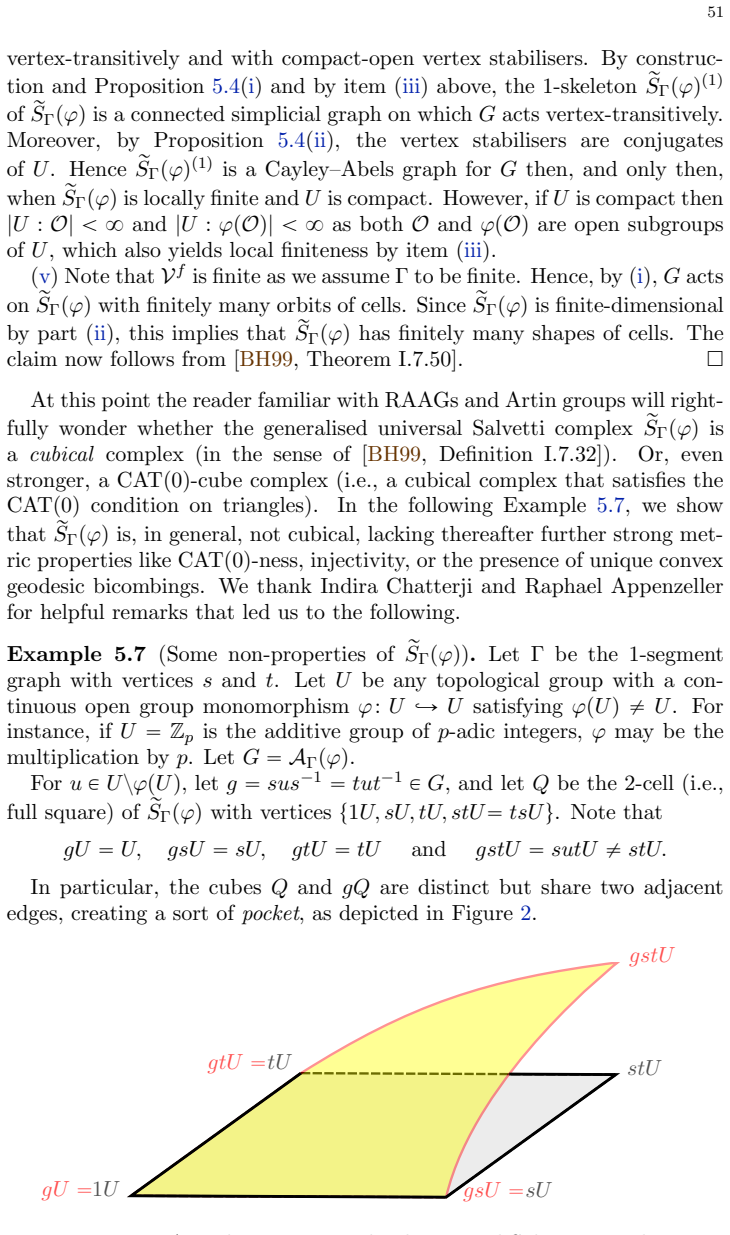
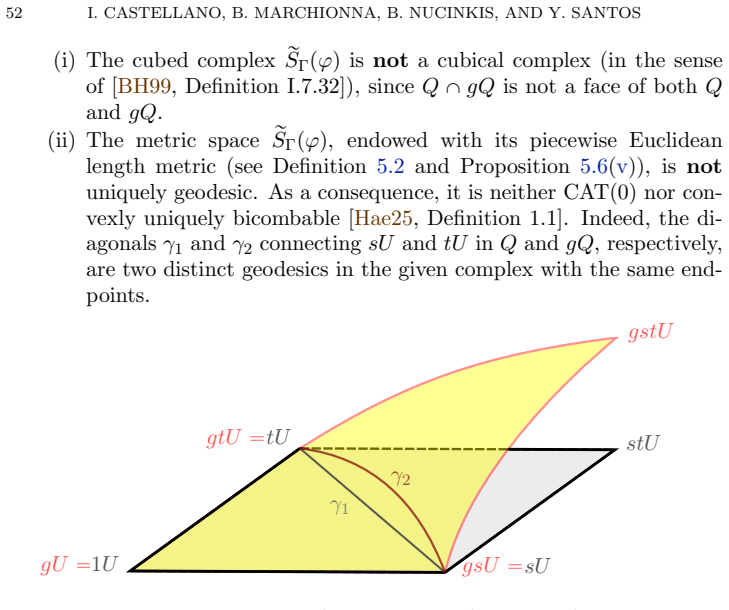
- Universal Salvetti-type complexes provide models for classifying spaces in some cases even when they are not CAT(0) cube complexes.
Where Pith is reading between the lines
- The method could be applied directly to the orientable surface groups, Artin groups, and Thompson groups mentioned to produce additional families of topological groups with controlled properties.
- High connectivity of the complexes might allow explicit constructions of models for classifying spaces in the locally compact setting beyond the cases where they are CAT(0).
- The distinction from lattice envelopes suggests these groups can be used to study actions where the discrete subgroup is not cocompact.
- The non-uniquely geodesic cases indicate that these complexes can serve as test objects for geometric properties that differ from standard cube complexes.
Load-bearing premise
The generalisable presentations for RAAGs produce locally compact groups whose universal Salvetti-type complexes satisfy the high-connectivity properties needed to reach the stated compactness and finiteness conclusions.
What would settle it
A concrete RAAG example where the associated universal Salvetti-type complex fails to be highly connected or where the resulting topological group does not have type FP_n but not FP_{n+1}.
Figures
read the original abstract
We propose the systematic study of presentations that can be generalised over a continuous open group monomorphism. Presentations with this property can turn well-known presentations such as those for as orientable surface groups, Artin groups, and some Thompson groups, into topological groups with a prescribed open subgroup. Later we focus on right-angled Artin groups (RAAGs) and introduce a notion of topological RAAGs. Our approach differs from lattice envelopes and produces examples of locally compact (LC) groups that contain RAAGs as discrete subgroups, but generally not as lattices. We investigate some geometric aspects of topological RAAGs, with a special emphasis on compactness properties of LC ones. This includes a study of universal Salvetti-type complexes which may be of independent interest. These complexes share some properties with buildings. Although in some cases they are CAT(0) cube complexes and provide models for classifying spaces, in other cases they are not even uniquely geodesic. For a large class of examples we establish high connectivity properties for these complexes. This yields novel examples of LC groups with prescribed compactness properties or rational cohomological dimension. We note that the Bestvina-Brady machinery does not automatically generalise to this setting; nevertheless, we extend the Bieri-Stallings construction to obtain totally disconnected locally compact (TDLC) groups of type $FP_n$ but not $FP_{n+1}$. Along the way we record counterparts of cohomological results, such as a Mayer-Vietoris sequence and K\"unneth formula in discrete (co)homology for TDLC groups, which have not appeared elsewhere in the literature. Despite our non-discrete LC focus we obtain, as by-product, new examples of discrete groups with controlled finiteness properties including, for every $n \geq 1$, a Thompson-like Bieri-Stallings group of type $F_n$ but not $F_{n+1}$.
Editorial analysis
A structured set of objections, weighed in public.
Referee Report
Summary. The paper proposes the systematic study of 'generalisable presentations' that extend over continuous open group monomorphisms, applies this framework to right-angled Artin groups to define topological RAAGs (distinct from lattice envelopes), investigates geometric aspects of these groups with emphasis on compactness properties via universal Salvetti-type complexes (which share properties with buildings, are sometimes CAT(0) cube complexes, and may model classifying spaces), establishes high connectivity of these complexes for a large class of examples yielding LC groups with prescribed compactness or rational cohomological dimension, extends the Bieri-Stallings construction to produce TDLC groups of type FP_n but not FP_{n+1}, records Mayer-Vietoris and Künneth formulas for discrete (co)homology of TDLC groups, and obtains new discrete groups (including Thompson-like examples) with controlled finiteness properties.
Significance. If the constructions and proofs are correct, the work supplies novel examples of locally compact groups containing RAAGs as discrete (but typically non-lattice) subgroups together with explicit control over compactness and cohomological dimension; the extension of Bieri-Stallings to the TDLC setting and the new cohomological sequences for TDLC groups are substantive additions to the literature on finiteness properties beyond the discrete case.
minor comments (3)
- [Abstract] Abstract, paragraph on topological RAAGs: the phrase 'for a large class of examples' is used for the high-connectivity result; the precise class (e.g., a stated condition on the defining graph or the monomorphism) should be recalled explicitly in the introduction or the relevant theorem statement.
- [Introduction / §5] The claim that the Bestvina-Brady machinery 'does not automatically generalise' is stated without a concrete counter-example or obstruction; a brief illustration in §4 or §5 would clarify the necessity of the new Bieri-Stallings extension.
- [Cohomology section] The paper records Mayer-Vietoris and Künneth formulas for discrete (co)homology of TDLC groups; these appear as new results, so a short comparison with existing literature on TDLC cohomology (even if none exist) would strengthen the 'have not appeared elsewhere' assertion.
Simulated Author's Rebuttal
We thank the referee for the positive and accurate summary of our manuscript, as well as for the recommendation of minor revision. No specific major comments were provided in the report.
Circularity Check
Derivation chain is self-contained; no reductions by construction
full rationale
The paper defines generalisable presentations and topological RAAGs as new objects, then derives high-connectivity results for their Salvetti-type complexes and extends the Bieri-Stallings construction to obtain TDLC groups of type FP_n but not FP_{n+1}. These steps are presented as direct consequences of the introduced definitions and standard topological group theory, with no equations or claims that reduce to fitted inputs, self-citations, or prior results by the same authors. The abstract and described content contain no self-definitional loops, renamed empirical patterns, or load-bearing self-citations that would force the conclusions.
Axiom & Free-Parameter Ledger
axioms (2)
- domain assumption Continuous open group monomorphisms preserve the structure needed to extend discrete presentations to topological groups
- ad hoc to paper Universal Salvetti-type complexes can be defined and studied for the new topological RAAGs
invented entities (1)
-
topological RAAG
no independent evidence
Reference graph
Works this paper leans on
-
[1]
‘Kompakt definierbare topologische Gruppen’
[Abe72] Herbert Abels. ‘Kompakt definierbare topologische Gruppen’. In:Math. Ann.197 (1972), pp. 221–233.doi:10 . 1007 / BF01428228. [Abe87] Herbert Abels.Finite presentability ofS-arithmetic groups. Compact presentability of solvable groups. Vol
1972
-
[2]
Springer-Verlag, Berlin, 1987, pp
Lec- ture Notes in Mathematics. Springer-Verlag, Berlin, 1987, pp. vi+178.doi:10.1007/BFb0079708. 7Note that in this section, following [BM00a], trees are in the sense of Jean-Pierre Serre. 90 REFERENCES [AB87] Herbert Abels and Kenneth S. Brown. ‘Finiteness properties of solvableS-arithmetic groups: an example’. In:Proceedings of the Northwestern confere...
-
[3]
MetabolicStabilityandEpigenesisinRandomlyConstructedGenetic Nets
1-3. 1987, pp. 77–83.doi:10.1016/0022- 4049(87)90016-8. [AT97] Herbert Abels and Andreas Tiemeyer. ‘Compactness properties of locally compact groups’. In:Transform. Groups2.2 (1997), pp. 119–135.doi:10.1007/BF01235936. [BFS20] Uri Bader, Alex Furman, and Roman Sauer. ‘Lattice envelopes’. In:Duke Math. J.2 (2020), pp. 213–278.doi:10 . 1215 / 00127094-2019-...
-
[4]
‘On homological properties of the Schlichting completion’
[BS26] Laura Bonn and Roman Sauer. ‘On homological properties of the Schlichting completion’. In:Math. Proc. Camb. Philos. Soc. 180.1 (2026), pp. 133–144.doi:10.1017/S0305004125101357. [Bou95] Nicolas Bourbaki.General Topology. Chapters 1–4. Elements of mathematics. Springer, Berlin, 1995, pp. vii+437.isbn: 9783540642411.doi:10.1007/978-3-642-61701-0. [BF...
-
[5]
Springer-Verlag, Berlin, 1999, pp
Grundlehren der mathematischen REFERENCES 91 Wissenschaften. Springer-Verlag, Berlin, 1999, pp. xxii+643. doi:10.1007/978-3-662-12494-9. [Bri04] Matthew G. Brin. ‘Higher dimensional Thompson groups’. In: Geom. Dedicata108 (2004), pp. 163–192.doi:10 . 1007 / s10711-004-8122-9. [Bro87] Kenneth S. Brown. ‘Finiteness properties of groups’. In:J. Pure Appl. Al...
-
[6]
Math. Sci. Res. Inst. Publ. Springer, New York, 1992, pp. 121–136.doi: 10.1007/978-1-4613-9730-4\_5. [Bro94] Kenneth S. Brown.Cohomology of groups. Vol
-
[7]
Corrected reprint of the 1982 original
Graduate Texts in Mathematics. Corrected reprint of the 1982 original. Springer-Verlag, New York, 1994, pp. x+306.doi:10.1007/ 978-1-4684-9327-6. [BM00a] Marc Burger and Shahar Mozes. ‘Groups acting on trees: From local to global structure’. In:Publ. Math. Inst. Hautes ´Etudes Sci.92 (2000), pp. 113–150.doi:10.1007/BF02698915. [BM00b] Marc Burger and Shah...
-
[8]
15943v2.url:https://arxiv.org/abs/2401.15943v2
arXiv:2401 . 15943v2.url:https://arxiv.org/abs/2401.15943v2. [CC20] Ilaria Castellano and Ged Corob Cook. ‘Finiteness properties of totally disconnected locally compact groups’. In:J. Algebra543 (2020). Corrigendum available under DOI:10.1016/j.jalgebra.2024.01.047, pp. 54–97.doi:10. 1016/j.jalgebra.2019.09.017. [CMW25] Ilaria Castellano, Bianca Marchionn...
-
[9]
Ann. of Math. Stud. Princeton University Press, Princeton, 1995, pp. 110–124.doi:10.1515/9781400882588-009. [Cio25] Corina Ciobotaru. ‘Strong Transitivity, the Moufang Condition and the Howe–Moore Property’. In:Transformation Groups30.1 (2025), pp. 165–185.doi:10.1007/s00031-022-09766-0. [Coh73] Daniel E. Cohen. ‘Group with free subgroups of finite index’...
-
[10]
Eu- ropean Mathematical Society (EMS), Z¨ urich, 2016, pp
EMS Tracts in Mathematics. Eu- ropean Mathematical Society (EMS), Z¨ urich, 2016, pp. viii+235. doi:10.4171/166. [DE09] Anton Dochtermann and Alexander Engstr¨ om. ‘Algebraic prop- erties of edge ideals via combinatorial topology’. In:Electron. J. Comb.16.2 (2009). article number R2.doi:10.37236/68. [FP90] Rudolf Fritsch and Renzo A. Piccinini.Cellular st...
work page doi:10.4171/166 2016
-
[11]
Cambridge University Press, Cambridge, 1990, pp
Cambridge Studies in Advanced Mathematics. Cambridge University Press, Cambridge, 1990, pp. xii+326.doi: 10.1017/CBO9780511983948. [Geo08] Ross Geoghegan.Topological methods in group theory. Vol
-
[12]
Graduate Texts in Mathematics. Springer, New York, 2008, pp. xiv+473.doi:10.1007/978-0-387-74614-2. [Hae25] Thomas Haettel. ‘A link condition for simplicial complexes and CUB spaces’. In:Math. Ann.393 (2025), pp. 1939–1987.doi: 10.1007/s00208-025-03244-0. [Hat02] Allen Hatcher.Algebraic Topology. Algebraic Topology. Cam- bridge University Press, 2002, pp....
-
[13]
Progress in Mathematics. Birkh¨ auser, Basel, 2005, pp. 269– 322.doi:10.1007/3-7643-7447-0_7. [LS01] Roger C. Lyndon and Paul E. Schupp.Combinatorial group theory. Classics in Mathematics. Springer-Verlag, Berlin- Heidelberg, 2001, pp. xiv+339.doi:10 . 1007 / 978 - 3 - 642 - 61896-3. [Mar45] A. A. Markov. ‘On free topological groups’. In:Izv. Akad. Nauk S...
-
[14]
Graduate Texts in Mathematics. Springer- Verlag, New York, 1995, pp. xvi+513.doi:10.1007/978- 1- 4612-4176-8. [Rot09] Joseph J. Rotman.An introduction to homological algebra. 2nd ed. Universitext. Springer, New York, 2009, pp. xiv+709. doi:10.1007/b98977. [Rou23] Guy Rousseau.Euclidean buildings. Vol
-
[15]
European Mathematical Society (EMS), Z¨ urich, 2023, p
EMS Tracts in Mathematics. European Mathematical Society (EMS), Z¨ urich, 2023, p. 607.doi:10.4171/ETM/35. [ST17] Roman Sauer and Werner Thumann. ‘Topological models of finite type for tree almost automorphism groups’. In:Int. Math. Res. Not. IMRN23 (2017), pp. 7292–7320.doi:10.1093/imrn/ rnw232. [Sch23] Petra Schwer.CAT(0) Cube Complexes. An Introduction. Vol
-
[16]
Springer-Verlag, Hei- delberg, 2023, pp
Lecture Notes in Mathematics. Springer-Verlag, Hei- delberg, 2023, pp. xii+188.doi:10.1007/978-3-031-43622-2. [Ser80] Jean-Pierre Serre.Trees. Springer-Verlag, Berlin-New York, 1980, pp. ix+142.doi:10.1007/978-3-642-61856-7. [SWZ19] Rachel Skipper, Stefan Witzel, and Matthew C. B. Zaremsky. ‘Simple groups separated by finiteness properties’. In:Invent. Ma...
-
[17]
[Wan84] John S. P. Wang. ‘The Mautner phenomenon for p-adic Lie groups’. In:Math. Z.185 (1984), pp. 403–412.issn: 0025-5874. [Wei94] Charles A. Weibel.An introduction to homological algebra. Vol
1984
-
[18]
Cambridge Studies in Advanced Mathematics. Cam- bridge University Press, Cambridge, 1994, pp. xiv+450.doi: 10.1017/CBO9781139644136. [Wil94] George A. Willis. ‘The structure of totally disconnected, locally compact groups’. In:Math. Ann.300.1 (1994), pp. 341–363.doi: 10.1007/BF01450491. [Wil15] George A. Willis. ‘The scale and tidy subgroups for endo- mor...
discussion (0)
Sign in with ORCID, Apple, or X to comment. Anyone can read and Pith papers without signing in.