Using GALEX UV Excess to Search for Metal-poor Halo Stars
Pith reviewed 2026-06-29 09:30 UTC · model grok-4.3
The pith
GALEX NUV excess shows an 8-sigma anti-correlation with metallicity, allowing photometric distinction of very metal-poor halo stars.
A machine-rendered reading of the paper's core claim, the machinery that carries it, and where it could break.
Core claim
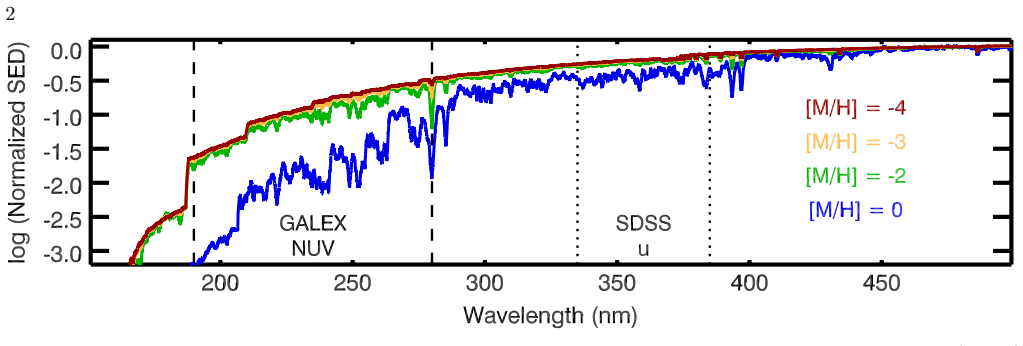
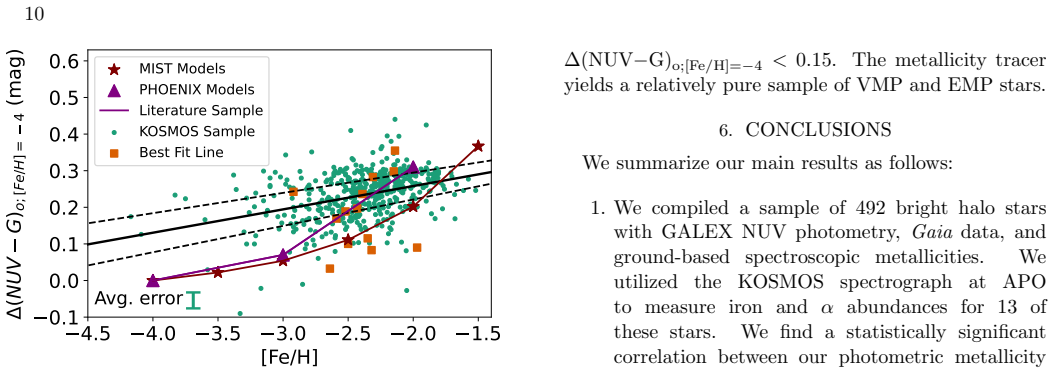
Metal-poor solar-type stars display a significant reduction in metal-line blanketing at short wavelengths, leading to an excess of near-ultraviolet (NUV) flux compared to their metal-rich counterparts. For a sample of 492 solar-type halo stars, an anti-correlation between NUV excess and [Fe/H] reaches 8 sigma significance. GALEX NUV excess can distinguish very metal-poor stars ([Fe/H] < -2) from metal-rich ones, although chromospheric variability from rotation and magnetic activity creates dispersion that prevents reliable selection of extremely metal-poor stars.
What carries the argument
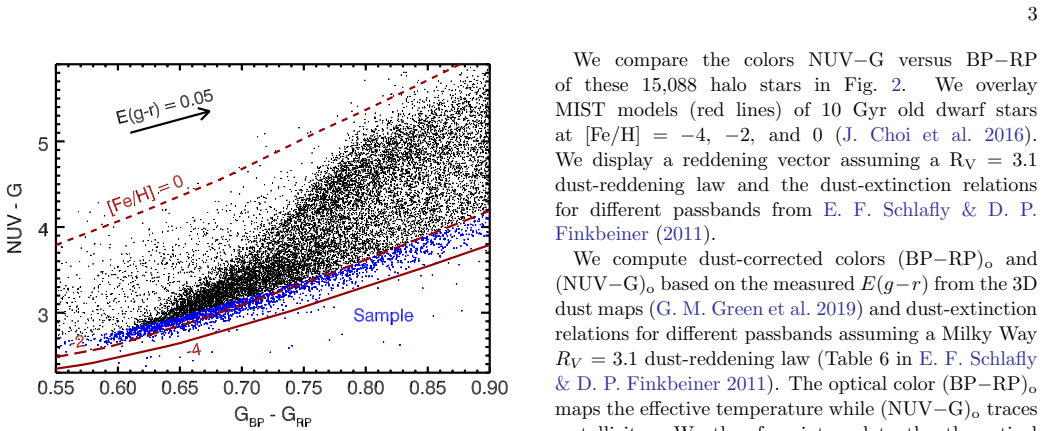
NUV excess produced by reduced metal-line blanketing, quantified as the difference between observed GALEX NUV magnitude and the value expected from Gaia colors for a given metallicity.
If this is right
- Photometric pre-selection of VMP halo stars becomes feasible with existing GALEX and Gaia catalogs.
- The relation supplies a new route to enlarge samples for high-resolution follow-up spectroscopy.
- New KOSMOS spectra add 11 previously unmeasured halo-star metallicities spanning -2.92 to -1.97.
- UV spectra of EMP stars are required to separate metallicity effects from activity-driven scatter.
- The method applies only to solar-type (F5-G9) stars; cooler or hotter stars require separate calibration.
Where Pith is reading between the lines
- Combining this NUV cut with Gaia proper motions could increase the yield of ancient halo stars available for chemical tagging.
- The same blanketing mechanism may appear in other UV bands or in metal-poor stars of different ages, offering a test of atmospheric models.
- If the dispersion can be reduced with activity indicators from TESS or ground-based photometry, the technique might extend to EMP selection.
Load-bearing premise
The NUV excess is driven primarily by reduced metal-line blanketing rather than being dominated by chromospheric variability from rotation and magnetic activity.
What would settle it
Measure NUV excess for a sample of spectroscopically confirmed stars with [Fe/H] < -3 and test whether they lie on the same linear relation as the VMP stars or show systematically larger scatter.
Figures
read the original abstract
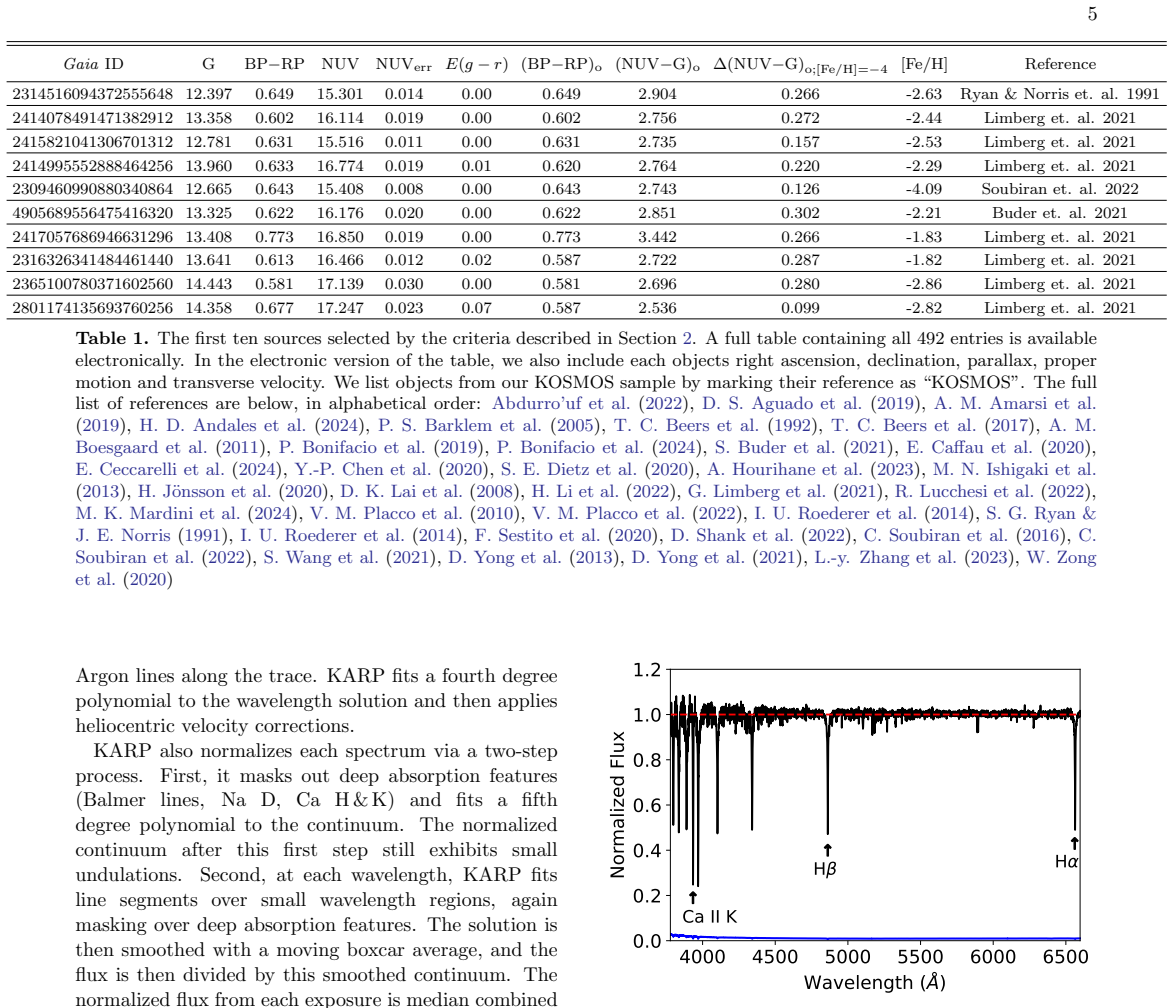
Metal-poor solar-type stars display a significant reduction in metal-line blanketing at short wavelengths, leading to an excess of near-ultraviolet (NUV) flux compared to their metal-rich counterparts. We utilize GALEX NUV and $\it{Gaia}$ DR3 photometry along with ground-based spectroscopy to establish a correlation between NUV excess and [Fe/H]. We construct a sample of 492 solar-type (F5-G9) halo stars with NUV excess and measured metallicitices. We perform our own observations with the KOSMOS spectrograph at Apache Point Observatory's 3.5m telescope to measure the abundances of 13 halo stars, 11 of which did not have previous metallicity measurements. Our targeted 13 halo stars span $-$2.92 $<$ [Fe/H] $<$ $-$1.97 and are all $\alpha$ enhanced with [$\alpha$/Fe] = 0.05-0.73. For our full sample of 492 objects, we find an anti-correlation between NUV excess and [Fe/H] that is statistically significant at the 8$\sigma$ level. GALEX NUV excess can be used to distinguish very metal-poor (VMP) stars ([Fe/H] $<$ $-$2) from their metal-rich counterparts. However, there is significant dispersion in the relation due to NUV chromospheric variability caused by rotational effects and magnetic cycle activity. The NUV chromospheric variability inhibits our ability to reliably distinguish extremely metal-poor (EMP) stars ([Fe/H] $<$ $-$3) from VMP stars based on photometry alone. UV spectra of EMP halo stars are needed to better calibrate their atmospheric properties and variability.
Editorial analysis
A structured set of objections, weighed in public.
Referee Report
Summary. The paper constructs a sample of 492 solar-type halo stars selected for GALEX NUV excess and with measured [Fe/H], reports an 8σ anti-correlation between NUV excess and metallicity, presents new KOSMOS abundances for 13 stars (11 previously unmeasured, spanning [Fe/H] from -2.92 to -1.97 and α-enhanced), and concludes that NUV excess can distinguish VMP stars ([Fe/H] < -2) while noting that chromospheric variability produces dispersion that prevents reliable photometric selection of EMP stars.
Significance. If the correlation is robust and the selection method generalizable, the result would supply a practical photometric indicator for identifying very metal-poor halo stars from existing GALEX+Gaia data, complementing spectroscopic surveys. The new abundance measurements for 13 objects directly enlarge the known VMP sample. The empirical nature of the correlation (no free parameters or circular derivations) is a strength, but the pre-selection and dispersion limit the immediate applicability for individual-star selection.
major comments (2)
- [Sample construction] Sample construction (abstract and § on sample): The 492-star sample is explicitly assembled from halo stars already showing NUV excess plus measured [Fe/H]. The reported 8σ anti-correlation is therefore measured inside an NUV-excess-selected population. No test on an unbiased control sample of halo stars (with and without NUV excess) or quantification of completeness/contamination is described, which is required to support the abstract claim that 'GALEX NUV excess can be used to distinguish VMP stars' outside the pre-selected set.
- [Results and discussion] Dispersion and VMP distinction (abstract and results section): The text states that 'significant dispersion' from NUV chromospheric variability 'inhibits our ability to reliably distinguish' even EMP stars. No quantitative metric (e.g., overlap integral between VMP and higher-metallicity distributions after variability, false-positive rate at a chosen excess threshold, or comparison of metallicity term vs. variability amplitude) is provided to demonstrate that the metallicity signal dominates sufficiently for reliable individual VMP selection.
minor comments (2)
- [Abstract] Abstract: 'metallicitices' is a typographical error and should read 'metallicities'.
- [Abstract] Abstract: The Gaia reference is written '$\it{Gaia}$'; consistent formatting with other survey names would improve readability.
Simulated Author's Rebuttal
We thank the referee for their constructive and detailed comments. We address each major point below, indicating planned revisions where appropriate.
read point-by-point responses
-
Referee: [Sample construction] Sample construction (abstract and § on sample): The 492-star sample is explicitly assembled from halo stars already showing NUV excess plus measured [Fe/H]. The reported 8σ anti-correlation is therefore measured inside an NUV-excess-selected population. No test on an unbiased control sample of halo stars (with and without NUV excess) or quantification of completeness/contamination is described, which is required to support the abstract claim that 'GALEX NUV excess can be used to distinguish VMP stars' outside the pre-selected set.
Authors: We agree that the 492-star sample is assembled from halo stars pre-selected for NUV excess, and the reported anti-correlation is measured within this population. The manuscript's claim is intended to apply to the use of NUV excess as a photometric indicator among halo stars that exhibit such excess, rather than as a blind selector from the full halo population. A fully unbiased control sample with both GALEX NUV photometry and [Fe/H] measurements is not available in existing catalogs, precluding a direct test of completeness and contamination. We will revise the abstract, sample section, and discussion to explicitly state the pre-selection and to include a quantitative discussion of selection biases, estimated contamination rates within the current sample, and the method's applicability limits. revision: partial
-
Referee: [Results and discussion] Dispersion and VMP distinction (abstract and results section): The text states that 'significant dispersion' from NUV chromospheric variability 'inhibits our ability to reliably distinguish' even EMP stars. No quantitative metric (e.g., overlap integral between VMP and higher-metallicity distributions after variability, false-positive rate at a chosen excess threshold, or comparison of metallicity term vs. variability amplitude) is provided to demonstrate that the metallicity signal dominates sufficiently for reliable individual VMP selection.
Authors: We acknowledge that the manuscript discusses the dispersion qualitatively but does not supply quantitative metrics such as distribution overlap or false-positive rates. Using the existing 492-star sample, we will compute the overlap between NUV-excess distributions for VMP ([Fe/H] < -2) and higher-metallicity stars, along with false-positive rates at representative excess thresholds. These metrics will be added to the results section to better quantify the reliability of photometric VMP selection and the impact of variability. revision: yes
Circularity Check
No circularity; empirical anti-correlation measured directly from independent photometry and spectroscopy
full rationale
The paper constructs a sample of 492 halo stars already showing NUV excess (from GALEX and Gaia) and obtains [Fe/H] via spectroscopy (literature plus new KOSMOS observations). It then reports a measured anti-correlation at 8σ significance. This is a direct empirical result with no equations, fitted parameters, or derivations that reduce the claimed relation to its inputs by construction. No self-citations of uniqueness theorems, ansatzes, or prior results are invoked as load-bearing. The acknowledged dispersion from chromospheric variability is noted but does not create a circular reduction. The central claim rests on observable data rather than tautological re-expression of the sample selection.
Axiom & Free-Parameter Ledger
axioms (1)
- domain assumption Metal-poor solar-type stars exhibit reduced metal-line blanketing at short wavelengths producing NUV excess
Reference graph
Works this paper leans on
-
[1]
2022, , 259, 35, 10.3847/1538-4365/ac4414
Abdurro’uf, Accetta, K., Aerts, C., et al. 2022, ApJS, 259, 35, doi: 10.3847/1538-4365/ac4414
-
[2]
2018, , 238, 36, 10.3847/1538-4365/aadfe9
Abohalima, A., & Frebel, A. 2018, ApJS, 238, 36, doi: 10.3847/1538-4365/aadfe9
-
[3]
S., Youakim, K., Gonz´ alez Hern´ andez, J
Aguado, D. S., Youakim, K., Gonz´ alez Hern´ andez, J. I., et al. 2019, MNRAS, 490, 2241, doi: 10.1093/mnras/stz2643
-
[4]
Amarsi, A. M., Nissen, P. E., & Sk´ ulad´ ottir,´A. 2019, A&A, 630, A104, doi: 10.1051/0004-6361/201936265
-
[5]
Mardini, M. K., & Frebel, A. 2024, MNRAS, 530, 4712, doi: 10.1093/mnras/stae670
-
[6]
2023, , 267, 8, 10.3847/1538-4365/acd53e
Andrae, R., Rix, H.-W., & Chandra, V. 2023a, ApJS, 267, 8, doi: 10.3847/1538-4365/acd53e
-
[7]
2023b, A&A, 674, A27, doi: 10.1051/0004-6361/202243462
Andrae, R., Fouesneau, M., Sordo, R., et al. 2023b, A&A, 674, A27, doi: 10.1051/0004-6361/202243462
-
[8]
Barklem, P. S., Christlieb, N., Beers, T. C., et al. 2005, A&A, 439, 129, doi: 10.1051/0004-6361:20052967
-
[9]
Beers, T. C., & Christlieb, N. 2005, ARA&A, 43, 531, doi: 10.1146/annurev.astro.42.053102.134057
-
[10]
Beers, T. C., Preston, G. W., & Shectman, S. A. 1992, AJ, 103, 1987, doi: 10.1086/116207
-
[11]
Beers, T. C., Placco, V. M., Carollo, D., et al. 2017, ApJ, 835, 81, doi: 10.3847/1538-4357/835/1/81
-
[12]
2011, Ap&SS, 335, 161, doi: 10.1007/s10509-010-0581-x
Bianchi, L., Herald, J., Efremova, B., et al. 2011, Ap&SS, 335, 161, doi: 10.1007/s10509-010-0581-x
-
[13]
2017, ApJS, 230, 24, doi: 10.3847/1538-4365/aa7053
Bianchi, L., Shiao, B., & Thilker, D. 2017, ApJS, 230, 24, doi: 10.3847/1538-4365/aa7053
-
[14]
Boesgaard, A. M., Rich, J. A., Levesque, E. M., & Bowler, B. P. 2011, ApJ, 743, 140, doi: 10.1088/0004-637X/743/2/140
-
[15]
2019, MNRAS, 487, 3797, doi: 10.1093/mnras/stz1378
Bonifacio, P., Caffau, E., Sestito, F., et al. 2019, MNRAS, 487, 3797, doi: 10.1093/mnras/stz1378
-
[16]
2024, A&A, 684, A91, doi: 10.1051/0004-6361/202347865
Bonifacio, P., Caffau, E., Monaco, L., et al. 2024, A&A, 684, A91, doi: 10.1051/0004-6361/202347865
-
[17]
2021, MNRAS, 506, 150, doi: 10.1093/mnras/stab1242
Buder, S., Sharma, S., Kos, J., et al. 2021, MNRAS, 506, 150, doi: 10.1093/mnras/stab1242
-
[18]
2020, MNRAS, 493, 4677, doi: 10.1093/mnras/staa589
Caffau, E., Bonifacio, P., Sbordone, L., et al. 2020, MNRAS, 493, 4677, doi: 10.1093/mnras/staa589
-
[19]
Camarota, L., & Holberg, J. B. 2014, MNRAS, 438, 3111, doi: 10.1093/mnras/stt2422
-
[20]
2024, A&A, 684, A37, doi: 10.1051/0004-6361/202348332
Ceccarelli, E., Massari, D., Mucciarelli, A., et al. 2024, A&A, 684, A37, doi: 10.1051/0004-6361/202348332
-
[21]
2020, ApJ, 899, 62, doi: 10.3847/1538-4357/ab9f35
Chen, Y.-P., Yan, R., Maraston, C., et al. 2020, ApJ, 899, 62, doi: 10.3847/1538-4357/ab9f35
-
[22]
2016, The Astrophysical Journal, 823, 102, doi: 10.3847/0004-637X/823/2/102 Chru´ sli´ nska, M
Choi, J., Dotter, A., Conroy, C., et al. 2016, ApJ, 823, 102, doi: 10.3847/0004-637X/823/2/102 de Laverny, P., Recio-Blanco, A., Worley, C. C., & Plez, B. 2012, A&A, 544, A126, doi: 10.1051/0004-6361/201219330
work page internal anchor Pith review doi:10.3847/0004-637x/823/2/102 2016
-
[23]
Deland, M. T., & Cebula, R. P. 2012, Journal of Atmospheric and Solar-Terrestrial Physics, 77, 225, doi: 10.1016/j.jastp.2012.01.007
-
[24]
Dietz, S. E., Yoon, J., Beers, T. C., & Placco, V. M. 2020, ApJ, 894, 34, doi: 10.3847/1538-4357/ab7fa4 Gaia Collaboration, Vallenari, A., Brown, A. G. A., et al. 2023, A&A, 674, A1, doi: 10.1051/0004-6361/202243940
-
[25]
2019, ApJ, 887, 93, doi: 10.3847/1538-4357/ab5362
Finkbeiner, D. 2019, ApJ, 887, 93, doi: 10.3847/1538-4357/ab5362
work page internal anchor Pith review doi:10.3847/1538-4357/ab5362 2019
-
[26]
2015, MNRAS, 452, 3092, doi: 10.1093/mnras/stv1529
Gu, J., Du, C., Jia, Y., et al. 2015, MNRAS, 452, 3092, doi: 10.1093/mnras/stv1529
-
[27]
Hourihane, A., Fran¸ cois, P., Worley, C. C., et al. 2023, A&A, 676, A129, doi: 10.1051/0004-6361/202345910
-
[28]
O., Wende-von Berg, S., Dreizler, S., et al
Husser, T. O., Wende-von Berg, S., Dreizler, S., et al. 2013, A&A, 553, A6, doi: 10.1051/0004-6361/201219058
work page internal anchor Pith review doi:10.1051/0004-6361/201219058 2013
-
[29]
Ishigaki, M. N., Aoki, W., & Chiba, M. 2013, ApJ, 771, 67, doi: 10.1088/0004-637X/771/1/67 Ivezi´ c,ˇZ., Sesar, B., Juri´ c, M., et al. 2008, ApJ, 684, 287, doi: 10.1086/589678 J¨ onsson, H., Holtzman, J. A., Allende Prieto, C., et al. 2020, AJ, 160, 120, doi: 10.3847/1538-3881/aba592
-
[30]
Kurucz, R. L. 1993, SYNTHE spectrum synthesis programs and line data
1993
-
[31]
Lai, D. K., Bolte, M., Johnson, J. A., et al. 2008, ApJ, 681, 1524, doi: 10.1086/588811
-
[32]
2022, ApJ, 931, 147, doi: 10.3847/1538-4357/ac6514
Li, H., Aoki, W., Matsuno, T., et al. 2022, ApJ, 931, 147, doi: 10.3847/1538-4357/ac6514
-
[33]
Limberg, G., Rossi, S., Beers, T. C., et al. 2021, ApJ, 907, 10, doi: 10.3847/1538-4357/abcb87
-
[34]
2022, MNRAS, 511, 1004, doi: 10.1093/mnras/stab3721
Lucchesi, R., Lardo, C., Jablonka, P., et al. 2022, MNRAS, 511, 1004, doi: 10.1093/mnras/stab3721
-
[35]
K., Frebel, A., Betre, L., et al
Mardini, M. K., Frebel, A., Betre, L., et al. 2024, MNRAS, 528, 2912, doi: 10.1093/mnras/stad3925
-
[36]
C., Fanson, J., Schiminovich, D., et al
Martin, D. C., Fanson, J., Schiminovich, D., et al. 2005, ApJL, 619, L1, doi: 10.1086/426387
work page internal anchor Pith review doi:10.1086/426387 2005
-
[37]
2021, A&A Rv, 29, 5, doi: 10.1007/s00159-021-00133-8
Matteucci, F. 2021, A&A Rv, 29, 5, doi: 10.1007/s00159-021-00133-8
-
[38]
Moe, M., Kratter, K. M., & Badenes, C. 2019, ApJ, 875, 61, doi: 10.3847/1538-4357/ab0d88
-
[39]
2019, ApJ, 872, 95, doi: 10.3847/1538-4357/aaf236
Mohammed, S., Schiminovich, D., Hawkins, K., et al. 2019, ApJ, 872, 95, doi: 10.3847/1538-4357/aaf236
-
[40]
Morrissey, P., Conrow, T., Barlow, T. A., et al. 2007, ApJS, 173, 682, doi: 10.1086/520512
-
[41]
2010, A&A, 516, A13, doi: 10.1051/0004-6361/200913932 12
Palacios, A., Gebran, M., Josselin, E., et al. 2010, A&A, 516, A13, doi: 10.1051/0004-6361/200913932 12
-
[42]
Intrinsic Colors, Temperatures, and Bolometric Corrections of Pre-Main Sequence Stars
Pecaut, M. J., & Mamajek, E. E. 2013, ApJS, 208, 9, doi: 10.1088/0067-0049/208/1/9
work page internal anchor Pith review doi:10.1088/0067-0049/208/1/9 2013
-
[43]
M., Almeida-Fernandes , F., Arentsen , A., et al
Placco, V. M., Almeida-Fernandes, F., Arentsen, A., et al. 2022, ApJS, 262, 8, doi: 10.3847/1538-4365/ac7ab0
-
[44]
Placco, V. M., Kennedy, C. R., Rossi, S., et al. 2010, AJ, 139, 1051, doi: 10.1088/0004-6256/139/3/1051
-
[45]
Roederer, I. U., Preston, G. W., Thompson, I. B., et al. 2014, AJ, 147, 136, doi: 10.1088/0004-6256/147/6/136
-
[46]
Ryan, S. G., & Norris, J. E. 1991, AJ, 101, 1835, doi: 10.1086/115811
-
[47]
Schlafly, E. F., & Finkbeiner, D. P. 2011, ApJ, 737, 103, doi: 10.1088/0004-637X/737/2/103
work page internal anchor Pith review doi:10.1088/0004-637x/737/2/103 2011
-
[48]
Sestito, F., Martin, N. F., Starkenburg, E., et al. 2020, MNRAS, 497, L7, doi: 10.1093/mnrasl/slaa022
-
[49]
2022, ApJS, 261, 19, doi: 10.3847/1538-4365/ac680c
Huang, Y. 2022, ApJS, 261, 19, doi: 10.3847/1538-4365/ac680c
-
[50]
Shen, Y.-F., Alexeeva, S. A., Zhao, G., et al. 2023, Research in Astronomy and Astrophysics, 23, 075019, doi: 10.1088/1674-4527/accdc3
-
[51]
Short, C. I., & Hauschildt, P. H. 2005, ApJ, 618, 926, doi: 10.1086/426128
-
[52]
Skrutskie, M. F., Cutri, R. M., Stiening, R., et al. 2006, AJ, 131, 1163, doi: 10.1086/498708
-
[53]
Sofia, U. J., Bruhweiler, F. C., & Sofia, S. 1989, J. Geophys. Res., 94, 9117, doi: 10.1029/JA094iA07p09117
-
[54]
2022, A&A, 663, A4, doi: 10.1051/0004-6361/202142409
Soubiran, C., Brouillet, N., & Casamiquela, L. 2022, A&A, 663, A4, doi: 10.1051/0004-6361/202142409
-
[55]
2016, A&A, 591, A118, doi: 10.1051/0004-6361/201628497
Soubiran, C., Le Campion, J.-F., Brouillet, N., & Chemin, L. 2016, A&A, 591, A118, doi: 10.1051/0004-6361/201628497
-
[56]
2020, A&A, 644, A67, doi: 10.1051/0004-6361/202039167
Ambily, S. 2020, A&A, 644, A67, doi: 10.1051/0004-6361/202039167
-
[57]
2021, Research in Astronomy and Astrophysics, 21, 292, doi: 10.1088/1674-4527/21/11/292
Wang, S., Zhang, H.-T., Bai, Z.-R., et al. 2021, Research in Astronomy and Astrophysics, 21, 292, doi: 10.1088/1674-4527/21/11/292
-
[58]
Xin, C., Renzo, M., & Metzger, B. D. 2022, MNRAS, 516, 5816, doi: 10.1093/mnras/stac2551
-
[59]
Yong, D., Norris, J. E., Bessell, M. S., et al. 2013, ApJ, 762, 26, doi: 10.1088/0004-637X/762/1/26
-
[60]
Yong, D., Da Costa, G. S., Bessell, M. S., et al. 2021, MNRAS, 507, 4102, doi: 10.1093/mnras/stab2001
-
[61]
2023, ApJS, 264, 17, doi: 10.3847/1538-4365/ac9b28
Zhang, L.-y., Su, T., Misra, P., et al. 2023, ApJS, 264, 17, doi: 10.3847/1538-4365/ac9b28
-
[62]
2019, ApJ, 873, 8, doi: 10.3847/1538-4357/ab0205
Zhu, W. 2019, ApJ, 873, 8, doi: 10.3847/1538-4357/ab0205
-
[63]
2020, ApJS, 251, 15, doi: 10.3847/1538-4365/abbb2d
Zong, W., Fu, J.-N., De Cat, P., et al. 2020, ApJS, 251, 15, doi: 10.3847/1538-4365/abbb2d
discussion (0)
Sign in with ORCID, Apple, or X to comment. Anyone can read and Pith papers without signing in.