Modal-Rectification-Based Directional Edge Diffusion for Cartesian Convection--Diffusion Problems
Pith reviewed 2026-06-29 10:07 UTC · model grok-4.3
The pith
A local directional edge-diffusion correction derived from modal rectification of the centered-stencil Fourier symbol damps oscillations in convection-dominated finite-difference schemes on uniform Cartesian grids.
A machine-rendered reading of the paper's core claim, the machinery that carries it, and where it could break.
Core claim
For homogeneous Dirichlet problems with constant coefficients on uniform Cartesian grids, the centered finite-difference discretization is augmented by ADSC, a local directional edge-diffusion correction obtained by rectifying the Fourier symbol. The correction is positive semidefinite and nearest-neighbor, replacing the ideal nonlocal modal damper. Consistency, fixed-epsilon energy stability, and conditional discrete H1-seminorm convergence hold for the regularized operator; existence and L2 compactness are proved for the nonlinear problem.
What carries the argument
ADSC (Adaptive Directional Sparse Correction), a nearest-neighbor positive semidefinite correction whose activation is generated by the computed solution and which rectifies the centered-stencil Fourier symbol to damp modes independently at the nodal level.
If this is right
- The regularized scheme remains consistent with the underlying continuous convection-diffusion problem.
- Fixed-epsilon energy stability holds for the regularized operator on uniform Cartesian grids.
- Conditional convergence in the discrete H1 seminorm follows for the regularized version.
- Existence of solutions is guaranteed for the fully coupled nonlinear iteration.
- Qualitative L2 compactness and convergence are obtained for the nonlinear problem.
Where Pith is reading between the lines
- The method might be extended to variable-coefficient or non-uniform-grid problems to test whether the modal-rectification idea remains effective.
- The paper's diagnostic comparisons with upwinding and SUPG suggest the correction can be used alongside rather than instead of those techniques.
- The open questions on uniqueness and energy-norm rates point to the need for further analysis before quantitative error bounds can be claimed.
Load-bearing premise
The assumption that a nearest-neighbor positive semidefinite correction activated by the solution can adequately approximate the ideal independent modal damping without losing the stabilizing effect.
What would settle it
Numerical solutions on successively refined grids for a convection-dominated test problem that continue to exhibit persistent oscillations or fail to converge in the discrete H1 seminorm would falsify the stability and convergence claims.
Figures
read the original abstract
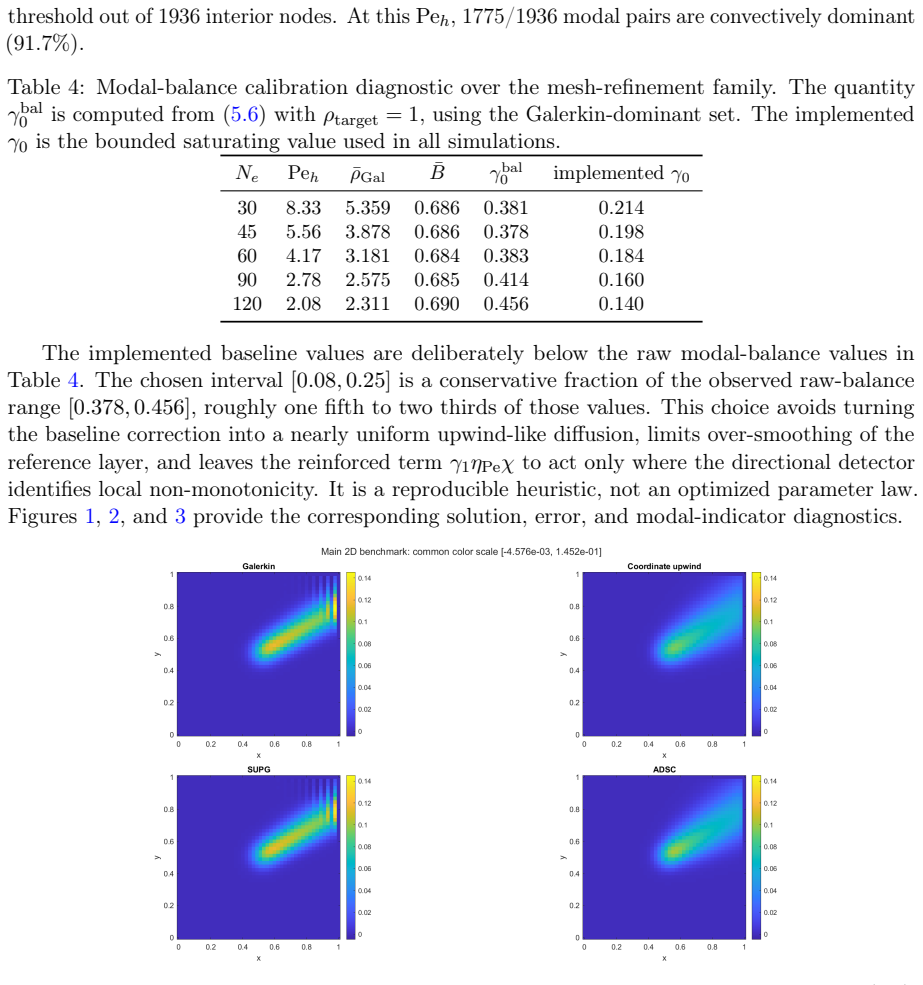
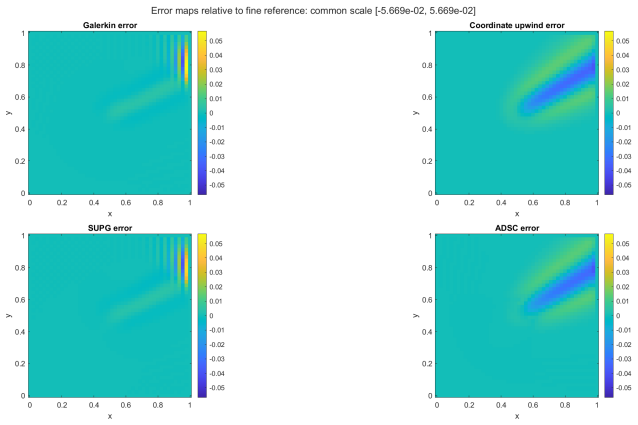
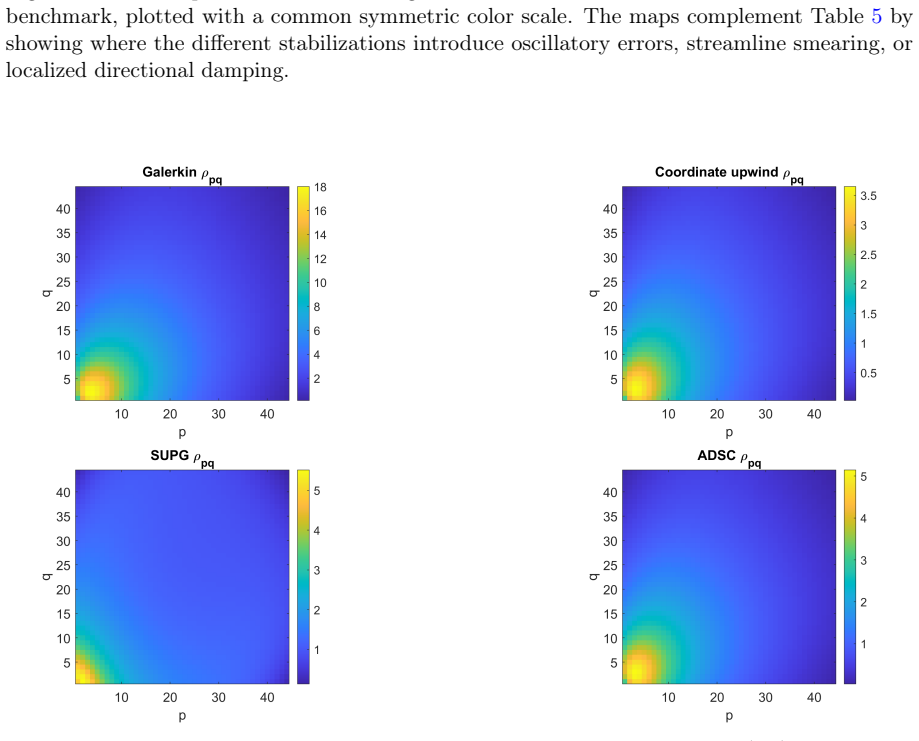
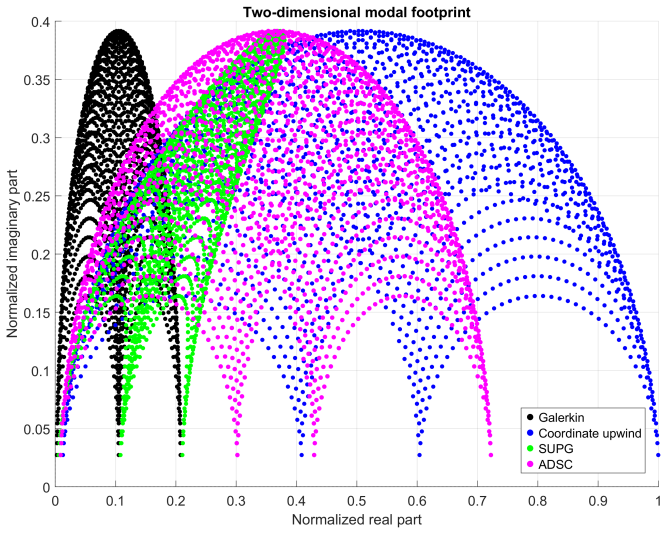
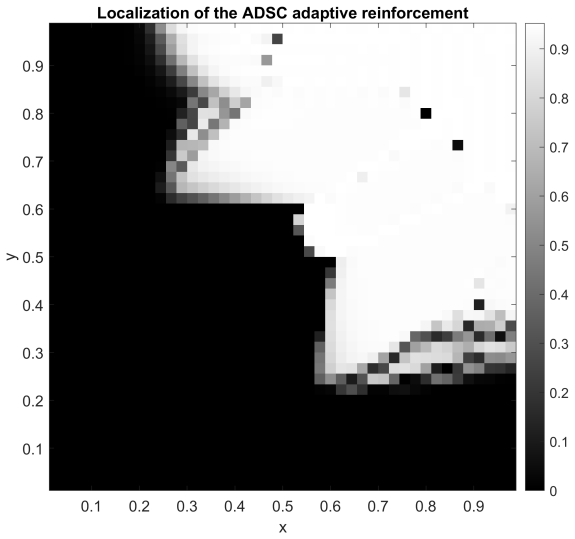
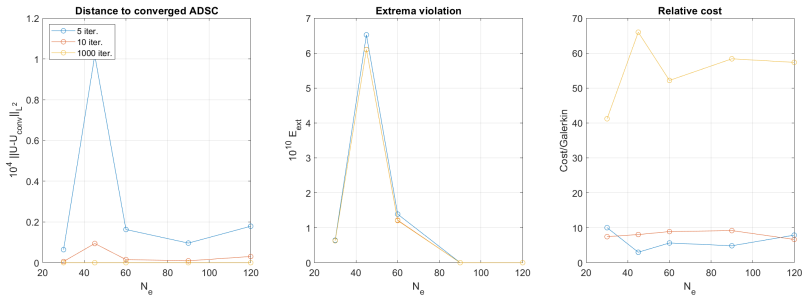
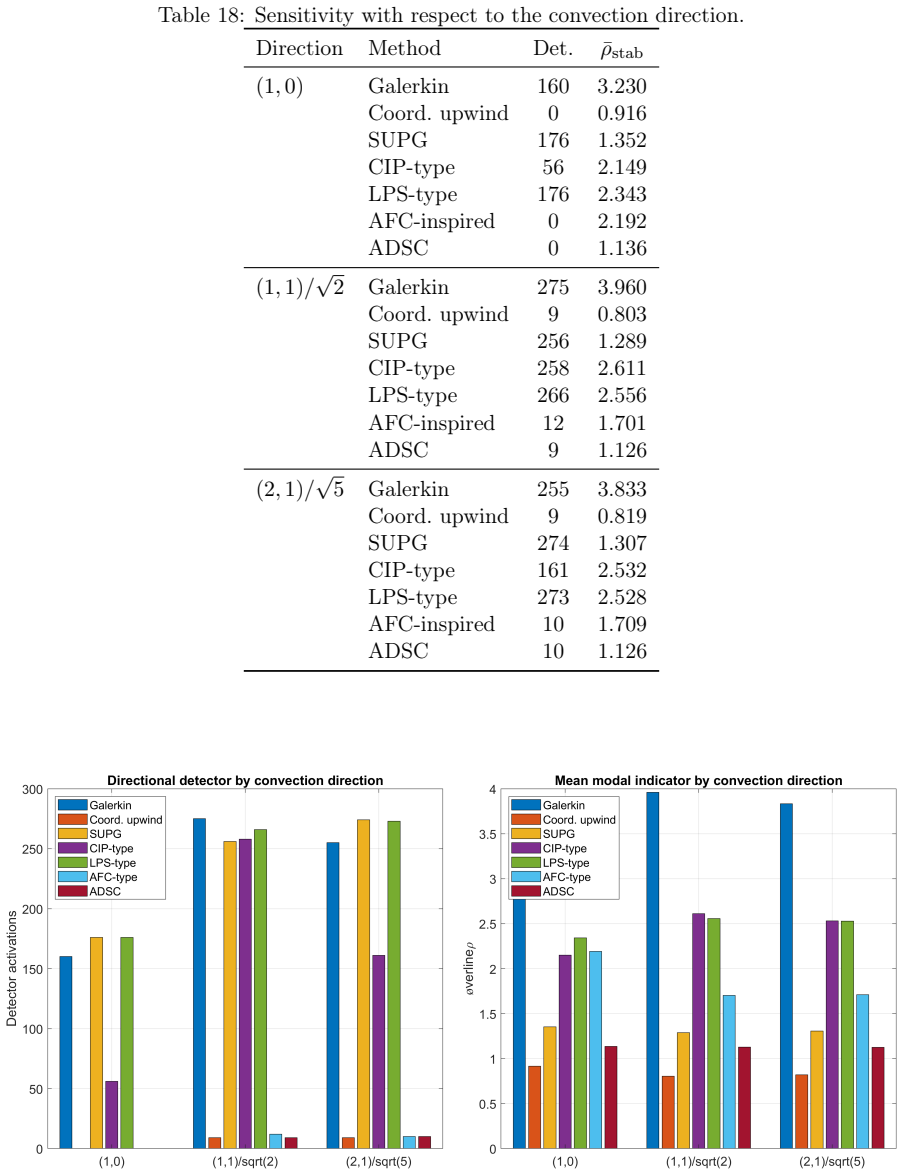
Centered finite-difference discretizations of convection--diffusion equations may oscillate when convection dominates at the mesh scale. For homogeneous Dirichlet problems with constant coefficients on uniform Cartesian grids, we derive ADSC (Adaptive Directional Sparse Correction), a local directional edge-diffusion correction guided by modal rectification of the centered-stencil Fourier symbol. The ideal modal reference damps modes independently, but its exact nodal action is nonlocal; ADSC replaces it by a nearest-neighbor positive semidefinite correction. For a regularized operator with activation fixed by an auxiliary sequence, we prove consistency, fixed-epsilon energy stability, and conditional discrete H^1-seminorm convergence. The implemented iteration instead uses activation generated by the computed solution. For that fully coupled nonlinear problem we prove existence and qualitative L^2 compactness/convergence only; uniqueness, convergence of activation updates, and energy-norm rates remain open. Numerical tests show selective extrema control, reduced modal-dominance indicators, and a low-cost few-shot variant. Comparisons with upwinding, SUPG, and AFC-inspired strategies are diagnostic rather than claims of uniform superiority.
Editorial analysis
A structured set of objections, weighed in public.
Referee Report
Summary. The paper derives ADSC, a local directional edge-diffusion correction for centered finite-difference schemes on uniform Cartesian grids for constant-coefficient convection-diffusion problems with homogeneous Dirichlet data. The correction is obtained by modal rectification of the centered-stencil Fourier symbol and is realized as a nearest-neighbor positive-semidefinite term whose activation is generated by the solution itself, rendering the scheme nonlinear. For a regularized operator with activation fixed a priori the authors prove consistency, fixed-ε energy stability and conditional discrete H¹-seminorm convergence; for the fully coupled nonlinear problem they establish only existence together with qualitative L² compactness. Numerical tests illustrate selective extrema control, reduced modal-dominance indicators and comparisons with upwinding, SUPG and AFC strategies.
Significance. If the results hold, the work supplies a sparse, Fourier-symbol-guided stabilization technique together with explicit proofs for the regularized case and existence for the nonlinear iteration. The transparent separation of what is proved from what remains open is a positive feature.
major comments (1)
- [Abstract] Abstract and theoretical sections: the strongest stability and conditional H¹-seminorm convergence statements are proved only for the regularized operator whose activation sequence is fixed a priori. The implemented ADSC iteration couples activation to the computed solution; for this version the manuscript proves existence and L² compactness but leaves uniqueness, activation convergence and energy-norm rates open. Because all numerical experiments and comparisons employ the fully coupled nonlinear scheme, the load-bearing theoretical guarantees do not cover the algorithm whose performance is being demonstrated.
minor comments (2)
- Notation for the activation parameter ε and the auxiliary sequence should be introduced once with a single consistent symbol.
- Figure captions for the modal-dominance plots should state the precise definition of the plotted indicator.
Simulated Author's Rebuttal
We thank the referee for the careful reading and for noting the transparent separation between proved results and open questions, which we view as a strength of the work. We respond to the single major comment below.
read point-by-point responses
-
Referee: [Abstract] Abstract and theoretical sections: the strongest stability and conditional H¹-seminorm convergence statements are proved only for the regularized operator whose activation sequence is fixed a priori. The implemented ADSC iteration couples activation to the computed solution; for this version the manuscript proves existence and L² compactness but leaves uniqueness, activation convergence and energy-norm rates open. Because all numerical experiments and comparisons employ the fully coupled nonlinear scheme, the load-bearing theoretical guarantees do not cover the algorithm whose performance is being demonstrated.
Authors: The manuscript already states this distinction explicitly in the abstract and throughout the theoretical sections: stronger consistency, energy stability, and conditional H¹-seminorm convergence are proved only for the regularized operator with a priori fixed activation, while the fully coupled nonlinear iteration receives only existence and qualitative L² compactness. The numerical tests are presented as illustrations of the implemented scheme rather than as validation of the stronger theorems. We agree that the load-bearing guarantees therefore apply to the regularized version, but this scope is already disclosed. No revision is required. revision: no
Circularity Check
No circularity: derivation from Fourier symbol to local correction is independent
full rationale
The paper starts from the centered-stencil Fourier symbol and constructs a nearest-neighbor positive-semidefinite correction (ADSC) whose activation is either fixed a priori or solution-generated. No step reduces a claimed prediction or theorem to a fitted parameter, self-definition, or self-citation chain. The abstract explicitly separates the proved properties (consistency, energy stability, conditional H^1 convergence) for the fixed-activation regularized operator from the weaker results for the nonlinear version; this distinction is stated rather than hidden. No load-bearing uniqueness theorem or ansatz is imported from prior work by the same authors. The derivation chain remains self-contained against external benchmarks.
Axiom & Free-Parameter Ledger
Reference graph
Works this paper leans on
-
[1]
G. R. Barrenechea, V. John, and P. Knobloch. Analysis of algebraic flux correction schemes. SIAM J.\ Numer.\ Anal., 54(4):2427--2451, 2016. doi:10.1137/15M1018216
-
[2]
G. R. Barrenechea, V. John, and P. Knobloch. Finite element methods respecting the discrete maximum principle for convection--diffusion equations. SIAM Rev., 66(1):3--88, 2024. doi:10.1137/22M1488934
-
[3]
M. Bolten and H. Rittich. Fourier analysis of periodic stencils in multigrid methods. SIAM J.\ Sci.\ Comput., 40(3):A1642--A1668, 2018. doi:10.1137/16M1073959
-
[4]
G. J.-M. Bomisso and A. O. Kouma. MATLAB codes for Adaptive Directional Sparse Correction (ADSC) experiments in Cartesian convection-diffusion problems, version 1.0.0. Zenodo, 2026. doi:10.5281/zenodo.20342147
-
[5]
J. P. Boyd. Chebyshev and Fourier Spectral Methods. Dover Publications, Mineola, NY, 2nd edition, 2001
2001
-
[6]
M. Braack and E. Burman. Local projection stabilization for the Oseen problem and its interpretation as a variational multiscale method. SIAM J.\ Numer.\ Anal., 43:2544--2566, 2006. doi:10.1137/050631227
-
[7]
A. N. Brooks and T. J. R. Hughes. Streamline upwind/Petrov-Galerkin formulations for convection dominated flows with particular emphasis on the incompressible Navier-Stokes equations. Comput.\ Methods Appl.\ Mech.\ Engrg., 32(1--3):199--259, 1982. doi:10.1016/0045-7825(82)90071-8
-
[8]
E. Burman and A. Ern. Continuous interior penalty hp-finite element methods for advection and advection--diffusion equations. Math.\ Comp., 76:1119--1140, 2007. doi:10.1090/S0025-5718-07-01951-5
-
[9]
E. Burman and P. Hansbo. Edge stabilization for Galerkin approximations of convection--diffusion--reaction problems. Comput.\ Methods Appl.\ Mech.\ Engrg., 193:1437--1453, 2004. doi:10.1016/j.cma.2003.12.032
-
[10]
B. Cockburn and C.-W. Shu. Runge-Kutta discontinuous Galerkin methods for convection-dominated problems. J.\ Sci.\ Comput., 16:173--261, 2001. doi:10.1023/A:1012873910884
-
[11]
Theory and practice of finite elements
A. Ern and J.-L. Guermond. Theory and Practice of Finite Elements. Springer-Verlag, New York, 2004. doi:10.1007/978-1-4757-4355-5
-
[12]
L. P. Franca, S. L. Frey, and T. J. R. Hughes. Stabilized finite element methods: I. Application to the advective--diffusive model. Comput.\ Methods Appl.\ Mech.\ Engrg., 95(2):253--276, 1992. doi:10.1016/0045-7825(92)90143-8
-
[13]
J.-L. Guermond, R. Pasquetti, and B. Popov. Entropy viscosity method for nonlinear conservation laws. J.\ Comput.\ Phys., 230(11):4248--4267, 2011. doi:10.1016/j.jcp.2010.11.043
-
[14]
H. Hajduk. Improvements of algebraic flux-correction schemes based on Bernstein finite elements. J.\ Numer.\ Math., 33(4):375--402, 2025. doi:10.1515/jnma-2024-0098
-
[15]
T. J. R. Hughes, L. P. Franca, and G. M. Hulbert. A new finite element formulation for computational fluid dynamics: VIII.\ The Galerkin/least-squares method for advective--diffusive equations. Comput.\ Methods Appl.\ Mech.\ Engrg., 73:173--189, 1989. doi:10.1016/0045-7825(89)90111-4
-
[16]
A. M. Il'in. Differencing scheme for a differential equation with a small parameter affecting the highest derivative. Math.\ Notes Acad.\ Sci.\ USSR, 6:596--602, 1969. doi:10.1007/BF01093706
-
[17]
John and P
V. John and P. Knobloch. On spurious oscillations at layers diminishing ( SOLD ) methods for convection--diffusion equations: Part I -- A review. Comput.\ Methods Appl.\ Mech.\ Engrg., 196:2197--2215, 2007
2007
-
[18]
V. John, P. Knobloch, and J. Novo. Finite elements for scalar convection-dominated equations and incompressible flow problems: a never ending story? Comput.\ Vis.\ Sci., 19(5--6):47--63, 2018. doi:10.1007/s00791-018-0290-5
-
[19]
Johnson and U
C. Johnson and U. N \"a vert. An analysis of some finite element methods for advection-diffusion problems. In Analytical and Numerical Approaches to Asymptotic Problems in Analysis, pages 99--116. North-Holland, Amsterdam, 1981
1981
-
[20]
Kuzmin, R
D. Kuzmin, R. L \"o hner, and S. Turek, editors. Flux-Corrected Transport: Principles, Algorithms, and Applications. Springer-Verlag, Berlin, 2005
2005
-
[21]
D. Kuzmin, H. Hajduk, and J. Vedral. An element-based convex limiting framework for continuous Galerkin methods with nonlinear stabilization. J.\ Comput.\ Phys., 560:114952, 2026. doi:10.1016/j.jcp.2026.114952
-
[22]
R. J. LeVeque. Finite Difference Methods for Ordinary and Partial Differential Equations: Steady-State and Time-Dependent Problems. SIAM, Philadelphia, 2007. doi:10.1137/1.9780898717839
-
[23]
Y. Luo, J. Wang, and S. Wu. Local projection stabilization methods for \( H(curl)\) and \( H(div)\) advection problems. J.\ Comput.\ Appl.\ Math., 476:117129, 2026. doi:10.1016/j.cam.2025.117129
-
[24]
S. P. MacLachlan and C. W. Oosterlee. Local Fourier analysis for multigrid with overlapping smoothers applied to systems of PDEs. Numer.\ Linear Algebra Appl., 18:751--774, 2011. doi:10.1002/nla.762
-
[25]
W. F. Mitchell. A Collection of 2D Elliptic Problems for Testing Adaptive Algorithms. NISTIR 7668, National Institute of Standards and Technology, Gaithersburg, MD, 2010
2010
-
[26]
Mizukami
A. Mizukami. An implementation of the streamline-upwind/Petrov-Galerkin method for linear triangular elements. Comput.\ Methods Appl.\ Mech.\ Engrg., 49(3):357--364, 1985
1985
-
[27]
H.-G. Roos, M. Stynes, and L. Tobiska. Robust Numerical Methods for Singularly Perturbed Differential Equations. Springer-Verlag, Berlin, 2nd edition, 2008. doi:10.1007/978-3-540-34467-4
-
[28]
M. A. Shubin. Pseudodifferential Operators and Spectral Theory. Springer-Verlag, Berlin, 2nd edition, 2001
2001
-
[29]
J. C. Strikwerda. Finite Difference Schemes and Partial Differential Equations. SIAM, Philadelphia, 2nd edition, 2004. doi:10.1137/1.9780898717938
-
[30]
M. Stynes. Steady-state convection--diffusion problems. Acta Numerica, 14:445--508, 2005
2005
-
[31]
E. Tadmor. Convergence of spectral methods for nonlinear conservation laws. SIAM J.\ Numer.\ Anal., 26(1):30--44, 1989
1989
-
[32]
M. E. Taylor. Pseudodifferential Operators. Princeton University Press, Princeton, NJ, 1981
1981
-
[33]
Tobiska and R
L. Tobiska and R. Verf \"u rth. Analysis of a streamline diffusion finite element method for the Stokes and Navier--Stokes equations. SIAM J.\ Numer.\ Anal., 33(1):107--127, 1996
1996
-
[34]
Trottenberg, C
U. Trottenberg, C. W. Oosterlee, and A. Sch \"u ller. Multigrid. Academic Press, San Diego, 2001
2001
-
[35]
Verf \"u rth
R. Verf \"u rth. A Review of A Posteriori Error Estimation and Adaptive Mesh-Refinement Techniques. Wiley-Teubner, Chichester, 1996
1996
-
[36]
R. F. Warming and B. J. Hyett. The modified equation approach to the stability and accuracy analysis of finite-difference methods. J.\ Comput.\ Phys., 14(2):159--179, 1974. doi:10.1016/0021-9991(74)90011-4
-
[37]
A. Zygmund. Trigonometric Series. Cambridge University Press, Cambridge, 3rd edition, 2002
2002
discussion (0)
Sign in with ORCID, Apple, or X to comment. Anyone can read and Pith papers without signing in.