Approximating full conformal prediction: distribution free guarantees via the tournament correction
Pith reviewed 2026-07-02 23:07 UTC · model grok-4.3
The pith
Tournament approximations to full conformal prediction deliver distribution-free coverage of 1-2α.
A machine-rendered reading of the paper's core claim, the machinery that carries it, and where it could break.
Core claim
We introduce a novel class of approximations to the full conformal prediction method, based on the idea of tournaments, which enables the construction of prediction sets with a rigorous marginal coverage guarantee of 1-2α. Under stability conditions, the theoretical coverage guarantee tightens to approximately 1-α. This new framework generalizes the existing method of leave-one-out cross-conformal prediction, while allowing for flexible use of various existing approximation strategies.
What carries the argument
The tournament correction, a procedure that organizes multiple approximate conformal sets into a tournament to produce a final set whose marginal coverage proof relies only on exchangeability.
If this is right
- Prediction sets can be built without exhaustive refitting over the response space.
- The method supplies a rigorous marginal coverage guarantee of 1-2α for arbitrary distributions.
- Under a stability condition the guarantee improves to roughly 1-α.
- The framework extends leave-one-out cross-conformal prediction and admits other approximation strategies.
Where Pith is reading between the lines
- The approach could make full conformal prediction practical for large datasets where refitting was previously prohibitive.
- Similar tournament corrections might be developed for other computationally heavy conformal variants.
- Empirical checks of the stability condition on real data would indicate when the tighter 1-α guarantee is reliable.
Load-bearing premise
The tournament construction itself produces sets whose coverage proof holds without depending on the unknown data distribution.
What would settle it
A large collection of exchangeable data points where the tournament-based prediction sets cover strictly fewer than 1-2α of the responses would falsify the claimed guarantee.
Figures
read the original abstract
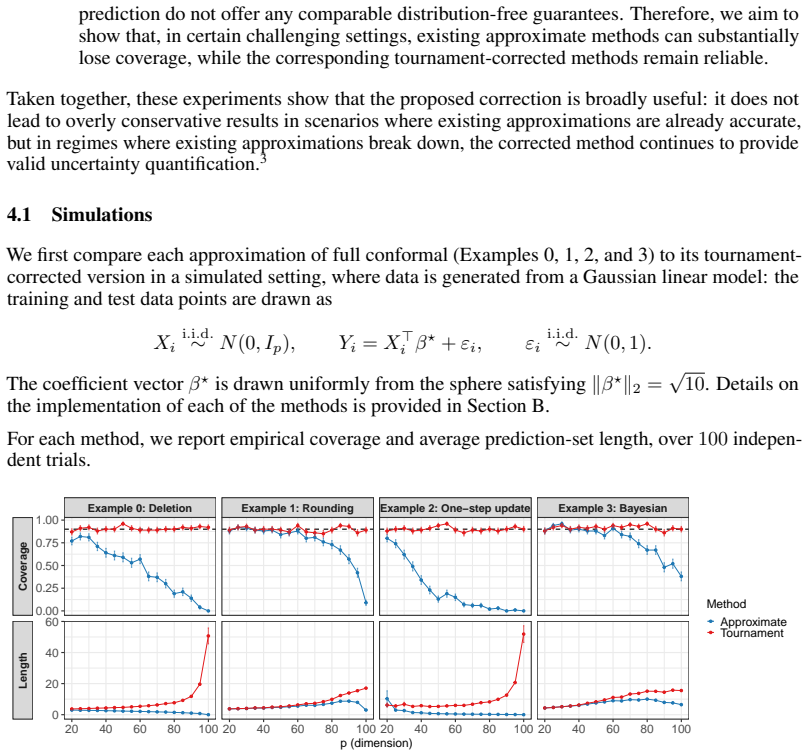
Conformal prediction is a framework for providing prediction intervals with distribution-free validity, guaranteeing predictive coverage for data drawn from any distribution. Its two main variants are full conformal prediction and split conformal prediction (also called transductive and inductive). Full conformal prediction is widely considered to be statistically more efficient (since split conformal prediction requires data splitting, and therefore can lead to wider prediction intervals due to the resulting loss in sample size), but its implementation is computationally prohibitive, as it requires the underlying model to be refit for every candidate value in the response space. Existing computational shortcuts, such as using a discrete grid of values to approximate the full conformal prediction construction, frequently lack theoretical guarantees on marginal coverage and can fail in practice. To address this limitation, we introduce a novel class of approximations to the full conformal prediction method, based on the idea of \emph{tournaments}, which enables the construction of prediction sets with a rigorous marginal coverage guarantee of $1-2\alpha$. Under stability conditions, the theoretical coverage guarantee tightens to approximately $1-\alpha$. This new framework generalizes the existing method of leave-one-out cross-conformal prediction, while allowing for flexible use of various existing approximation strategies.
Editorial analysis
A structured set of objections, weighed in public.
Referee Report
Summary. The paper introduces a class of tournament-based approximations to full conformal prediction. These approximations construct prediction sets with a claimed rigorous marginal coverage guarantee of 1-2α that holds distribution-free for any data distribution; under additional stability conditions the guarantee tightens to approximately 1-α. The framework is presented as a generalization of leave-one-out cross-conformal prediction that remains compatible with existing approximation heuristics.
Significance. If the distribution-free coverage argument is valid, the work supplies a computationally tractable route to full-conformal-style intervals while retaining unconditional marginal validity, which would be a useful addition to the conformal-prediction toolkit. The explicit generalization of cross-conformal methods and the allowance for flexible approximation strategies are constructive features.
major comments (1)
- [Theoretical results / main coverage theorem] The central claim of a distribution-free 1-2α marginal coverage guarantee rests on the tournament scores inheriting the exchangeability (or permutation symmetry) of the full conformal scores so that the standard conformal argument applies. No lemma, theorem, or explicit symmetry step that carries this property is identified in the theoretical development; without that step the bound may implicitly rely on model stability rather than holding unconditionally for arbitrary distributions.
minor comments (1)
- [Abstract] The abstract refers to “stability conditions” without a concise definition or pointer to the precise assumption used in the tightening argument; adding a one-sentence characterization would improve readability.
Simulated Author's Rebuttal
We thank the referee for their careful reading of the manuscript and for identifying the need for greater explicitness in the symmetry argument underlying the main coverage result. We respond to the major comment below.
read point-by-point responses
-
Referee: The central claim of a distribution-free 1-2α marginal coverage guarantee rests on the tournament scores inheriting the exchangeability (or permutation symmetry) of the full conformal scores so that the standard conformal argument applies. No lemma, theorem, or explicit symmetry step that carries this property is identified in the theoretical development; without that step the bound may implicitly rely on model stability rather than holding unconditionally for arbitrary distributions.
Authors: We agree that the presentation would benefit from an explicit lemma establishing that the tournament scores inherit exchangeability. The tournament is constructed symmetrically: the pairwise comparison matrix is formed from all points (training, calibration, and test) without reference to any distinguished ordering, so that any permutation of the underlying data induces a corresponding permutation of the tournament scores. This property is implicit in the definition given in Section 3 and in the reduction to leave-one-out cross-conformal prediction shown in Section 4, but we acknowledge that it is not isolated as a standalone statement. We will therefore insert a new Lemma 2 that formally proves exchangeability of the tournament scores for arbitrary distributions; the standard conformal argument then applies directly to yield the unconditional 1-2α marginal coverage guarantee. Model stability is used only for the refined 1-α statement and is not required for the 1-2α bound. revision: yes
Circularity Check
No circularity: tournament construction yields coverage claim from new definition without reduction to inputs.
full rationale
The abstract introduces the tournament approximation as a novel construction that directly enables the 1-2α marginal coverage guarantee, generalizing leave-one-out cross-conformal without any quoted equations or steps that define the guarantee in terms of itself, fit parameters to data then rename them as predictions, or rely on self-citations for the core exchangeability argument. No load-bearing step reduces by construction to prior fitted results or author-specific uniqueness theorems. The derivation is presented as self-contained from the tournament definition.
Axiom & Free-Parameter Ledger
axioms (1)
- domain assumption Data observations are exchangeable
Reference graph
Works this paper leans on
-
[1]
The interplay between bayesian inference and conformal prediction
Nina Deliu and Brunero Liseo. The interplay between bayesian inference and conformal prediction. arXiv preprint arXiv:2510.26930,
-
[2]
Leave-one-out stable conformal prediction.arXiv preprint arXiv:2504.12189,
Kiljae Lee and Yuan Zhang. Leave-one-out stable conformal prediction.arXiv preprint arXiv:2504.12189,
-
[3]
Dharmesh Tailor, Alvaro HC Correia, Eric Nalisnick, and Christos Louizos. Approximating full conformal prediction for neural network regression with gauss-newton influence.arXiv preprint arXiv:2507.20272,
-
[4]
[2021, Theorem 1]
A Proofs of theorems A.1 Proof of Theorem 1 The proof follows the core idea of proof of Barber et al. [2021, Theorem 1]. We will construct a (n+1)×(n+1) matrix A, as a function of the data, such thatA is atournament matrix, meaning that Aij ∈ {0,1} , and Aij +A ji ≤1 , for all i, j (that is, Aij can be viewed as an indicator of whether team i wins its gam...
2021
-
[5]
The rest of the proof proceeds exactly as before
We define a score matrixS with entries Sij :=s approx(Zi;D [n+1]\{i,j} +{Z i, Zj};ξ ij), i̸=j, Sii := +∞, i=j, and observe that S satisfies row/column-wise exchangeability by assumption on the data and the random seeds. The rest of the proof proceeds exactly as before. A.2 Proof of Theorem 2 This proof follows a similar argument as Barber et al. [2021, Th...
2021
-
[6]
The dataset has n= 442 observations and p= 10 predictors
as closely as possible. The dataset has n= 442 observations and p= 10 predictors. To mirror their preprocessing, we normalize the full dataset by X← X− ¯X sX √p , Y← Y− ¯Y sY , where ¯X and sX denote the columnwise empirical mean and population standard deviation of the full design matrix, and ¯Y and sY are the empirical mean and population standard devia...
2025
-
[7]
In our R implementation, we solve the same convex objective using optim with the BFGS algorithm
Their public code solves this optimization problem in cvxpy. In our R implementation, we solve the same convex objective using optim with the BFGS algorithm. The nonconformity score is the absolute residual s(z;D) =|y−f bβ(x)|. 18 For the approximate rounding method, we use the same grid-search FullCP construction as in the public code of Lee and Zhang [2...
2025
-
[8]
Finally, for both methods we report empirical coverage and average prediction-set length over100 random train/test splits
Concretely, for each candidate y∈ Y grid and eachi∈[n], we compute sapprox Z y n+1;D n\i +{Z i, Zy n+1} ands approx Zi;D n\i +{Z i, Zy n+1} , where the approximation is of rounding type, with Yi rounded to its nearest grid value and y restricted to the same candidate grid. Finally, for both methods we report empirical coverage and average prediction-set l...
2021
discussion (0)
Sign in with ORCID, Apple, or X to comment. Anyone can read and Pith papers without signing in.