Isotope shifts and hyperfine splitting of the {}¹S₀rightarrow{}³P₁ transition in zinc
Pith reviewed 2026-06-29 00:14 UTC · model grok-4.3
The pith
Laser spectroscopy of zinc's 307.6 nm intercombination line delivers kHz-precision isotope shifts and hyperfine constants for all stable isotopes.
A machine-rendered reading of the paper's core claim, the machinery that carries it, and where it could break.
Core claim
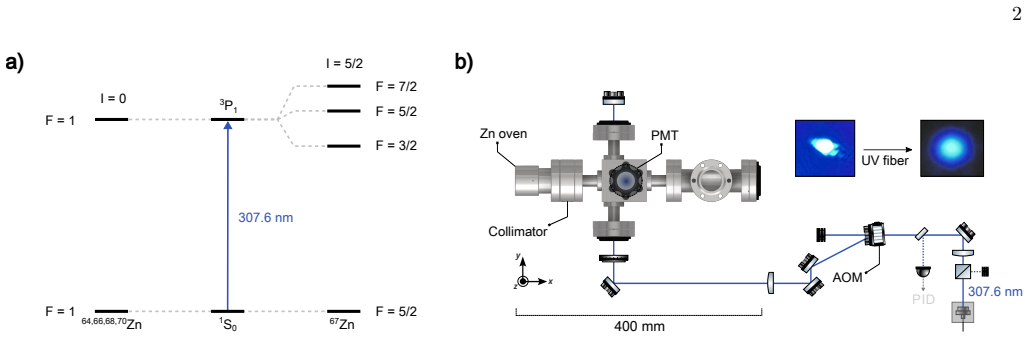
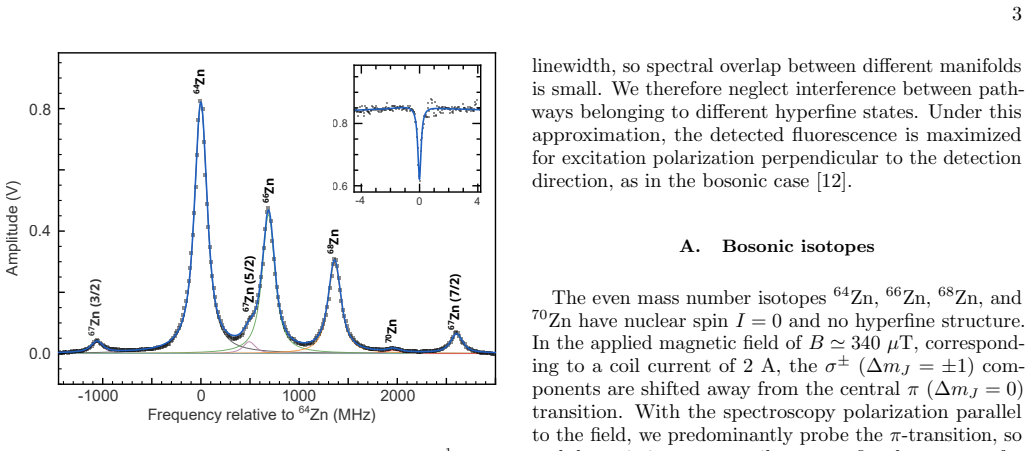
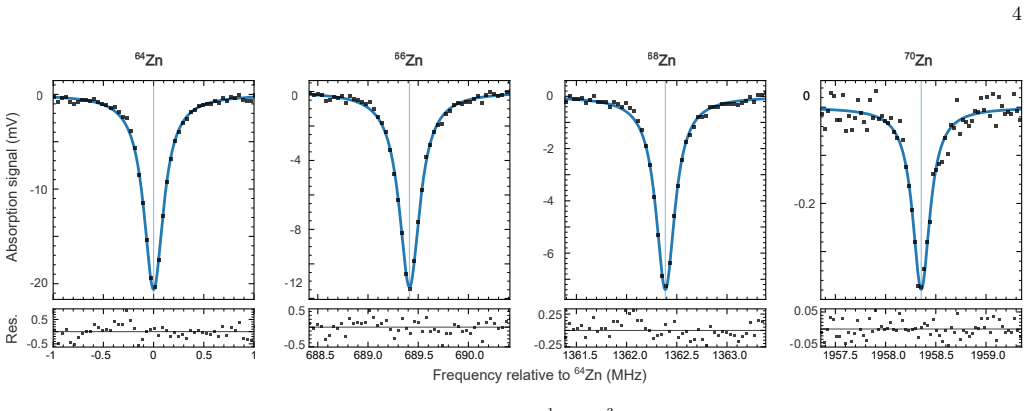
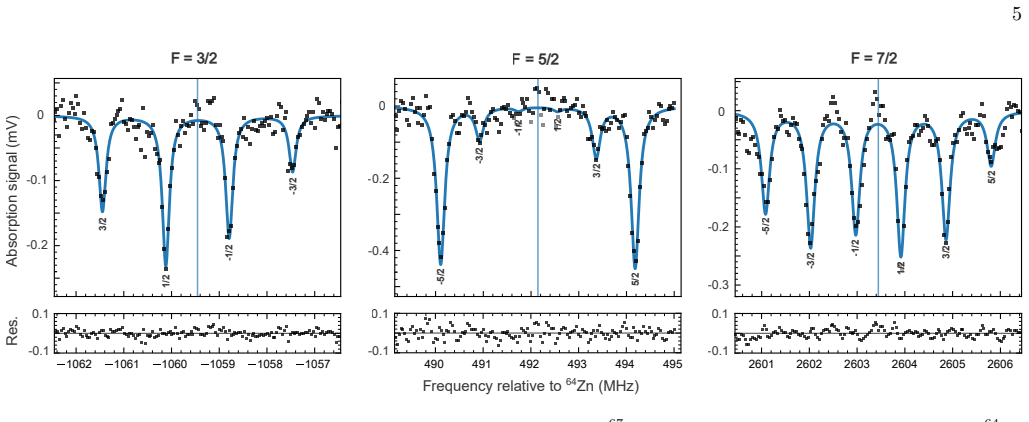
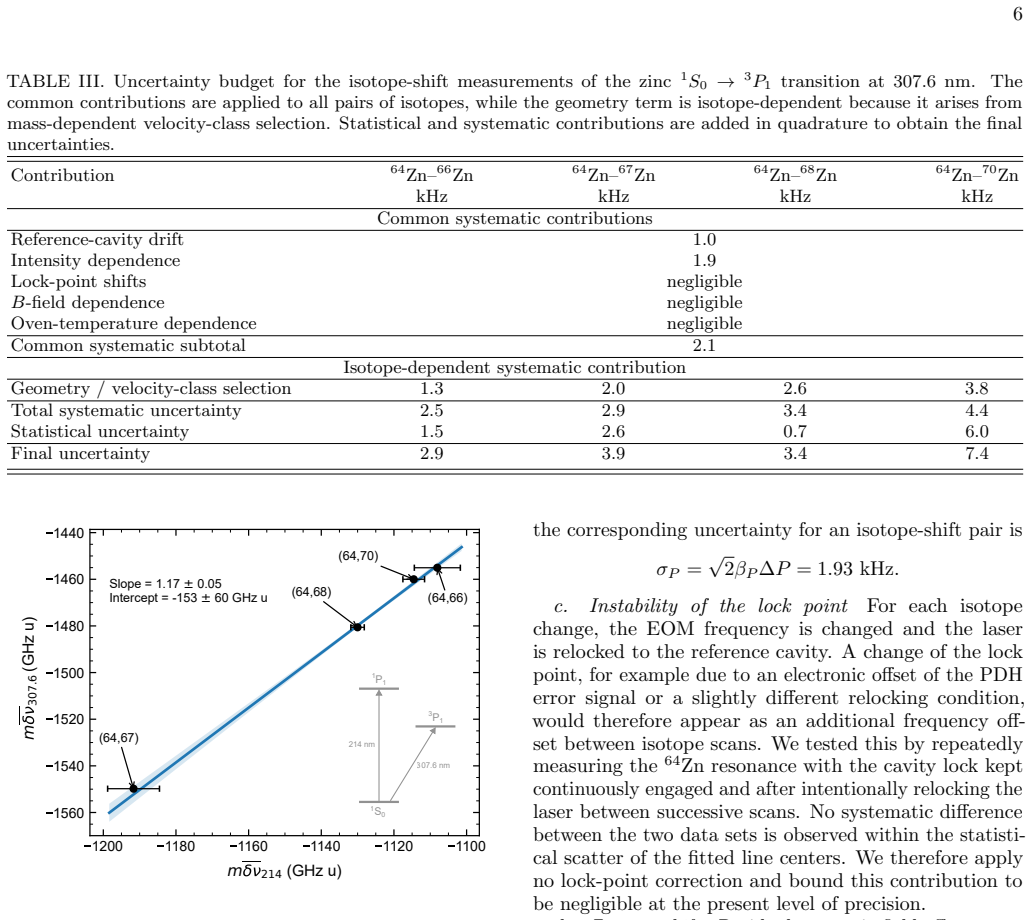
We report laser-induced-fluorescence spectroscopy of the 1S0→3P1 intercombination transition in neutral zinc at 307.6 nm. Isotope shifts are measured for all stable isotopes with kHz-level precision, improving previous data by about two orders of magnitude. For 67Zn, we resolve the excited-state hyperfine structure and determine δν_COG^67,64 = 1085.933(4) MHz, A = 608.922(1) MHz, and B = −18.995(4) MHz. A King-plot comparison with the 1S0→1P1 transition at 214 nm gives field- and mass-shift parameters of F_307.6,214 = 1.17(5) and K = −153(60) GHz u. These results provide the spectroscopic basis for narrow-line cooling and precision measurements based on zinc, including the development of an
What carries the argument
King-plot comparison of measured isotope shifts between the 307.6 nm and 214 nm transitions, which isolates the field-shift factor F and mass-shift constant K.
If this is right
- Narrow-line laser cooling of zinc atoms on the 307.6 nm transition becomes feasible with the reported frequencies and shifts.
- Development of an optical clock based on the zinc intercombination line is now supported by the extracted constants.
- The field- and mass-shift parameters allow calculation of isotope shifts in additional zinc transitions or for unstable isotopes.
Where Pith is reading between the lines
- The same laser-fluorescence and King-plot approach could be repeated on other group-II atoms to supply data for their optical clocks.
- The kHz-level data set provides a benchmark that atomic-structure calculations for zinc can be tested against directly.
Load-bearing premise
The King-plot comparison with the 214 nm transition accurately determines the field- and mass-shift parameters without significant systematic errors from the measurements.
What would settle it
An independent measurement of the isotope shift between 64Zn and 67Zn (or any other pair) that deviates from the reported center-of-gravity value by more than 4 kHz would falsify the precision results.
Figures
read the original abstract
We report laser-induced-fluorescence spectroscopy of the \({}^{1}S_{0}\rightarrow{}^{3}P_{1}\) intercombination transition in neutral zinc at \(307.6~\mathrm{nm}\). Isotope shifts are measured for all stable isotopes with kHz-level precision, improving previous data by about two orders of magnitude. For \(^{67}\mathrm{Zn}\), we resolve the excited-state hyperfine structure and determine \(\delta\nu_{\mathrm{COG}}^{67,64}=1085.933(4)~\mathrm{MHz}\), \(A=608.922(1)~\mathrm{MHz}\), and \(B=-18.995(4)~\mathrm{MHz}\). A King-plot comparison with the \({}^{1}S_{0}\rightarrow{}^{1}P_{1}\) transition at \(214~\mathrm{nm}\) gives field- and mass-shift parameters of \(F_{307.6,214}=1.17(5)\) and \(K=-153(60)~\mathrm{GHz\,u}\). These results provide the spectroscopic basis for narrow-line cooling and precision measurements based on zinc, including the development of an optical clock.
Editorial analysis
A structured set of objections, weighed in public.
Referee Report
Summary. The manuscript reports laser-induced-fluorescence spectroscopy of the ¹S₀→³P₁ intercombination line at 307.6 nm in neutral zinc. Isotope shifts are measured for all stable isotopes at kHz precision (two orders of magnitude better than prior work). For ⁶⁷Zn the excited-state hyperfine structure is resolved, yielding δν_COG^{67,64}=1085.933(4) MHz, A=608.922(1) MHz and B=-18.995(4) MHz. A King-plot analysis against existing 214 nm ¹S₀→¹P₁ isotope-shift data extracts the field- and mass-shift parameters F_{307.6,214}=1.17(5) and K=-153(60) GHz u. The results are presented as the spectroscopic foundation for narrow-line cooling and optical-clock development in zinc.
Significance. The direct isotope-shift and hyperfine measurements constitute a substantial improvement in precision and completeness. If the quoted uncertainties are reliable, the data set supplies the necessary spectroscopic constants for laser-cooling and precision-metrology applications on zinc. The King-plot parameters, while secondary, are explicitly offered for future use in isotope-shift predictions.
major comments (1)
- [King-plot analysis] King-plot analysis (results section): the parameters F_{307.6,214}=1.17(5) and K=-153(60) GHz u are obtained from a two-transition King plot that incorporates the new 307.6 nm shifts together with the existing 214 nm data set. The ~39 % relative uncertainty on K already indicates sensitivity to the reference values; the manuscript does not quantify possible systematic offsets, calibration errors or higher-order contributions in the 214 nm measurements and how they would propagate into the fitted slope and intercept. This directly affects the utility claim for precision applications.
minor comments (1)
- [Abstract] The abstract states 'kHz-level precision' without indicating the breakdown between statistical and systematic contributions; the main text should explicitly reference the relevant table or subsection that tabulates these contributions for each isotope shift.
Simulated Author's Rebuttal
We thank the referee for the positive assessment of the measurements and the recommendation for minor revision. We address the major comment on the King-plot analysis below.
read point-by-point responses
-
Referee: King-plot analysis (results section): the parameters F_{307.6,214}=1.17(5) and K=-153(60) GHz u are obtained from a two-transition King plot that incorporates the new 307.6 nm shifts together with the existing 214 nm data set. The ~39 % relative uncertainty on K already indicates sensitivity to the reference values; the manuscript does not quantify possible systematic offsets, calibration errors or higher-order contributions in the 214 nm measurements and how they would propagate into the fitted slope and intercept. This directly affects the utility claim for precision applications.
Authors: We agree that additional discussion of uncertainty propagation from the 214 nm reference data would improve the manuscript. In the revised version we will add a paragraph in the results section that quantifies the sensitivity of the fitted F and K values by varying the input 214 nm isotope shifts within their reported uncertainties and reporting the resulting changes in slope and intercept. This will make explicit how calibration errors or offsets in the literature data affect the extracted parameters. Higher-order contributions are neglected in the standard King-plot formalism used here, as is conventional unless specific evidence for their significance exists; we will note this assumption explicitly. These additions will better support the claimed utility for precision applications. revision: yes
Circularity Check
No circularity in experimental measurements or King-plot extraction
full rationale
This is a direct experimental spectroscopy paper. Isotope shifts and hyperfine constants are obtained from laser-induced fluorescence measurements on the 307.6 nm transition, with the 214 nm comparison performed via a standard King-plot linear fit to independent literature values. No derivation reduces to its own inputs by construction, no self-citations are load-bearing for any uniqueness or ansatz claim, and no fitted parameter is relabeled as a prediction. The reported quantities are self-contained against external benchmarks as raw spectroscopic data.
Axiom & Free-Parameter Ledger
Reference graph
Works this paper leans on
-
[1]
Witkowski, G
M. Witkowski, G. Kowzan, R. Munoz-Rodriguez, R. Ciury lo, P. S. ˙Zuchowski, P. Mas lowski, and M. Za- wada, Absolute frequency and isotope shift measurements of mercury 1S0 → 3P1 transition, Opt. Express27, 11069 (2019)
2019
-
[2]
M. Gu, K. Koenigsmann, J. Yang, and P. Schauss, Mod- ulation transfer spectroscopy and isotope shifts of the 1S0 → 3P1 transition of ytterbium, Phys. Rev. A112, 062807 (2025)
2025
-
[3]
Miyake, N
H. Miyake, N. C. Pisenti, P. K. Elgee, A. Sitaram, and G. K. Campbell, Isotope-shift spectroscopy of the 1S0 → 3P1 and 1S0 → 3P0 transitions in strontium, Phys. Rev. Res.1, 033113 (2019)
2019
-
[4]
M. G. Tarallo, T. Mazzoni, N. Poli, D. V. Sutyrin, X. Zhang, and G. M. Tino, Test of Einstein equivalence principle for 0-spin and half-integer-spin atoms: Search for spin-gravity coupling effects, Phys. Rev. Lett.113, 023005 (2014)
2014
-
[5]
Aeppli, K
A. Aeppli, K. Kim, W. Warfield, M. S. Safronova, and J. Ye, Clock with 8 × 10⁻¹⁹ systematic uncertainty, Phys. Rev. Lett.133, 023401 (2024)
2024
-
[6]
R¨ oser, J
D. R¨ oser, J. E. Padilla-Castillo, B. Ohayon, R. Thomas, S. Truppe, G. Meijer, S. Stellmer, and S. C. Wright, Hyperfine structure and isotope shifts of the (4 s2) 1S0 → 8 (4s4p) 1P1 transition in atomic zinc, Phys. Rev. A109, 012806 (2024)
2024
-
[7]
L. M¨ oller and S. Stellmer, Magneto-optical trapping of zinc (2025), arXiv:2510.21376 [physics.atom-ph]
-
[8]
R. W. P. Drever, J. L. Hall, F. V. Kowalski, J. Hough, G. M. Ford, A. J. Munley, and H. Ward, Laser phase and frequency stabilization using an optical resonator, Appl. Phys. B31, 97 (1983)
1983
-
[9]
Colombe, D
Y. Colombe, D. H. Slichter, A. C. Wilson, D. Leibfried, and D. J. Wineland, Single-mode optical fiber for high- power, low-loss UV transmission, Opt. Express22, 19783 (2014)
2014
-
[10]
K. J. R. Rosman and P. D. P. Taylor, Isotopic compo- sitions of the elements 1997, Pure Appl. Chem.70, 217 (1998)
1997
-
[11]
R. C. Brown, S. Wu, J. V. Porto, C. J. Sansonetti, C. E. Simien, S. M. Brewer, J. N. Tan, and J. D. Gillaspy, Quantum interference and light polarization effects in unresolvable atomic lines: Application to a precise mea- surement of the 6,7LiD 2 lines, Phys. Rev. A87, 032504 (2013)
2013
-
[12]
Hofs¨ ass, J
S. Hofs¨ ass, J. E. Padilla-Castillo, S. C. Wright, S. Kray, R. Thomas, B. G. Sartakov, B. Ohayon, G. Meijer, and S. Truppe, High-resolution isotope-shift spectroscopy of Cd I, Phys. Rev. Res.5, 013043 (2023)
2023
-
[13]
F. W. Byron, M. N. McDermott, R. Novick, B. W. Perry, and E. B. Saloman, Spin and nuclear moments of 245-day 65Zn; redetermination of the hfs of 67Zn and τ(3P1) of zinc, Phys. Rev.134, A47 (1964)
1964
-
[14]
Campbell, J
P. Campbell, J. Billowes, and I. S. Grant, The specific mass shift of the zinc atomic ground state, J. Phys. B30, 2351 (1997)
1997
-
[15]
B. K. Sahoo and B. Ohayon, All-optical differential radii in zinc, Phys. Rev. Res.5, 043142 (2023)
2023
-
[16]
Biero´ n, L
J. Biero´ n, L. Filippin, G. Gaigalas, M. Godefroid, P. J¨ onsson, and P. Pyykk¨ o, Ab initio calculations of the hyperfine structure of zinc and evaluation of the nuclear quadrupole moment Q(67Zn), Phys. Rev. A97, 062505 (2018)
2018
-
[17]
Filippin, J
L. Filippin, J. Biero´ n, G. Gaigalas, M. Godefroid, and P. J¨ onsson, Multiconfiguration calculations of electronic isotope-shift factors in Zn I, Phys. Rev. A96, 042502 (2017)
2017
discussion (0)
Sign in with ORCID, Apple, or X to comment. Anyone can read and Pith papers without signing in.