REVIEW 2 major objections 2 minor 33 references
Surrogate modeling for convection-dominated parametric problems based on error learning
T0 review · 2 major / 2 minor · reviewed 2026-06-29 · grok-4.3
Pith's one-line read A small projection-based reduced-order model corrected by neural-network error learning yields accurate fast surrogates for convection-dominated parametric problems.
desk verdict The paper gives a practical hybrid of small projection ROM plus separate DNN error correction for convection parametric problems, with a non-intrusive option, but the abstract leaves the numerical evidence and generalization details thin. read the letter →
The pith
A machine-rendered reading of the paper's core claim, the machinery that carries it, and where it could break.
The reading
What carries the argument
The hybrid surrogate formed by a projection-based reduced-order model plus a deep neural network that learns and adds the ROM-to-full-order error function.
What would settle it
On the 2D inviscid Burgers' test case, if the hybrid model's error on held-out parameter values exceeds the error of the uncorrected small ROM, the performance advantage claim would be refuted.
Extended reading notes
Core claim
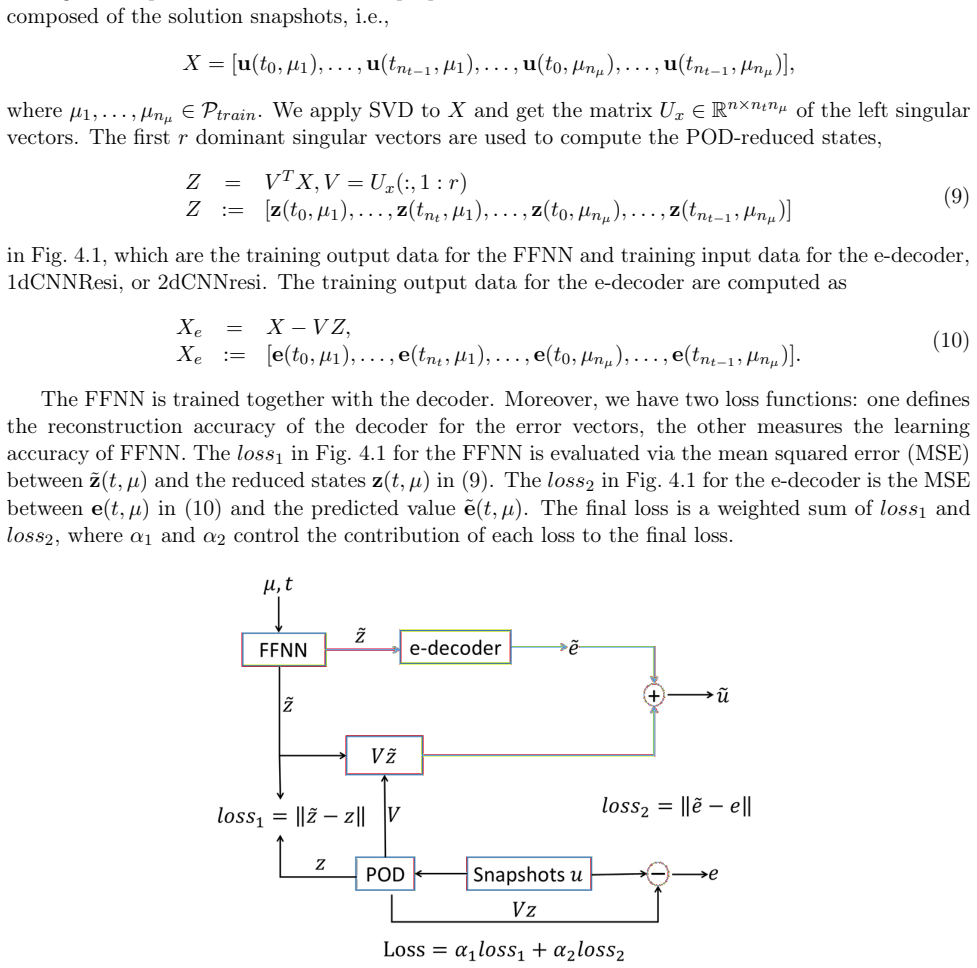
The central claim is that the error between a low-dimensional projection-based reduced-order model and the full-order solution of nonlinear convection-dominated parametric problems can be learned by a deep neural network. Adding this learned correction produces accurate hybrid predictions while the reduced basis stays small. The model and network are built sequentially offline and combined online. The non-intrusive version requires only solution data and employs fewer network parameters than purely data-driven surrogates.
Load-bearing premise
The error between the small projection-based reduced-order model and the full solution can be learned reliably by a deep neural network across the parameter range.
Editorial extensions
If this is right
- The reduced dimension of the projection-based model can remain small while still delivering high accuracy through the added error correction.
- Online prediction time drops substantially relative to full-order solves and to nonlinear manifold methods.
- The non-intrusive variant requires a lighter neural network with fewer parameters than pure deep-learning surrogates.
- Separate offline construction of the reduced-order model and the network permits modular updates for new parameter regimes.
Reading between the lines
- The sequential offline training structure could support incremental addition of new parameter samples without retraining the entire surrogate from scratch.
- The error-correction principle might apply to other transport-dominated parametric systems where linear reduced bases alone are insufficient.
- If the learned error map proves smooth in parameter space, the same network could be reused across similar convection problems with modest retraining.
Editorial analysis
A structured set of objections, weighed in public.
Referee Report
Summary. The manuscript proposes a hybrid surrogate modeling approach for convection-dominated parametric PDE problems. It combines a projection-based reduced-order model (ROM) with a deep neural network (DNN) that learns and corrects the error between the ROM approximation and the full-order solution. A non-intrusive variant is introduced for black-box solvers. Both are tested on the 1D and 2D inviscid Burgers equations with one or two parameters, claiming higher accuracy and substantially reduced online prediction time relative to state-of-the-art MOR and pure deep-learning methods.
Significance. If the central numerical claims hold under broader testing, the work would offer a pragmatic middle path between linear projection ROMs (which suffer from slow n-width decay in convection problems) and fully nonlinear or data-driven surrogates. The sequential offline construction, the ability to retain a small ROM dimension, and the lighter network in the non-intrusive case are presented as practical advantages over nonlinear-manifold or pure-DNN alternatives.
major comments (2)
- [§4] §4 (Numerical experiments on 1D/2D inviscid Burgers): the reported results do not include an ablation on DNN size, training-sample count, or generalization error as the parameter domain is enlarged or shock locations vary more strongly. This directly bears on the central claim that the ROM dimension can be kept small while the DNN correction remains reliable and lightweight.
- [§3] §3 (Methodology): no a-priori bound, regularity assumption, or numerical diagnostic is supplied on how well a DNN can approximate the parameter-dependent error field when the underlying solution contains moving discontinuities. Without this, the assertion that the hybrid construction overcomes the drawbacks of linear MOR for convection problems remains unverified.
minor comments (2)
- [Abstract] The abstract states that the methods exhibit "higher accuracy yet with largely reduced prediction time" but does not name the concrete error norms or timing metrics used; these should be stated explicitly.
- Notation for the error field, the projection operator, and the DNN input/output dimensions should be introduced once and used consistently across sections.
Simulated Author's Rebuttal
We thank the referee for the constructive comments. We address the points below and will incorporate additional numerical ablations to strengthen the experimental section.
read point-by-point responses
-
Referee: §4 (Numerical experiments on 1D/2D inviscid Burgers): the reported results do not include an ablation on DNN size, training-sample count, or generalization error as the parameter domain is enlarged or shock locations vary more strongly. This directly bears on the central claim that the ROM dimension can be kept small while the DNN correction remains reliable and lightweight.
Authors: We agree that further ablations would strengthen the central claims. In the revised manuscript we will add experiments that vary DNN depth/width, training-sample count, and test generalization on enlarged parameter domains with more strongly varying shock locations. These will be reported alongside the existing results to confirm that the DNN correction stays reliable and lightweight for small ROM dimensions. revision: yes
-
Referee: §3 (Methodology): no a-priori bound, regularity assumption, or numerical diagnostic is supplied on how well a DNN can approximate the parameter-dependent error field when the underlying solution contains moving discontinuities. Without this, the assertion that the hybrid construction overcomes the drawbacks of linear MOR for convection problems remains unverified.
Authors: The manuscript is a numerical study whose primary contribution is the hybrid construction and its practical performance. No a-priori bounds are supplied because deriving rigorous approximation guarantees for DNNs on parameter-dependent discontinuous error fields lies outside the paper’s scope. The 1-D and 2-D inviscid Burgers tests already contain moving discontinuities; the reported error norms and online timings serve as the numerical diagnostics that the DNN correction is effective, thereby supporting the practical advantage over linear MOR on these convection-dominated problems. revision: no
Circularity Check
No circularity; hybrid ROM + separate DNN error correction is an independent construction
full rationale
The paper defines a sequential offline procedure (build projection ROM, then train DNN on residual error) and an online coupling step. No equation reduces a prediction to a fitted quantity defined from the same data, no self-citation is invoked to justify uniqueness or an ansatz, and the central claim rests on explicit construction plus numerical tests on Burgers benchmarks rather than on renaming or self-referential definitions. This is a standard non-circular new method.
Assumptions & free parameters
Cite this review
Pith. "Pith review of Surrogate modeling for convection-dominated parametric problems based on error learning." pith.science (2026). https://pith.science/paper/G6CYQWD2
@misc{pith2026260529769,
  author       = {Pith},
  title        = {Pith review of: Surrogate modeling for convection-dominated parametric problems based on error learning},
  year         = {2026},
  howpublished = {\url{https://pith.science/paper/G6CYQWD2}},
  note         = {Machine review of arXiv:2605.29769}
}
abstract
Convection-dominated problems are known for their slow Kolmogorov $n$-width decays and are challenging for model order reduction (MOR). In this work, we propose a hybrid surrogate modeling approach and a non-intrusive variant that overcome some drawbacks of linear MOR methods. The proposed hybrid surrogate model is a projection-based reduced-order model (ROM), corrected by the error learned from a deep neural network. With the aid of deep learning, the model component of the surrogate model can be kept in a small reduced dimension. The neural network component and the model component are sequentially but separately built during the offline stage. At the online stage, they are easily coupled to output the solution predictions. Due to the intrusive nature of the hybrid-ROM, the numerically discretized operators of the original model must be available. For problems solved using black-box solvers, where the details of the numerical discretization are not accessible, we further propose a non-intrusive variant of the hybrid surrogate. Compared to the existing MOR methods with nonlinear manifolds, the proposed hybrid ROM is more easily built and is also easily assembled for online prediction. In contrast to the surrogate modeling approaches purely based on deep-learning, the proposed non-intrusive variant has a lighter neural network structure with much fewer parameters to be learned. We test the proposed methods on two nonlinear convection parametric problems. The first is the 1D inviscid Burgers' equation with one parameter, and the second is the 2D inviscid Burgers' equation with two parameters. Since both methods are based on error correction, their online predictions exhibit higher accuracy yet with largely reduced prediction time, compared to state-of-the-art methods.
Figures


Figures from the paper (6 more)


Reference graph
Works this paper leans on
- [1]
-
[2]
S. E. Ahmed, S. Pawar, O. San, A. Rasheed, T. Iliescu, and B. R. Noack. On closures for reduced order models—A spectrum of first-principle to machine-learned avenues.Phys. Fluids, 33(9):091301, 2021
2021
-
[3]
Ares de Parga, R
S. Ares de Parga, R. Tezaur, C. G. Hernández, and C. Farhat. Nonlinear projection-based model order reduction with machine learning regression for closure error modeling in the latent space. Comput. Methods Appl. Mech. Engrg., 448:118443, 2026
2026
-
[4]
Quadraticapproximationmanifoldformitigatingthekolmogorovbarrier in nonlinear projection-based model order reduction.J
J.BarnettandC.Farhat. Quadraticapproximationmanifoldformitigatingthekolmogorovbarrier in nonlinear projection-based model order reduction.J. Comput. Phys., 464:111348, 2022
2022
-
[5]
Barnett, C
J. Barnett, C. Farhat, and Y. Maday. Neural-network-augmented projection-based model order reduction for mitigating the kolmogorov barrier to reducibility.J. Comput. Phys., 492:112420, 2023
2023
-
[6]
Barral, T
N. Barral, T. Taddei, and I. Tifouti. Registration-based model reduction of parameterized PDEs with spatio-parameter adaptivity.J. Comput. Phys., 499:112727, 2024. 17 Figure 5.3: The FOM solutions and the surrogate predictions at time instances 0, 5, 10, 15, 20, and 25. Figure 5.4: The FOM solutions and the surrogate predictions at time instances 0, 5, 10...
2024
-
[7]
Barrault, Y
M. Barrault, Y. Maday, N. C. Nguyen, and A. T. Patera. An ‘empirical interpolation’ method: application to efficient reduced-basis discretization of partial differential equations.C.R. Acad. Sci. Paris, 339(9):667–672, 2004
2004
-
[8]
Benner, S
P. Benner, S. Gugercin, and K. Willcox. A survey of projection-based model reduction methods for parametric dynamical systems.SIAM Rev., 57(4):483–531, 2015
2015
Show all 33 references
-
[9]
Cagniart, Y
N. Cagniart, Y. Maday, and B. Stamm. Model order reduction for problems with large convection effects. In B. N. Chetverushkin, W. Fitzgibbon, Y. Kuznetsov, P. Neittaanmaeki, J. Periaux, and O. Pironneau, editors,Contributions to Partial Differential Equations and Applications,...
2019
-
[10]
Carlberg, C
K. Carlberg, C. Bou-Mosleh, and C. Farhat. Efficient non-linear model reduction via a least- squares Petrov-Galerkin projection and compressive tensor approximations.Int. J. Numer. Meth- ods. Engrg., 86(2):155–181, 2011
2011
-
[11]
Chaturantabut and D
S. Chaturantabut and D. C. Sorensen. Nonlinear model reduction via discrete empirical interpo- lation.SIAM J. Sci. Comput., 32(5):2737–2764, 2010
2010
-
[12]
Chinesta, E
F. Chinesta, E. Cueto, E. Abisset-Chavanne, J. L. Duval, and F. E. Khaldi. Virtual, digital and hybrid twins: A new paradigm in data-based engineering and engineered data.Arch. Comput. Methods Eng., 27:105–134, 2020
2020
-
[13]
Codega, A
G. Codega, A. Ivagnes, N. Demo, and G. Rozza. Machine learning-based quadratic closures for non-intrusive reduced order models. e-prints 2506.09830, arXiv, 2025
2025 arXiv
-
[14]
Ehrlacher, D
V. Ehrlacher, D. Lombardi, O. Mula, and F.-X. Vialard. Nonlinear model reduction on metric spaces. Application to one-dimensional conservative PDEs in wasserstein spaces.ESAIM: Math. Model. Numer. Anal., 54(6):2159–2197, 2020. 19
2020
-
[15]
L. Feng, S. Chellappa, and P. Benner. A posteriori error estimation for model order reduction of parametric systems.Adv. Model. and Simul. in Eng. Sci., 11(1):5, 2024
2024
-
[16]
Fresca, L
S. Fresca, L. Dedé, and A. Manzoni. A comprehensive deep learning-based approach to reduced order modeling of nonlinear time-dependent parametrized PDEs.J. Sci. Comput., 87(2):61, 2021
2021
-
[17]
Fresca and A
S. Fresca and A. Manzoni. POD-DL-ROM: Enhancing deep learning-based reduced order models for nonlinear parametrized PDEs by proper orthogonal decomposition.Comput. Methods Appl. Mech. Engrg., 388:114181, 2022
2022
-
[18]
Geelen, L
R. Geelen, L. Balzano, S. Wright, and K. Willcox. Learning physics-based reduced-order models from data using nonlinear manifolds.Chaos, 34(3):033122, 2024
2024
-
[19]
Grimberg, C
S. Grimberg, C. Farhat, and N. Youkilis. On the stability of projection-based model order re- duction for convection-dominated laminar and turbulent flows.J. Comput. Phys., 419:109681, 2020
2020
-
[20]
Grundel and N
S. Grundel and N. Sarna. Hyper-reduction for parametrized transport dominated problems via adaptive reduced meshes.Partial Differ. Equ. Appl., 5(1):3, 2024
2024
-
[21]
Hesthaven and S
J. Hesthaven and S. Ubbiali. Non-intrusive reduced order modeling of nonlinear problems using neural networks.J. Comput. Phys., 363:55–78, 2018
2018
-
[22]
Khamlich, N
M. Khamlich, N. Tonicello, F. Pichi, and G. Rozza. A multi-fidelity parametric framework for reduced-order modeling using optimal transport-based interpolation: Applications to diffused- interface two-phase flows. e-prints 2603.04232v1, arXiv, 2026
2026
-
[23]
Y. Kim, Y. Choi, D. Widemann, and T. Zohdi. A fast and accurate physics-informed neural network reduced order model with shallow masked autoencoder.J. Comput. Phys., 451:110841, 2022
2022
-
[24]
B. Koc, S. Rubino, T. Chacón Rebollo, and T. Iliescu. Residual-based data-driven variational multiscale reduced order models for parameter-dependent problems.Comp. Appl. Math, 44(308), 2025
2025
-
[25]
Lee and K
K. Lee and K. T. Carlberg. Model reduction of dynamical systems on nonlinear manifolds using deep convolutional autoencoders.J. Comput. Phys., 404:108973, 2020
2020
-
[26]
Manti, P.-H
S. Manti, P.-H. Tsai, A. Lucantonio, and T. Iliescu. Symbolic regression of data-driven reduced or- der model closures for under-resolved, convection-dominated flows.J. Comput. Phys., 540:114298, 2025
2025
-
[27]
C. Mou, B. Koc, O. San, L. G. Rebholz, and T. Iliescu. Data-driven variational multiscale reduced order models.Comput. Methods Appl. Mech. Engrg., 373:113470, 2021
2021
-
[28]
N. J. Nair and M. Balajewicz. Transported snapshot model order reduction approach for paramet- ric, steady-state fluid flows containing parameter-dependent shocks.Internat. J. Numer. Methods Engrg., 117(12):1234–1262, 2019
2019
-
[29]
Ohlberger and S
M. Ohlberger and S. Rave. Nonlinear reduced basis approximation of parameterized evolution equations via the method of freezing.C. R. Math. Acad. Sci. Paris, 351(23–24):901–906, 2013
2013
-
[30]
Peherstorfer
B. Peherstorfer. Model reduction for transport-dominated problems via online adaptive bases and adaptive sampling.SIAM J. Sci. Comput, 42(5):A2803–A2836, 2020. 20
2020
-
[31]
D. Rim, B. Peherstorfer, and K. T. Mandli. Manifold approximations via transported subspaces: Model reduction for transport-dominated problems.SIAM J. Sci. Comput., 45(1):A170–A199, 2023
2023
-
[32]
Salvador, L
M. Salvador, L. Dedè, and A. Manzoni. Non intrusive reduced order modeling of parametrized PDEs by kernel POD and neural networks.Comput. Math. Appl., 104:1–13, 2021
2021
-
[33]
Taddei and L
T. Taddei and L. Zhang. Space-time registration-based model reduction of parameterized one- dimensional hyperbolic PDEs.ESAIM: Math. Model. Numer. Anal., 55(1):99 –130, 2021. 21 Appendix A. Details of the NN structure for the examples Figure A.1: Residual block for the 1D invi...
2021
Reviewed June 29, 2026 · model on record in the stance chip above.
Discussion (0). Continue with ORCID to comment.