Absorption and Phase-Contrast Microtomography Using Direct X-ray Detection With COTS CMOS Sensors
Pith reviewed 2026-06-29 00:35 UTC · model grok-4.3
The pith
COTS CMOS sensors function as direct detectors for high-resolution absorption and phase-contrast X-ray microtomography.
A machine-rendered reading of the paper's core claim, the machinery that carries it, and where it could break.
Core claim
The central claim is that COTS CMOS image sensors serve as viable direct X-ray detectors in a cone-beam microtomography system, delivering reconstructions with voxel sizes between 3.9 and 5.2 microns for both absorption-contrast and propagation-based phase-contrast modes, enabled by a dynamic flat-field correction algorithm that mitigates radiation-induced degradation in consumer-grade hardware.
What carries the argument
Direct X-ray detection via the intrinsic resolution of COTS CMOS sensors in microfocus cone-beam geometry, augmented by a dynamic flat-field correction algorithm.
If this is right
- Voxel sizes of 3.9 to 5.2 microns become attainable with standard laboratory equipment.
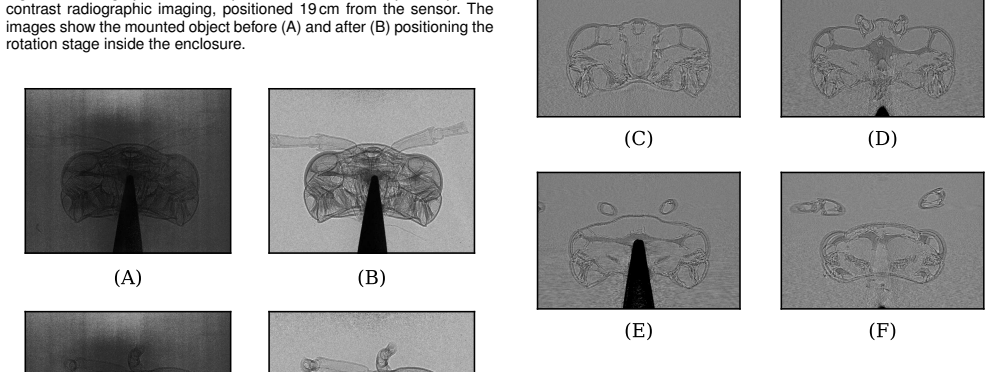
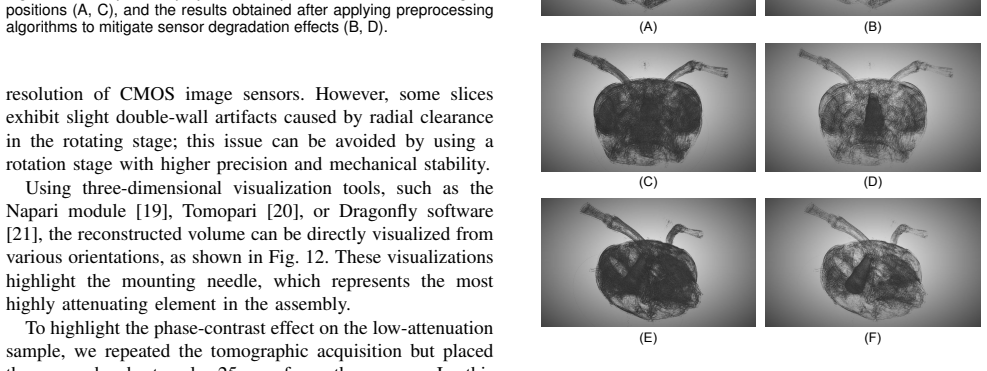
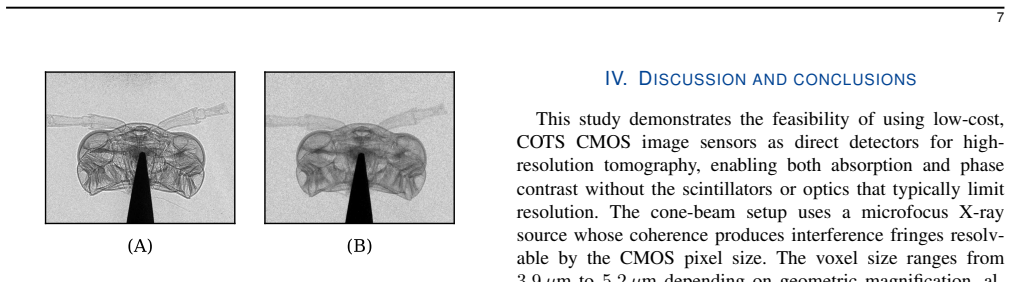
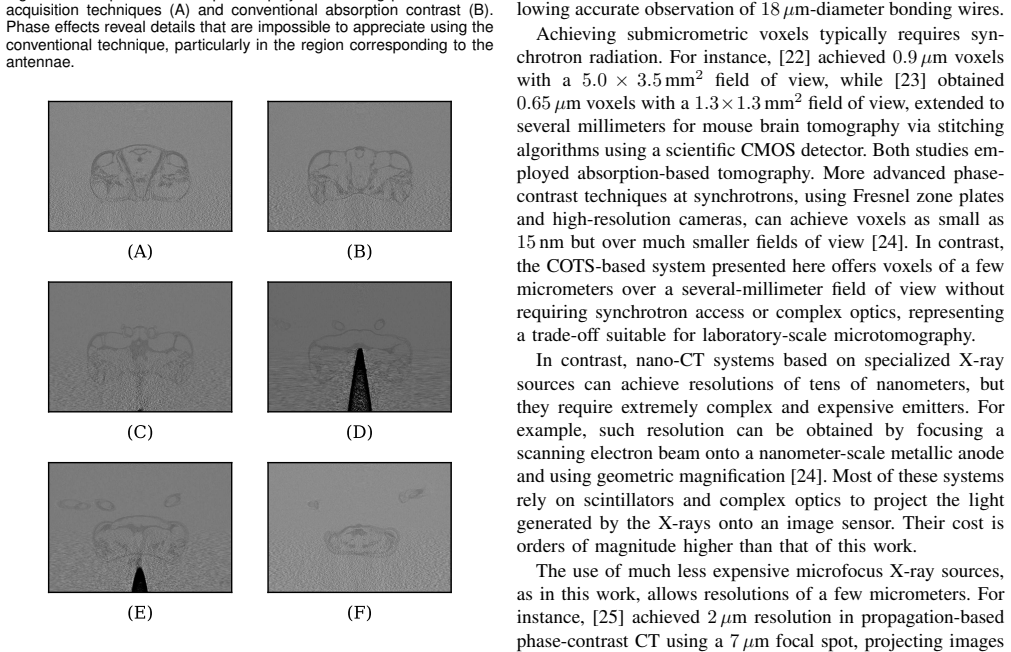
- Phase-contrast imaging visualizes soft tissue boundaries that remain invisible under absorption contrast.
- The system requires no optical components or synchrotron sources.
- Dynamic flat-field correction permits extended acquisitions on consumer sensors.
- Overall cost and complexity drop relative to nanofocus or synchrotron alternatives.
Where Pith is reading between the lines
- Smaller research groups could gain access to detailed 3D X-ray imaging of low-contrast samples without major capital investment.
- The direct-detection cone-beam method may shorten iteration cycles in materials testing or biological sample analysis.
- Adaptation of the correction algorithm to other sensor models could expand use in portable or field-deployable imaging.
- Phase-contrast results suggest utility for visualizing interfaces in non-biological specimens where density variations are small.
Load-bearing premise
The dynamic flat-field correction algorithm successfully mitigates radiation-induced degradation in consumer-grade sensors during long acquisitions without introducing artifacts that compromise the tomographic reconstructions.
What would settle it
A tomographic reconstruction that exhibits visible artifacts or reduced resolution after a long scan despite application of the dynamic flat-field correction would falsify the viability of the approach.
Figures
read the original abstract
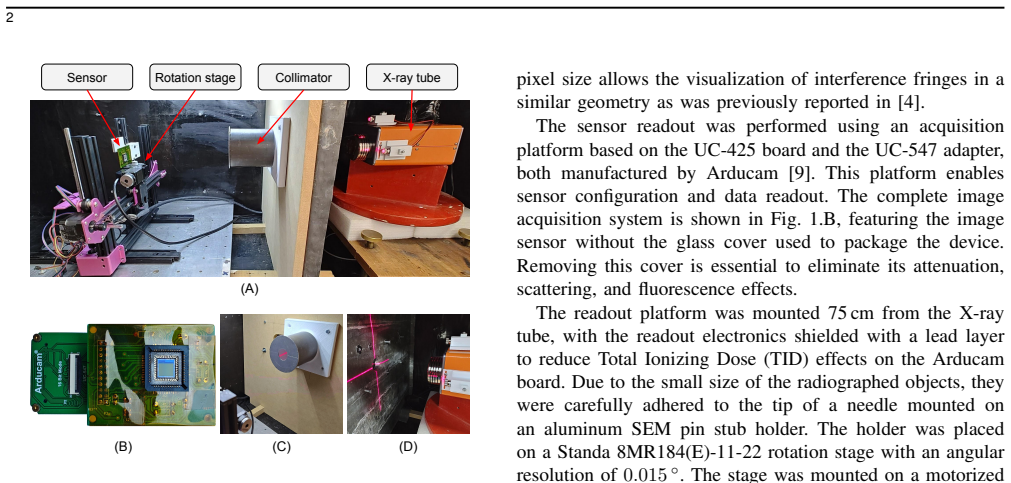
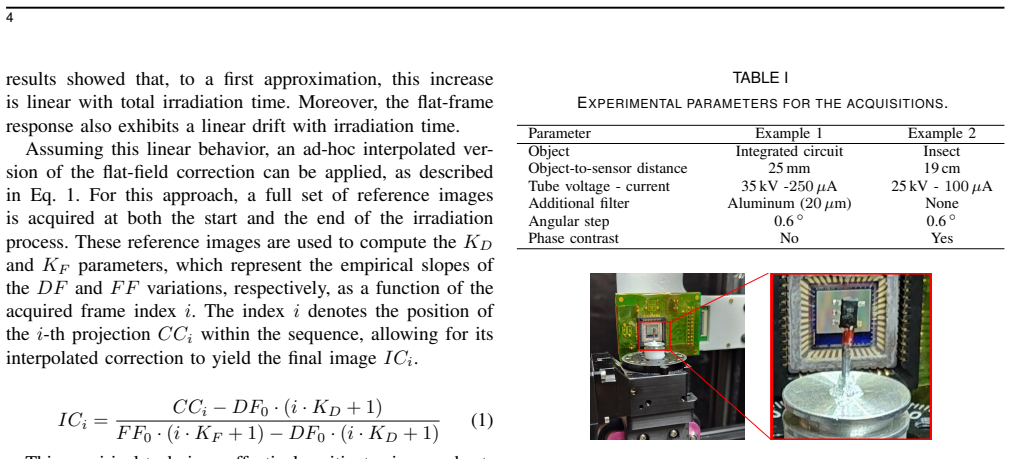
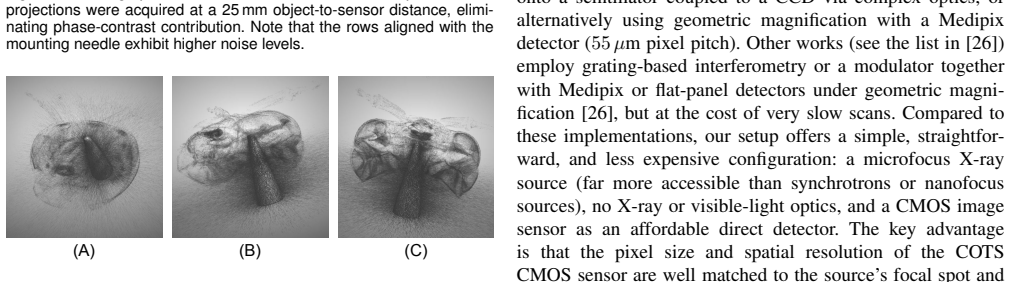
This work presents a high-resolution X-ray microtomography system that uses commercial off-the-shelf (COTS) CMOS image sensors as direct detectors, relying on the sensor s intrinsic resolution to achieve tomographic reconstructions without optical components. The system employs a microfocus X-ray source in cone-beam geometry, enabling both absorption-contrast and propagation-based phase-contrast imaging. A dynamic flat-field correction algorithm mitigates radiation-induced degradation during long acquisitions, helping to overcome limitations of consumer-grade hardware. The setup provides voxel sizes from 3.9 micron to 5.2 micron. Phase contrast visualizes soft tissue boundaries that would be undetectable by conventional radiography. Compared to synchrotron or nanofocus systems, our solution is simpler, lower-cost, and avoids complex optics or slow scans. COTS CMOS sensors appear as a viable alternative for laboratory-scale high-resolution microtomography.
Editorial analysis
A structured set of objections, weighed in public.
Referee Report
Summary. The manuscript describes a laboratory-scale X-ray microtomography setup using commercial off-the-shelf (COTS) CMOS image sensors as direct detectors in cone-beam geometry with a microfocus source. It reports voxel sizes of 3.9–5.2 µm and demonstrates both absorption-contrast and propagation-based phase-contrast imaging, with a dynamic flat-field correction algorithm introduced to mitigate radiation-induced degradation in consumer-grade sensors during long acquisitions. The central claim is that such sensors provide a simpler, lower-cost alternative to synchrotron or nanofocus systems.
Significance. If the empirical performance claims were substantiated, the approach could enable more accessible high-resolution microtomography for phase-contrast visualization of soft-tissue boundaries without complex optics. The work highlights a potential route to laboratory-scale imaging but currently lacks the quantitative grounding needed to evaluate its practical viability.
major comments (2)
- [Abstract and description of the dynamic flat-field correction algorithm] The viability claim for COTS CMOS sensors as an alternative rests on the dynamic flat-field correction successfully handling radiation-induced degradation over long scans without introducing artifacts that compromise reconstructions or the phase-contrast signal. No quantitative comparisons (e.g., MTF, CNR, or artifact power spectra) between corrected and uncorrected datasets are supplied, nor is there direct before/after validation in the tomographic results.
- [Abstract] The abstract asserts that the system provides usable reconstructions at 3.9–5.2 µm voxels and that COTS sensors appear viable, yet supplies no error metrics, system comparisons, or validation data to support these statements; the claims rest on description alone.
minor comments (1)
- The manuscript would benefit from explicit discussion of how the correction preserves propagation-based phase contrast without low-frequency artifacts affecting tomographic consistency.
Simulated Author's Rebuttal
We thank the referee for their constructive feedback. We address each major comment below and indicate planned revisions.
read point-by-point responses
-
Referee: [Abstract and description of the dynamic flat-field correction algorithm] The viability claim for COTS CMOS sensors as an alternative rests on the dynamic flat-field correction successfully handling radiation-induced degradation over long scans without introducing artifacts that compromise reconstructions or the phase-contrast signal. No quantitative comparisons (e.g., MTF, CNR, or artifact power spectra) between corrected and uncorrected datasets are supplied, nor is there direct before/after validation in the tomographic results.
Authors: We agree that quantitative comparisons (MTF, CNR, artifact power spectra) and before/after tomographic validation are needed to substantiate the dynamic flat-field correction's effectiveness. In the revised manuscript we will add these metrics and direct comparisons. revision: yes
-
Referee: [Abstract] The abstract asserts that the system provides usable reconstructions at 3.9–5.2 µm voxels and that COTS sensors appear viable, yet supplies no error metrics, system comparisons, or validation data to support these statements; the claims rest on description alone.
Authors: The abstract summarizes the work at a high level. We will revise the abstract to reference key quantitative results from the body of the paper or adjust phrasing to better reflect the available evidence. revision: yes
Circularity Check
No circularity: empirical demonstration without derivations or fitted predictions
full rationale
The paper describes an experimental X-ray microtomography system using COTS CMOS sensors, a dynamic flat-field correction algorithm, and reports voxel sizes and phase-contrast visualizations. No equations, derivations, parameter fittings, or self-citations of uniqueness theorems appear in the provided text. The viability claim rests on direct empirical reconstructions rather than any chain that reduces by construction to its inputs, satisfying the default expectation of no significant circularity for a system-demonstration paper.
Axiom & Free-Parameter Ledger
Reference graph
Works this paper leans on
-
[1]
Development of an internet of things (iot) embedded open-source gamma-ray detector using cmos image sensor technology,
D. L. Corzi, J. Lipovetzky, and M. G ´omez Berisso, “Development of an internet of things (iot) embedded open-source gamma-ray detector using cmos image sensor technology,” Journal of Sensors and Sensor Systems, vol. 14, no. 2, pp. 197–202, 2025. [Online]. Available: https://jsss.copernicus.org/articles/14/197/2025
2025
-
[2]
Enhanced high-spatial resolution radiographic images based on cots cmos image sensors applied to wood dendrochronology and densitometry,
D. L. Corzi, J. Lipovetzky, F. P . A. Bessia, L. Baqu ´e, A.-S. Sergent, M. P ´erez, M. S. Haro, I. C. A. Vinciguerra, A. Martinez-Meier, G. Dalla- Salda et al. , “Enhanced high-spatial resolution radiographic images based on cots cmos image sensors applied to wood dendrochronology and densitometry,” Radiation Measurements, vol. 172, p. 107085, 2024
2024
-
[3]
X- ray micrographic imaging system based on COTS CMOS sensors,
F. Alcalde Bessia, M. P ´erez, J. Lipovetzky, N. A. Piunno, H. Mateos, I. Sidelnik, J. J. Blostein, M. Sofo Haro, and M. G ´omez Berisso, “X- ray micrographic imaging system based on COTS CMOS sensors,” International Journal of Circuit Theory and Applications , vol. 46, no. 10, pp. 1848–1857, 2018
2018
-
[4]
Acquisition of phase-contrast x-ray images with commercial off-the-shelf cmos image sensors,
M. P ´erez, J. Lipovetzky, L. Marpegan, M. S. Haro, J. J. Blostein, M. G. Berisso, M. L. Crespo, and A. Cicuttin, “Acquisition of phase-contrast x-ray images with commercial off-the-shelf cmos image sensors,” IEEE Sensors Journal , vol. 25, no. 6, pp. 9618–9625, 2025
2025
-
[5]
Comparing x-ray phase-contrast imaging using a Talbot array illumi- nator to propagation-based imaging for non-homogeneous biomedical samples,
M. Riedel, K. Taphorn, A. Gustschin, M. Busse, J. U. Hammel, J. Moosmann, F. Beckmann, F. Fischer, P . Thibault, and J. Herzen, “Comparing x-ray phase-contrast imaging using a Talbot array illumi- nator to propagation-based imaging for non-homogeneous biomedical samples,” Scientific Reports , vol. 13, no. 1, p. 6996, Apr 2023
2023
-
[6]
St ¨ohr, The nature of X-rays and their interactions with matter
J. St ¨ohr, The nature of X-rays and their interactions with matter . Springer, 2023, no. PUBDB-2024-05989
2023
-
[7]
Direct measurement of the x-ray refractive index by fresnel diffraction at a transparent edge,
C. W. Gayer, D. Hemmers, C. Stelzmann, and G. Pretzler, “Direct measurement of the x-ray refractive index by fresnel diffraction at a transparent edge,” Opt. Lett. , vol. 38, no. 9, pp. 1563–1565, May 2013. [Online]. Available: https://opg.optica.org/ol/abstract.cfm?URI=ol-38-9- 1563
2013
-
[8]
Modelling of phase contrast imaging with x-ray wavefront sensor and partial coherence beams,
G. Begani Provinciali, A. Cedola, O. d. L. Rochefoucauld, and P . Zeitoun, “Modelling of phase contrast imaging with x-ray wavefront sensor and partial coherence beams,” Sensors, vol. 20, no. 22, 2020. [Online]. Available: https://www.mdpi.com/1424-8220/20/22/6469
2020
-
[9]
Arducam wiki,
Arducam, “Arducam wiki,” https://docs.arducam.com/USB-Industrial- Camera/USB3.0-Camera-Shield/Introduction/, 2022, accessed: 2023-12- 06
2022
-
[10]
Displacement damage in cmos image sensors after thermal neutron irradiation,
F. A. Bessia, M. P ´erez, M. S. Haro, I. Sidelnik, J. J. Blostein, S. Su ´arez, P . P´erez, M. G. Berisso, and J. Lipovetzky, “Displacement damage in cmos image sensors after thermal neutron irradiation,” IEEE Transac- tions on Nuclear Science , vol. 65, no. 11, pp. 2793–2801, 2018
2018
-
[11]
A filtered backprojection algorithm with ray-by-ray noise weighting,
G. L. Zeng and A. Zamyatin, “A filtered backprojection algorithm with ray-by-ray noise weighting,” Medical physics , vol. 40, no. 3, p. 031113, 2013
2013
-
[12]
Orhan et al
K. Orhan et al. , Micro-computed Tomography (micro-CT) in Medicine and Engineering . Springer, 2020
2020
-
[13]
C. C. Shaw, Cone beam computed tomography . CRC Press, 2014
2014
-
[14]
Radiation effects on cmos active pixel image sensors,
V . Goiffon, “Radiation effects on cmos active pixel image sensors,” Ionizing Radiation Effects in Electronics: From Memories to Imagers , pp. 295–332, 2015
2015
-
[15]
S. Rit, M. Vila Oliva, S. Brousmiche, R. Labarbe, D. Sarrut, and G. C. Sharp, “The reconstruction toolkit (rtk), an open-source cone-beam ct reconstruction toolkit based on the insight toolkit (itk),” Journal of Physics: Conference Series , vol. 489, no. 1, p. 012079, mar 2014. [Online]. Available: https://doi.org/10.1088/1742-6596/489/1/012079
-
[16]
Practical cone-beam algorithm,
L. A. Feldkamp, L. C. Davis, and J. W. Kress, “Practical cone-beam algorithm,” J. Opt. Soc. Am. A , vol. 1, no. 6, pp. 612–619, Jun 1984. [On- line]. Available: https://opg.optica.org/josaa/abstract.cfm?URI=josaa-1- 6-612
1984
-
[17]
A. V aniqui, L. E. J. R. Schyns, I. P . Almeida, B. van der Heyden, M. Podesta, and F. V erhaegen, “The effect of different image reconstruction techniques on pre-clinical quantitative imaging and dual- energy ct,” British Journal of Radiology , vol. 92, no. 1095, p. 20180447, 11 2018. [Online]. Available: https://doi.org/10.1259/bjr.20180447
-
[18]
Effect of geometric magnification on dimensional measurements with a metrology- grade x-ray computed tomography system,
H. Villarraga-G ´omez and S. T. Smith, “Effect of geometric magnification on dimensional measurements with a metrology- grade x-ray computed tomography system,” Precision Engineering , vol. 73, pp. 488–503, Jan. 2022. [Online]. Available: https://www.sciencedirect.com/science/article/pii/S0141635921002610
2022
-
[19]
napari: a multi-dimensional image viewer for python,
napari contributors, “napari: a multi-dimensional image viewer for python,” Zenodo, 2019, uRL: https://doi.org/10.5281/zenodo.3555620
-
[20]
tomopari, a plugin for accelerated tomographic reconstruction
D. P . G. M. T. C. Marcos Antonio Obando, Minh Nhat Trinh, “tomopari, a plugin for accelerated tomographic reconstruction.” 2026. [Online]. Available: https://napari-hub.org/plugins/tomopari.html
2026
-
[21]
Dragon fly (version 20xx.x) [computer software],
Comet Technologies Canada Inc., “Dragon fly (version 20xx.x) [computer software],” Montreal, Canada, 20XX. [Online]. Available: https://dragonfly.comet.tech/
-
[22]
A wide-field micro-computed tomography detector: micron resolution at half-centimetre scale,
M. A. Y akovlev, D. J. V anselow, M. S. Ngu, C. R. Zaino, S. R. Katz, Y . Ding, D. Parkinson, S. Y . Wang, K. C. Ang, P . La Riviere et al. , “A wide-field micro-computed tomography detector: micron resolution at half-centimetre scale,” Synchrotron Radiation, vol. 29, no. 2, pp. 505– 514, 2022
2022
-
[23]
Synchrotron radiation-based tomography of an entire mouse brain with sub-micron voxels: Augmenting interactive brain atlases with terabyte data,
M. Humbel, C. Tanner, M. Girona Alarc ´on, G. Schulz, T. Weitkamp, M. Scheel, V . Kurtcuoglu, B. M ¨uller, and G. Rodgers, “Synchrotron radiation-based tomography of an entire mouse brain with sub-micron voxels: Augmenting interactive brain atlases with terabyte data,” Ad- vanced Science , vol. 12, no. 28, p. 2416879, 2025
2025
-
[24]
Comparing image quality of synchrotron and laboratory nano-ct scans: a round robin study,
S. Wittl, S. Zabler, J. Fell, J. Villanova, P . Lhuissier, S. Hildebrandt, and H.-G. Herrmann, “Comparing image quality of synchrotron and laboratory nano-ct scans: a round robin study,” Synchrotron Radiation, vol. 33, no. 2, pp. 489–507, 2026
2026
-
[25]
Phase contrast tomography of the mouse cochlea at microfocus x-ray sources,
M. Bartels, V . H. Hernandez, M. Krenkel, T. Moser, and T. Salditt, “Phase contrast tomography of the mouse cochlea at microfocus x-ray sources,” Applied Physics Letters , vol. 103, no. 8, 2013
2013
-
[26]
X- ray phase-contrast microtomography of soft tissues using a compact laboratory system with two-directional sensitivity,
C. Navarrete-Le ´on, A. Doherty, S. Savvidis, M. F. Gerli, G. Piredda, A. Astolfo, D. Bate, S. Cipiccia, C. K. Hagen, A. Olivo et al. , “X- ray phase-contrast microtomography of soft tissues using a compact laboratory system with two-directional sensitivity,” Optica, vol. 10, no. 7, pp. 880–887, 2023
2023
-
[27]
On the use of flat-fields for tomographic reconstruction,
C. Jailin, J.-Y . Buf fi`ere, F. Hild, M. Poncelet, and S. Roux, “On the use of flat-fields for tomographic reconstruction,” Synchrotron Radiation , vol. 24, no. 1, pp. 220–231, 2017
2017
discussion (0)
Sign in with ORCID, Apple, or X to comment. Anyone can read and Pith papers without signing in.