Four-wave mixing and secondary radiations generated by nonharmonic two-color filaments in air: Influence of the Kerr and plasma nonlinearities
Pith reviewed 2026-06-29 05:39 UTC · model grok-4.3
The pith
Two-color filaments in air generate tunable mid-infrared light at 3.3 micrometers via four-wave mixing driven by both Kerr and plasma effects.
A machine-rendered reading of the paper's core claim, the machinery that carries it, and where it could break.
Core claim
Two-color nonharmonic filaments combining approximately 800 nm and 1.3 micrometer waves produce tunable mid-infrared radiation around 3.3 micrometers; the Kerr response initiates the four-wave mixing that creates visible and mid-IR modes, while plasma nonlinearities contribute additional broadening and mixing, with numerical results showing that broad visible emission is required to trigger the weaker secondary radiations.
What carries the argument
Four-wave mixing in two-color filaments, where Kerr nonlinearity amplifies initial radiations and plasma nonlinearities broaden and mix frequencies to produce secondary satellites.
If this is right
- Mid-infrared radiation can be tuned by adjusting the seed wavelength around 1.3 micrometers.
- Ionization during the plasma stage broadens the generated mid-IR spectrum.
- Kerr-driven four-wave mixing occurs first and amplifies the visible and mid-IR modes before plasma effects dominate.
- Secondary cascaded radiations appear only after a broad visible spectrum has been established.
Where Pith is reading between the lines
- The same two-color approach might be tested in other gases to alter the balance between Kerr and plasma contributions.
- The requirement for a broad visible spectrum suggests that controlling the visible output could be used to switch secondary mid-IR generation on or off.
- Extending the filament length or adjusting focal conditions could further separate the Kerr and plasma stages in time.
Load-bearing premise
The local-current model and unidirectional solver used in the simulations correctly represent the relative timing and contributions of Kerr versus plasma nonlinearities.
What would settle it
An experiment that produces strong secondary mid-IR radiation while suppressing the broad visible emission, or a simulation that reproduces the mid-IR without including plasma broadening, would contradict the central claim.
Figures
read the original abstract
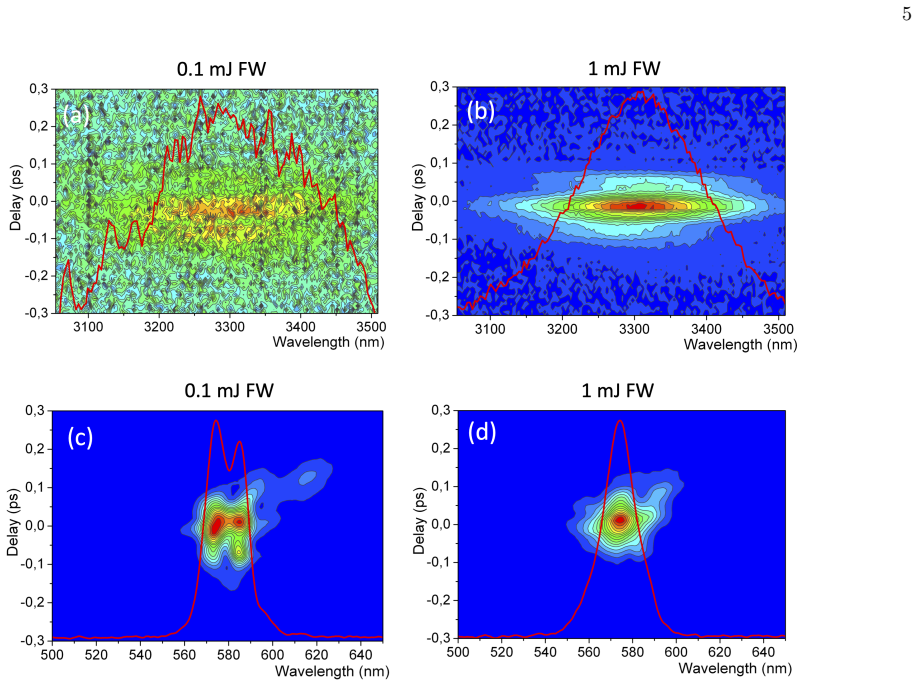
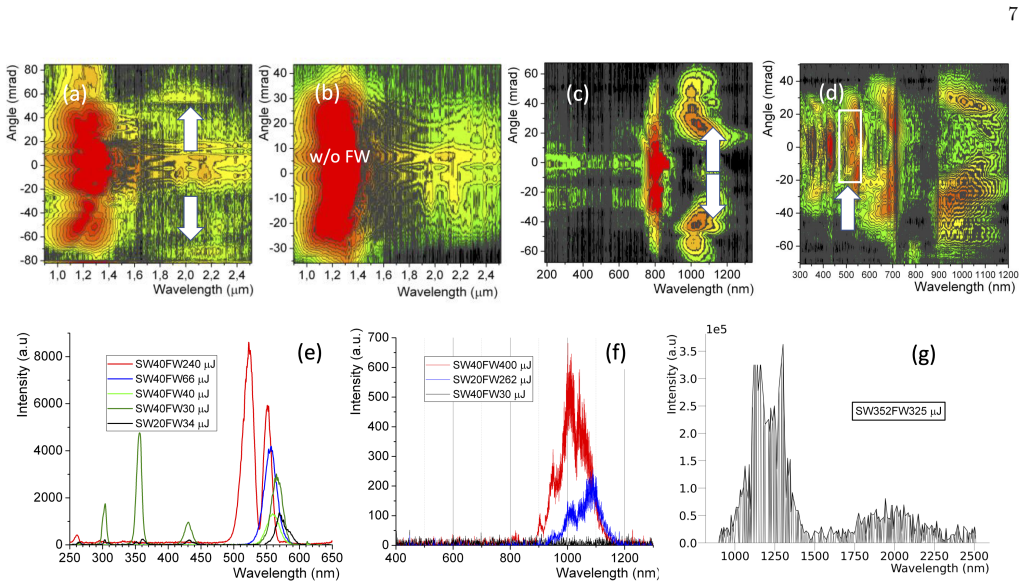
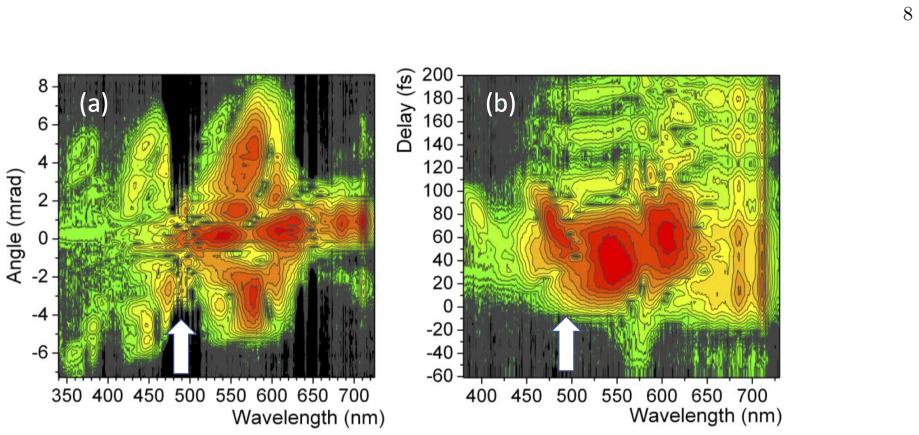
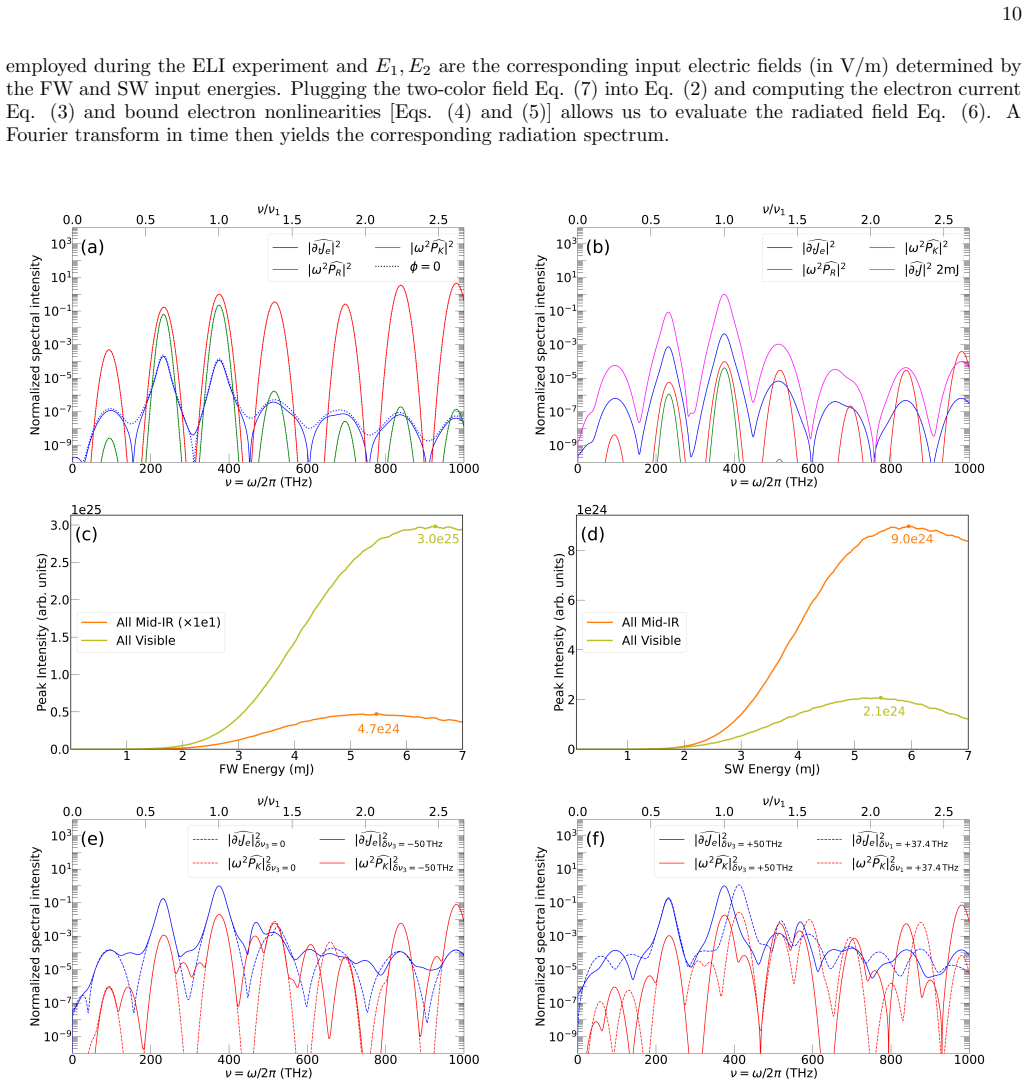
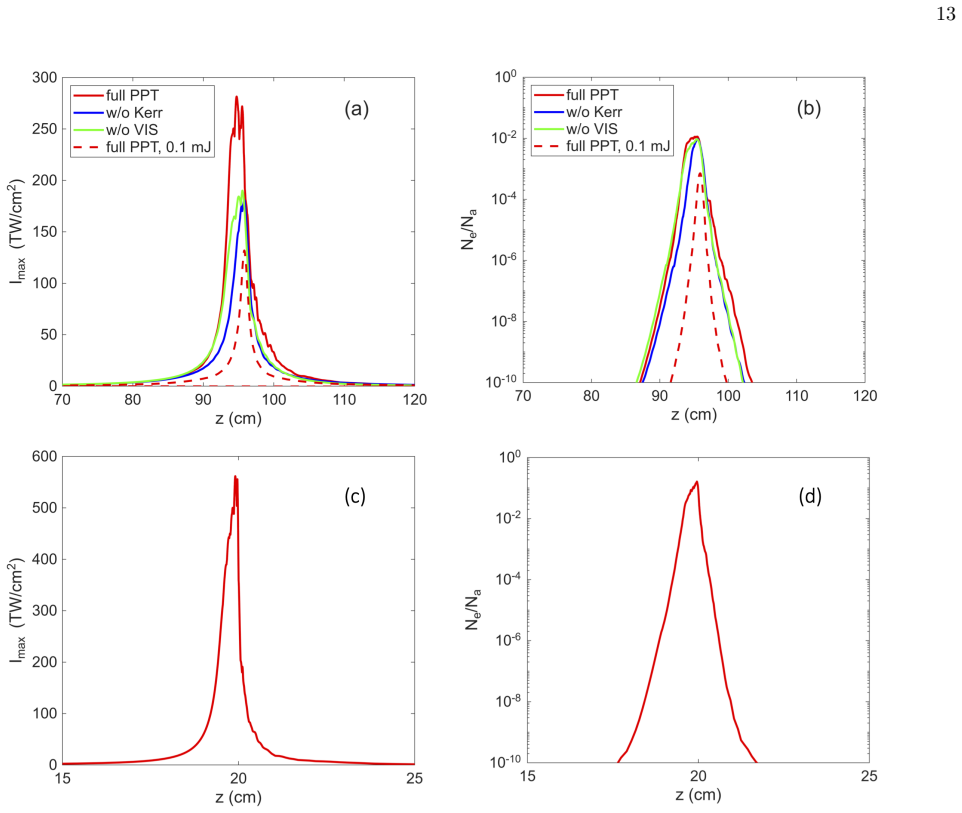
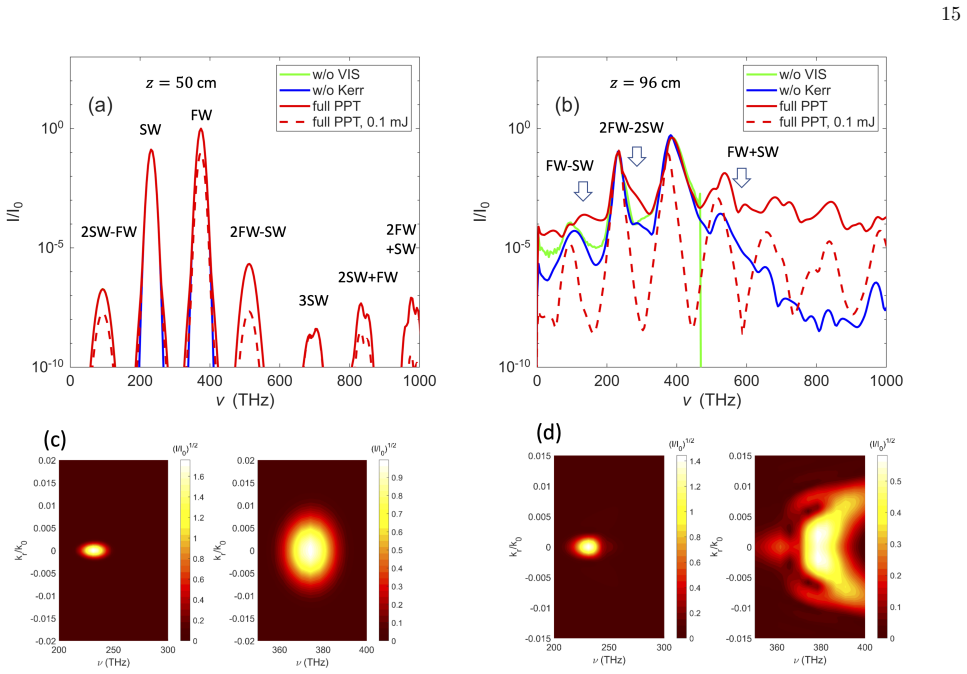
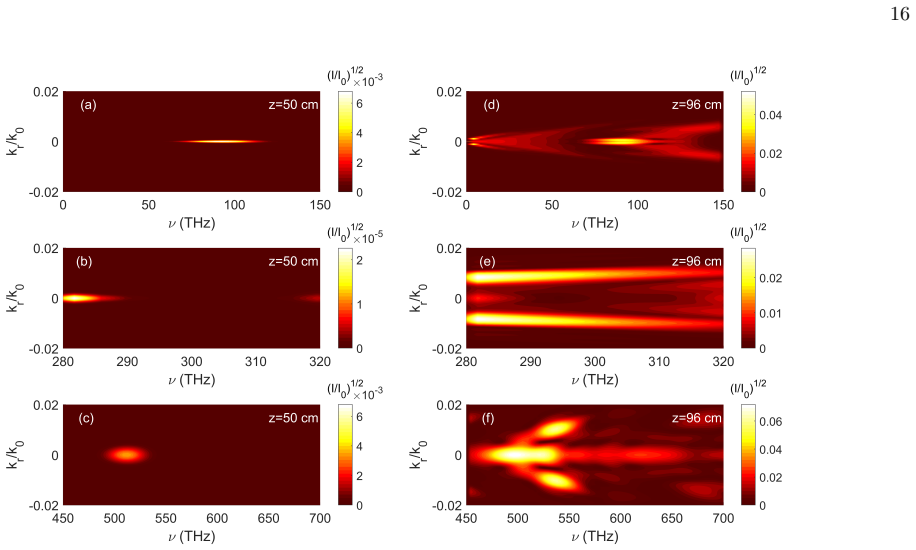
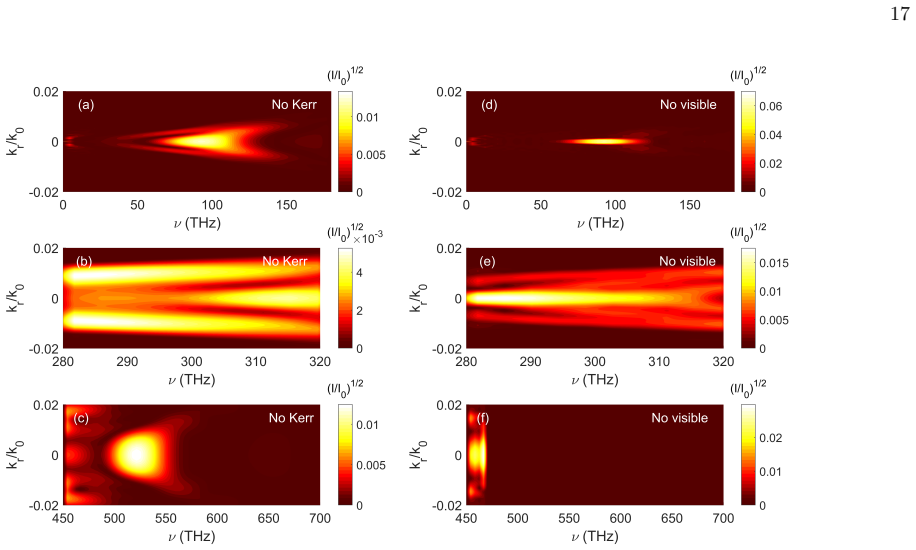
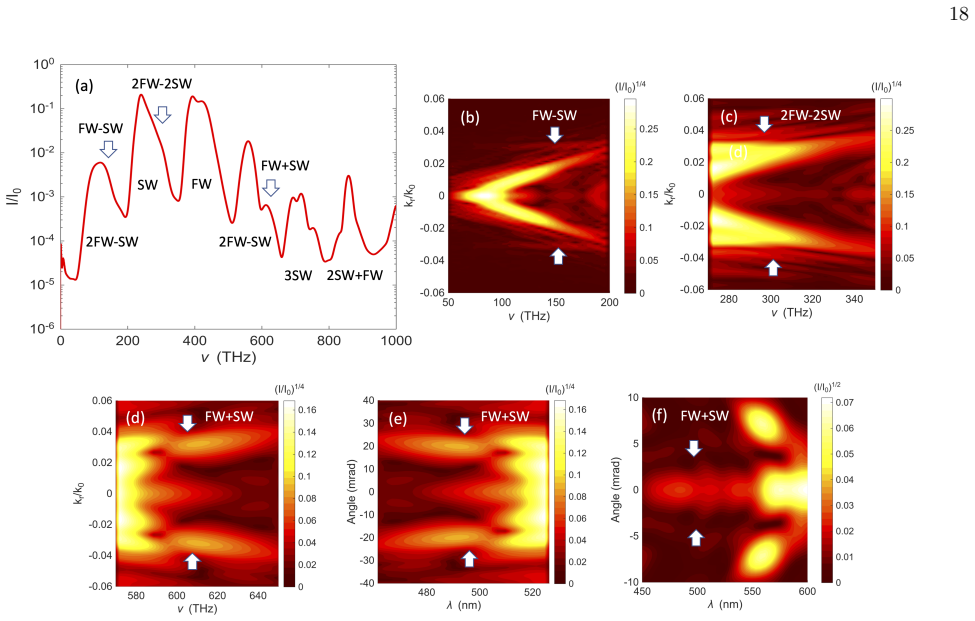
Four-wave mixing (FWM) is an efficient source of light waves emitted at various frequencies, usually associated with third-order optical nonlinearities. Whereas attention has mostly been paid in the past to the generation of Stokes (e.g., visible) modes by mixing two nonharmonic frequencies in degenerate FWM, the present work aims to analyze the weaker components, i.e., the anti-Stokes (resp. mid-IR) radiation and cascaded satellites, and characterize their conversion efficiency and tunability. Here we report the production of tunable mid-infrared radiation around 3.3 $\mu$m delivered by two-color femtosecond filaments in air combining $\sim 800$ nm fundamental and $\sim 1.3$ $\mu$m seed waves. Although the Kerr response of air plays a key role in creating both visible and mid-IR radiations, we show that plasma nonlinearities also contribute by broadening and mixing the pump frequencies. Two experimental setups are exploited to focus, separately, on the production of FWM modes and cascaded satellites - called secondary radiations. A first filamentation setup employing different focal lengths for the two colors displays an ionization-induced broadening of the mid-IR radiation during the plasma stage. A second setup focusing the two pump components over equal propagation distances allows us to unveil the secondary radiations emerging at lower intensity levels when plasma occurs. We examine which player, among the plasma- or Kerr-induced FWM, is the most active in the conversion process. Numerical simulations based on a local-current model and a unidirectional solver highlight the role of the Kerr stage in amplifying the FWM radiations prior to the development of the weaker satellites in plasma regime. Their results, agreeing well with the experimental data, demonstrate that a broad visible emission is needed to trigger secondary radiations.
Editorial analysis
A structured set of objections, weighed in public.
Referee Report
Summary. The paper reports tunable mid-IR radiation around 3.3 μm generated via four-wave mixing in two-color (~800 nm + ~1.3 μm) femtosecond filaments in air. It claims that the Kerr response primarily drives initial FWM amplification of visible and mid-IR components, while plasma nonlinearities contribute secondarily by broadening and mixing frequencies to enable cascaded secondary radiations; this sequence is supported by two experimental configurations (differing focal lengths vs. equal propagation) and numerical simulations using a local-current model plus unidirectional solver that agree with the data and indicate a broad visible emission is required to trigger the satellites.
Significance. If the attribution of Kerr vs. plasma roles holds, the work clarifies the sequence of nonlinear mechanisms in filament-based frequency conversion and demonstrates a practical route to tunable mid-IR sources. The dual experimental setups and direct simulation-experiment comparison are strengths; the absence of free parameters in the model derivation would further strengthen the result if confirmed.
major comments (2)
- [Numerical simulations] Numerical simulations section: the local-current plasma model and unidirectional solver are asserted to accurately separate the timing and relative contributions of Kerr (initial FWM amplification) versus plasma (broadening/mixing after visible emission), yet no validation against independent benchmarks, sensitivity tests on ionization rate, or checks for missing higher-order/nonlocal terms at filament intensities is provided; this directly underpins the central claim that Kerr dominates prior to plasma-enabled satellites.
- [Experimental setups] Experimental setups (first filamentation setup with different focal lengths): the ionization-induced broadening of mid-IR during the plasma stage is reported, but quantitative details on how focal-length choices and post-hoc adjustments influence the observed sequence versus pure Kerr-driven FWM are not given, leaving open whether the separation of mechanisms is robust or setup-dependent.
minor comments (2)
- [Abstract] Abstract and introduction: the statement that simulations 'agree well with the experimental data' would benefit from explicit mention of quantitative metrics (e.g., spectral overlap or conversion efficiency differences) rather than qualitative description.
- Figure captions and text: ensure consistent notation for the two pump wavelengths (~800 nm fundamental and ~1.3 μm seed) across all panels to avoid ambiguity in comparing FWM components.
Simulated Author's Rebuttal
We thank the referee for the constructive comments on our manuscript. We address each major comment below and will revise the manuscript accordingly to strengthen the presentation of the numerical model validation and experimental setup details.
read point-by-point responses
-
Referee: Numerical simulations section: the local-current plasma model and unidirectional solver are asserted to accurately separate the timing and relative contributions of Kerr (initial FWM amplification) versus plasma (broadening/mixing after visible emission), yet no validation against independent benchmarks, sensitivity tests on ionization rate, or checks for missing higher-order/nonlocal terms at filament intensities is provided; this directly underpins the central claim that Kerr dominates prior to plasma-enabled satellites.
Authors: We agree that explicit validation steps would reinforce the separation of Kerr and plasma contributions. In the revised manuscript we will add comparisons of the unidirectional solver against established filament propagation benchmarks from the literature, include sensitivity tests varying the ionization rate within reported experimental uncertainties, and discuss the rationale for omitting higher-order nonlocal terms (which remain negligible at the intensities and propagation distances considered). The existing agreement between simulations and measured spectra without adjustable parameters already supports the timing sequence, but these additions will directly address the concern. revision: yes
-
Referee: Experimental setups (first filamentation setup with different focal lengths): the ionization-induced broadening of mid-IR during the plasma stage is reported, but quantitative details on how focal-length choices and post-hoc adjustments influence the observed sequence versus pure Kerr-driven FWM are not given, leaving open whether the separation of mechanisms is robust or setup-dependent.
Authors: We will expand the experimental section to provide the specific focal lengths employed, the resulting peak intensities, and the measured filament onset positions for each color. These choices were made to temporally separate the Kerr-dominated FWM stage from the subsequent plasma stage; we will add a quantitative discussion of how small adjustments in focal length shift the relative timing and confirm that the observed mid-IR broadening remains tied to plasma onset rather than pure Kerr FWM. The complementary equal-propagation setup further supports robustness, and the added details will clarify that the mechanism separation is not an artifact of the particular configuration. revision: yes
Circularity Check
No circularity: simulations and experiments provide independent checks
full rationale
The paper's central claims rest on experimental observations of mid-IR and secondary radiations in two-color filaments, with numerical simulations (local-current model + unidirectional solver) presented as independent verification that agree with data. No equations, fitted parameters renamed as predictions, self-citations used as load-bearing uniqueness theorems, or ansatzes smuggled via prior work are exhibited in the provided text. The derivation chain does not reduce any result to its inputs by construction; the attribution of Kerr vs plasma roles is framed as an outcome of comparing model output to measurements rather than a definitional equivalence.
Axiom & Free-Parameter Ledger
Reference graph
Works this paper leans on
-
[1]
created upon secondary mixings of the pump frequencies have been reported in photocurrent-driven Brunel-type radiations [25] without receiving any clear identification so far. In this paper we report two experimental demonstrations: i – The first one is dedicated to generating not only visible radiation [21], but above all an efficient and tunable mid-IR ...
2000
-
[2]
1 (see also [35])
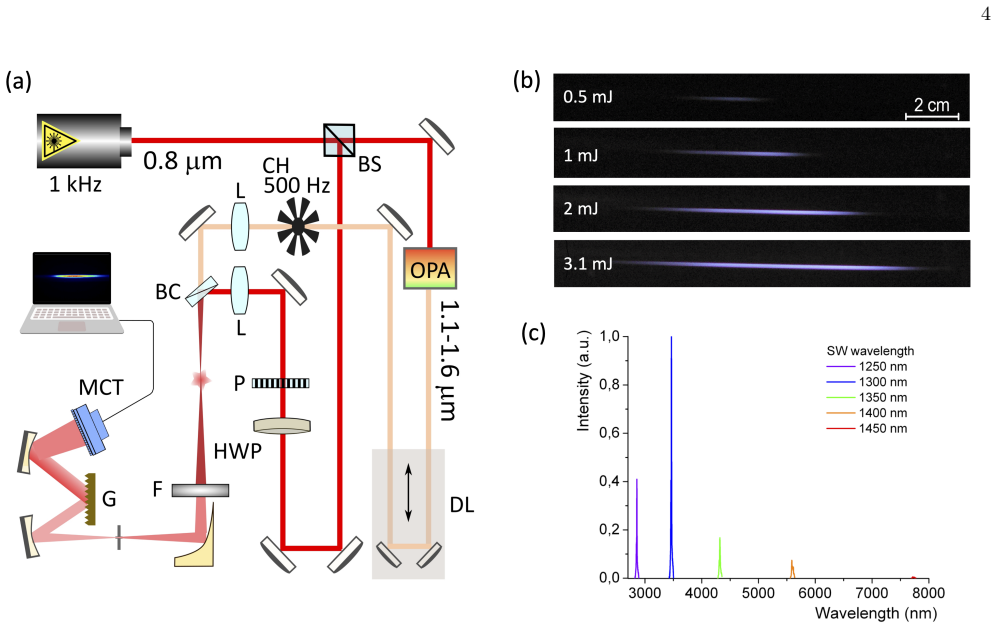
The ELI setup The ELI experimental setup is shown in Fig. 1 (see also [35]). An amplified Ti:Sapphire system (Coherent Astrella, 802 nm, 35 fs FWHM, 1 kHz, 6 mJ max.) provides the FW pump. Part of its energy (1.5 mJ approx.) seeds an OPA (TOPAS Prime) producing a 40-fs SW pulse tunable in 1.1–1.6µm. The SW wavelength is set to 1292 nm – where the OPA deli...
-
[3]
Here, both pulse components were focused at the same linear distancef= 20 cm in focused propagation geometry orf= 100 cm in filamentation regime
The LRC Vilnius setup Complementary experiments were performed at LRC, Vilnius, to acquire more and finer spectral data in frequency regions that were not scanned during the ELI experiment. Here, both pulse components were focused at the same linear distancef= 20 cm in focused propagation geometry orf= 100 cm in filamentation regime. Attention was paid to...
-
[4]
Universities’ Excellence Initiative
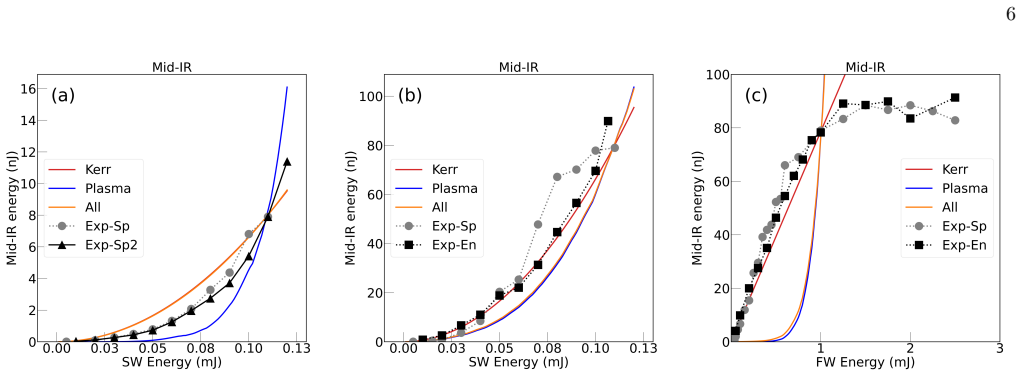
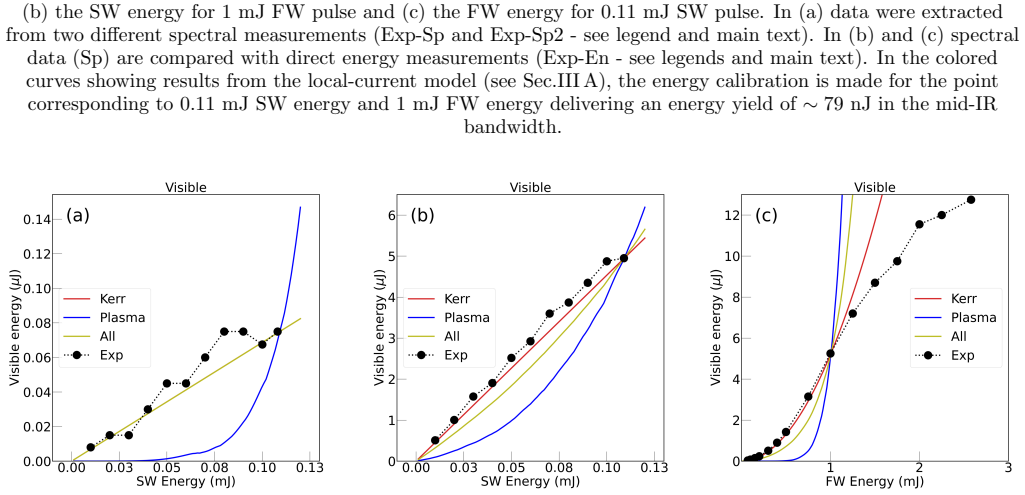
Here, instead of plotting ”best” curves fitting our experimental data, we fix every emitting source (instantaneous Kerr response, plasma response alone and sum of all nonlinearities) to an experimental reference point defined by the 79 nJ yield measured at 0.11 mJ SW energy and 1 mJ FW energy. The energy yield at 0.1 mJ has been decreased by a factor 10 a...
-
[5]
R. W. Boyd,Nonlinear Optics(Academic Press, San Diego, 2008)
2008
-
[6]
Agrawal,Nonlinear Fiber Optics(Academic Press, New York, 2012)
G. Agrawal,Nonlinear Fiber Optics(Academic Press, New York, 2012)
2012
-
[7]
A. D. DiChiara, S. Ghimire, C. I. Blaga, E. Sistrunk, E. P. Power, A. M. March, T. A. Miller, D. A. Reis, P. Agostini, and L. F. DiMauro, Scaling of high-order harmonic generation in the long wavelength limit of a strong laser field, IEEE J. Sel. Top. Quantum Electron.18, 419 (2012)
2012
-
[8]
Colosimo, G
P. Colosimo, G. Doumy, C. I. Blaga, J. Wheeler, C. Hauri, F. Catoire, J. Tate, R. Chirla, A. M. March, G. G. Paulus, H. G. Muller, P. Agostini, and L. F. DiMauro, Scaling strong-field interactions towards the classical limit, Nat. Phys.4, 386 (2008)
2008
-
[9]
Auguste, F
T. Auguste, F. Catoire, P. Agostini, L. F. DiMauro, C. C. Chirila, V. S. Yakovlev, and P. Sali` eres, Driving-frequency scaling of high-harmonic quantum paths, New Journal of Physics14, 103014 (2012)
2012
-
[10]
Clerici, M
M. Clerici, M. Peccianti, B. E. Schmidt, L. Caspiani, M. Shalaby, M. Gigu` ere, A. Lotti, A. Couairon, F. L´ egar´ e, T. Ozaki, D. Faccio, and R. Morandotti, Wavelength scaling of terahertz generation by gas ionization, Phys. Rev. Lett.110, 253901 (2013)
2013
-
[11]
Nguyen, K
A. Nguyen, K. J. Kaltenecker, J.-C. Delagnes, B. Zhou, E. Cormier, N. Fedorov, R. Bouillaud, D. Descamps, I. Thiele, S. Skupin, P. U. Jepsen, and L. Berg´ e, Wavelength scaling of terahertz pulse energies delivered by two-color air plasmas, Opt. Lett.44, 1488 (2019)
2019
-
[12]
D. Jang, R. M. Schwartz, D. Woodbury, J. Griff-McMahon, A. H. Younis, H. M. Milchberg, and K.-Y. Kim, Efficient terahertz and brunel harmonic generation from air plasma via mid-infrared coherent control, Optica6, 1338 (2019)
2019
-
[13]
L. S. C. Calabrese, A. M. Stingel, and P. B. Petersen, Ultrafast continuum mid-infrared spectroscopy: probing the entire vibrational spectrum in a single laser shot with femtosecond time resolution, Opt. Lett.37, 2265 (2012)
2012
-
[14]
Werner, V
K. Werner, V. Gruzdev, and N.et al.. Talisa, Single-shot multi-stage damage and ablation of silicon by femtosecond mid-infrared laser pulse, Sci. Reports9, 19993 (2019)
2019
-
[15]
J. Ma, Z. Qin, G. Xie, L. Qian, and D. Tang, Review of mid-infrared mode-locked laser sources in the 2.0µm – 3.5µm spectral region, Appl. Phys. Rev.6, 021317 (2019)
2019
-
[16]
Mirov, I
S. Mirov, I. Moskalev, S. Vasilyev, V. Smolski, V. Fedorov, D. Martyshkin, J. Peppers, M. Mirov, A. Dergachev, and V. Gapontsev, Frontiers of mid-ir lasers based on transition metal doped chalcogenides, IEEE J. Sel. Top. Quantum Electron.24, 1601829 (2018)
2018
-
[17]
Y. Yu, X. Gai, T. Wang, P. Ma, R. Wang, Z. Yang, D.-Y. Choi, S. Madden, and B. Luther-Davies, Mid-infrared supercon- tinuum generation in chalcogenides, Opt. Mater. Express3, 1075 (2013)
2013
-
[18]
K. Liu, J. Liu, H. Shi, F. Tan, and P. Wang, High power mid-infrared supercontinuum generation in a single-mode zblan fiber with up to 21.8 w average output power, Opt. Express22, 24384 (2014)
2014
-
[19]
Y. Yao, A. J. Hoffman, and C. Gmachl, Mid-infrared quantum cascade lasers, Nat. Photonics6, 432 (2012)
2012
-
[20]
Dubietis and A
A. Dubietis and A. Matijoˇ sius, Table-top optical parametric chirped pulse amplifiers: past and present, Opto-Electron. Adv.6, 220046 (2023)
2023
-
[21]
J. Li, J. Lu, A. Chew, S. Han, J. Li, Y. Wu, H. Wang, S. Ghimire, and Z. Chang, Attosecond science based on high harmonic generation from gases and solids, Nat. Commun.11, 2748 (2020)
2020
-
[22]
K. Y. Kim, A. J. Taylor, J. H. Glownia, and G. Rodriguez, Coherent control of terahertz supercontinuum generation in ultrafast laser-gas interactions, Nature Photonics2, pp. 605 (2008)
2008
-
[23]
Vaiˇ caitis, M
V. Vaiˇ caitis, M. Ivanov, K. Adomaviˇ cius, v. Svirskas, U. Morgner, and I. Babushkin, Influence of laser-preformed plasma on thz wave generation in air by bichromatic laser pulses, Laser Phys.28, 095402 (2018)
2018
-
[24]
Vaiˇ caitis, Cherenkov-type phase-matched third harmonic generation in air, Opt
V. Vaiˇ caitis, Cherenkov-type phase-matched third harmonic generation in air, Opt. Commun.185, 197–202 (2000)
2000
-
[25]
Th´ eberge, N
F. Th´ eberge, N. Ak¨ ozbek, W. Liu, A. Becker, and S. L. Chin, Tunable ultrashort laser pulses generated through filamen- tation in gases, Phys. Rev. Lett.97, 023904 (2006)
2006
-
[26]
Ak¨ ozbek, A
N. Ak¨ ozbek, A. Iwasaki, A. Becker, M. Scalora, S. L. Chin, and C. M. Bowden, Third-harmonic generation and self- channeling in air using high-power femtosecond laser pulses, Phys. Rev. Lett.89, 143901 (2002)
2002
-
[27]
Tamulien˙ e, G
V. Tamulien˙ e, G. Juˇ skeviˇ ci¯ ut˙ e, D. Buoˇ zius, V. Vaiˇ caitis, U. Morgner, and I. Babushkin, Influence of tunnel ionization to third-harmonic generation of infrared femtosecond laser pulses in air, Sci. Reports10, 17437 (2020)
2020
-
[28]
Vaiˇ caitis, R
V. Vaiˇ caitis, R. Butkus, O. Balachninait˙ e, U. Morgner, and I. Babushkin, Diffraction-enhanced femtosecond white-light filaments in air, Appl. Phys. B124, 221 (2018)
2018
-
[29]
Brunel, Harmonic generation due to plasma effects in a gas undergoing multiphoton ionization in the high-intensity limit, josab7, 521 (1990)
F. Brunel, Harmonic generation due to plasma effects in a gas undergoing multiphoton ionization in the high-intensity limit, josab7, 521 (1990). 20
1990
-
[30]
David, F
P. David, F. Catoire, and L. Berg´ e, Harmonic structure of the brunel spectra, Physica D483, 134930 (2025)
2025
-
[31]
T. Fuji, T. Horio, and T. Suzuki, Generation of 12 fs deep-ultraviolet pulses by four-wave mixing through filamentation in neon gas, Opt. Lett.32, 2481 (2007)
2007
-
[32]
Fuji and T
T. Fuji and T. Suzuki, Generation of sub-two-cycle mid-infrared pulses by four-wave mixing through filamentation in air, Opt. Lett.32, 3330–3332 (2007)
2007
-
[33]
Berg´ e and S
L. Berg´ e and S. Skupin, Few-cycle light bullets created by femtosecond filaments, Phys. Rev. Lett.100, 113902 (2008)
2008
-
[34]
Vaiˇ caitis and V
V. Vaiˇ caitis and V. Tamulien˙ e, Four-wave mixing in air by bichromatic spectrally broadened femtosecond laser pulses, J. Opt. Soc. Am. B35, 2091 (2018)
2091
-
[35]
Th´ eberge, M
F. Th´ eberge, M. Chˆ ateauneuf, G. Roy, P. Mathieu, and J. Dubois, Generation of tunable and broadband far-infrared laser pulses during two-color filamentation, Phys. Rev. A81, 033821 (2010)
2010
-
[36]
Z. Fan, C. Lu, and Y. Liu, Tunable broadband thz emission from air plasma pumped by femtosecond pulses composed of a fundamental frequency with its detuned second harmonic, Opt. Commun.505, 127532 (2022)
2022
-
[37]
Kim, Generation of coherent terahertz radiation in ultrafast laser-gas interactions, Phys
K.-Y. Kim, Generation of coherent terahertz radiation in ultrafast laser-gas interactions, Phys. Plasmas16, 056706 (2009)
2009
-
[38]
Berg´ e, S
L. Berg´ e, S. Skupin, R. Nuter, J. Kasparian, and J.-P. Wolf, Ultrashort filaments of light in weakly ionized, optically transparent media, Reports on Progress in Physics70, 1633 (2007)
2007
-
[39]
Vaiˇ caitis, M
V. Vaiˇ caitis, M. Rebarz, S. Espinoza, and O. Balachninait˙ e, Mid-infrared radiation generation in air by four-wave mixing of femtosecond laser pulses, Opt. Quantum Electron.58, 219 (2026)
2026
-
[40]
J. R. Pe˜ nano, P. Sprangle, P. Serafim, B. Hafizi, and A. Ting, Stimulated Raman scattering of intense laser pulses in air, Phys. Rev. E68, 056502 (2003)
2003
-
[41]
Nguyen, P
A. Nguyen, P. Gonz´ alez de Alaiza Mart´ ınez, J. D´ echard, I. Thiele, I. Babushkin, S. Skupin, and L. Berg´ e, Spectral dynamics of thz pulses generated by two-color laser filaments in air: the role of Kerr nonlinearities and pump wavelength, Optics Express25, 4720 (2017)
2017
-
[42]
Stathopulos, S
A. Stathopulos, S. Skupin, and L. Berg´ e, A Raman-delayed nonlinearity for elliptically polarized ultrashort optical pulses, Eur. Phys. J. Spec. Top.232, 2285 (2023)
2023
-
[43]
Babushkin, S
I. Babushkin, S. Skupin, A. Husakou, C. K¨ ohler, E. Cabrera-Granado, L. Berg´ e, and J. Herrman, Tailoring terahertz radiation by controling tunnel photoionization events in gases, New J. Phys.13, 123029 (2011)
2011
-
[44]
Kolesik, J
M. Kolesik, J. V. Moloney, and M. Mlejnek, Unidirectional optical pulse propagation equation, Phys. Rev. Lett.89, 283902 (2002)
2002
-
[45]
Kolesik and J
M. Kolesik and J. V. Moloney, Nonlinear optical pulse propagation simulation: From Maxwell’s to unidirectional equations, Phys. Rev. E70, 036604 (2004)
2004
-
[46]
K. Y. Kim, J. H. Glownia, A. J. Taylor, and G. Rodriguez, Terahertz emission from ultrafast ionizing air in symmetry- broken laser fields, Optics Express15, pp. 4577 (2007)
2007
-
[47]
Nguyen, P
A. Nguyen, P. Gonz´ alez de Alaiza Mart´ ınez, I. Thiele, S. Skupin, and L. Berg´ e, THz field engineering in two-color fem- tosecond filaments using chirped and delayed laser pulses, New. J. Phys.20, 033026 (2018)
2018
-
[48]
Alirezaee, S
H. Alirezaee, S. Skupin, V. Vaicaitis, A. Demircan, I. Babushkin, L. Berg´ e, and U. Morgner, Universal properties of locally generated terahertz waveforms from polarization-controlled two- and multicolor ionizing fields, Phys. Rev. Res.7, 033057 (2025)
2025
-
[49]
A. M. Perelomov, V. S. Popov, and M. V. Teret’ev, Ionization of atoms in an alternating electric field: I, Sov. Phys. JETP 23, 924 (1966)
1966
-
[50]
Gonz´ alez de Alaiza Mart´ ınez and L
P. Gonz´ alez de Alaiza Mart´ ınez and L. Berg´ e, Influence of multiple ionization in laser filamentation, J. Phys. B: At. Mol. Opt. Phys.47, 204017 (2014)
2014
-
[51]
Talebpour, J
A. Talebpour, J. Yang, and S. L. Chin, Semi-empirical model for the rate of tunnel ionization in N 2 and O 2 molecule in an intense Ti:Saphir laser pulse, Opt. Commun.163, 29 (1999)
1999
-
[52]
L. V. Keldysh, Ionization in the field of a strong electromagnetic wave, Sov. Phys. JETP20, 1307 (1965)
1965
-
[53]
L. D. Landau and E. M. Lifshitz,Quantum Mechanics(Pergamon, New York, 1965)
1965
-
[54]
M. V. Ammosov, N. B. Delone, and V. P. Krainov, Tunnel ionization of complex atoms and of atomic ions in an alternating electromagnetic field, Sov. Phys. JETP64, 1191 (1986)
1986
-
[55]
Tailliez, A
C. Tailliez, A. Stathopulos, S. Skupin, D. Buoˇ zius, I. Babushkin, V. Vaiˇ caitis, and L. Berg´ e, Terahertz pulse generation by two-color laser fields with circular polarization, New J. Phys.22, 103038 (2020)
2020
-
[56]
V. A. Kostin, I. D. Laryushin, A. A. Silaev, and N. V. Vvedenskii, Ionization-induced multiwave mixing: Terahertz generation with two-color laser pulses of various frequency ratios, Phys. Rev. Lett.117, 035003 (2016)
2016
-
[57]
Wang, Z.-M
W.-M. Wang, Z.-M. Sheng, Y.-T. Li, Y. Zhang, and J. Zhang, Terahertz emission driven by two-color laser pulses at various frequency ratios, Phys. Rev. A96, 023844 (2017)
2017
-
[58]
Zhang, W.-M
L.-L. Zhang, W.-M. Wang, T. Wu, R. Zhang, S.-J. Zhang, C.-L. Zhang, Y. Zhang, Z.-M. Sheng, and X.-C. Zhang, Observation of terahertz radiation via the two-color laser scheme with uncommon frequency ratio, Phys. Rev. Lett.119, 235001 (2017)
2017
-
[59]
O. D. Jefimenko,Electricity and Magnetism: An Introduction to the Theory of Electric and Magnetic Fields(Electret Scientific Company, 1989)
1989
-
[60]
A. V. Borodin, N. A. Panov, O. G. Kosareva, V. A. Andreeva, M. N. Esaulkov, V. A. Makarov, A. P. Shkurinov, S. L. Chin, and X.-C. Zhang, Transformation of terahertz spectra emitted from dual-frequency femtosecond pulse interaction in gases, Opt. Lett.38, 1906 (2013)
1906
-
[61]
V. A. Andreeva, O. G. Kosareva, N. A. Panov, D. E. Shipilo, P. M. Solyankin, M. N. Esaulkov, P. Gonz´ alez de Alaiza Mart´ ınez, A. P. Shkurinov, V. A. Makarov, L. Berg´ e, and S. L. Chin, Ultrashort terahertz spectrum generation from an air-based filament plasma, Phys. Rev. Lett.116, 063902 (2016). 21
2016
-
[62]
J. H. Marburger, Self-focusing: Theory, Prog. Quant. Electr.4, 35 (1975)
1975
-
[63]
E. R. Peck and K. Reeder, Dispersion of air, J. Opt. Soc. Am. A62, 958 (1972)
1972
-
[64]
P. E. Ciddor, Refractive index of air: new equations for the visible and near infrared, Appl. Opt.35, 1566 (1996)
1996
-
[65]
T. A. Pitts, T. S. Luk, J. K. Gruetzner, T. R. Nelson, A. McPherson, S. M. Cameron, and A. C. Bernstein, Propagation of self-focusing laser pulses in atmosphere: experiment versus numerical simulation, J. Opt. Soc. Am. B21, 2008 (2004)
2008
-
[66]
Zahedpour, J
S. Zahedpour, J. K. Wahlstrand, and H. M. Milchberg, Measurement of the nonlinear refractive index of air constituents at mid-infrared wavelengths, Optics Letters40, 5794 (2015)
2015
-
[67]
Couairon, E
A. Couairon, E. Brambilla, T. Corti, D. Majus, O. de J. Ram´ ırez-G´ ongora, and M. Kolesik, Practitioner’s guide to laser pulse propagation models and simulation, The European Physical Journal Special Topics199, 5–76 (2011)
2011
-
[68]
M. S. Wartak,Computational Photonics. An Introduction with MATLAB(Cambridge University Press, 2013) pp. 357–360
2013
-
[69]
Banerjee, G
P. Banerjee, G. Nehmetallah, and M. Chatterjee, Numerical modeling of cylindrically symmetric nonlinear self-focusing using an adaptive fast Hankel split-step method, Optics Communications249, 293 (2005)
2005
discussion (0)
Sign in with ORCID, Apple, or X to comment. Anyone can read and Pith papers without signing in.