Constructing Contact and Connectivity Matrices for Infectious Disease Modelling
Pith reviewed 2026-06-28 23:49 UTC · model grok-4.3
The pith
Contact matrices encode interaction frequencies between subpopulations and are reviewed for data types, methods, uncertainties, and challenges in infectious disease modeling.
A machine-rendered reading of the paper's core claim, the machinery that carries it, and where it could break.
Core claim
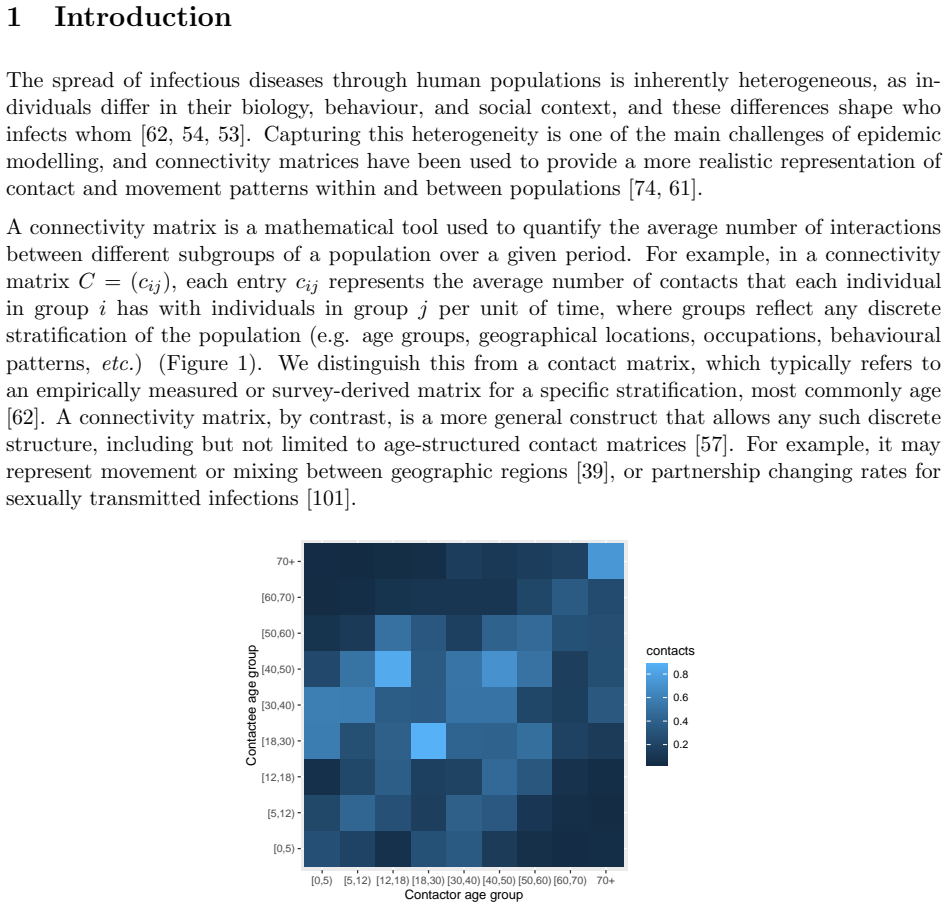
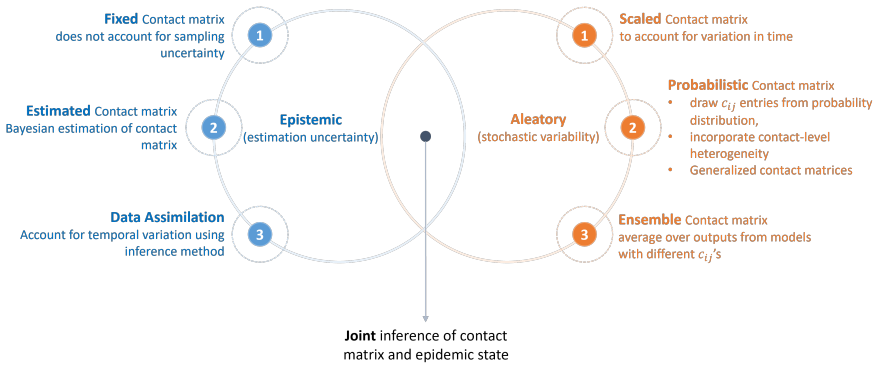
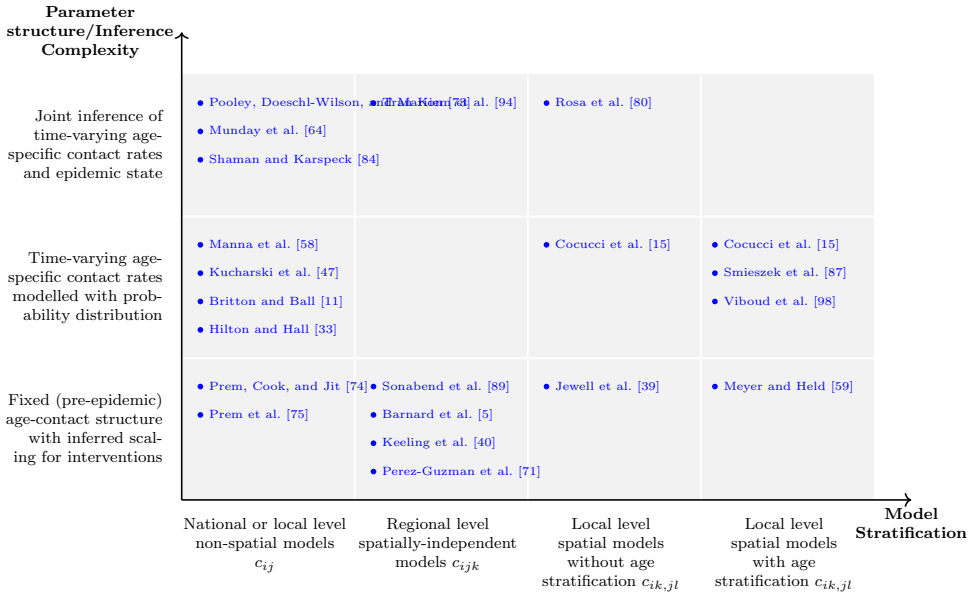
Contact matrices are a fundamental component of modelling and inference for infectious disease epidemiology. Their structure and parametrisation directly accounts for the frequency of interactions between different subpopulations of individuals, as well as having the potential to encode dynamic heterogeneity in these interactions across demographic axes, space and time. The paper reviews the existing literature on the data types used to construct contact matrices and the methods for incorporating uncertainties and heterogeneities into them, while highlighting remaining challenges and future directions in the use of these contact matrices for epidemiological research.
What carries the argument
Contact or connectivity matrices, which represent the frequency of interactions between different subpopulations and encode heterogeneities across axes.
If this is right
- Outbreak control strategies can be informed by matrices that capture dynamic interaction frequencies.
- Disease spread forecasts become more reliable when uncertainties and heterogeneities are incorporated into the matrices.
- Research can target the highlighted remaining challenges to advance epidemiological modeling.
Where Pith is reading between the lines
- Combining multiple data sources could further reduce estimation uncertainties in practice.
- Privacy protections on individual interaction data may constrain the resolution of future matrices.
- Dynamic matrices updated in real time could support more adaptive responses during outbreaks.
Load-bearing premise
The body of existing literature covered is representative and sufficiently complete to identify all major data types, methods, and remaining challenges without critical omissions.
What would settle it
Discovery of a major omitted data type or construction method that would alter the identified challenges or future directions.
Figures
read the original abstract
Contact (or mixing, or more generally connectivity) matrices are a fundamental component of modelling and inference for infectious disease epidemiology. Their structure and parametrisation directly accounts for the frequency of interactions between different subpopulations of individuals, as well as having the potential to encode dynamic heterogeneity in these interactions across demographic axes, space and time. Considerable research has been devoted to the structure and estimation of (components of) these matrices to help inform outbreak control and forecast disease spread. In this paper, we review the existing literature on the data types used to construct contact matrices and the methods for incorporating uncertainties and heterogeneities into them. We also highlight remaining challenges and future directions in the use of these contact matrices for epidemiological research.
Editorial analysis
A structured set of objections, weighed in public.
Referee Report
Summary. The manuscript reviews data types and methods for constructing contact and connectivity matrices in infectious disease epidemiology, methods for incorporating uncertainties and heterogeneities, and remaining challenges and future directions in their use for modeling and inference.
Significance. If the literature coverage is comprehensive and representative, the review could provide a useful synthesis of data sources (e.g., diary studies, sensors, mobility data) and estimation approaches for contact matrices, which are central to compartmental models and outbreak forecasting. However, the absence of any stated search strategy, inclusion criteria, or database sources in the abstract undermines the ability to assess completeness or identify potential omissions in data types or techniques.
major comments (1)
- [Abstract] Abstract: the claim to 'review the existing literature' on data types, methods, uncertainties, and challenges is not supported by any description of search strategy, inclusion/exclusion criteria, number of works reviewed, or databases queried. This is load-bearing for the central claim of the paper as a review, as it prevents verification that major sources (diary studies, proximity sensors, Bayesian hierarchical models, network approaches) are adequately covered without critical omissions.
Simulated Author's Rebuttal
We thank the referee for their constructive comments on our manuscript. We address the major comment below.
read point-by-point responses
-
Referee: [Abstract] Abstract: the claim to 'review the existing literature' on data types, methods, uncertainties, and challenges is not supported by any description of search strategy, inclusion/exclusion criteria, number of works reviewed, or databases queried. This is load-bearing for the central claim of the paper as a review, as it prevents verification that major sources (diary studies, proximity sensors, Bayesian hierarchical models, network approaches) are adequately covered without critical omissions.
Authors: We agree that the manuscript would benefit from greater transparency regarding how the reviewed literature was identified. In the revised version, we will add a brief 'Literature search and selection' subsection (likely in the Introduction or a new Methods section) that describes the primary databases consulted (PubMed, Web of Science, arXiv), key search terms, and the criteria used to select representative studies across data types and modelling approaches. This addition will allow readers to evaluate coverage without altering the narrative-review character of the paper. revision: yes
Circularity Check
No circularity: review paper with no derivations or predictions
full rationale
This is a literature review summarizing data types, methods, and challenges for contact matrices in epidemiology. It contains no equations, fitted parameters, predictions, or derivation chains that could reduce to self-definition or self-citation. All claims reference external literature rather than constructing results from the paper's own inputs. The representativeness assumption noted by the reader is a methodological limitation of reviews but does not constitute circularity under the defined patterns.
Axiom & Free-Parameter Ledger
Reference graph
Works this paper leans on
-
[1]
Adeshina Adekunle et al. “Delaying the COVID-19 epidemic in Australia: evaluating the effectiveness of international travel bans”. In:Australian and New Zealand journal of public health44.4 (2020), pp. 257–259.doi:10.1111/1753-6405.13016
-
[2]
Leonardo Angeli et al. “Who acquires infection from whom? A sensitivity analysis of trans- mission dynamics during the early phase of the COVID-19 pandemic in Belgium”. In:Journal of Theoretical Biology581 (2024), p. 111721.doi:10.1016/j.jtbi.2024.111721
-
[3]
Projecting social contact matrices to different demographic structures
Sergio Arregui et al. “Projecting social contact matrices to different demographic structures”. In:PLoS computational biology14.12 (2018), e1006638.doi:10 . 1371 / journal . pcbi . 1006638
2018
-
[4]
Jantien A Backer et al. “Dynamics of non-household contacts during the COVID-19 pan- demic in 2020 and 2021 in the Netherlands”. In:Scientific Reports13.1 (2023), p. 5166.doi: 10.1038/s41598-023-32031-7
-
[5]
Modelling the medium-term dynamics of SARS-CoV-2 transmis- sion in England in the Omicron era
Rosanna C Barnard et al. “Modelling the medium-term dynamics of SARS-CoV-2 transmis- sion in England in the Omicron era”. In:Nature communications13.1 (2022), p. 4879.doi: 10.1038/s41467-022-32404-y
-
[6]
The exciting potential and daunting challenge of using GPS human-mobility data for epidemic modeling
Francisco Barreras and Duncan J Watts. “The exciting potential and daunting challenge of using GPS human-mobility data for epidemic modeling”. In:Nature Computational Science 4.6 (2024), pp. 398–411.doi:10.1038/s43588-024-00637-0
-
[7]
Luke D. Bevan. “The ambiguities of uncertainty: A review of uncertainty frameworks relevant to the assessment of environmental change”. In:Futures137 (2022), p. 102919.issn: 0016- 3287.doi:https://doi.org/10.1016/j.futures.2022.102919.url:https://www. sciencedirect.com/science/article/pii/S0016328722000180
work page doi:10.1016/j.futures.2022.102919.url:https://www 2022
-
[8]
A Contact Matrix-Based Approach for Predicting COVID-19 Using Influenza Data
Liu Bingchen, Tao Li, and Zhang Zili. “A Contact Matrix-Based Approach for Predicting COVID-19 Using Influenza Data”. In:2022 IEEE/WIC/ACM International Joint Confer- ence on Web Intelligence and Intelligent Agent Technology (WI-IAT). IEEE. 2022, pp. 782– 787.doi:10.1109/WI-IAT55865.2022.00129. 22
-
[9]
Quantifying contact patterns in response to COVID-19 public health measures in Canada
Gabrielle Brankston et al. “Quantifying contact patterns in response to COVID-19 public health measures in Canada”. In:BMC public health21.1 (2021), p. 2040.doi:10.1186/ s12889-021-12080-1
2021
-
[10]
Social mixing patterns in the UK following the relaxation of COVID-19 pandemic restrictions, July–August 2020: a cross- sectional online survey
Jessica RE Bridgen, Chris Jewell, and Jonathan M Read. “Social mixing patterns in the UK following the relaxation of COVID-19 pandemic restrictions, July–August 2020: a cross- sectional online survey”. In:BMJ open12.12 (2022), e059231.doi:10 . 1136 / bmjopen - 2021-059231
2020
-
[11]
Improving the use of social contact studies in epidemic mod- eling
Tom Britton and Frank Ball. “Improving the use of social contact studies in epidemic mod- eling”. In:Epidemiology36.5 (2025), pp. 660–667.doi:10.1097/EDE.0000000000001876
-
[12]
Identifiability analysis for stochastic differential equation models in systems biology
Alexander P. Browning et al. “Identifiability analysis for stochastic differential equation models in systems biology”. In:Journal of The Royal Society Interface17.173 (Dec. 2020), p. 20200652.issn: 1742-5689.doi:10.1098/rsif.2020.0652. eprint:https://royalsocietypublishing. org/rsif/article-pdf/doi/10.1098/rsif.2020.0652/216790/rsif.2020.0652.pdf. url:ht...
-
[13]
Jamie M Caldwell et al. “Understanding COVID-19 dynamics and the effects of interven- tions in the Philippines: A mathematical modelling study”. In:The Lancet Regional Health– Western Pacific14 (2021).doi:10.1016/j.lanwpc.2021.100211
-
[14]
Digital proximity tracing on empirical contact networks for pandemic control
Giulia Cencetti et al. “Digital proximity tracing on empirical contact networks for pandemic control”. In:Nature communications12.1 (2021), p. 1655.doi:10 . 1038 / s41467 - 021 - 21809-w
2021
-
[16]
A hybrid approach combining Bayesian networks and logistic regression for enhancing risk assessment
Pietro Coletti et al. “CoMix: comparing mixing patterns in the Belgian population during and after lockdown”. In:Scientific reports10.1 (2020), p. 21885.doi:10.1038/s41598- 020-78540-7
-
[17]
Singapore: Springer, 2024.doi:10.1007/978-981-97-2539-7
Nik Cunniffe et al.Identifiability and Observability in Epidemiological Models - A Primer. Singapore: Springer, 2024.doi:10.1007/978-981-97-2539-7
-
[18]
Four key challenges in infectious disease modelling using data from multiple sources
Daniela De Angelis et al. “Four key challenges in infectious disease modelling using data from multiple sources”. In:Epidemics10 (2015). Challenges in Modelling Infectious DIsease Dy- namics, pp. 83–87.issn: 1755-4365.doi:https://doi.org/10.1016/j.epidem.2014.09. 004.url:https://www.sciencedirect.com/science/article/pii/S175543651400053X
-
[19]
New Routes to Phylogeography: A Bayesian Structured Coalescent Approximation
Nicola De Maio et al. “New Routes to Phylogeography: A Bayesian Structured Coalescent Approximation”. In:PLoS Genetics11.8 (Aug. 2015), pp. 1–22.doi:10.1371/journal. pgen.1005421.url:https://doi.org/10.1371/journal.pgen.1005421
-
[20]
Data-driven dynamical analysis of an age-structured model: A graph-theoretic approach
Preeti Deolia and Anuraj Singh. “Data-driven dynamical analysis of an age-structured model: A graph-theoretic approach”. In:Mathematical Methods in the Applied Sciences48.2 (2025), pp. 2446–2473.doi:10.1002/mma.10445
-
[21]
Laura Di Domenico et al. “Mobility-driven synthetic contact matrices as a scalable solution for real-time pandemic response modeling”. In:Nature Communications17.1 (Jan. 2026), p. 1845.issn: 2041-1723.doi:10.1038/s41467-026-68557-3.url:https://doi.org/10. 1038/s41467-026-68557-3. 23
work page doi:10.1038/s41467-026-68557-3.url:https://doi.org/10 2026
-
[22]
The construction of next-generation matrices for compartmental epidemic models
Odo Diekmann, Johan Andre Peter Heesterbeek, and Michael G Roberts. “The construction of next-generation matrices for compartmental epidemic models”. In:Journal of the royal society interface7.47 (2010), pp. 873–885.doi:10.1098/rsif.2009.0386
-
[23]
Transmission matrices used in epidemiologic modelling
M Bekker-Nielsen Dunbar. “Transmission matrices used in epidemiologic modelling”. In: Infectious Disease Modelling9.1 (2024), pp. 185–194.doi:10.1016/j.idm.2023.11.009
-
[24]
Quantifying population contact patterns in the United States during the COVID-19 pandemic
Dennis M Feehan and Ayesha S Mahmud. “Quantifying population contact patterns in the United States during the COVID-19 pandemic”. In:Nature communications12.1 (2021), p. 893.doi:10.1038/s41467-021-20990-2
-
[25]
Evolutionary Trees from DNA Sequences: A Maximum Likelihood Approach
Joseph Felsenstein. “Evolutionary Trees from DNA Sequences: A Maximum Likelihood Approach”. In:Journal of Molecular Evolution17 (1981), pp. 368–376.doi:10 . 1007 / BF01734359
1981
-
[26]
R package version 0.5.1
Sebastian Funk et al.socialmixr: Social Mixing Matrices for Infectious Disease Modelling. R package version 0.5.1. 2026.url:https://github.com/epiforecasts/socialmixr
2026
-
[27]
Amy Gimma et al. “Changes in social contacts in England during the COVID-19 pandemic between March 2020 and March 2021 as measured by the CoMix survey: A repeated cross- sectional study”. In:PLoS medicine19.3 (2022), e1003907.doi:10.1371/journal.pmed. 1003907
-
[28]
Amy Gimma et al.CoMix social contact data (UK). Zenodo, Sept. 2024.doi:10.5281/ zenodo.13684044.url:https://doi.org/10.5281/zenodo.13684044
-
[29]
Post-pandemic social contact patterns in the United Kingdom: the Reconnect survey
Lucy Goodfellow et al. “Post-pandemic social contact patterns in the United Kingdom: the Reconnect survey”. In:medRxiv(2025), pp. 2025–08.doi:10.1101/2025.08.13.25333584
-
[30]
Google.COVID-19 Community Mobility Reports.https : / / www . google . com / covid19 / mobility/. Accessed: 2026-01-06
2026
-
[31]
Examining the influence of imbalanced social contact matrices in epidemic models
Mackenzie A Hamilton, Jesse Knight, and Sharmistha Mishra. “Examining the influence of imbalanced social contact matrices in epidemic models”. In:American journal of epidemi- ology193.2 (2024), pp. 339–347.doi:10.1093/aje/kwad185
-
[32]
Failure to balance social contact matrices can bias models of infectious disease transmission
Mackenzie A Hamilton, Jesse Knight, and Sharmistha Mishra. “Failure to balance social contact matrices can bias models of infectious disease transmission”. In:medRxiv(2022), pp. 2022–07.doi:10.1101/2022.07.28.22278155
-
[33]
A beta-Poisson model for infectious disease transmission
Joe Hilton and Ian Hall. “A beta-Poisson model for infectious disease transmission”. In: PLoS computational biology20.2 (2024), e1011856.doi:10.1371/journal.pcbi.1011856
-
[34]
A systematic review of social contact surveys to inform transmission models of close-contact infections
Thang Hoang et al. “A systematic review of social contact surveys to inform transmission models of close-contact infections”. In:Epidemiology30.5 (2019), pp. 723–736.doi:10 . 1097/EDE.0000000000001047
2019
-
[35]
Thang Van Hoang et al. “Exploring human mixing patterns based on time use and social contact data and their implications for infectious disease transmission models”. In:BMC Infectious Diseases22.1 (2022), p. 954.doi:10.1186/s12879-022-07917-y
-
[36]
Human mobility data in the COVID-19 pandemic: characteristics, applica- tions, and challenges
Tao Hu et al. “Human mobility data in the COVID-19 pandemic: characteristics, applica- tions, and challenges”. In:International Journal of Digital Earth14.9 (2021), pp. 1126–1147. doi:10.1080/17538947.2021.1952324. 24
-
[37]
Maude Jacquot et al. “Bluetongue virus spread in Europe is a consequence of climatic, land- scape and vertebrate host factors as revealed by phylogeographic inference”. In:Proceedings of the Royal Society B: Biological Sciences284.1864 (Oct. 2017), p. 20170919.issn: 0962- 8452.doi:10.1098/rspb.2017.0919. eprint:https://royalsocietypublishing.org/ rspb/art...
-
[38]
Quantifying the impact of physical distance measures on the transmission of COVID-19 in the UK
Christopher I Jarvis et al. “Quantifying the impact of physical distance measures on the transmission of COVID-19 in the UK”. In:BMC medicine18.1 (2020), p. 124.doi:10. 1186/s12916-020-01597-8
2020
- [39]
-
[40]
Comparison of the 2021 COVID-19 roadmap projections against public health data in England
Matt J Keeling et al. “Comparison of the 2021 COVID-19 roadmap projections against public health data in England”. In:Nature communications13.1 (2022), p. 4924.doi:10. 1038/s41467-022-31991-0
2021
-
[41]
Exact phylodynamic likelihood via structured Markov genealogy processes
Aaron A. King, Qianying Lin, and Edward L. Ionides.Exact phylodynamic likelihood via structured Markov genealogy processes. 2025. arXiv:2405.17032 [q-bio.QM].url:https: //arxiv.org/abs/2405.17032
work page internal anchor Pith review Pith/arXiv arXiv 2025
-
[42]
On Parameter Identifiability in Network-Based Epidemic Models
Istvan Z Kiss and Peter L Simon. “On Parameter Identifiability in Network-Based Epidemic Models”. In:Bulletin of Mathematical Biology85.18 (2023).doi:10.1007/s11538- 023- 01121-y
-
[43]
Moses C Kiti et al. “Changing social contact patterns among US workers during the COVID- 19 pandemic: April 2020 to December 2021”. In:Epidemics45 (2023), p. 100727.doi: 10.1016/j.epidem.2023.100727
-
[44]
Contagion! the bbc four pandemic–the model behind the documentary
Petra Klepac, Stephen Kissler, and Julia Gog. “Contagion! the bbc four pandemic–the model behind the documentary”. In:Epidemics24 (2018), pp. 49–59.doi:10.1016/j.epidem. 2018.03.003
-
[45]
Petra Klepac et al. “Contacts in context: large-scale setting-specific social mixing matrices from the BBC Pandemic project”. In:MedRxiv(2020), pp. 2020–02.doi:10.1101/2020. 02.16.20023754
-
[46]
Eigenvector-based sensitivity analysis of contact pat- terns in epidemic modelling
Evans Kiptoo Korir and Zsolt Vizi. “Eigenvector-based sensitivity analysis of contact pat- terns in epidemic modelling”. In:Journal of The Royal Society Interface22.233 (Dec. 2025), p. 20250664.issn: 1742-5689.doi:10 . 1098 / rsif . 2025 . 0664. eprint:https : //royalsocietypublishing.org/rsif/article- pdf/doi/10.1098/rsif.2025.0664/ 4416802/rsif.2025.066...
-
[47]
The contribution of social behaviour to the transmission of in- fluenza A in a human population
Adam J Kucharski et al. “The contribution of social behaviour to the transmission of in- fluenza A in a human population”. In:PLoS pathogens10.6 (2014), e1004206.doi:10.1371/ journal.ppat.1004206. 25
2014
-
[48]
Denise K¨ uhnert et al. “Phylodynamics with Migration: A Computational Framework to Quantify Population Structure from Genomic Data”. In:Molecular Biology and Evolution 33.8 (Apr. 2016), pp. 2102–2116.issn: 0737-4038.doi:10.1093/molbev/msw064. eprint: https://academic.oup.com/mbe/article-pdf/33/8/2102/7946826/msw064.pdf.url: https://doi.org/10.1093/molbev/msw064
-
[49]
Evolving social contact patterns during the COVID-19 crisis in Luxembourg
Ardashel Latsuzbaia et al. “Evolving social contact patterns during the COVID-19 crisis in Luxembourg”. In:PLoS ONE15.8 (2020), e0237128.doi:10.1371/journal.pone.0237128
-
[50]
Edwin van Leeuwen, PHE Joint Modelling Group, and Frank Sandmann. “Augmenting con- tact matrices with time-use data for fine-grained intervention modelling of disease dynamics: A modelling analysis”. In:Statistical Methods in Medical Research31.9 (2022), pp. 1704– 1715.doi:10.1177/09622802211037078
-
[51]
Bayesian phylogeography finds its roots
Philippe Lemey et al. “Bayesian phylogeography finds its roots”. In:PLoS computational biology5.9 (2009), e1000520.doi:10.1371/journal.pcbi.1000520
-
[52]
Social contact patterns relevant for infectious disease transmission in Cambodia
William TM Leung et al. “Social contact patterns relevant for infectious disease transmission in Cambodia”. In:Scientific Reports13.1 (2023), p. 5542.doi:10 . 1038 / s41598 - 023 - 31485-z
2023
-
[53]
Rapid review of social contact patterns during the COVID-19 pandemic
Carol Y Liu et al. “Rapid review of social contact patterns during the COVID-19 pandemic”. In:Epidemiology32.6 (2021), pp. 781–791.doi:10.1097/EDE.0000000000001412
-
[54]
Superspreading and the effect of individual variation on disease emergence
James O Lloyd-Smith et al. “Superspreading and the effect of individual variation on disease emergence”. In:Nature438.7066 (2005), pp. 355–359.doi:10.1038/nature04153
-
[55]
Spatial and Temporal Phylogeny of Border Disease Virus in Pyre- nean Chamois (Rupicapra p. pyrenaica)
Camilla Luzzago et al. “Spatial and Temporal Phylogeny of Border Disease Virus in Pyre- nean Chamois (Rupicapra p. pyrenaica)”. In:PLoS ONE11.12 (Dec. 2016), pp. 1–17.doi: 10 . 1371 / journal . pone . 0168232.url:https : / / doi . org / 10 . 1371 / journal . pone . 0168232
2016
-
[56]
Anna Machens et al. “An infectious disease model on empirical networks of human contact: bridging the gap between dynamic network data and contact matrices”. In:BMC infectious diseases13.1 (2013), p. 185.doi:10.1186/1471-2334-13-185
-
[57]
Generalized contact matrices allow integrating socioeconomic vari- ables into epidemic models
Adriana Manna et al. “Generalized contact matrices allow integrating socioeconomic vari- ables into epidemic models”. In:Science Advances10.41 (2024), eadk4606.doi:10.1126/ sciadv.adk4606
2024
- [58]
-
[59]
Incorporating social contact data in spatio-temporal models for infectious disease spread
Sebastian Meyer and Leonhard Held. “Incorporating social contact data in spatio-temporal models for infectious disease spread”. In:Biostatistics18.2 (2017), pp. 338–351.doi:10. 1093/biostatistics/kxw051
2017
-
[60]
Parameter sensitivity analysis for biochemical reaction networks
Giorgos Minas and David A Rand. “Parameter sensitivity analysis for biochemical reaction networks”. In:Mathematical Biosciences and Engineering16.5 (2019), pp. 3965–3987.issn: 1551-0018.doi:10.3934/mbe.2019196.url:https://www.aimspress.com/article/doi/ 10.3934/mbe.2019196
work page doi:10.3934/mbe.2019196.url:https://www.aimspress.com/article/doi/ 2019
-
[61]
Inferring high-resolution human mixing patterns for disease modeling
Dina Mistry et al. “Inferring high-resolution human mixing patterns for disease modeling”. In:Nature communications12.1 (2021), p. 323.doi:10.1038/s41467-020-20544-y. 26
-
[62]
Social contacts and mixing patterns relevant to the spread of infectious diseases
Jo¨ el Mossong et al. “Social contacts and mixing patterns relevant to the spread of infectious diseases”. In:PLoS Medicine5.3 (2008), e74.doi:10.1371/journal.pmed.0050074
-
[63]
Andria Mousa et al. “Social contact patterns and implications for infectious disease transmission– a systematic review and meta-analysis of contact surveys”. In:Elife10 (2021), e70294.doi: 10.7554/eLife.70294
-
[64]
James D Munday et al. “Evaluating the use of social contact data to produce age-specific short-term forecasts of SARS-CoV-2 incidence in England”. In:PLoS Computational Biology 19.9 (2023), e1011453.doi:10.1371/journal.pcbi.1011453
-
[65]
A mixed methods analysis of participation in a social contact survey
Emily Nixon et al. “A mixed methods analysis of participation in a social contact survey”. In:Epidemics41 (2022), p. 100635.doi:10.1016/j.epidem.2022.100635
-
[66]
Reduction in mobility and COVID-19 transmission
Pierre Nouvellet et al. “Reduction in mobility and COVID-19 transmission”. In:Nature communications12.1 (2021), p. 1090.doi:10.1038/s41467-021-21358-2
-
[67]
Office for National Statistics.Coronavirus (COVID-19) Infection Survey, UK: 13 May 2022. Tech. rep. Accessed: 2026-03-05. Office for National Statistics, May 2022.url:https://www. ons.gov.uk/peoplepopulationandcommunity/healthandsocialcare/conditionsanddiseases/ bulletins/coronaviruscovid19infectionsurveypilot/13may2022
2022
-
[68]
2020.doi:10.1126/sciadv.abc0764
Nuria Oliver et al.Mobile phone data for informing public health actions across the COVID- 19 pandemic life cycle. 2020.doi:10.1126/sciadv.abc0764
-
[69]
Mark Pagel. “Detecting correlated evolution on phylogenies: a general method for the com- parative analysis of discrete characters”. In:Proceedings of the Royal Society B: Biological Sciences225 (1342 1994), pp. 37–45.doi:10.1098/rspb.1994.0006
- [70]
-
[71]
Epidemiological drivers of transmissibility and severity of SARS-CoV-2 in England
Pablo N Perez-Guzman et al. “Epidemiological drivers of transmissibility and severity of SARS-CoV-2 in England”. In:Nature Communications14.1 (2023), p. 4279.doi:10.1038/ s41467-023-39661-5
2023
-
[72]
Establishment and lineage dynamics of the SARS-CoV-2 epidemic in the UK
Louis du Plessis et al. “Establishment and lineage dynamics of the SARS-CoV-2 epidemic in the UK”. In:Science371.6530 (2021), pp. 708–712.doi:10.1126/science.abf2946
-
[73]
Christopher M Pooley, Andrea B Doeschl-Wilson, and Glenn Marion. “Estimation of age- stratified contact rates during the COVID-19 pandemic using a novel inference algorithm”. In:Philosophical Transactions of the Royal Society A380.2233 (2022), p. 20210298.doi: 10.1098/rsta.2021.0298
-
[74]
Projecting social contact matrices in 152 coun- tries using contact surveys and demographic data
Kiesha Prem, Alex R Cook, and Mark Jit. “Projecting social contact matrices in 152 coun- tries using contact surveys and demographic data”. In:PLoS computational biology13.9 (2017), e1005697.doi:10.1371/journal.pcbi.1005697
-
[75]
Kiesha Prem et al. “Projecting contact matrices in 177 geographical regions: an update and comparison with empirical data for the COVID-19 era”. In:PLoS computational biology17.7 (2021), e1009098.doi:10.1371/journal.pcbi.1009098
-
[76]
Em Prestige et al. “Estimating social contact rates for the COVID-19 pandemic using Google mobility and pre-pandemic contact surveys”. In:Epidemics(2025), p. 100830.doi:10.1016/ j.epidem.2025.100830. 27
-
[77]
Social mixing patterns in rural and urban areas of southern China
Jonathan M Read et al. “Social mixing patterns in rural and urban areas of southern China”. In:Proceedings of the Royal Society B: Biological Sciences281.1785 (2014).doi:10.1098/ rspb.2014.0268
-
[78]
Large-scale spatial-transmission models of infectious disease
Steven Riley. “Large-scale spatial-transmission models of infectious disease”. In:Science 316.5829 (2007), pp. 1298–1301.doi:10.1126/science.1134695
-
[79]
Age-specific contribution of contacts to transmission of SARS-CoV-2 in Germany
Isti Rodiah et al. “Age-specific contribution of contacts to transmission of SARS-CoV-2 in Germany”. In:European Journal of Epidemiology38.1 (2023), pp. 39–58.doi:10.1007/ s10654-022-00938-6
2023
-
[80]
Santiago Rosa et al. “Transmission matrix parameter estimation of COVID-19 evolution with age compartments using ensemble-based data assimilation”. In:PLoS ONE20.4 (2025), e0318426.doi:10.1371/journal.pone.0318426.url:https://pmc.ncbi.nlm.nih.gov/ articles/PMC12036932/
work page doi:10.1371/journal.pone.0318426.url:https://pmc.ncbi.nlm.nih.gov/ 2025
-
[81]
On the Estimation of Contact Matrices for Age- Structured Models at the Onset of Epidemic Spread
Santiago Sarratea and Gabriel Fabricius. “On the Estimation of Contact Matrices for Age- Structured Models at the Onset of Epidemic Spread”. In:Bulletin of Mathematical Biology 88.1 (2026), p. 3.doi:10.1007/s11538-025-01571-6
discussion (0)
Sign in with ORCID, Apple, or X to comment. Anyone can read and Pith papers without signing in.