Advanced Externally Seeded FEL Schemes for High-Repetition-Rate Operation at SHINE
Pith reviewed 2026-06-28 23:34 UTC · model grok-4.3
The pith
Self-modulation and direct-amplification enable MHz-level seeded FEL operation with harmonics beyond the 30th order at SHINE.
A machine-rendered reading of the paper's core claim, the machinery that carries it, and where it could break.
Core claim
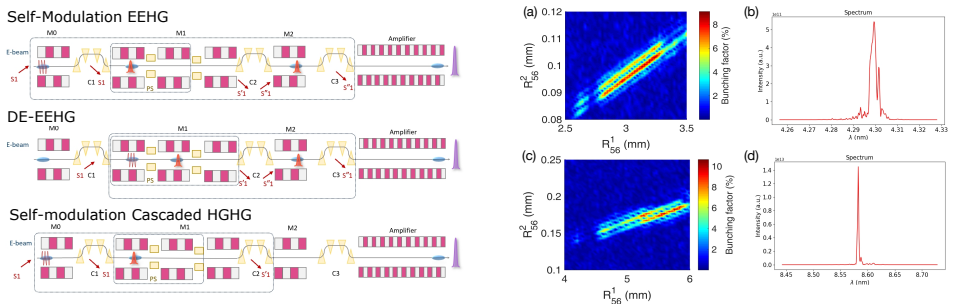
Using the SHINE bypass line, three compatible high-repetition-rate seeded-FEL configurations are explored: self-modulation cascaded HGHG, self-modulation EEHG, and direct-amplification-driven EEHG. Numerical simulations indicate that these schemes can provide flexible routes toward MHz-level operation with harmonic generation beyond the 30th order. A common modulator-chicane layout is proposed to preserve compatibility among the candidate modes and to support future optimization and experimental implementation at SHINE.
What carries the argument
A common modulator-chicane layout supporting self-modulation cascaded HGHG, self-modulation EEHG, and direct-amplification-driven EEHG on the bypass line.
If this is right
- MHz-level repetition rates become accessible for externally seeded FELs without high-power seed lasers.
- Harmonic generation reaches orders higher than 30 in the proposed schemes.
- Multiple operating modes remain compatible through a single modulator-chicane arrangement.
- The layout directly supports experimental tests and optimization on the SHINE bypass line.
Where Pith is reading between the lines
- The same modulator-chicane approach could be adapted at other high-repetition-rate FEL facilities facing similar seed-power limits.
- Successful implementation would allow systematic comparison of the three modes under identical beam conditions.
- Extension to even higher harmonics or shorter wavelengths would follow if the demonstrated techniques scale as assumed.
Load-bearing premise
The self-modulation and direct-amplification techniques demonstrated in recent SHINE experiments can be extended without major unforeseen limitations to the proposed cascaded HGHG and EEHG configurations on the bypass line.
What would settle it
An experiment or detailed simulation on the SHINE bypass line that fails to produce harmonic generation beyond the 30th order at MHz repetition rates with the proposed layouts would falsify the central claim.
Figures
read the original abstract
Externally seeded free-electron lasers (FELs) are promising approaches for generating fully coherent soft-X-ray radiation. Their extension to shorter wavelengths and MHz-level repetition rates is, however, constrained by the limited availability of high-repetition-rate seed lasers with sufficient energy modulation. Recent self-amplification and direct-amplification experiments at the Shanghai Soft X-ray FEL facility have significantly relaxed the peak-power requirement for high-gain harmonic generation (HGHG) and opened a practical path toward echo-enabled harmonic generation (EEHG). Using the SHINE bypass line, three compatible high-repetition-rate seeded-FEL configurations are explored: self-modulation cascaded HGHG, self-modulation EEHG, and direct-amplification-driven EEHG. Numerical simulations indicate that these schemes can provide flexible routes toward MHz-level operation with harmonic generation beyond the 30th order. A common modulator-chicane layout is proposed to preserve compatibility among the candidate modes and to support future optimization and experimental implementation at SHINE.
Editorial analysis
A structured set of objections, weighed in public.
Referee Report
Summary. The paper proposes three compatible externally seeded FEL configurations on the SHINE bypass line—self-modulation cascaded HGHG, self-modulation EEHG, and direct-amplification-driven EEHG—to enable MHz-level repetition rates with harmonic generation beyond the 30th order. Building on recent SHINE self-modulation and direct-amplification experiments, numerical simulations are used to demonstrate viability, and a common modulator-chicane layout is suggested to maintain compatibility across modes for future optimization.
Significance. If the simulation results hold, the work offers practical, flexible routes to extend high-gain harmonic generation and echo-enabled harmonic generation to higher orders and repetition rates at existing facilities, directly leveraging demonstrated techniques to relax seed-laser requirements. The emphasis on layout compatibility strengthens the case for experimental follow-up.
minor comments (2)
- The abstract states that simulations indicate viability for harmonics beyond the 30th order, but without explicit parameter tables or baseline comparisons to the recent SHINE experiments cited, it is difficult to assess the margin by which the schemes exceed current limits.
- The proposed common modulator-chicane layout is described as preserving compatibility, yet the manuscript would benefit from a dedicated figure or schematic showing how the three configurations share hardware without requiring mode-specific re-alignment.
Simulated Author's Rebuttal
We thank the referee for the positive summary and significance assessment of our work on self-modulation cascaded HGHG, self-modulation EEHG, and direct-amplification-driven EEHG schemes for MHz-level operation at SHINE. The recommendation for minor revision is appreciated. No major comments were provided in the report.
Circularity Check
No significant circularity detected
full rationale
The paper's argument consists of numerical simulations exploring three modulator-chicane configurations on the SHINE bypass line to achieve MHz repetition rates and high-order harmonic generation. These simulations build on cited prior experiments at the facility but do not reduce any claimed prediction or result to a quantity defined by the authors' own prior work, a fitted parameter, or a self-citation chain. The central claims remain independent simulation outputs rather than tautological restatements of inputs, with no evidence of self-definitional steps, ansatz smuggling, or uniqueness theorems imported from overlapping authors.
Axiom & Free-Parameter Ledger
axioms (1)
- domain assumption Standard assumptions of FEL physics and electron-beam dynamics hold for the proposed configurations.
Reference graph
Works this paper leans on
-
[1]
Generation of intense UV radiation by subharmon- ically seeded single-pass free-electron lasers
L. H. Yu, “Generation of intense UV radiation by subharmon- ically seeded single-pass free-electron lasers”,Phys. Rev. A, vol. 44, pp. 5178–5193, 1991. doi:10.1103/PhysRevA.44.5178
-
[2]
Using the beam-echo effect for generation of short-wavelength radiation
G. Stupakov, “Using the beam-echo effect for generation of short-wavelength radiation”,Phys. Rev. Lett., vol. 102, p. 074801, 2009. doi:10.1103/PhysRevLett.102.074801
-
[3]
Self-amplification of coherent energy modula- tion in seeded free-electron lasers
J. Yanet al., “Self-amplification of coherent energy modula- tion in seeded free-electron lasers”,Phys. Rev. Lett., vol. 126, p. 084801, 2021. doi:10.1103/PhysRevLett.126.084801
-
[4]
High-repetition-rate seeded free-electron laser enhanced by self-modulation
H. Yang, J. Yan, and H. Deng, “High-repetition-rate seeded free-electron laser enhanced by self-modulation”,Adv. Pho- tonics Nexus, vol. 2, p. 036004, 2023. doi:10.1117/1.APN.2.3.036004
-
[5]
Self-enhanced coherent har- monic amplification in seeded free-electron lasers
H. Yang, J. Yan, and H. Deng, “Self-enhanced coherent har- monic amplification in seeded free-electron lasers”,Funda- mental Research, vol. 6, no. 2, pp. 705–712, 2026. doi:10.1016/j.fmre.2024.03.030
-
[6]
Z. Qi, J. Liu, L. Niet al., “First lasing and stable operation of a direct-Amplification enabled harmonic generation free- electron laser”,Phys. Rev. Lett., vol. 135, p. 035001, 2025. doi:10.1103/sslg-jjkz
-
[7]
Status and future of the soft X-ray free- electron laser beamline at the SHINE
T. Liuet al., “Status and future of the soft X-ray free- electron laser beamline at the SHINE”,Front. Phys., vol. 11, p. 1172368, 2023.doi:10.3389/fphy.2023.1172368
discussion (0)
Sign in with ORCID, Apple, or X to comment. Anyone can read and Pith papers without signing in.